



Abstract
The Problem
Although previous research suggests current human resource management (HRM) policies and procedures do not fully accommodate the diverse strengths and needs of jobseekers and employees on the autism spectrum, the human resource development (HRD) community, including its scholars, researchers and practitioners will benefit from learning more about autism and how people with the condition can develop resilience capacity at work.
The Solutions
Utilizing a community-based participatory research approach (CBPR), we recommend an Autism Work Peer Support Group (AWPSG) program as a new framework that can help the HRD community as well as HRM work coaches and disability employment advisors to foster environments, where people’s social adaptation is key for their resilience capacity development.
The Stakeholders
The current research provides a framework on how a CBPR approach could be utilized to operationalize the design and evaluation of an employment intervention (i.e., AWPSG) that could involve autistic jobseekers in the process of resilience building. Furthermore, our findings indicate that fostering the emergence of a subjectively meaningful employment-focused peer support group program could help enlighten the HRD community about the challenges faced by this particular group and thereby offer effective autism-HRD advice and support to autistic jobseekers, employees and employers, management, work-coaches and disability employment advisors.
Autism Spectrum Condition (ASC) is a heterogeneous lifelong neurodevelopmental condition that affects how a person communicates with and relates to other people, and how they conceptualize and experience the world (American Psychiatric Association [APA], 2013). It is estimated that over 1% of the world’s population is autistic (Baio et al., 2018; Brugha et al., 2011) and this group is also associated with considerably high healthcare costs (e.g., Buescher et al., 2014; Leigh & Du, 2015). The financial and emotional costs to organizations become more acute when traditional Human Resource Development interventions such as learning and development and performance are used to deal with difficulties experienced by autistic people. In addition, about 70% of people with ASCs may have another mental health condition whereas 41% of them may have two or more (e.g., ADHD, anxiety and/mood disorders, Oppositional defiant disorder and Conduct disorder [Leyfer et al., 2006; Simonoff et al., 2008]). Hence, social difficulties and co-morbidities could result in additional challenges that may make the traditional HRD measures less effective in helping this group secure, retain employment and benefit from improved mental health, social inclusion and better quality of life (Barnard et al., 2000; Billstedt et al., 2011; López & Keenan, 2014; Morgan, 1996).
In fact, only 32% (approximately 28,000 out of 90,000) of adults with Autism Spectrum Conditions (ASCs, including those with repetitive behaviors, having difficulties in social interactions, or in keeping relationships and a job) are employed compared to 80% of non-disabled people, and only 16% work full-time in the UK (e.g., National Autistic Society [NAS], 2016), despite established figures that approximately 45% of people with ASCs have an IQ in the average to high range and do not have any additional physical needs (Baird et al., 2006). These numbers suggest the magnitude of the need to highlight the importance of the use of alternative interventions to deal with such issues within HRD, which Chalofsky (1992) as one of its founding scholars defined as “the study and practice of increasing the learning capacity of individuals, groups, collectives and organizations through the development and application of learning-based interventions for the purpose of optimizing human and organizational growth and effectiveness” (p. 179). Traditionally, HRD’s use of learning and developing performance has overlooked the importance of developing capacity for resilience notably in barrier-prone environments (Rahman & Mendy, 2018). While recognizing HRD’s ability to develop human development through channelling learning and development techniques via individual agents, among others, in efforts to improve an organization’s performance (Baker, 2019), there are other interventions that have been overlooked in such an aspect of the discipline. Likewise, Human Resource Management (HRM), which has prided itself in the formulation and implementation of strategies, policies and procedures such as recruitment, selection, performance appraisal and so on within workplaces, has overlooked autistic people and the way they may develop resilience so as to enhance greater effectiveness in the way these human resources are utilized (Guest, 2001). In as much as the overlaps in coaching, mentoring, learning and development and performance activities are recognized in these two disciplines, this article highlights what type of intervention will be beneficial for both HRD and HRM scholarship, given the oversight in the application of these interventions on an autistic group of people whose support is crucial in mitigating against their additional problems in securing and keeping employment across the UK, the USA, Canada, Australia and other parts is crucial (Baldwin et al., 2014; Eaves & Ho, 2008; Howlin et al., 2005; Roux et al., 2015; Werner, 2014).
The widespread nature of the unemployment amongst autistic people highlights the need for more studies in both HRM and HRD to investigate what type(s) of interventions can deal with the adversities (i.e., how resilience plays a role in enabling such a neglected group to bounce back). Despite recent calls in the UK and other developed countries for additional employment support mechanisms for autistic people we do not know how this may look like in HRM or HRD (Baio et al., 2018; Buescher et al., 2014; Hedley et al., 2018). Thus, the purpose of the present study are namely (1) to increase resilience in autistic jobseekers by co-developing a subjectively meaningful and purposeful peer support group at a DWP Jobcentre Plus and (2) to demonstrate the implementation of CBPR as a method to enhance engagement and resilience in autistic adults seeking employment through engaging with the autistic community and utilizing their views and opinions in a research design process.
Multiple Perspectives on Resilience
The concept of resilience is the dynamic process of demonstrating positive adaptations through “bouncing back” and making personal adjustments to achieve outcomes despite experiencing significant adversity, trauma or negative life circumstances (Bonanno, 2004; Luthar et al., 2000). These positive adaptations include psychosocial competence (Luthar & Cicchetti, 2000), emotional or behavioral adjustment (Luthar et al., 2000) and age-appropriate and environmentally specific task development (Kaboski et al., 2017; Wright et al., 2013). The positive effects of resilience has already been shown to be of great importance in a number of diverse research contexts, including people living in poverty and disadvantage (Canvin et al., 2009) when considering individual differences among career-focused employees despite the adversity of long-term unemployment (Taormina, 2015). Such disadvantaged individuals and groups are at the core of the work of the founding scholars of HRD (see Chalofsky, 1992; Chalofsky & Cavallaro, 2013) as parts of efforts to mitigate against individual and organizational failure (Mendy & Hack-Polay, 2018). Although resilience appears to provide a core framework for describing optimal- (i.e., autistic individuals without learning difficulties, experiencing no negative features or behaviors linked to ASCs) and positive outcomes for autistic people’s quality of life and the enhancement of personal relationships, it is not clear how this can be understood in HRM or HRD research (Fein et al., 2013; Kaboski et al., 2017). However, little is known about potential methods for resilience building in autistic people within HRM procedures or HRD scholarship.
Resilience, Employment, and Autism
Conversely, the available research literature on the connection between resilience and autistic adults’ work and life experiences is remarkably limited (Szatmari, 2018). Although it has been ascertained that it is the overarching interaction between risk- and protective factors that determine a person’s resilience (Szatmari, 2018), the extent to which traditional HRD interventions such as learning and development may hinder the resilience of autistic jobseekers to deal with their societal and work conditions has been greatly overlooked (Kaboski et al., 2017; Ungar et al., 2013). While protective factors fuel resilience and change the typically expected negative outcomes of adverse life events to positive ones (Benzies & Mychasiuk, 2009; Shochet et al., 2016), there still remains a paucity of research to guide the provision of HRD-interventions, which could help promote resilience in autistic jobseekers.
Community Support and Resilience in Autism
Having a sense of belonging, or in other words, the ability to regulate one’s emotions, affect and internal states helps in suppressing and replacing maladaptive responses with more effective ones thereby playing a significant role in promoting resilience amongst autistic adults in educational settings and supported employment (Gross, 2015; Lai & Szatmari, 2019; Shochet et al., 2016). Of even more importance were the findings that family and community support, opportunities to participate in self-esteem boosting activities and support service providers’ positive, respectful and polite attitudes and behaviors were particularly relevant for building resilience (Canvin et al., 2009; Lai & Szatmari, 2019; Nicholas et al., 2018).
Interestingly, peer-mediated interventions were found to increase active engagement and performance feedback, as peers have already been shown to influence the behaviors of one another (Hoff & Robinson, 2002). For example peer support groups for children on the autism spectrum were an effective means to foster inclusion in educational settings (McCurdy & Cole, 2014) and to improve social and vocational skills for autistic adolescents and adults (Hillier et al., 2007). Therefore, the relative paucity of peer-mediated interventions within the context of employment and HRD scholarship is surprising, given that only a few interventions exist for autistic jobseekers, and considering the potential positive outcomes in resilience, well-being, employability and cost-effectiveness (Hillier et al., 2007; Moxon & Gates, 2001).
Autism Knowledge and Resilience in People Supporting Autistic People
Furthermore, those supporting autistic children and adults reported that greater knowledge and understanding of autism increased their abilities to fulfill their roles both within family and professional contexts, thereby also cultivating resilient outcomes (Bitsika et al., 2013; Hamilton et al., 2016). Also, a number of initiatives, policies, and reports (Autism Act, 2009; British Association for Supported Employment [BASE], n.d.; Department for Work and Pensions [DWP] & Department of Health, 2016; European Union of Supported Employment [EUSE], 2010; National Institute for Health and Care Excellence [NICE], 2012; Weinberg et al., 2017) have been to help increase workplace capacities to manage autistic people (Lai & Szatmari, 2019; Nicholas et al., 2018). Although these findings have also gained recent support in helping to understand autism, the interventions used to accurately assess the employability skills, strengths and needs of autistic people are still limited (Whitfield et al., in press).
Policy Development and Management Interventions in Resilience Capacity Within Autism
It is argued that employment policies used in, for example HRM and the interventions adopted in HRD should take account of the many affected parties and actively involve autistic people in the full research and review processes (Hedley, 2018, 2017). Assessing the literature shows that at present, to a great extent this population does not have a meaningful active role in the process of conceptualization, design development or implementation of policy interventions partly because they are perceived as passive (for a comprehensive review see Hedley et al., 2017). Therefore, engaging the autistic community in the research processes to develop needs-led service interventions and practices in a manner that is mutually beneficial and meaningful is of great importance (Fletcher-Watson et al., 2019; Nicholas et al., 2015).
Research Design
This study’s research design is inspired by the principles of Participatory Design (PD), which acknowledge the importance of bottom-up decision making for example to improve work and emancipatory practices and emancipatory practices (Brosnan et al., 2016; Nicolaidis & Raymaker, 2015; Racadio Rose & Kolko, 2014). PD has been suggested as a promising method to engage autistic communities in the research process such as in the identification of barriers to access health services (Raymaker et al., 2017; Weiss et al., 2016) and the associated mental and economic difficulties as a result of the lesser effective application of developmental and technology-based interventions (Brosnan et al., 2016; Neri & Kroll, 2003; Parsons et al., 2011).
Previous studies have indicated that Community-Based Participatory Research (CBPR) can inform PD to help understand the views of marginalized autistic people and low-resource communities (Minkler & Wallerstein, 2010), for example about their experiences as they transition into work (Racadio et al., 2014). In fact, CBPR appears to be a useful strategy to engage autistic communities in a meaningful way as it requires the involvement of stakeholders in all aspects of the research process, from the exploratory stage to dissemination (Hedley et al., 2018; Nicolaidis et al., 2011; Racadio et al., 2014; Wright et al., 2014). For instance, CBPR has already been used to investigate the health care experiences of autistic adults (Israel et al., 1998, 2005; Nicolaidis et al., 2015a).
On the other hand, additional considerations including include defining what/who constitute the autistic community, where it is located that is, virtually or in situ should be made to benefit the development of CBPR, the ASC communities it serves and how to convey their position and opinions via culturally-accepted interpersonal means (Jivraj et al., 2014; Nicolaidis et al., 2013; 2015b). Furthermore, it remains unclear how the implementation of CBPR research can be translated from healthcare settings into the context of employment and autism (Nicolaidis et al., 2015a; Wright et al., 2014). To be specific, further insight must be gained about how autistic jobseekers’ perspectives can be gathered; and how they can influence research design (Jivraj et al., 2014). Furthermore, the use of survey questionnaires, focus groups and interviews has not yet been standardized within such designs.
An obvious corollary from the above is that understanding how CBPR can be integrated in the context of autism is essential for developing evidence-based needs-led health and social services. This objective also aligns with the “impact agenda” of the UK Government in valuing and encouraging research that can demonstrate an impact on people’s lives and experiences beyond the immediate confines of academe (HM Government, 2014; Research Council UK, 2015a, 2015b).
Membership in the Autism Work Peer Support Group
Purposeful sampling strategies are widely used in implementation research (Palinkas et al., 2015). In an attempt to gain a comprehensive and diverse range of perspectives into the challenges experienced by autistic jobseekers a wide range of participants were recruited via adopting the multistage funnel approach (Morgan, 1996). Thus, maximum variation sampling was used to reflect on the heterogeneity in autistic jobseekers’ academic qualifications, employment history and level of functioning, and in service-providers’ work experience (Creswell & Plano Clark, 2018; Patton, 2002).
In total, 26 individuals participated in the present study. Specifically, the Autism Work Peer Support Group (AWPSG) comprised of 24 jobseekers with a formal diagnosis of high-functioning ASC (seven females; age range: 18–46 years), 90% with secondary education up to A-levels and 10% with HND or above. Their previous employment history (none, part-time or full-time) within various sectors (e.g., customer service, retail, catering, and administration) was considerably diverse and they have been actively seeking employment between 1 and 10 years. Additionally, two Disability Employment Advisors (one female), who were known to the 24 autistic jobseekers and they were aware of some of their employment and health related issues, acted as the AWPSG facilitators.
Focus of Peer Support
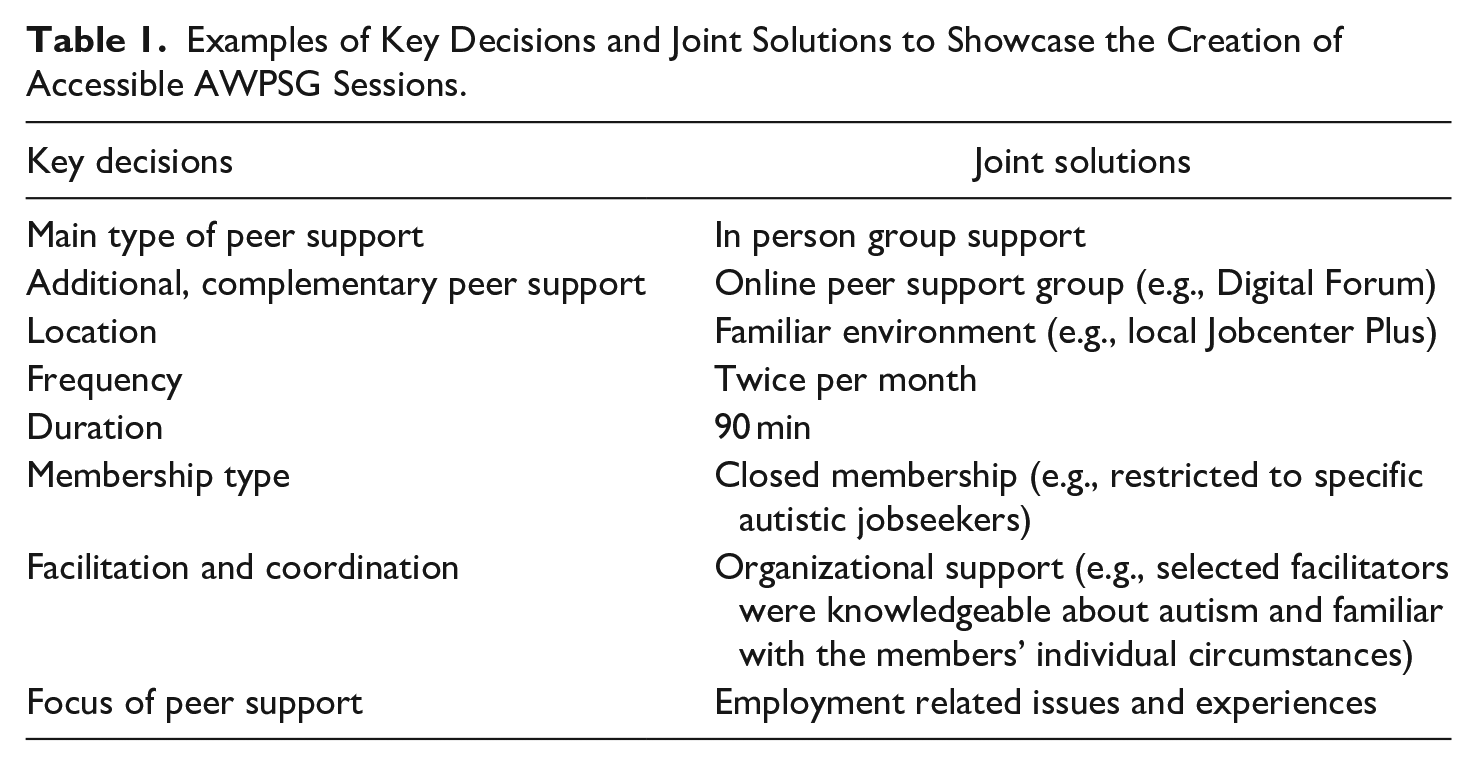
The main purpose of the AWPSG was to assist participants in generating and sharing thoughts, opinions and concerns, and making comments on intervention measures in a relaxed, comfortable setting, where the engagement of discussion partners could motivate others and help in expressing their views. The ability to support and encourage rich discussion is a central feature of peer support groups, which enables the extraction of underlying rationales by reflecting on participants’ queries and explanations (Barbour, 2008). This could not have been possible in a one-to-one interview context, especially with autistic jobseekers, who often withdraw or disengage from the conversation. In the initial meeting, all members were involved in creating the peer support sessions’ structure and format (e.g., accessible location, convenient times and frequency of meetings, group size, choice of facilitators, range of topics and activities, alternative format to participate in discussions) in order to ensure that these will be accessible and fit for purpose (see Table 1 for examples of key decisions and joint solutions reached with AWPSG members). All 24 autistic members agreed that they would like to receive organizational support to organize the sessions so as to increase their effectiveness (Mendy & Hack-Polay, 2018). Specifically, they requested to have two known DEAs to coordinate and facilitate the sessions. It was also decided that the peer support group will restrict membership only to the 26 initial members and that the minutes of sessions will be shared with the research team.
Examples of Key Decisions and Joint Solutions to Showcase the Creation of Accessible AWPSG Sessions.
Questionnaire about Autism Work Peer Support Group Membership
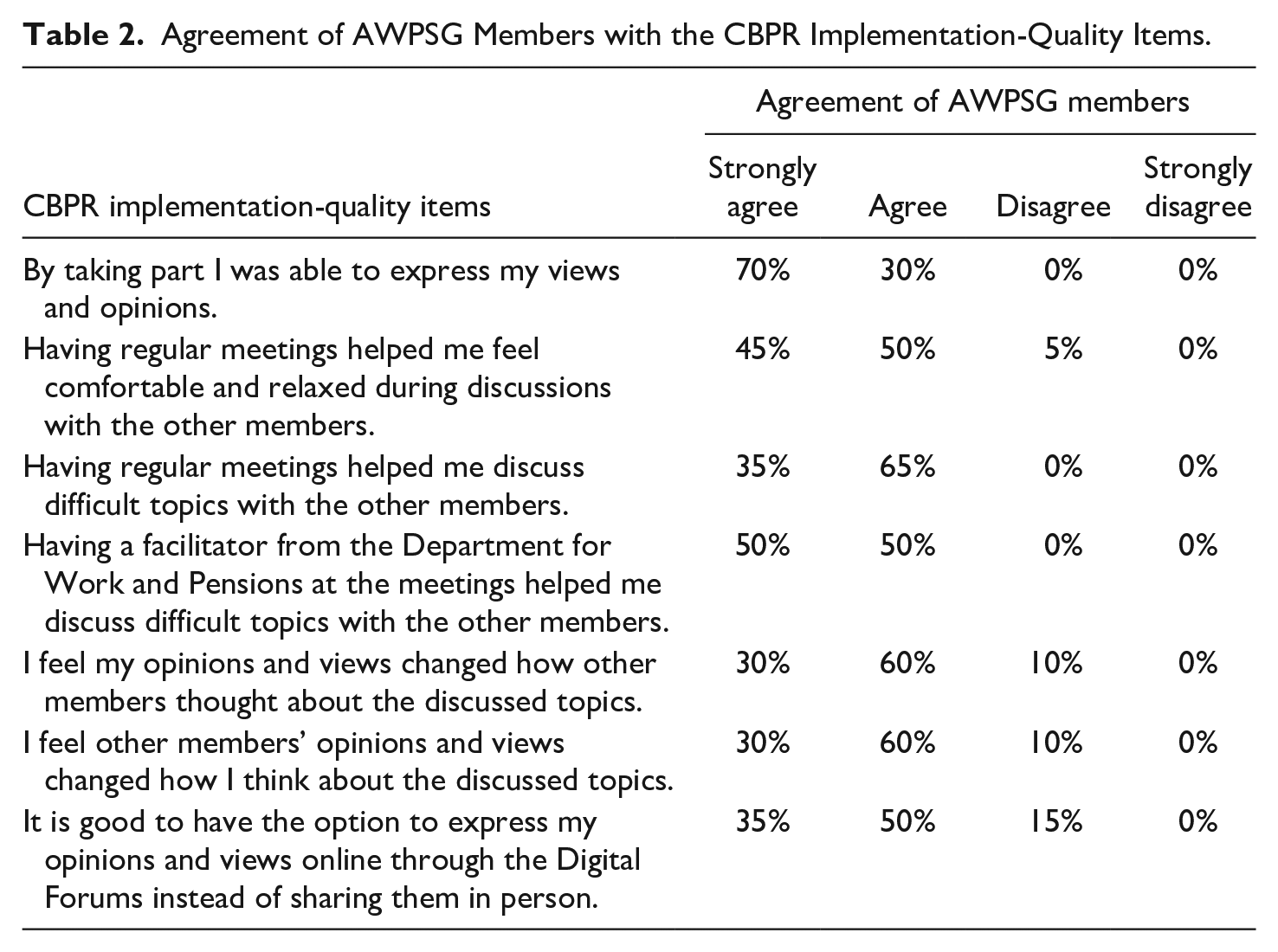
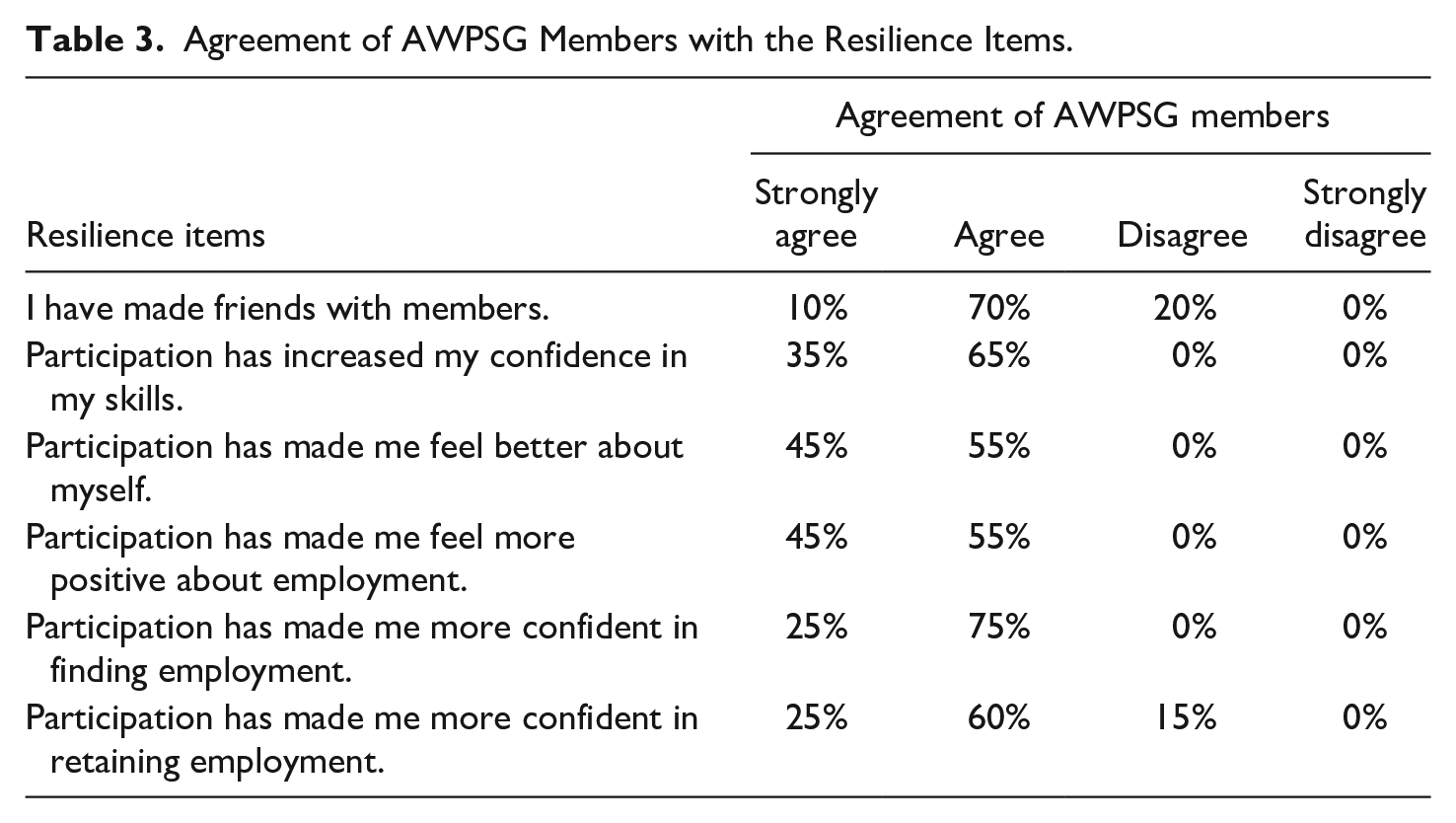
Members were asked to complete a 13-item questionnaire, at least 12 months after the start of the peer support group to evaluate its potential benefits as an intervention. Seven items assessed the reception of AWPSG measures to accommodate the needs of autistic jobseekers and facilitate active participation, while the other six items measured changes in perspectives on employment, employability skills, self-esteem and social network, to reflect on overall quality of CBPR implementation and on the potential increase in member’s resilience, respectively (see Tables 2 and 3 for the items). A 4-point Likert scale was used to present agreement with the items with scale points ranging from “Strongly Agree” to “Strongly Disagree.” At the end of the questionnaire, additional feedback was gathered as participants were asked to provide any further comments. These responses were reviewed and linked to participants’ attitudes toward other group members, their social connections, employment and opinions of the AWPSG program in line with Hillier et al. (2007).
Agreement of AWPSG Members with the CBPR Implementation-Quality Items.
Agreement of AWPSG Members with the Resilience Items.
Discussion of Findings
Data about the members’ reception of AWPSG intervention measures to accommodate the needs of autistic jobseekers and facilitate active participation are shown in Table 2.
Overall, members’ responses to the CBPR Implementation Quality items indicated that the vast majority agreed or strongly agreed with the above statements. Hence, it was shown that the appropriate accommodations for creating accessible AWPSG sessions and to foster active participation were implemented.
Data about the impact on the AWPSG members’ perspectives on their social network, self-esteem, employability skills and employment are shown in Table 3.
Overall, members’ responses to the Resilience items indicated that the vast majority agreed or strongly agreed with the above statements. Hence, it was shown that AWPSG members’ resilience was enhanced as a result of the intervention used.
Two key findings emerged from this study. Specifically, the large majority of the AWPSG members reported that the peer support sessions’ structure and format accommodated their needs and requirements and as a result it promoted active participation. Furthermore, consistent with previous research (Hillier et al., 2007) it was found that participation in the AWPSG had a positive impact on their self-esteem, social connections, employability skills and confidence to find and sustain employment. These findings combine to support the efficacy of the AWPSG program and provide a successful framework for delivering employment-focused peer support interventions to this population. The practicality of a finding is that in addition to educational (McCurdy & Cole, 2014) and vocational interventions (Hillier et al., 2007), HRD should help foster environments, where people’s social adaptation is key for their resilience capacity development (Lai & Szatmari, 2019; Nicholas et al., 2018). Finally, the present study sheds some light on how CBPR can be implemented to promote the employability of people on the autism spectrum through building resilience and emphasizing the need to involve autistic people in the development of autism appropriate HRM procedures and employment support mechanisms (Jivraj et al., 2014; Kaboski et al., 2017; Nicolaidis et al., 2015b).
With regards to designing accessible AWPSG sessions, involving autistic members in its development was crucial in creating a relaxed and safe environment to foster the emergence of a subjectively meaningful community group. There, through a sense of connectedness, members could openly share experiences and learn from one another about potential ways to overcome challenges, which they may encounter during the process of finding and keeping employment and which may be magnified by their autism profile (e.g., managing unpredictable changes in the work environment, forming effective work-relationships). In fact, consistent with Hillier et al.’s (2007) previous research, group members reported that participation in the program led to significant personal and professional benefits as they formed friendships and social connections, which in some cases have directly led to new employment opportunities. This finding gives further support to research indicating that sense of belonging plays a significant role in promoting capacity building programs leading to resilience, such as inclusive educational settings, personalized environmental accommodation and supported employment (Lai & Szatmari, 2019; Seltzer et al., 2003; Szatmari, 2018).
Implications for HRD
In terms of theory, we have developed a novel HRD intervention that could facilitate employment services especially within the context of autism. This takes into consideration the subjectivities of marginalized and under-represented groups in HRD discourse, as the first step to incorporate these into more effective intervention programs to help marginalized and disadvantaged individuals and groups (Chalofsky, 1992). This shift also highlights the need for a more meaningful HRD-autism employee-development-partnership through greater use of our proposed employment-focused peer support group program. It is anticipated that such inclusion will facilitate the development of resilience capacity within autistic jobseekers, an aspect that has previously been overlooked in both HRM and HRD scholarship. This also has further implications in identifying practice-based autism-friendly developmental programs for work-coaches and disability employment advisors so as to provide a sense of meaning and worth to such a marginalized group of individuals as originally envisaged by some of the founding scholars of HRD such as Chalofsky and Cavallaro (2013).
Tackling the developmental trajectories from both the potential autistic employees’ and work coaches’ levels will facilitate the identification and implementation of effective resilience-building programs that could promote, create and sustain optimal workplace environments for a diverse workforce. This will undoubtedly drive not only the employment but also the long-term career development- and progression of autistic people in contemporary society and the world of work. Furthermore, our findings expand on previous research in identifying a promising solution to the challenges posed to numerous organizations and their management as they work with a growing number of autistic employees. Therefore, the emerging niche of HRD and resilience research would benefit from incorporating the views and insights of a group that has been marginalized and adversely challenged over the decades. Our proposed model may increase workplace performance while at the same time it has the potential to capture new workplace challenges that HRD should be dealing with as part of its legitimization as a force for developmental good. It is also suggested that future trajectories should focus on how sustainable the CBPR and PD model can be and on practical steps of balancing the need to generate knowledge from the autistic jobseekers’ community in the longer term.
Limitations
It is worth pointing out that due to the diverse strengths and needs of people on the autism spectrum, finding effective, potentially beneficial accommodations for autistic jobseekers, employees and employers needs creative, person-centered and diverse strategies. For instance, although we provided evidence indicating that the AWPSG program had a positive impact as an intervention mechanism for enabling the resilience of high functioning autistic jobseekers, further research is needed to establish whether this model of peer support could be suitable for autistic people right across the spectrum. It is also suggested that future studies of HRD autism support mechanisms should involve more sensitive measures of resilience changes and adaptations as well as pre- and post-evaluations. For example, an evaluation of self-perceived and factual employability skills and attitudes towards employment before the start of the intervention phase and prior to the beginning of the AWPSG program itself may be beneficial in ascertaining the degree of effectiveness.
Conclusion
The findings of the current research add to the theoretical and practical developments of the autism, HRD and resilience research body. Specifically, this research provides a framework on how a CBPR approach could be utilized to operationalize the design and evaluation of an employment intervention (i.e., AWPSG) through involving autistic jobseekers in the process. It is suggested that further research is needed to investigate if such a design process could help in generating an optimal autism workplace environment. Furthermore, our findings indicate that fostering the emergence of a subjectively meaningful community group could help resolve some of the challenges identified in previous relevant scholarship (Hillier et al., 2007; Lai & Szatmari, 2019; McCurdy & Cole, 2014; Szatmari, 2018) thereby having the potential to offer autism-HRD advice and practical support to autistic jobseekers, management, work-coaches and disability employment advisors.
Footnotes
Acknowledgements
The authors would like to thank the members of the Autism Work Peer Support Group (AWPSG) for sharing their views and experiences and for the perspective-changing, rich discussions. Also, the authors are grateful to the Department for Work and Pensions Jobcenter Plus in Lincoln and in Grantham for co-developing this project.
Declaration of Conflicting Interests
The author(s) declared no potential conflicts of interest with respect to the research, authorship, and/or publication of this article.
Funding
The author(s) received no financial support for the research, authorship, and/or publication of this article.