




Abstract
Aims:
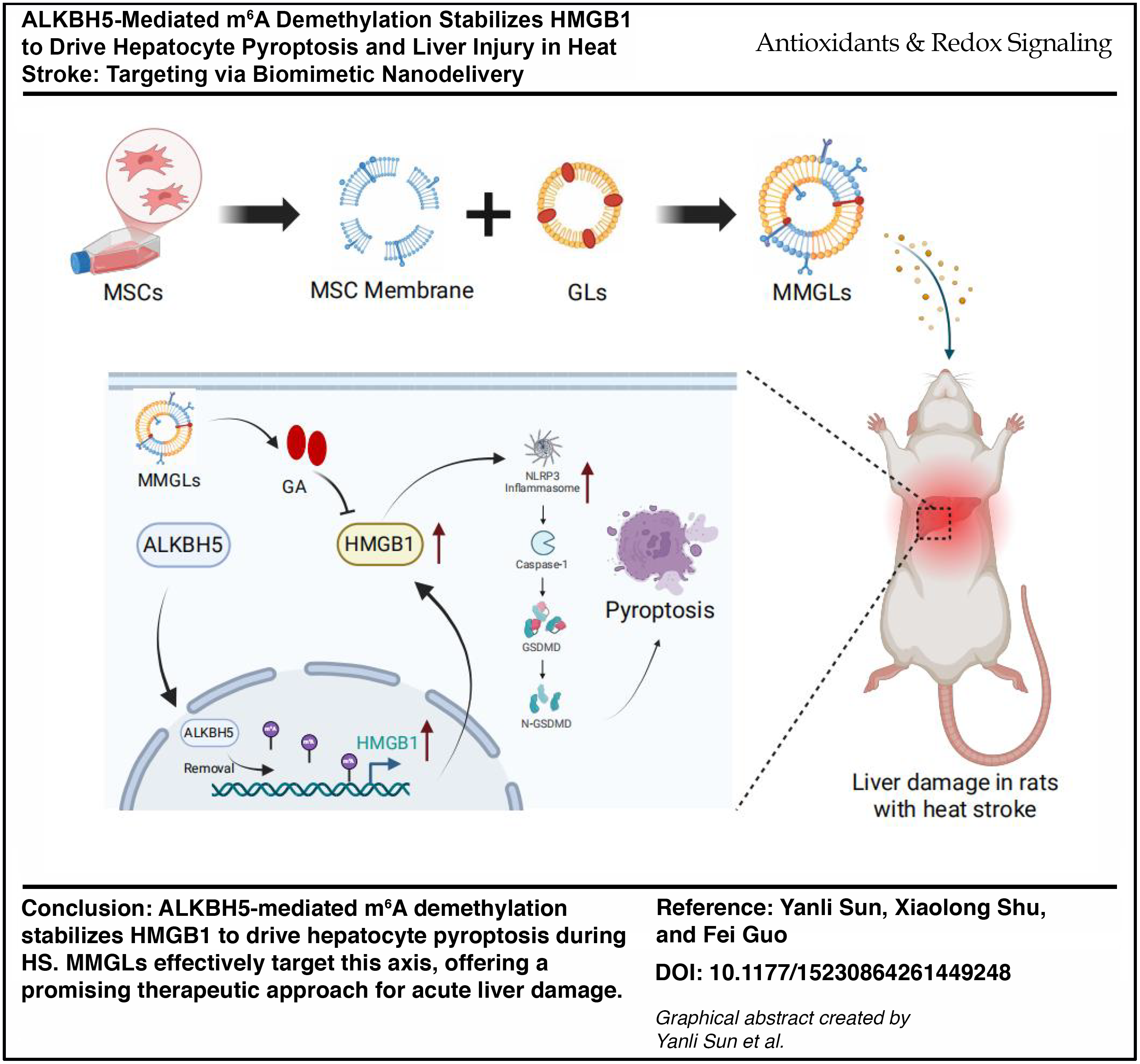
Heat stroke causes life-threatening liver injury, but its molecular basis remains poorly understood. We investigated whether ALKBH5-mediated N6-methyladenosine (m6A) demethylation stabilizes Hmgb1 transcripts and promotes hepatocyte pyroptosis through the NLRP3 inflammasome. We also developed mesenchymal stem cell membrane-coated glycyrrhizic acid liposomes (MMGLs) as a targeted therapeutic strategy.
Results:
RNA-seq of HS rat livers revealed significant enrichment of pyroptosis pathways, with ALKBH5 identified as a hub gene. Mechanistically, heat stress upregulated ALKBH5, which demethylated HMGB1 mRNA, preventing its degradation and enhancing transcript stability. This stabilization led to increased intracellular High-mobility group box 1 (HMGB1) abundance, nucleocytoplasmic translocation, and extracellular release, subsequently activating the NLRP3-Caspase-1-GSDMD axis. Alkbh5 knockdown shortened Hmgb1 half-life and attenuated pyroptosis, whereas HMGB1 supplementation restored it. To target this axis, we engineered MMGLs (encapsulation efficiency: 81.7%), which exhibited superior inflammatory homing compared to unmodified liposomes. In HS rats, MMGLs achieved rapid hepatic accumulation, significantly reduced serum alanine aminotransferase/aspartate aminotransferase, and suppressed Interleukin-1 beta (IL-1β)/IL-18. MMGLs restored redox homeostasis by decreasing reactive oxygen species/malondialdehyde and boosting reduced glutathione/superoxide dismutase, thereby preserving hepatocyte architecture and inhibiting pyroptosis.
Innovation:
This study identifies an epitranscriptomic mechanism in HS-induced liver injury, in which ALKBH5-dependent stabilization of Hmgb1 mRNA amplifies pyroptotic signaling. MMGLs provide a biomimetic nanotherapeutic strategy to interrupt this inflammatory cascade.
Conclusion:
ALKBH5-mediated m6A demethylation stabilizes HMGB1 to drive hepatocyte pyroptosis during HS. MMGLs effectively target this axis, offering a promising therapeutic approach for acute liver damage. Antioxid. Redox Signal. 00, 000–000.
Get full access to this article
View all access options for this article.