




Abstract
Aims:
Cataracts are the leading cause of blindness worldwide, and the mechanism underlying cataract formation is linked to the oxidative damage and the apoptosis of lens epithelial cells. Retinoic acid Receptor‐related orphan receptor α (RORα), a transcription factor, prevents oxidative stress and cell apoptosis. RORα is decreased in the lens from patients with cataract, but it remains unclear whether decreases in RORα are attributed to cataract formation.
Results:
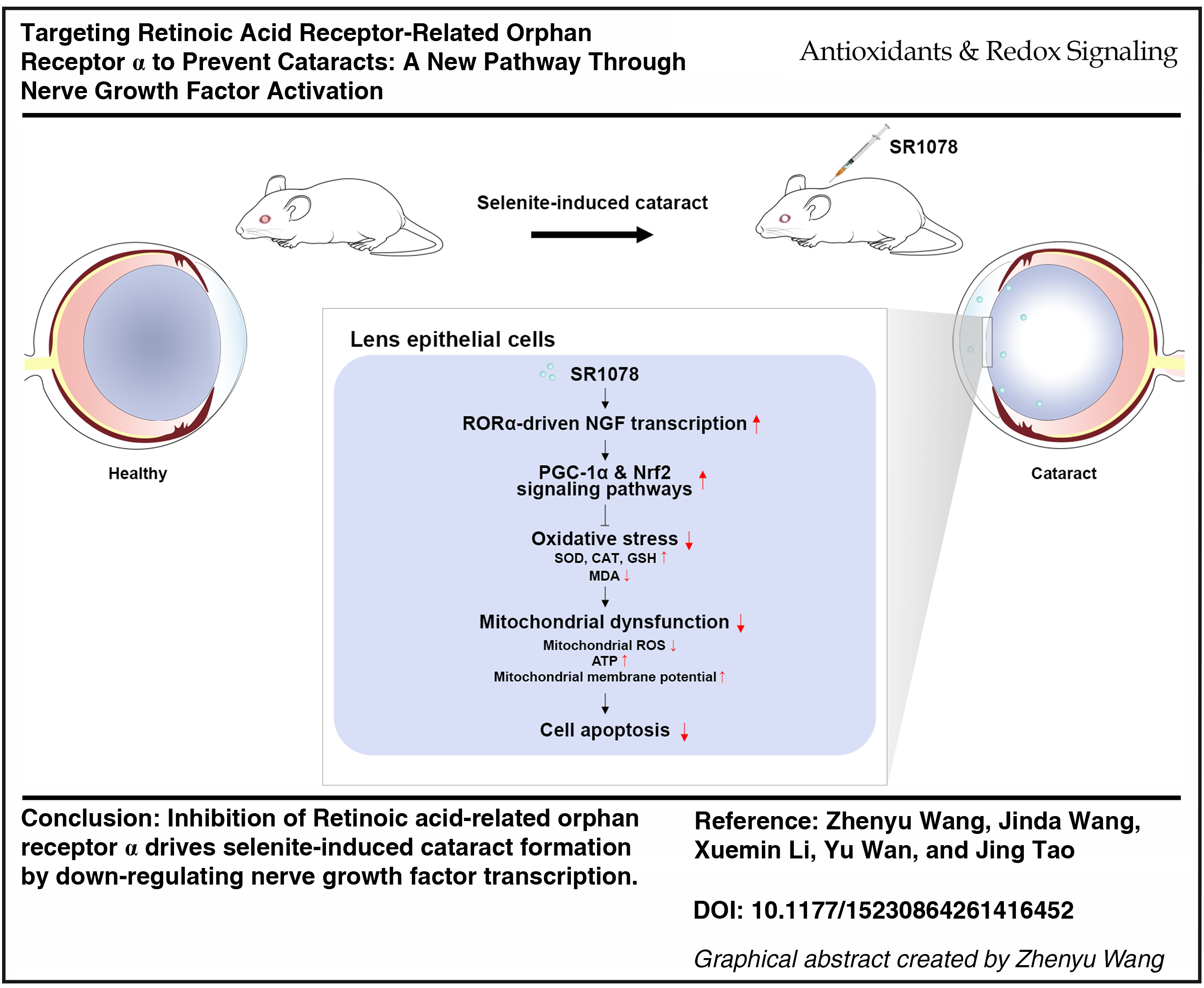
Here, rat models of selenite-induced cataracts were used for in vivo experiments. In vitro, human lens epithelial cells (SRA01-04) were treated with selenite. RORα was downregulated in the lens from rat models of selenite-induced cataracts. The RORα agonist SR1078 significantly mitigated the degree of lens opacity. SR1078 reduced oxidative stress, cell apoptosis, and mitochondrial dysfunction and promoted the peroxisome proliferative activated receptor gamma coactivator (PGC-1α) and the nuclear factor erythroid 2-related factor 2 (Nrf2)-heme oxygenase-1 pathways in the lens from rat models of selenite-induced cataracts and lens epithelial cells upon selenite stimulation. RORα overexpression showed a similar protective effect on lens epithelial cells in vitro. Nerve growth factor (NGF) expression was up-regulated by RORα overexpression. Although RORα overexpression prevented selenite-induced damage to lens epithelial cells, the damage recurred following NGF knockdown.
Conclusion:
RORα protects against selenite-induced oxidative stress and cellular apoptosis. In the context of cataractogenesis, NGF is newly identified as a transcriptional target of RORα, and its reduction is related to mitochondrial dysfunction in lens epithelial cells. Our study highlights the translational potential of RORα activation as a nonsurgical cataract intervention. Antioxid. Redox Signal. 44, 599–617.
Graphical Abstract
Get full access to this article
View all access options for this article.
References
Supplementary Material
Please find the following supplemental material available below.
For Open Access articles published under a Creative Commons License, all supplemental material carries the same license as the article it is associated with.
For non-Open Access articles published, all supplemental material carries a non-exclusive license, and permission requests for re-use of supplemental material or any part of supplemental material shall be sent directly to the copyright owner as specified in the copyright notice associated with the article.
