




Abstract
Aims:
Iron metabolism disorders are critical in the pathogenesis of acute kidney ischemia-reperfusion injury (IRI). However, the molecular mechanisms driving these disturbances remain poorly understood.
Results:
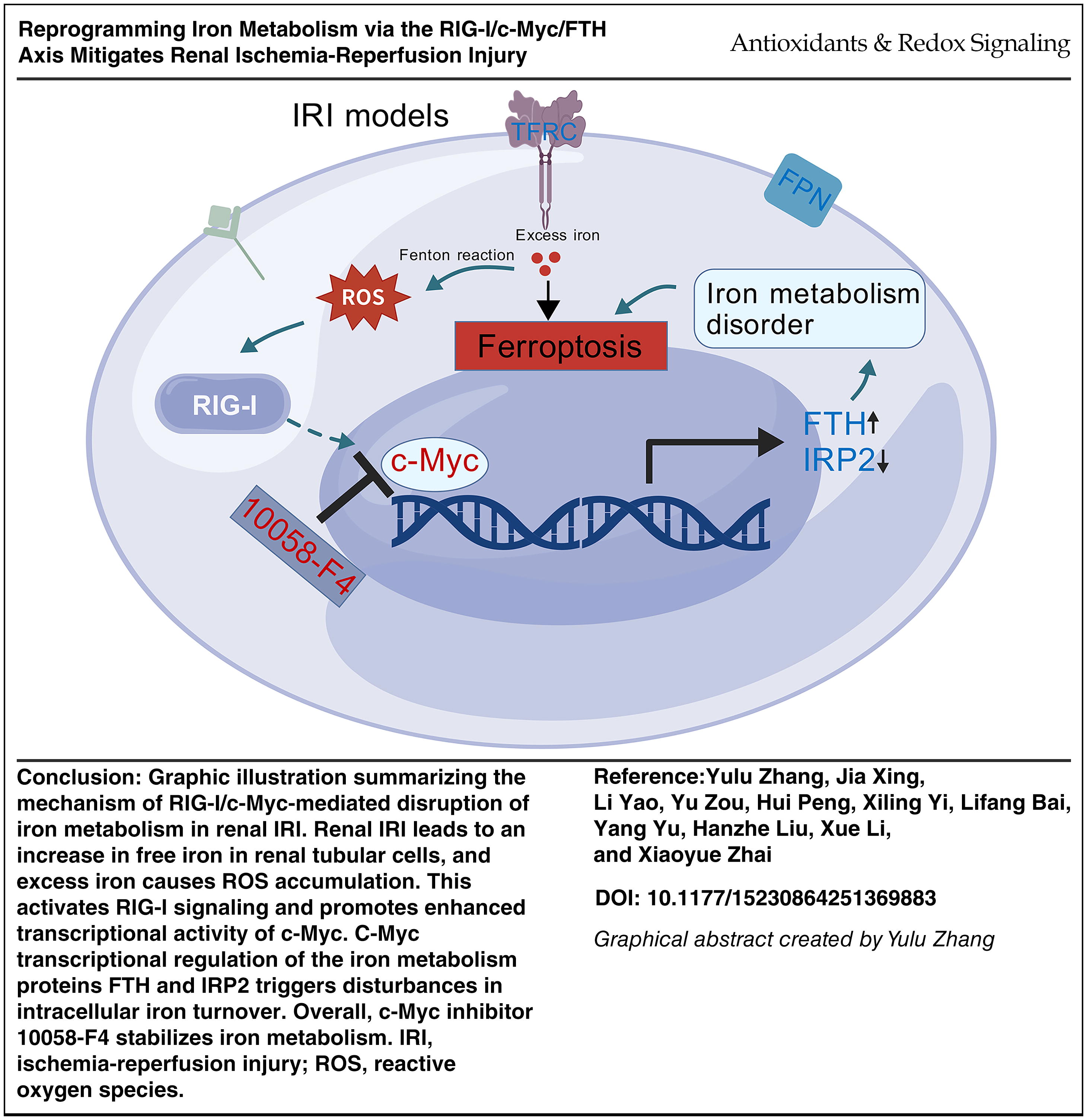
In IRI mouse kidneys, pathological alterations, iron metabolism disruptions, and functional impairments were observed. Retinoic acid-inducible gene-I (RIG-I), transcription factor c-Myc, and ferritin heavy chain (FTH) exhibited elevated expression and colocalization in tubular epithelial cells, accompanied by decreased glutathione peroxidase 4 (GPX4) level and evidence of ferroptosis. Further in vitro studies revealed that RIG-I promoted c-Myc activation. The latter demonstrated its positive regulation of FTH transcription by chromatin immunoprecipitation assays and c-Myc siRNA experiments. Interestingly, FTH overexpression resulted in elevated levels of RIG-I, transferrin receptor, ferroportin, and nuclear receptor coactivator 4. Ultimately, the c-Myc inhibitor 10058-F4 reversed all adverse alterations and demonstrated a protective role in IRI mouse kidneys and mouse kidney tubule cells subjected to the ferroptosis inducer erastin, RIG-I agonist, or hypoxia/reoxygenation. This reversal was reflected in improved renal morphology and function, balanced iron metabolism, increased GPX4 level, decreased 4-hydroxynonenal level, reduced inflammatory cell infiltration, interleukin-1 beta release, and kidney injury molecule 1 expression.
Innovation:
This study proposes a novel mechanism in which c-Myc is activated by elevated RIG-I in IRI kidneys and positively regulates FTH transcription, therefore involving iron metabolism disorders.
Conclusions:
The RIG-I, c-Myc, and FTH disrupt iron homeostasis, and the c-Myc inhibition stabilizes iron metabolism and mitigates oxidative stress, suggesting a potential therapeutic target in IRI. Antioxid. Redox Signal. 43, 622–636.
Get full access to this article
View all access options for this article.
References
Supplementary Material
Please find the following supplemental material available below.
For Open Access articles published under a Creative Commons License, all supplemental material carries the same license as the article it is associated with.
For non-Open Access articles published, all supplemental material carries a non-exclusive license, and permission requests for re-use of supplemental material or any part of supplemental material shall be sent directly to the copyright owner as specified in the copyright notice associated with the article.
