




Abstract
Austria's university system has no tuition fees and allows students to enroll in an unlimited program number. Public university funding and students’ enrollment validity are dependent on workload per program. This study aimed to compare the workload of students in multiple programs and their status (dropout, graduation) as basis for further research. The European Credit Transfer System credits and contact hours from course appointments were the major workload measures. Outcome status and enrollment type (one vs. multiple programs) were grouping variables. The sample consisted of 58,282 students in 93,705 programs with 23,526,625 single-course appointments between 2010/11 and 2022/23. Analysis of variance models showed that workload becomes higher as more programs are finished, with graduation as the outcome. On every degree level, students in multiple programs have higher workload measures than students in one program. Both dropouts and graduates accomplish higher workloads compared to single-enrollment students. Future research can build upon this study.
Keywords
In Austria (Europe), the university system allows students to enroll in as many degree programs as they want. Students can do this in a consecutive fashion, meaning switching from one program to another, or in a parallel fashion (i.e., having valid enrollments for several programs simultaneously). The decision to allow for multiple and parallel enrollments is of importance as Austria does not allocate tuition fees to the students (Federal Ministry of Education, Science and Research, 2002), making it a common phenomenon among students. However, being enrolled in multiple studies comes with more responsibilities for students compared to single enrollments as the university system is based on performance per enrolled program instead of a student level. Consequences of not meeting the standards can lead to the expiration of the enrollment in a program (Federal Ministry of Education, Science and Research, 2018). No existing research has focused specifically on this student subgroup's performance with comparisons across outcomes of dropout and graduation as well as dependent on having one or multiple enrollments. Understanding the performance characteristics of students in this university system can have implications not only for Austrians, but also for policymakers and higher education systems worldwide.
Performance-Driven University System in Austria
Austria's public university funding system is based on three pillars, namely, teaching, research, and infrastructure (Federal Ministry of Education, Science and Research, 2018). The exact relative amount of the budget coming from each pillar can vary and is based on negotiations between each university and the ministry (Federal Ministry of Education, Science and Research, 2002, 2018), with the largest one usually being teaching (around 40–50% of the total budget; University of Graz & Federal Ministry of Education, Science and Research, 2021; University of Vienna & Federal Ministry of Education, Science and Research, 2021). This is important in the context of student performance since the major performance indicator is defined as student “activity.” On a study level, programs of students are only eligible for funding if they accumulate 16 or more European Credit Transfer System (ECTS) credits over the course of an academic year (Federal Ministry of Education, Science and Research, 2018). One ECTS credit is defined as the equivalent of 25 real-time working hours (European Union, 2015; Karran, 2004). Additionally, a lower relative amount of the budget comes from the number of graduates as the number of successfully completed degree programs (Federal Ministry of Education, Science and Research, 2018). This led both policymakers and universities to make an increase in active studies and require graduates to declare goals for the upcoming years until 2030 (Federal Ministry of Education, Science and Research, 2019, 2022a, 2022b). Following official statistics, Austrian public universities face the problem of declining numbers of first-semester and active students, especially after a positive peak (increasing) during the COVID-19 pandemic (Federal Ministry of Education, Science and Research, 2023). Developing new strategies and identifying subgroups in the existing student population with the potential to fulfill these goals are warranted. From universities’ perspectives, students with multiple enrollments could have the potential to increase the funding of universities. However, before determining a possible impact on the funding, performance differences of those students need to be identified to the question of whether they should be a target group for the strategy of university management.
From students’ perspectives, the absence of tuition fees and freedom of choice are regulated by a set of rules defined by law that every study program adheres to. First, universities can set up entrance exams for their programs. Second, at the beginning of undergraduate programs, curriculum designers can implement a so-called beginning and orientation phase. This is a stack of mandatory courses in the first semester totaling between eight to 20 ECTS credits that students must successfully pass. Beyond this phase, they are allowed to add 22 ECTS credits from other courses, but are then restricted to passing these introductory ones first before they can continue with the rest of the curriculum (Federal Ministry of Education, Science and Research, 2002). Third, another restriction was set up through the introduction of a minimum workload requirement. Sitting at 16 ECTS credits after the second academic year post-enrollment, this threshold needs to be reached by students in each of their programs. Otherwise, the validity of their enrollments expires, and they are banned from enrollment into the same program for years in the future (Federal Ministry of Education, Science and Research, 2022c). Fourth, although there are no tuition fees per se, students must pay them once they cross the maximum allowed number of so-called tolerance semesters in one of their enrolled programs. This is a time limit defined as the minimum required time for the completion of a program (e.g., six semesters for a bachelor's degree program, plus two more semesters). Only as long as they stay within this timeframe, they are free from tuition payments. The time count starts with the earliest registered program with a valid enrollment, meaning payments start once the threshold is reached in this one. This is independent of the number of semesters accumulated in programs with later enrollment dates (Federal Ministry of Education, Science and Research, 2002). In Austria, general universities offer no part-time programs, making every program a full-time program (Federal Ministry of Education, Science and Research, 2002). Due to these rules applying to a program level, students with multiple and parallel enrollments need to show different overall performance profiles as a student compared to single-program students.
Parallel Enrollments and Student Performance
In an international context, the opportunity for multiple and parallel enrollments needs to be differentiated from similar concepts both from what their names suggest and the programs’ actual intentions. One of them is dual enrollment, which is a program type for high school students allowing them to take college courses (Barnett & Stamm, 2010). They are meant to facilitate the transition from school to college and are shown to increase the odds of later graduation (Ison, 2022). Closely related to parallel enrollments is the well-established program type of joint degree programs. Also known as double-degree or combined-degree programs, students receive two degrees from two universities, which can be in two different countries (Dukhanov et al., 2014; Russell et al., 2008). Based on qualitative student reports, the reasons for enrolling in a joint degree program are linked to an enrichment of the curriculum vitae, skill acquisition, or increasing career opportunities after graduation, meaning better chances in the labor market (Borsetto & Saccon, 2022, 2023). Another concept is double majors, with students graduating in two different fields and with two degrees. However, they receive only one bachelor's degree and approximately complete the same number of credits as single-program students (Hemelt, 2010), which is different from multiple and parallel enrollments. Double majors show higher average earnings than single-major counterparts (Hemelt, 2010). Due to a lack of peer-reviewed research on the unique situation of multiple and parallel enrollments in Austria, it can only be assumed that students’ motivations to enroll in more than one program share a specific overlap with the reasons to enroll in a joint degree program or doing double majors. Previous research shows that college dropouts earn significantly more than their counterparts without attending college 15 years after high school. This led to the conclusion that “some college” performs better in the labor market than none (Giani et al., 2020). Other works show that employers and hiring staff look for job-relevant skills when rating university dropout, making lack of graduation not a problem per se (Neugebauer & Daniel, 2022). Thus, it needs to be taken into consideration that not every student with multiple enrollments may want to graduate in every program or altogether. For some cases, being able to switch a program may even offer the opportunity to save them from dropping out and to graduate in a different field of study.
Contrary to the abovementioned clearly structured program types, multiple and parallel enrollment is not defined as a concept by law (Federal Ministry of Education, Science and Research, 2002); it only constitutes an informal possibility for students. Beyond the formal regulations that make reaching workload goals mandatory, enrolling into more than one program simultaneously comes with the problem of overlapping course times and almost the full workload of every program in addition to the first one. The total workload can still be a bit lower than adding a full curriculum since exams and ECTS credits can be transferred from one program to another (Federal Ministry of Education, Science and Research, 2002). This means that students can register some of the courses from one of their studies as elective courses in the other one and vice versa. The more closely related two curricula are, for instance, law and business law compared to psychology and chemistry, the more courses may be transferrable as equal courses shared in both curricula (Federal Ministry of Education, Science and Research, 2002). Nonetheless, enrolling into more than one program should intuitively come with a higher workload compared to a single-degree program enrollment. However, there are no studies clarifying these differences. For instance, among the possible outcome combinations of dropout and graduation, it is not clear whether single-study dropouts are different in their achievements from students dropping out of more than one program. This is important as it can be seen as a first indicator of which groups may profit more from “some college” over no college (Giani et al., 2020). By gaining more information on these differences, future research can build upon this foundation and lead to recommendations for both university management (e.g., by introducing target-group specific micro-credentials) and students (e.g., by recommending for or against switching and parallel enrolling before dropping out).
Aims and Expectations
The major aim of this study is to answer the questions of how performance of students in two or more programs differs depending on their outcomes and whether there are differences in the workload of students with one enrollment and students with two or more enrollments. The second aim is to gather evidence on whether students in multiple and parallel enrollments should be made a target group in the strategy of university management. Workload is defined as the overall contact hours and ECTS credits for each study program of a student. Comparing the student workload, it reflects the circumstances of the degree levels and status outcomes: students in diploma programs have the highest workload, followed by those in bachelor's programs. Master's programs have the lowest workload. The highest workload is seen in students with the outcome of graduation in multiple studies, while the workload is lowest for dropping out of all programs. The constellation of graduation and dropout lies in the middle workload-wise. Among students with at least one graduation, it is expected that students with parallel enrollments generally show higher workload measures than students with one enrollment.
Checks for the theoretical background of this study show strong positive correlations between the number of contact hours and the ECTS credits, both reflecting the number of courses taken. The longer students stay in the university system, the higher their workload measures.
Methods
Data Background and Sample Characteristics
Data were retrieved from the internal database of an Austrian university. It is among Austria's biggest universities with around 30,000 students per year. The data were queried at the end of September 2023, marking the end of the academic year 2022/23. All studies of students between 2010/11 to the end of the academic year of 2022/23 were included. Only finished bachelor's, master's, or diploma programs were left in the dataset (i.e., having an outcome status either being graduation or dropout). A total of 58,282 unique students in 93,705 studies were the sample used in this study. Doctoral studies and additional study programs were excluded. In total, 23,526,625 single-course appointments of students with compulsory attendance have been processed. Non-compulsory courses were excluded.
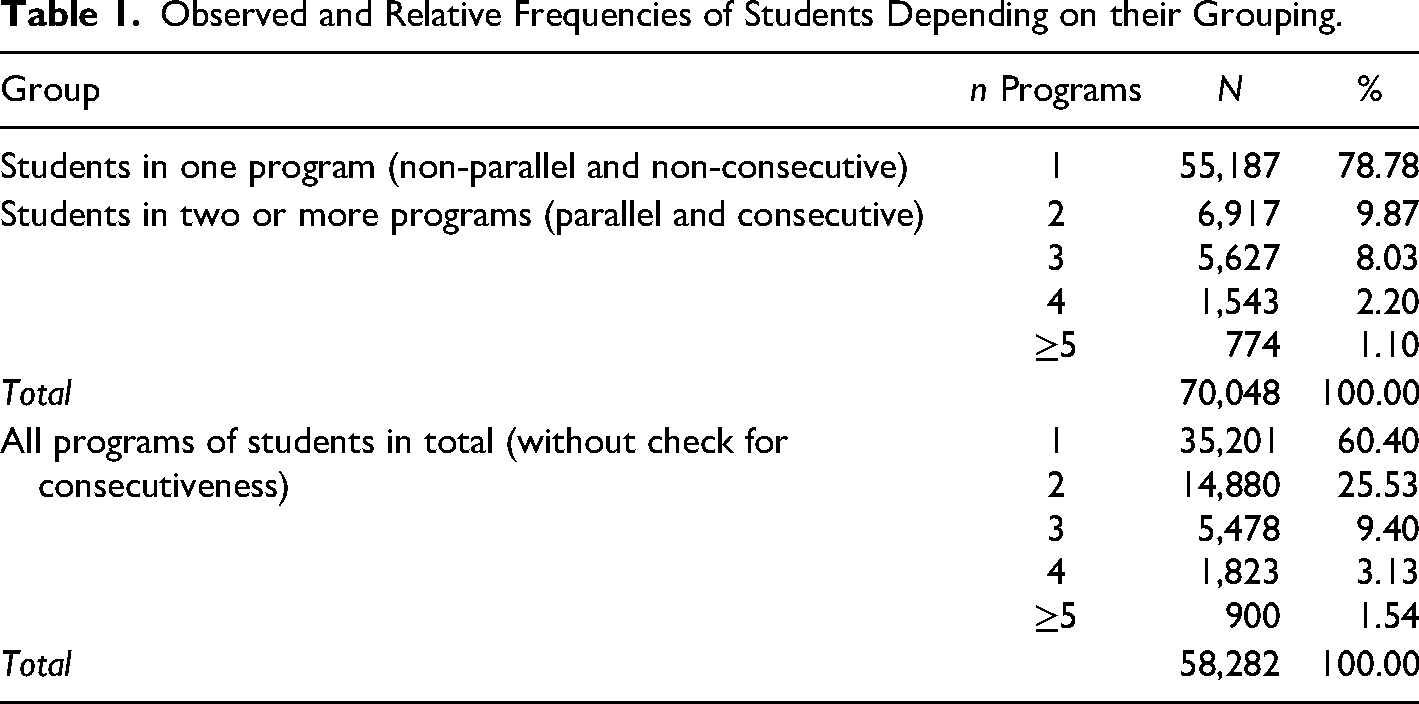
Students with parallel and multiple programs were defined as students with programs overlapping in time or having consecutive enrollments. To be included, programs had to be on the same degree level. Graduating from a bachelor's degree program and starting a master's program in the next semester are not relevant in this definition. It applies to same degree programs overlapping or being switched in the following semester or academic year. The academic year as a criterion was applied to programs that can only be started at the beginning of the winter term, for instance, if they have restricted access via entrance exams once per year. Since there is no limit to how many programs are allowed to enroll in, the data structure suffered from a number of multiplied rows, which can be traced back to students with more than two simultaneous programs. One column in the dataset represented each program of each student (i.e., the “observed program”). Another column defined as the “parallel column” included all parallel and consecutive study programs meeting the above criteria. If there were none, the corresponding cell in the column was empty. However, if a student had more than two programs (the observed one and more than one in the parallel column), parallel enrollments needed to be multiplied over an equal number of rows. The column for the observed study program was filled with neutral values in the data curation process, and a distinct function was applied to the data to avoid additional multiplication over this column. Parallel programs still appeared once in each of the two columns since constellations can be different depending on which program is the observed one. This means that two programs can overlap, with the first being closed and the other one being continued for a longer timeframe. By starting a third program in addition to the second one, which was the original parallel program, the data structure would not show the third program as the parallel entry of the first one, but would show up as a parallel program for the second one as the observed program. To account for these possibilities, summing up the dependent variables and structuring the dataset on the student level instead of program level was not meaningful. Table 1 shows the outcome of the multiplication process listing the absolute and relative frequencies of students and the number of their study programs. The group “one program” counts every student not meeting the criteria for parallel or multiple study programs, while “two or more programs” counts students by the above definition of parallel and multiple programs. The group “all programs of students” counts the number of students based on their total number of enrollments at the university in the target timeframe, neglecting consecutiveness, degree level equality, and multiplication. Comparing totals, a difference of 11,766 students is revealed, meaning that the final dataset contained around 20% more cases, accounting for all people with more than two programs at once.
Observed and Relative Frequencies of Students Depending on their Grouping.
Variables
The main outcome variables of this study were contact time in hours and the ECTS credits overall. The contact time was retrieved from every mandatory course appointment of each student in the dataset. Course times existed as beginning and end times with a date for each one. Duration was calculated, transformed into hours, and summed up per study program of each student. The accumulated ECTS credits in each program were summed up, but only true achievements in a program were counted. This means that the transfer of the credits from one program to another was not considered relevant, only including real exams that were passed within the timeframe of this study for the students’ enrolled programs they belong to. Therefore, the accumulated ECTS credit values upon graduation do not necessarily have to be the same for each student, reflecting only the students’ true workload.
The outcome status was used as an independent variable. For both the observed and parallel columns, the status could be “dropout” or “graduation.” Students with currently enrolled programs have been excluded. The degree level (bachelor's, master's, diploma) and the group for the number of parallel study programs (one program, two or more programs) were also included as independent variables.
The overall graduation status was used as a filter variable in additional analyses for students with more than one enrollment. It was defined as graduating at least in one program.
The overall time enrolled at the university was included as an additional variable. The time variable was defined as the number of semesters between the earliest beginning of two programs and the farthest endpoint. For instance, beginning one program in the winter term 2015/16, adding a parallel program in the winter term 2016/17, and ending the first one in 2017/18 and the second one in 2020/21, the timeframe is defined as winter term 2015/16 to winter term 2020/21.
Apparatus
The university's database was set up using an Oracle® SQL server. Data queries and curation were done using R (R Core Team, 2022) and the RODBC package (Ripley & Lapsley, 2022) in combination with the Oracle Instant Client 19®. Analyses were conducted in IBM SPSS® 29. The hardware used was a desktop PC with an installation of Windows® 11, 16 core, and 64 GB RAM.
Statistical Analyses
Two univariate three-way ANOVAs were conducted with overall contact hours and ECTS credits as dependent variables. The degree level of the programs and the status groups of the observed and parallel programs were used as independent variables.
Two univariate two-way ANOVAs with overall contact hours and ECTS credits as dependent variables were conducted. Degree level and grouping of the number of study programs of students were used as independent variables. The analyses were applied to a filtered dataset, only including students with at least one enrollment. This ensured that no dropout–dropout constellations remained in the dataset, skewing the workload measures. By focusing at least on one graduation outcome, the difference in the workload between students in one and two or more programs should be quantified. All ANOVA models relied on Bonferroni correction for the post-hoc comparisons.
Additional analyses were conducted using Pearson correlations. They served as checks for the theoretical assumptions of the study.
Results
Student Workload and Outcome
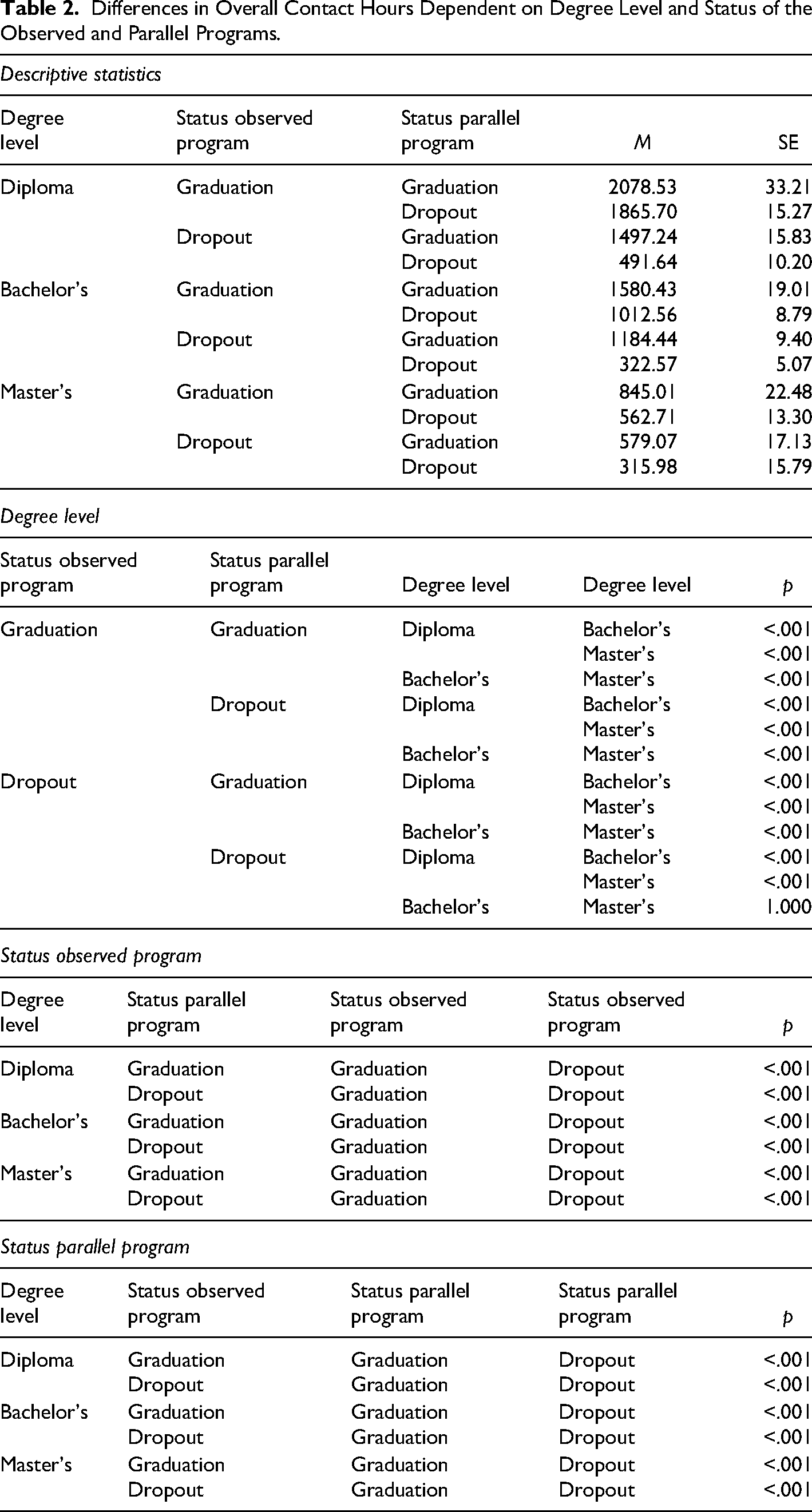
A univariate three-way ANOVA with the dependent variable contact hours for students with two or more programs showed significant main-effects degree level, F(2, 30,143) = 2,289.32, p < .001, ηp2 = .13, status observed program, F(1, 30,143) = 3,641.74, p < .001, ηp2 = .11, and status parallel program, F(2, 30,143) = 2,940.52, p < .001, ηp2 = .09. It also showed significant-interactions degree level × status observed program, F(2, 30,143) = 357.34, p < .001, ηp2 = .02, degree level × status parallel program, F(2, 30,143) = 220.96, p < .001, ηp2 = .01, and degree level × status observed program × status parallel program, F(3, 30,143) = 176.14, p < .001, ηp2 = .02. Post-hoc tests using Bonferroni correction were conducted. Due to the three-way interaction being significant, only these interactions are reported. Results can be found in Table 2.
Differences in Overall Contact Hours Dependent on Degree Level and Status of the Observed and Parallel Programs.
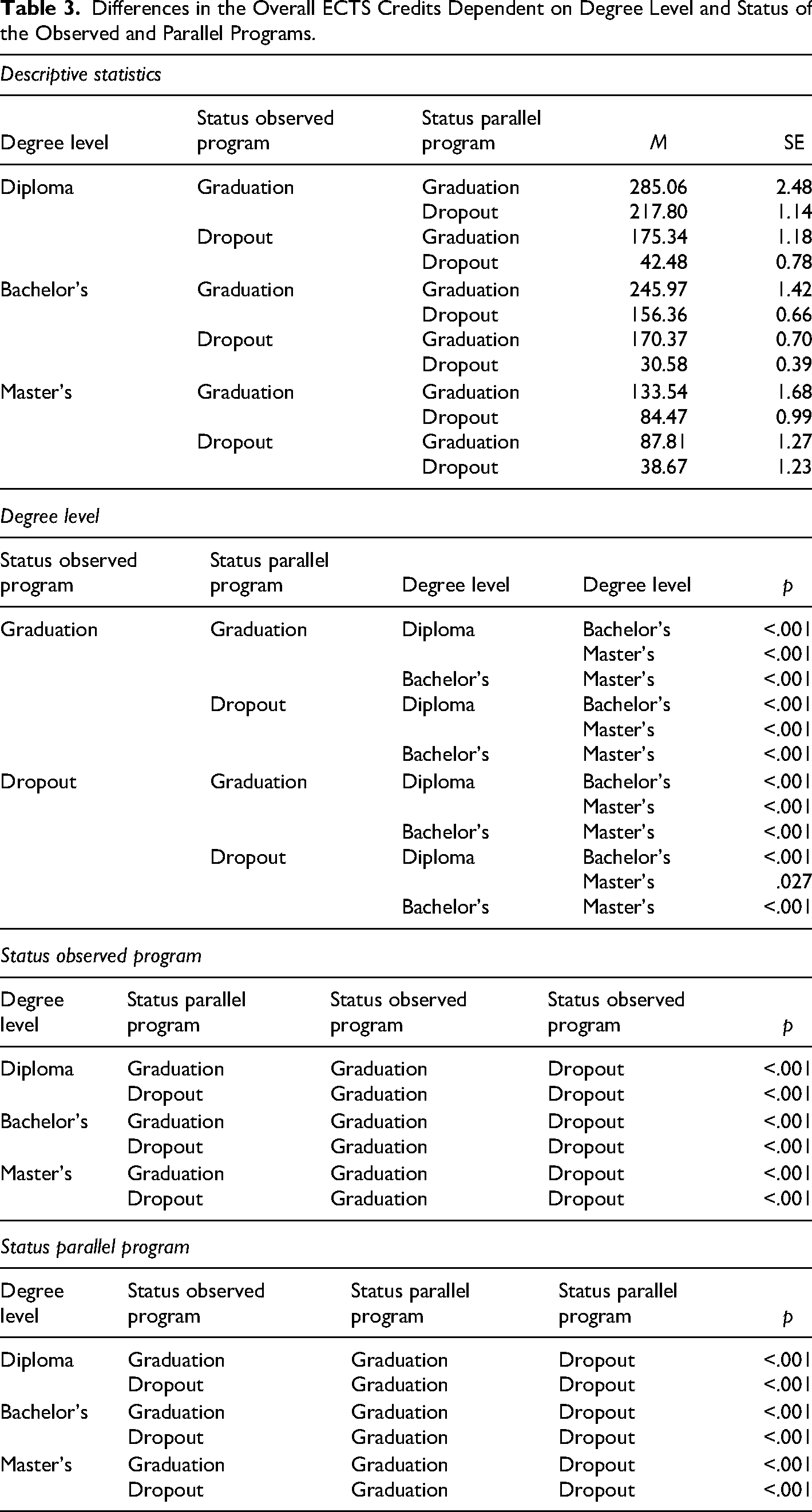
A univariate three-way ANOVA with the dependent variable overall ECTS credits for students with two or more programs showed significant main-effects degree level, F(2, 29,141) = 5,026.35, p < .001, ηp2 = .26, status observed program, F(1, 29,141) = 17,161.90, p < .001, ηp2 = .37, and status parallel program, F(2, 29,141) = 14,309.44, p < .001, ηp2 = .33. It also showed significant-interactions degree level × status observed program, F(2, 29,141) = 1,199.43, p < .001, ηp2 = .08, degree level × status parallel program, F(2, 29,141) = 865.64, p < .001, ηp2 = .06, and degree level × status observed program × status parallel program, F(3, 29,141) = 423.29, p < .001, ηp2 = .04. Post-hoc tests using Bonferroni correction were conducted. Due to the three-way interaction being significant, only these interactions are reported. Results can be found in Table 3.
Differences in the Overall ECTS Credits Dependent on Degree Level and Status of the Observed and Parallel Programs.
Student Workload and Parallel Enrollments with Graduation
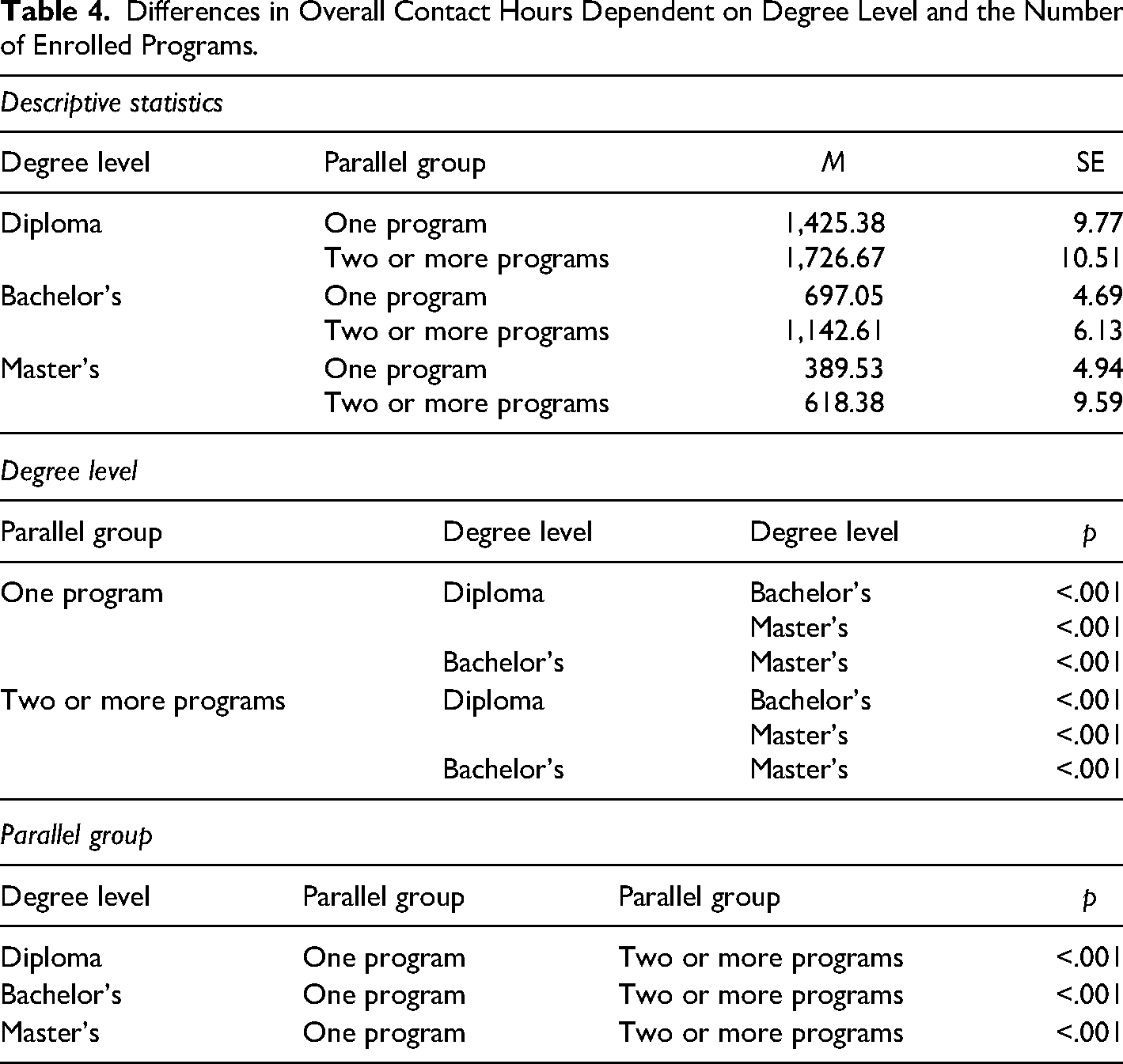
A univariate two-way analysis of variance (ANOVA) with the dependent variable contact hours for students with at least one graduation status showed a significant main-effects degree level, F(2, 43,969) = 7,144.12, p < .001, ηp2 = .25, a parallel category, F(1, 43,969) = 2,492.93, p < .001, ηp2 = .05, and a significant-interactions degree level × parallel category, F(2, 43,969) = 143.73, p < .001, ηp2 = .01. Post-hoc tests using Bonferroni correction were conducted. Due to the two-way interaction being significant, only these interactions are reported. Results can be found in Table 4.
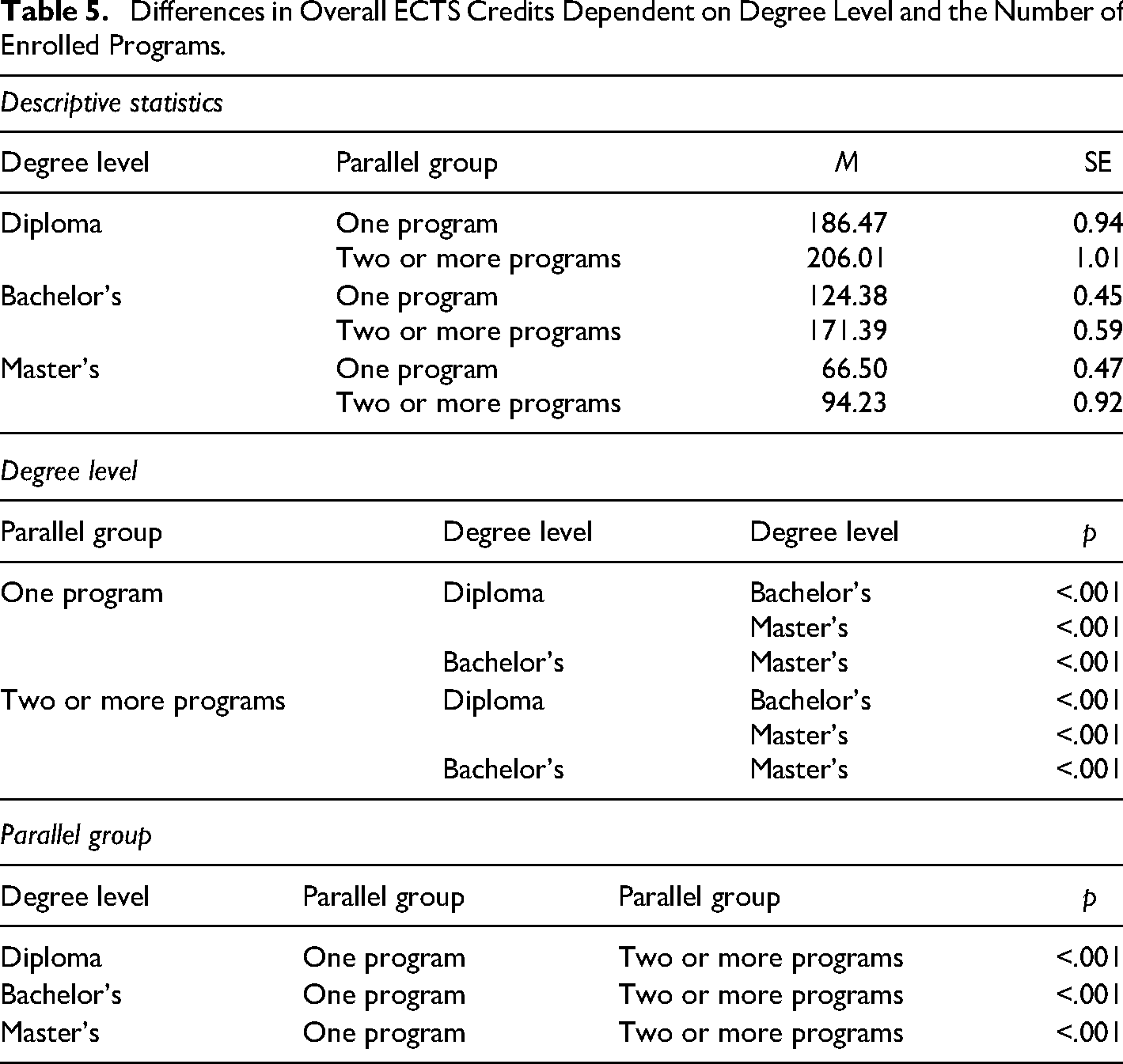
A univariate two-way ANOVA with the dependent variable overall ECTS credits with at least one graduation status showed a significant main-effects degree level, F(2, 44,378) = 10,172.43, p < .001, ηp2 = .31, a parallel category, F(1, 44,378) = 2,532.63, p < .001, ηp2 = .05, and a significant-interactions degree level × parallel category, F(2, 44,378) = 212.36, p < .001, ηp2 = .01. Post-hoc tests using Bonferroni correction were conducted. Due to the two-way interaction being significant, only these interactions are reported. Results can be found in Table 5.
Differences in Overall Contact Hours Dependent on Degree Level and the Number of Enrolled Programs.
Differences in Overall ECTS Credits Dependent on Degree Level and the Number of Enrolled Programs.
Additional Analyses
Pearson correlations for students with two or more enrollments revealed positive correlations between the overall time at university and the overall ECTS credits, r = .51, p < .001, and between the overall time enrolled and the number of contact hours, r = .54, p < .001. Another positive correlation between the number of contact hours and the overall ECTS credits was obtained, r = .74, p < .001.
Discussion
Student Workload and Outcome Status
The main aim of this study was to compare how the performance of students in two or more programs differs depending on their status outcomes (dropout and graduation) and whether there are differences in the workload of students with one enrollment and students with two or more enrollments. The second aim was to gather evidence on whether students in multiple and parallel enrollments should be made a target group in the strategy of university management. The workload was operationalized as the sum of contact hours through students’ lifecycles and the overall sum of ECTS credits. Due to natural differences in the expected workload dependent on the degree level, analyses showed significant interactions. In general, students in diploma programs have the highest workload, followed by bachelor's programs, and master's programs have the lowest workload. These differences are explained via the ECTS credits necessary to finish one of these programs. For instance, bachelor's programs have 180 to 240 ECTS credits, while master's programs have 120 and diploma programs 300 ECTS credits (Assefa & Sedgwick, 2004; Conference on Master-level Degrees, 2003). The same differences were obtained for contact hours.
The higher the number of graduations involved, the higher the workload in contact hours and ECTS credits obtained when comparing the differences. Graduation–graduation had the highest average readings, while graduation–dropout had lower mean values, and dropout–dropout had the lowest. The only exception with no difference was the comparison of students dropping out of two bachelor's and master's programs. They had the same amount of contact hours, while the mean ECTS credits were higher for master's students. This effect may be explained by the limitations of the raw data. All appointments of courses from students with a valid registration were considered. However, their status outcome was present on a semester level, targeting the end of each semester. Therefore, registered course appointments beyond the true dropout date could not be filtered, not being accessible on the true granularity level students stopped attending courses. It also needs to be considered that there are no records in the database on such cases, meaning that students planning to drop out could stop taking part in the courses a lot earlier than their dropout date would suggest. This limitation cannot be resolved with the database used in this study and has likely masked the difference between workload in contact hours of students dropping out from two study programs on the bachelor's and master's levels.
Within all degree levels, students with two or more programs and at least one graduation had higher workload measures in both contact hours and ECTS credits than students in one program. Between degree levels, the differences reflect the ECTS requirements of the curricula (Assefa & Sedgwick, 2004). Mean differences between students in one and two or more programs between diploma students were 19.54 ECTS credits and 301.29 contact hours; for bachelor's students, these were 47.01 ECTS credits and 445.56 contact hours; and for master's students, these were 27.72 ECTS credits and 228.85 contact hours. One credit is equal to 25 real working hours (European Union, 2015; Karran, 2004). Students in two or more programs always had higher values.
These results show that students with multiple and parallel enrollments have a higher overall workload than students with one enrollment. Revealing differences not only in contact hours, but also in ECTS credits, students take and pass more exams when studying more than one program. If contact hours were higher, but not ECTS credits, this would mean that students registered in courses, but did not take exams. Much to the contrary, students with multiple and parallel programs voluntarily take more exams than their single-enrolled peers. More research on the exact reasons for parallel studying is needed, but the assumption that one of these reasons can be the enhancement of the curriculum vitae is supported by the results of this study (Borsetto & Saccon, 2022, 2023).
From a university's perspective, this also supports the assumption that multiple enrollments can generate more student workloads, possibly making more programs eligible for funding (Federal Ministry of Education, Science and Research, 2002). In a performance-based university system comparable to Austria (Federal Ministry of Education, Science and Research, 2002), funding is dependent on a program level (Federal Ministry of Education, Science and Research, 2018). Since students in two or more programs accomplish higher workloads and accumulate more ECTS credits than students with one enrollment, they offer the chance to increase a university's budget without increasing the number of students. Dependent on the university system, future studies and internal analyses in universities need to be done to evaluate the impact of allowing students to enroll in more than one program simultaneously. This study gathered evidence that students with multiple enrollments can be a target group for specialized measures, such as the implementation of micro-credentials. This may possibly encourage single-enrollment students to think about parallel and multiple programs as a way to enrich their curriculum vitae without the need to graduate in more than one program. However, more research is needed to clarify which measures are appropriate and to learn more about the behavior of specific subgroups.
Additional Analyses
A very strong correlation between ECTS credits and contact hours as well as strong positive correlations between the time at university and the ECTS credits and contact hours were obtained. These correlations being strong, but not near perfect, indicate the existence of student behavior patterns in the data not following the general assumptions. The lack of a near-perfect correlation coefficient for ECTS credits and contact hours is related to the limitations of the dataset discussed earlier. Students becoming dropouts stop attending courses the moment they leave university. Although their course appointments are being registered, they do not take exams, therefore not accumulating any additional ECTS credits. The two weaker correlations between workload and study time, although still strong, may be a product of dropouts stopping taking exams or failing them, but keeping their enrollment for some time before they finally leave. Previous works show that dropping out of university is a prolonged process, with problems accumulating over time (Bardach et al., 2020; Heublein, 2014; Ozga & Sukhnandan, 1998; Wilcox et al., 2005). Students go through set of different phases until they make a final decision (Bäulke et al., 2022). Dropping out of university being a longer-lasting decision process (Mashburn, 2000) is likely linked to the correlations not showing higher coefficients.
There is also a second group of students in the dataset, attending courses, but never registering for the exams. Research showing that dropouts can still have a higher value on the labor market than people never coming in touch with a university (Giani et al., 2020) and the Austrian university system allowing multiple enrollments with the absence of tuition fees (Federal Ministry of Education, Science and Research, 2002), there may be a group of students seeing university as further education without the need to graduate or even formally pass exams. Future studies will have to address this group of students and check both their motivations for enrolling in university programs and their outcomes on the labor market. In this study, it is assumed that strategically increasing employability (Borsetto & Saccon, 2022, 2023; Hemelt, 2010) or satisfying personal interests in certain topics can be a motivation to enroll in study programs, without ever planning to graduate or to take exams.
Limitations
The main effects in the ANOVA models showed low to moderate effect sizes, while the interactions showed rather small ones. The interactions mainly being influenced by the inclusion of the degree level to the models and their natural ECTS requirements, they must be treated as less substantial than the actual main effects. From a theoretical background, the choice of keeping the degree levels in one model instead of splitting the dataset and creating three separate models was made to make differences between dropout–dropout constellations visible. Students, who leave university are not bound to the ECTS requirements compared to graduating. Therefore, seeing workload differences in these groups supports the assumption of different student groups among dropouts in that these differences show up depending on the degree level.
The multiplication process of students with more than two parallel programs could not be avoided in this study. Some bias may not have been avoidable, but it has to be considered as an unsystematic influence in the analyses. With the performance comparisons per outcome status being calculated on the program level, not the student level, no influences should be expected. The ANOVA models comparing the group of students with one enrollment and the group of students with two or more enrollments have also been executed on the same data structure (i.e., program level). Due to multiplication, the mean workload values of students in two or more programs were likely influenced. However, with respect to the Austrian university system counting on the same level (Federal Ministry of Education, Science and Research, 2018), keeping this structure for comparability and generalization was determined a priority. Furthermore, changing the data structure to the student level and creating general workload measures on the person level would neglect possible timing differences between enrollments. This means it is possible to begin a first program and to add another one, which is closed while the first enrollment is kept valid. For instance, they can begin additional programs to circumvent ECTS restrictions by channeling the ECTS load to a second transition program. Once they fulfill the requirements, they can close the second program and transfer the ECTS credits and exams to their first program. By beginning a third program several semesters in the future, the parallel constellations read differently depending on which of the programs is the observed one. Studies 1 and 2 would be considered parallel in the same way as 1 and 3. However, 2 and 3 share no overlap, not being considered parallel and therefore not showing up in the dataset as such. To represent each possible constellation, keeping the program level for the analyses was necessary.
Further Research and Implications
With this study showing that students with more than one enrollment have a higher number of contact hours and accumulate more ECTS credits than students with one enrollment, more research is needed on what leads to the different outcome constellations. Reasons for enrolling in more than one program in the Austrian university system need to be identified. It needs to be considered that there is no randomization in who enrolls in more than one program, creating a bias among students with one or more programs as well as among those with multiple programs. Therefore, there should be different types of dropouts among former students with two or more programs, likely having different motivations to enroll in multiple studies. Being able to identify such groups, targeted support measures can be implemented by the university management (Linden, 2022; Ortigosa et al., 2019) to increase retention rates (Suhlmann et al., 2018; Zając & Komendant-Brodowska, 2019). Knowing about the motivations, future studies also need to link them to the interests of these sub-groups. This has implications for policymakers and university governance in that parts of the curricula can be used or micro-credentials in the most sought-after programs can be newly implemented (Selvaratnam & Sankey, 2021). By doing so, the graduation–dropout and dropout–dropout situation may change to “graduation–certificate” or “certificates from a list of study programs,” aiding the employability of former students currently labeled as “dropout” (Giani et al., 2020). Comparisons of the labor market performance between students, dropouts, and graduates with one and two or more enrollments in respect of their outcome status are warranted. This could have implications for policy makers worldwide. It also needs to be considered that allowing for parallel and multiple enrollments could also be a chance for increased student retention as the higher workloads from students in multiple and parallel programs with the outcome graduation–dropout over single enrolled students with graduation suggest. Potential dropouts may take courses from other fields of studies and slowly transfer their center of academic attention to another program without having to close the first one immediately. Such groups can be identified by clustering the motivations to enroll into more than one program.
Conclusion
This study compared the workload of students in two or more programs per degree level and their status outcomes when leaving university with the workload of students in one program and students in two or more programs. The workload was dependent on the degree level and its general ECTS requirements. The higher it is, the higher the number of programs successfully finished. On every degree level, students in two or more programs had higher workload measures than students in one program. Dropouts and graduates accomplish higher workloads than their single-enrollment counterparts, with the implementation of micro-credentials being a possible strategy to give students an option to achieve certificates instead of dropping out the traditional way. Being unclear about the motivations of students to study parallel programs, more research is needed in this field. By identifying specific subgroups among students with two or more programs, policymakers, university management, and students worldwide can profit from parallel and multiple enrollments. Recommendations for or against allowing and enrolling into parallel programs as well as support structures may be developed. Implications from this study are that students in more than one program potentially leave university with a more diverse skillset, which is more attractive in the labor market. Future work is needed to gain more evidence and to compare the employability of these groups. Students in multiple and parallel enrollments may also increase student retention as potential dropouts may switch to another program and graduate.
Footnotes
Declaration of Conflicting Interests
The author declared no potential conflicts of interest with respect to the research, authorship, and/or publication of this article.
Funding
The author disclosed receipt of the following financial support for the research, authorship, and/or publication of this article: The author acknowledges financial support from the University of Graz.
