




Abstract
While mindfulness intervention research is prevalent, it is limited in (1) relation to college students’ grade point average (GPA) and retention and (2) minimum dosage recommended for the intervention. This repeated-measures quasi-experimental nonequivalent control groups study investigated differences in mindfulness, stress, flourishing, GPA, and retention between students (n = 248) in first-year experience seminars who received a brief mindfulness intervention and the comparison group (n = 125) who did not receive the intervention. The intervention consisted of three- to five-minute mindfulness exercises at the beginning of class that met once a week. In contrast to results of previous studies, this study—when controlling for class sections and gender—showed no significant differences in any outcome variable between groups. These results provide important evidence that a mindfulness dosing limit might exist. A post hoc binary logistic regression supported previous findings that GPA predicts retention. Implications are discussed in regard to college administrators, faculty, and student affairs professionals.
Keywords
Although the practice of mindfulness is currently trending in the western world, it has existed for more than 2,500 years in Buddhist dharma (i.e., natural law or teachings). Today, mindfulness is most commonly defined as “paying attention on purpose, in the present moment, and nonjudgmentally” (Kabat-Zinn, 2003, p. 145). Contemporary mindfulness practice is used to reduce suffering and to increase well-being, and it has been studied in medicine (e.g., Mikolasek et al., 2018), business (e.g., Dane & Brummel, 2014), counseling (e.g., Fjorback et al., 2011), and education (e.g., Napoli et al., 2005).
Adjusting to college is a stressful time for many students as they have to adjust socially, environmentally, and academically, with often drastic changes in social support, living situations, and academic responsibilities (Leppink et al., 2016). For traditional students, this transition occurs during the age when they are more likely to develop a psychological disorder (Kessler et al., 2005), and 66.4% of all college students in 2018 reported experiencing overwhelming anxiety within the past year (ACHA, 2019). Such emotional disturbances can cause anxiety and depression (Morrison & O’Connor, 2005) and can hinder students’ academic achievement, making students at greater risk for lower GPAs and dropping out (Sohail, 2013).
Mindfulness has been shown to improve mental health (Bohlmeijer et al., 2010; Fjorback et al., 2011) and decrease stress (Chin et al., 2019; Sparado & Hunker, 2016), yet it has not been studied in relation to retention. Further, relationships between retention and well-being, which mindfulness has been shown to impact, have been investigated (Zajacova et al., 2005), but there are no mindfulness interventions with a specific focus on retention. In fact, mindfulness and academic achievement is a neglected area of study in general, with virtually no discussion on the amount of mindfulness practice needed. To address this gap, we investigated whether a brief mindfulness intervention with first-year college students at the beginning of class impacted their levels of mindfulness, stress, flourishing, and academic achievement in terms of GPA and retention.
Mindfulness
Mindfulness research with college students abounds. Three relevant areas of research to the current study include stress, flourishing, and academic achievement. Mindfulness has been shown to decrease anxiety and depression (Bamber & Kraenzle Schneider, 2016; Cole et al., 2015), improve first-year college adjustment (Dvořáková et al., 2017), and improve loneliness and academic achievement (Rosenstreich & Margalit, 2015).
Mindfulness and Stress
Stress is a physiological response to a stressor, (Everly & Sobelman, 1987), and an individual's responses are generally similar despite the nature of the stressor; therefore, an individual could respond to a physical stimulus and a psychological stimulus (e.g., a thought) in the same way (Cohen et al., 1995). The appraisal of the stimulus occurs between the stimulus and the response and determines the response (Ellis, 1987; Everly & Sobelman, 1987). For example, if a college professor reminds the class of an upcoming exam, one student may stay calm because they believe they are prepared, while another student may become anxious because they doubt their readiness and believe they might fail. Mindfulness has been shown to reduce these negative automatic thought processes along with stress levels (Baer, 2009; Brown et al., 2013). These thought processes are associated with negative affect, including depression and anxiety (Morrison & O’Connor, 2005).
Mindfulness and Flourishing
The concept of flourishing is often mistakenly equated to happiness (Haybron, 2008). While happiness is used colloquially to describe well-being, it does not encompass the full meaning of the construct. Well-being theory, therefore, is divided into two subsets: hedonic, which includes the elusive feeling of happiness, and eudaimonic, which includes the more stable feeling of fulfilment (Keyes, et al., 2002). Hedonic well-being includes the day-to-day feelings that are susceptible to situational circumstances, while eudaimonic well-being is considered to be authentic happiness or how well the person is functioning; therefore, eudaimonic well-being is also referred to as psychological well-being (Easterlin, 2001). While flourishing includes the hedonic components of life circumstances like support from friends and family, life events, and the presence or lack of physical ailments, it also includes deeper concepts such as having self-acceptance, purpose in life, and other self-growth characteristics that are positively self-focused (Ryff, 1989). Mindfulness has been shown to improve flourishing levels (Akin & Akin, 2015; Feicht et al., 2013).
Mindfulness and Academic Achievement
Academic achievement is most often defined in terms of grade point average (GPA) and retention, and GPA has been shown to be significantly predictive of retention (Westrick et al., 2021); therefore, when a student's GPA is negatively impacted, their chances of dropping out increase (Shaw & Mattern, 2013). Further, stress has been shown to impact both GPA and retention (Zajacova et al., 2005); for example, students with the high stress of financial burdens are more likely to drop out (Webster & Showers, 2011). While there are relatively few studies that look at the effect of mindfulness on academic achievement, particularly on retention, mindfulness meditation has been shown to improve cumulative GPA (Hall, 1999), metacognition and attention (Bergen-Cico et al., 2013), and academic performance (Hanley et al., 2015).
Dosage of Mindfulness
Dosage of mindfulness training is sparsely discussed and not well measured in the literature; so, it is unknown whether there is a minimal amount of training that will correlate with positive effects. The most commonly studied mindfulness intervention is mindfulness-based stress reduction (MBSR), an 8-week program with 2.5-hr sessions per week and a full-day retreat at the end (Ramler et al., 2016). Like MBSR, mindfulness-based cognitive therapy (MBCT) sessions are typically for 2 hr once a week for 8 weeks (Fjorback et al., 2011). However, there is little evidence to support that the standard 8 weeks is a critical minimum for effective change. Bergen-Cico and colleagues (2013) ran a brief 5-week MBSR program with 2 hr per session for a total of 10 hr—almost one-third the time of the standard program. Findings included improvements in self-compassion and non-significant reduction in anxiety; so, they suggested that for more serious issues such as anxiety, full MBSR programs are preferable. McIndoo et al. (2016) reduced the total number of meetings in their MBCT study to 4 weeks, with one meeting per week, and still findings indicated a reduced recurrence of depression, stress, and rumination.
There have been promising studies that investigate the effect of much shorter sessions as well. Feicht et al. (2013) conducted an online mindfulness training program for 7 weeks, and participants were required to complete three 10- to 15-min exercises once a week. Subjective happiness and satisfaction increased significantly. Hartel et al. (2017) ran 3-min guided meditations at the beginning of each class meeting for the duration of the course. Feedback was collected and showed overwhelmingly positive responses. These two studies are notable for their brief exercises, showing that perhaps even short mindfulness sessions can have positive outcomes. Although there seems to be consensus that better outcomes correlate positively with more quality time spent practicing mindfulness (Baer, 2009; Goldberg et al., 2014), there is little discussion on what might constitute a minimum amount of practice to obtain noticeable results. In their meta-analysis on meditation interventions in schools, Waters et al. (2015) found that effect sizes were generally strongest when practice was consistent for at least 24 weeks. After a 9-week program for only 80 min per session, Lam 2016) suggested that future research should include randomized controlled studies with larger sample sizes “as well as an increased number of weekly sessions so that new learning can be consolidated” (p. 3305). Garland et al. (2016) specifically stated that dosage throughout the literature is unclear and called for future studies to investigate it.
Purpose
In addition to feeling socially connected to the university (Pym et al., 2011), college students need tools to help them reduce their stress and increase their psychological well-being in order to improve their likelihood of staying in school and graduating. Including brief mindfulness exercises at the beginning of class would provide college students with routine practice, but to obtain faculty participation, the length of practice cannot interfere with the course curriculum; therefore, the exercises must be kept to <5 min. Therefore, the purpose of this study was to investigate whether a brief mindfulness intervention with first-year college students at the beginning of class impacted their levels of mindfulness, stress, flourishing, and academic achievement in terms of GPA and retention. The research question that guided this study was:
Are there differences in mindfulness, stress, flourishing, GPA, and retention between students in a first-year experience seminar who received 3 to 5 min of a mindfulness intervention and the comparison group?
Method
Participants
A total of 809 college students who were enrolled in an elective first-year experience seminar participated in this study at a large, mid-Atlantic research university. Of these students, 373 successfully completed both the in-class paper pretest and posttest, with 248 in the intervention group and 125 in the comparison group. This was 46.1% of the possible sample. Women made up 75.4% of the mindfulness group and 59.2% of the comparison group, and men made up 24.6% of the mindfulness group and 40.8% of the comparison group. White students made up 37.7% of the mindfulness group and 44% of the comparison group; Black students made up 27.1% of the mindfulness group and 25.6% of the comparison group; Hispanic or Latinx students made up 6.1% of the mindfulness group and 1.6% of the comparison group; Asian or Pacific Island students made up 10.5% of the mindfulness group and 8% of the comparison group; American Indian, Alaskan Native, or Native Hawaiian made up 0% of the mindfulness group and 1.6% of the comparison group; biracial multiracial or multiracial made up 17% of the mindfulness group and 17.6% of the comparison group; and students who chose “other race” made up 1.6% of the mindfulness group and 1.6% of the comparison group. Group differences will be assessed via χ2 tests of independence and independent samples t-tests to calculate the variances between the intervention and comparison groups.
Procedure
After Institutional Review Board approval was obtained, the research team gave all instructors of the first-year experience course, which met once per week, the option to join the intervention group and complete training on implementing the mindfulness activities in their course sections. Instructors who participated were asked to follow the intervention procedures in all sections of their course. All instructors, regardless of whether they participated in the intervention, were asked by the research team to allow a team member to come into their classroom three times during the semester to administer the surveys. Twenty-one instructors taught a total of 44 sections of the course. Fourteen of these instructors volunteered to provide the mindfulness intervention to their total of 27 class sections. Because instructors chose between the intervention and control groups, and because students were enrolled in their advisor's section, this study was not randomized.
On the first day of class, each intervention section received an overview of mindfulness practice by a member of the research team. At the beginning of subsequent classes, the instructors played 2- to 5-min pre-recorded guided meditations that were a combination of breath awareness, body scans, and sitting meditations, which align with Kabat-Zinn’s (2013) mindfulness exercises. The guided meditations came from YouTube and emphasized the elements essential to mindfulness: paying attention to the present moment and gently guiding back attention when the mind has wandered. Students were told that they were not required to participate in the meditations and were asked to remain silent for those who wanted to participate. At the beginning of classes during the twelfth week, which was the week after the tenth and final week of the intervention, the research team returned to read and collect the informed consent and administer the posttest. Instructors were surveyed after the final assessment in order to gather information on the frequency that they actually played the exercises in class and whether all students stayed quiet regardless of participation in the mindfulness exercise.
Instruments
Both the intervention and the comparison groups received the same paper pretest and posttest questionnaires, while the written informed consent forms varied slightly to include the intervention. In addition to demographic questions and questions regarding prior and current mindfulness activities, the pretests and posttests contained the three instruments detailed below. Instructors were surveyed at the end of the semester to assess whether they had followed through with the requirements of the intervention and if their class remained uninterrupted during the mindfulness exercises. GPA and retention data were collected from the university after the following fall semester had begun.
Mindful Attention Awareness Scale (MAAS)
The MAAS (Brown & Ryan, 2003) is a 15-item questionnaire with a 6-point Likert scale ranging from 1 (almost always) to 6 (almost never), and the higher the score, the higher the level of mindfulness. It was created to measure mindfulness in individuals who had no “meditation training experience” (Sampl et al., 2017, p. 7). Mindfulness is measured in terms of consciousness, or, attention and awareness (Brown & Ryan, 2003). In line with Kabat-Zinn’s (2013) definition of mindfulness, Sampl et al. (2017) stated that the MAAS measures “present moment awareness” (p. 7). The MAAS had good internal consistency at both the pretest (α = .87) and the posttest (α = .90).
Perceived Stress Scale (PSS)
The PSS was created by Cohen et al. (1983) to measure “the degree to which situations in one's life are appraised as stressful” (p. 385) in the past month. Previous measures assessed life events, but Cohen et al. (1983) found the PSS to be more predictive of stress than assessments based on life events because participants could report how stressed they felt instead of being given an objective score that may not represent their actual stress levels. The PSS had good internal consistency at both the pretest (α = .82) and the posttest (α = .85).
Flourishing Scale (FS)
The FS (Diener et al., 2010) measures eudaimonic well-being, also known as psychological and social well-being. It is a brief 8-item measure that includes items on social relationships, having a life of purpose and meaning, engagement and interest in activities, self-respect and optimism, and feelings of competence and ability in meaningful activities. Like the PSS, the FS is based on the respondent's subjective perspective. The FS scale ranges from 1 (strongly disagree) to 7 (strongly agree), and the final score is the sum of all scores, with higher scores indicating higher levels of flourishing. The FS had good internal consistency at the pretest (α = .85) and the posttest (α = .89).
Analysis
This study was a repeated measures quasi-experimental nonequivalent control group design. The repeated measures were pretests and posttests collected at the first and twelfth weeks of class in multiple class sections. Data analysis was run in four stages. First, descriptive statistics compared the sample to the overall first-year student population at the institution. Second, χ2 tests of independence and independent samples t-tests calculated the variances between the intervention and comparison groups. Third, intra-class correlations determined whether outcomes varied among class sections. Because GPA and gender varied significantly across class sections, multilevel models controlled for these differences to determine whether outcomes differed between the group that received the mindfulness exercises and the group that did not (Statistics for Windows, version 25). Finally, a post-hoc binary logistic regression was run to see if GPA predicted retention, as has been shown in previous studies (Allen, 1999; Shaw & Mattern, 2013; Westrick et al., 2021).
Results
After accounting for class sections that did not follow through with participating in the intervention, as well as removing outliers, the groups varied significantly by gender but not by race/ethnicity. At the time of the pretest, the number of participants who had heard of mindfulness (35.5% of the mindfulness group and 40% of the comparison group) was greater than the number who had been taught mindfulness (23.4% and 22.4%, respectively), greater than the number who had ever participated in mindfulness (30.4% and 29.6%, respectively), and greater than the number who practiced mindfulness at least once per month (12.8% and 16%, respectively). Chi-squared tests of independence were conducted for participation in additional practices such as prayer, mindful spiritual practice, and yoga. The mindfulness and comparison groups did not differ significantly in any of these mindfulness-type practices.
The scale scores for each construct were analyzed to see if the two groups varied significantly. Table 1 shows the independent samples t-tests that compared mean scale scores of the two groups’ pretests. The Levene's Test for the MAAS t-test was significant; so, t, degrees of freedom, and significance were determined by equal variances not assumed. Levene's Tests for the other two variables were not significant; so, t, degrees of freedom, and significance were determined by equal variances assumed. None of the mean scale scores for any of the variables varied significantly between the mindfulness and comparison group; therefore, it was acceptable to proceed in comparing the two groups with the caveat that being non-randomized, they could still vary in ways unmeasured.
Independent Samples t-Tests for Comparison of Pretest Scores Between Groups.
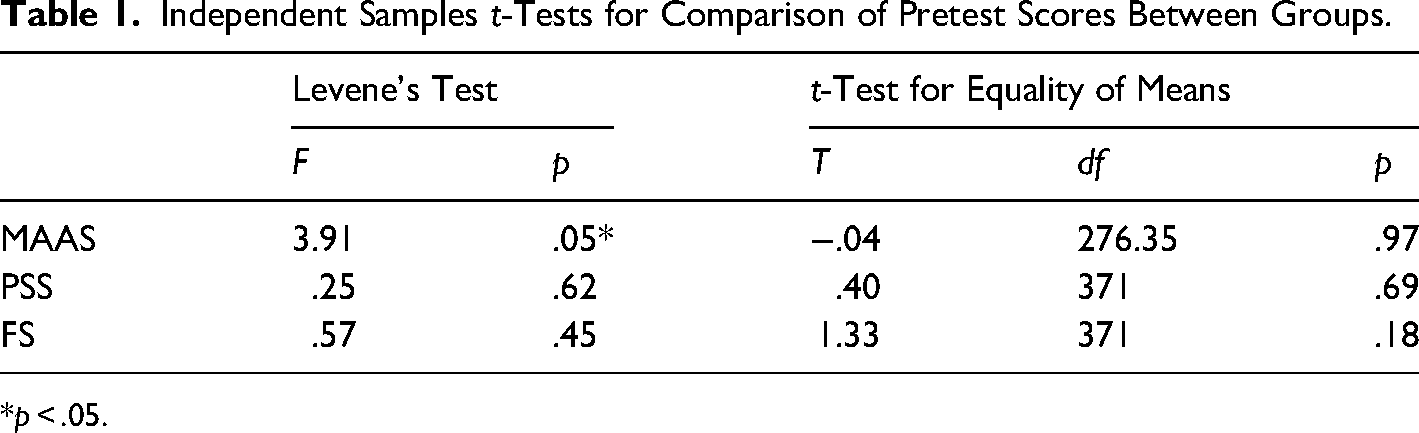
*p < .05.
Participants were enrolled in 35 different class sections, so there was the possibility of nested data. Variances among class sections were tested through intra-class correlations, with results shown in Table 2, and class sections were nested instead of professors since professors taught multiple sections. The latent variables mindfulness, stress, and flourishing, as well as the observed variable retention, did not vary significantly across sections; however, the observed variables Fall, Spring, and cumulative GPAs did. Whereas the percentages of variances between sections for mindfulness, stress, flourishing, and retention were 1.08, 2.35, 0, and .05, respectively, and the percentages of variances between sections for Fall, Spring, and cumulative GPAs were 6.97, 7.22, and 6.97, respectively.
Intra-Class Correlations for Outcome Variables.
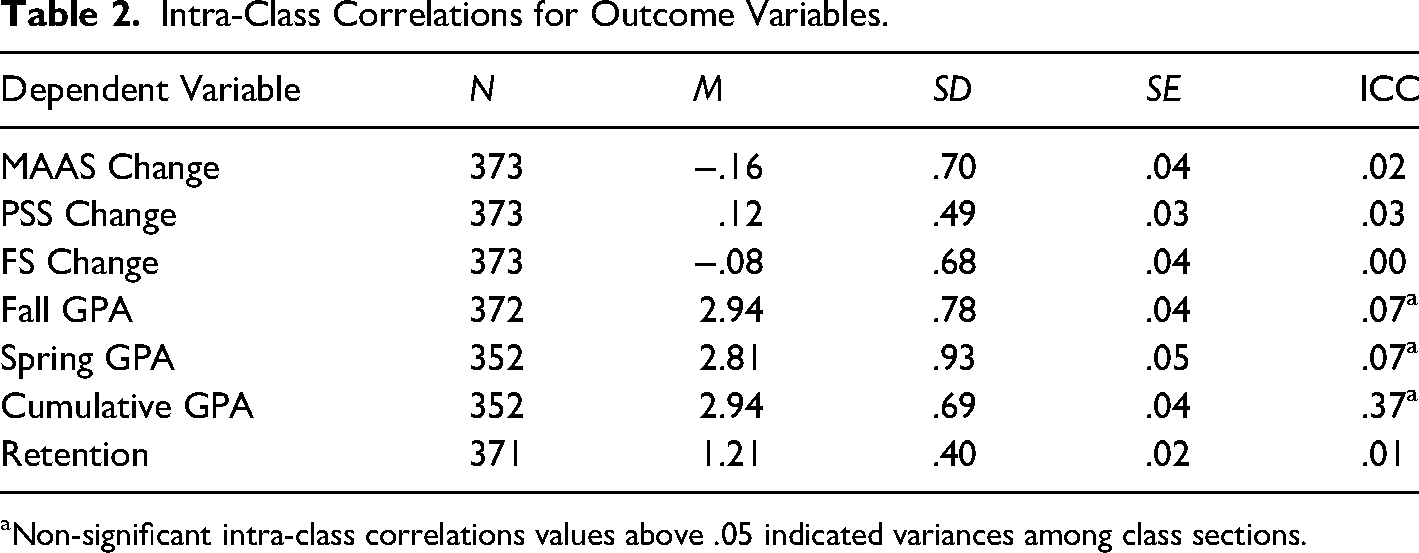
Non-significant intra-class correlations values above .05 indicated variances among class sections.
Because there were variances among class sections for all time points of GPA, GPA required a multilevel analysis. Further, gender varied significantly between the mindfulness and comparison groups (p < .01); therefore, multilevel analyses were run for all outcome variables with gender as the level one variable and class section as the level two variable.
Results as shown in Tables 3 and 4 are as follow. When controlling for class section, (1) neither the students’ gender nor the mindfulness intervention significantly predicted the students’ levels of mindfulness; (2) neither the students’ gender nor the mindfulness intervention significantly predicted students’ stress levels; (3) neither students’ gender nor the mindfulness intervention significantly predicted students’ flourishing levels; and (4) neither students’ gender nor the mindfulness intervention predicted students’ retention.
Estimates From Multilevel Models Predicting Mindfulness, Stress, and Flourishing.
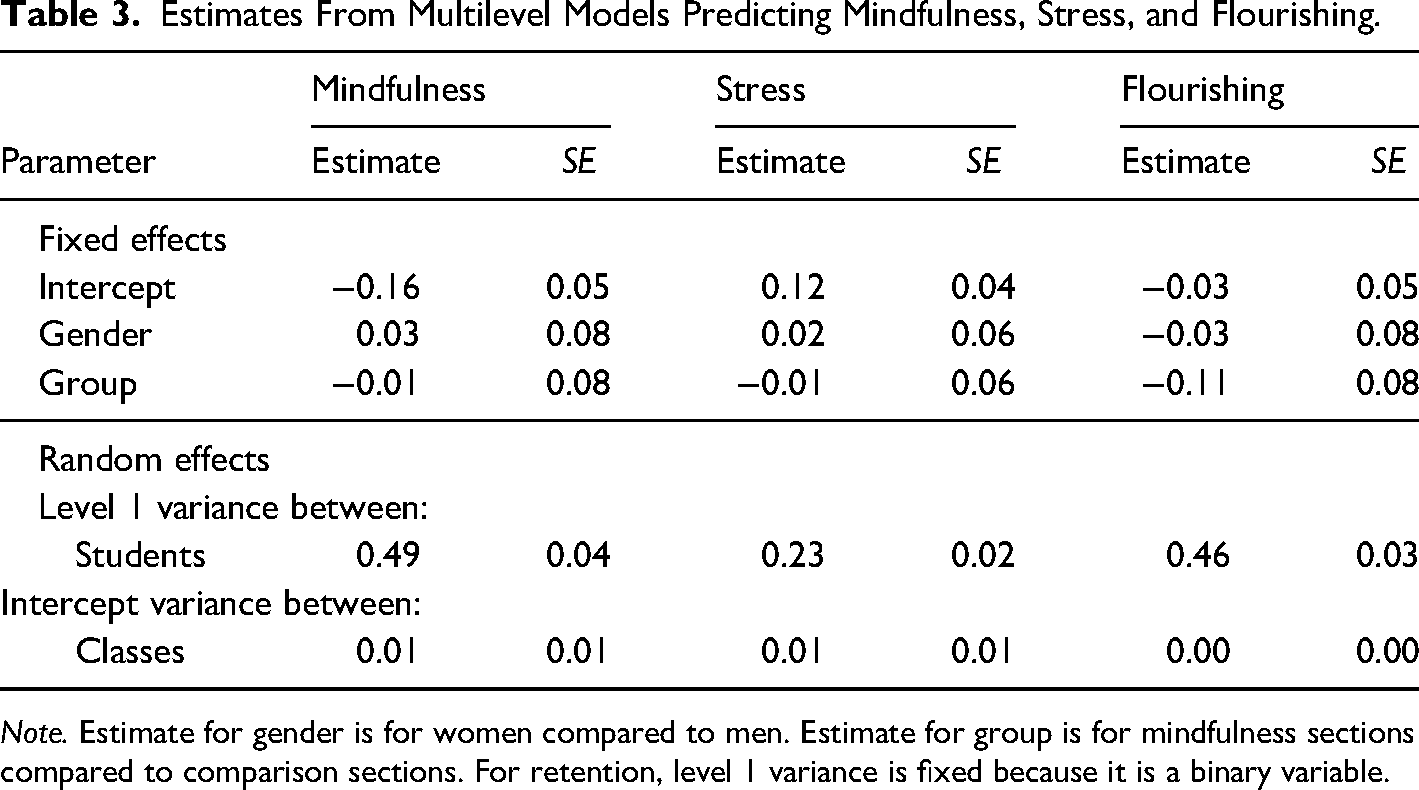
Note. Estimate for gender is for women compared to men. Estimate for group is for mindfulness sections compared to comparison sections. For retention, level 1 variance is fixed because it is a binary variable.
Estimates From Multilevel Models Predicting Grade Point Average and Retention.
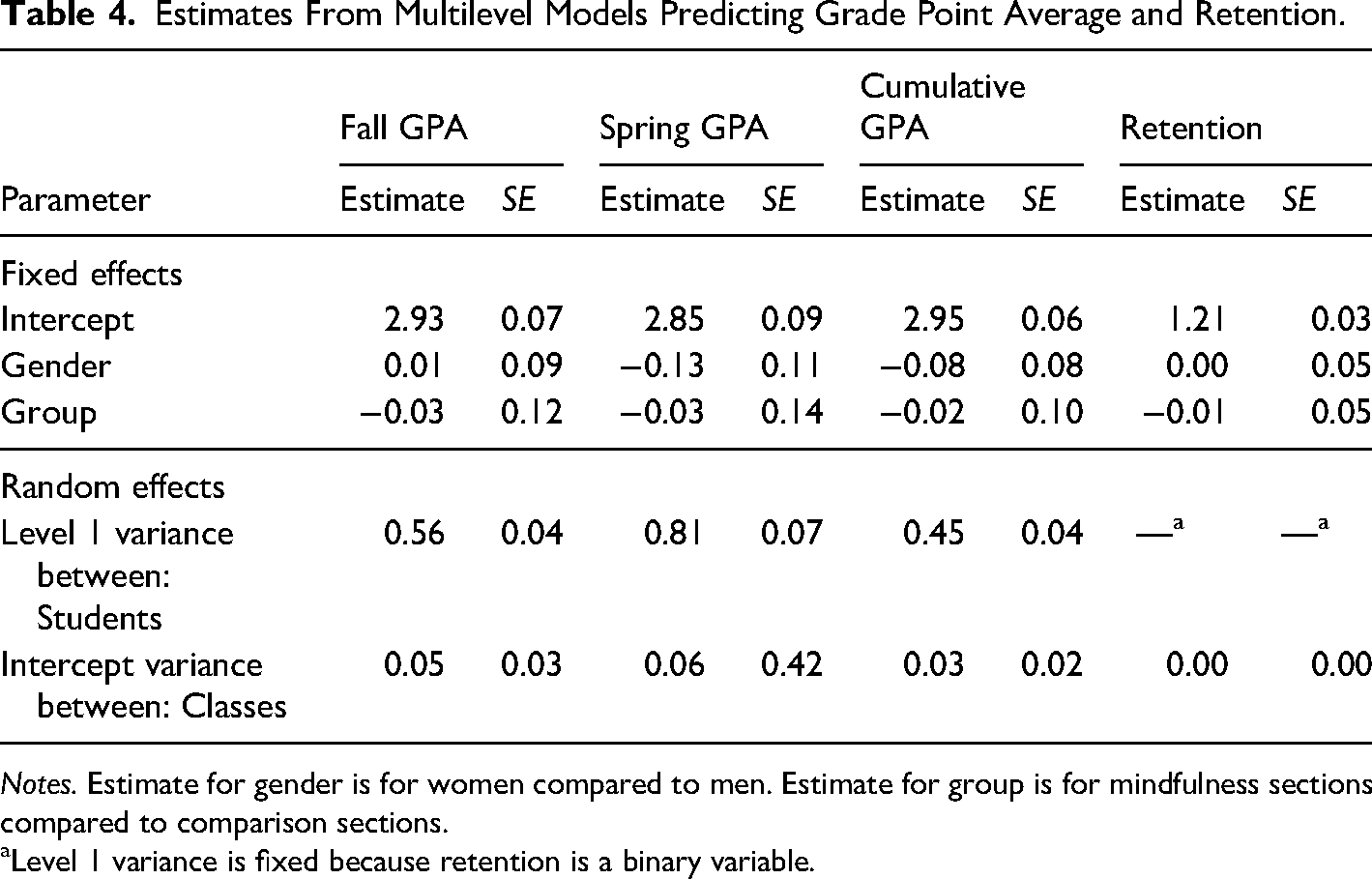
Notes. Estimate for gender is for women compared to men. Estimate for group is for mindfulness sections compared to comparison sections.
Level 1 variance is fixed because retention is a binary variable.
For GPA, which showed variances across the class section level, neither students’ gender nor the mindfulness intervention significantly predicted students’ Fall GPA. Spring GPA was neither predicted by students’ gender nor the mindfulness intervention. Finally, cumulative GPA was neither predicted by students’ gender nor by the mindfulness intervention.
Because the treatment and comparison groups did not differ significantly, the differences between the pretest and the posttest scales were analyzed to see whether (1) the latent variables differed between beginning and end of the semester and (2) whether those differences were significant. The importance of this information, as well as the implications and ideas for future research, are explored in the discussion.
Post-hoc binary logistic regressions tested whether previous findings of GPA's predictive relationship with retention could be replicated (Allen, 1999; Shaw & Mattern, 2013; Westrick et al., 2021). GPA data was collected for Fall 2016, Spring 2017, and cumulatively for the 2016–2017 academic year. Retention was measured by enrollment in the Fall 2017 semester. Results from all three GPA data points significantly predicted Fall 2017 enrollment. First, the Fall 2016 GPA had an odds ratio of 1.80, so the odds of returning for the following Fall semester increased by 1.80 times as GPA increased. The Hosmer and Lemeshow test (x2 = 9.98, df = 8) was not significant (p = .27) and the percentage of correctly classified observations was 79.6; so, fall GPA was a significant predictor of retention (Wald = 14.51, df = 1, p = .00). Second, the Spring 2017 GPA had an odds ratio of 1.91; so, the odds of returning for the following Fall semester increased by 1.91 times as GPA increased. The Hosmer and Lemeshow test (x2 = 13.48, df = 8) was not significant (p = .10) and the percentage of correctly classified observations was 84; so, GPA was a significant predictor of retention (Wald = 20.50, df = 1, p = .00). Finally, the cumulative 2016–2017 GPA had an odds ratio of 1.87, meaning that the odds of returning for the following Fall semester increased by 1.87 times as GPA increased, and the model was significant. The Hosmer and Lemeshow test (x2 = 4.98, df = 8) was not significant (p = .76) and the percentage of correctly classified observations was 84; so, GPA was a significant predictor of retention (Wald = 10.51, df = 1, p = .00).
Discussion
In contrast to results of previous studies, this study—when controlling for class sections and gender—showed no significant differences in mindfulness, stress, flourishing, GPA, and retention between students who received the brief mindfulness intervention and those that did not. Napora (2013) and Shao and Skarlicki (2009) found relationships between mindfulness and GPA. Rosenstreich and Margalit (2015) and Sampl et al. (2017) showed that mindfulness treatments have positive effects on academic achievement. Hanley et al. (2015) found that students with greater mindful awareness had higher academic self-efficacy, which is connected to academic achievement.
There are three possible explanations for the results of this study not showing positive impact that are notable for future research and intervention implementation. First, when comparing the current study's pretest stress levels with the Cohen and Janicki-Deverts (2012) U.S. Census-based stress norms as measured by the PSS-10, the students in the current study had higher levels of stress when compared to the rest of the country. This higher baseline level of stress could explain the lack of response to the intervention. If this sample of students started out more stressed, then they might require more than 2 to 5 min of mindfulness per week to affect change.
Second, instructor levels of mindfulness practice and amounts of previous mindfulness exposure were not collected or measured. Evidence shows that teachers who embody the core elements of mindfulness (i.e., paying attention, on purpose, in the present moment, and non-judgmentally) through intentional self-practice more positively impact outcomes of MBSR and MBCT clients (Crane et al., 2010; Van Aalderen et al., 2014); therefore, not knowing to what extent the instructors in this study were themselves observed as mindfulness practitioners points to another possible reason for the null results. In future studies, then, it is recommended to assess the instructors’ skillset as well as prior experience with mindfulness. Further, teacher training should not only include structured plans for implementing the intervention, as was done in the current study, but also incorporate instructors to build a personal practice. Treatment fidelity will be discussed in the limitations section.
The third and most probable reason for not seeing positive changes in the mindfulness group could be that the dose of mindfulness was too small, providing evidence that a dosing limit exists. According to Voils et al. (2012), “Dosing is potentially the most important decision that must be made when building or refining behavioral interventions” (p. 1225), and it should be operationally defined by duration, frequency, and amount. Before the Voils et al. (2012) study, there was no standardization of dosing terminology or reporting in social science behavioral interventions. Mindfulness research has mixed reports of intervention details in terms of duration, frequency, and amount, making it difficult to replicate studies and to determine the minimum amount of mindfulness training necessary to affect the positive changes often reported.
As is also a problem in social science research, there may be countless mindfulness studies that have been conducted but not reported due to “insignificant” findings, often referred to as the “file-drawer” problem (Creswell & Lindsay, 2014, p. 405; Rosenthal, 1979). The non-publishing of null results not only creates the issue of denying other researchers critical information that could prevent them from making similar “mistakes,” but also in this case it prevents researchers and practitioners from selecting a dosage of mindfulness training that is not associated with change in behavior or cognition. The results of the current study did not reveal significant changes in mindfulness, stress, flourishing, or academic achievement, but in terms of dosage those results may be significant. As stated by previous researchers, dosage of mindfulness training is an area that requires further study (Garland et al., 2016; Lam, 2016).
Implications
In terms of research and practice, this study provides evidence that there is a minimum to the amount of mindfulness practice training that makes it effective. While these results do not confirm what the minimum might be, and while this non-randomized design cannot determine causal relationships, an inference is that training for 2 to 5 min once a week for 10 weeks is not enough mindfulness intervention to see improvements in mindfulness, stress, flourishing, and academic achievement. The Napora (2013) mindfulness intervention ran for 6 min over 15 weeks and showed improvement in GPA; therefore, the authors estimate that the minimum effective intervention exists somewhere in between. A wealth of mindfulness research clearly supports that mindfulness improves all of these outcome areas. The current study suggests that perhaps there is a tipping point as to the amount of training a person receives to observe such improvements.
Another research implication is with regard to the findings of significant differences between the pretest and the posttest latent variables. These findings support other research that shows that many college students struggle emotionally and academically and experience decreased well-being (American College Health Association, 2019; Gallagher, 2014; Morrison & O’Connor, 2005). It is hoped that the current study adds to this literature that calls for more work to be done not just to alleviate students’ stress but also to help them thrive. Further, the current findings show that students who have higher levels of mindfulness and flourishing at the end of their first semester of college and lower levels of stress do better academically, while students who have higher levels of flourishing at the end of their first semester have increased odds of staying in school.
One implication of these findings is support for previous studies that show positive effects of mindfulness and flourishing on grades, while increased stress predicts lower grades. A second implication is to add to the literature the significant predictability that end-of-first-semester flourishing levels have with retention into the following year. Stress, which is negatively correlated with flourishing, did not have a negative predictive relationship with retention, which might be evidence supporting Keyes’ (2002) and Low's (2011) findings of the ability for flourishing and mental illness to coexist in the dual continua model, in which a person can both have depression and be flourishing. While stress and depression are separate constructs, an implication of the current study may be that flourishing and stress can coexist. Further research would need to be done to investigate this notion.
Additionally, previous research reports that students who do better academically and who persist in school have greater resilience (Hartley, 2010) and use more positive coping skills (Pritchard & Wilson, 2003). The current findings may help support these findings, suggesting that those who maintain or improve their levels of mindfulness and flourishing, while keeping their stress levels relatively low, have increased odds of persisting in college. This study's findings also provide evidence that discovering significant relationships between academic achievement and mindfulness, stress, and flourishing may depend on the time of the semester the data is collected. Additional research would need to be done to determine how students fare during various points throughout the semester.
Administrators in higher education have an invested interest in retaining students. Colleges and universities must maintain a minimum number of students to remain financially stable; so, when students leave they must recruit new students. The most cost effective solution is to keep the students who are already attending. This study has several implications that warrant administrators’ attention. The first is the support for students’ psychological well-being, which research shows can be enhanced through mindfulness. The second is support that grades and retention are significantly positively related, meaning that increased grades predict increased retention. The third is support that the outcome variables mindfulness, stress, and flourishing are all significantly correlated with grades; therefore, if grades and retention are strongly connected, administrators should want to do what they can to help students improve their grades. While the current study does not show cause, it does show connection—and there is a significant connection between each posttest outcome variable and grades at each time point. However, it is unknown why all the outcome variables have predictive relationships with grades and only flourishing has a predictive relationship with retention, the relationships are worth noting in relation to retention.
More specifically, this and previous research show that retention and grades are positively correlated with each other (Pritchard & Wilson, 2003), that grades are positively correlated with mindfulness (Rosenstreich & Margalit, 2015) and flourishing (Datu, 2016), and that grades are negatively correlated with stress (Sohail, 2013). The implication for higher education administrators, then, is to focus programming on increasing students’ mindfulness and flourishing levels and decreasing their stress levels in the hopes that students can improve or maintain their GPA and remain in school.
While the current study does not provide evidential support to past mindfulness studies’ findings that mindfulness training often results in positive outcomes, the review of the literature and this study's list of limitations still offer support for higher education administrators to consider implementing mindfulness programs at their institutions. Although the current study's mindfulness intervention dosages were likely too small, many others have shown positive effects in educational settings; therefore, it is recommended that institutions of higher education offer mindfulness or mindfulness-related programs to better support their students’ psychological well-being and academic achievement.
The findings that student well-being decreases significantly at the end of the first semester and that stress increases not only support the well-accepted knowledge that college is stressful (Morrison & O’Connor, 2005), but it also supports the need for higher education administrators to address the issue that many students struggle psychologically during their first semester of college and need more resources than campuses are currently equipped to provide (American College Health Association, 2019). Because college and university counseling centers are overwhelmed, understaffed, and under resourced (Gallagher, 2014), administrators can offer programming to a greater number of students to offset their stress and increase their well-being. Programming options include mindfulness workshops and incorporating mindfulness training into class time.
Student affairs professionals and faculty are the individuals who often work most closely with students; so, they can benefit from the current study as well, particularly because they are the ones who would be conducting the mindfulness workshops or incorporating a practice into their classes. One of the most important takeaways for these two groups is dosage of the intervention. Should an instructor decide to teach their class mindfulness, they should be aware that fewer than 6 min once a week might not be enough for observable benefits in terms of mindfulness, stress, flourishing, or academic achievement. Student affairs professionals who decide to run mindfulness training workshops that are separate from in-class versions may want to choose a version with well documented research supporting its effectiveness, like MBSR. Workshops generally run for 8 weeks with one 2-hr meeting per week.
Limitations
This study does have limitations. The non-randomized selection for both instructors and students may have presented a problem. Participants chose which section of the class to take based on time and instructor; therefore, they could not be randomly assigned to groups and the groups were considered nonequivalent even though the group not receiving the intervention was used as the control group (Goodwin, 1998). Further, instructors chose whether or not to incorporate the intervention into their classes. Instructors may have volunteered because they already practice mindfulness or they may have felt coerced, believing that not participating would negatively impact their performance evaluations—regardless of being told it would not. Although the intra-class correlation across class sections may have accounted for error variances, the non-randomization of instructors still might have been an issue. Future studies should replicate this study using a randomized controlled design for both instructors and students.
It is possible that design contamination impacted the results. First, students in the comparison group received the same pretest and posttest as the students in the mindfulness group received. The pretest asked questions such as “Have you ever participated in mindfulness exercises,” which could have informed students in the comparison section that they may not be receiving a particular treatment that another group was receiving. While it also asked questions such as, “How often do you participate in prayer,” it asked several other questions about prior experience with mindfulness. Future studies that gather similar data should consider replacing such questions to conceal an obvious focus on mindfulness. Students who discover that they are not receiving the treatment may become resentful, a feeling that could impact their assessment responses. An additional design contamination possibility happened when one of the instructors mentioned to the class in her introduction of the posttest assessment administrator that they were part of the study but not receiving the mindfulness treatment. A recommendation for future intervention studies would be to include training for the comparison group instructors, too, so that they are instructed not to divulge to their classes that they are in the comparison group.
Instrumentation is another potential limitation to this study. Even though the eight research team members who administered the informed consent forms and the assessments received written and oral training, ensuring uniformity of the administrations was not possible. At least one class received more information than the other sections because the research team member answered a student's question. There were probably more instances like this that were not accounted for. Further, each team member had their own style of presenting; so, students may have reacted differently to someone who was more energetic and friendly than to someone who simply read the instructions with a more subdued tone. There were too many sections of the classes that met at the same time; so, having all eight administrators was necessary; however, additional training on making the administrations more uniform would be recommended for future studies, as well as having the administrators report any instances that made particular administrations different.
Treatment fidelity may have been the limitation that most impacted the integrity of the study. While easily controlled in a laboratory setting, the treatment dosage and implementation becomes more difficult in educational settings because non-researchers are usually the ones who implement it. As stated by Hulleman and Cordray (2009), “Teachers may alter portions of the curriculum to better match their students’ needs and therefore enhance its effectiveness, or they may change portions that require too much advanced preparation and therefore undermine its effectiveness” (p. 89). The instructors of this study's mindfulness sections attended a training session prior to the start of the semester, and they completed a survey at the conclusion of the semester that asked how often they played the mindfulness recordings to their classes. They were instructed to read a statement before every exercise that reminded students of the purpose of mindfulness, the recommended posture, and the required silence throughout the exercises so those who wanted to participate could do so without interruption; however, it was unknown as to whether and to what extent they altered the statement and whether they truly did play the recordings each week. It was also unknown the extent to which they practiced mindfulness themselves and whether they believed it to be an effective practice for the students to learn. Including personal questions in the instructor survey would have made them participants, which was beyond the purview of this study. However, looking at the instructors’ experiences is an important area for future research. Studies that look at teachers’ experiences of running mindfulness in the classroom focus on the K-12 level (e.g. Black & Fernando, 2014; Waters et al., 2015). Future researchers could investigate the experiences college instructors have with running mindfulness activities in their classroom. It would be particularly interesting to see if beginning classes with mindfulness, which has been shown to improve children's attention and teacher's job satisfaction due to the improved classroom behavior (Black & Fernando, 2014), also improves student attention and instructor satisfaction at the college level, especially when upwards of 90% of students are distracted by their digital devices (McCoy, 2013).
Finally, history could have played a major role in impacting the results of this study. The data were collected in the Fall 2016 semester, when tensions were high over the presidential election. The posttest was collected during the twelfth week of the semester, which was 1 to 2 weeks after the election (Monday classes were a week behind the others due to the Labor Day holiday). High anxiety has been shown to reduce mindfulness meditation participation (Gutierrez et al., 2020). While Gutierrez et al. (2020) studied adherence to an online mindfulness program, the distress of the election to this particular body of students may have overwhelmed their ability to benefit from the intervention. This university is a diverse institution, with many students belonging to one or more minority groups. Gonzalez et al. (2018) found that their minority group of lesbian, gay, bisexual and transgender students was significantly more stressed following the 2016 election, due to discriminatory campaigns and lack of reconciliatory messages afterwards. It is possible that the students at the current study's university felt the same way. This stress may have overridden the impact of the brief mindfulness intervention by increasing students’ stress levels, thereby negatively affecting their mindfulness and flourishing levels.
Given the limitations of the study, particularly dosage, treatment fidelity, sample size, and design contamination, future researchers should repeat the study to better control for these issues. For example, a future study could include a treatment group that receives more of the intervention in order to test the duration, frequency, and amount of the mindfulness training to contribute more literature on treatment dosage. Students could receive the same 2 to 5 min of mindfulness training at the beginning of class, but at the beginning of a class that meets 2 or 3 times a week instead of 1. Alternatively, the students could receive 10 minutes of mindfulness training at the beginning of class once a week, thereby simply increasing by several minutes the current study's intervention. It is recommended that only one of these factors change at a time or that multiple treatment groups are used so that the roles of duration, frequency, and amount are distinguishable.
Conclusion
The purpose of this study was to investigate the relationships among a mindfulness intervention with first-year college students and their levels of mindfulness, stress, flourishing, and academic achievement in terms of GPA and retention. Contrary to the many published findings on mindfulness, no significant differences between the mindfulness and comparison groups were found. While surprising, it leads one to question the number of other “insignificant” findings that may have fallen victim to the “file-drawer” problem.
While the data analyses were statistically insignificant, the findings are significant in terms of their contribution to the literature. Most critically, they show that a 2- to 5-min session once a week for 10 weeks may not be enough mindfulness exposure to influence statistically significant differences between those who receive the treatment and those who do not. A replication study that addresses the mentioned limitations would be necessary to see whether the dosage was too low or if the limitations were too problematic.
Future research should also be conducted not only to replicate this study with fewer of the aforementioned limitations, but also to see whether more robust mindfulness interventions can make the difference in students’ mindfulness levels, stress levels, flourishing levels, and academic achievement in terms of GPA and retention.
Footnotes
Declaration of Conflicting Interests
The authors declared no potential conflicts of interest with respect to the research, authorship, and/or publication of this article.
Funding
The authors received no financial support for the research, authorship and/or publication of this article.
