




Abstract
Resilience is of utmost importance for first-year undergraduate students to persist and flourish throughout the course of their studies. The researchers explored the comparative and simultaneous effect of two factors, i.e., emotional intelligence (EI) and critical thinking (CT) disposition in predicting the resilience of first-year undergraduate students. A total of 490 participants from the state of West Bengal (eastern part of India) filled out a self-report questionnaire comprising the Connor–Davidson Resilience Scale, a profile for emotional competency, and CT disposition assessment (EMI). Pearson correlation and multiple regression analysis reported that resilience was positively correlated with EI and CT disposition. Further, both EI and CT disposition had unique as well as shared contributions in explaining resilience and the outcome was in favor of EI being the stronger predictor. The study suggests that college authorities and counselors should undertake efficacious support initiatives to foster resilience in students.
Keywords
Introduction
The transition to higher education, i.e., from school to college or university, is one of the most vital crossroads and stressful adjustment phases (Aderi et al., 2013; Kahn, 2016) in the lives of students. Despite their misgivings and nervousness about the new social and academic environment, students get admitted to college or university with aspirations for success in education and employment and prosperous future life (Pillai & Joseph, 2016). Researchers have revealed that a college degree is connected to social and economic outcomes such as financial success, well-being, family stability, and social association (Haktanir et al., 2021; Haut, 2012). Despite the high enrolment rate in higher education globally (215.9 million students) (Calderon, 2018) students are dropping out before completion of their program (Bustamante, 2019; Kim, 2019). The challenge seems to be common, whether in a developed country such as the U.S.A. or in a developing country such as India (Bustamante, 2019; Jain, 2017). For instance, in the U.S.A., 40% of all undergraduate students left college before program completion (Bustamante, 2019). Jain (2017) reported that 75% of Indian students drop out within the first two years of enrolment, well before three years of program completion. All-India Survey on Higher Education reported that out of the 18.4 million enrolled for the three years undergraduate program (Govt. of India [GOI], 2017) only 4.45 million finally completed and received graduate degrees in the session 2018–19 (GOI, 2019), revealing that a large number of students left studies before program completion.
Researchers reported that maladjustment, anxiety, and stressful events in the academic transition phase play triggering roles in student dropout (e.g., Nordstrom et al., 2014; Tinto, 1996). Shadowen et al. (2019) reported that among international undergraduate students (including those from South & Southeast, Central Asia, Europe, and North America) 62.3% experienced depression while 43.2% demonstrated anxiety symptoms. Rout (2015) mentioned in his study that the failure to cope with an institutional environment and its process of teaching–learning is one of the most crucial determinants in dropping out of Indian higher studies. Researchers found that 72%, 56%, and 52% of Indian first-year general undergraduate students experienced higher levels of academic, social, and emotional adjustment difficulties, respectively (Sharma, 2012) and also, 74% to 85% of first-year undergraduate students in India were reported to experience uncontrollable and unpredictable stress (Daisy, 2012; George & Joseph, 2018; Reddy et al., 2015). Empirical researchers have explained that resilience played a significant role in college retention, academic persistence (Eisenberg et al., 2016; Hartley, 2010, 2011; Shaw, 2018), and mental well-being of the undergraduate students (Galante et al., 2018; Houston et al., 2017; Tan et al., 2021). They agreed that resilient students experience few adjustment difficulties, resulting in few stress-related issues which in turn increase persistence in their course completion.
Resilience is a measure of successful “stress-coping ability,” which enables individuals to flourish in adversities (Connor et al., 2003), is not merely an innate ability (Albuquerque et al., 2015), rather, can be learned and is an achievable trait (Masten, 2001). In the resilience process, protective factors interact with chronic or acute risk factors, resulting in positive outcomes (Condly, 2006), and these risk and protective factors may occur at individual, family, or community levels and may be situational or ongoing (Coyle, 2011). For example, youth at risk of social exclusion with self-regulatory competence appeared to be confident, well-adjusted, tenacious, and capable of tolerating unpleasant situations (i.e., resilience) (Artuch-Garde et al., 2017).
Researchers revealed that higher resilience resulted in reductions in adjustment difficulties, depression, and less suicidal ideation among undergraduate students (e.g., Kahn, 2016; Kamble, 2015; Tan et al., 2021). Undergraduate resilient students experience positive emotions (Fredrickson, 2001), and can cope with stress in a positive manner (Somaiya et al., 2015), allowing them to use adaptive coping techniques (Sonika & Kumar, 2019). Further, resilience helps the first-year undergraduate students in college adjustment (Haktanir et al., 2021), boosts academic achievement (Galante et al., 2018), and improves college persistence (Shaw, 2018). Acknowledging such therapeutic effects of resilience, increased attention has been given to the identification of possible factors to boost the resilience of college students (Argyros & Johnson, 2018).
In the quest to understand what makes students resilient, researchers identified different individual characteristics, i.e., internal factors such as cognitive intelligence (Jowkar, 2007), self-regulation (Artuch-Garde et al., 2017), self-efficacy (Ngui & Lay, 2017), emotional intelligence (EI) (Trigueros et al., 2020), spiritual intelligence (Salmabadi et al., 2016), and optimism (Himmel, 2015). A major part of the research indicated EI, as an internal personal quality, as one of the prerequisites for resilience (e.g., Armstrong et al., 2011; Matthews et al., 2002; Trigueros et al., 2020). Sarrionandia et al. (2018) concluded that undergraduate students with higher EI levels possessed higher resilience. Moreover, EI is a stronger predictor in comparison to general intelligence (Jowkar, 2007) and spiritual intelligence (Keshavarzi & Yousefi, 2012). Although critical thinking (CT), as another personal factor, fosters resilience (Benítez & Canales, 2013), research in this area is sparse. Hence, the present study intends to explore the effectiveness of CT on resilience.
EI is related to affective skills, and CT disposition is related to cognitive skills. EI had a predominant effect on resilience, irrespective of population and culture (e.g., Armstrong et al., 2011; Magnano et al., 2016; Sharma, 2014). Further, EI has been found to be positively associated with CT disposition (e.g., Arslan & Kayıhan, 2020; Kang, 2015; Sk & Halder, 2020). Therefore, EI along with CT disposition may result in better outcomes in predicting resilience. However, the literature is yet to integrate EI and CT disposition simultaneously in the protective model of resilience. Such simultaneous integration of both protective factors may address the existing gap in resilience research particularly for first-year students. Furthermore, earlier, EI was found to be a better factor in comparison to cognitive intelligence (Jowkar, 2007) and spiritual intelligence (Keshavarzi & Yousefi, 2012); however, whether EI will have a more pronouncing effect on resilience than CT disposition will be significant to know. Therefore, in the present study, researchers intend to explore the comparative and simultaneous effectiveness of EI and CT disposition as predictive factors of resilience of first-year college students. Present research would contribute to a better understanding of resilience of the first-year students in relation to their EI and CT disposition.
The present study focused on first-year students in transition to higher education phase because during this period they experience various psychosocial stressful challenges such as building a relationship, adjusting to the new environment, etc. Pitt et al. (2018) marked the first semester as the riskiest period for students, with the highest occurrence of negative stress-related consequences. Their struggle in India seems to be relatively more voluminous than the final-year students (Ramteke & Ansari, 2016). World Bank reported that, in terms of the volume of students, the Indian higher education segment is the third-largest in the world, after China and the U.S.A. (Sheikh, 2017). The majority of Indian students (66%–68%) secured admission in general undergraduate level programs, i.e., Bachelor of Arts (B.A.), Bachelor of Sciences (B.Sc.), and Bachelor of Commerce (B.Com.) in the past three consecutive years (GOI, 2017, 2018, 2019). Further, Indian first-year students reported lower levels of resilience (Stanley & Bhuvaneswari, 2015), which is of concern. Hence, the present study considered a sample of Indian first-year general stream students to study resilience.
Emotional Intelligence
EI is the processing of emotional information in such a way that enables an individual to perceive, understand, use, and regulate emotions for oneself and others (Mayer & Salovey, 1997). There are two distinct concepts of EI: ability EI, measuring maximum performance, and trait EI, measuring emotion-related behavior (Petrides, 2011). The focus here is not on what people know or can do, rather on what they typically do, given that operationalization, ability EI is problematic due to the subjectivity of emotional experience (e.g., Petrides, 2011). The theory of trait EI provides an operationalization that recognizes the inherent subjectivity of emotional experience (Petrides, 2011). An emotionally intelligent person has an optimistic perspective in which they evaluate stressful situations in a positive way (Akbari & Khormaiee, 2015). Their ability to perceive, manage, regulate, and control emotional acts such as protective factors against adversities (Foumany & Salehi, 2015) allows them to adapt and cope better with a stressful situation (Magnano et al., 2016). Hence, EI seems to appear as a significant factor of individual resiliency. Compelling evidence revealed the association between EI and resilience, indicating that the former affects the latter (e.g., Armstrong et al., 2011; Fabio & Saklofske, 2018; Fong-Hong, 2019; Magnano et al., 2016). In India, studies on school adolescents (Choudhary, 2019; Sharma, 2014), corporate executives (Ravikumar & Dhamodharan, 2014), flood victims (Habib, 2017), medical interns (Shukla et al., 2020), and cancer patients (Kunte, 2014) found a substantial association between the said variables. However, there are limited studies to evaluate EI as a factor of resilience of first-year undergraduate students and moreover, the Indian educational context was far overlooked, and hence the present research intends to fill this gap. First-year students who experience increased academic pressure and decreased social support (Himmel, 2015; Sun & Hui, 2012) experience considerable adversities, maladjustment indications, increased stress, and depression (Gupta et al., 2014; Sharma, 2012), which are negatively associated with resilience. However, the factors of EI; interpersonal and intrapersonal emotional competencies (ECs) support the development of resilient characteristics among the first-year students (Lopes et al., 2003, 2004). Further, researchers empirically reported its importance in persistence of college students (e.g., Willis, 2014). Hence, EI is considered in the present study in association with resilience of the first-year students.
Critical Thinking
CT is a purposeful, self-regulatory judgmental skill (Facione, 1990). Along with skills, CT also involves dispositions, a set of habits of mind that reflect one’s disposition for CT. Ideal critical thinkers are curious, truth-seekers, inquisitive, well-informed, focused and persistent in investigation, open and broad-minded to criticism, flexible, honest in the face of personal bias, and prudent in judgments (Facione, 1990). A person demonstrating CT skill can be substantiated and therefore disposed to using the skill (Facione et al., 2000). Behavioral disposition of CT was considered as the gateway through which one allows the mind to engage in CT activity (Irani et al., 2007).
Researchers reported that undergraduate students possess moderate (Khandaghi et al., 2011) to low levels of CT disposition (Broadbear et al., 2005). Students with CT dispositions perform better in problem-based learning (Pu et al., 2019) that significantly impacts the academic success of first-year college students (Stupnisky et al., 2008). Further, CT disposition was found to be a significant predictor of academic persistence in college (Chatzinikolaou & Tsirides, 2020) that is positively related to self-esteem (Abasi et al., 2013; Pilevarzadeh et al., 2014) and self-efficacy (Kim et al., 2015). Researchers pointed that self-esteem and self-efficacy affect resilience of the undergraduate students (Wen et al., 2020). Empirically CT skills are found to have a significant impact on resilience (Benítez & Canales, 2013; Kamali & Fahim, 2011). However, the association between trait orientation or personality characteristic of resiliency (Connor et al., 2003) and CT disposition of first-year undergraduate students remain unexplained; therefore, CT disposition has been included in the study to fill the gap in the literature.
Present Study
Existing literature has supported the importance of resilience in retention, especially for first-year undergraduate students. They experience higher stress levels, adjustment difficulties, and other relational problems compared to sophomore or final-year students (Ramteke & Ansari, 2016; Sharma, 2012). The researchers of this study decided to further explore the probable factors promoting resilience of the particular population of first-year undergraduate students. Further, on the basis of literature, the researchers identified EI and CT disposition as the probable predictive factors of resilience. Therefore, the study may contribute to the existing literature by exploring more effective intrinsic factors of resilience of the first-year students.
Empirical evidence found that demographic factors such as gender and socioeconomic status (SES) have favorable and as well as a nonsignificant effect on resilience (e.g., Conger et al., 2010; Coşkun et al., 2014; Erdogana et al., 2015; Karataş et al., 2016; Machuca, 2010; Somaiya et al., 2015). Participants’ demographic characteristics may mislead the independent effect of EI and CT disposition on resilience. Therefore, controlling for the effect of gender and SES in the present study may provide a more precise idea of how EI and CT disposition uniquely and simultaneously predict the resilience of first-year students. To address these concerns, the researchers identified two research questions:
How are independent variables (IVs), i.e., EI and CT disposition, associated with dependent variables (DVs), i.e., resilience? How much predictive power do EI and CT disposition account for in predicting resilience after controlling demographic factors (i.e., gender and SES)?
Method
Participants
The current research was conducted in three districts of West Bengal (i.e., Kolkata, South 24 Parganas, and North 24 Parganas). The inclusion criteria for selection of the sample were students from (a) general academic streams (B.A./B.Sc./B.Com.), (b) first-year college students, and (c) public (government) institutions. A total of 500 undergraduate first-year students were selected from 11 undergraduate colleges and two undergraduate sections of the state university. About 28.3458 million students enrolled in a general degree program in the session 2016–2017. Yamane’s formula (1967) (n = N/1 + N[e2] = 28,345,800/1 + 28,345,800 [.052] = 399.99 = 400; N = total population) was applied to determine the required sample size; this indicated a requirement of 400 students for proper representation of the population of first-year undergraduate students. To achieve a higher level of precision, the number of participants was increased to 500. After detecting the outliers, 10 participants were excluded; subsequently, 490 first
Measures
Participants were asked to complete a questionnaire comprising demographic data that included age, gender, academic stream, parental income, and education. To measure the main variables, three adapted scales were used. With permission from the developer, the measuring scales were translated into the regional/local Bengali language. Blind back translation was done from English to Bengali and from Bengali to English by native speakers. The final version has been finalized based on interrater consensus on conceptual similarities of the original English and translated Bengali versions. Cross-cultural validation has been done for the instruments. The tools were administered on 100 targeted population and standardization of measures were calculated. An acceptable range of reliability and validity of the scales were reported.
Connor–Davidson Resilience Scale (2003)
Connor–Davidson Resilience Scale-25 (CD-RISC-25, 2003) measures of inability to cope with stress and adversity were used to measure resilience in the present study. Participants rate the items on a scale from 0 (“not true at all”) to 4 (“true nearly all of the time”). The score range is 0–100 and a higher score implies higher resilience. The scale had five factors: (1) personal competence, high standards, and tenacity; (2) trust in one’s instincts, tolerance of negative affect, and strengthening effects of stress; (3) positive acceptance of change and secure relationships; (4) control; and (5) spiritual influences. The reliability of the original full scale was 0.89 and an item-total correlation ranged from 0.30 to 0.70. Recent studies also reported a higher Cronbach’s alpha of .92 and .86 (Hébert et al., 2018; Tsigkaropoulou et al., 2018).
In the present study, Cronbach’s alpha for the adopted CD-RISC scale was .81 and item-total correlations ranged from 0.20 to 0.65.
The Profile of Emotional Competence (2013)
The Profile of Emotional Competence (PEC) was developed by Brasseur et al. (2013) to measure EI in terms of intra- and interpersonal ECs, i.e., identification, understanding, expression/listening, regulation, and use of emotions of self and others. The scale contained 50 items with a five-point rating scale, from “strongly agree” (5) to “strongly disagree” (1). The scale indicated good internal consistency of the subscales (0.60 to 0.83) and factors (0.84) and the total score (0.88). The reliability of the intrapersonal EC score was 0.86 and that of the interpersonal EC score was 0.89, while the total EI score was 0.92. Campo et al. (2019) reported identical internal consistency for the subscales (0.86) and as well as total PEC (0.86) displaying satisfactory discriminant validity (Brasseur et al., 2013).
The item-total correlations of the PEC scale ranged from 0.20 to 0.55, while Cronbach’s alpha was .84. One item each from the PEC was deleted for low validity with dimension total and total scores. To the best of the researchers’ knowledge, the present study is the first research endeavor where PEC is used for first-year undergraduate students.
Critical Thinking Disposition Assessment (EMI, 2005)
The scale EMI, developed by Ricketts and Rudd (EMI, 2005), comprised of 26 items with three constructs, namely, (1) engagement, (2) cognitive maturity, and (3) innovativeness, derived primarily from Facione’s original Delphi study, the California Critical Thinking Disposition Assessment (CCTDI, 1990). The scale is also termed as UF-EMI (University of Florida-Engagement, Cognitive Maturity, and Innovativeness Assessment). The scale is measured on a five-point Likert type scale; “strongly agree” to “strongly disagree.” Reliability estimates for original EMI were 0.91 for engagement, 0.79 for maturity, and 0.80 for innovativeness, while the total was 0.94. The subsequent researcher also reported a higher reliability of 0.88 for overall EMI; 0.90 for engagement, 0.81 for maturity, and 0.84 for innovativeness dimension (Coskun & Altinkurt, 2016).
The item-total correlation range of the EMI scale was 0.25–0.71 and Cronbach’s alpha was .84. EMI has been used extensively in higher education samples (e.g., Arslan & Kayıhan, 2020; Lamm et al., 2011; Ricketts & Rudd, 2004).
Procedure
Undergraduate colleges and sections of the state university, who consented to participate, were selected for the study. After describing the purpose and confidentiality issues consent forms attached to the main questionnaire were given to the students. The respondents who signed the consent form completed the survey in classroom settings. Data were collected from February 2017 to May 2017.
Data Analysis
Statistical Power
A priori power analysis was conducted using G*Power 3.1 software (Faul et al., 2007) with a moderate effect size of 0.15 (f2 = 0.15), alpha .05 (α = .05), power 0.80 level, and two predictors. The statistical test was “linear multiple regression fixed model, R2 deviate from 0.” In the analysis, 68 participants were recommended. In our study, 490 participants were included, implying a sufficient sample size and power to explain the regression model.
Normality of Data
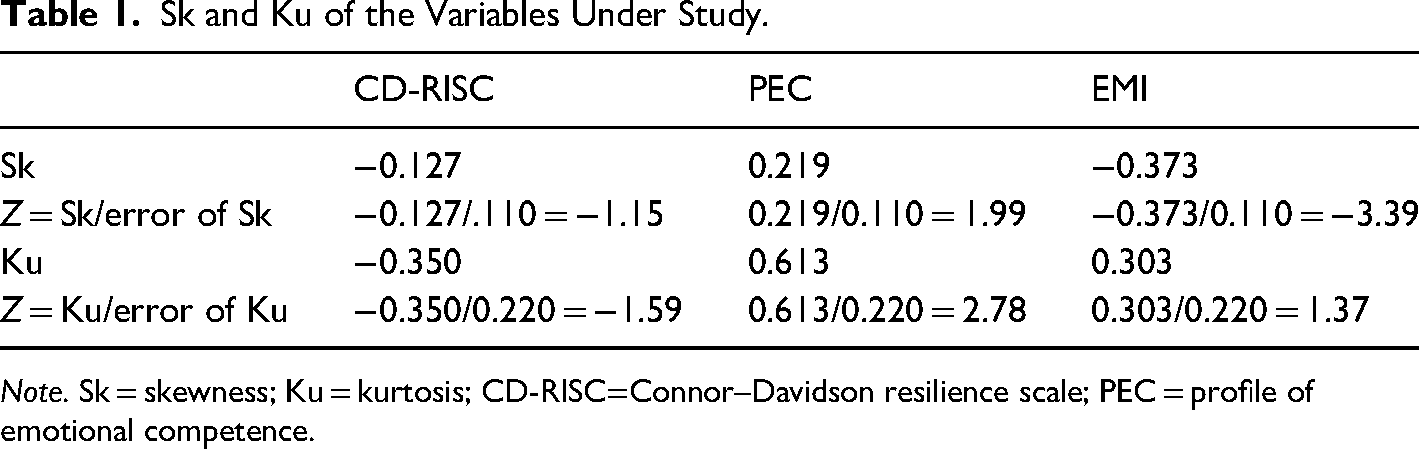
In the study, normality was ensured by skewness (Sk) and kurtosis (Ku) (Table 1). Sk was −0.127, 0.219, and −0.373 with Ku of −0.305, 0.613, and −0.382 for CD-RISC, PEC, and EMI, respectively, which are accepted according to Kline (1998) (sk < 3, ku < 10) (Evrekli et al., 2010, p. 191; West et al., 1995) (sk < 2, ku < 7).
Sk and Ku of the Variables Under Study.
Note. Sk = skewness; Ku = kurtosis; CD-RISC=Connor–Davidson resilience scale; PEC = profile of emotional competence.
With respect to z score (absolute standard error of Sk or Ku [Sk or Ku/SE]) (Table 1), for CD-RISC Sk was −1.15 and Ku was 1.39, both were within ±1.96 limits, suggesting that the CD-RISC score is likely to be normally distributed (Kim, 2013). The z score of PEC was 1.99 for Sk and 2.78 for Ku, both within ±3.29, suggesting that the PEC score is likely to be normally distributed (Kim, 2013). For EMI distribution, z score was −3.39 for Sk and 1.37 for Ku, implying minor variation from ±3.29 for only Sk. Hence study data may be considered as a relatively normal distribution as per the absolute Sk value (Kim, 2013).
Homoscedasticity and Multicollinearity
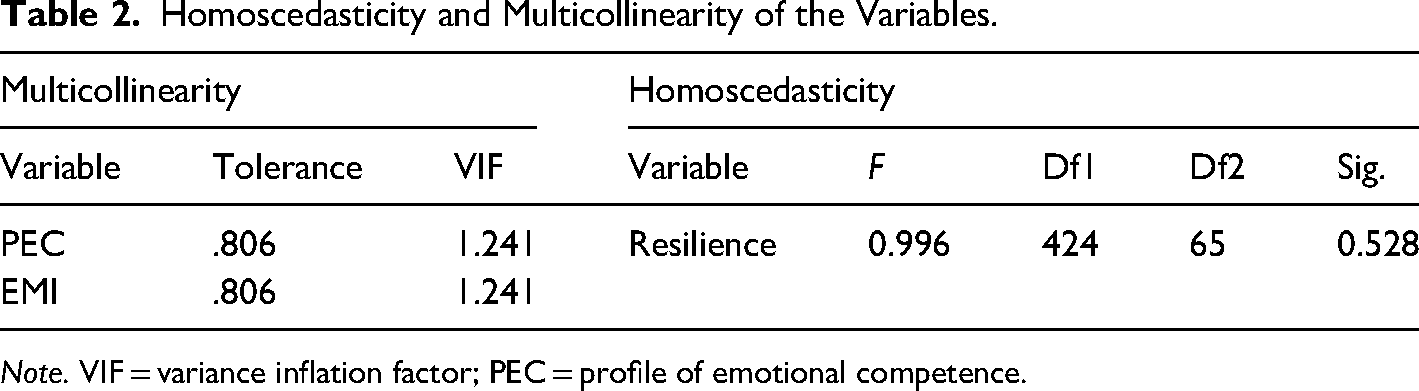
The nonsignificant result of Levene’s test of equality of variance (Table 2) ensured that variance among these variables was homogeneous. Further, the variance inflation factor (VIF) of predictors was <4.0 (VIF <4.0) and with tolerance above 0.2 (>0.2), no multicollinearity (Table 2) among predictors was ensured (Hair et al., 2010).
Homoscedasticity and Multicollinearity of the Variables.
Note. VIF = variance inflation factor; PEC = profile of emotional competence.
Correlation and Regression Analysis
SPSS (version 14.0) was used for all statistical analyses. Pearson’s correlation results showed the association among the study variables. Hierarchical multiple linear regression (entry method) was conducted to evaluate the comparative and simultaneous effects of EI and CT disposition on resilience while controlling demographic variables. The entry method was applied due to the uncertainty about the best predictor among predictors. LibreOffice was used to depict the correlation and regression path model.
Control Variable
Researchers used gender and SES as control variables. Gender was dummy coded as “1” for male and “0” for female. Three levels of SES (low, moderate, and high) were dummy coded as “1” for low and “0” for others (moderate and high); “1” for moderate and “0” for others (i.e., low and high); further “1” for high and “0” for others.
Results
Descriptive Analysis
Descriptive analysis showed that most (over 50%) first-year undergraduate students possess below-average resilience (M > Mdn) and EI (M > Mdn) and above-average CT disposition (M < Mdn).
Research Question 1
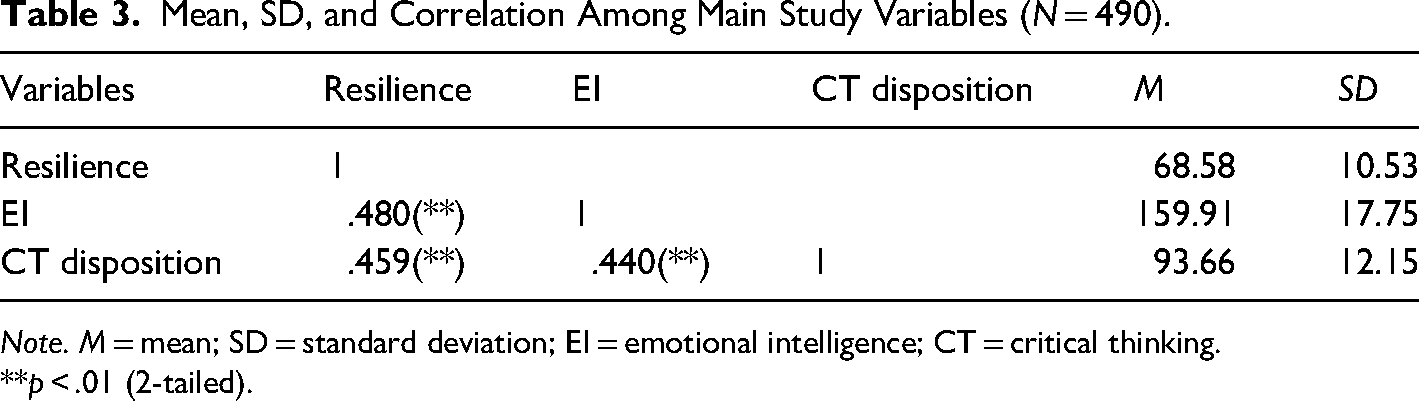
For the first question, Pearson’s bivariate correlation (Table 3) was applied and showed that resilience was significantly associated with EI (r = 0.480, p < .01) and CT disposition (r = 0.459, p < .01), indicating a moderate level effect size (r = 0.3–0.5) in the correlation between DVs and IVs (Cohen, 1992). Further, two IVs were also significantly correlated (r = 0.44, p < .01) with a moderate effect size.
Mean, SD, and Correlation Among Main Study Variables (N = 490).
Note. M = mean; SD = standard deviation; EI = emotional intelligence; CT = critical thinking.
**p < .01 (2-tailed).
Research Question 2
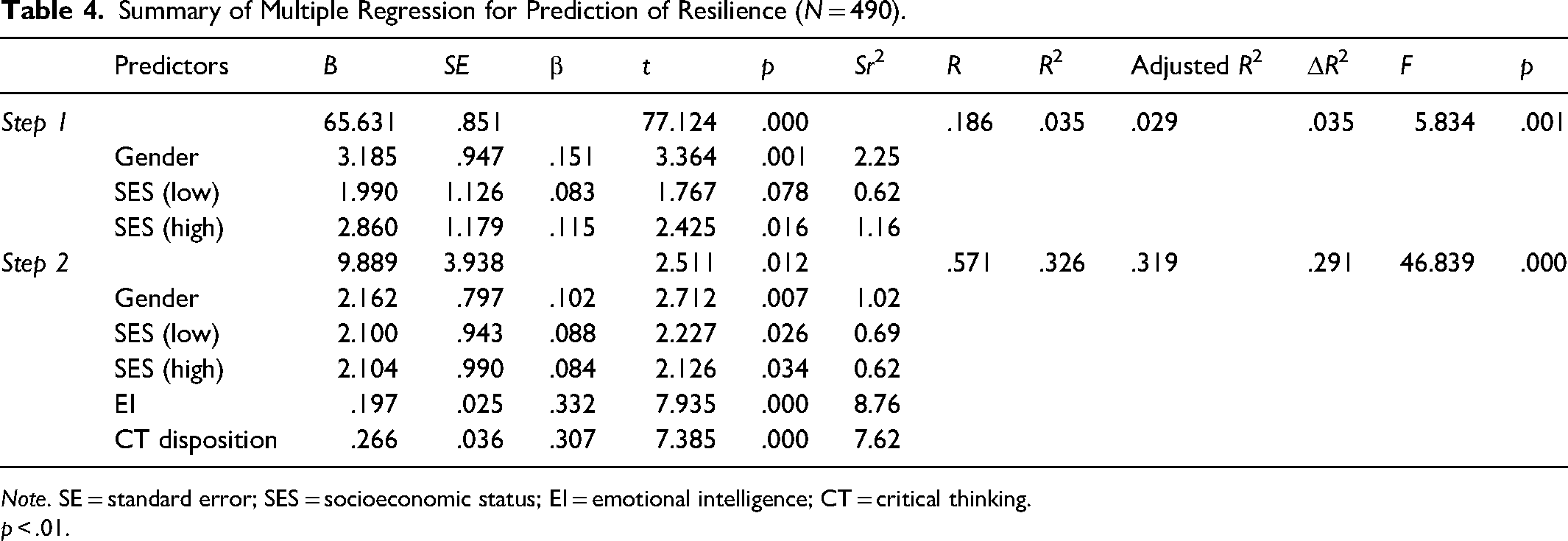
As pointed earlier, hierarchical multiple regression was followed to examine the second research question (Table 4). To control for the effect of demographic variables in the effect of main IVs on resilience, researchers entered gender and SES in the first step (block 1) and EI and CT disposition (i.e., main IVs) were entered in the next step (block 2) using a forced entry method.
Summary of Multiple Regression for Prediction of Resilience (N = 490).
Note. SE = standard error; SES = socioeconomic status; EI = emotional intelligence; CT = critical thinking.
p < .01.
A multiple regression analysis revealed (Table 4) in the first step that though control variables had a significant relation with resilience (R = .18, p < .01), a negligible variance, R2 =.035, F(3,486) = 5.834, p < .01) was accounted for gender and SES. When EI and CT disposition were added in the second step, R2 value increased to .326 (R2 = .326) implying that overall variance in resilience was significantly increased to 32.6%, F(5,484) = 46.839, p < .001), and the change in R2 value was .291 (ΔR2 = .291), which was significant, ΔF(2, 484) = 104.614, p < .001. Therefore, 29.1% of the variance in resilience was accounted for main IVs, i.e., EI and CT disposition, indicating medium effect size (Cohen, 1992). Individually, EI had a significant effect on resilience (β = 0.332, t = 7.935, p < .001, sr2 = 8.76) indicating 8.76% of the variance was uniquely explained by EI. Further, CT disposition was also found to have a significant effect on resilience (β = .307, t = 7.385, p < .001, sr2 = 7.62), indicating 7.62% of the variance uniquely explained by CT disposition of our first-year student sample. Therefore, 16% of the variance was uniquely explained by EI and CT disposition (sum of sr2s), and 13% of the variance was explained by the combination of EI and CT disposition (R2–sum of sr2s) (Figure 1).
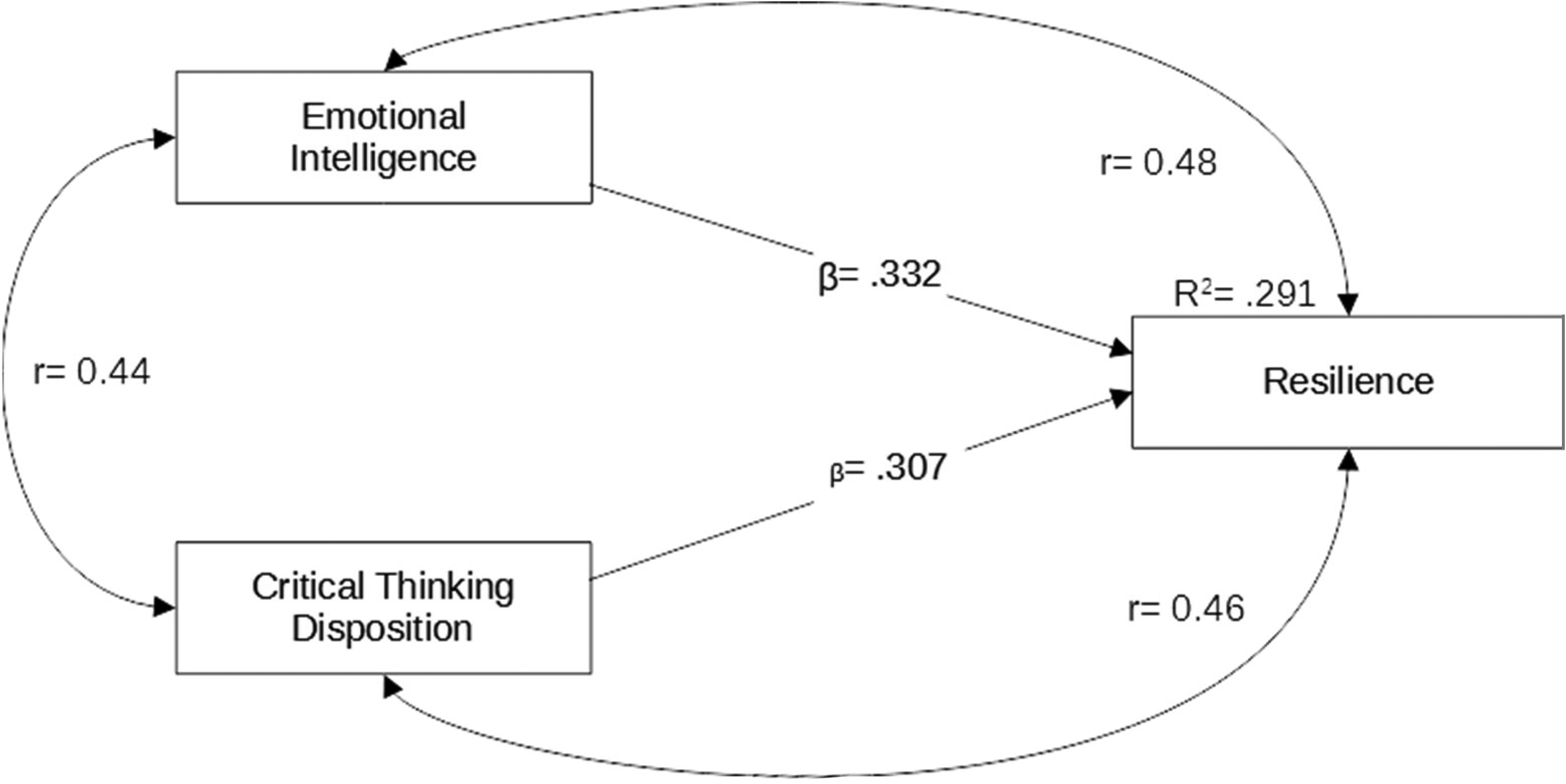
Path diagram of the regression model.
Discussion
The transition to college brings abundant challenges for students, such as adjusting to a new environment, making new peer relationships, and managing personal responsibilities (Feldt et al., 2011). This is especially pertinent in India where first-year students face multiple challenges in dealing with changing emotional and social demands of their environments as compared to final-year students (Sharma, 2012). Since resilient students can effectively handle these personal and social issues, college authorities and educational administrators should accord importance to resilience and factors that can promote resilience among first-year undergraduate students. Following this concern, that there are factors that promote positive variance of resilience, the researchers have examined (a) the association of resilience with EI and CT disposition, and (b) the effect of EI and CT disposition on resilience.
Results of the multiple regression analysis showed that EI uniquely contributed to resilience of first-year undergraduate students. This outcome was supported by earlier researchers with students of higher education in different cultural contexts (e.g., Foumany & Salehi, 2015; Sarrionandia et al., 2018; Trigueros et al., 2020) but more specifically the Indian cultural context with its distinctive sample nature, comprising school-going adolescents, at-risk population, etc. (Bagheri et al., 2015; Habib, 2017; Sharma, 2014). Emotionally intelligent people are optimistic in nature, with the ability of self-control and ability to withstand stressful events. As a result, they hardly succumb to or encounter any adverse or stressful situations, and even if so, they overcome the obstacles and return early to their former status (Akbari & Khormaiee, 2015; Yamani et al., 2014). Emotionally intelligent people can shift their emotional state toward betterment (Sayko, 2013) and can handle personal, social, and environmental changes effectively, demonstrating reasonableness and adaptability in dealing with emergent situations (Bar-On, 2006). Therefore, first-year college students with EI can deal with challenges in newfound environments and can respond to negative emotional situations in a positive manner. Emotionally intelligent people also receive social support (Peña-Sarrionandia et al., 2015) that plays a significant role in nurturing resilience (Machuca, 2010; Pidgeon et al., 2014). Hence, first-year students with EI are capable of acquiring social support from their peers and other members of the surroundings, which in turn enhances their resilience.
The study also revealed that CT disposition uniquely contributed to resilience in first-year undergraduates, as demonstrated by Kamali and Fahim (2011) in an Iranian learner with CT skill studying English as a foreign language. Brooks and Goldstein (2001) stated that CT disposition contributes to the attainment of lower anxiety and higher self-esteem (Suliman & Halabi, 2007), both attributes of a resilient individual. Self-confidence is one of the disposition-related characteristics of CT (Irani et al., 2007); this means that first-year students with CT disposition will be able to demonstrate self-confidence in dealing with and resolving various issues in their academic surroundings. Since they are open-minded, communicate confidently, consider divergent viewpoints, and possess the self-assurance to make good judgments (Irani et al., 2007), they will probably opt to face instead of running away from adversity, thus demonstrating resilience. Another characteristic of CT disposition is the ability to anticipate problems (Irani et al., 2007), which implies that first-year students with CT disposition can anticipate potential challenges and their consequences, and can take preventive or adaptive measures to address the issues, thus justifying the outcomes of the present research.
Resilience was found to be affected by EI and CT disposition simultaneously with better variance than independently. Research evidence asserted that EI and CT disposition were positively correlated (Afshar & Rahimi, 2014; Arslan & Kayıhan, 2020). Daneshvar (2015) pointed out that critical thinkers can control their emotions, and that is an integral characteristic of EI. Emotional control can increase positive emotions while reducing negative emotions, and this may be crucial to promoting resilience (Kay, 2016). EI helps in utilizing required emotional information in problem-solving and decision-making; on the other hand, CT disposition helps to perceive any complexity of problems and helps the person become proactive in solving them. EI and CT disposition both interpret as well as manage one’s personal responses to various problematic situations, which make an individual resilient in stressful situations.
The present study reported that EI was the greater contributing factor in predicting resilience than CT disposition. This outcome was consistent with earlier findings that EI contributed more to resilience than spiritual intelligence (Keshavarzi & Yousefi, 2012), even more so than cognitive intelligence (Jowkar, 2007). One of the factors of EI is the use of emotion to facilitate cognitive processes such as thinking, reasoning, problem-solving, and decision-making (Mayer et al., 2004). Hence, first-year students with a strong ability to use emotions can select and prioritize the cognitive behaviors or activities most beneficial to their present state of mind. Furthermore, they can adapt their mood to enhance situational circumstances, which means their EI may affect their thinking process, so EI might more strongly affect resilience as compared to CT disposition.
Implication and Application
This is one of the few studies that explored the simultaneous and unique importance of EI and CT disposition in the positive variance of resilience of students in their transition to higher education. The research outcomes have implications for college authorities, particularly teachers, counselors, and curriculum planners, who can utilize the information related to resilience, ECs, and behavioral disposition of CT of first-year undergraduate students. Because of the newfound environment in terms of institutional norms, rules and regulations, peers, and other academic staff, the students face adjustment difficulties. Resilience is evidently related to better adjustment to college (Haktanir et al., 2021) and retention of first-year students (Shaw, 2018). This study may help to identify the newly admitted, less resilient students who are at risk of leaving out or quitting before program completion, so they may be oriented at the beginning of the new session. This program may include “ice breaking,” reassurance of help from college authorities during adversities, assistance in resolution of their problems, and fostering in them a feeling of worthiness and a sense of belonging as new members of the institution, all of which might result in student retention.
Resilience capacity is developed not by avoiding the situation rather by facing the adversities as students subjected to a degree of hardships and challenges make them stronger. “Healthy ragging,” may be beneficial to develop their emotional resilience confronting first-year undergraduate students to encounter racial–emotional adversities. Gamage (2017) argued that minor ragging such as singing a song, talking to female students, or role playing, etc., positively affects the socializing process of Sri Lankan first-year students especially those belonging to culturally, socially, familial, and economic backward backgrounds.
Students with inadequate EI faced challenges in maintaining interpersonal relations (Hsieh et al., 2014) or in getting support from others (Fabio & Kenny, 2012). The study may help identify students lacking in intra- and interpersonal EI. Counselors can provide individual or group counseling services, which may help them to get the support they need from peers and other institutional personnel. Moreover, an emotional competency intervention program can be particularly beneficial for undergraduates (Nelis et al., 2011), can be organized to improve specific competencies, i.e., identifying, understanding, expressing, using, and managing emotions through role-playing games, group discussions, and activities in dyads. This program, through a relatively short training period, is quite effective in alleviating stress and improving well-being (Nelis et al., 2009; Slaski & Cartwright, 2003). The Social–Emotional Learning (SEL) program, which is world-renowned as a positive intervention, can be a great way to facilitate resilience in school students (LaBelle, 2019) and can be implemented for undergraduate students as well. Gallagher and Stocker (2017) depicted a guideline incorporating SEL in the college classroom. The SEL program helps to overcome the challenges faced by college students during transition to higher education (Reinert, 2019).
Elements or characteristics of CT disposition need to be incorporated through daily or weekly academic schedules, in curriculum content, in teaching–learning methodologies, and also in assessment approaches. Problem-solving approaches (Ozturk et al., 2008), the active learning method (Qing et al., 2010), and the inquiry method (Edward, 2007) should be considered in curriculum content design for the development of CT dispositions for students of higher education (Khandaghi et al., 2011). In the inquiry-based environment, students are more likely to ask questions freely, offer supporting evidence for their arguments, communicate productively and efficiently with each other, and actively monitor and assess their own participative behavior (Kolodner et al., 2003; White & Frederiksen, 1998). Metacognitive strategies or mental management are effective in fostering the CT disposition (Hendrix, 1999), which the present study found to be effective in enhancing resilience. Practicing mental management brings awareness of how and when to move away from a challenging situation. The thinking disposition, featuring intellectual curiosity, fair-mindedness, awareness of bias, and ability to assume and change a position, are strongly involved with metacognition (Hendrix, 1999). Another key strategy for cultivating dispositions is focused practice applying those dispositions in various scenarios (Hendrix, 1999). Along with that, curriculum planners and educators may arrange several programs for awareness training and reflective discovery, thus offering collaborative and participatory ways of learning to make students critical thinkers; this, in turn, may facilitate resilience among them. The Northeast Resiliency Consortium (2018) effectively integrated five competencies (namely self-awareness, adaptability, CT, reflective learning, and collaboration) into the curriculum to help students develop strong resiliency and proposed the Resiliency Competency Model, which may help students in significantly varied ways to rise above the challenges they face.
Any formal academic program or course always prefers to develop capabilities or habits related to cognitive ability. However, the current study has strongly advocated that in the making of a resilient student, particularly at the first-year undergraduate level, the affective component, such as emotion-related competencies, is more effective than CT disposition. Therefore, various academic stakeholders need to be aware of the urgency to incorporate in the curriculum schedule appropriate content to develop EI.
Resilience has certain universal cultural characteristics (Gunnestad, 2006). In the International Resilience Project, Ungar (2008) pointed out that resilience-related phenomena share culturally embedded aspects and also universal dimensions. Thus, though the present resilience study was conducted in an Indian cultural context, the outcomes may be generalized across other cultures too.
As per the “2019 Open Doors Report on International Educational Exchange” (Dennis, 2020), Indian students enrolled in the higher education system in the U.S.A. in session 2018–2019, was the second largest in number after China. In 2016, Indians received the maximum number of high-skilled H-1B visas and also formed the second largest community of international student residents in the U.S.A. (Kohli, 2020). Their basic cultural beliefs and values are not changing either easily or quickly. Hence, the findings of the present study may have relevance and application to undergraduates beyond the regional Indian context and can be applied to a vast number of migrating Indian American students as well.
The environment of higher study is quite different from the school environment across the countries. Students come from different cultural backgrounds, indicating that there is heterogeneity of students in terms of personal characteristics, values, and beliefs in the higher educational institutions. To a large extent, many similar challenges are faced by the students in their transition to the higher education phase, irrespective of cultural differences. From the developmental perspective, students at this stage of emerging adulthood or late adolescence while entering higher educational settings may also have some of the common age- and development-specific challenges and characteristics, notwithstanding cultural differences. Therefore, in this current cosmopolitan era, the findings from research on resilience from one culture can be generalized above and beyond cultural diversities. Thus, the study outcomes from first-year Indian students (i.e., undergraduates) may have wider implications beyond the concerned culture and hence may have far-reaching significance for other cultural contexts as well.
Limitations
The study has certain limitations that need to be considered. There is a lack of diversity of the sample in terms of Indian culture, which is a crucial feature of Indian society. Future research may include samples from various demographics, geographies, and ethnicities. Being a cross-sectional design study, the findings have limited interpretations regarding causality and the nature of effects obtained. The sample of the present study overlooked the students from professional courses. Future research can deploy comparative approaches, encompassing different academic streams, including the vocational ones as well. Another limitation arises from the limited number of predictors included in this study. While the study found significant results for both predictors, there still remains a large percentage of unexplained variance in resilience. Accordingly, as counselors or educators seek to improve resilience of first-year college students, they need to consider integrating other variables into their course or program in addition to EI and CT disposition. The study also lacks control variables related to participants’ demographic characteristics, which may have significant explanatory impacts that are not covered in the present study. Future researchers may include control variables along with IVs to predict resilience.
In the current study, all the measures employed self-reported responses, which are subject to response bias and increase the chances of errors in reliability and validity. Further research might be designed employing both quantitative and qualitative methods, where students’ resilience behavior is measured via interviews or data collected from the responses of family members and teachers with respect to the students’ reactivity in the face of any adversity that would lead to revealing in-depth specificities and insights
Conclusion
Despite these limitations, the study may add culture- and population-specific empirical evidence of the unique and simultaneous importance of EI and CT disposition in the resilience of first-year undergraduate students, which was missing in resilience research. The research outcomes highlight the need of strengthening EI and CT disposition of students in transition to higher education to improve their resilience which in turn can enhance their overall performance throughout the course and better adaptability to the newly found transitional circumstances. College authorities may support freshers in navigating their initial challenges and facilitate a smooth transition at the entry point so that students have successful experiences throughout the course of study.
Footnotes
Declaration of Conflicting Interests
The authors declared no potential conflicts of interest with respect to the research, authorship, and/or publication of this article.
Funding
The authors received no financial support for the research, authorship, and/or publication of this article.
