




Abstract
Research suggests that achieved ethnic identity has positive implications for the adjustment of Adolescents of Color. However, researchers know very little about whether (or how) the impact of achieved ethnic identity extends into college years. To explore this, our study examined the effects of ethnic identity on both social and academic adjustment of Students of Color at two large public research universities with distinct enrollment characteristics. Using multiple group analyses, we tested and confirmed the developmental significance of Phinney’s conceptualization of achieved ethnic identity. In both university contexts, achieved ethnic identity related to academic adjustment for Students of Color. We found no differences in regression paths between the two institutional contexts, supporting the assertion that achieved ethnic identity plays a prominent role in student success for minoritized students across college contexts. Our study extends Phinney’s theory of ethnic identity development to the study of college adjustment.
As Students of Color enroll in four-year institutions more frequently (National Center for Education Statistics, 2020), researchers and practitioners have become increasingly interested in factors associated with positive adjustment to college for this group of students. This interest is particularly strong because of the systemic racism in most institutions of higher education and related disparities in college success between Students of Color and White students (Banks & Dohy, 2019). Exacerbated by racism engrained in our society and in institutions of higher education in particular, ethnic identity is the most salient form of identity for Students of Color and has the potential to enhance their college adjustment (Phinney, 1990). Studies of the role of ethnic identity in college adjustment have yielded mixed results, possibly because investigators have not recognized the developmental nature of ethnic identity—the distinction between identity exploration and achievement—as well as the culture and contexts of institutions. Ethnic identity development may proceed differently for Students of Color in different college environments—in predominantly White versus more ethnically diverse institutions, for example—because of the differing salience of ethnicity in these institutions. In this study, we examined the extent to which key aspects of ethnic identity development related to social and academic adjustment for Students of Color in two compositionally different higher education settings.
College Adjustment and Success for Students of Color
Students’ experiences in college influence academic and retention outcomes (Mayhew et al., 2016). Especially important is their integration into the college context. Tinto’s (1993) theory of academic-social integration proposed that college students are more likely to persist if they are socially and academically integrated into their campus environments. Recent models have built on this conceptualization to focus on the needs of Students of Color (Museus et al., 2017) as well as dismantle the structural factors that hinder their success in higher education (McGee, 2020). Although Tinto’s theory has been criticized for being based on a predominantly White student population and for failing to include the perspectives of minoritized students (Howard-Hamilton, 1997; Torres, 2003), it is empirically accurate in predicting students’ college success (Credé & Niehorster, 2012).
Baker and Siryk (1984, 1989) leveraged Tinto’s integration framework to conceptualize college adjustment as a multidimensional construct that includes four broad categories, two of which—academic and social adjustment—have been consistently connected to student success outcomes. In Credé and Niehorster’s (2012) meta-analytic review, the predictive validity of academic adjustment for college GPA was almost as strong as that of SAT scores and high school GPA. Researchers have also linked social adjustment consistently to student success outcomes (Mayhew et al., 2016), especially early in a student’s college career (Braxton et al., 2013). Because of the respective roles that academic and social adjustment play in student success, it is important to further establish what elements of student development increase the likelihood of adjusting to college. One likely element for Students of Color is ethnic identity.
Ethnic Identity: A Prominent Developmental Task
Grounded in Erikson’s (1968) and Marcia’s (1980) conceptualizations of identity development, Phinney’s (1989) theory of ethnic identity formation proposed an identity process that is similar across ethnic groups. Phinney proposed that, over the course of adolescence and emerging adulthood, individuals move through a three-stage progression. Young people who have not been exposed to ethnic identity issues and have a lack of clear identity are in the unexamined ethnic identity stage. A second stage—similar to Marcia’s moratorium status and typically initiated in early adolescence—is characterized by exploration of one’s ethnic identity. Exploration leads to a deeper understanding of and commitment to ethnicity. The final stage, ethnic identity achievement, is often negotiated during the college years. Progression through the stages can be tracked by assessing the two dimensions of ethnic identity exploration and achievement.
Research suggests that ethnic identity is especially critical to the self-concept of Youth of Color in a nation like the United States, where the salience of ethnic identity is informed by the histories of trauma and the institutionalized racism that cuts across educational, societal andpolitical realms (McGee, 2020; Phinney & Chavira, 1992). Youth of Color attribute greater importance to their ethnic identity than their White peers do (Phinney, 1990). A meta-analysis of 184 studies revealed a moderate association between ethnic identity and the well-being of Individuals of Color (Smith & Silva, 2011).
Adolescents of Color who have a stronger ethnic identity report more positive self-esteem, more self-confidence, and better overall psychological adjustment (Carlson et al., 2000; St. Louis & Liem, 2005). Although this research base is not specific to college student experiences, it is very likely that the college experience contributes to identity development. The move into a college environment often entails changing social networks, being exposed to new norms, encountering people with differing opinions and beliefs, and experiencing environments that are different from home. This can prompt students to reflect on their self-concept and engage in identity searching (Phinney, 1990; Phinney et al., 1997). For Students of Color, identity exploration and commitment should play a prominent role in their adjustment to college.
Ethnic Identity and College
There is surprisingly little peer-reviewed research on the impact of ethnic identity on college student adjustment, however (Kalsner & Pistole, 2003). The small body of research investigating the main effects of ethnic identity on college adjustment of Students of Color has provided inconsistent results (Gonzalez, 2003; Kalsner & Pistole, 2003; Maduramente, 2015). One reason may be that investigators have treated ethnic identity as an accomplishment, ignoring process. In other words, most studies have examined ethnic identity as a unidimensional measure. Research that has differentiated exploration and achievement has reported distinctive associations with adjustment. For example, research on Latino adults in the workplace found that ethnic identity exploration was associated with increased psychological distress, whereas ethnic identity commitment mitigated the impact of covert discrimination on mental health ( Torres et al., 2011).
Although studies report high rates or levels of ethnic identity achievement among college students, scholars have also suggested that college experiences promote cycling between stages. Hence, for many adolescents, identity development continues into college (Syed et al., 2007). In college contexts, ethnic identity exploration is often stirred by experiences of racism and prejudice (Syed & Azmitia, 2010). Because of this, ethnic identity exploration may not serve as a positive predictor of college adjustment. Some research points to the negative implications of exploration and positive implications of commitment (which most closely captures the achieved identity status) for college Students of Color. For example, Schwartz et al. (2009) found that personal identity exploration was negatively associated with adaptive psychosocial functioning and was positively associated with anxiety, depression, and impulsivity in university students. More specific to ethnic identity, Syed et al. (2013) found that ethnic identity search (measured with the Multidimensional Ethnic Identity Measure [MEIM]; Phinney, 1992) related negatively to well-being for Students of Color. On the contrary, Brittain et al.’s (2013) study found that ethnic identity resolution and affirmation were positively associated with adjustment outcomes in bi-racial college students. In the current study, we hope to extend some of these findings.
Contextual Considerations
Existing research has overlooked context in the study of minoritized students’ college adjustment. From a developmental-contextual perspective (Lerner, 1991), individuals’ context plays a critical role in shaping their experiences in that context. College environments present considerable challenges to adjustment for Students of Color, particularly when there is a stark contrast between the ethnic composition of college and students’ home environments. In particular, research suggests that environments in Predominantly White Institutions (PWIs) present Students of Color with such challenges. Yet, little research has attended to whether the impact of ethnic identity on college adjustment for these students differs based on the compositional diversity of a college context. Phinney articulated an ethnic identity development process that is similar across groups and contexts, but this theoretical assumption deserves closer consideration.
Social Support and Adjustment
Several factors could shape how strongly ethnic identity among Students of Color relates to student adjustment in various college contexts. Foremost among these, peers become more prominent influences on adjustment across time and are especially relevant during college if students move away from home into a residential college setting (Brown, 1999). The importance of peers is illustrated in a recent study (Sriram et al., 2020) that found peer interactions to be the most significant contributor to college students’ psychological sense of community. Another factor especially important to college adjustment for Students of Color was their relationships with college faculty. Credé and Niehorster’s (2012) review found that institutional support as well as social support from faculty had a stronger relationship with college student academic adjustment than other types of support. Based on this evidence, we controlled for support from peers and instructors to assure our models reflected ethnic identity’s effects on adjustment.
Current Study
In sum, college appears to be an especially salient context for ethnic identity development among Students of Color and ethnic identity development should bear a strong association with adjustment to college. The limited research on these topics has produced inconsistent results, possibly because investigators have tended to treat ethnic identity development as an achievement or milestone rather than a process. Researchers have also ignored salient features of the context such as ethnic composition and students’ ability to form effective support systems with peers and the institution’s faculty. To address these limitations, the current study considers the differential role of two facets of ethnic identity development, exploration and commitment, on two aspects of college adjustment (academic and social) among Students of Color in two college contexts: a Predominantly White Institution (PWI) and an ethnically diverse institution (DI) (see Figure 1). Other factors potentially related to adjustment (demographic background, peer and faculty support) are controlled in analyses.
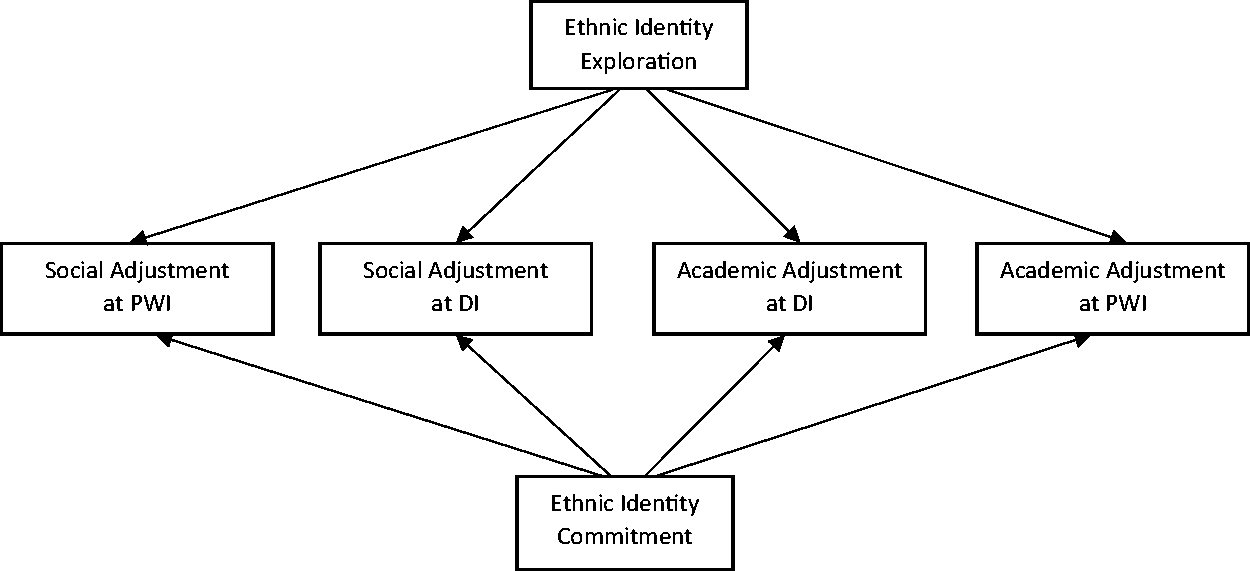
Conceptual Model for Ethnic Identity Correlates of Social and Academic Adjustment at Predominantly White (PWI) and Diverse (DI) Institutions.
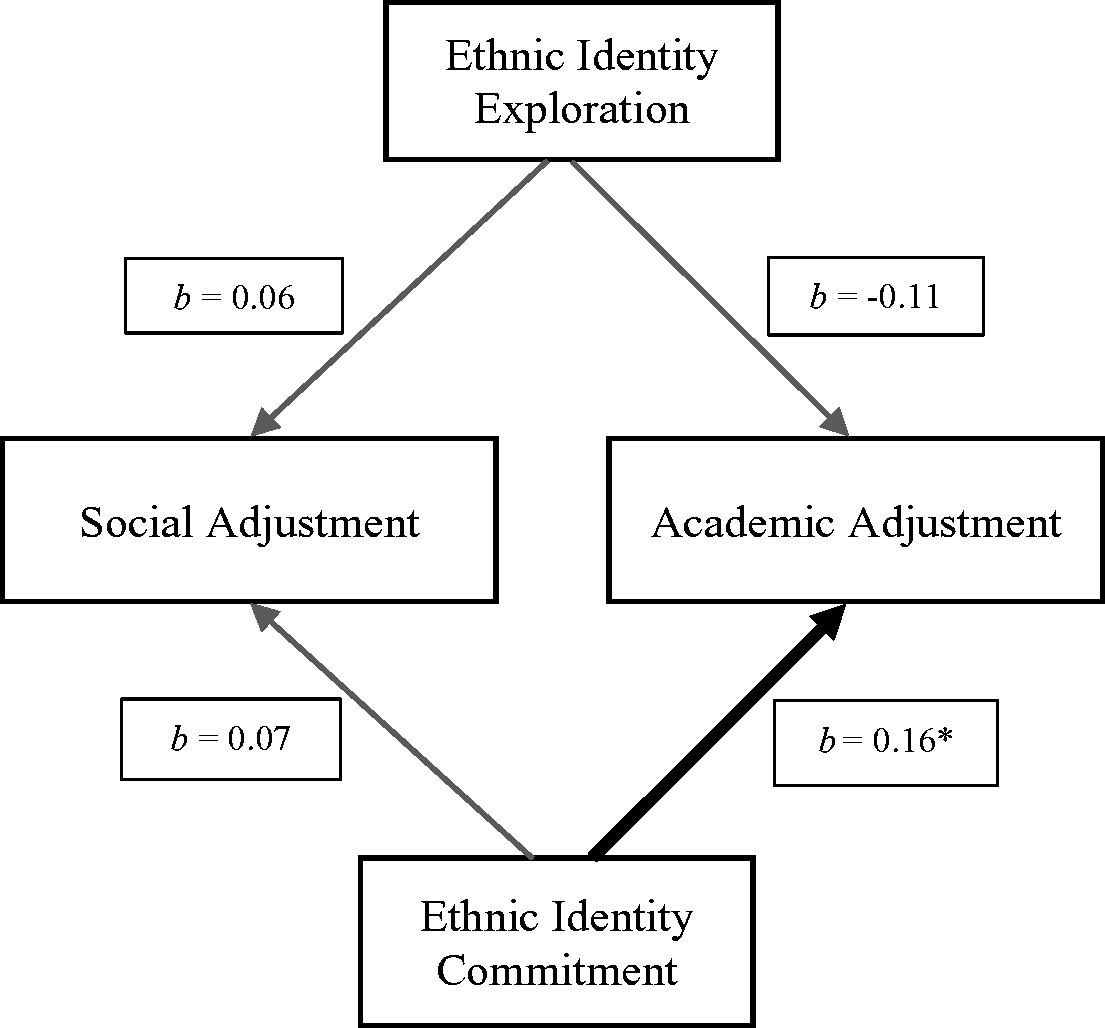
Associations between Ethnic Identity and Academic and Social Adjustment of Minoritized Students. Note. b = standardized regression slope. Thick regression lines indicate significant associations. *p < .05.
Based on previous research and theory, we hypothesized: H1: Students of Color at the PWI will show higher levels of ethnic identity exploration when compared to Students of Color at the DI. H2: Controlling for demographic and social support variables, ethnic identity commitment will positively relate to minoritized students’ academic and social adjustment in both contexts. H3: Controlling for demographic and social support variables, ethnic identity exploration will be negatively associated with minoritized students’ academic and social adjustment in both contexts.
Method
To evaluate study hypotheses, we examined the association between ethnic identity and social and academic adjustment of Students of Color in two compositionally different higher education contexts: one predominantly White (PWI) and another much more diverse (DI; 75% non-White, primarily Asian and Hispanic). We focused this study on ethnically and racially minoritized students because research evidence indicates that ethnic identity is especially salient for this population.
Participants
Students of Color at the aforementioned PWI and DI completed a self-report survey during the fall (late October through early December) of the 2019-2020 academic year. We chose two higher education institutional contexts due to their similarity on most dimensions except for the compositional diversity of each university (Table 1). Compositionally, the DI in our study enrolls primarily Asian and Hispanic student populations (see Table 1). Both are public research and land-grant universities, and both institutions are comparable in size. The PWI is a university in the Midwestern U.S., and the DI is located on the U.S. West coast.
Demographic Data.
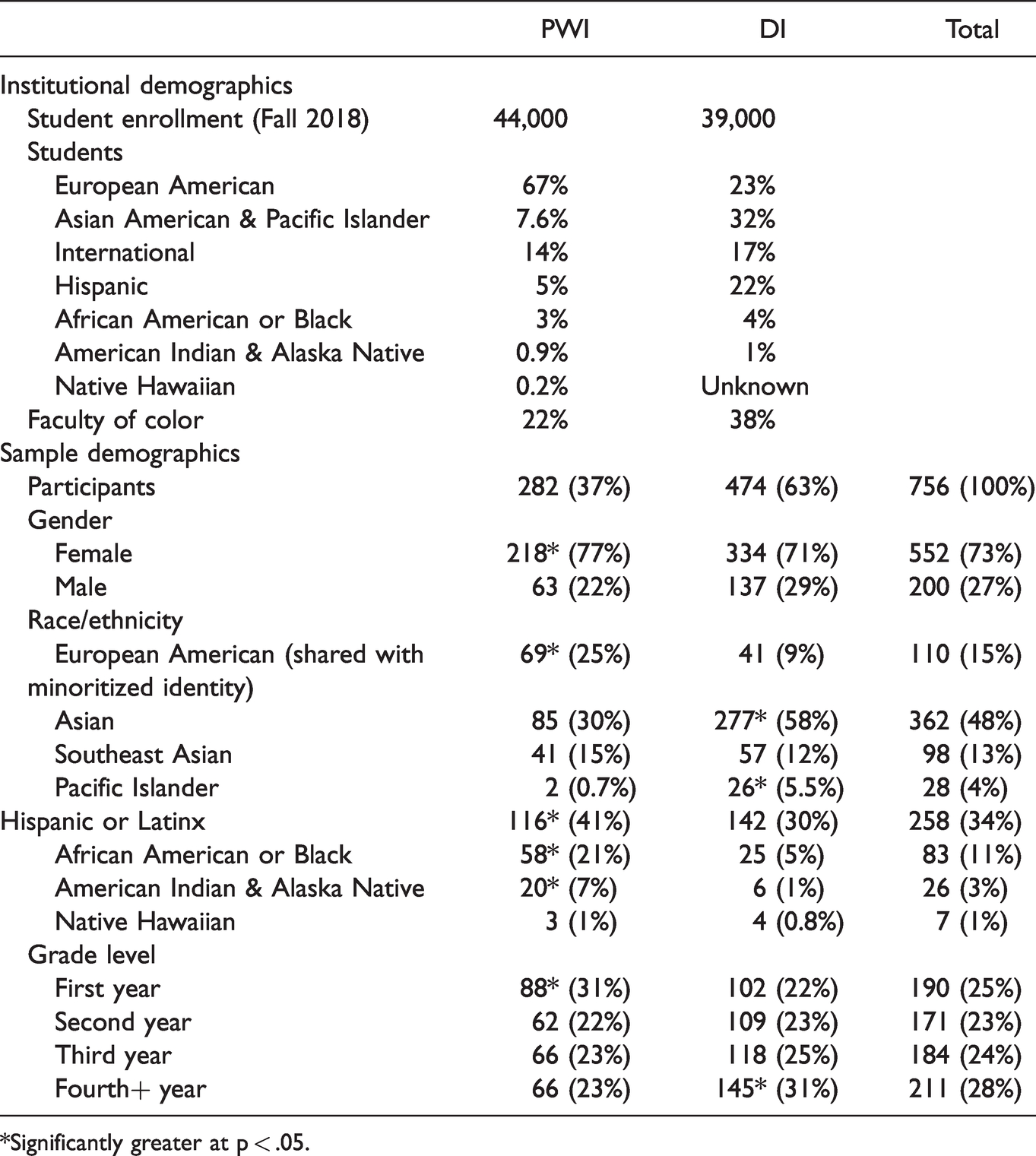
*Significantly greater at p < .05.
At the PWI, we contacted students via the listservs of programs designed to serve historically underrepresented populations. We also recruited a smaller pool of students via the SONA research participation system, allowing students taking classes in a number of disciplines to earn course credit for participating in research studies. Participants completed a pre-screen survey to ensure that they met the inclusion criteria (i.e., belonging to minoritized group). Students who participated in the study outside of the SONA system were entered into a drawing for ten $25 gift cards to a major retailer. At the DI, we recruited participants via the SONA system to complete the survey and receive course credit for their participation. Seven hundred fifty-six participants—mostly of traditional college age—comprised the total sample (Table 1).
We analyzed means of demographic variables for significant differences between the sample characteristics at each institution. As detailed in Table 1, the PWI sample had proportionately (a) more females; (b) more African American or Black, Hispanic, American Indian or Alaska Native participants; (c) more students who shared White identity with minoritized identity; (d) fewer Asian and Pacific Islander participants; and (e) more first year and fewer fourth+ year participants. Given these demographic differences between institutions, we controlled for gender, race, and students’ college year in multiple group analysis.
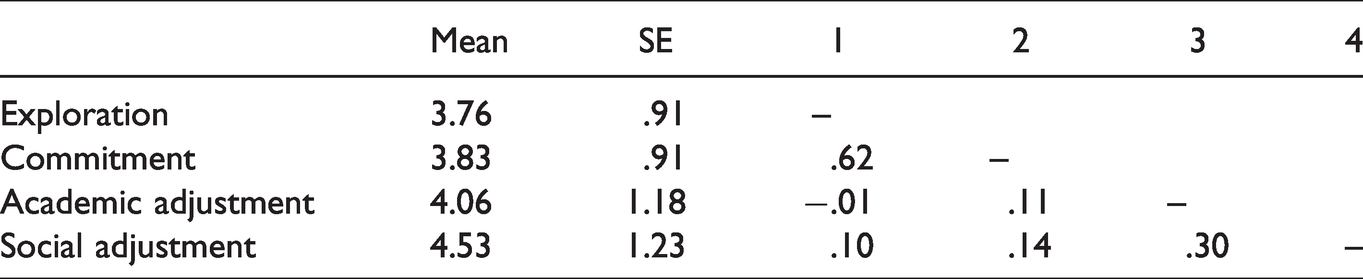
Summary Statistics and Correlations for Scales.
Measures
Participants completed a self-report survey including demographic information, the MEIM, adapted Multidimensional Scale of Perceived Social Support (MSPSS; Zimet et al., 1988), and Student Adaptation to College Questionnaire (SACQ; Baker & Siryk, 1989).
Demographics
Participants provided information about their ethnic group affiliation (Black, Hispanic, White, Asian, Southeast Asian, American Indian or Native American, Native Hawaiian, Pacific Islander), college year (first, second, third, orfourth year and beyond), and gender (male, female, transgender).
Ethnic Identity
Participants completed the MEIM-Revised (Phinney & Ong, 2007; Roberts et al., 1999). This widely used measure assesses ethnic identity exploration (6 items concerning efforts to learn more about one’s group and participation in ethnic cultural practices) and commitment (6 items about positive affirmation of one's group, and clear sense of commitment). The commitment component of the MEIM, developed by Phinney, most closely resembles the achievement stage of the ethnic identity development process central to our study. Participants indicated how applicable each item was to them on a 5-point Likert scale, from strongly disagree (1) to strongly agree (5) with 3 as a neutral position. We calculated scale scores for commitment and exploration as means of item scores. Phinney and Ong (2007) reported adequate reliability for each subscale, with Cronbach alphas of .76 for exploration and .78 for commitment, and with the .81 alpha for the combined 6-item scale. Overall scale reliability for our sample was .88.
Instructor and Peer Support
We adapted items from the Friends, Family, Significant Other subscales of the MSPSS scale (Zimet et al., 1988) to assess study participants’ perceptions of social support from instructors and friends. The MSPSS is an established and widely used measure that has been validated with undergraduate college students (Dahlem et al., 1991; Kazarian & McCabe, 1991). The measure has also been validated across different cultures with Hispanic (Ermis-Demirtas et al., 2018), African American (Canty-Mitchell & Zimet, 2000), and Asian (Akhtar et al., 2010; Ho & Chan, 2017) populations. Participants responded to MSPSS items on a 7-point Likert scale (from “1” = very strongly disagree to “7” = very strongly agree, with “4” being a neutral position). Zimet et al. (1988) reported reliability for the total scale (.88), as well as each of the subscales (Significant Other = .91, Family = .87, Friends = .85). We made minor modifications to the original items to direct participants to answer items about peer support and instructor support. Peer support scale consisted of four items and assessed participants’ perceived level of support from friends in general. Instructor support scale consisted of five items and assessed participants’ perceived level of support from instructors in general. We calculated scale scores as means of all items. With modifications, the measure remained reliable in our sample (αinstructor = .89; αpeer = .95).
Academic and Social Adjustment
To measure academic and social adjustment to college, participants completed social and academic adjustment subscales of the SACQ (Baker & Siryk, 1989). The SACQ is a 67-item questionnaire widely used in the research literature on college adjustment. Based on the goals of this study, we used only the 24-item academic adjustment and 19-item social adjustment SACQ subscales. The academic adjustment subscale measured students' attitudes toward their academic work, the degree to which students felt motivated to do their work, and their satisfaction with their program. The social adjustment subscale measured students' involvement in social activities, success with interpersonal relationships, and satisfaction with their social environment. Participants indicated how applicable each item was to them, using a 7-point Likert scale ranging from 1 (Not at all) to 7 (Very well). We included these measures as outcome variables in our analysis of ethnic identity’s influence on adjustment based on the previously reviewed literature.
In a recent meta-analysis, researchers found the SACQ to have substantial reliability (alphas from .83 to .91 for social adjustment; .77 to .86 for academic adjustment) and validity (Credé & Niehorster, 2012). The SACQ has also shown reliability and validity cross-culturally (Beyers & Goossens, 2002; Young & Koplow, 1997). Young and Koplow (1997) confirmed the predictive validity of the academic adjustment scores for African American and Hispanic American students.
Results
To begin, we analyzed the sample for missing data. If a scale score was missing at least one item response, we imputed missing items on the basis of participants’ responses to other questions (predictive mean matching; Rubin, 1986) using the mice package in R (van Buuren, 2018). All variables had a small number of missing observations (14 for ethnic identity, or 1.9%; 44 for academic adjustment, or 5.8%; 111 for social adjustment, or 14.7%). R imputed a total of 10 datasets, which were subsequently used for SEM analyses.
Item Analysis
Before testing study hypotheses, we conducted item analysis on ethnic identity and adjustment measures. These analyses generated a two-factor solution from our six-item ethnic identity measure, consistent with Phinney’s conceptualization of exploration and commitment. Similarly, item analysis supported the use of academic and social adjustment as separate factors in our models.
Ethnic Identity
EFA with promax rotation showed that a two-factor solution had a lower BIC compared to a one-factor solution (BIC2-factor = -9.5; BIC1-factor = 312). EFA showed that the items were loading highly on two factors (Table 5, Online Appendix): “commitment” and “exploration,” which is consistent with design of the scale (Phinney & Ong, 2007; Roberts et al., 1999). These two factors were correlated (r = .62), but not to the extent that it would warrant combination into one factor. Thus, we used a two-factor solution in subsequent analyses. The two factors had high reliabilities (αexploration = .84; αcommitment = .86).
Academic and Social Adjustment
EFA with promax rotation initially suggested a 9-factor solution based on BIC. Given that social and academic adjustment scales are established scales and widely used as sub-scales of Baker and Siryk’s (1989) measure, we further analyzed the measure to eliminate items with loadings lower than .60. The resulting scale consisted of 16 items loading on a 2-factor structure based on additional EFA with promax rotation (Table 6, Online Appendix), which has been retained for model analysis. These factors showed high reliability (αsocadj = .91; αacadadj = .82) and were only moderately correlated (r = .30), suggesting two independent but related constructs. With this new two-factor structure making both statistical and conceptual sense, we determined it appropriate to use these two sub-scales as correlated outcome variables in SEM analyses.
Following EFA, we checked ranges, correlations, and other descriptive data for predictors and outcomes to further assess their appropriateness for inclusion in later analyses (Table 2).
Institutional and Demographic Analyses
To begin testing hypotheses, we compared descriptive data between the PWI and DI. The two samples differed significantly on ethnic identity exploration: the PWI sample had a significantly higher average for this variable (Table 3). Hence, we found support for H1.
Scale Means (With Standard Errors) by Institution.
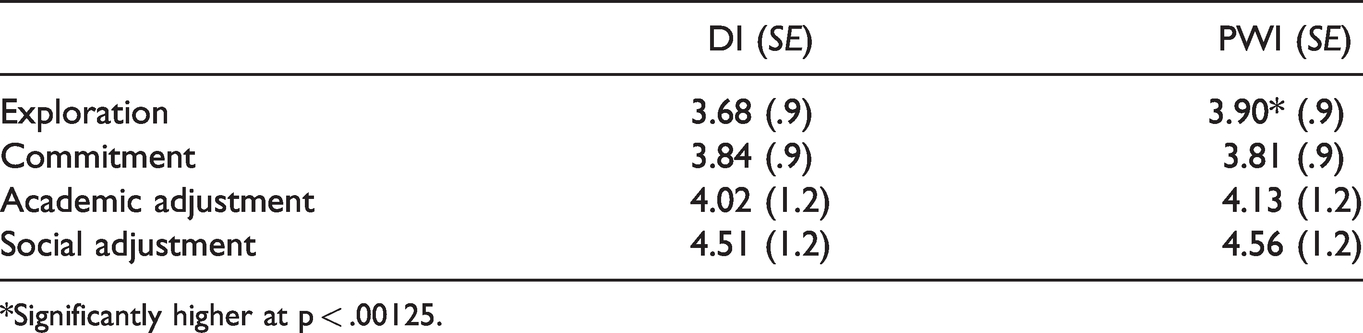
*Significantly higher at p < .00125.
After checking differences between institutions, we conducted three-way ANOVAs to analyze differences by gender, race/ethnicity, and college year. Females (MMale = 3.53, MFemale = 3.84) and African American students were, on average, higher on ethnic identity exploration (MBlack = 4.05, Mnon-Black = 3.72). Students who shared White identity with minoritized identity were lower on ethnic identity commitment compared to students who did not have a shared White identity (MWhite = 3.43, MNon-White = 3.90). On average, males reported higher academic adjustment (MMale = 4.23, MFemale = 4.00); however, Pacific Islander males were lower on academic adjustment compared to Pacific Islander females (MPIMale = 4.04, MPIFemale = 4.72). Compared to other racial/ethnic groups, Black students had lower average social adjustment scores (MBlack = 4.21, MNon-Black=4.57).
Comparing Two Contexts: Multiple Group Analysis
To determine whether the models in both institutions were equal to each other, we conducted multiple group analyses. The model was built to analyze differences between institutions in regression paths while controlling for gender, race, college year, and social support. Because all scales had moderate to high reliability, we used the imputed scale scores for the model analysis, which were calculated as means of item scores. We used the “mlr” estimator to deal with non-normality. In the lavaan model, we included two adjustment scales (academic and social adjustment) as outcome variables; ethnic identity exploration and commitment (along with all controls) were predictor variables. The initial free model did not fit on the basis of χ2 (Table 4). When we added institution type to the model, χ2 and BIC values increased. Next, all paths were constrained, and the constrained model was compared to the free model by institution type. The constrained model had a larger χ2 value, but this model fit the data (p = .08). This model also had a lower BIC compared to the free model, suggesting that the paths are similar between institutions. Additionally, the constrained model showed much better fit on the basis of TLI and RMSEA. This completely constrained model was not significantly different from a free model by institution type (p = .32), suggesting no variability between institutions. Therefore, we chose this completely constrained model as the final model for interpretation.
SEM Summary Statistics.

In this final, constrained model, ethnic identity commitment had a significant positive relationship with minoritized students’ academic adjustment in both institutions, while controlling for ethnic identity exploration, general instructor support, gender, race, and college year. Net the effects of control variables, ethnic identity commitment was not significantly associated with social adjustment. Thus, we found partial support for H2. Contrary to expectations (H3) ethnic identity exploration was not significantly associated with either academic or social adjustment (net effects of control variables) (see Figure 2).
Discussion
For Students of Color, retention and graduation are matters of critical importance as opportunity gaps persist and minoritized students are faced with challenges of navigating institutional racism in higher education spaces. In this study, we explored whether ethnic identity commitment continues to serve as a source of resilience and strength for Students of Color during their college years. Results revealed positive associations between ethnic identity commitment and academic adjustment after controlling for effects of demographic and instructor support variables and regardless of compositional diversity of institutional context. These findings reinforce the centrality of achieved ethnic identity in the academic success of Students of Color, underscoring the importance of cultivating a strong sense of ethnic group membership in these students during college years. However, ethnic identity commitment was not related to students’ social adjustment, which was contrary to our expectations. Results also affirmed that students who attended a PWI were higher in ethnic identity exploration, reinforcing the links between compositional diversity of college context and identity searching. Consistent with our expectations, we found no differences in associations between ethnic identity and college adjustment across compositionally different institutional contexts. However, contrary to expectations, we found no significant association between ethnic identity exploration and either adjustment factor. These findings refine our limited knowledge of ethnic identity’s role in positive development during college years, providing more nuance than was evident in prior literature.
In our sample, African American students reported higher scores in ethnic identity exploration in comparison to peers from other ethnic backgrounds. In Pahl and Way’s (2006) study of urban Black and Latino adolescents, Black students experienced less deceleration of exploration over time compared to their Latino peers. Declining exploration in middle adolescence was moderated by perceived discrimination by peers, reflecting the high level of cultural and institutional discrimination that Black adolescents experience. In our sample, Black participants’ higher levels of ethnic identity exploration (as well as lower social adjustment scores) may be explained by experiences that prompt them to re-evaluate and question their racial background–in the immediate context of their institution or the US context in general. Recognizing this, institutions may design initiatives to re-affirm a strong sense of ethnic and racial identity in this particularly vulnerable student group, especially in contexts that report low participation by Black students and faculty.
Following this logic, exploration scores were also significantly higher for students attending the PWI in our study—the context in which one’s ethnic or racial identity is more likely to be at odds with institutions’ ethnic composition and curriculum (Nora & Cabrera, 1996). In light of previous research (e.g., Syed & Azmitia, 2010), higher exploration scores for Black students and students attending a PWI suggest that these students are more likely to have experiences that prompt them to re-evaluate their identities. According to Syed and Azmitia (2010), college Students of Color who experienced racial prejudice (a negative experience) or connection to culture (a positive experience) reported increased ethnic identity exploration. It is likely that, when ethnic identity exploration is prompted by positive experiences such as connection to culture, students will continue maintaining high commitment to their ethnic identity. However, when exploration is prompted by negative experiences such as racial prejudice or discrimination, rising exploration scores may be coupled with decreased commitment.
Based on prior research, it is clear that PWI contexts are more likely to incur such negative experiences (Winkle-Wagner & McCoy, 2018). If some experiences in PWI contexts disrupt students’ positive sense of ethnic identity, institutions must create deliberate and purposeful strategies to reduce experiences that negatively impact college Students of Color while simultaneously facilitating spaces on campus that allow students to cope with challenging situations. For example, Byars-Winston (2014) suggested that counselors help Students of Color identify and cope with racism by depersonalizing racism and invalidation and reinforcing their self-efficacy in their area of study. On this note, future research may benefit from exploring in more detail what different experiences may result in high exploration and high commitment as opposed to high exploration and low commitment to ethnic identity for Students of Color. This, in turn, may play a role in students’ adjustment to college as we have shown in this study.
Consistent with Phinney’s ethnic identity theory, our results also affirmed the positive implications of ethnic identity commitment for college Students of Color. Past research exploring associations between ethnic identity and college student adjustment reported weak, although generally positive, associations (Gonzalez, 2003; Kalsner & Pistole, 2003; White, 1999). Deconstructing ethnic identity into two components may explain these generally weak associations in past work. For Students of Color, the two components of ethnic identity may relate differently to college student adjustment. Our results confirmed that ethnic identity commitment, not exploration, has positive implications for minoritized students’ academic adjustment. These results were replicated when the full social and academic adjustment SACQ scales, used in previous research, were substituted for the version of these scales used in the current analyses.
This has clear implications for institutions, emphasizing the need for colleges and universities to generate specific policies and programs to support Students of Color who are still exploring their ethnic identity. Building this “bridge” from exploration to commitment may be integral in forming a pathway to positive adjustment for Students of Color across college contexts. By encouraging students’ movement from ethnic identity exploration to commitment to an ethnic identity, as Phinney’s ethnic identity theory suggested, institutions can implement impactful practices. If institutional efforts focus on cultivating a sense of ethnic pride and ethnic group membership among Students of Color, this could play an important role in building pathways to student success through adjustment as students recognize how their identities are valued on campus (Banks & Dohy, 2019; Museus et al., 2017). For example, the institutions may show the value in the students’ cultural knowledge, background, and identities by listening to their voices and enacting changes at the institutional and policy levels that are responsive to student needs. Recent models for supporting adjustment of college Students of Color call for culturally engaged campus environments (Museus et al., 2017). Institutions can develop opportunities for Students of Color to connect with faculty and staff who understand their backgrounds and experiences and to learn and exchange knowledge about their own cultural communities. This multi-tiered and multifaceted approach may push Students of Color from identity exploration to commitment and, in turn, move them toward longer-term success.
In light of our findings of higher exploration scores for Black students, for example, initiatives should deliberately support the development of positive identity for African American and Black students with a focus on providing culturally-engaging campus environments for ethnic identity exploration (e.g., Museus et al., 2017). Based on our findings, African American and Black students may be especially prepared to engage with these opportunities for ethnic identity exploration. Due to this, colleges and universities should focus on expanding access to culturally-engaging spaces that allow for positive exploration of ethnic identity, such as opening (or expanding) centers for students of the African diaspora, ramping up support for majors like African American and African Studies, increasing the representation of African American and Black voices and perspectives in campus events (e.g., art exhibits, lecture series), and providing student success services (e.g., advising, counseling) designed specifically for African American and Black students by African American and Black faculty and staff. In tandem with this, institutions should be vigilant about eliminating the devaluation of African American and Black identities to allow African American and Black students to feel safe in exploring ethnic identity when accessing these opportunities on campus. At the institutional level, colleges and universities should plan campus-level messaging that affirms the value of Black lives in response to current events while also taking actions that show the devaluation of African American and Black identities will not be tolerated on campus.
Since there were higher exploration scores for Students of Color at the PWI, our findings may be particularly useful in changing practices in PWI contexts where Students of Color tend to experience more challenges adjusting to and navigating predominantly White spaces (Offidani-Bertrand, et al., 2019). Historically, whiteness has often been perceived by institutional agents as “the norm” to which students are expected to adapt (Howard-Hamilton, 1997; V. Torres, 2003), whereas this seems less common at more diverse institutions. Administrators and faculty at PWIs should pay particular attention to how whiteness is elevated via curricula, policies, and histories of these institutions, while diminishing the value of diverse voices and perspectives in these institutions. This is especially notable at land-grant universities like those in our study, where universities may wish to launch initiatives specific to land-grant universities’ complex history with race, displacement, and social justice. Based on this, training and professional development for staff and faculty at PWIs can emphasize strategies for dismantling whiteness as the norm and incorporating culturally relevant (and, potentially, restorative) practices in these institutional spaces. When this happens, faculty and staff can astutely turn their focus to helping Students of Color move from ethnic identity exploration to commitment, which, in turn, may lead to higher levels of adjustment. This may also be an essential component of developing culturally-engaging campus environments, an important focal point of recent literature (Museus et al., 2017).
Our finding that commitment, but not exploration, related to academic adjustment perhaps affirms that, by the time Students of Color attend college, exploration is no longer a developmental focus. This is consistent with Phinney’s theory, which presents exploration as the second stage of ethnic identity development, most salient during early and middle adolescence (Pahl & Way, 2006). It seems likely that college Students of Color who have crossed the bridge from exploration to commitment are prepared to adjust to the demands of college across institutional contexts. Therefore, institutions should take steps to help students move from exploration to commitment, or from tentative to firmer commitment.
Our study results showed that ethnic identity commitment was not significantly associated with social adjustment of college Students of Color. It is likely that social adjustment is primarily related to factors in the immediate context of minoritized students, such as peer connections (Sriram et al., 2020). Research has shown that college-level contextual factors replace individual background factors in their influence during college years (Saylor & Aries, 1999), and this may be more the case for social adjustment than academic adjustment.
Last, we found no difference between compositionally different institutions in regression paths. This suggests the significance of ethnic identity commitment across higher education contexts, regardless of the compositional diversity of their students. This aligns with past research that revealed no impact of the broader institutional context on a number of variables related to student success (Juang et al., 2006; Kim, 1996; Syed et al., 2007; Tsai & Fuligni, 2012). Although our findings showed higher exploration at a PWI, ethnic identity commitment appeared to play a role as a protective factor for Students of Color. Recognizing the similarities across two large public research universities, it is possible that larger-scale (e.g., regional or national) programs can be designed to emphasize ethnic identity’s potential role in facilitating success for Students of Color as they face the academic and social challenges of higher education. This broader approach may be a key component to providing longer-term equitable experiences for historically marginalized students, especially if organizations focused on supporting Students of Color in college (e.g., the American Indian College Fund) were stakeholders in program design and implementation.
Surprisingly, we found no significant relationship between ethnic identity exploration and social adjustment or between ethnic identity exploration and academic adjustment. This is a prime topic for further research, as these factors seemed highly likely to relate to each other in a negative direction based on our review of theory and prior literature. While we did see a nonsignificant negative association between exploration and academic adjustment, even the direction of the association between exploration and social adjustment contrasted our expectations. It is possible that commitment—not exploration—is truly the driving factor for Students of Color. If this is the case, it will benefit institutions to focus on supporting students who are still exploring their ethnic identity in college. Based on these findings, it may be paramount to give students the appropriate supports to lead from ethnic identity exploration to ethnic identity commitment, therefore placing students on a clearer path toward success in college.
Limitations and Future Directions
This research has a number of limitations. We collected data at a single time point and all results are correlational. Implications of this study are for large, public, residential colleges and traditional age students. These findings should not be generalized to non-residential higher education institutions. The study employed a convenience sample, which may not be representative of minoritized students at each participating institution. Further, the DI sample was predominantly Asian, and our study did not differentiate between domestic and international Asian students. Both institutions in this study have low rates of Black student enrollment, which is one of many potential areas for future research. We did not find evidence of intersectionality of race and gender in our sample, but we lacked the statistical power (given sample size) to test intersectional effects reliably. This would be an important aspect of future research.
Future research may look at the longer-term implications of college students’ ethnic identity commitment on adjustment outcomes in middle adulthood and later life. Our study confirmed the positive role that ethnic identity commitment plays in the academic adjustment of college Students of Color attending large, residential, public universities. Future studies could explore these associations in other higher education contexts. Conducting comparative analyses in historically Black institutions, Hispanic-serving institutions, Tribal Colleges and predominantly White colleges may reveal differences in the effects of ethnic identity exploration and commitment that were not apparent in our data. These studies would shed light on the differences and similarities for minoritized groups in context of higher enrollment numbers compared to institutions that we analyzed (e.g., Black, American Indian). Future studies may also consider exploring how ethnic identity influences adjustment over time, with measurements taken at various time points over the course of students’ college careers. Last, future research should attempt to include measures of SES, which would have been informative in our sample and let us know the extent to which effects exist across income levels or parental education level, as well as the extent to which our samples represented similar family income quintiles.
Conclusion
Our study contributes to the scholarship on college adjustment for Students of Color by exploring the significance of ethnic identity for this population of students across compositionally different higher education institutions. Our results confirmed the continued significance of positive sense of ethnic group membership into the college years, extending theoretical implications of Phinney’s theory of ethnic identity development. In light of these findings, there is room for college contexts to elevate ethnic identities of the Students of Color and diminish devaluation of these identities via policies and concrete actions against structural racism in institutions of higher learning. This has particular implications for PWIs, where negative experiences regarding race delay students’ commitment to ethnic identity that is strongly associated with positive academic adjustment.
Supplemental Material
sj-pdf-1-csr-10.1177_15210251211022649 - Supplemental material for How Does Ethnic Identity Relate to Adjustment for Minoritized Students? A Two-Site Comparison of Large Public Universities
Supplemental material, sj-pdf-1-csr-10.1177_15210251211022649 for How Does Ethnic Identity Relate to Adjustment for Minoritized Students? A Two-Site Comparison of Large Public Universities by Aygul N. Batyrshina, Joseph A. Anistranski and B. Bradford Brown in Journal of College Student Retention: Research, Theory & Practice
Footnotes
Declaration of Conflicting Interests
The author(s) declared no potential conflicts of interest with respect to the research, authorship, and/or publication of this article.
Funding
The author(s) received no financial support for the research, authorship, and/or publication of this article.

Supplemental material
Supplementary material for this article is available online.
Author Biographies
References
Supplementary Material
Please find the following supplemental material available below.
For Open Access articles published under a Creative Commons License, all supplemental material carries the same license as the article it is associated with.
For non-Open Access articles published, all supplemental material carries a non-exclusive license, and permission requests for re-use of supplemental material or any part of supplemental material shall be sent directly to the copyright owner as specified in the copyright notice associated with the article.
