




Abstract
The current study was designed to investigate the influence of COVID-19-related worry and online learning attitudes on enrollment behavior using the Reasoned Action Model. Participants (N = 246) completed measures of other-focused COVID-19 worry, self-focused COVID-19 worry, attitudes, perceived normative pressure, perceived behavioral control, and behavioral intention during the Spring and Summer 2020 academic semesters. Additionally, participants allowed us access to their university records to determine their enrollment status during the Fall 2020 semester. Mediation analysis results indicated the relationship between other-focused COVID-19 worry and enrollment intention was mediated by both perceived normative pressure and perceived behavioral control. Further, behavioral intention was found to share a positive relationship with enrollment behavior. Our discussion focuses on how the findings of the current research can be used to enhance student enrollment and retention.
Citizens worldwide are working to navigate complex intrapersonal, social, financial, and health-related concerns associated with the emergence of the COVID – 19 virus in late 2019. Early work into the impacts of COVID-19 has demonstrated that society’s struggle to contain the virus has placed a large number of individuals at increased risk for mental health complications and reduced subjective well-being. Specifically, concern surrounding COVID-19 has been shown to contribute to elevated levels of anxiety, stress, and depression, sleep-related difficulties, and increased incidence of self-harm (Brooks et al., 2020; Iob et al., 2020; Liu et al., 2020; Salari et al., 2020). Beyond the general risk to well-being following from COVID-19 related concerns, the mitigation strategies taken by countries requiring or enforcing voluntary social distancing and government restrictions on commercial activities have had severe financial repercussions for domains that rely on face-to-face interaction to provide goods or services. Experts note that no other pandemic has affected the US stock market in such profound ways as COVID-19 (Baker et al., 2020). For instance, more than 280 companies have declared bankruptcy in the United States in 2020 and cited COVID-19 as a reason for their demise (Scigliuzzo et al., 2020). From retailers to restaurants, airlines to hospitals, and many other markets in between, the unprecedented financial impact of a global pandemic has been far-reaching and non-discriminant. Another sector of the economy whose survival has faced immense uncertainty due to the coronavirus is higher education. Concerns regarding the ability of higher education institutions to ensure learners’ safety while providing a quality educational experience have led a large percentage of students to consider delaying their enrollment (Blankstein et al., 2020; National Student Clearinghouse Research Center, 2021a, 2021b; Sutton, 2021). There is little doubt that lasting declines in enrollment stemming from COVID-19 would have deleterious effects for higher education institutions that have become increasingly reliant on tuition to cover operating costs. Therefore, the current study was designed to investigate the influence of COVID-19-related worry and attitudes toward online learning on enrollment behavior using the Reasoned Action Model.
The Influence of COVID-19 on University Enrollment
Colleges and universities were some of the first organizations to be hit heavily by COVID-19 related shutdowns in early March 2020. Many higher education institutions were pressured to issue lofty refunds for room and board, dining services, parking fees, and other auxiliary revenues when college classes had to shift online for the remainder of the Spring term (Friedman et al., 2020). Further exacerbating these financial stressors were concerns regarding the unpredictability of future enrollment. Growing concerns about the spread of COVID-19 coupled with some students’ (and caregivers’) distinct preference for a traditional face-to-face college experience made it extremely difficult for administrators and decision-makers to have confidence in their ability to accurately anticipate future enrollment trends. In a representative example of work conducted related to this issue, Blankstein et al. (2020) examined students’ curricular needs, safety and well-being, and intentions for returning to college for the Fall 2020 semester amidst the coronavirus pandemic. Their results indicated that one-fifth of non-graduating students were hesitant to re-enroll in Fall 2020 because of financial constraints, a perceived decrease of educational value stemming from increased use of online learning, and challenges with online learning (Blankstein et al., 2020). Although most non-graduating college students in the sample reported that they were very likely to re-enroll at their current college or university in the fall, many students reported feeling uncertain about the timeline towards degree completion. Specifically, 8% of respondents who intended to re-enroll anticipated that their estimated graduation date would change, with an additional one-third of the sample stating that they were unsure if their timeline to graduation would be impacted (Blankstein et al., 2020).
In addition to fears about slowing progress towards degree completion, COVID-19 has also negatively impacted students’ current labor market participation and expectations about post-college workforce outcomes. A survey of over 1500 students at one of the largest public universities in the nation sought to assess the impact of COVID-19 on students’ present experiences and future outcomes (Aucejo et al., 2020). Results indicated that working students suffered a significant decrease in wages and hours worked due to the pandemic, with nearly 40% of respondents losing an internship, job, or job offer. Students’ confidence in finding a job post-graduation decreased by 20%, and their expected earnings decreased by 2.5% (Aucejo et al., 2020).
There is little doubt that the concerns expressed by students and caregivers have had a substantial impact on Fall 2020 college and university enrollment. In fact, a report published by the National Student Clearing House Research Centers (2021a) estimated a 6.8 percent decline in new fall 2020 college enrollment. This is 4.5 times larger than the 2019 decline rate (pre-pandemic). Graduates of high schools in low-income, impoverished, and high minority communities were less likely to enroll in college this past fall (National Student Clearinghouse Research Center, 2021a). Furthermore, preliminary Spring 2021 enrollment data has indicated that undergraduate enrollment is down 4.5% while overall college enrollment is running 2.9% below last Spring’s levels (National Student Clearinghouse Research Center, 2021b). Finally, available data suggests there has been a substantial reduction in the number of students (roughly 7% nationwide) completing federal financial aid forms for Fall 2021, further solidifying the deleterious impact of COVID-19 on university enrollment (National College Attainment Network, 2021). Although it appears that college enrollment is trending downward due to the impact of COVID-19, we acknowledge that more research is needed to fully understand how the pandemic has factored into students’ enrollment decisions and how those decisions differ across diverse student groups. Given the evidence of the far-reaching impacts of the ongoing pandemic, university stakeholders have called for work directed at better understanding the influence of COVID-19 on enrollment decisions with the hope that increased understanding will support the development of recruitment materials with the potential to improve retention among continuing and first-time students.
Reasoned Action Model
The Reasoned Action Model (RAM; Fishbein & Ajzen, 2010) is an integrative approach to behavioral prediction that extends upon the Theory of Reasoned Action (Fishbein & Ajzen, 1975) and the Theory of Planned Behavior (Ajzen, 1985, 1991). One of the theoretical framework's primary assertions rests on the importance of behavioral intention to eventual behavioral implementation. Specifically, individuals possessing well-defined and durable behavioral intentions are more likely to engage in future behavior than their counterparts with weaker behavioral intentions (Ajzen, 1985, 1991). Further, the RAM suggests cognitive and social factors impact intention and behavior through their influence on attitudes, perceived normative pressure, perceived behavioral control (Ajzen, 1991). Within the RAM, attitudes refer to constellations of beliefs regarding the likely outcome of behavioral action (Fishbein & Ajzen, 2010). Perceived normative pressure is theorized to be the result of beliefs regarding others’ views concerning the appropriateness of a given behavior and the perceived frequency of which social others engage in the behavior (Fishbein & Ajzen, 2010). Finally, perceived behavioral control (PBC) follows from individuals’ belief regarding their ability to organize the intrapersonal and interpersonal resources needed to engage in behavior – a concept similar to self-efficacy as outlined in Social Cognitive Theory (Fishbein & Ajzen, 2010). Often, positive attitudes, increased perceived normative pressure, and high PBC translates into the formation of stronger behavioral intentions (Albarracın et al., 2001; Armitage & Conner, 2001; Fishbein & Ajzen, 2010).
For college and university administrators, the ability to predict students' enrollment behaviors has been of utmost interest during the present global pandemic that has been colored with uncertainty. The predictive utility of the RAM has been demonstrated by researchers using the model to explain considerable variation in student enrollment behavior. For example, Dewberry and Jackson (2018) found that RAM variables explained over 60% of the variance in students’ intention to voluntarily withdraw from college before degree completion, and subsequently found that intention to withdraw was associated with students’ actual dropout behavior. Beyond predicting persistence and graduation, the theory of planned behavior has also been successful in predicting variance in other academic behaviors, such as students’ intention to apply to graduate school (Ingram et al., 2000), their intentions to engage in academic dishonesty (Mayhew et al., 2009), and their intentions to engage in academic help seeking behavior (Thomas & Tagler, 2019).
One of RAM's major strengths is the ability of well-designed studies to capture data that can easily translate into intervention efforts to increase wanted – or suppress unwanted – behavior (Fishbein & Ajzen, 2010). Specifically, available evidence highlights that meaningful behavioral change can be achieved through targeted efforts to alter the beliefs contributing to the primary predictor(s) of a behavior (Darabi et al., 2017; Parker et al., 1996; Steinmetz et al., 2016). Stated another way, the strength of behavioral intention and the likelihood of future behavior implementation can be changed by altering the belief structures that contribute to attitudes, normative pressure, and PBC. For this reason, we believe investigations on the predictors of enrollment intention guided by the RAM will have considerable value to university stakeholders who can use the findings to inform interventions to increase enrollment behavior.
Current Study
The field of higher education is working diligently to attract continuing and first-time students to their campuses following a dramatic reduction in University enrollment for the Fall 2020 semester . Current work highlights concern about contracting COVID-19 and an apparent preference for face-to-face instruction likely contributed to students’ reluctance to pursue their post-secondary education (Blankstein et al., 2020). Because of the financial ramifications associated with reduced enrollment, university stakeholders are interested in better understanding what steps could be taken to attract reluctant and concerned students to their campuses. As such, the primary aim of the current study was to better understand the mechanisms through which COVID-19 related worrying and online learning attitudes influence enrollment decisions using the Reasoned Action Model. We believe a better understanding of the determinations of students’ enrollment decisions may provide university officials with the information needed to develop messaging with the potential to increase student enrollment during the COVID-19 pandemic.
We generated the following hypotheses based on our understanding of the existing literature.
Method
Participants
The participants in this study were 246 students (Male = 62, Female = 184, Other = 3) attending a public university located in the southern United States. The majority of participants in the current study were Caucasian (n = 141, 57.3%) followed by Hispanic/Latino (n = 44, 17.9%), Black/African American (n = 25, 10.2%), Asian (n = 18, 7.3%), and two or more ethnic heritages (n = 16, 6.5%). The mean age of participants was 26.43 (SD = 9.05).
Measures
Enrollment Intention
Intention to enroll in courses at the university during the Fall 2020 semester was measured using 5 items adapted from sample questionnaires provided by developers of the reasoned action model (Fishbein & Ajzen, 2010). Sample items include: “I will enroll in courses at the University of Texas at Tyler for the Fall 2020 semester,” “I plan to enroll in courses at the University of Texas at Tyler for the Fall 2020 semester.” Participants responded to the items on a series of 7-point Likert-type scales (e.g., 1 = definitely do, 5 = definitely do not). Results of a reliability analysis indicated that our measure of enrollment intention demonstrated excellent internal consistency (Cronbach's α = .88, McDonald’s ω = .90).
Attitude
Participants' attitude toward enrolling in courses at the university were assessed using a 5-item semantic differential scale adapted from prior research guided by the reasoned action model (Fishbein & Ajzen, 2010; Thomas & Tagler, 2019). Sample item anchors include “good-bad,” “unpleasant-pleasant.” Prior work has demonstrated that the semantic differential technique can provide accurate estimates of individuals’ evaluation of attitude objects (Hughes, 1967; Osgood et al., 1957; Vidali, 1976). Further, our attitude measure demonstrated excellent internal consistency when applied to graduate and undergraduate learners (Cronbach's α = .92, McDonald’s ω = .92).
Normative Pressure
We assessed perceived social pressure to enroll in courses at the university using 5 self-report items. Consistent with prior work, these items were designed to assess both the injunctive and normative components of normative pressure (Fishbein & Ajzen, 2010). Sample items include “Most people like me have decided to enroll at courses at the University of Texas at Tyler for the Fall 2020 semester,” “Most people I respect and admire will enroll in courses at the University of Texas at Tyler for the Fall 2020 semester.” Participants responded to the items on a series of 7-point Likert-type scales (e.g., 1 = unlikely, 7 = likely). Reliability analyses showed that internal consistency for the normative pressure instrument was acceptable (Cronbach's α = .78, McDonald’s ω = .80).
Perceived Behavioral Control
The amount of perceived control participants had over their decision to enroll in courses during the Fall 2020 semester was assessed using 5 self-report items. Consistent with best practices in reasoned action model research, our items assessed the capacity and autonomy components of perceived behavioral control (Fishbein & Ajzen, 2010). Sample items include “I am confident I can enroll in courses at the University of Texas at Tyler for the Fall 2020 semester,” “My enrolling in courses at the University of Texas at Tyler for the Fall 2020 semester is completely up to me.” Participants responded to the items on a series of 7-point Likert-type scales (e.g., 1 = true, 7 = false). The measure of perceived behavior control demonstrated acceptable internal consistency (Cronbach's α = .82, McDonald’s Omega = .82).
COVID-19 Concern
COVID-19 related worry was assessed using two self-report items. Specifically, participants were asked to report their level of concern about contracting – or one of their loved ones contracting – COVID-19. Participants responded to the items on a 5-point scale (1 = not at all concerned, 5 = extremely concerned). Importantly, these items were not averaged to create an overall index of COVID-19 concern. Instead, we used the individual items to test the differential effects of self-focused and other-focused worry on RAM components because of work suggesting individuals experience differential levels of self/other focused COVID-19 worry (Maaravi & Heller, 2020). Although, educational and psychological researchers often make use of multi-item scale to assess complex constructs, it is important to note that single item instruments can be reliable and valid sources of data (Christophersen & Konradt, 2011; Wanous & Reichers, 1996).
Online Learning Challenge
We assessed the overall difficulty of online learning following a shift from face-to-face instruction using two self-report items (“Compared to classroom-based instruction, how challenging was it to learn in an entirely online environment” & “Compared to classroom-based instruction, how much effort did you put into your newly online courses?”). Participants responded to the items on 5-point Likert Type scales (e.g., 1 = Much less, 5 = Much more). Reliability analyses indicated that our measure of online learning challenge exhibited relatively low levels of internal consistency (Cronbach's α = .26, McDonald’s Omega = .26). However, it is important to note that Cronbach’s alpha and related indices may underestimate internal consistency when measurement tools contain fewer than 10 items (Briggs & Cheek, 1986; Clark & Watson, 1995; Ferketich, 1990; Nunnally, 1978 ). As such, researchers have suggested that mean inter-item correlation values may provide a more accurate estimate of internal consistency when using brief measurement tools. As such, we estimated the mean inter-item correlation value for our measure of online learning challenge. The inter-item correlation value was interpreted using the guidelines outlined by Clark and Watson (1995) and Streiner (2003), with values between .15 and .50 indicating acceptable internal consistency. Our results indicated that our measure of online learning challenge demonstrated acceptable internal consistency in the current study (Mean inter-item correlation = .15).
Enrollment Behavior
At the onset of the study procedure, interested participants provided us permission to access university records for this research study. Following the onset of the Fall 2020 academic semester, we asked the university’s Office of Information Analysis to provide us with the enrollment status of each participant who provided us with access to their records. Enrollment information was dummy coded (0 = not enrolled during Fall 2020, 1 = enrolled during 2020) to allow the variable to be included in subsequent analyses.
Procedure
Participants were invited to complete the study materials through a campus-wide recruitment email sent to all students enrolled in courses at the University of Texas at Tyler during the Spring 2020 semester. The recruitment message was sent to approximately 7000 students. Of those, 596 opened the survey link and 246 completed the study materials. All participants completed the survey items using the Qualtrics Survey management platform. The questionnaire items were presented in a random order to prevent potential order effects. Each participant who completed the study materials was entered into a random drawing, and a subset of the participants were selected to receive a $25 Amazon gift card. The study materials and data collection procedure were approved by the University of Texas at Tyler Institutional Review Board.
Results
Descriptive Statistics and Correlational Analyses
A review of descriptive information revealed relatively high mean scores for each of the RAM components. Specifically, participants reported favorable attitudes, considerable social pressure, high perceived behavioral control, and strong intentions to enroll in courses at the University of Texas at Tyler during the Fall 2020 semester. Further, descriptive data indicates an interesting discrepancy in terms of sources of COVID-19 worry. Participants reported being more concerned about loved ones contracting COVID-19 than becoming infected with COVID-19 themselves.
Results of the correlational analyses were consistent with predictions of the RAM and past investigations of the associations between attitude, normative pressure, PBC, and behavioral intention (Tagler et al., 2017; Thomas & Tagler, 2019). Specifically, our results indicated that the RAM components shared statistically significant positive associations. Further, our results indicated other-focused COVID-19 worry was positively associated with attitude, normative pressure, and PBC. Interestingly, self-focused COVID-19 worry and perceive online learning challenge were not associated with RAM components in the current examination. Descriptive statistics and correlation results are presented in Table 1.
Descriptive Statistics and Bivariate Correlations.
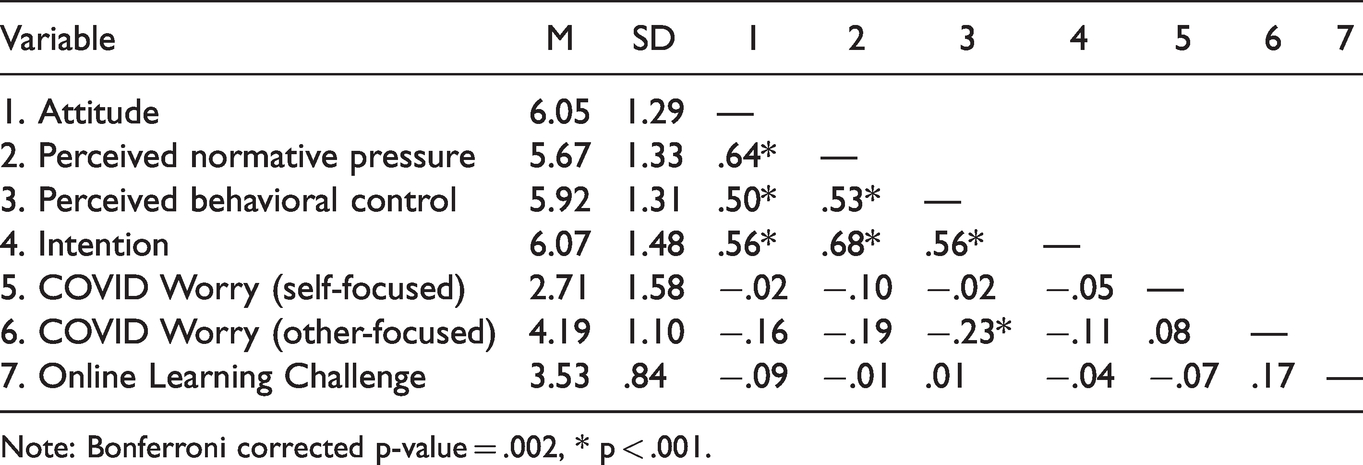
Note: Bonferroni corrected p-value = .002, * p < .001.
Mediation Analysis
We used mediation analysis to determine if the relationship between COVID-19 worry (self & other-focused), online learning challenge, and enrollment intentions was mediated by learners' attitudes, perceived normative pressure, and perceived behavioral control. The mediation analysis was conducted using the open-source JAMOVI statistical package and advanced mediation models (jAMM) module (Gallucci, 2019). A graphical representation of the mediation model can be found in Figure 1.
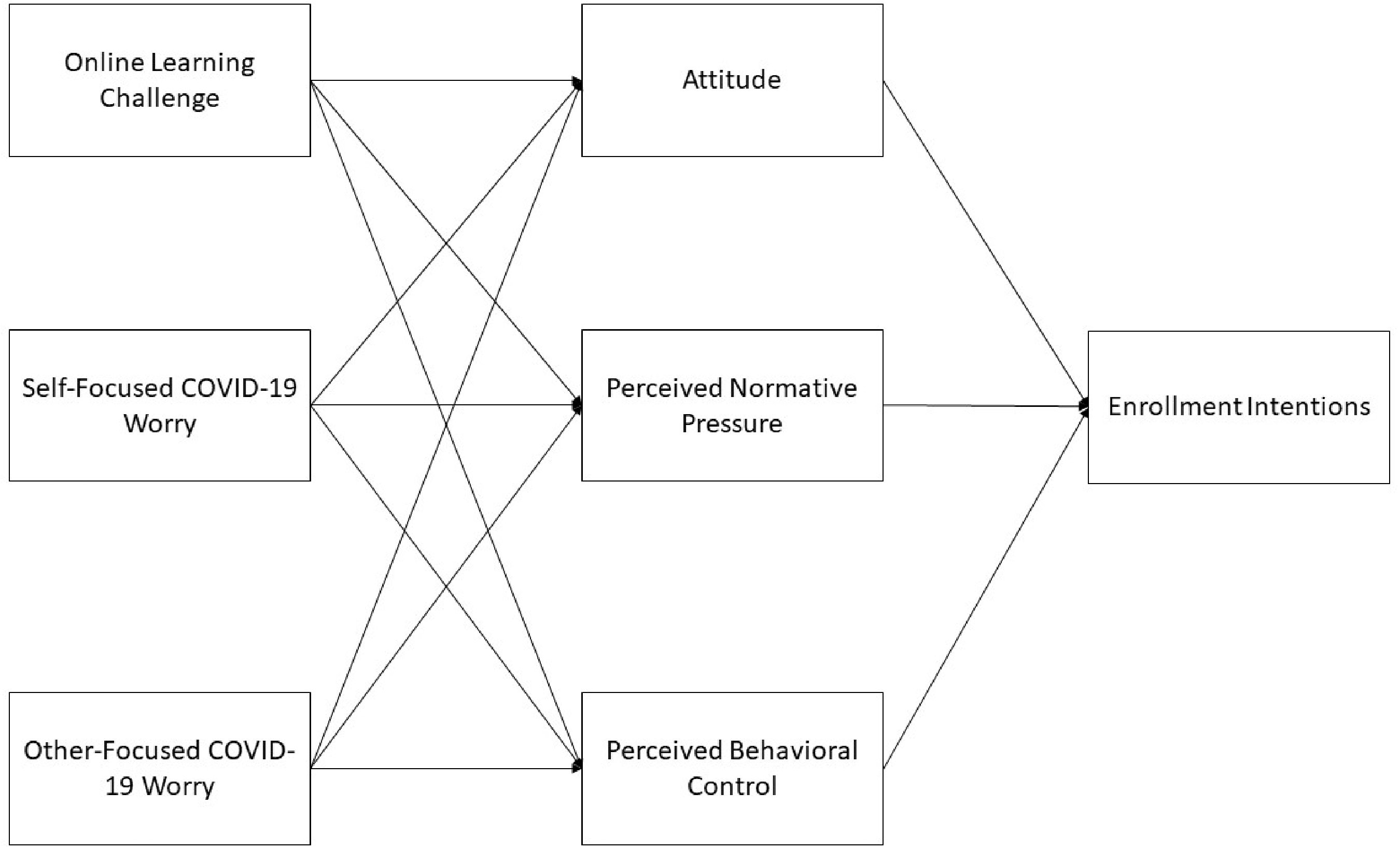
Visual Representation of the Specified Path Model.
To begin, we reviewed total effect estimates to determine the overall influence of COVID-19 concern (other & self-focused) and online learning challenge on enrollment intention. The results indicated the total effect of self-focused COVID-19 worry (β = −.03, p > .05), other-focused COVID-19 worry (β = −.11, p > .05), and online learning challenge (β = .06, p > .05) were non-significant. Traditionally, the presence of total effects has been considered a prerequisite condition for testing indirect effects of variables of interest (Loeys et al., 2014). However, recent work has questioned the viability of this assumption by demonstrating that reliance on significant total effects may obfuscate our ability to detect indirect effects of theoretical and practical significance (Rucker et al., 2011). Specifically, recent work has demonstrated that tests for total effects often have less statistical power than tests for indirect effects – meaning tests of total effects are likely to be non-significant even in situations where significance mediation is occurring (Kenny & Judd, 2014; MacKinnon et al., 2002). As such, leaders in the field of mediation analysis have called for researchers to abandon the notion that indirect effects can be only examined in the presence of significant total effects (Hayes, 2009; Rucker et al., 2011).
Next, we reviewed direct effect estimates to better understand the relationships among the variables of interest. A review of standardized beta coefficients revealed that attitudes (β = .15, p < .05), normative pressure (β = .52, p < .05), and PBC (β = .30, p < .05) were positively associated with behavioral intentions. Further, our results indicated that other-focused COVID-19 worry was negatively associated with attitude (β = −.16, p < .05), normative pressure (β = −.19, p < .05), and PBC (β = −.24, p < .05). Interestingly, self-focused COVID-19 worry, and online learning challenge were not associated with RAM components and did not exert a direct influence on enrollment intention.
Finally, we examined indirect effect estimates to determine if significant mediation effects were present in our data. Examination of indirect direct effects indicates that the relationship between other-focused COVID-19 worry and behavioral intentions was mediated by normative pressure, (β = −.10, p < .05), and PBC (β = −.07, p < .05). Additionally, our results suggested that self-focused COVID-19 worry, and online learning challenge did not exert an indirect influence on enrollment intentions through RAM components. Unstandardized, standardized, and confidence interval estimates for the total, direct, and indirect effects can be found in Table 2. Further, a graphical overview of the primary findings can be found in Figure 2.
Specific indirect, direct, and total effects on enrollment intention.
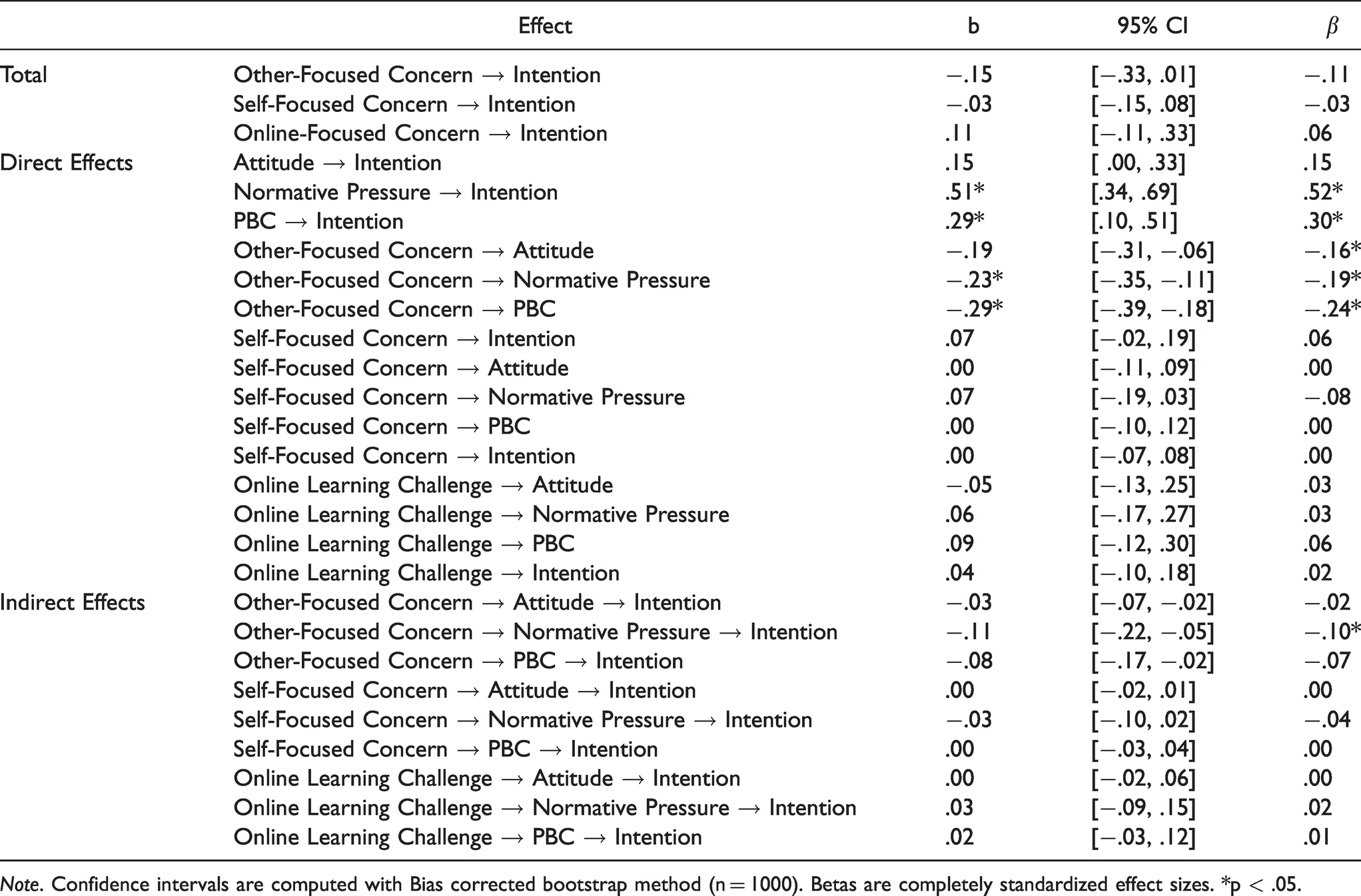
Note. Confidence intervals are computed with Bias corrected bootstrap method (n = 1000). Betas are completely standardized effect sizes. *p < .05.
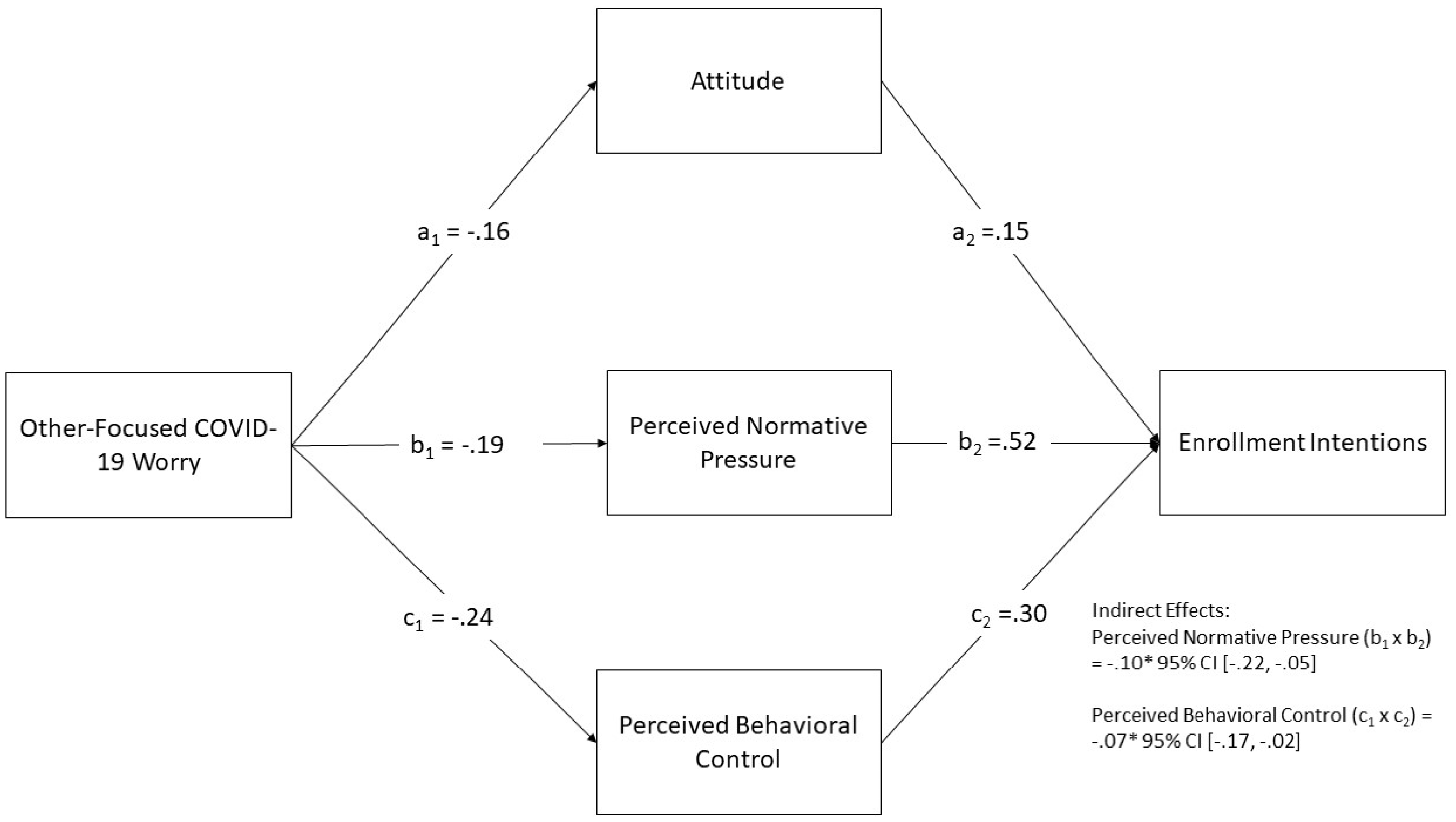
Results of the mediation analysis; Only significant paths are shown. Note. Confidece intervals are computed with Bias corrected bootstrap method (n = 1000). Betas are completely standardized effect sizes.
Point-Biserial Correlation
A key proposition of the Reasoned Action Model is that behavioral intentions are predictive of future behavior. That is, it is assumed individuals with stronger behavioral intentions are more likely to engage in behavior in the future (Fishbein & Ajzen, 2010). We tested this broad assertation using point-biserial correlation to determine the strength of the association between enrollment intention and enrollment behavior. Results of the analysis indicated that behavioral intentions shared a strong, positive association with participants’ Fall 2020 enrollment behavior, r = .60, p < .05.
Discussion
The current study was designed to address three primary objectives. First, we wanted to systematically investigate the viability of the Reasoned Action Model in predicting university enrollment intentions and behavior. Second, given university students across the globe are working to complete their course work in the midst of a global pandemic, we sought to better understand the mechanisms through which COVID-19 related worry influences university enrollment. Finally, given many students were required to make sudden shifts from traditional to online instruction at the onset of the COVID-19 pandemic, we sought to determine if challenges associated with online learning during that transitional period influenced future enrollment intentions.
The Reasoned Action Model and conceptually similar theoretical frameworks (i.e., The Theory of Reasoned Action, The Theory of Planned Behavior) propose behavioral intentions – and eventual behavioral implementation – are heavily influenced by individuals’ attitude toward a behavior, perceived social pressure surrounding the behavior, and perceived control over the behavior (Ajzen, 1985; Fishbein & Ajzen, 1975, 2010). Consistent with these predictions and in support of our H1, our results indicated that RAM components were significant predictors of participants’ intention to enroll in courses during the Fall 2020 semester. Further, our results support H2 and highlight the predictive power of behavioral intentions through the presence of a strong association between our estimate of enrollment intention and actual enrollment behavior. Collectively, these findings add to a substantial body of empirical literature accumulated following the first empirical description of the Reasoned Action Framework demonstrating the viability of motivational factors in explaining volitional behavior (Albarracın et al., 2001; Armitage & Conner, 2001; Hausenblas et al., 1997).
Further, our results provided partial support for H3. Other-focused COVID-19 concern was shown to indirectly influence enrollment intention through perceived normative pressure and PBC. We believe the indirect influence of other-focused COVID-19 concern through PBC is consistent with past work showing that worry is associated with reductions in perceived competence. For instance, previous work has shown that behavioral and cognitive manifestations of worry – such as increased physiological arousal and impaired information processing capability – contribute to feelings of general inadequacy and problem-solving difficulties that undermine individuals’ confidence in their ability to implement volitional behavior (Bandura, 1977; Kelly & Daughtry, 2011; Tallis & Eysenck, 1994).
However, the factors contributing to the indirect influence of other-focused COVID-19 concern through normative pressure are more difficult to isolate. We suspect this mediation effect is the result of the complex interplay between self and other-focused COVID-19 worry, COVID-19 messaging in the popular media, and the impact of worry on health-supportive behaviors. To begin, investigations into the salient dimensions of COVID-19 related anxiety have demonstrated that individuals often report being more worried about loved ones’ health status in relation to COVID-19 than about themselves contracting COVID-19 (Maaravi & Heller, 2020) – a general pattern that was replicated in the current study. Following the onset of the pandemic, world leaders and public health agencies have emphasized the importance of social distancing to slow the spread of coronavirus and protect those individuals most at-risk for serious complications (e.g., the elderly & those with pre-existing conditioning; Anderson et al., 2020; Utych & Fowler, 2020 ). Interestingly, prior work has demonstrated that elevated worry about negative health-related outcomes is associated with stronger behavioral intentions to engage in preventive behavior (Schmiege et al., 2009). Therefore, it is possible students high in other-focused COVID-19 worry might be more willing to avoid activities that involve a considerable degree of social interaction (i.e., attending university courses) in an effort to protect the well-being of important social others. Of course, this relationship is only speculative and additional work is needed to better understand the relationship between other-focused COVID-19 worry and enrollment intention.
Practical Implications
One of the most notable findings of the current study is the considerable impact normative pressure seems to have on enrollment intention and behavior. Specifically, our results demonstrated that normative pressure (beliefs of whether others approve of engaging in a behavior & beliefs regarding whether important others engage in the behavior themselves) were more important to enrollment intention than the perceived benefits of future enrollment (i.e., attitudes) and perceived control over the behavior. When considered in the context of the broader university completion crisis, we believe our results have implications for efforts to increase student retention. As articulated in Tinto’s (1975, 2012) seminal work on student attrition, it is critical to acknowledge the importance of supportive peer and faculty relationships (i.e., social integration) to students’ overall academic success and enrollment decisions. As noted in prior work, the establishment of meaningful relationships can increase students' access to sources of emotional, academic, and practical support, thereby increasing their resilience to academic stress (Jones, 2008; Thompson, 2008; Thompson & Mazer, 2009). Further, we contend that social integration exposes students to powerful sources of normative information – in the form of peers who share certain demographic and personality characteristics and faculty/staff mentors – who encourage students to persist (or disengage) through their behavior and statements regarding the importance of degree completion. As such, we believe colleges and universities could improve student retention through increased use initiatives designed to foster social connection – such as high-quality faculty, staff, and student-driven mentoring programs (Campbell, 2007; Johnson, 1989) and student learning/living-learning communities (Astin, 1985; Schuh & Whitt, 1999). Further, our results highlight the importance of assisting students as they work to cope with health and safety concerns related to COVID-19. In the months following the onset of the pandemic, universities across the country began implementing campaigns to support the mental health of students that include directing at-risk learners to institutional sources of support (e.g., campus health or counseling center), crisis support hotlines, and free stress reduction applications. We believe, and available evidence supports, that utilization of these services can provide students with the coping resources and strategies needed to navigate periods of considerable stress and prevent negative mental health consequences. Further, work in related domains has demonstrated an association between knowledge and worry such that individuals who are more knowledgeable about stress-inducing topics/situations (e.g., cancer, aging, etc.) are less prone to worry. Therefore, we encourage universities to devote resources to educational programming emphasizing precautionary measures that have been shown to slow the spread of COVID-19 and potential modes of transmission in an attempt to alleviate COVID-19 worry that has the potential to impact enrollment decisions.
Limitations
The current study has several limitations readers should consider when interpreting our primary findings. First, we relied on single-item instruments to measure self & other-focused COVID-19 worry. Although single-item measurement tools can provide reliable and valid data (Christophersen & Konradt, 2011; Wanous & Reichers, 1996), it is possible our reliance on truncated measures prevented us from developing a fully realized representation of the relationship between COVID-19 focused worry and students’ enrollment attention. Therefore, we encourage researchers to replicate our work using validated measures of COVID-19 related worry and anxiety such as the COVID-19 stress scales (Taylor et al., 2020) and coronavirus stress measure (Arslan et al., 2020). Further, participants in the current study were recruited from a single university and as such are limited in terms of demographic characteristics. We believe future work could overcome this limitation through the use of a multi-lab approach to better isolate the relationships among worry, RAM components, enrollment intention, and enrollment behavior in a diverse group of university learners. Finally, it is important to note that our sample consisted only of current students of the University of Texas at Tyler. Therefore, the results presented in the current study may not accurately reflect the relationship between COVID-19 worry, online learning attitudes, and RAM components among first-time freshman students.
Footnotes
Declaration of Conflicting Interests
The authors declared no potential conflicts of interest with respect to the research, authorship, and/or publication of this article.
Funding
The authors received no financial support for the research, authorship, and/or publication of this article.
