




Abstract
Background:
This study evaluated the accuracy and safety of the Anytime 5Pro continuous glucose monitoring (CGM) system, a real-time, factory-calibrated device, over a 16-day period in adults with diabetes.
Methods:
Adult participants with type 1 or type 2 diabetes were recruited from three clinical sites in China. Each participant was equipped with four sensors (one on each upper arm and two on the abdomen) for a period of up to 16 days. To evaluate sensor performance, participants were randomly assigned to one of three 7-hour clinic sessions on days 1 or 2, days 7, 8 or 9, and day 16. During the sessions, the real-time glucose values measured by Anytime 5Pro CGM system were compared with venous blood glucose values measured by the EKF blood glucose detector. Primary endpoints for assessment were the mean absolute relative difference (MARD), the proportion of CGM values within ± 20%/±20 mg/dL of reference values, and the percentage of paired points within Zones A and B of the consensus error grids.
Results:
In the cohort of 72 participants (287 sensors), the CGM system exhibited an overall MARD of 8.58%, with 96.59% of values within the ± 20%/±20 mg/dL criteria. Comparative analysis revealed similar accuracy between arm (MARD: 8.58%; agreement: 97.03%) and abdomen (MARD: 8.58%; agreement: 96.16%) sensor placements. Throughout the 16-day wear period, the ± 20%/±20 mg/dL agreement rates remained above 95%, with MARDs ranging from 8.30%–8.88%. Consensus error grid analysis showed 99.99% of points in Zones A and B. No serious adverse events were reported.
Conclusions:
The system demonstrated accurate glucose measurements across the 16-day wear period, irrespective of sensor placement site or glucose concentration.
This is a visual representation of the abstract.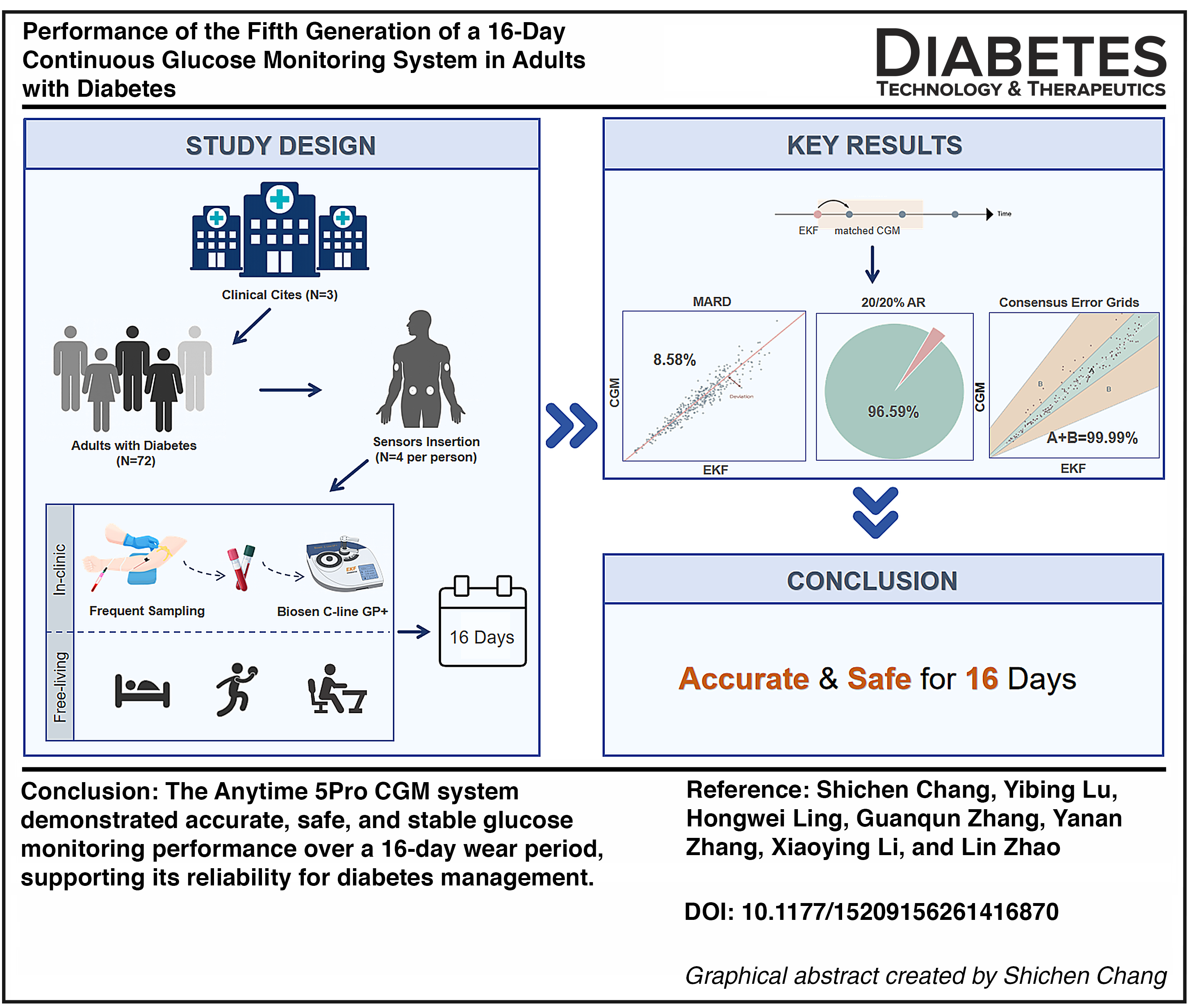
Get full access to this article
View all access options for this article.
References
Supplementary Material
Please find the following supplemental material available below.
For Open Access articles published under a Creative Commons License, all supplemental material carries the same license as the article it is associated with.
For non-Open Access articles published, all supplemental material carries a non-exclusive license, and permission requests for re-use of supplemental material or any part of supplemental material shall be sent directly to the copyright owner as specified in the copyright notice associated with the article.
