



Abstract
Objective:
A majority of adults with type 1 diabetes (T1D) are overweight (OW) or obese (OB) and often struggle to reach glycemic targets. Tirzepatide, a dual-incretin approved for type 2 diabetes (T2D) and OW/OB, has been shown to improve glucose control, reduce body weight, and insulin requirements in off-label adjunctive use for patients with T1D. This study evaluated changes in continuous glucose monitoring (CGM) data over 12-months of tirzepatide use in OW/OB adults with T1D.
Materials and Methods:
This a single-center, retrospective, longitudinal case-control study included 61 OW/OB adults with T1D using tirzepatide and 54 computer-matched (for age, HbA1c, and weight) controls. CGM data were analyzed at baseline and every 3 months over a 15-month period (−3, 3, 6, 9, and 12 months). We assessed both within- and between-groups changes in CGM metrics from baseline at each time point.
Results:
Baseline characteristics were similar between tirzepatide-treated and control groups for age, HbA1c, and body weight. Compared with controls, tirzepatide-treated group significantly improved CGM metrics over 12 months. Time in range (TIR) was higher at 3 months (+4.6%, P = 0.04) and remained greater at 6 (+9.0%, P < 0.001), 9 (+6.9%, P < 0.001), and 12 months (+7.4%, P < 0.001). Time in tight range (TITR) was also higher at 6–12 months (P ≤ 0.02). Mean glucose, time above range (TAR), time >250 mg/dL, and coefficient of variation were all lower in the tirzepatide group compared with controls. Time below range <70 mg/dL (TBR) and TBR2 (<54 mg/dL) remained similar between groups throughout the study. At 12 months, a greater proportion of tirzepatide-treated participants achieved composite CGM targets (TIR ≥70% and TBR <4%) compared with controls (50.8% vs. 25.9%; P < 0.01). No severe hypoglycemia or diabetic ketoacidosis occurred in either group.
Conclusions:
We conclude that adjunctive tirzepatide treatment in OW/OB adults with T1D was associated with sustained improvements in CGM metrics over 12 months, without increased hypoglycemia risk in this real-world study. Proper long-term randomized control trials are needed to confirm our findings.
This is a visual representation of the abstract.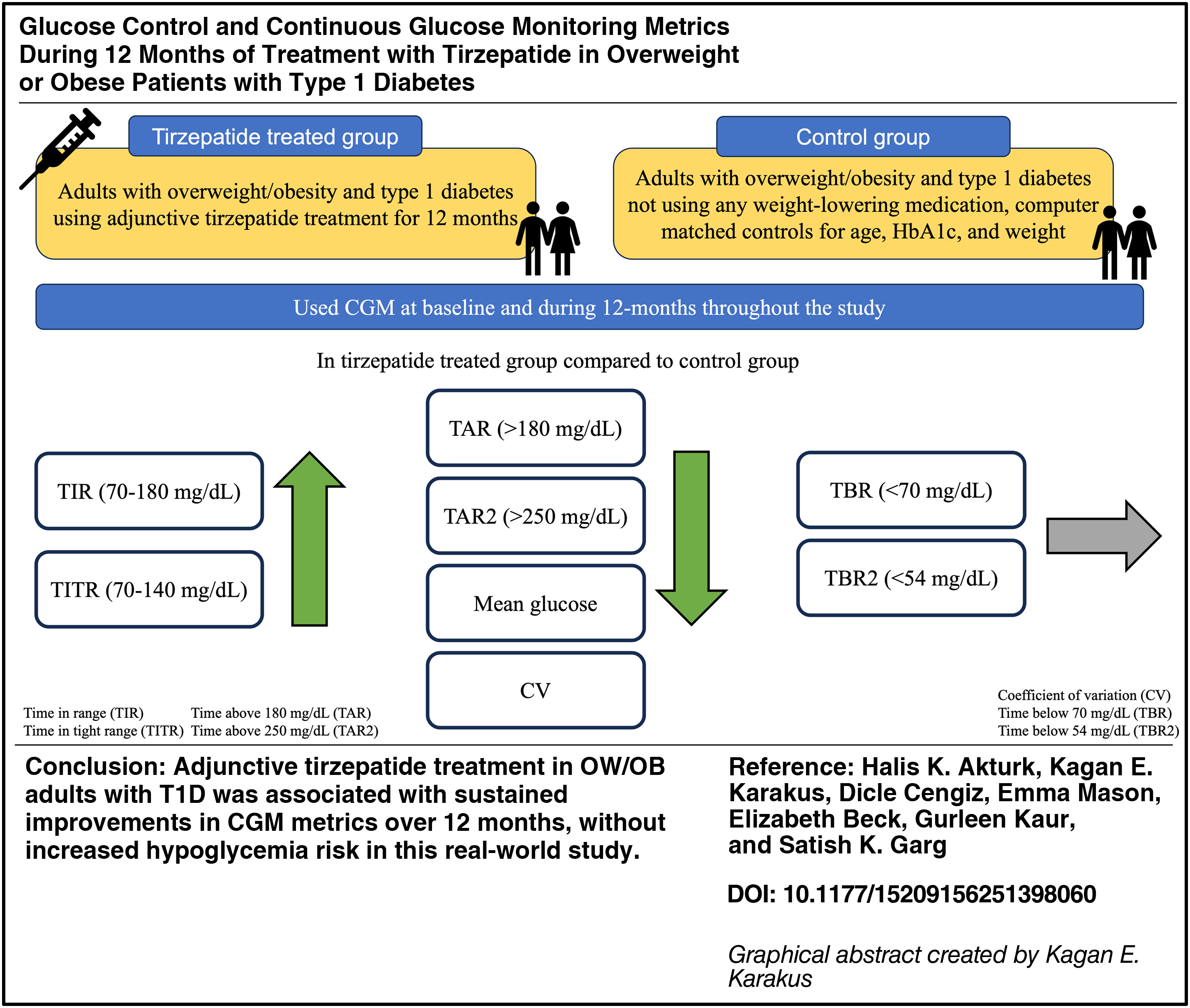
Keywords
Get full access to this article
View all access options for this article.