



Abstract
When asked about their health status, people sometimes intentionally respond inaccurately, such as pretending to feel better or worse than they actually do. This behaviour is often referred to as ‘faking’ and can be motivated by various reasons, including the desire to gain certain benefits or avoid negative consequences. In this study, we explored whether personality traits Machiavellianism, narcissism, psychopathy and sadism (i.e., the Dark Tetrad) are related to three aspects of faking bad and faking good behaviour. Specifically, we looked at the relationship of students’ (N = 215) scores on the Short Dark Tetrad scale (SD4) and their (1) spontaneous faking behaviour (i.e., honest responses on Inventory of Problems-29, faking bad measure, and on Supernormality Scale, faking good scale); (2) Self-reported history of faking bad and faking; and (3) Propensity to fake in civil and criminal contexts. Propensity to faking bad and faking good was investigated using vignettes including both civil and criminal contexts (Faking Badcivil n = 54; Faking Badcriminal n = 54; Faking Goodcivil n = 54; or Faking Goodcriminal n = 53) after which students were asked to rate their willingness to fake in depicted situations. The results indicated that Machiavellianism, psychopathy and sadism were associated with spontaneous faking bad, whereas narcissism was linked to spontaneous faking good. Additionally, no significant relationship emerged between Dark Tetrad traits and the history of faking behaviour. Lastly, Machiavellianism was positively associated with a greater propensity to fake, regardless of the context.
Distorted symptom reporting, whether through exaggeration or minimization, has serious consequences, including erroneous decision-making in areas such as insurance claims and legal sentencing. Therefore, understanding the mechanisms and factors influencing faking behaviour is crucial for its detection and prevention. Symptom reporting generally involves two primary types of faking behaviour: ‘faking bad’, which entails overstating or fabricating symptoms, and ‘faking good’, which involves concealing genuine problems. These behaviours are typically driven by the desire to gain certain benefits or avoid negative consequences, with motivations varying based on context. For instance, in forensic settings, the motive for faking bad is often to obtain monetary compensation (Rogers, 2018), while faking good may be aimed at receiving parole or securing child custody (Mazza et al., 2019). In civil contexts, motives could include obtaining sick leave (faking bad) or securing a job (faking good; Levashina, 2018; Rogers, 2018). The prevalence of faking bad is estimated to be around 15 ± 15% (Young, 2015), while faking good is believed to be even more prevalent (Rogers, 2018).
Although much of the research on faking bad behaviour stems from forensic contexts, surveys of the general population reveal similar rates (Dandachi-Fitzgerald et al., 2020; Boskovic et al., 2024a; Puente-López et al., 2023). These surveys found that 34% of the general population have, at some point, claimed non-existent or exaggerated symptoms, mainly to secure sick leave or justify a failure. Additionally, over half of the respondents (59% and 62.4%, respectively) reported knowing someone who had engaged in faking bad, indicating its high prevalence (Dandachi-Fitzgerald et al., 2020; Puente-López et al., 2023). Similar findings emerged in surveys about Covid-19 infection reports, with 28% of respondents knowing someone who faked and 14% admitted to doing so themselves. The motives behind faking bad behaviour were consistent with previous findings, primarily involving obtaining sick leave (Boskovic et al., 2024a).
The Boskovic et al. (2024a) survey also addressed how often people concealed (i.e., faked good) having Covid-19. This addition is significant because most available information about faking good behaviour pertains to job applicants and personality reports (Levashina, 2018). In their Covid-related behaviour, 12% of respondents admitted to concealing their infection, while over half reported knowing others who had hidden their Covid-19 status (51%). The main motives were avoiding stigma or keeping appointments (Boskovic et al., 2024a). These rates, along with those from custody battles (e.g., 44%; Mazza et al., 2019), support the view that faking good is even more prevalent than faking bad, albeit these estimates vary depending on the assessment methods used and the context of the assessment (Rogers, 2018).
Faking bad is typically assessed using validity scales from multi-scale personality inventories (e.g., the F-r or Fp-r scales of MMPI-2-RF; Ben-Porath & Tellegen, 2011) or stand-alone tests. The latter usually include implausible claims that genuine patients would rarely endorse but that people who fake report experiencing (Symptom Validity Tests [SVTs]; Rogers, 2018). Faking good, on the other hand, is defined as the enhanced self-presentation of one's personality, or more broadly, as social desirability, is mostly investigated in job-seeking contexts (Levashina, 2018). It is commonly measured using validity scales of personality inventories that contain items indicating flaws that people who underreport will avoid acknowledging (e.g., the L scale of MMPI-2-RF; Ben-Porath & Tellegen, 2011). In health contexts, commonly concealed issues range from mental health conditions and substance abuse (Bogaers et al., 2021) to even everyday complaints (e.g., headaches). In prior studies of underreporting behaviour, hiding even commonly present complaints was labelled as ‘supernormality’ (Cima et al., 2003), a term that is now widely recognised. However, research has shown that measures of various forms of faking behaviour, ranging from faking bad to supernormality, are not only driven by external motives but can also be influenced by individual differences, such as personality traits (for a review, see Van Helvoort et al., 2022).
Personality and Faking Behaviour
The relationship between different personality traits and both types of faking behaviours has only recently garnered more attention from researchers. This is an important area of study, especially given the long-standing assumptions about this link that have lacked thorough empirical examination. For instance, in the Diagnostic and Statistical Manual (5th Revised Edition; DSM-5-TR, American Psychological Association, 2022), it is stated that faking bad should be strongly suspected in the presence of antisocial personality disorder. However, the review of the empirical work on this topic found this link to be either non-existent or present to a weak extent (Niesten et al., 2015). The available studies on the personality-faking relationship indicated that some other personality features, such as alexithymia, do play a more important role in faking behaviour, although of modest impact (van Helvoort et al., 2022). Specifically, people with higher levels of alexithymia might be more prone to endorse SVT items resulting in scores indicative of faking bad behaviour (Brady et al., 2017; Merckelbach et al., 2018). Similar findings were observed in individuals scoring high on dissociation (Merckelbach et al., 2017). Another individual trait of interest is the fantasy proneness which has been moderately positively correlated with SVT scores (Kunst et al., 2011; Merckelbach & Smith, 2003). Other studies also confirmed this relationship (correlations being >.50; Boskovic et al., 2019). However, no association was found between fantasy proneness and the narrative style of fabricated symptoms (Boskovic et al., 2021). As for faking good, the findings are rather inconsistent (see van Helvoort et al., 2022). These inconsistencies may be due to various operationalisations of this behaviour, employment of different assessment measures and/or diverse samples used (e.g., students vs. war veterans). As expected, due to their positive relationship with faking bad, both dissociation (Elzinga et al., 2002) and alexithymia (Bouchard, 2008; Vellante et al., 2013) were found to be in an inverse relationship with socially desirable responding. However, other studies found no relationship between these constructs (e.g., Otgaar et al., 2017; Waldstein et al., 2002). The link between faking good and fantasy proneness has yet to be addressed by researchers.
Another understudied area is the relationship between faking behaviours and broader personality traits that are often associated with deception, such as Machiavellianism, narcissism and psychopathy (i.e., Dark Triad; Paulhus & Williams, 2002) and the recently added Sadism (Dark Tetrad; Paulhus et al., 2020). Machiavellianism involves manipulation and superficial charm, narcissism is characterized by dominance and superiority, psychopathy includes impulsivity and low affective empathy, and sadism involves deriving pleasure from causing harm (Paulhus et al., 2020). These traits have been linked to deceptive behaviour to varying degrees (Forsyth et al., 2021). Machiavellianism is shown to be the strongest predictor of lying (Baughman et al., 2014) and propensity to lie in general, whereas narcissism is linked to increased confidence in one's lies (Forsyth et al., 2021). Psychopathy, besides the propensity to lie, is also linked to a lack of remorse (Baughman et al., 2014), and sadism is related to propensity to lie (Forsyth et al., 2021), internet trolling (Craker & March, 2016) and online deception (Farooq & Ashraf, 2022).
In the domain of faking behaviour, the existing literature provides inconsistent results. Regarding faking bad behaviour, available research indicated no significant relationship with any of the four antagonistic traits (Bensch et al., 2019). Similarly, there is no significant link between the ability to fake schizophrenia and Machiavellianism, narcissism, psychopathy and sadism (Akca et al., 2023). In the context of faking good, it was shown that people with heightened levels of narcissism exhibit slightly higher supernormality (i.e., symptom concealment), especially when reporting about depression (De Page & Merckelbach, 2021). This is expected, as people with narcissistic traits may view admitting such issues as a weakness, contrary to the superiority they want to project. However, another study found a negative relationship between faking good and narcissism, suggesting that the relationship is challenging to establish due to a potential ceiling effect people with high narcissism might already exhibit in honest conditions (Bensch et al., 2019; Maaß et al., 2017). Instead of narcissism, these authors argued that Machiavellianism is more relevant for faking good (Bensch et al., 2019).
Overall, these limited results suggest that Machiavellianism, narcissism, psychopathy and sadism may play a more significant role in faking good than in faking bad. Yet, the above-mentioned studies employed different measures of assessing faking in general, thus, the inconsistent findings might be due to the inclusion of different, although mutually related, aspects of faking.
Current Study
In this exploratory study, we investigated the relationship between both forms of faking behaviour (i.e., faking bad and faking good) and students’ antagonistic traits, defined as the Dark Tetrad. Specifically, we examined multiple aspects of faking behaviour by looking at: (1) spontaneous (i.e., uninstructed) responses to tests designed to detect faking bad (i.e., overreporting; Inventory of Problems-29; IOP-29; Viglione et al., 2017) and faking good (i.e., underreporting; Supernormality Scale; SS; Cima et al., 2003); (2) self-reported history of faking bad and faking good behaviour; and (3) propensity to engage in faking bad and faking good behaviour in hypothetical situations depicted in different vignettes. To investigate the propensity to fake bad and fake good, we used two contexts (civil vs. criminal), randomly allocating participants to one of four conditions. Each participant received a vignette depicting a scenario they were to imagine themselves in and then report the likelihood of engaging in faking behaviour. We then examined the correlations between participants’ scores on Machiavellianism, narcissism, psychopathy and sadism and the three aspects of faking behaviour: spontaneous responses, self-reported history and propensity in hypothetical situations.
This study is particularly relevant as it addresses underexplored aspects of faking behaviour and provides valuable insights into the dynamics between personality traits and the validity of health reports. Based on prior research, we hypothesized that Machiavellianism would be the strongest predictor of both types of faking behaviour considering the three aspects of each type of faking: spontaneous, historical and propensity. Narcissism was expected to be specifically related to faking good behaviour (spontaneous, historical and propensity).
Method
Participants
According to the a priori G*power analyses (ɑ set to .05, β to .80, f = .50), the required sample was 180. Initially, 250 students joined the project, but 35 were excluded. Namely, 29 provided incomplete responses, 2 did not give permission to use their data, and 4 people failed the embedded attention checks (see Materials). The final data thus included 215 participants, mostly females (86.5%, n = 186) of Dutch nationality (57%, n = 122) 1 , with an average age of 21 years (SD = 2.63, range 18–31). All participants reported high English proficiency (M = 4.12, SD = .66).
Participants were randomly allocated to one of four vignette groups: faking bad civil context (Faking Badcivil n = 54), faking bad criminal context (Faking Badcriminal n = 54), faking good civil context (Faking Goodcivil n = 54) and faking good criminal context (Faking Goodcriminal n = 53). The groups did not differ in terms of age (F(3, 214) = .85, p = .47), nor in English proficiency (F(3, 214) = .91, p = .46).
Materials
The Short Dark Tetrad (SD4; Paulhus et al., 2020): SD4 contains 28 items that cover the following traits: Machiavellianism, narcissism, psychopathy and sadism. The response format is a 5-point Likert scale (1 = strongly disagree, 5 = strongly agree), and the sum of scores ranges from 0 to 140, with higher scores indicative of higher levels of the traits (Paulhus et al., 2020). The SD4 shows excellent levels of internal consistency with Cronbach's α estimated at .83. Looking at the subscales, internal consistency ranged from .65 for Machiavellianism, .81 for narcissism, .73 for psychopathy and .73 for sadism. We embedded one attention check in this measure (i.e., Please select ‘Agree’), and one inattentive participant was removed from the dataset.
The Inventory of Problems-29 (IOP-29; Viglione et al., 2017, Viglione & Giromini, 2020): IOP-29 is a test that captures negative response bias using 29 items, from which 26 require self-report and three items are problem-solving tasks. IOP-29 pertains to presentations for post-traumatic stress disorder, depression, anxiety, psychosis, cognitive impairment and combinations of these claims (Giromini & Viglione, 2022; Puente-López et al., 2023). For 27 of the 29 items, the response format includes three possibilities, True/False/Doesn't make sense (Viglione et al., 2017); the two remaining items use an open-ended format. The total score is computed as False Disorder Score (FDS) that indicates a probability of fabricated complaints (range being 0 to 1). Overall, the scale shows excellent validity in detecting negative response bias (Giromini & Viglione, 2022; Giromini et al., 2022, Puente-López et al., 2023). As in SD-4, we also included one attention check in IOP-29 and three participants failed it, hence, were removed from the dataset.
The Supernormality Scale (SS; Cima et al., 2003 ): SS contains 37 items that capture everyday symptoms or behaviours likely to be endorsed among the general public, falling under two subscales: supernormality and social desirability. Also, five items are bogus and check the attentiveness of responders. The response format includes two options: True and False. It is expected that individuals displaying positive response bias would claim not to have experienced depicted issues or situations. The total score, which is a sum of subscales scores, ranges from 0 to 32, with higher scores indicating higher supernormality. The proposed cutoff point of >15 showed good sensitivity (.74), but low specificity (.42; Cima et al., 2003). The SS displayed excellent internal consistency with Cronbach's α estimated at .83. We embedded one attention check in SS and none of the participants failed it.
History of Faking Behaviour: Participants were asked whether they had ever reported or exaggerated non-existent symptoms (faked bad) and if they concealed existing complaints (faked good) in the past, to which they could indicate ‘Yes’ or ‘No’. If answered affirmatively, participants provided a number of times they did so in the last two years and selected strategies they had used to appear convincing (for the full list, see Supplemental Material). Questions about the history of faking bad and faking good were presented in randomized order.
Vignettes: Participants assigned to the faking bad group received one of two vignettes. In the civil context vignette, participants imagined a minor car accident with no personal injury but were given the option to falsely claim a whiplash injury to receive monetary compensation from their insurance company. In the criminal context vignette, participants envisioned a high-conflict situation in a bar where they resolved the conflict by hitting another person. The following day, they received a police summons because the other person had reported the incident. Their attorney advised them to feign trauma-related issues to potentially reduce their legal consequences. Participants in the faking good civil context group were instructed to pretend being in a job interview and had to portray being in a good mood and satisfied with life in order to secure the job, despite actually feeling depressed. In the criminal context vignette, participants were asked to imagine driving home after having dinner and drinks with friends. They were pulled over by a police officer who asked them about alcohol consumption and informed them that the officer did not have a breathalyser. Participants were then asked to decide whether to lie or to be honest about their alcohol consumption. Students were then asked to rate their willingness to fake in the depicted situation, their confidence in their ability to fake, and the moral justification for such behaviour, using a 7-point scale (1 = extremely unwilling/unconfident/unjustifiable; 7 = extremely willing/confident/justifiable).
Procedure
The study was conducted online through Qualtrics and posted on our university's student research participation platform. Upon accessing the link, participants were first asked to provide informed consent. Once consent was given, they completed demographic questions regarding their gender, age, nationality and English proficiency. Participants then completed three questionnaires (i.e., SD4, IOP-29 and SS) in a randomized order. Each of the scales included embedded attention checks in order to ensure that we would only inspect the scores of participants who attentively participated in our study. Following the completion of these questionnaires, participants were asked about their history of faking bad and faking good behaviour. Participants were then randomly assigned to one of four vignettes (see Supplementary Materials for a full description of the vignettes) followed by questions regarding their willingness to engage in faking, confidence in doing so and views on the morality of such behaviour. After completing these tasks, participants were asked to evaluate, using a 5-point scale (1 = not at all, 5 = extremely), their experience of the study, including their motivation, the clarity of the questions and instructions, and the overall difficulty. They were also given the opportunity to ask questions and provide comments. Finally, participants were debriefed, thanked for their participation and requested to grant permission for their data to be used. The study was approved by the standing ethical committee of the Erasmus School of Social and Behavioural Sciences, Erasmus University Rotterdam.
Data Analysis
The data were first inspected using descriptive analyses. Then, using one-way analyses of variance (ANOVA), we compared the four conditions’ (independent variable) scores obtained on SD4, IOP-29, SS and propensity, confidence and morality questions (dependent variables). Further, the relationship between the Dark Tetrad and spontaneous faking was inspected using Spearman's rho and Pearson's r coefficient. Namely, the scores on IOP-29 were skewed so we opted for Spearman’ rho and as this issue was not present for SS, we used Pearson's r. The correlation with history, and propensity, confidence and morality ratings per each group were inspected via Spearman's rho coefficient. All analyses were conducted using the Statistical Package for the Social Sciences (SPSS) software. The data and the outputs are available at open science framework platform: https://osf.io/xbr56/.
Results
Participation Experience: Motivation, Clarity of Questions and Difficulty of the Task
Overall, our participants (N = 215) reported moderate motivation (M = 3.28, SD = .77), moderate clarity of questions (M = 3.67, SD = .95) and high clarity of instructions (M = 4.21, SD = 74) and low difficulty of the task (M = 1.43, SD = .70). We inspected whether the four conditions differed in any of these domains and found that none of the contrasts were statistically significant (Fs < 1.16, ps > .32).
Spontaneous Faking Bad (IOP-29) and Faking Good (SS)
Regarding the response style of our sample, the FDS score on IOP-29 was low (M = .14, SD = .12; range .02–.78), which indicates that participants in general did not show any sign of negative response bias. For positive response bias, the supernormality average score was moderate, slightly above the proposed cutoff (M = 17, SD = 5.50, range 5–30). We inspected whether the four different conditions that were subsequently formed differed in their a priori responding styles, but the difference was not significant for symptom overreporting (IOP-29; F(3, 214) = .84, p = .47, ɳ2 = .01), nor for supernormality (SS; F(3, 214) = 1.21, p = .31, ɳ2 = .02).
History of Faking Behaviour
We asked our participants whether they ever exhibited faking behaviour in the past. In relation to faking bad, 33.5% (n = 72) of our participants acknowledged faking in the past, on average four times (range 1–15 times). We asked these participants to report the strategies they used to appear convincing and 51.4% (n = 37) stated using extensive symptom description, 45.8% (n = 33) behavioural expression of symptoms, 19.4 (n = 14) emotional appeal and the same proportion of students (19.4%, n = 14) reported using false evidence. Participants also added other strategies (22.2%, n =16), such as calling/texting/e-mailing others to ensure a written trail of their claims. They rated their confidence in their prior faking performance using a 7-point scale, and their average responses indicated relatively high confidence (M = 5.32, SD = 1.15).
When asked about prior faking good, 48.4% (n = 104) confirmed exhibiting such behaviour, approximately 26 times during the prior two years (range 1–600 times). The most commonly used strategies were downplaying the symptoms (76%, n = 79), avoidance of talk about health or keeping it superficial (68.3%, n = 71), putting physical effort to hide the symptoms/discomfort (56.7%, n = 59), providing false evidence of good health (16.3%, n = 17). Participants also added other strategies (11.5%, n = 12), namely joking about the issue and denying it when confronted about it. Participants’ reported confidence in their fake good performance was high (M = 5.53, SD = 1.08).
Propensity to Fake Bad and Good, Confidence and Morality
We inspected the participants’ ratings on propensity to engage in faking, confidence in their performance and morality of such behaviour between the four conditions. Overall, the lowest ratings on all three domains were obtained among participants placed in Faking Bad criminal context, whereas the highest were provided by those in Faking Good in civil setting (see Table 1).
Participants’ Ratings (Range: 1–7) on Propensity to Fake, Performance Confidence and Morality of Faking Across Four Conditions.
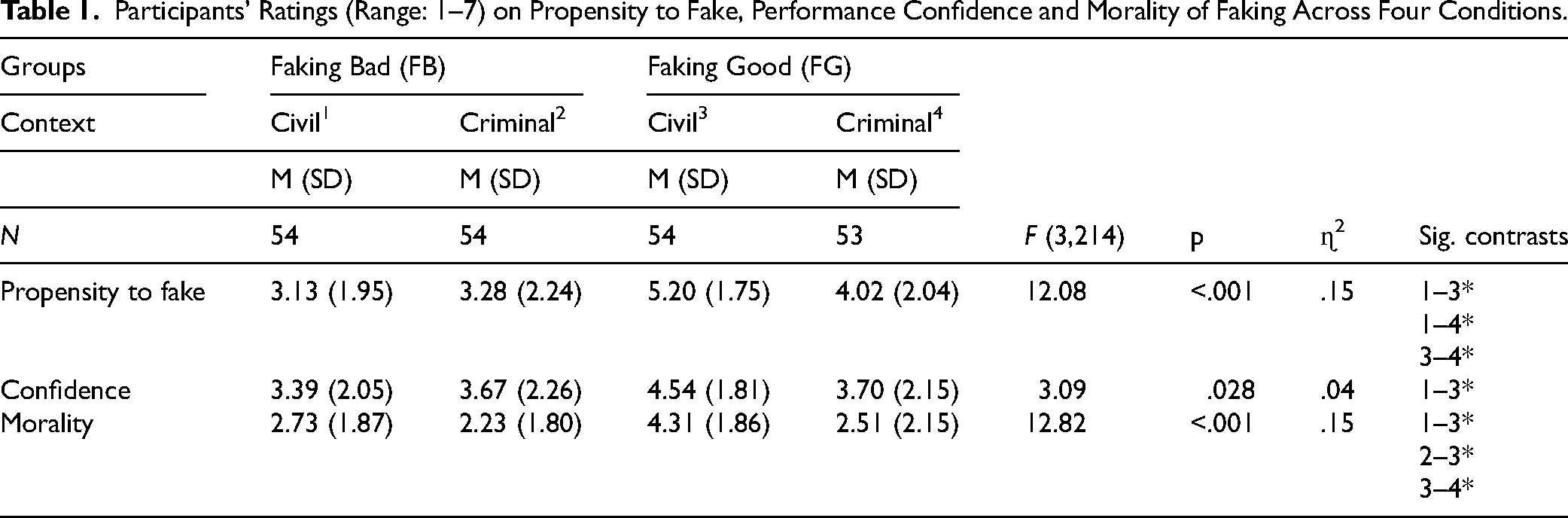
Bonferroni corrected post-hoc tests indicated that, regarding the propensity to fake, the Faking Bad civil context group obtained significantly lower ratings than Faking Good in both civil (p < .001) and criminal contexts (p < .001). The Faking Good groups mutually differed, with civil setting group being more inclined to engage in faking than Faking Good in criminal context (p = .015). Participants’ confidence ratings only differed in civil context groups, between Faking Bad and Faking Good groups (p < .001). Finally, ratings of morality (i.e., justifiability) of faking behaviour were significantly lower for Faking Bad in civil context than for Faking Good in the same setting (p < .001), as well as for Faking Bad in criminal setting than for Faking Good in civil context (p < .001). Also, Faking Good groups mutually differed, with Faking Good in civil setting receiving higher morality ratings than Faking Good in criminal context (p < .001).
Looking separately within Faking Bad and Faking Good conditions, the only significant differences were observed between the two Faking Good groups. Namely, propensity ratings were significantly higher for the civil setting group than for criminal context condition (p = .015), and similar was found for the morality ratings (p < .001; see Table 1).
Dark Tetrad (SD4) and Faking (Spontaneous, History and Propensity) Behaviour
On the SD4, with each subscale ranging from 0 to maximum 35 points, our participants exhibited moderate levels of Machiavellianism (M = 22.30, SD = 3.82, range 13–35) and slightly lower levels of narcissism (M = 18.51, SD = 4.92, range 7–30), psychopathy (M = 12.71, SD = 4.06, range 7–26) and sadism (M = 14.35, SD = 4.66, range 7–33). The four conditions did not differ in any of the four traits (Fs < 1.37, ps > .25, ɳ2 < .02).
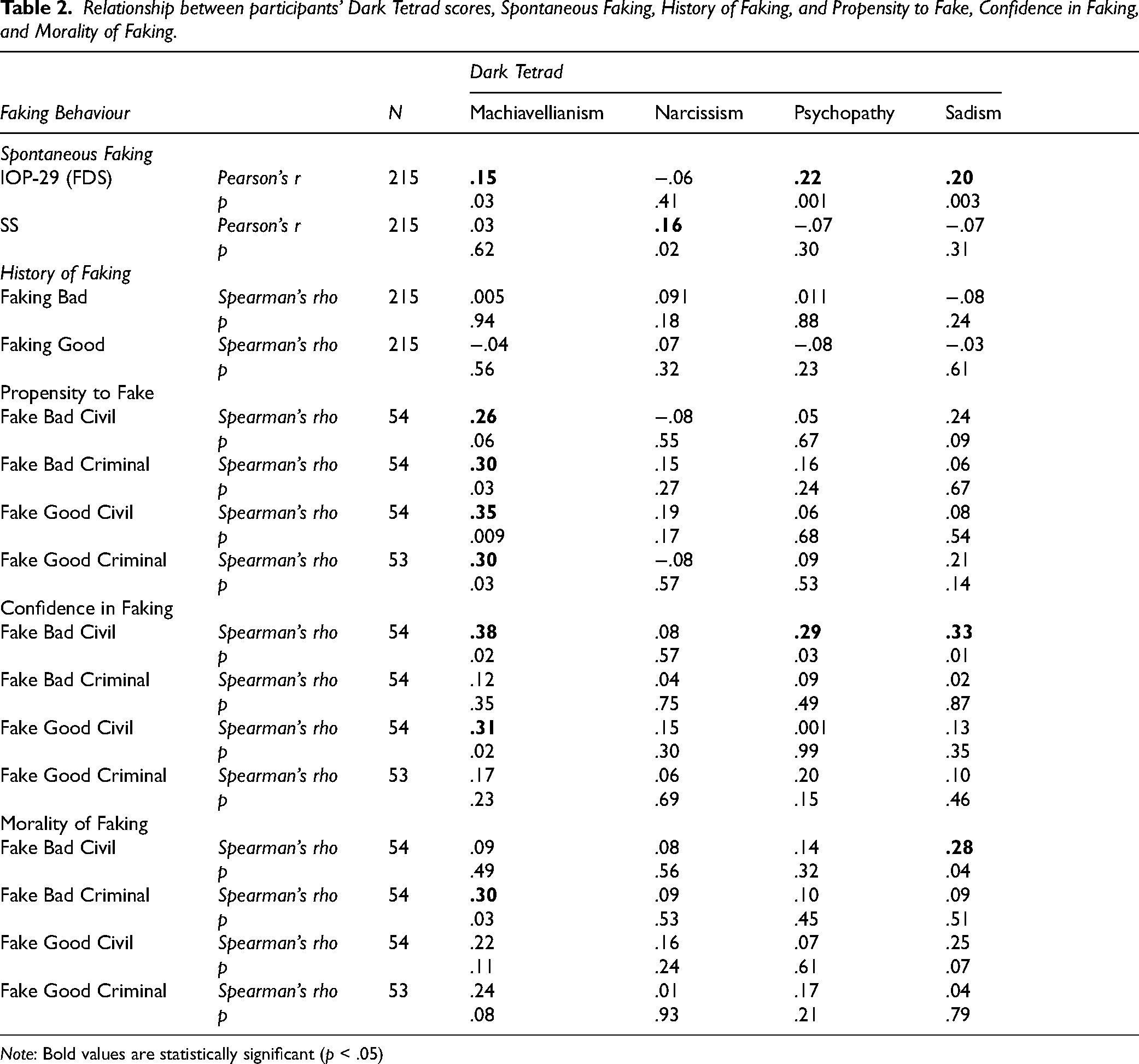
We first inspected whether the participants’ scores (N = 215) on Dark Tetrad were related to their response styles measured via IOP-29 and SS. Machiavellianism, psychopathy and sadism appear significant for symptom overreporting, whereas narcissism scores had a weak but significant relationship with supernormality. Next, we inspected the relationship between participants scores on SD4, their self-reported (yes/no) history of engaging in faking bad and faking good behaviour. None of the four antagonistic traits correlated significantly with the reported history of faking behaviour (see Table 2).
Relationship between participants’ Dark Tetrad scores, Spontaneous Faking, History of Faking, and Propensity to Fake, Confidence in Faking, and Morality of Faking.
Note: Bold values are statistically significant (p < .05)
Finally, we examined the relationship between Dark Tetrad (SD4) scores and participants’ propensity ratings (1–7) to engage in faking bad or good across different contexts. Machiavellianism emerged as the only trait significantly correlated with propensity ratings across all four conditions. However, the overall correlation was moderate, with faking good in a civil (i.e., job-seeking) context showing the strongest correlation. But it should be noted that sadism was marginally associated with faking bad in civil context (Spearman's rho = .23, p = .088). We also inspected the relationship between participants’ confidence and morality ratings (ranging from 0 to 7) across different faking conditions and their reported levels of four antagonistic traits. Higher confidence in faking bad in a civil context was associated with higher Machiavellianism (Spearman's rho = .38, p = .02), psychopathy (Spearman's rho = .29, p = .03) and sadism (Spearman's rho = .33, p = .01). However, Machiavellianism was the only trait significantly linked to confidence in faking good in the same context (Spearman's rho = .31, p = .02). Regarding morality ratings, the only significant correlations were between faking bad in a civil context and sadism (Spearman's rho = .28, p = .04) and between faking bad in a criminal context and Machiavellianism (Spearman's rho = .30, p = .03; see Table 2).
Exploratory Analyses: Mutual Relationship of Different Aspects of Faking Behaviour
We further explored the correlations between different aspects of faking behaviour. Specifically, we examined the relationship between spontaneous faking bad (measured by IOP-29 scores) and faking good (measured by SS scores) with the self-reported history of both behaviours. Employing Spearman's rho coefficient, we found that participants’ IOP-29 scores did not significantly correlate with their disclosed history of faking (faking bad: rho = .01, p = .813; faking good: rho = .11, p = .105). However, there was a significant correlation between SS scores and the history of both faking bad (rho = .22, p = .001) and faking good (rho = .33, p < .001). Additionally, we examined whether a history of faking bad was related to a history of faking good. The results indicated a significant positive relationship (rho = .26, p < .001).
Discussion
In this study, we examined three related aspects of students’ faking behaviour – spontaneous faking, history of faking and propensity to fake – and how these behaviours related to the Machiavellianism, narcissism, psychopathy and sadism (i.e., Dark Tetrad). Our findings provide nuanced insights into how these personality traits may influence different aspects of faking behaviour, which has significant implications for understanding deceptive practices in psychological assessments and beyond.
Spontaneous Over- and Underreporting, History of Faking and Propensity to Fake
First, it is important to note that our participants reported moderate motivation to contribute to this research, along with high clarity and low difficulty of the provided questions and tasks. Additionally, due to the attention check exclusion criteria we included in our task, we consider that the participants’ responses have high validity. This claim is further supported by the overreporting scores obtained via the IOP-29, and, to a slightly lesser extent, the underreporting ones on SS, with the average score being slightly above the cutoff (>15; Cima et al., 2003). Specifically, the average scores on the IOP-29 showed that pre-existing response bias, particularly in the direction of faking bad (i.e., overreporting symptoms), was very low. The SS scores indicated moderate levels of faking good (i.e., underreporting symptoms). Nonetheless, the participants’ average scores on both measures align well with those obtained from honest, healthy participants in prior studies (IOP-29: Banovic et al., 2022; Boskovic, Giromini et al., 2024; see also Giromini & Viglione, 2022; SS: Cima et al., 2003; De Page & Merckelbach, 2021), and with previous findings that honest participants exhibit a spontaneous tendency to underreport symptoms (e.g., Boskovic, Giromini et al., 2024; Cima et al., 2003). However, it is also relevant to point out the psychometric flaws of the SS, particularly its low specificity (.42; Cima et al., 2003), which should be taken into consideration. Alternatively, higher underreporting scores captured on SS could also stem from defensiveness conceptualized as a personality trait (e.g., Garofalo et al., 2017), as such characteristics are likely to manifest in enhanced health underreporting.
Second, by inquiring about participants’ history of faking behaviour and about the strategies students use to appear convincing, we gained valuable insights into the prevalence of faking. Specifically, 33.5% of our sample acknowledged engaging in symptom overreporting in the past, with an average of four instances (ranging from 1 to 15) over the two-year period. This figure aligns perfectly with previously reported estimates that around 30% of the general population engaged in faking bad behaviour at least once (Boskovic et al., 2024; Dandachi-Fitzgerald et al., 2020; Puente-López et al., 2023). The most common strategies were extensively describing the complaints, creating false evidence (e.g., calls or texts about the symptoms) and exhibiting behaviour that matches the fabricated issue. These findings are consistent with a previous study using a similar sample (Boskovic et al., 2021), particularly regarding the detailed description of symptoms (Boskovic et al., 2017). Regarding faking good, half of our sample (48.4%) reported engaging in this behaviour over the last two years, with an average of 26 instances (ranging from 1 to 600). These findings support the assumption that faking good occurs more frequently than faking bad (Levashina, 2018; Rogers et al., 2018) and replicates previous prevalence results obtained from the general public (51%; Boskovic et al., 2024). The main strategies for faking good behaviour were downplaying symptoms, avoiding contact with others and putting physical effort into hiding discomfort. As there is no prior literature on strategies used when faking good, this finding might be highly informative for further faking good investigation behaviour but requires validation in different samples.
The third and final aspect of faking behaviour we examined was the likelihood that participants would engage in such behaviour when presented with a hypothetical situation, also known as the propensity to fake. Students provided higher propensity rating for faking good (scores > 4.20) than for faking bad (scores < 3.28), regardless of the context. Actually, the rank of their ratings (from highest to lowest) is as follows: (1) faking good in a civil setting, (2) faking good in a criminal setting, (3) faking bad in a criminal context and (4) faking bad in a civil context. These findings do not fully align with previous studies, which consistently show that faking bad is more likely to occur in civil rather than in criminal settings (Merckelbach et al., 2009; van Oorsouw & Merckelbach, 2010). The discrepancy might be due to our sample, as job-seeking might be the most relevant and relatable situation for students, supported by the highest propensity score for faking good in this context. Similarly, confidence ratings indicated that students felt most confident in their ability to fake in a job interview. Faking in this context was also rated as the most morally acceptable, whereas claiming trauma to avoid sentencing was seen as the least morally justifiable. These results likely reflect students’ cognitive dissonance used to justify behaviour they are most likely to exhibit (see Merckelbach & Merten, 2012).
Dark Tetrad and Faking Behaviour
Finally, we examined how the various aspects of faking behaviour relate to Machiavellianism, narcissism, psychopathy and sadism. When looking at the possible range of scores (0–35), participants displayed moderate levels of these traits, with Machiavellianism being the highest and least variable (scores ranging from 13 to 30), while other traits, like sadism, showed a wider range (scores from 7 to 33).
Machiavellianism, psychopathy and sadism were weakly associated with increased levels of spontaneous overreporting (i.e., faking bad), whereas narcissism was related to higher levels of underreporting (i.e., faking good). Because of the cross-sectional approach we used for our research design, no inferences about causality can be made, so these findings can be interpreted in two ways. A first possible explanation is that individuals with higher scores in traits associated with manipulation and deception, such as Machiavellianism and psychopathy, or with pleasure in harming others (sadism), are more likely to report nonexistent issues or exaggerate their health problems. This aligns with the understanding that faking is a form of deceptive behaviour, and these traits are closely linked to lying (Bensch et al., 2019; Forsyth et al., 2021; Paulhus et al., 2020). In the domain of faking good, our findings support the premise of a mutual relationship between Narcissism and symptom concealment (De Page & Merckelbach, 2021). An alternative explanation is that individuals who exaggerate symptoms to appear worse than they are may exaggerate their dark traits also when responding to measures like the SD4. As for the other end of the faking behaviour (i.e., faking good), a parallel, alternative explanation would be that those who are inclined to present themselves more favourably might end up scoring higher on narcissism because of their tendency to present themselves in a more positive light, which is a typical trait of individuals with narcissistic characteristics. Therefore, while there is a significant relationship between these concepts, further investigation is needed to clarify the direction of this association.
Regarding the history of faking behaviour, no significant relationship was found with any of the four (antagonistic) personality traits. However, caution is needed when interpreting this finding, as exploratory analyses suggest that participants’ a priori tendency to fake good may have influenced their self-reported history of faking. This social desirability bias could have lowered the reported prevalence of faking and affected its correlation with the antagonistic four traits. Additionally, we found a moderate correlation between the history of faking bad and faking good, indicating that individuals who engage in one form of faking are more likely to engage in the other. Yet, this modest association could reflect some differences in decision-making based on the type of faking, or, again, participants’ underreporting while responding to our questions.
Examining propensity to fake ratings, Machiavellianism emerged as the most relevant trait across the four different conditions. Previous studies have also indicated that Machiavellianism is the strongest predictor of deception (Baughman et al., 2014; Forsyth et al., 2021). Hence, a high score in Machiavellianism might indicate a proneness to fake, although it has limited utility in predicting the specific form of faking. For such a task, it might be informative to note that the correlation was highest for faking good in a job interview (rho = .35, p = .009), and that scores on sadism showed a marginal correlation (rho = .24, p = .08) with fabricated personal injury claims for monetary compensation (e.g., faking bad in a civil setting). Still, these findings, as those before, were likely influenced by participants’ underreporting, thus require some dose of scepticism.
Finally, analyses of the relationship between the four antagonistic traits and participants’ confidence in their ability to fake revealed that higher levels of Machiavellianism, psychopathy and sadism were associated with greater confidence in faking bad in a civil setting. In the same context, Machiavellianism was the only significant predictor of confidence in faking good. Regarding morality ratings, only sadism was linked to a higher perceived justifiability of faking – specifically, faking bad in a civil context. This may be explained by the vignette's storyline, in which faking bad involved suing another person and falsely claiming they caused the protagonist's health problems. Given that sadism includes deriving enjoyment from harming others, wrongfully accusing someone may be seen as a more acceptable means of achieving personal gain. The only other significant relationship was between Machiavellianism and the justifiability of faking good in a criminal context. Considering the nature of Machiavellianism and the vignette's driving under the influence scenario, this finding is unsurprising and aligns well with previous research (see Forsyth et al., 2021).
Overall, while Machiavellianism, narcissism, psychopathy and sadism are not linked to a self-reported history of actual behaviour, they are weakly related to biased health reporting and a willingness to engage in faking in hypothetical situations. These findings support the notion that faking is a multifaceted behaviour, involving different decision-making mechanisms.
Limitations and Future Directions
Before drawing definitive conclusions, it is important to acknowledge several limitations of this study. First, the use of a student sample constrains the generalizability of our findings to broader and more diverse populations, especially those involved in high-stakes assessments that can have far-reaching consequences. Second, the reliance on self-report measures, particularly for assessing the history of faking behaviour where only dichotomous answer options were employed, introduces the risk of response biases, such as social desirability or recall bias. Participants may underreport or overreport their behaviour, both related to faking or (antagonistic) personality traits, thus skewing the data. To mitigate these biases, future research should incorporate a multi-method approach (e.g., behavioural observations, informant reports or physiological measures) to capture faking behaviour in a more objective manner. Third, the cross-sectional design of this study limits our ability to infer causality. Although we identified associations between the antagonistic personality traits and faking behaviour, we cannot determine the direction or causality of these relationships. Longitudinal studies are needed to track the dynamic between these traits and faking over time and in varying contexts. Also, it is important to inspect nuanced differences in the distinct psychological mechanisms underlying the connection between faking and each trait. Machiavellianism may drive more strategic faking, while psychopathy may lead to impulsive behaviour. Such insight could aid the development of interventions based on the predominant trait present in individuals. It is also worth noting that the four traits included in the SD4 are conceptualized as independent, unidimensional constructs. However, research suggests that three of these traits – Machiavellianism, narcissism and psychopathy – may serve as proxies for psychopathy, while sadism appears to be a more distinct and separate construct (Glenn & Sellbom, 2015; Međedović & Petrović, 2015). Fourth, the hypothetical scenarios may not have been fully mutually comparable nor could they capture the complexities and nuances of real-life decision-making. Future research should aim to investigate faking behaviour in more ecologically valid settings, such as through simulated environments or analysis of actual case studies. Finally, given that our participants were students, presumably well-adjusted young adults, it is important to note that the majority demonstrated relatively low levels of the four antagonistic personality traits. Consequently, studies incorporating samples with greater variability in Machiavellianism, narcissism, psychopathy and sadism may uncover associations that were not detected in the present study (e.g., a history of feigning).
Implications of Our Findings
This study sheds light on the multi-dimensional nature of faking and highlights the interplay between antagonistic personality traits and deceptive behaviours. These findings, along with their acknowledged limitations, are particularly significant in contexts where accurate self-reporting is crucial, such as forensic assessments, employment screenings and clinical evaluations. Understanding the complexity of faking behaviours, as well as the personality profiles that predispose individuals to deception, can help develop more effective assessment tools and strategies to detect and mitigate faking. Specifically, our results suggest two primary implications: (a) Mental health professionals should adopt a cohesive approach when assessing faking behaviours by encompassing a range of measures addressing its various forms, and (simultaneously) including both tendencies towards overreporting and underreporting; (b) Equal attention should also be directed towards the personality traits of the evaluees, as these can play a significant role in influencing their propensity to engage in faking, with a particular focus on levels of Machiavellianism.
Conclusion
Our findings indicate that students, when responding honestly do not exhibit overreporting (i.e., faking bad) but tend to show moderate underreporting (i.e., faking good) tendencies as measured by IOP-29 and SS, respectively. This is also confirmed by students’ self-reported history of faking showing that they engage in faking good more commonly (approximately 50%) than in faking bad (approximately 30%). The reported history of faking was not associated with students’ antagonistic personality traits (i.e., Dark Tetrad). However, these findings should be interpreted with caution, as they may have been influenced by a tendency for general underreporting (i.e., concealment) facilitated by the nature of self-report measures. Students’ propensity to fake ratings revealed that faking good in general is more likely than faking bad, and students are the most willing to fake good in job-seeking context, in which it is also perceived as the most justifiable. Additionally, three of the four antagonistic traits, Machiavellianism, psychopathy and sadism, are associated with greater confidence in faking, but only in the context of faking bad in a civil setting. Meanwhile, only Machiavellianism and sadism are linked to the perceived justifiability of faking bad.
Overall, Machiavellianism appears to have a prominent role in driving both faking bad and faking good behaviours, regardless of the setting. The associations with narcissism, psychopathy and sadism further underscore the multifaceted nature of deception, with different traits contributing to different aspects of faking behaviour. Therefore, the primary implications of this study are that the assessment of faking should address a range of its forms and that the personality traits of evaluees should be equally scrutinized.
Supplemental Material
sj-docx-1-fmh-10.1177_14999013251326582 - Supplemental material for Faking Bad, Faking Good and the Dark Tetrad: Relationship Between Spontaneous Faking, History of Faking Behaviour, Propensity to Fake and Dark Tetrad
Supplemental material, sj-docx-1-fmh-10.1177_14999013251326582 for Faking Bad, Faking Good and the Dark Tetrad: Relationship Between Spontaneous Faking, History of Faking Behaviour, Propensity to Fake and Dark Tetrad by Irena Boskovic, Luciano Giromini, Ali Yunus Emre Akca, Cristina Mazza and Paolo Roma in International Journal of Forensic Mental Health
Footnotes
Acknowledgments
The authors wish to thank our students who contributed to this project: Bente Wensveen, Giorgia Caon, Estelle Nobel and Lisanne van Hulst.

Funding
The authors received no financial support for the research, authorship and/or publication of this article.
Declaration of Conflicting Interests
The authors declared no potential conflicts of interest with respect to the research, authorship and/or publication of this article.
Supplemental Material
Supplemental material for this article is available online.
Notes
References
Supplementary Material
Please find the following supplemental material available below.
For Open Access articles published under a Creative Commons License, all supplemental material carries the same license as the article it is associated with.
For non-Open Access articles published, all supplemental material carries a non-exclusive license, and permission requests for re-use of supplemental material or any part of supplemental material shall be sent directly to the copyright owner as specified in the copyright notice associated with the article.
