



Abstract
This study was designed to explore the relationship between serum levels of soluble receptor for advanced glycation end products (sRAGE) and cigarette smoking in non-diabetic healthy subjects. A total of 98 non-diabetic, otherwise healthy male subjects were recruited. A fasting blood sample and medical history including detail history of cigarette smoking was collected. The serum sRAGE levels were found significantly higher (p=0.002) in cigarette smokers (1475±422 pg/ml, n=45) compared with non-smokers (1165±350 pg/ml, n=53). Moreover, among the cigarette smokers, serum sRAGE levels were found significantly correlated with number of cigarettes smoked per day (r=0.60, p<0.001). In bivariate analysis in the total population, sRAGE positively correlated with smoking habit (r=0.37, p=0.002) and negatively correlated with systolic (r=−0.32, p=0.01) and diastolic blood pressure (r=−0.36, p=0.003). However, in stepwise multivariate linear regression model, sRAGE showed a significant independent association with smoking habit (b=0.32, p=0.007, R2=0.23). In conclusion, this study for the first time shows a significant elevation of serum sRAGE in cigarette smokers compared with non-smokers, a strong correlation between sRAGE and number of cigarettes smoked per day and an independent association of sRAGE with smoking habit in non-diabetic healthy subjects.
The receptor for advanced glycation end products (RAGE) is a cell surface receptor of immunoglobulin superfamily and is highly expressed in the lung tissue. 1 The lung tissue is directly exposed to cigarette smoke in smokers, and the cigarette smoke has been shown to elevate RAGE expression in cultured cells and in the lung tissues of animals. 2 Some of the diseases prevalent among cigarette smokers, particularly atherosclerotic cardiovascular diseases and cancer, have also been shown to be linked with RAGE signalling. 3 A soluble form of RAGE (sRAGE), which is a splice variant of full-length RAGE or a shedding/cleavage product of membrane-bound RAGE, has been found circulating in the plasma. The sRAGE has been considered to be protective against diseases originating from RAGE activation since sRAGE can bind and sequester RAGE ligands, and thereby, can reduce RAGE activation. 3 On the contrary, a pro-inflammatory role of sRAGE has also been described. 4,5 We therefore asked in the present study, whether sRAGE level is altered in cigarette smokers and is associated with smoking habit in non-diabetic healthy subjects.
A total of 98 non-diabetic, otherwise healthy, male subjects were recruited from the employees of the Bangabandhu Sheikh Mujib Medical University, Dhaka, Bangladesh, after giving written consent. The study was conducted according to the Declaration of Helsinki and was approved by the institutional ethical review committee. A fasting blood sample and medical history including detail history of cigarette smoking were collected. Subjects who reported as never smoked during the last 5 consecutive years or never in life were considered as ‘non-smokers’, and those reported as current smoker with more than 5 sticks per day for at least 1 year were considered as ‘smokers’. Occasional smokers with irregular smoking habit as well as subjects with hypertension and regular drug users were excluded. Serum samples were analysed for glucose, creatinine and alanine aminotransferase (ALT) to exclude patients with diabetes, renal or liver disease. Serum sRAGE levels were measured by enzyme-linked immunosorbent assay (ELISA) in triplicate, as suggested by the manufacturer (R&D Systems, Minneapolis, MN, USA). Data are presented as mean ± SD. Student’s t-test, Pearson’s correlation and multivariate linear regression analyses were performed as appropriate. The sRAGE values were log-transformed and statistical analyses were performed on log-transformed values. A p value of <0.05 was considered statistically significant. SPSS 15.0 software was used for all statistical testing.
The sRAGE levels found in this relatively young (34 ± 8 years) non-diabetic healthy subjects were 1320 ± 415 pg/mL (n = 98). However, sRAGE levels were significantly higher (p = 0.002) in cigarette smokers (1475 ± 422 g/mL, n = 45) compared with non-smokers (1165 ± 350 pg/mL, n = 53) (Table 1). The cigarette smokers were otherwise similar to non-smokers in terms of age, height, weight, body mass index (BMI), systolic and diastolic blood pressure, fasting glucose and estimated glomerular filtration rate (eGFR) (Table 1). However, among the cigarette smokers, serum sRAGE levels were found significantly correlated with number of cigarettes smoked per day (r = 0.60, p < 0.001) but not with the duration of smoking (r = 0.31, p = 0.09). In the total population, sRAGE positively correlated with smoking habit (yes or no) (r = 0.37, p = 0.002) and negatively correlated with systolic blood pressure (BP) (r = −0.32, p = 0.01) and diastolic BP (r = −0.36, p = 0.003). In a stepwise multivariate linear regression model including sRAGE as dependent variable and age, BMI, systolic and diastolic BP, smoking habit, fasting glucose and eGFR as predictor variables, sRAGE showed significant positive association with smoking habit (β = 0.32, p = 0.007) and negative association with diastolic BP (β = −0.30, p = 0.011) independent of other variables entered in the model (R 2 = 0.23).
Physical and biochemical characteristics of study population.
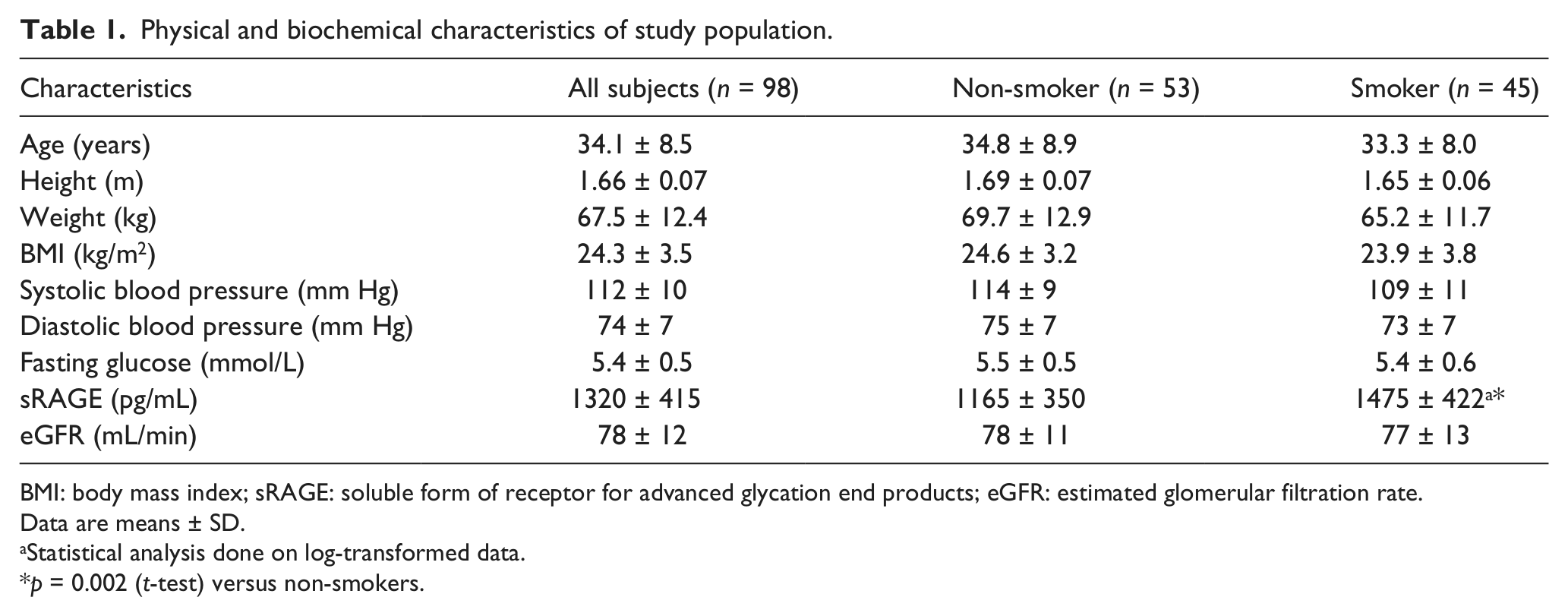
BMI: body mass index; sRAGE: soluble form of receptor for advanced glycation end products; eGFR: estimated glomerular filtration rate.
Data are means ± SD.
Statistical analysis done on log-transformed data.
p = 0.002 (t-test) versus non-smokers.
Cigarette smoking is a worldwide problem and is associated with chronic obstructive pulmonary diseases, cardiovascular diseases, stroke, different types of cancer and insulin resistance. Therefore, the finding of independent positive relationship between sRAGE and smoking habit observed in the present study supports the role of endogenous sRAGE more in favour of a pro-inflammatory biomarker than its protective role against inflammatory diseases. Although many studies showed a protective anti-inflammatory role of sRAGE, 3 a pro-inflammatory role of sRAGE has also been described. A significant correlation was found between elevated serum levels of sRAGE and markers of inflammation in a group of type 2 diabetic patients. 4 Furthermore, experimental data showed that sRAGE itself may appear as a pro-inflammatory and chemotactic molecule through its interaction with beta2 integrin Mac-1. 5 Thus, considering sRAGE as a pro-inflammatory molecule, the finding of elevated levels of sRAGE in cigarette smokers is not surprising.
Of note, the finding observed in the current study is mechanistically not unexpected because cigarette smoke increases RAGE expression in the lung, 2 which is likely to contribute to elevate circulating sRAGE level through increased shedding of membrane-bound RAGE and/ or increased expression of its splice variants. However, this theoretical assumption needs experimental evidence to confirm whether cigarette smoke influences increased shedding of membrane-bound RAGE and/or increased expression of its splice variants in the lungs and in other tissues.
In conclusion, this study for the first time shows a significant elevation of serum sRAGE in cigarette smokers compared with non-smokers, a strong correlation between sRAGE and number of cigarettes smoked per day and an independent association of sRAGE with smoking habit in non-diabetic healthy subjects. Based on the existing data and our present finding, it may be considered that AGE-RAGE-sRAGE axis may participate in the pathogenesis of diseases resulting from cigarette smoking.
Footnotes
Funding
This study was supported by a grant from the ‘Conversion of Bangabandhu Sheikh Mujib Medical University (BSMMU) into Center of Excellence Project, 2nd Phase’.
Conflict of interest
The authors declare that they have no conflicts of interest.