



Abstract
This study investigates the ambivalent relationship between populism and party cohesion. While populist parties often project unified fronts against “corrupt elites,” their heterogeneous support bases and anti-establishment origins may foster internal divisions. Using V-Party data, we test whether populist parties demonstrate higher or lower degrees of intra-party unity than traditional parties. Our analysis uncovers a strong negative relationship between populism and party cohesion, challenging the common perception of populist parties as internally unified or monolithic. The comparative analysis also allows for systematically testing several hypotheses related to organizational and ideological features of political parties and the way they interact with populism. Results indicate that organizational characteristics play a significant role: notably, personalism tends to strengthen cohesion, partially offsetting the divisive effects of populism. Additional findings show that right-wing parties generally exhibit lower levels of cohesion compared to their left-wing counterparts. Furthermore, transitioning from opposition to government appears to decrease internal unity within populist parties. These insights deepen our understanding of the structural vulnerabilities within populist movements and underscore the complex interrelations between populism, party organization, and democratic governance.
Introduction
Political parties are complex organizations that vary significantly in their internal dynamics and organizational structures (Sartori, 1976; Scarrow et al., 2017). While it might be questionable the extent to which intra-party democracy is important for the functioning and quality of representative democracies (Cross and Katz, 2013), the degree to which parties show unitary goals and actions is key for government survival and executive-parliament relations (Owens, 2003; Ozbudun, 1970). Party cohesion, intended as the degree to which party members align in their positions across various issues, is fundamental to the functioning of political parties and varies across time, parties, and countries (Bowler et al., 1999; Close and Gherghina, 2019; Laver and Shepsle, 1999).
Scholarship has extensively studied party factionalism and party unity in the parliamentary arena, as well as how party cohesion influences Members of Parliament’s (MPs’) legislative behavior, electoral performance, and coalition strategies (e.g., Belloni and Beller, 1978; Ceron, 2019; Giannetti and Benoit, 2009). Yet, less systematic analysis has been conducted on the diverse mechanisms and conditions that produce varying degrees of party cohesion across different political systems and organizational contexts. The existing literature on these determinants has identified several key factors, including internal organizational features, party size, government participation status, and ideological characteristics. The question of whether party cohesion varies across distinct types of parties, however, is still underexplored, especially if we look at populist parties, which have prospered around European democracies over the last years. Indeed, the rise of populist actors across democratic systems in recent decades has introduced new dynamics that warrant fresh examination of this important phenomenon.
The relationship between populism and party cohesion presents an intriguing paradox. On the one hand, populist parties often emerge around charismatic leaders who maintain tight control over the party organization, fostering centralization and potentially suppressing internal dissent (Heinisch and Mazzoleni, 2016a; Lisi, 2025). The emphasis on unity against the “corrupt elite” and the claim to represent the “pure people” can serve as powerful mechanisms for maintaining internal cohesion and discouraging the formation of factions. On the other hand, the opposite dynamic is equally plausible. Many populist parties arise as splinter groups from established parties, bringing together dissatisfied members with diverse ideological positions and strategic preferences (Gerbaudo, 2018; Russo et al., 2014). These parties can attract a heterogeneous coalition of supporters united primarily by their opposition to the political establishment rather than by a coherent ideological program. Such diversity in their support base and origins can foster the development of competing internal factions.
This tension between centralization and internal disagreements in populist parties remains theoretically underexplored and empirically untested. Party cohesion is crucial for organizational survival and institutionalization (Janda, 1970: 110), a challenge that is particularly acute for populist parties (Arter and Kestilä-Kekkonen, 2014; Pedhazur and Brichta, 2002). These parties often struggle with institutionalization due to their rapid emergence, personalistic leadership, and anti-establishment origins, making the maintenance of internal unity both more difficult and more essential for their long-term survival. This study investigates this puzzle by analyzing the connection between populism and party cohesion 1 .
Understanding whether populist parties are more or less cohesive than their non-populist counterparts offers crucial insights into contemporary political dynamics and the evolution of party systems. First, it helps us understand the organizational features that contribute to populist parties’ survival and success. Second, it provides insights into how these parties manage internal dissent and maintain cohesion. The monist worldview that pits “the people” against “the elite” may conflict with efforts to grant members more rights and participatory opportunities (Lourenço et al., 2024; Mikola, 2019). In addition, the comparative analysis of cohesion patterns between populist and non-populist parties can also illuminate broader questions about party system stability and democratic governance. Traditional parties typically develop sophisticated institutional mechanisms for managing internal conflicts and maintaining unity. Whether populist parties develop similar mechanisms or operate under different principles of internal organization has significant implications for their impact on political systems, namely for government stability (Taggart and Kaltwasser, 2015).
The main research question addressed in this article is the following: what association exists between populism and party cohesion? Drawing on V-Party data, this article systematically examines the relationship between populism and party cohesion across distinct countries and party types. In doing this, this study offers a twofold contribution to the literature. First, it deepens understanding of party politics by exploring the relationship between populism and intra-party cohesion. Second, it provides an empirical contribution by systematically testing a series of hypotheses across different institutional and political contexts.
This article unfolds in several stages. We begin by establishing key theoretical foundations, defining central concepts, and synthesizing the scholarly literature on party cohesion and its intersection with populism and intra-party dynamics. Building on this framework, we detail our methodological approach and the dataset that forms the basis of our analysis. We then present our empirical findings, discussing the relationship between key independent variables and intra-party cohesion. The article concludes by exploring the broader implications of these results for party politics and identifying promising directions for future research in this field.
Exploring the Relationship Between Party Cohesion and Populism
Political parties are complex organizations where members naturally cluster into distinct internal groups. These intra-party formations emerge through various mechanisms: geographical proximity, shared social backgrounds, or common ideological positions. This is evident not only in formal organizational structures, such as regional branches and specialized units catering to specific demographics like youth wings, women’s organizations, or professional associations, but also in the presence of informal networks (Bolleyer, 2013; Dilling, 2024). These internal structures serve multiple strategic functions. They anchor parties in local communities, facilitate vertical communication within the party hierarchy, and serve as recruitment channels. However, they may also prove counterproductive by undermining the party’s public image, diminishing its effectiveness within institutional arenas, or weakening its ability to implement programmatic objectives.
Scholarship on intra-party politics has traditionally centered on the concept of factionalism to analyze the internal dynamics and power distribution within political parties. While earlier studies have primarily emphasized the organizational dimension as a defining characteristic of party factions (Belloni and Beller, 1978; Panebianco, 1988), more recent accounts have relaxed the strict organizational component by focusing on the process and dynamics of factionalism, thus interpreting this phenomenon in a more flexible and holistic way, blurring the distinction between factionalism and other related concepts, such as those of party unity, party discipline or intra-party cohesion (Boucek, 2012; Kerr, 2024).
The concept of party cohesion has been subject to various interpretations in political science literature, with scholars emphasizing different dimensions of intra-party unity. Close and Nuñez Lopez (2013) identify three dimensions of party cohesion, namely ideological cohesion (the extent to which party members share similar political beliefs, values, and policy preferences), organizational cohesion—that is, the degree of unity in party operations, decision-making processes, and strategic choices—and behavioral cohesion, which is related to the observable unity in voting patterns, public statements, and other political actions 2 .
This multidimensional approach highlights a critical limitation in earlier definitions that focused primarily on behavioral manifestations of cohesion. Any working definition must balance analytical precision with practical applicability across different political contexts and party types. Drawing on these discussions, we propose a synthesized definition of party cohesion as the degree to which party members demonstrate unity across ideological, organizational, and strategic dimensions, encompassing shared preferences, coordinated practices, and aligned public positioning, whether arising from common beliefs, institutional structures, or leadership coordination. This definition effectively captures the multidimensional nature of the concept while accounting for both formal and informal mechanisms that contribute to intra-party unity (see Kerr, 2024).
It is useful to elucidate and discuss the relationship between factionalism and intra-party cohesion. As aforementioned, factions are generally seen as organized groups within a party that have distinct identities, preferences, or interests. They represent structural divisions within the party—for example, ideological wings (like moderate vs progressive factions), regional units, or groups organized around specific leaders. Factions are essentially the subunits or internal groups that exist within a party’s organization.
Intra-party cohesion, by contrast, refers to the degree of unity in how party members act together—whether they vote the same way, support the same policies, or maintain consistent positions. It is a measure of how well the party functions as a unified entity despite any internal divisions that might exist. The key relationship between these concepts is that factions can influence the level of cohesion, but they do not automatically determine it. For example, a party might have clear factions but still maintain high cohesion if there are strong mechanisms for internal negotiation and compromise (e.g., Jupskas, 2016). Conversely, a party with no clear factions might show low cohesion if it lacks effective tools for coordinating member behavior. The number and strength of factions can affect cohesion, but this relationship depends on various factors like leadership strength, institutional rules, and party culture.
Having elucidated the key concepts, we proceed to examine the determinants that influence intra-party cohesion. Organizational structures significantly shape cohesion through formal disciplinary mechanisms, candidate selection processes, and resource allocation (Owens, 2003; Hazan, 2003). Parties with centralized decision-making and strong leadership typically demonstrate higher unity in voting patterns, as they can effectively sanction dissenting members and control advancement opportunities within the party hierarchy. Moreover, clientelism tends to undermine party cohesion by prioritizing personalized, transactional relationships over collective programmatic commitments, thereby weakening internal unity and discipline within the party (Mershon, 2001; Warner, 2001). These organizational features are particularly important in preventing the emergence of internal factions that could threaten party unity.
Ideological positioning also plays a crucial role, as parties holding more extreme positions generally exhibit greater cohesion than centrist ones, partly due to self-selection of like-minded members and clearer policy stances (Close and Nuñez Lopez, 2013; Lanfranchi et al., 1999; Wilson and Wiste, 1976). This phenomenon is often explained by the fact that members of ideologically extreme parties share stronger convictions and face fewer ambiguous policy choices, while centrist parties must navigate more nuanced positions that can lead to internal disagreements. Research has shown that parties with clear ideological profiles tend to maintain stronger voting discipline and experience fewer defections on key issues (van Haute and Pauwels, 2016).
Finally, institutional status also affects cohesion, with governing parties typically showing stronger unity than opposition parties, largely due to increased pressure to maintain stability and implement their agenda (Owens, 2003; Rahat, 2007). This pattern is particularly evident in parliamentary systems where government survival depends on maintaining party discipline. When in power, parties face additional incentives to present a united front, as internal divisions can threaten their ability to implement policies and maintain public confidence. Moreover, governing parties often have access to additional resources and patronage opportunities that can be used to reward loyalty and discourage dissent, further reinforcing cohesion (Cox and McCubbins, 2005). Opposition parties, while still valuing unity, may tolerate more internal disagreement as the immediate stakes of dissent are lower. However, Sieberer’s (2006) analysis of roll call votes revealed a counterintuitive pattern: governing parties exhibit lower levels of legislative cohesion than opposition parties. This finding challenges the conventional expectation that the responsibilities of governance would strengthen party unity.
Party type has been surprisingly understudied as a determinant of party cohesion. Traditional scholarship suggests that mass parties, with their strong ideological foundations and organizational structures, display greater cohesion than catch-all or elite parties (Duverger, 1964; Gunther and Diamond, 2003). However, contemporary political dynamics have challenged this assumption. Higher levels of party switching (Rahat and Kenig, 2018), rising electoral volatility (in particular, “extra-systemic” (Chiaramonte and Emanuele, 2022), and the growing emergence of new parties have challenged the programmatic and strategic coherence of established actors, creating unprecedented difficulties for maintaining internal unity.
The emergence of new forms of political organization, particularly populist parties, has further complicated traditional understandings of party cohesion. As Mudde (2007) notes, populist parties often exhibit different organizational structures and internal dynamics compared to non-populist actors, necessitating revised conceptual frameworks for understanding cohesion. The relationship between populism and party cohesion presents a complex strategic dilemma, characterized by competing pressures for both unity and flexibility. On the one hand, populist parties require strong internal cohesion to maintain their distinctive anti-establishment identity and credibly present themselves as unified representatives of “the people’s will” (Mény and Surel, 2002; Taggart, 2000; Zaslove, 2008). On the other hand, the often-opportunistic nature of populist politics demands strategic flexibility that may be hampered by strict party discipline. The swift and significant rise of populist forces may also be associated with the recruitment of more pragmatic politicians who do not share common principles, but whose primary goals are only to receive material benefits.
We argue that the ideological fluidity of populist parties is likely to decrease party cohesion. First, in terms of policy positioning, populist parties often need to adjust their stances rapidly to capitalize on emerging public grievances or shift between left and right-wing positions depending on the political opportunity structure (Caiani and Graziano, 2022). In fact, many populist parties present what Zulianello and Larsen (2023) called “valence populism,” which means that it is difficult to position themselves on the traditional left–right spectrum. These parties tend to focus on non-positional competition, most notably anti-corruption messages, and lack a thick ideology.
Second, the absence of a strong ideological foundation, combined with the attachment of core populist elements to a broader “host” ideology, may hinder the development of cohesive patterns of behavior among party members. The protest-driven character of populist parties tends to attract a wide and ideologically diverse range of supporters and members, united more by rejection of the status quo than by a shared vision for governance (Zaslove, 2008). In addition, populist parties often originate from splits, mergers or political entrepreneurs that make it difficult to maintain consistent internal positions, leading to factionalism or policy disagreements.
Third, the ideological ambiguity of populist parties challenges the possibility to adopt a coherent coalition strategy. Indeed, empirical research shows that populist parties display intra-party conflicts and distinct strategic orientations, particularly when comparing the national and local level (Heinisch and Mazzoleni, 2016b). While populist parties tend to be more cohesive in the institutional arena, local branches or youth wings are more likely to present divergent behavior or attitudes, especially as a consequence of moderation and political integration.
Our broader expectation is that populist parties are associated with lower levels of party cohesion. Although populist parties tend to exhibit a higher concentration of power in the hands of party leaders, empirical research does not reveal a consistent pattern of organizational structures unique to this party type (e.g. Lisi, 2025). Even within distinct ideological strands of populism—such as left-wing versus right-wing populist parties—existing studies show a diversity of organizational models (Vittori, 2020). For these reasons, we argue that the ideological characteristics of populist parties are a key factor contributing to lower levels of party cohesion. Accordingly, our main hypothesis is as follows:
H1: The higher the level of populism, the lower the tendency for party cohesion.
Drawing on scholarly work, we develop hypotheses on the interaction between core aspects of populist discourse and intra-party cohesion. First, the theoretical distinction between anti-elitism and people-centrism as separate dimensions of populism has gained increasing recognition in contemporary scholarship, with important implications for understanding their differential effects on party organization. While both components represent core elements of populist ideology, as defined by Mudde (2004), empirical research has yet to examine how these distinct dimensions generate different pressures in terms of internal unity.
Anti-elitism constitutes the antagonistic dimension of populism, framing political competition as a conflict between the corrupt establishment and the authentic people. As several scholars have noted, this feature is largely outward-oriented, since the central aim of populist discourse is to attack established parties and challenge party system cartelization (Norris, 2019; Peters and Pierre, 2020). By focusing primarily on external adversaries, anti-elitism generates few organizational incentives for internal cohesion, often neglecting the internal bonds that foster in-group solidarity. In many cases, populist parties are built around a strong leader capable of articulating shared grievances and a collective purpose that transcends internal disagreements in order to mobilize voters. Nevertheless, despite the anti-elite rhetoric, policy differences and personal conflicts persist within these parties, though they are frequently concealed to maximize electoral opportunities.
People-centrism, in contrast, highlights the sovereignty and wisdom of the people as the ultimate source of political legitimacy. While this component provides populist parties with strong democratic legitimacy claims, it also generates more complex organizational challenges. The emphasis on popular sovereignty creates incentives to reinforce the programmatic and ideological dimensions of populism (Caramani, 2017; Urbinati, 2019). From an organizational perspective, populist parties often establish institutionalized mechanisms to aggregate members’ concerns and translate them into coherent policy platforms. Participatory appeals and inward-looking goals tend to strengthen partisan identities and reduce centrifugal tendencies.
While there are compelling theoretical reasons to expect different effects, scholarly debates suggest multiple plausible scenarios regarding how distinct populist appeals influence intra-party cohesion. One could argue that people-centrism, with its emphasis on direct democratic participation and grassroots mobilization, might actually generate greater internal discord as it encourages broader party member engagement and potentially conflicting voices in decision-making processes. Conversely, anti-elitism’s focus on external enemies might be seen as providing clearer strategic direction that could enhance rather than undermine internal coordination.
Despite these plausible counterarguments, we hypothesize that anti-elitism will exhibit stronger negative effects on intra-party cohesion than people-centrism, reflecting the superior capacity of “symbolic representation” to generate internal unity compared to populist forces that rely primarily on antagonistic appeals.
H2: Within populist discourse, the anti-elitist dimension is hypothesized to have a more pronounced negative impact on party cohesion than the people-centrist dimension.
A number of authors have argued that left-wing populist parties differ from right-wing populist parties, not only in terms of programmatic and symbolic terms, but also regarding organizational features (Vittori, 2020; Zaslove, 2008). First, right-wing populist parties benefit from ideological coherence around exclusionary nationalism and traditional social hierarchies, displaying a more unified worldview centered on cultural homogeneity and national sovereignty. Second, right-wing populism’s acceptance of hierarchical authority structures aligns more naturally with centralized party organization, whereas left-wing populism’s emphasis on participatory processes and more deliberative mechanisms conflicts with necessary leadership concentration (Vittori, 2022). Empirical studies seem to confirm that the impact of left-wing populism on intra-party democracy is weaker when compared to right-wing populist actors (Böhmelt et al., 2022). Consequently, we propose the following hypothesis:
H3: The negative effect of populism on party cohesion will be significantly weaker for right-wing populist parties compared to left-wing populist parties.
In addition, personalism (i.e., the extent to which party politics is personalized) is likely to impact the way populist discourse affects party cohesion, as the characteristics and role of leadership may vary within parties (Cross et al., 2018; Frantz et al., 2022). Populist parties tend to concentrate power in the hands of their leaders, thereby reducing internal fragmentation. Populist leadership is typically marked by hierarchical structures that suppress dissent, marginalize opposing voices, and limit centrifugal tendencies (Betz and Immerfall, 1998; Heinisch and Mazzoleni, 2016a; Lisi, 2025). Their organization often relies on direct links between the leader and party members, fostering emotional bonds that enable leaders to transcend policy or strategic disagreements. Empirical evidence shows that populist parties generally exhibit lower levels of intra-party democracy, providing members with fewer opportunities to participate in and influence decision-making. Research also indicates that populism is positively associated with more personalized leadership styles (Moffitt, 2016; Nai and Martínez i Coma, 2019). Building on these insights, we propose the following hypothesis:
H4: The negative impact of populism on party cohesion will be less pronounced in populist parties that display higher levels of personalism.
The literature on populist parties suggests that one of the main challenges they face is access to government and the subsequent maintenance of their populist identity when wielding power. Scholars have identified a fundamental tension in populist governance that Mény and Surel (2002) characterize as the ‘populist paradox’: populist parties build their appeal on anti-establishment positions but risk becoming part of the very establishment they critique when entering government.
This tension illustrates what Heinisch (2003) calls the contradiction of being in office, as populist parties struggle to balance their anti-establishment rhetoric with the demands of holding power. The governance dilemma is particularly acute for parties emphasizing anti-elitism, as their anti-establishment positioning becomes problematic when populists themselves assume elite positions (Wolinetz and Zaslove, 2018). In addition, people-centrism—the claim to uniquely represent “the people”—becomes more difficult to sustain when making necessary policy compromises in coalition governments. As Akkerman and de Lange (2012) demonstrate in their study of populist parties in Western Europe, this contradiction can lead to significant internal strains within the party organization. Their comparative analysis reveals that populist parties often experience increased factionalism and decreased cohesion when transitioning from opposition to government. Therefore, our fifth hypothesis suggests the following:
H5: Populist parties will exhibit lower levels of internal cohesion when in government than when in opposition.
Data and Methods
As aforementioned, this article adopts a multidimensional approach to party cohesion, focusing specifically on manifestations of unity that can emerge in different arenas. While party cohesion has traditionally been measured through parliamentary roll call votes, this approach has important limitations. First, as Hazan (2003) notes, analyzing individual voting behavior makes it difficult to distinguish between genuine party cohesion and enforced party discipline. Second, the focus on parliamentary behavior provides only a partial view of party unity. Our study advances the literature by adopting a more comprehensive approach that examines party cohesion at the meso level. This party-level perspective allows us to capture multiple dimensions of cohesion, including ideological alignment, public messaging consistency, and organizational behavior beyond parliamentary voting.
Starting from this premise, we use V-Party data to measure party cohesion across parties and countries (Lindberg, 2022). In our analysis, we include only consolidated Western democracies between 1970 and 2019 3 . Overall, the dataset comprises 280 parties from 24 different countries. This selection allows us to exclude non-democratic regimes and other confounding contextual factors that make it more difficult to examine the association between populism and internal cohesion. By focusing on stable democratic systems, we ensure a degree of institutional comparability and reduce noise related to regime instability, transitional politics, or weak party systems. Indeed, Western democracies provide a more homogeneous institutional context that allows us to isolate the effects of party-level variables on cohesion, while controlling for broader systemic differences in democratic quality, rule of law, and political culture that might confound results in a global sample. This institutional similarity enables more precise measurement of how party-related factors specifically influence intra-party unity. Moreover, this period captures the emergence and consolidation of populist parties across Western democracies, making it particularly relevant for studying their impact on party cohesion and internal dynamics. Finally, it is worth noting that Western democracies offer superior data quality and coverage for the temporal period examined in this study. The V-Party dataset provides more reliable and consistent expert assessments for these cases across the full timeframe, reducing measurement error and missing data problems that would complicate analysis of newer or less stable democracies. Overall, these selection criteria enhance the internal validity of our findings while providing a solid foundation for future comparative research extending to other regional contexts.
Similar to V-Dem, the V-Party project relies on expert surveys, with contributions from country specialists and political scientists worldwide. The dataset provides information on party positions regarding various dimensions such as economic policy, social issues, and regime characteristics. It also includes data on party organizational characteristics, such as the extent of internal democracy, electoral strategies, and leadership dynamics. The V-Party dataset offers unique advantages for our analysis of party cohesion, not only because of its multidimensional operationalization but also because it includes key indicators of populism in different political and institutional contexts.
The dependent variable is based on the item of “party cohesion” included in the V-Party dataset. The project asks experts the following question: “To what extent do the elites in this party display disagreement over party strategies?” This study operationalizes party cohesion through an expert survey that examines key strategic decisions in party life. The selected dimensions capture critical junctures where internal disagreements are most likely to surface and where unity is essential for party effectiveness. The operationalization encompasses five fundamental areas of party strategy. First, it includes an assessment of electoral campaign strategy, examining unity in campaign messaging, resource allocation, and tactical decisions during electoral periods. Second, it considers cohesion in policy positions across different issues and over time. Third, distribution of party financial resources: (i.e., allocating party funds, including campaign financing, organizational development, and routine operations) may also be taken into account. Inter-party cooperation is another important aspect that might be related to this operationalization, considering decisions about coalition formation and other forms of party cooperation. Finally, experts are asked to consider also unity in the selection of legislative candidates, presidential candidates, and party leaders. The variable is measured on an ordinal scale from 0 to 4.
The use of expert surveys to measure these dimensions offers several methodological advantages. First, experts can assess both public and internal party dynamics, providing insights that might not be visible through voting records or public statements alone (see Kerr, 2024). Second, expert evaluations can capture nuanced variations in cohesion across different strategic dimensions, allowing for more sophisticated analysis than binary measures of unity versus division. Third, experts can evaluate cohesion over extended periods, providing a more comprehensive picture than snapshot measurements.
The multidimensional nature of this operationalization not only follows our comprehensive definition of party cohesion but also allows for nuanced analysis of how populist and non-populist parties may exhibit different patterns of cohesion across various aspects of party strategy. For instance, populist parties might show high cohesion in campaign messaging but lower cohesion in coalition decisions, reflecting tensions between anti-establishment rhetoric and practical governance requirements. Moreover, this operationalization enables examination of how different organizational features of populist and non-populist parties affect cohesion across these strategic dimensions. For example, the strong leadership often associated with populist parties might produce different patterns of cohesion in candidate selection compared to the more institutionalized processes of traditional parties.
Drawing on the literature review and empirical findings of relevant studies, we selected a number of independent variables and controls for explaining variation in party cohesion. Our main independent variable is “populism.” Although various approaches exist to study this phenomenon, we adopt the ideational approach, which has been widely utilized in empirical research on political parties. According to this perspective, populism is defined as a thin-centered ideology that divides society into two antagonistic groups: “the pure people” and “the corrupt elite” (Mudde, 2004). It emphasizes the primacy of popular sovereignty, portraying politics as a struggle to return power to the people, who are seen as a morally virtuous and homogeneous group. Populism is often combined with other ideological elements, such as nationalism or socialism, to form a more comprehensive political stance.
The operationalization adopted by the V-Party project follows this conceptualization closely by considering two main components: anti-elitism (v2paanteli) and people-centrism (v2papeople). Both measures are coded by experts from 0 (not important) to 4 (very important). The populism index (v2xpa_popul) is calculated by averaging the two dimensions. Overall, this measure evaluates the extent of populist rhetoric used by party representatives, with further granularity offered by each specific indicator.
Beyond the core independent variable, the models incorporate key characteristics of political parties. First, research shows that the degree of centralization in candidate selection procedures significantly influences party cohesion dynamics. Centralized candidate selection processes, where party leadership exercises strong control over candidate recruitment and nomination, tend to enhance party discipline and unity by ensuring that selected candidates align with leadership priorities and party positions (Cordero et al., 2018). Conversely, when candidate selection is dispersed across multiple actors or levels, party elites may reflect varied constituencies and preferences, potentially complicating efforts to maintain consistent party lines (Carty, 2004). Therefore, we include a measure of candidate nomination processes (v2panom), categorized on a scale from 0 (decision by the party leader) to 4 (decision by all registered voters).
Second, the degree of personalism represents another critical factor shaping internal party dynamics. Although conventional wisdom suggests that strong personal ties may undermine party cohesion (Katz, 2018), both theoretical and empirical evidence challenge this expectation. Theoretically, highly personalized parties tend to subordinate organizational structures, concentrating control over decision-making and leaving little space for internal dissent. Empirically, research indicates that personalization is not linked to higher levels of intra-party conflict (Chiru, 2018). Consequently, we expect a positive relationship between personalization and intra-party cohesion. Personalism (v2paind) is operationalized on a scale from 0 (not focused on personal will) to 4 (solely focused on personal will).
While traditional clientelism is typically associated with fragmented party structures and weak centralized authority, recent scholarship argues that ’new clientelism’ exhibits fundamentally different organizational characteristics, including enhanced internal party cohesion and concentrated leadership control that contrast sharply with classical clientelistic patterns (Hopkin, 2006). This also applies to situations where multiple patronage pyramids coexist, each dominated by the preferences of its respective patron (Hale, 2014). Empirical studies validate this proposition by showing that clientelism correlates with enhanced leadership control, which manifests through more exclusive decision-making structures and the systematic suppression of factional development that might otherwise fragment party organization (Chiru, 2025). We use the “clientelism” variables (v2paclient) included in the V-Party dataset, which asks experts to evaluate the degree to which parties provide targeted and excludable goods to secure votes, coded from 0 (not at all) to 4 (as its main effort).
According to the literature on party models, the strength of local party organization constitutes a critical infrastructure for party cohesion. Robust grassroots networks—that typically characterize mass parties—facilitate both vertical communication between party levels and horizontal coordination among members, creating the institutional foundation necessary for sustained party unity (Bolleyer, 2013). Strong local organizations foster ideological alignment through regular interaction and collective activities that reinforce shared party identity and programmatic commitments. Local organizational strength (v2paactcom) measures the degree to which party activists and personnel maintain a permanent presence in local communities, ranging from negligible (0) to widespread (4) presence. In our statistical models, all ordinal variables were rescaled to range from 0 to 1 in order to facilitate a more meaningful comparison between coefficients.
Finally, we include ideological positions as a control, given robust evidence that parties located at the ideological extremes generally exhibit greater internal cohesion than those situated closer to the center. To account for this, we incorporate a variable measuring each party’s ideological position. Economic left–right positioning (v2pariglef) places parties ideologically on a spectrum ranging from 0 (far left) to 6 (far right). We also include the squared term of ideology (left–right (LR) squared) to gauge potential curvilinear effects, as extreme parties are expected to present higher levels of cohesion.
Contextual variables refer to the institutional position, namely, whether parties are in government or opposition. Government support (v2pagovsup) captures whether a party supported the government formed immediately after the election, coded as a binary variable (0 for no, 1 for yes). Moreover, electoral strength (v2pavote) measures the percentage of votes obtained by a party in elections for the lower chamber of the national legislature. Party age, which could serve as a measure of party institutionalization, was excluded from the final model specification as it did not reach statistical significance in preliminary analyses 4 .
Regarding macro-level characteristics, we include a dichotomous control variable that distinguishes between presidential and parliamentary democracies. 5 This variable accounts for institutional differences in the structure of government, allowing us to control for their potential impact on party cohesion. In order to account for institutional differences that may influence party cohesion, we include a dummy variable distinguishing between majoritarian and proportional representation (PR) electoral systems (see Emanuele et al., 2023). This variable captures the broad distinction between systems that tend to concentrate power and those that foster broader representation, allowing us to control for the potential effects of electoral rules on the outcomes under analysis. In addition, we control for the age of democracy (continuous variable and logarithmic term), measured in years since the country’s democratic transition or consolidation, to account for higher levels of political instability in more recent democracies, frequently associated with party splits and lower party institutionalization.
The statistical analysis relies on mixed-effects regression models to account for the hierarchical structure of the data (Johnson and Albert, 1999) 6 . This approach allows us to account for the unobserved heterogeneity of political parties nested within countries. The fixed effects specification addresses potential endogeneity concerns by accounting for stable characteristics of parties that might correlate with both our independent variables and the outcome of interest. Our models include year fixed effects to account for common shocks and time trends across all parties 7 . For robustness, we also estimate models with country-year fixed effects to control for country-specific time-varying factors. Standard errors are clustered at the party level to account for serial correlation in the error terms. This multilevel modeling approach efficiently handles the nested nature of our data structure while isolating the effects of our key independent variables, as it appropriately adjusts for the non-independence of observations within parties and countries over time.
Results
Our multivariate analyses reveal several significant relationships between party characteristics and intra-party cohesion. Figure 1 presents the main findings from our regression models 8 . The most striking result is the strong negative association between populism and party cohesion. This suggests that as parties adopt more populist orientations, their internal unity tends to decrease substantially. This finding aligns with theoretical expectations that populism, while often projecting an image of unity against established elites, frequently struggles with internal tensions between different factions competing to represent “the people’s will 9 .” The results demonstrate that populism exhibits one of the strongest effects on party cohesion among all determinants examined in the model, even after controlling for institutional arrangements.
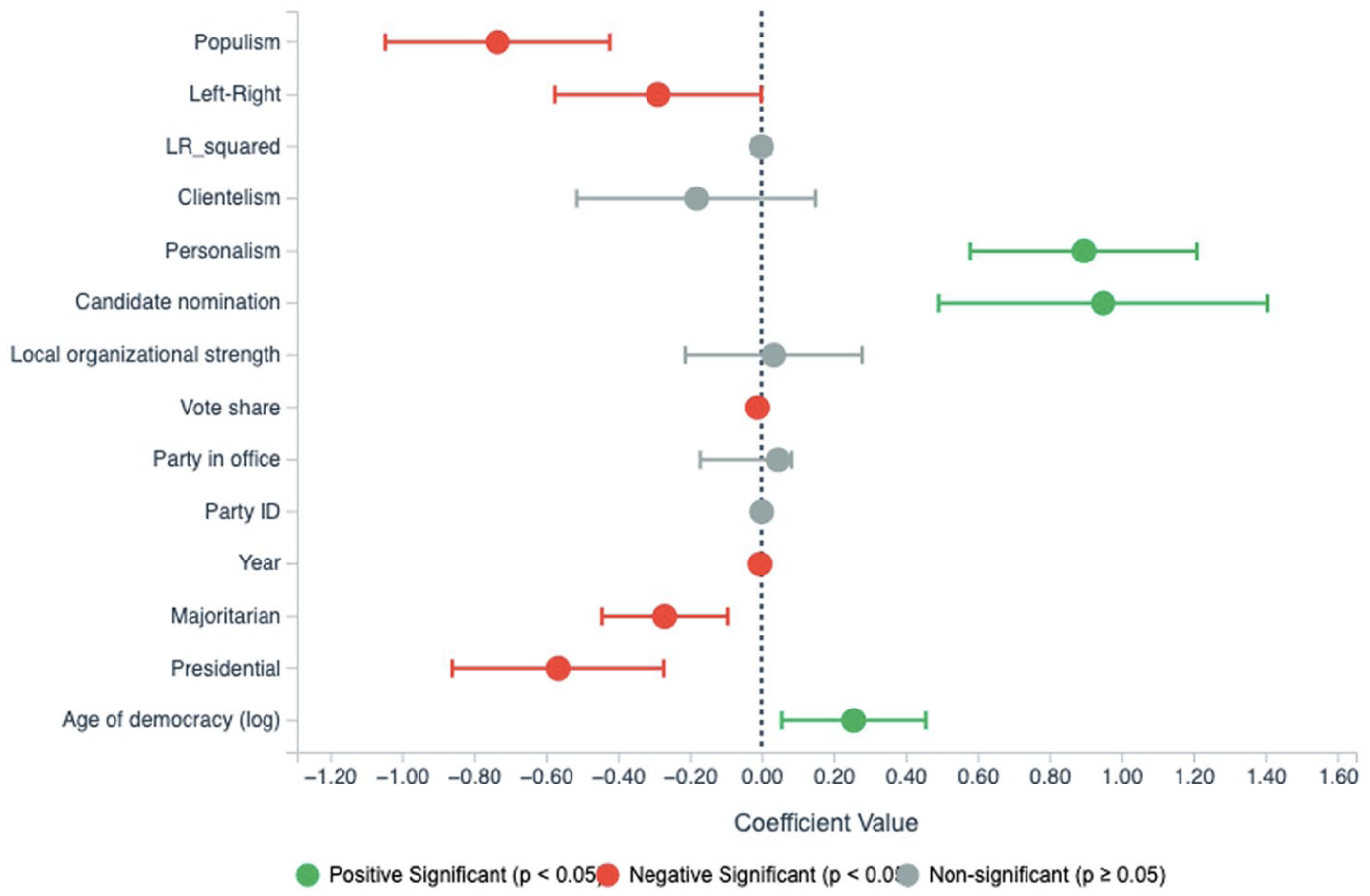
Mixed-effects ordinal regression models for populist parties.
We also tested a model including a lagged variable for populism to account for the longitudinal structure of the dataset and ensure the robustness of our results over time (Table A4 in the Supplemental Appendix). The inclusion of the lagged populism variable does not alter the main findings, which remain substantively and statistically consistent. This suggests that the observed relationships are not driven by short-term fluctuations or temporal autocorrelation, but rather reflect more stable patterns across the period under analysis. The results are confirmed even when controlling for country fixed effects (see Table A6 in the Supplemental Appendix).
Several organizational factors emerge as important factors influencing internal party unity. Personalism demonstrates a robust positive relationship with cohesion. This indicates that parties with strong central leadership figures are better able to maintain internal unity, enhancing effective coordination and clearer lines of authority. Interestingly, more inclusive candidate selection procedures are associated with higher levels of party unity. This finding points to the potential for plebiscitarian dynamics within parties, as one-member-one-vote methods may, in practice, reinforce leadership centralization. This aligns with the cartel party thesis, which suggests that more direct nomination processes can enhance legitimacy while simultaneously preserving internal stability. By contrast, we do not find evidence that clientelism has a significant impact on intra-party cohesion. Similarly, the extent of local organizational penetration, measured through the density of party offices, does not achieve standard levels of statistical significance.
Right-wing ideology demonstrates a negative relationship with party cohesion. This may reflect the less rigid ideological foundations of right-wing actors compared to their left counterparts. The more individualistic and elite-centered decision-making processes may also contribute to decreasing internal cohesion, as these parties often form through coalitions of diverse interest groups with varying backgrounds. The effect is notable but smaller than that of populism, suggesting ideology plays a secondary role in determining cohesion. We also examine the potential curvilinear relationship between ideology and party unity in our model, but the results do not confirm previous evidence (Close and Nuñez Lopez, 2013).
Moving to country-level characteristics, our results show that majoritarian electoral systems are associated with lower party cohesion compared to PR systems, whereas presidential systems are associated with lower party cohesion compared to parliamentary ones. Both findings align with theoretical expectations from comparative politics literature. Parliamentary systems typically require stronger party discipline for government stability, while presidential systems allow for more candidate-centered politics. Similarly, PR systems often require parties to maintain cohesion to effectively compete as unified lists, whereas majoritarian systems can encourage more individualistic candidate behavior within districts. The presidential regime effect is particularly notable as it has the strongest institutional effect, suggesting that the separation of powers inherent in presidential systems is more consequential for party cohesion than the electoral formula itself. Finally, the findings reveal that the age of democracy exerts a significant positive influence on party cohesion, with older democracies demonstrating substantially higher levels of internal party discipline than their younger counterparts. This result underscores the importance of temporal dynamics in party development, suggesting that cohesion is not merely a function of immediate organizational choices or ideological factors, but also reflects the broader institutional environment shaped by democratic experience and the gradual strengthening of party systems over time.
These findings have important implications for understanding party functioning and populist politics. The strong negative effect of populism on cohesion suggests that populist parties may face particular challenges in maintaining long-term organizational stability. These insights also paint a nuanced picture of party organization dynamics. While factors like populism and right-wing ideology strain party unity, strong leadership structures and candidate selection can help maintain cohesion. However, parties face important trade-offs when designing their internal procedures, particularly regarding the balance between democratic participation and organizational unity. This implies that party leaders must carefully calibrate their organizational strategies based on their specific contexts and priorities.
In the next step, we aim to examine how different dimensions of populism relate to party cohesion. Specifically, we seek to assess whether the negative effect of populism on intra-party unity is primarily driven by its anti-elitist component or by its emphasis on “people-centrism.” The V-Party dataset enables this analysis by allowing us to include each component separately in the regression models.
Looking at the results in Figure 2 (see also Table A7 in the Supplemental Appendix), we can observe that anti-elitism has a substantial negative impact on party cohesion. Higher levels of anti-elitist rhetoric are associated with decreased party cohesion. This highly significant relationship suggests that parties embracing anti-establishment positions tend to experience more internal fragmentation. When parties position themselves against traditional power structures, they often attract diverse supporters united primarily by their opposition to elites rather than by coherent ideological frameworks. This oppositional stance may create difficulties in maintaining consistent party lines on policy issues, as the unifying force is what they stand against rather than what they stand for.
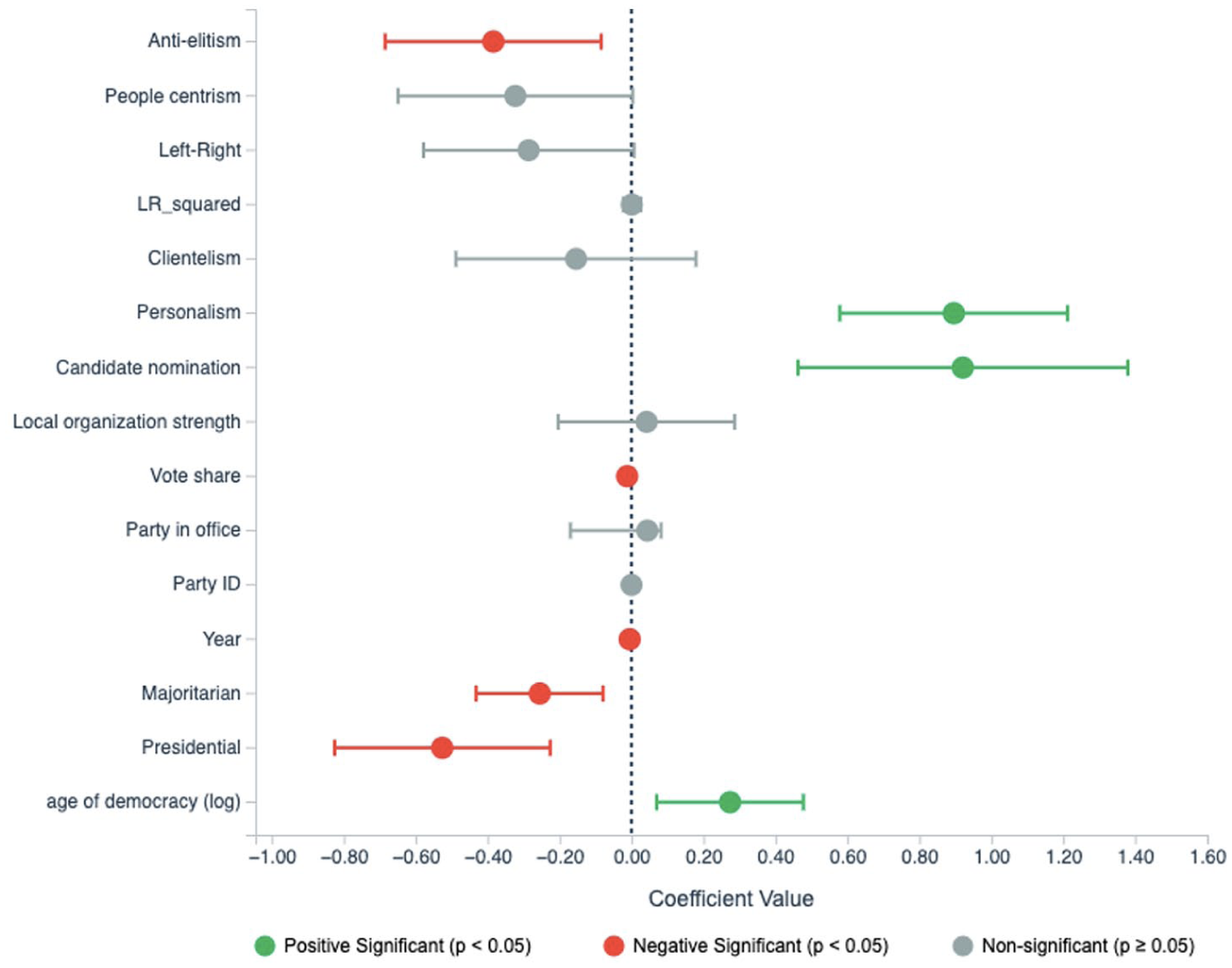
Mixed-effects ordinal regression models for distinct components of populism.
Moving to people-centrism, the results indicate a weaker negative relationship with party cohesion. The fact that this coefficient does not achieve standard levels of statistical significance indicates that populist appeals to the “people” do not undermine party cohesion. The combined effect is smaller than the original index, suggesting some measurement or interaction effects. While both dimensions are core components of populism, anti-elitism appears to exert a stronger and more consistent negative influence, as reflected in its larger and more statistically significant coefficient. This may indicate that distrust or opposition toward established elites creates more internal tension within parties, fostering factionalism or challenging hierarchical structures. In contrast, people-centrism, which emphasizes unity and popular sovereignty, represents a less divisive or destabilizing force internally. The evidence underscores the importance of disaggregating the different dimensions of populism, as the internal dynamics and organizational consequences of populist parties may vary significantly depending on which facet is more prominent. This distinction strengthens the robustness of the findings and supports a more nuanced understanding of how different components of populist discourse relate to internal party cohesion.
The next step of our analysis seeks to explore how populism can moderate the impact of key party-related features. In particular, we explore how populism interacts with left–right ideology, on the one hand, and with personalism on the other.
While populist ideas generally reduce party unity, this impact varies by the “host ideology.” The interaction term between populism and the left–right scale is negative, which means that the effect of populism on party cohesion depends on where a party sits ideologically—specifically, populism is less harmful (or even more cohesive) on the left side of the spectrum compared to the right (Figure 3) 10 . For right-wing populist parties, the negative effect of populism on cohesion is stronger. The coefficients indicate that parties further to the right tend to have slightly higher cohesion, but when populism increases, the negative impact of right-wing ideology increases. These outcomes underscore that in highly populist parties, ideology (particularly right-wing) contributes less to party cohesion, as populist parties may blur ideological consistency or foster internal tension over policy directions. Overall, the empirical patterns do not support our third hypothesis, challenging widely held views on the internal dynamics of populist parties.
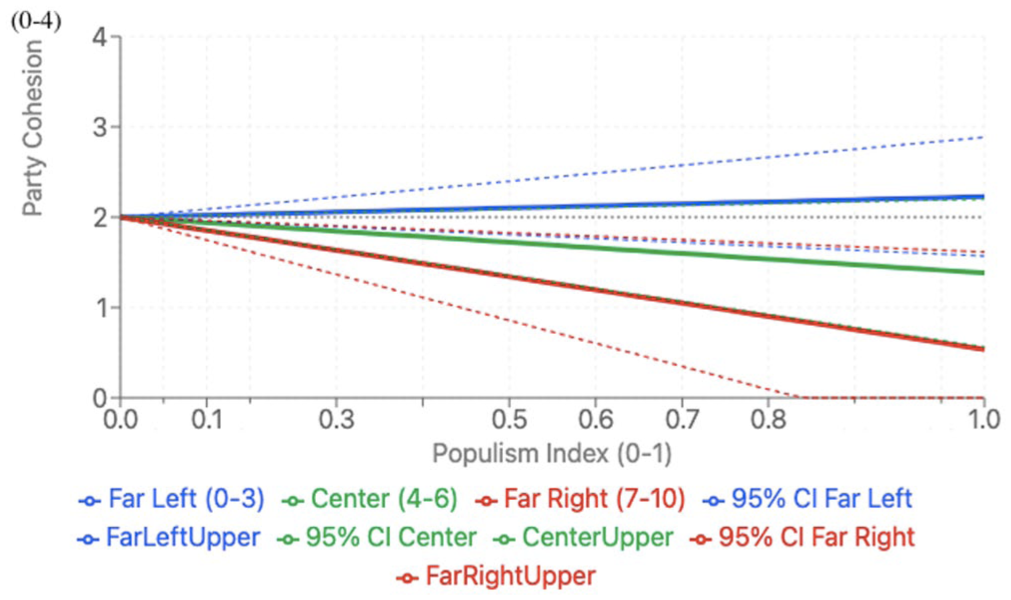
Interaction effects between populism and ideology on party cohesion.
Moving to the interaction between populism and personalism, we observe that the coefficient term is negative and significant 11 . At lower levels of populism, party cohesion remains relatively stable regardless of the degree of personalism. However, as populist discourse intensifies, party cohesion deteriorates significantly, particularly in highly personalistic parties (see Figure 4). In contrast, parties with lower levels of personalism show a much flatter trajectory, with cohesion remaining relatively stable even as populism increases. This pattern resonates with existing evidence that, in populist parties, no systematic link has been found between internal ideological disagreement and intra-party democracy (Heinze et al., 2023).
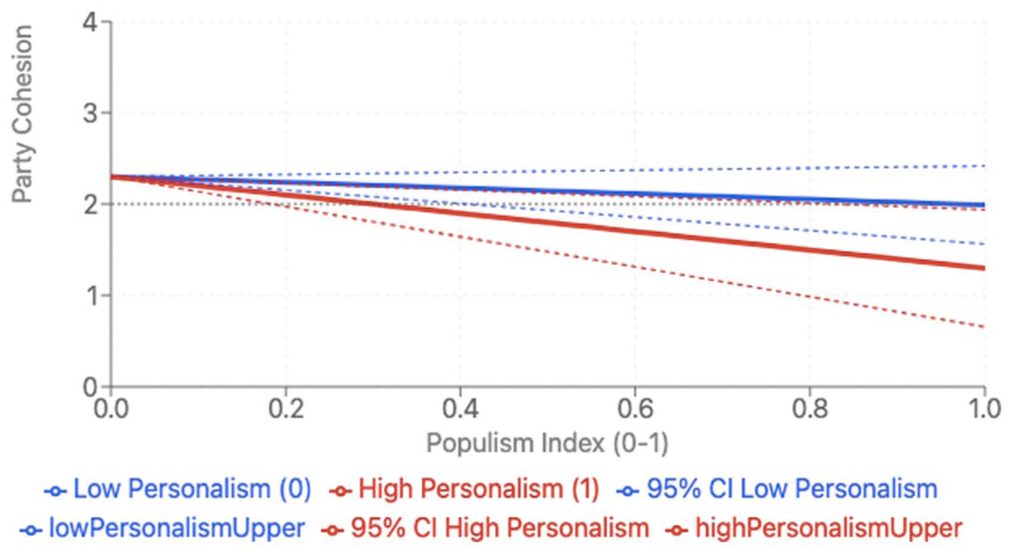
Mixed-effects ordinal regression models for interaction effects between populism and personalism.
These findings initially appear counterintuitive, given that populist parties traditionally exhibit centralized structures and personalized leadership styles, characterized by strong individual figures and leader-centered branding. However, a key distinction emerges between structural centralization—defined by concentrated decision-making authority and hierarchical leadership—and behavioral unity—reflected in consistent voting patterns and unified public positions. Our results suggest that populist parties may experience significant internal disagreements and factional tensions beneath their centralized facade. In this context, personalism may serve as a compensatory mechanism to maintain apparent unity despite underlying fragmentation. Rather than being a source of strength, leadership centralization appears to be a response to internal behavioral fragmentation, with party leaders exercising integrative power to hold together otherwise divided organizations. This interpretation aligns with previous findings regarding the complex internal power dynamics within populist parties (Albertazzi et al., 2025; Heinisch and Mazzoleni, 2016b). Ultimately, these results highlight that the cohesion challenges facing populist parties differ fundamentally from those of established political actors, with populist party unity depending more heavily on leadership dynamics and personalistic appeals than on institutional or ideological foundations
Our last step is to assess whether incumbency shapes the link between populism and cohesion. Therefore, we include in our model an interaction between populism (measured through both anti-elitism and people-centrism dimensions) and “party in office” (dummy variable), allowing us to examine whether the negative relationship between populist positioning and party cohesion is amplified when populist parties enter government. Following Akkerman and de Lange (2012), we hypothesize that the challenges to cohesion will be more pronounced for governing populist parties than for those remaining in opposition.
Figure 5 illustrates how government status moderates the relationship between populist characteristics and party cohesion, revealing that this association varies according to whether the party holds power or remains in opposition (see also Table A10 in the Supplemental Appendix). The slope for populist parties in government (red line) is steeper than for populist parties in opposition, which indicates that for parties in office, the negative effect of populism decreases party cohesion. For populist parties in opposition, the slope is less steep (blue line), indicating that the negative effect of populism on internal cohesion is weaker. Overall, the evidence is consistent with H5.
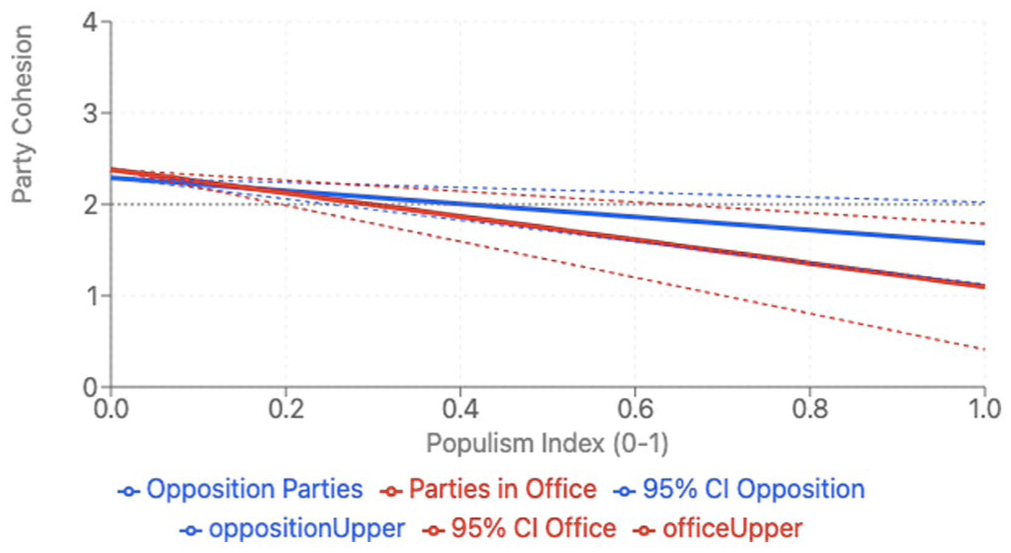
Interaction effects between populism and party in office (marginal effects).
The results suggest that populist parties struggle more with internal cohesion when they hold power, due to internal tensions, contradictions, or competing ambitions within a loosely structured, leader-centric force. When in opposition, these internal divisions are less pronounced or easier to manage, because they can rally around anti-elite rhetoric without the burden of governing. Nonetheless, the interaction effect points to a noteworthy pattern: government participation can foster the destabilizing impact of populism, likely due to the tensions between responsiveness, on the one hand, and reliability, on the other. The findings reveal a striking feature of populism, particularly how governing transforms populist parties in ways that do not affect traditional parties. While established parties often become more cohesive in government due to collective responsibility and institutional constraints, populist parties experience the opposite: their anti-establishment appeals and personalistic structures create irreconcilable tensions with the compromises required for effective governance.
Discussion and Conclusion
The main purpose of this article was to examine the relationship between intra-party cohesion and populism, aiming at testing whether populist “thin” ideology is associated with more dissent and lack of internal party coordination. This study reveals a consistent and robust negative relationship between populism and party cohesion, challenging prevalent conceptions of populist parties as monolithic entities. Our findings suggest that populist parties face distinctive organizational challenges that may stem from fundamental tensions between their anti-establishment rhetoric and the practical demands of organizational maintenance and governance.
A key contribution of this article lies in its systematic exploration of party cohesion within the context of populist heterogeneity, moving beyond monolithic conceptualizations of populism to examine how different populist characteristics interact to shape internal party dynamics. By disaggregating populism along multiple dimensions—distinguishing between anti-elitist and people-centric discourse, ideological positioning on the left–right spectrum, levels of personalism, and governmental status—this study reveals that populist parties’ cohesion challenges are not uniform but vary considerably depending on their specific organizational and contextual features. This nuanced approach demonstrates that the relationship between populism and party unity is fundamentally conditional, with some combinations of populist characteristics (such as high personalism or right-wing ideology) creating particularly acute cohesion problems, while others may actually enhance internal solidarity. These findings challenge simplified assumptions about populist party organization and highlight the importance of considering populist diversity when analyzing contemporary party politics and democratic governance.
This study makes significant substantive contributions to both party politics and populism scholarship by challenging fundamental assumptions about organizational dynamics and democratic governance. From a theoretical standpoint, this work demonstrates the critical need to distinguish between the formal organizational architecture of political parties and their actual strategic and behavioral performance. Our results show that even if populist parties grant minimal individual influence and exhibit low levels of intra-party democracy, efforts to build mass party structures or foster grassroots mobilization (Albertazzi et al., 2025; Katsambekis and Kioupkiolis, 2018) may generate tensions that undermine intra-party cohesion.
Regarding populist politics, our analysis fundamentally reframes how populism should be conceptualized and studied. Rather than treating populism merely as a discursive or ideological phenomenon, we demonstrate that populism generates distinct strategic and organizational imperatives that create unique governance challenges. The conditional effects we identify—where populist discourse interacts with personalism, ideological positioning, and governmental responsibility to produce varying cohesion outcomes—reveal that populism constitutes a fundamentally different mode of political organization with profound implications for democratic stability. These findings suggest that populist parties operate under organizational logics that differ qualitatively from traditional parties, requiring new theoretical frameworks for understanding their internal dynamics and their broader impact on democratic systems.
These results have significant implications for our understanding of contemporary party politics and democratic governance. By documenting systematic differences in cohesion patterns between populist and non-populist parties, we contribute to a more nuanced theoretical framework that accounts for the organizational vulnerabilities inherent in populist mobilization. In a context of growing electoral and parliamentary relevance of populist forces, these results reveal a “vicious circle” that contributes to greater political instability and electoral volatility. The inherent organizational tensions within populist parties create conditions that undermine stable democratic governance and may fuel further anti-establishment sentiment, perpetuating cycles of political fragmentation.
The empirical evidence demonstrates that internal fragmentation becomes particularly pronounced when populist parties assume office, potentially contributing to political instability and compromised policy implementation. The intensification of these internal tensions during periods of governance indicates that the transition from opposition to power represents a critical decision in the institutional development of populist parties. By analyzing this interaction, we contribute to the growing literature on the “populism in power” phenomenon (Albertazzi and Mueller, 2013; Caiani and Graziano, 2022), moving beyond the traditional focus on populist rhetoric and electoral success to examine the organizational consequences of populist governance. This approach aligns with recent calls by scholars for more attention to the institutional dynamics of populist parties across different political contexts.
Our findings also reveal important theoretical and practical insights into the functioning and understanding of party organizations. First, the findings highlight that organizational features are key determinants of internal cohesion, serving as counterbalancing forces to ideological traits. The results imply that maintaining internal stability involves a balance between centralization and inclusiveness—demonstrating that it is possible to combine personalization with broader participatory practices to enhance the effectiveness of party organizations. This does not necessarily imply that more cohesive parties exhibit higher levels of intra-party democracy (Cross and Katz, 2013). In fact, more inclusive methods of candidate selection may foster plebiscitarian dynamics that ultimately reinforce the power and autonomy of party leaders. From this perspective, populist parties may be particularly effective in managing intra-party dynamics and governance, as their organizational structures appear well-suited to the challenges facing contemporary party organizations.
Second, the strong relationship between personalism and cohesion offers new insights into the ongoing debate about leadership in political parties. While excessive personalism/personalization is often criticized as detrimental to democratic politics, our findings suggest it may serve important organizational functions. This creates an intriguing paradox: features that might be problematic for the quality of democracy and party institutionalization might simultaneously strengthen party organizations.
This finding is particularly intriguing, as populist parties are often characterized by more centralized leadership structures compared to non-populist parties. From this perspective, personalization of leadership may serve as an essential strategy to control and contain centrifugal tendencies within populist organizations. Internal splits and leadership conflicts have frequently challenged populist parties, making the centralization of decision-making powers a vital condition for their survival amid internal and external pressures. Another possible interpretation of these results is that populist parties may incorporate a stratarchical dimension, combining vertical and horizontal organizational ties as distinct mechanisms to enhance electoral performance while simultaneously preserving internal unity in the face of centrifugal forces. Further research is needed to delve deeper into the internal dynamics of populist parties and to better understand the interplay between leadership centralization, organizational structure, and party unity.
The analysis of party cohesion across variants of populist parties not only reveals inherent ambiguities and tensions in how party unity operates, but also highlights how these parties present more complex mechanisms than traditionally theorized. From this standpoint, these results underscore the limitations of existing party theory in adequately explaining the dynamics of contemporary party organizations, which face fundamentally different challenges than those addressed by classic organizational models. The fact that some findings contradict established assumptions demonstrates that empirical case studies are limited in capturing the full complexity of intra-party relationships, particularly when relying on specific countries or time periods that may not fully capture the nuanced realities of intra-party unity across diverse political contexts.
This study acknowledges three important limitations that should be considered when interpreting the findings. First, the cross-national comparative design, while providing valuable insights into broad patterns across diverse democratic contexts, inherently limits our ability to fully explore the causal mechanisms underlying the relationship between populism and party cohesion. The analysis thus maintains a more exploratory character regarding the specific pathways through which populism and organizational features translate into reduced internal discipline—though this limitation is somewhat mitigated by the theoretical grounding of our hypotheses and the robustness of institutional effects across model specifications. Second, expert assessments of party cohesion, despite their widespread use in comparative research, present inherent measurement challenges given the difficulty of consistently evaluating internal party dynamics across varied national contexts and time periods. While expert surveys remain among the most comprehensive approaches available for cross-national analysis, the validity of our findings would benefit from triangulation with alternative measurement strategies, such as legislative voting records, where available, or survey data capturing elite perceptions of party unity from multiple vantage points within party organizations. Finally, while our results demonstrate robust patterns for advanced democracies, these findings must be confirmed in other world regions that display different political and institutional features, as the relationship between populism and party cohesion may vary significantly across distinct democratic contexts and levels of democratic consolidation.
These findings suggest several promising avenues for future research. Further exploration of how party cohesion varies across different types of populist parties requires a deeper analysis of party subtypes, particularly with attention to “valence” populism. Future work should examine how these relationships evolve over time. Do parties learn to manage the tensions between inclusiveness and cohesion? How do organizational strategies adapt to changing political environments? Another promising line of research may explore the relationship between electoral success and party cohesion. Future studies should examine how various combinations of organizational features influence party electoral performance. In addition, leadership styles play a crucial role in shaping intra-party cohesion. A more nuanced analysis of how different forms of personalized leadership affect party organization could help resolve the apparent tension between intra-party democracy and organizational effectiveness. These research directions would not only advance our theoretical understanding of party organizations but also provide practical guidance for party leaders seeking to build effective and democratic political organizations in contemporary contexts.
Supplemental Material
sj-docx-1-psw-10.1177_14789299251409099 – Supplemental material for United We Stand? Populism and Party Cohesion: A Comparative Study
Supplemental material, sj-docx-1-psw-10.1177_14789299251409099 for United We Stand? Populism and Party Cohesion: A Comparative Study by Marco Lisi in Political Studies Review
Footnotes
Declaration of conflicting interests
The author declared no potential conflicts of interest with respect to the research, authorship, and/or publication of this article.
Funding
The author received no financial support for the research, authorship, and/or publication of this article.

Supplemental material
Supplemental material for this article is available online.
Notes
Author biography
References
Supplementary Material
Please find the following supplemental material available below.
For Open Access articles published under a Creative Commons License, all supplemental material carries the same license as the article it is associated with.
For non-Open Access articles published, all supplemental material carries a non-exclusive license, and permission requests for re-use of supplemental material or any part of supplemental material shall be sent directly to the copyright owner as specified in the copyright notice associated with the article.
