



Abstract
Research has shown a persistent gender gap in political self-efficacy across most Western countries. Nevertheless, the regularity in these findings masks the diversity in the measures used to capture this construct and little reflection has been undertaken on the extent that changing the measures has on the size and the direction of the gender gap. This article tests on students aged 14 in 38 countries using the IEA International Civic and Citizenship Education Study, the extent that self-efficacy in the domain of politics is a unidimensional measure and if different gender gaps can be found between self-efficacy measures capturing partisan politics compared to broader citizenship self-efficacy measures. The findings show that it is only partisan political self-efficacy measures where there is a significant gender gap and where girls are disadvantaged. This is the case for 37 out of 38 countries and robust when controlling for different levels of political knowledge. When a broader measure of citizenship self-efficacy is used, there are much less gender differences, and when there is a significant difference, girls outperform boys in 14 out of 38 countries. These contrary findings are similar in the same study when comparing the measures on interest in politics and interest in social issues.
Introduction
Research has shown a persistent gender 1 gap in political efficacy within the adult population across most Western countries, including Europe and North America (Fraile and De Miguel, 2019). This gap in political efficacy has also been observed among early adolescents (Arens and Watermann, 2017; Husfeldt et al., 2005). Nevertheless, this rather clear picture hides the reality that there is a wide range of different measures used to capture self-efficacy in the field of politics (Kleer et al., 2023). Significant research has been undertaken to determine the difference between internal and external political efficacy (Lane, 1959) but much less research has been undertaken to review the many measures used to capture the construct of internal political efficacy/political self-efficacy, particularly those aimed at early adolescents. To understand more precisely the phenomena that females are less confident to undertake than males regarding politics, it is necessary to identify if different measures are capturing the same construct and the same gender gap.
This research is even more important as recent studies that examine the measurement of the gender gap on political interest have identified that it is the narrow and partisan conceptual understanding of politics that is putting women off answering positively on survey items rather than an actual lack of interest in topics that can be understood to be political (Ferrín et al., 2020; Ferrín and García-Albacete, 2023; Tormos and Verge, 2022). This research has identified that politics is understood by most survey respondents regardless of their gender as referring only to partisan politics. Building on the research on political interest, this article tests the extent that framing the measures on self-efficacy in terms of partisan politics is reducing female respondents’ confidence compared to measures on self-efficacy developed within a broader citizenship conceptual framework.
The contribution of this article is twofold. First, we identify that political self-efficacy is not a unidimensional measure in 38 countries and that the size and direction of the gender gap change when the measure differs. Second, we find that girls do not necessarily lack confidence to participate in politics per se but more precisely lack confidence compared to boys in participating in and understanding partisan politics in the majority of the countries studied. These contributions are accomplished by analysing the IEA International Citizenship and Civic Education study from 2009 in which two different measures of self-efficacy in politics were included: one that frames the measure in terms of partisan politics and one which is framed as a broader measure of citizenship self-efficacy. The findings show that only when the measures are framed as partisan politics and use the word politics throughout are there large significant gender gaps where girls are disadvantaged and this is the case for 37 out of 38 countries studied. These results are robust as they remain even when controlling for different levels of political knowledge. When the measure is framed as citizenship self-efficacy and the word politics is less present or used alongside the wording or social issues, the size of gender gap decreases, and when the difference is significant, girls outperform boys in 14 out of 38 countries.
Political Efficacy
Political self-efficacy is understood as an important attribute, as it has been found to be one of the main predictors of various forms of future political engagement (Eckstein et al., 2013; Kosberg and Grevle, 2022; Reichert, 2016; Vecchione et al., 2014; Verba et al., 1995). In this study, we utilise a widely used definition of political self-efficacy: ‘an individual’s level of self-confidence in their own ability to politically engage’ (Lane, 1959: 149 and then used by Campbell et al., 1980 [1960]; Kahne and Westheimer, 2006; Milbrath, 1965). This definition clearly describes the internal aspects of political efficacy asking about an individual’s own capacity to undertake political activities and not the expected responsiveness of the institutions which is referred to as external political efficacy. This separation is a well-rehearsed distinction in political science research (Lane, 1959), and since Lane’s seminal paper, most measures used in political science research are clearly divided between those that measure one construct or the other (Kosberg and Grevle, 2022).
Another well-used definition of political self-efficacy in political science is ‘individuals’ self-perception that they are capable of understanding politics and are competent enough to participate in political acts such as voting’ (Craig and Maggiotto, 1982: 86). We have chosen not to apply this definition as the main reference point for this study as it identifies understanding politics as an essential element of a measure of political self-efficacy. While we argue that understanding politics is clearly important, it is not addressed in many of the measures used to study early adolescents and using this definition would exclude these measures. In addition, this definition stresses voting, an activity that early adolescents are ineligible because of their age to participate in. For both reasons, we have used the more general definition developed by Lane (1959) as the overarching reference point. We do, nevertheless, draw on Craig and Maggiotto’s (1982) definition when identifying the differences between the measures used in this article to capture self-efficacy in politics.
When political self-efficacy is applied to the early adolescents age group, the research typically uses a broad understanding of political actions and includes actions that are possible for the age group in question to undertake, including those that can be performed in a school environment (Arens and Watermann, 2017; Schulz et al., 2011).This has led to a new form of political self-efficacy being conceptualised and measured called ‘Citizenship-self-efficacy’ which has been defined as perceived self-confidence regarding specific tasks related to civic participation (Schulz et al., 2018) and is measured within the IEA international Citizenship surveys (ICCS) in 2009 and 2016 (Schulz et al., 2010, 2018). We understand the concept of citizenship self-efficacy to be one type of political self-efficacy as it fits under our overarching definition of political self-efficacy by Lane (1959), described above. Kosberg and Grevle (2022) found in their systematic review of the 27 journal articles that use the IEA ICCS citizenship self-efficacy measure that like more traditional measures of political self-efficacy, citizenship self-efficacy measure is an important predictor of future political engagement.
The breadth of measures used to measure self-efficacy in the field of politics when studying early adolescents is vast, but to the best of our knowledge, there has been no reflection on the effects that these diverse measures have on the size and direction of gender gaps. We now address why it is important to examine gender differences on these measures.
Gender Gaps in Politics
The importance of identifying if political self-efficacy is a unidimensional construct and understanding if partisan politics is a key factor in deterring the confidence of girls is to gain a better understanding of the gender gap. This in turn would pave the way for being better able to identify how to reduce this form of gender inequality and increase girls’/women’s political voice. Until now, research has consistently shown that women have lower political self-efficacy than men (Fraile and De Miguel, 2019 – women; Arens and Watermann, 2017; Husfeldt et al., 2005 – for girls) and this gap has been persistent over many years (Kleer et al., 2023). It has also been shown that it is early adolescence and between the ages 11 and 16 when the gap develops (García-Albacete and Hoskins, 2021), suggesting that it is this age group where research on political self-efficacy needs to focus.
There have been important recent findings concerning the measure of political interest that have profound implications for the development of measures on political self-efficacy. Like political self-efficacy, the gender gap on political interest has shown significant and persistent gender gap across the West (Fernández et al., 2021; Fraile and Gomez, 2017; Ojeda et al., 2023; Quaranta and Dotti Sani, 2018; Superti, 2023) and has an origin in early adolescence (Janmaat and Hoskins, 2022). Nevertheless, recent research on political interest has suggested that much of the gender differences in this phenomenon is due to the wording of the questions (Ferrín et al., 2020; Tormos and Verge, 2022) and that political interest is not a unidimensional construct (Campbell and Winters, 2008). This emerging body of research has identified that the word politics itself is influencing how women respond to questions on interest in politics (Campbell and Winters, 2008; Ferrín et al., 2020; Tormos and Verge, 2022). These researchers have consistently found that topics which are understood from an academic perspective to be political and refer to social policy rather than partisan politics such as an interest in policies on education, welfare, health and gender equality are all reported to be of more interest to women than men. However, a consistent pattern emerges where partisan politics are reported to be of more interest to men than women. In this research, the term politics has been understood by respondents regardless of the gender to refer to party politics and that of male preferences (Ferrín et al., 2020; Ferrín and García-Albacete, 2023; Tormos and Verge, 2022). Thus, the common definition for survey respondents for the word politics is a very narrow understanding of national government and national political parties. When these differences in conceptualisation of politics were considered within the analysis on political interest (Ferrín et al., 2020) or this narrow definition of understanding politics challenged in an experiment (Tormos and Verge, 2022), the gender gap in political interest was eliminated. The question that this article is addressing is the extent that this limited conceptual understanding of politics as partisan politics is also influencing girls in their early adolescents to respond negatively to certain measures of political self-efficacy where the breadth of the concept is not made explicit. This is accomplished by comparing the gender gaps on a narrow partisan politics measure with a broader citizenship self-efficacy measure of self-confidence in the field of politics. It is important to clarify at this point that we are not suggesting that by changing the wording of the questions we will have the potential to eliminate inequalities in confidence to perform politics. The argument is more subtle than this. Instead, we are arguing that if it is partisan politics alone where girls’ confidence is at a lower level rather than for participation in politics more generally, then it is necessary to measure the different forms of confidence in politics separately to have a more precise understanding of where the gender gaps in the domain of politics rest.
There are potential similarities and differences in how interests and self-efficacy are developed and this should be considered when placing an argument from the field of political interest into the field of political self-efficacy. The underlying commonality is that gendered political socialisation (Bos et al., 2022) is likely to be influencing the development of both attributes. This process is where a child internalises their expected role or place in society through simultaneous political and gender socialisation. This can occur through stereotyping by significant others (parents, teachers, and peers) and through gendered representation in the media such as women being responsible for care of the family and at the same time a lack of role models of women in leadership positions (Ellemers, 2018).
The main possible difference between political interest and political self-efficacy in terms of how they are learned and developed is that building confidence is likely to require an additional process. We know from the social cognitive theories of Bussey and Bandura (1999) that building gendered self-efficacy is developed at least partly through the socialisation process and through gaining positive reinforcement from significant others about how well you are doing at an activity (parents, teachers, and peers) and watching people you identify yourself with (gender role models) as performing well at this activity.
In addition to the socialisation process, Bandura’s (1997, 2006) research has shown that self-efficacy can be developed through graded mastery of knowledge or a skill, and in a school environment, a strong association has been found between subject-based self-efficacy and higher level performance (Bandura, 1997; Robbins et al., 2004). More surprisingly and drawing on research on the effects of social comparisons, individual students’ level of self-efficacy in subjects like mathematics has been consistently negatively related to the competence level of the class which is referred to as the big-fish-little-pond-effect (Marsh et al., 2008, 2014). Nevertheless, the relationship between civic knowledge and political efficacy is less straightforward than other academic fields as research has suggested that boys/men typically are overconfident about their levels of political knowledge and when this is corrected for within an experiment, men’s political self-efficacy lowers reducing the gender gap between women and men (Preece, 2016). There are, however, specific educational processes which have been identified as developing political self-efficacy including open discussions in the classroom (Claes et al., 2017; Hoskins et al., 2021; Knowles and McCafferty-Wright, 2015; Kuang et al., 2018), and outside the school through information seeking (Romanova and Hutchens, 2023). These additional educational processes for gaining self-efficacy beyond an interest in a field would suggest that political self-efficacy is even perhaps harder and more complex to achieve than political interest.
Hypothesis
Building on the above literature, in this article we test eight hypotheses for the pooled sample (n = 140,650) for all 38 participating countries, and then comparatively across the 38 countries where data are available:
H1: Girls will have less interest than boys in politics in their country.
H2: Boys will have less interest than girls in social issues in their country.
H3: Self-efficacy in the field of politics is not unidimensional.
H4: Girls will have less political self-efficacy than boys in measures on partisan politics.
H5: There will be no significant gender gap in scales that emphasis a broader sense of politics (citizenship self-efficacy).
Finally, we explore country-level differences. First, we explore the associations between both measures of political self-efficacy with a country’s level of development. Development is measured by a country’s average student educational achievement in politics and a country’s levels of gender equality (Dotti Sani and Quaranta, 2017). Regarding student achievement, we do not expect that an increase in a country’s level of sophistication on politics will lead to higher levels of confidence on either measure of political self-efficacy, in fact, the reverse. Based on findings on students’ levels of confidence in other disciplines (Marsh et al., 2014), students are likely on an individual level to be engaging in social comparisons with their peers, and when a student is in a country context where other students’ level of political sophistication is, on average, higher, it is more likely that this individual will have comparatively lower levels of political self-efficacy. This individual-level effect is then hypothesised to lead on a country level to overall lower levels of political self-efficacy – the big-fish-little-pond-effect (Marsh et al., 2008, 2014):
H6: The higher the average level of a student’s attainment of political knowledge in a country, the lower the average country levels of both measures of political self-efficacy.
Regarding the association with the macro level development indicator of gender equality, we propose a straightforward theory. Building on the international and comparative gender equality research of Dotti Sani and Quaranta (2017), we argue that in countries where women are more empowered and visible in the public sphere, including as politicians, girls observe, learn and embody characteristics such as confidence in undertaking politics more than in countries that have lower levels of overall gender equality:
H7: The higher the levels of gender equality in a country, the higher the level of girls’ confidence compared to boys on both measures of gender equality on political self-efficacy.
Finally, political efficacy at a country level has been associated with the quality of democracy and its institutions (Corcoran et al., 2011; Szabó and Oross, 2017). Scholars argue that in countries where there is more chance of effecting change, in a more open, transparent and coherent democratic system, the higher the levels of political efficacy of the population (Corcoran et al., 2011):
H8: The higher the quality of democracy, the higher the level of girls’ confidence compared to boys on both measures of gender equality on political self-efficacy.
Methods
Data
We use data from the International Association for the evaluation of Educational Achievement (IEA) International Civic and Citizenship Study 2009 study (ICCS, 2009) as this is the only ICCS study in which both a partisan political and a citizenship self-efficacy scale were used. In addition, the study contains items on both social and political interest ‘in your country’. The more recent studies in 2016 and 2022 do not include three of these selected measures.
The IEA has a long history of developing international and comparative studies on citizenship education and political socialisation (Schulz and Carstens, 2022). The IEA ICCS 2009 addition of their studies includes representative samples of eighth graders which is on average about 13.5 years old, from 38 countries including a total sample size of N = 140,650. The representative samples from each country were designed as a two-stage cluster design – in the first stage, taking a random sample of about 150 schools from a list of all the secondary schools in an education system. Within each school, one intact class was randomly selected to undertake the study which reaches a nominal sample size of more than 3000 students per country.
The participating countries in ICCS 2009 are Austria, Belgium (Flemish), Bulgaria, Chile, Chinese Taipei, Colombia, Cyprus, Czech Republic, Denmark, Dominican Republic, England, Estonia, Finland, Greece, Guatemala, Hong Kong, Indonesia, Ireland, Italy, Republic of Korea, Latvia, Lichtenstein, Lithuania, Luxembourg, Malta, Mexico, Netherlands, New Zealand, Norway, Paraguay, Poland, Russia, Slovak Republic, Slovenia, Spain, Sweden, Switzerland and Thailand. These countries range across the full spectrum of levels of gender equality according to the 2008 UN Gender Inequality Index (United Nations Development Programme, 2010) including the top five most equal countries, namely, Sweden, Netherlands, Denmark, Switzerland and Finland, and two countries in the final 30, namely, Dominican Republic and Lichtenstein.
Measures
The 2009 ICCS study included two measures of self-efficacy in the field of politics. The first scale clearly measures political self-efficacy, which refers at all opportunity to the word politics and corresponds closely with the definitions used within political science research (see Craig and Maggiotto, 1982) as it includes items on knowledge and understanding (see Table 1). We name this scale, the partisan political self-efficacy measure. 2 The second scale measures citizenship self-efficacy, which has little mention of the actual word politics within it and when the word is used next to it is placed the alternative ‘or social issues’. This scale is referred to in this article as the citizenship self-efficacy measure. This measure draws on a broader understanding of politics typically used for measuring adolescent’s political self-efficacy and includes measures on students’ perceived ability to undertake political actions in schools such as standing as a candidate in a school election (see Table 1). These two ICCS measures have been used in 27 journal articles and are the main measures used internationally and comparatively to understand early adolescents’ political self-efficacy and the learning of political engagement (Kosberg and Grevle, 2022). Within the analysis, we use the IEA ICCS generated scale scores which are constructed through a partial credit item response theory model, and linearly transformed to have a mean of 50 points, and standard deviation of 10 points for the pooled sample. These scores presented reliabilities of 0.84 partisan political self-efficacy and 0.82 citizenship self-efficacy using the Cronbach’s alpha coefficient, in the pooled sample, and reliabilities for each country ranging from 0.72 to 0.89, and 0.70 and 0.88, respectively (Schulz et al., 2011).
Two Scales That Measure Self-Efficacy in the Field of Politics ICCS 2009.
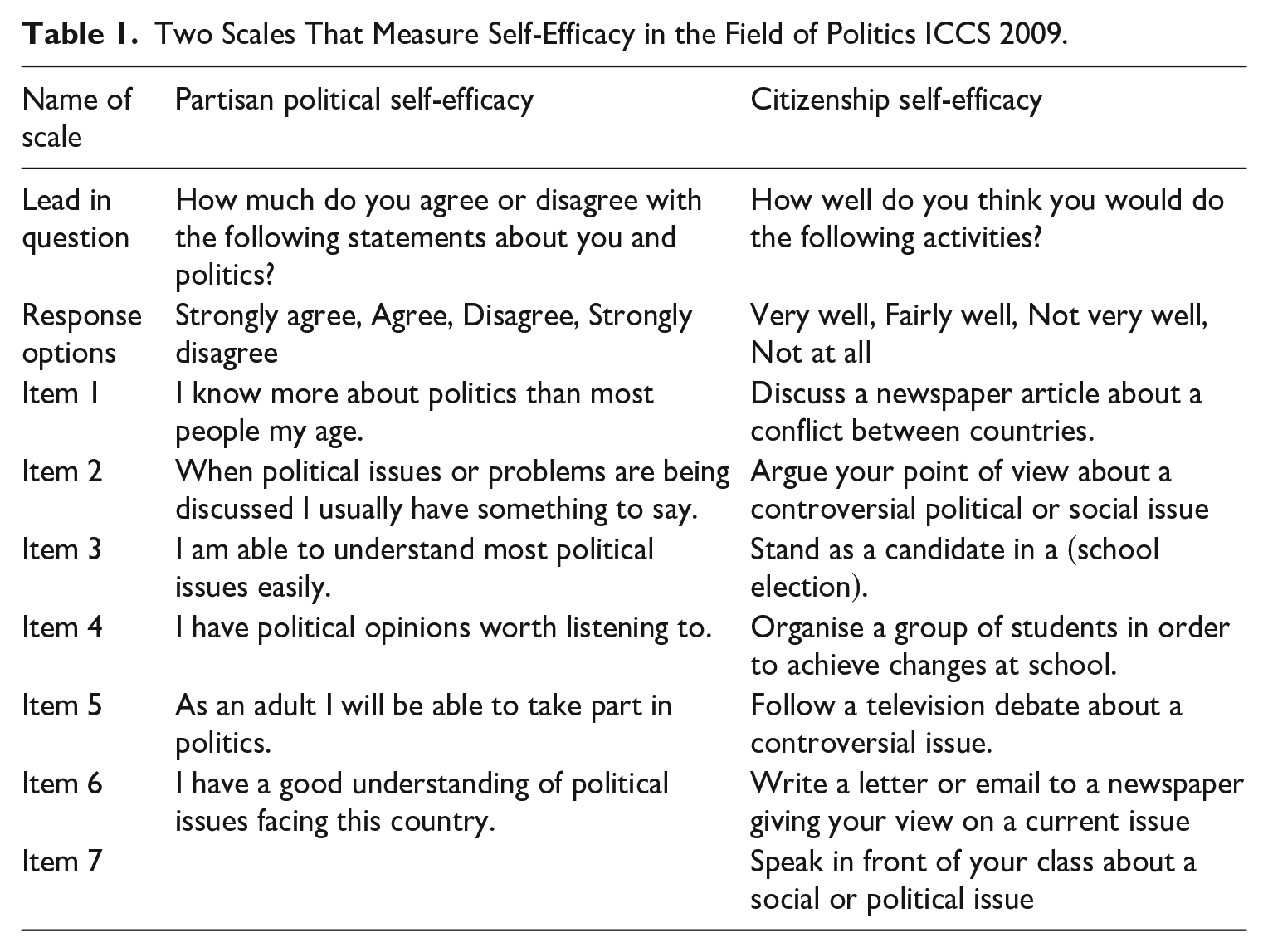
The items we use to measure interests in politics are two single items from a scale of political interest. The lead in statement to the items is, ‘How interested are you in the following issues?’. The first item is worded, ‘Political issues in your country’ that is expected to capture male political interests and the second item is worded, ‘Social issues in your country’ which in this study is expected to present a higher positive response from female students.
As the main predictor variable for all four of the models, we use students’ self-reported gender (i.e. ‘Are you a boy or a girl?’). 3 We recode the original values as a dummy variable, leaving boys as the reference category (boys = 0), and girls as the focal category (girls = 1). The descriptive estimates for the two highest categories of responses for the pooled sample, and by gender are in the Supplementary Material, Table 2.
The main control variable in the models is civic knowledge which is measured using the civic knowledge test scores from the ICCS 2009 study and is understood to be a measure of political sophistication (Schulz et al., 2013:336). The scores for this measure enable the researcher to rank students in their ability to perform reasoning, understanding and knowledge on political issues (Schulz et al., 2011). Students achieving the highest scores (above 563 scores) demonstrate holistic knowledge and understanding of civic and citizenship concepts. Students at this highest level can make evaluative judgements of policies and can hypothesise outcomes based on their understanding. Students who achieve the median level (between 479 and 562 scores) demonstrate familiarity with the broader concept of representative democracy as a political system. For example, students who achieve a medium score can describe the main role of the legislature. In contrast, students at the lower levels (below 479 scores) demonstrate familiarity with equality, social cohesion and freedom as principles of democracy. However, these students tend to show a more mechanistic understanding rather than relational thinking regarding how civic and civil institutions work (Schulz et al., 2010). In summary, civic knowledge test scores enable the researcher to represent how much students know and can reason on different political issues. The results of the descriptive statistics for each scale are in the Supplementary Material, Table 2.
Analytical Strategy
To test H1 and H2, we fit a generalised multivariate ordinal logistic model, where the two items on interest in political issues (political issues in your own country and social issues in your country) are the dependent variables, conditioned by students’ reported gender and civic knowledge test score, and the interaction between these two factors. This enables us to obtain gender gap estimates and assess if the gaps vary by students’ civic knowledge. We use Figure 1 to illustrate these results.
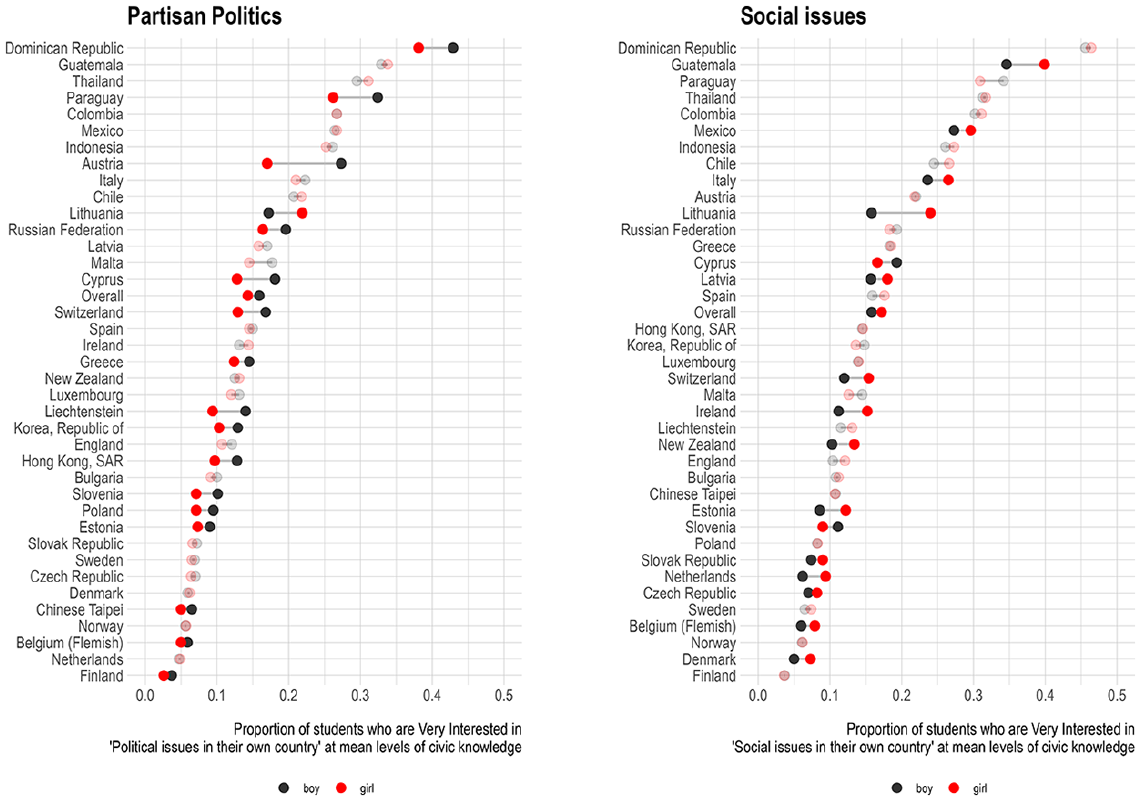
Expected Proportion of the Highest Category of Interest in Political and Social Issues of Boys and Girls, at Mean Levels of Civic Knowledge per Country.
To test the dimensionality of the construct of political self-efficacy (H3), we fit a bifactor model and estimate the explained common variance (ECV). Unidimensionality can be assumed when the global factor accounts for 85% of the variance or more, in comparison to the specific factors (Rodriguez et al., 2016; Stucky and Edelen, 2015).
To test H3 and H4 on the gender gap on self-efficacy in the field of politics, we then fit a multivariate regression model, where the two efficacy scales partisan political self-efficacy and citizenship self-efficacy are dependent variables, conditioned by students’ reported gender. Civic knowledge is added as the control variable in the model to ensure that we are measuring confidence and not competence in the domain of politics while also including the interaction between gender and civic knowledge. With the fitted model, we can retrieve gender gaps and test if these gaps are similar at differing levels of civic knowledge. We use deviation coding for students’ gender; thus, gender gaps are twice the regression coefficient estimate associated with this factor. Figure 2 depicts these results.
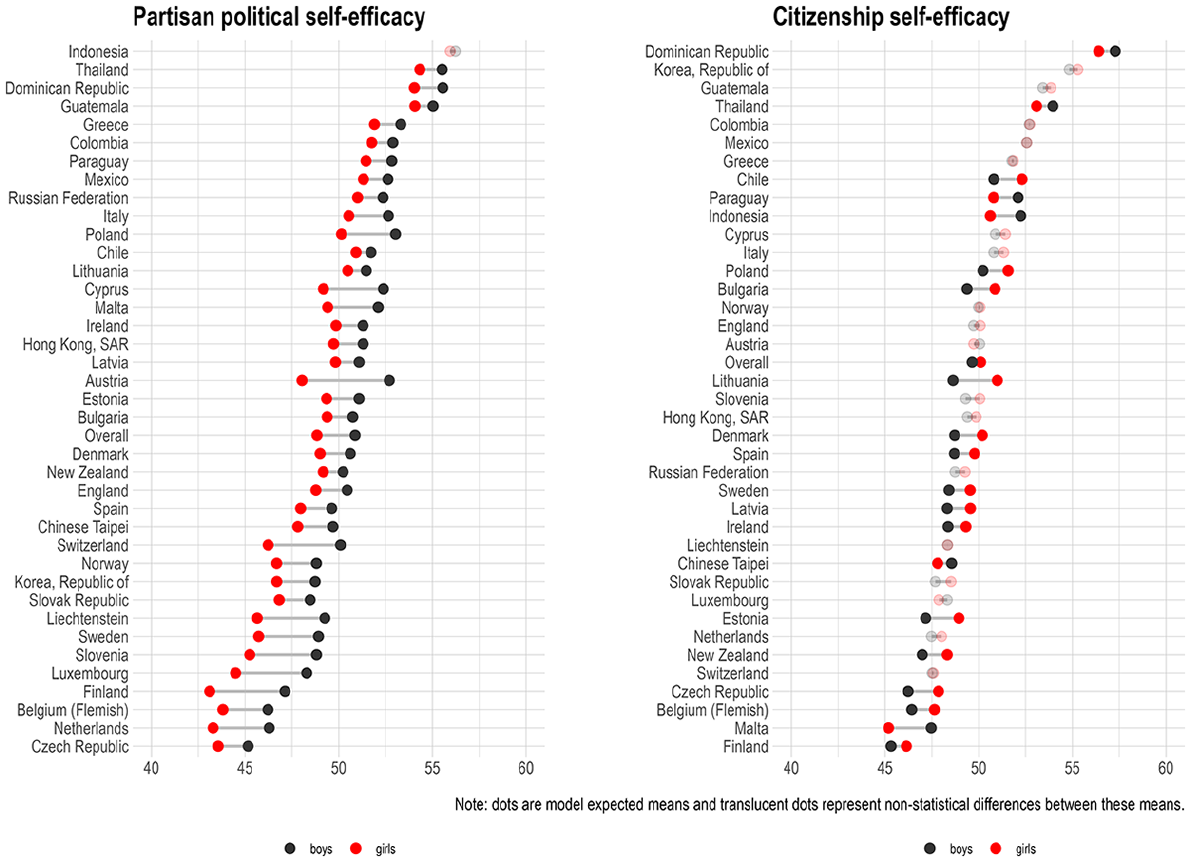
Expected Means of Boys and Girls on Partisan Political and Citizenship Self-Efficacy at the Mean Levels of Civic Knowledge, per Country.
Both models were fitted for each country separately and the unstandardised coefficients were retrieved. Standard errors are corrected using Taylor Series Linearization, using schools as the primary sampling unit, and jackknife zones as pseudo strata. The multivariate approach in each model has the advantage of producing estimates that consider the individual-level response to both dependent variables simultaneously, instead of ignoring the other variable of interest. In Supplementary Material 1, we include the equations of the fitted models.
To test our hypotheses regarding country-level indicators (H6–H8), we use correlations and meta-regressions. To test H6, the effect of a country’s level of educational achievement on civic knowledge, we correlate the partisan political self-efficacy and citizenship self-efficacy expected country means, with the country’s civic knowledge means.
To assess the remaining country-level hypothesis (H7 and H8), we calculate correlations and then meta-regression analysis to assess the relationship of the country-level estimates of political self-efficacy with country-level indicators, using its F statistic (see Supplementary Material 2 for rationale for selection of meta-regression). The country-level indexes used were the UN Gender Inequality Index (United Nations Development Programme, 2010) that combines indicators on reproductive health, political empowerment and labour market participation. The indicators selected on the quality of democracy are years of uninterrupted democracy (Boix et al., 2013), the Transparency International Corruption Index (Lauglo, 2013; Transparency International, 2023) and the Reasoned Justification Index (Coppedge et al., 2021), all these indexes were retrieved from the year 2008, the year preceding the ICCS study to demonstrate a lagged effect. The final index, the Reasoned Justification Index is generated with the responses of five expert coders, recruited by the V-DEM project (Coppedge et al., 2021). It ranks the extent that political elites of countries give public, in-depth and reasoned justification for their positions, when important policy changes are being considered.
We use scatter plots to illustrate the results of H7 and H8 (Figure 3 and Supplementary Material, Figure 10).
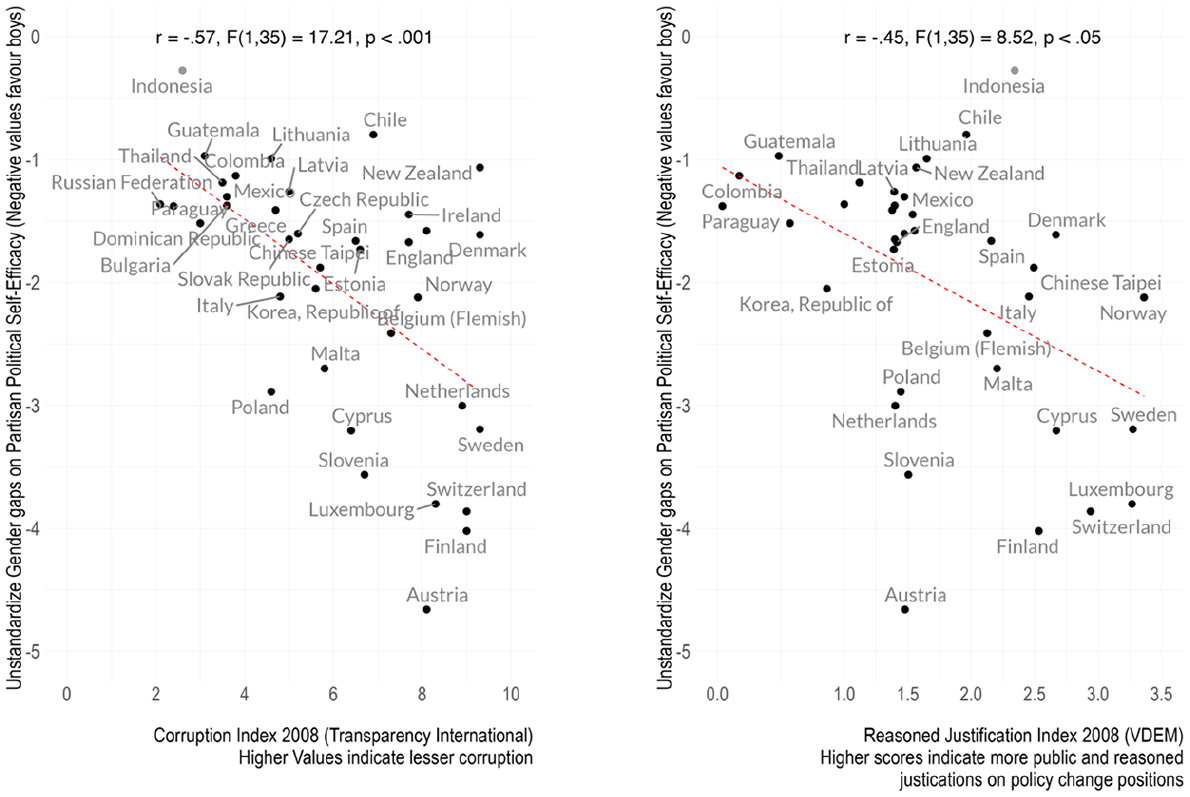
Gender Gaps on Partisan Political Self-Efficacy at Mean Levels of Civic Knowledge, per Country, by Corruption Index (2008), and Reasoned Justification Index (2008) (V-DEM).
Results
Political Interest
The results show a significant gender gap in favour of boys on their level of political interest compared to girls for the pooled sample (Figure 1 and Supplementary Material, Table 3). This was the case when we compared the expected proportion of students’ responses selecting the category ‘Quite Interested’ with ‘Very interested’ by gender (boys = 0.54, girls = 0.50, Z = –8.58, p < 0.001). When analysing the countries individually, we found statistical differences for 16 out of 38 very diverse countries in the expected direction. To illustrate this finding, we report the standardised estimates as
We explored interaction effects to verify if these results changed according to the levels of political sophistication of the students in each country. We found two negative interaction terms, for Denmark and Spain, and a positive interaction for Paraguay (Figure 4, Supplementary Material). Although there are no significant differences between girls and boys for Denmark and Spain at mean levels of civic knowledge, at 2 standard deviations of civic knowledge or higher, we can predict gender gaps favouring boys (Denmark: boys = 0.21, girls = 0.16; Spain: boys = 0.19, girls = 0.12). In Paraguay, we found the reverse pattern: at higher levels of civic knowledge (2 standard deviations over the country mean), the gender gap on political interest among girls and boys are smaller (Paraguay: boys = 0.21, girls = 0.25).
We next tested the extent that girls are more interested than boys on social issues (H2). We found some evidence to support this proposition with a significant gap in the pooled sample and in 14 countries out of 38 examined. Lithuania, Netherlands and Denmark were the countries with the three largest gaps that favoured girls (Figure 1 and Supplementary Material, Table 4). There were only two countries, namely, Slovenia and Cyprus, where boys are more interested in social issues in their country than girls, while the remaining countries all provided non-significant results.
Concerning social issues, we found a single positive interaction between students’ gender, and civic knowledge, for Austria. At the mean levels of civic knowledge, we found no gender gaps, yet we can predict a positive gender gap for interest in social issues favouring girls, at higher levels of civic knowledge (+2SD) (Austria: boys = 0.31, girls = 0.38) (Figure 4, Supplementary Material).
We summarise the results on political interest in Figure 1, to highlight the obtained statistical differences between girls and boys from the fitted models. Figure 1 is a Cleveland plot that displays the proportions of expected response in the highest category of interest for each item, for political issues and social issues. Full colour dots depict statistically significant gaps between girls and boys, while translucent dots depict obtained non-significant gaps in the fitted multivariate model.
Self-Efficacy in Politics
Next, we test the multidimensionality of political self-efficacy (H3), and then identify the gender gaps on the two measures of political self-efficacy (H4 and H5).
To assess if self-efficacy in politics is unidimensional, we fitted a bifactor model and estimated the ECV of a general factor. The general factor reached an ECV = 0.63 – a result below the expected benchmark for unidimensionality (ECV > 0.85) (Rodriguez et al., 2016; Stucky and Edelen, 2015). The two-factor model fits the data better (
Regarding the gender gaps on political self-efficacy, there is substantial evidence in support of the hypothesis that girls have lower levels of confidence on partisan political self-efficacy (H4). In the pooled sample and for 37 out of 38 countries in this study, there is a statistically significant gender gap favouring boys (Figure 2, and Supplementary Material, Table 5). We report here the results of the three countries with largest gaps between boys and girls (2*), and provide the mean difference standardised by the standard deviation (10 points) of the scores on the scale of both measures of political self-efficacy (
The fifth hypothesis stated that there would be no significant gender gaps for the broader citizenship self-efficacy measure. The results for this measure are unexpected. There are significant differences and a gender gap on citizenship self-efficacy measures; nevertheless, these gaps are considerably smaller in scale in comparison with the gaps on the partisan measure of political self-efficacy (measured by the absolute standardised gap) (
In the case of citizenship self-efficacy, the gender gaps are more movable in relationship to the levels of students’ political sophistication. The interaction term of the fitted model is different from zero for 19 of the 38 countries. For 16 of these countries, we can expect that gender gaps favouring girls are larger at higher levels of civic knowledge and for three countries where the gender gap is favouring boys, these gender gaps reduce in size at higher levels of civic knowledge (for country examples, see Supplementary Material 3 and Figure 7).
The very different results on gender gaps for the two self-efficacy measures in the field of politics indicate quite clearly that this is not a unidimensional construct. These two measures are capturing different phenomena regarding confidence in the field of politics. In Figure 2, we summarise our obtained results displaying the expected means for each scale for girls and boys, highlighting the mean differences that are significant between countries, similar to Figure 1.
Country Differences
The results of the analysis for the first development hypothesis (H6) showed that countries with higher levels of political knowledge had on average significantly lower levels of both measures of political self-efficacy (partisan political self-efficacy: r = –0.61, F(1, 36) = 20.81, p < 0.001; citizenship self-efficacy: r = –0.56, F(1, 36) = 16.47, p < 0.001) (Supplementary Material, Figure 8).
We then attempted to explain the comparative size and direction of the gender gaps across countries using our second indicator on development on macro levels of gender equality. The result for the association between the gender inequality index and partisan political self-efficacy is paradoxical and not what we had hypothesised: the higher the level of gender equality in a country, the larger the gender gap favouring boys (r = 0.58, F(1, 34) = 18.06, p < 0.001) (Supplementary Material, Figure 9). However, the association between gender inequality index and citizenship self-efficacy follows the expected result (r = –0.40, F(1, 34) = 7.41, p < 0.05). At higher levels of gender equality, countries have larger gender gaps favouring girls, and at lower levels of gender equality, countries have gender gaps favouring boys (Supplementary Material, Figure 10).
Concerning the country-level indicators on quality of democracy (H8), we found significant results only for partisan political self-efficacy. For all of the indexes considered, there is an unexpected negative relationship, where the higher the quality of democracy, the larger the gender gap favouring boys (age of democracy: r = –0.36, F(1, 36) = 6.52, p < 0.05; corruption index: r = –0.57, F(1, 35) = 17.21, p < 0.001; reasoned justification: r = –0.44, F(1, 35) = 8.52, p < 0.05). Figure 3, depicts the varying gender gaps on partisan politcal self-efficacy on these two country level indicators.
Discussion
To assist with the discussion, we begin by summarising the results of our eight hypotheses:
H1: Partially supported (16/38 countries). The results suggest that girls in some countries have less interest than boys in politics.
H2: Partially supported (14/38 countries). The results suggest that boys in some countries have less interest than girls in social issues.
H3: Supported. Self-efficacy in the field of politics is not unidimensional.
H4: Supported (37/38 countries). Girls have less political self-efficacy than boys in measures on partisan politics.
H5: Alternative hypothesis is not supported: The evidence suggests that there are significant gender gaps in scales that emphasise a broader sense of politics (favourable to girls: 14 countries, favourable to boys: six countries).
H6: Supported. The higher the average level of student’s attainment on political knowledge in the country, the lower the average country levels of both measures of political self-efficacy.
H7 (Citizenship self-efficacy): Supported. The levels of gender equality in a country are associated with comparatively higher levels of citizenship self-efficacy in girls compared to boys.
H7 (Partisan political self-efficacy): Alternative hypothesis is not supported: the results indicate that the higher the levels of gender equality in a country, the lower the level of girls’ partisan political self-efficacy compared to boys.
H8 (Partisan political self-efficacy): Alternative hypothesis not supported: the results suggest that the higher the quality of democracy, the lower the level of girls’ confidence compared to boys for partisan political self-efficacy.
H8 (Citizenship self-efficacy): Alternative hypothesis not supported. Null hypothesis – there is no evidence of a relationship between the quality of democracy and the level of girls’ citizenship self-efficacy comparatively to boys.
The findings in this article (H1 and H4) are indicative that it is likely to be partisan politics represented by the word ‘politics’ within the measure used which in many countries around the world may well have a negative influence on adolescent girls’ interest and even more consistently and in many more countries on their confidence in their ability to politically engage in party politics. This pattern is consistent with the recent research findings in the field of political interest (Ferrín et al., 2020; Tormos and Verge, 2022), suggesting that the gender gap favouring men remains mostly in formal partisan politics for political interest and our contribution is finding that this is also the case for political self-efficacy. Similar with this existing literature, our findings show (H2) that the gender gaps are much smaller when the concept of politics is widened to include political action on more social issues (e.g. health, education, welfare) and our new contribution to this literature is that this also appears to be the case for political actions inside schools where girls appear to be at least as confident as boys in most country contexts. In this regard, the stereotype of boys not being interested in social issues appears to remain in many countries studied. It is important to reiterate our earlier argument here that changing the wording in the questions will not remove the inequality in either direction but that stereotypical roles within the political sphere need to be measured separately to understand and then tackle gender inequalities in confidence and interest in politics.
Nevertheless, the pattern on partisan political interest is not conclusive in all country contexts as we note for 21 countries, where there were no significant differences (H1). Instead, this pattern was more consistent for partisan political self-efficacy (37 out of 38 countries) within our data set. For the 21 countries with no significant differences on political interest, we can speculate that with social change a reduction of stereotyping of roles in society allows for girls to be interested in formal politics in these countries, but still not enough social change has occurred to allow for the additional step of growth of confidence in participating in partisan politics.
Another difference between the two measures on self-efficacy in the field of politics was the inclusion in the partisan political self-efficacy measure of items on knowledge and understanding. It is important to note that within the inferential statistics, we are controlling for actual levels of civic knowledge in the model so we have greater certainty that we are measuring levels of confidence in knowledge as opposed to actual competence. In the descriptive statistics, the two items on knowledge and understanding in the pooled data had two of the largest gender gaps favouring boys. Could it be that girls have lower confidence in their knowledge and understanding of partisan politics than boys and this could be one of the main drivers of these results? This could be the case even though girls consistently outperform boys on international and comparative testing of civic knowledge and skills that includes the assessment of reasoning, understanding and knowledge on political issues (Schulz et al., 2010, 2018). The gendered socialisation process appears to be leading boys to be much more confident about their knowledge on partisan politics than girls. It would be interesting to have measures of confidence on broader civic knowledge and understanding in surveys to see if these gender gaps then disappear or start to favour girls. It will also be important to address in future research the socialisation process inside and outside schools which is leading boys to be more confident than girls in their knowledge and skills on politics. In addition, investigating the effects on political mobilisation of the gender gaps on political self-efficacy would help identify the long-term consequences.
Regarding country differences, there is some evidence and contrary to the above findings that students to a certain extent appear to be comparing themselves with other students from their country context based on their actual ability. When we tested H6, the big-fish-little-pond-effect we found that as expected that in countries where the overall political knowledge and skills scores are higher, students have lower levels of both measures of political self-efficacy. These results for both measures of political self-efficacy are in accordance with international and comparative research for other academic concepts of self-efficacy such as confidence to perform mathematics (Marsh et al., 2008, 2014). Nevertheless, this is the first time that the relationship between knowledge and confidence has been analysed and retrieved in the field of politics.
When it comes to explaining the size and direction of the gender gap on political self-efficacy, there appears to be an additional effect unrelated to actual ability and it is these results where partisan and citizenship self-efficacy diverge. Citizenship self-efficacy follows more of our expected country patterns on gender equality where the widest gaps favouring girls are found in the more gender equal countries (H7). However, at higher gender inequality between countries gender gaps favour boys. In contrast, partisan political self-efficacy has wider gender gaps favouring boys in countries with higher levels of gender equality such as in the Nordic countries. These paradoxical findings are replicated with the three indexes on quality of democracy for the partisan political self-efficacy measure, where the higher the quality of democracy the wider the gender gaps on partisan political self-efficacy favouring boys. We speculate that the reason for these results is that being knowledgeable and sophisticated on politics is a masculine stereotype connected with political leadership in highly developed democracies. Therefore, in countries where high levels of political sophistication are performed by political leaders, there appears to be more pressure for boys to demonstrate and even exaggerate their own level of political knowledge by being overly confident in their own ability on partisan politics. In contrast, countries where political sophistication forms less of a part of the stereotypical images of political power and leadership and where there are higher levels of corruption, and less years of democracy, there is simply less pressure for boys to appear politically knowledgeable as these attributes are less associated with cultural stereotypes of leadership and power. Thus, we are suggesting, and as argued by some feminists that different cultural stereotypes of masculinity, political power and political leadership exist in different often none Western national contexts (Patil, 2013) and these need to be considered when understanding gender inequality from an international and comparative perspective (Khelghat-Doost and Sibly, 2020). Further research is required to test this argument further.
Conclusion
The gender gap in political efficacy is still very much present within the adult population (Fraile and De Miguel, 2019) and the results from this article suggest that in 2009 this was likely to be the case for self-efficacy in partisan politics for 14 years old. This research identifies that it is likely that it is self-confidence in party politics and knowledge and understanding on this subject which still needs to be addressed to gain greater equality in political voice. In contrast, confidence in broader social and civic participation has already been achieved by many girls in many countries. In this case, it is important concerning policy and practice to establish teaching methods in schools to increase girls’ confidence and political interest in party politics. It is also equally necessary within education to identify how to challenge stereotypes and start to interest boys and build their confidence in social issues.
However, continued research in this field is limited by the fact that the IEA ICCS studies since 2009 have not continued to use the partisan political self-efficacy scale. The action of dropping this scale has resulted in a missed opportunity in understanding gender equality in future political engagement and identifying possible methods that could mitigate these differences. It has also masked the possibility to continue to monitor gender gaps in partisan politics for the adolescents age group.
Supplemental Material
sj-docx-1-psw-10.1177_14789299241264970 – Supplemental material for Understanding Gender Inequality in Political Self-Efficacy in Early Adolescents: Different Measures, Different Gender Gaps
Supplemental material, sj-docx-1-psw-10.1177_14789299241264970 for Understanding Gender Inequality in Political Self-Efficacy in Early Adolescents: Different Measures, Different Gender Gaps by Bryony Hoskins and Diego Carrasco in Political Studies Review
Footnotes
Declaration of conflicting interests
The author(s) declared no potential conflicts of interest with respect to the research, authorship and/or publication of this article.
Funding
The author(s) disclosed receipt of the following financial support for the research, authorship, and/or publication of this article: This research is supported by a co-funding from the UKRI grant number 10064651 and EU Horizon grant number 101095000.

Supplemental material
Additional supplementary information may be found with the online version of this article.
Contents
Table 2. Population Pooled Descriptive Estimates for the Pooled Sample on Political Self-Efficacy, Citizenship Self-Efficacy, Political Interest, and Civic Knowledge. 1.Equation for Fitted Models. 2.Rational for the Use of Meta-Regression. 3.Examples of Country Differences at Different Levels of Civic Knowledge for Citizenship Self-Efficacy. Table 3. Population Estimates of the Multivariate Ordinal Logit for Interest in Political Issues, Accounting for Students’ Civic Knowledge. Table 4. Population Estimates of the Multivariate Ordinal Logit for Interest in Social Issues, Accounting for Students’ Civic Knowledge. Table 5. Population Gender Gap Estimates and Partisan Political Self-Efficacy Expected Means, at Mean Levels of Civic Knowledge. Table 6. Population Gender Gap Estimates and Citizenship Self-Efficacy Expected Means, at Mean Levels of Civic Knowledge. Figure 4. Expected Proportion of the Highest Category of Interest in Partisan Politics of Boys and Girls, at Different Levels of Civic Knowledge (–1SD, Mean, +1SD), by Country. Figure 5. Expected Proportion of the Highest Category of Interest in Social Issues of Boys and Girls, at Different Levels of Civic Knowledge (–1SD, Mean, +1SD), by Country. Figure 6. Expected Means of Boys and Girls of Partisan Political Self-Efficacy, at Different Values of Civic Knowledge (–1SD, Mean, +1SD) by Country. Figure 7. Expected Means of Boys and Girls of Citizenship Self-Efficacy, at Different Values of Civic Knowledge (–1SD, Mean, +1SD) by Country. Figure 8. Partisan Political Self-Efficacy and Citizenship Self-Efficacy Adjusted Means per Country, by Students Civic Knowledge per Country. Figure 9. Gender Gaps on Partisan Political Self-Efficacy by Gender Inequality Index (2008). Figure 10. Gender Gaps on Citizenship Self-Efficacy by Gender Inequality Index (2008).
Notes
Author Biographies
References
Supplementary Material
Please find the following supplemental material available below.
For Open Access articles published under a Creative Commons License, all supplemental material carries the same license as the article it is associated with.
For non-Open Access articles published, all supplemental material carries a non-exclusive license, and permission requests for re-use of supplemental material or any part of supplemental material shall be sent directly to the copyright owner as specified in the copyright notice associated with the article.
