



Abstract
Opposition parties are a key feature of parliamentary democracies, but their participation rights differ markedly. In the UK House of Commons, the institutional operation of the Westminster model facilitates a marked distinction between the rights afforded to the Official Opposition party compared to smaller opposition parties. During times of crisis, these Westminster model dynamics can shift, impacting opposition rights. This article uses a case study of the COVID-19 pandemic to assess institutional inequalities across opposition party groups. Drawing on an analysis of over 4000 contributions to parliamentary debates and interviews with MPs, we examine the pandemic’s impact on the roles of opposition parties beyond the Official Opposition. We find that the pandemic initially generated unprecedented cooperation between the government and small opposition parties but that this was short-lived. In the long term, the pandemic exacerbated existing institutional barriers and the size and geographical concentration of small opposition parties in the devolved nations brought disproportionate participation and oversight barriers. This suggests the need to guarantee formal opposition rights within Westminster systems beyond the Official Opposition party to ensure that all political parties have the capacity to carry out their functions during times of crisis.
Introduction
The presence of opposition parties and their scrutiny of government policy is an ‘indispensable’ (Andeweg, 2013: 99) feature of democratic political systems (Kirshner, 2022: 13) and parliaments must decide how best to distribute participation rights among them. This brings inequalities between legislators as well as between political parties (Cox, 2015: 142). In the Westminster model system of the UK House of Commons, procedural and agenda-setting powers are concentrated in the government (Schleiter and Belu, 2016: 37), creating inequality between the Government and parliament as a whole, but especially between the Government and opposition parties. Observers have lamented the resulting impotence of parliament, especially in the twenty-first century, where opposition parties in particular have been constrained since the UK’s withdrawal from the European Union (Baldini et al., 2022: 336; White, 2022a, 2022b).
The majoritarianism inherent in this Westminster system does not only create inequality between the governing party and opposition parties. It also embeds inequality between opposition parties, with the largest opposition party (the Official Opposition), receiving far greater guaranteed participation rights in the House of Commons, including speaking opportunities for frontbench spokespersons, oral parliamentary questions and positions on parliamentary committees. Since the late 1990s, the second-largest opposition party has received some privileges but on a much lesser scale. No formal rights exist for other opposition parties (Fusaro, 1979: 377; Thompson, 2020), and thus, the institutional strength of these parties is very low (Garritzmann, 2017: 17). They are typically excluded from scrutiny, oversight and decision-making.
There are times, however, when the dynamics of this executive-dominated Westminster model system of parliamentary government change. In emergency situations, executive dominance increases even further, with governments passing legislation quickly (Shephard, 2009) and opposition scrutiny being muted (Lai and Reiter, 2005: 256; Shephard, 2009: 194). The COVID-19 pandemic is one such emergency. Political parties had to work in a challenging institutional environment, with suspensions of parliamentary proceedings and social distancing requirements at odds with the need for sustained opposition scrutiny (Bar-Siman-Tov, 2020; Griglio, 2020; Laflamme et al., 2023). The ‘huge legislative response’ from governments across a wide range of policy areas (Cormacain, 2020: 245) brought additional scrutiny challenges (Chaplin, 2020a: 112).
Considerable research exists on parliamentary responses to the pandemic. UK-focused studies have explored the adaptations made to parliamentary business (SPG, 2021) and the way in which opposition parties took a supportive stance towards government at the start of the pandemic (Louwerse et al., 2021). Little distinction is made, though, between the Official Opposition and small ‘o’ opposition parties. This raises two questions: (1) the extent to which opposition parties in the House of Commons saw greater inclusion in the government’s decision-making and (2) whether opposition parties who sit outside the guaranteed participation rights given to the Official Opposition, saw any change in their position vis-à-vis other opposition parties and the government.
We explore here the experience of the eight opposition parties beyond the Official Opposition who sat in the House of Commons in the first 18 months of the pandemic. 1 We focus on party groups, drawing on a content analysis of over 4,000 contributions to parliamentary debates between March 2019 and March 2021, as well as interviews with Members of Parliament (MPs) and officials. First, we establish the operation of opposition politics in the House of Commons under the Westminster model, showing the hostile environment facing smaller opposition parties and their exclusion from participation channels. We consider existing work on opposition in the UK during times of crisis, which focuses overwhelmingly on the Official Opposition, before considering research on parliaments elsewhere during the pandemic to establish key expectations around opposition behaviour.
We then structure our answer to these two research questions around key areas of opposition activity: (i) participation in parliamentary business, (ii) access to decision-making structures and (iii) oversight of government. Our findings contribute to existing work on opposition parties during the pandemic (e.g. Laflamme et al., 2023; Louwerse et al., 2021), showing that the government’s immediate response to opposition parties in the United Kingdom was more inclusive than we would expect under the Westminster model system. As in other countries, however, this new-found status was short-lived and small opposition party participation in decision-making soon dissipated. In addition, we find that small parties suffered disproportionately in terms of participation in scrutiny and oversight activities as the pandemic exacerbated existing institutional barriers. This is significant given the geographical concentration of these parties in the devolved regions of the United Kingdom. In light of ongoing evaluations of how political systems should best deal with public health emergencies (e.g. Bingham Centre, 2022) this suggests the need to reconsider the inequality of parliamentary rules, particularly during times of crisis, to ensure parity across both parties and regions in scrutiny processes.
Small Opposition Parties in a Westminster Model Parliament
Although the precise definition of the term ‘Westminster Model’ and its utility to comparative politics is debated (Russell and Serban, 2021), it remains a common concept for examining the changing nature of the UK’s political and parliamentary system (e.g. Baldini et al., 2018; Flinders and Matthews, 2017; Giuliani, 2023). Majoritarianism lies at its core, characterised by a ‘power hoarding’ single-party executive which dominates the parliamentary agenda (Baldini et al., 2018: 538; Flinders and Matthews, 2017: 157) and an adversarial, two-party system which is dominated by the Conservative and Labour parties (Russell and Serban, 2021: 752). This two-party majoritarianism privileges the Official Opposition party, excluding other opposition parties from policy making and scrutiny (Matthews, 2018: 53; Thompson, 2018). This is underscored by the architecture, rules and norms of the House of Commons which, until the late 1990s, operated as though only two parliamentary parties existed (Kaiser, 2008: 21; see also Norton, 2018: 16; Thompson, 2020: 36). Even today, Erskine May (2019: part 1, chapter 4) notes that parliamentary procedures operate the broad principle of ‘on the basis of a clear-cut division between Government and [Official] Opposition’.
This emphasis on two political parties at Westminster has also influenced our understanding of executive-legislative relations. King’s (1976) study highlighted the importance of the ‘opposition mode’ but focused solely on the relationship between the Government and the Official Opposition (see also Russell and Cowley, 2018). Research on the institutional opportunities for opposition influence on government also focuses overwhelmingly on the Official Opposition party (e.g. Matthews, 2018) and, to a much more limited extent, the second largest opposition party who have, since the late 1990s, received ‘third party’ rights in the Commons. Opposition parties smaller than the Scottish National Party (SNP) face a hostile parliamentary environment, receiving no guaranteed participation in question times or debates in the Commons chamber, and no guaranteed places on any investigative or legislative committees (Fusaro, 1979: 377). Crucially, they are excluded from the ‘usual channels’, bringing an information deficit, with no right to updates on parliamentary business, votes or government statements (Thompson and Pearson, 2022: 11). While the third party has some limited rights (e.g. participation during Prime Minister’s Question Time), in practice their position is far closer to that of the other smaller parties than to the Official Opposition. This has been exacerbated by the SNP's public position as opponents of the traditional Westminster system and their self-designated role as temporary legislators (Thompson, 2018: 450). The collective representatives of all parties beyond the Official Opposition are therefore in a weak institutional position as opposition parties.
Expectations About the Behaviour of Small Opposition Parties During the Pandemic
The single-party governments, which are characteristic of the Westminster Model, mean that during times of crisis, including the 9/11 terrorist attacks, the 2005 London bombings or the UK’s withdrawal from the EU, the typical relationship between government and opposition has shifted further in the government’s favour (Shephard, 2009: 201, discussing Hill, 2005; Lister, 2019: 418; Lynch et al., 2019), exacerbating existing resource and information imbalances (Neal, 2012: 263) and cementing government control of the parliamentary agenda. Opposition has acceded to the legislative demands of government, passing bills quickly with little scrutiny (Hiebert, 2005: 676; Neal, 2012: 266; Shephard, 2009: 194). Opposition parties have been overtly supportive of government policy (Shephard, 2009: 195–200) in what Neal (2012: 359) describes as a ‘discourse of emergency’.
The behaviour of the House of Commons during previous times of crisis gives us some indication of what to expect from the pandemic, but we must also draw on the experience of pandemic parliaments elsewhere. There is considerable scholarship here, but this mostly discusses parliamentary opposition as a whole. For example, Chaplin (2020b: 10) notes how, in the Canadian House of Commons, ‘there was no parliamentary time allocated to the opposition’, which was problematic, given that ‘the Westminster model is contingent on governing within a parliament infused with opposition’. Nor does existing work distinguish between larger and smaller parties or between those with different participation rights (e.g. Bar-Siman-Tov, 2020; Bromo et al., 2024; Feldmann, 2021). Studies by Louwerse et al. (2021) and Laflamme et al. (2023) are exceptions here. The former found smaller parties to be less supportive of the government in their parliamentary contributions during the initial period of the pandemic than the main opposition party (Louwerse et al., 2021: 1042), while the latter study found no evidence of any differences between opposition parties in a Westminster model parliament (Laflamme et al., 2023: 18). Other work on small parties is limited to the behaviour of radical political parties (e.g. Lehmann and Zehnter, 2022) and those with a place in coalition governments (Chiru, 2023: 23).
In his review of existing pandemic parliaments scholarship, Chiru (2023, 2024) highlights four key factors affecting the role of parliamentary institutions. We use two of these: the constitutional and legal opportunities available for parliamentary oversight (Chiru, 2023: 23) and the strength of the government-opposition dynamic pre-pandemic (Chiru, 2023: 28) as a guide to establishing our expectations around small party behaviour in the House of Commons.
First, the central tenets of the Westminster model and the lack of small party rights in normal times lead us to expect that the opportunities for parliamentary oversight and participation will remain low and that there will be inequality between the Official Opposition (Labour) and the smaller opposition parties. Research elsewhere has highlighted the importance of existing mechanisms such as parliamentary debates (Chaplin, 2020a: 112), committee systems (Chiru, 2024: 415) and parliamentary question times (Chiru, 2024: 415; Siefken, 2023: 670), particularly in terms of the ‘fact finding’ role-played by legislators in their oversight of pandemic decision-making (Griglio, 2020: 63). In some parliaments use of these tools by opposition parties actually increased during the pandemic (Pedersen and Borghetto, 2021: 413; Siefken, 2023: 670). While these tools are likely to have been well used by the Official Opposition at Westminster, they are mechanisms from which smaller parties are excluded in normal times. Therefore while the House of Commons saw new procedures to ensure the continuity of business (Bar-Siman-Tov, 2020: 15; Griglio, 2020: 53), it seems unlikely that these will have generated new scrutiny opportunities for small parties.
Second, research on government and opposition politics in the immediate pre-pandemic period suggests an increasingly powerful UK executive, and these concerns escalated further during the pandemic itself (Ewing, 2020; Hidalgo et al., 2022; Russell et al., 2021). We note, however, that both Siefken’s (2023) and Brack et al. (2021: 15) find evidence that the pre-pandemic relationship between governments and opposition party groups did not necessarily determine how the pandemic relationship between the two branches would play out. Opposition party groups in the Bundestag and European Parliament were included to a much greater extent than previously, and this involved ‘all parliamentarians’, including those from minority parties (Siefken, 2023: 676). Similarly, during the passage of the UK’s negotiated Brexit deal through the House of Commons in early 2019 the Prime Minister made efforts to ‘reach out’ to all political parties (HC Debates 15 January 2019: c1126). Thus, while we anticipate that although the government would willingly relinquish control to parliament, we expect it to have reached out to a broader range of opposition parties.
Methodology
Our exploratory approach was guided by the need to access both public-facing and internal parliamentary group activity during the pandemic. The former required the study of parliamentary contributions while the latter necessitated in-depth research interviews with MPs themselves. In line with Louwerse et al. (2021), we utilise a content analysis of over 4,000 contributions to House of Commons debates between 18 March 2019 and 17 March 2021. This 2-year time frame enabled us to compare contributions made by small parties during the pandemic with a conventional parliamentary year. Parliament’s online records were used to gather all speeches, interventions and oral questions by each small party MP across this two-year period. We coded the type of contribution made (speech, intervention and question) and nature of participation (chamber or virtual), checking these against the Parliament TV database. 2 Alongside this, we examined every statement, debate and select committee inquiry relating to COVID policy during this period. The Procedure Committee’s (2020) inquiry into procedure under coronavirus restrictions was particularly useful here as party groups submitted written evidence documenting their experiences. We include all opposition parties beyond the Official Opposition in our analysis. Although the SNP receives third-party rights, these are far less significant than those given to the Official Opposition (Thompson, 2018: 448). Coding for SNP contributions helped to better understand the extent and impact of changes to party rights and whether the government treated the third party any differently than the smaller parties.
To provide a deeper insight into intra-party organisation, we interviewed eight MPs spanning five party groups (Alliance, DUP, Liberal Democrats, Plaid Cymru and the SNP), as well as the Chair of the Procedure Committee, Karen Bradley. These MPs were purposively selected on the basis of the party positions they held (e.g., Whip or party leader) or their prominence during pandemic debates and proceedings. We additionally interviewed three senior parliamentary officials between October 2020 and January 2021. We concentrated on our key themes of decision-making, oversight and participation at the party level and encouraged our interviewees to reflect in detail on key periods during the pandemic, exploring the ways in which their party’s work, organisation and relationship with government had changed.
How Did the Pandemic Affect Small Parties in the House of Commons?
The relationship between opposition parties and the government at the start of the pandemic (March to April 2020) was typical of previous emergency situations with an almost complete cessation of party politics (e.g. Louwerse et al., 2021: 1027; Neal, 2012: 263). All opposition parties interviewed described internal discussions around the need to tone down party politics in public-facing forums (Interview 3, SNP; Interview 9, PC) and publicly subscribing to the view that the government was ‘entitled to get its business through’ (Interview 3, SNP). Considerable intra-party tension existed though around how this supportive stance could be balanced with necessary opposition scrutiny. Parties wondered how they would be perceived by the public (Interview 5, LD), and a finer filter than normal was applied to parliamentary contributions to ensure they would not be ‘hijacked’ by others (Interview 9, PC). The timing of the pandemic heightened opposition anxiety as it was unclear which institutional oversight tools would be available to opposition parties after the Easter recess or how the relationship between the opposition and the government would work (Interview 9, PC). To illuminate these questions further, we begin by considering the participation opposition parties in parliament, before focusing on their role in decision-making and scrutiny.
Participation of Party Groups in House of Commons Business
All opposition parties sought to actively participate in scrutiny (Interview 5, LD; Interview 9, PC), but we find that the burden of parliamentary participation fell inequitably across party groups. This resulted less from the availability of institutional mechanisms, the lack of guaranteed participation rights or pre-pandemic participation patterns stressed in previous studies (e.g. Chiru, 2023: 28) and more due to opposition parties’ individual circumstances, namely group size and geographical distance from Westminster. All parties, regardless of size or parliamentary position, had to comply with the government’s coronavirus regulations around travel and social distancing. For the two largest parties, this was an easier task. Their greater numbers, combined with the location of many Conservative and Labour MP constituencies in the South and Midlands of England, made it far easier to maintain a continued physical parliamentary presence at Westminster. It was more challenging for small parties whose MPs, 89% of whom represented constituencies in Scotland, Wales and Northern Ireland. They constituted 100% of Northern Ireland’s MPs and 80% of Scotland’s MPs. 3 Research by Willumsen (2019) has shown that remoteness from Westminster has an impact on parliamentary activity at the individual MP level. The pandemic highlighted the impact of remoteness at the party group level too. Opposition parties took collective decisions around their participation, with MPs who had no underlying health conditions and whose personal circumstances were more conducive to long periods away from home volunteering to travel to Westminster. This contrasts with the top-down allocation of participation by party groups (Malloy, 2020: 3; Rayment and VandenBeukel, 2020: 5).
The Liberal Democrats and Plaid Cymru both recalled how one member of their group had to stay in London for several months to do the ‘heavy lifting’, taking part in urgent questions, statements and debates. This protected the other MPs in their party group from virus exposure and limited its potential spread to their constituencies (Interview 5, LD; Interview 10, DUP; Interview 9 PC). These nominated MPs would ‘over-index’ themselves, becoming the parliamentary face of their party group and maximising its visibility (Interview 8, LD). Figure 1 demonstrates this shift within Plaid Cymru. In normal times, most contributions (60%) in the chamber are made by the party’s Westminster leader, Liz Saville-Roberts. Between June and December 2020, however, this pattern changes. Following a ‘complete rethink’ (Interview 9, PC) about its operations, one MP (Ben Lake) felt more able to remain in London and thus made the majority of oral contributions for Plaid Cymru from Westminster.
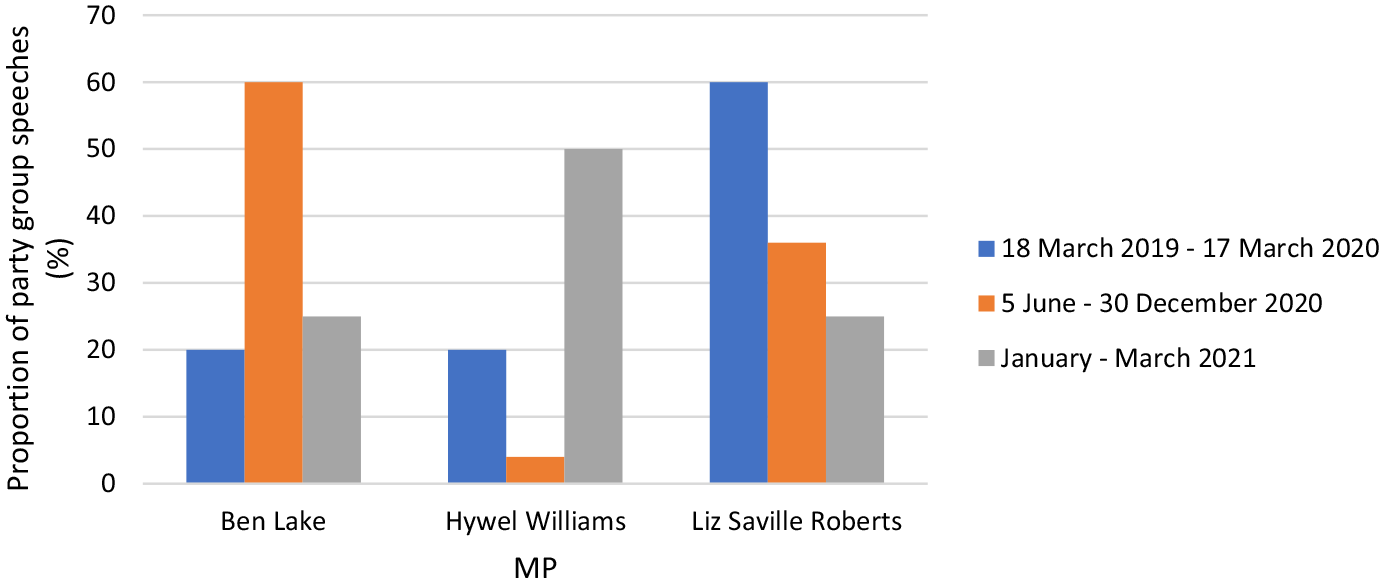
Proportion of Parliamentary Contributions Across Plaid Cymru Parliamentary Group March 2019 to March 2021.
Such was the significance of remoteness from Westminster on small party activity, that even the SNP saw a direct impact on its participation. Travel rules issued by the Scottish Government, coupled with decisions made by the UK government around hybrid proceedings, prevented the SNP from exercising its third-party participation rights. No SNP MPs took part in the debate on changes to parliamentary business on 21 April 2020, despite their guaranteed speaking slot. On other occasions, no frontbench spokespersons were present (HC Debates 21 October 2020, c1083), and backbench SNP MPs were forced to speak on issues ‘outside their normal comfort zone’ (Interview 3, SNP). Even where virtual participation was possible, small parties saw different treatment compared to the Official Opposition, as those participating online were prohibited from intervening on others’ speeches. Pre-pandemic, interventions were a favoured tool for smaller parties as way of ‘circumventing’ the bias towards contributions from large parties, especially at the beginning of debates (Interview 10, DUP). This was apparent in the very first hybrid debate on 22 April 2020 where every contribution from opposition MPs beyond the Official Opposition party was made virtually and therefore no interventions could be made. The limited seating available in the socially distanced House of Commons chamber compounded these issues, meaning that even if smaller opposition parties could attend in person, they would need to share seats between party groups on the small party benches (Interview 10, DUP; Interview 9, PC), something which the Official Opposition never had to do.
The pandemic therefore brought clear inequalities between party groups, but this was not recognised by the larger parties. The Procedure Committee Chair, a government MP, maintained that all parties were equally affected (Interview 7, Karen Bradley). Nor did the media or the general public understand the need for the smaller parties to maintain a physical presence at Westminster. Alistair Carmichael warned colleagues that the end of hybrid participation in June 2020 was ‘a recipe for us being a Parliament essentially of people who live within driving distance of London’ (HC Deb, 2 Jun 2020, c750). One DUP MP spoke of ‘mischief making’ by the media who would regularly question his flights to London to participate in proceedings, suggesting that he was not following the mandated work from home guidance (e.g. Hughes, 2021). As the holder of the party’s proxy votes, his presence was required at Westminster, yet it placed him in a very difficult position (Interview 10, DUP).
Despite these challenges, our analysis of small parties’ parliamentary contributions finds that all opposition parties made more parliamentary speeches than the preceding year (Figure 2), and this was widely acknowledged (Interview 5, LD; Interview 8, LD). Plaid Cymru saw a fourfold increase, from 20 speeches pre-pandemic to 81 across 2020-21, while the Liberal Democrats saw their total number of speeches double from 173 to 394. These figures can be attributed partly to the removal of interventions during virtual proceedings, which opened up more time for speeches. It is likely also due to the introduction of published call lists for all debates from April 2020 which reduced the constant need for small party MPs to try to catch the Speaker’s eye to participate (Interview 3, SNP; Interview 4, Alliance).
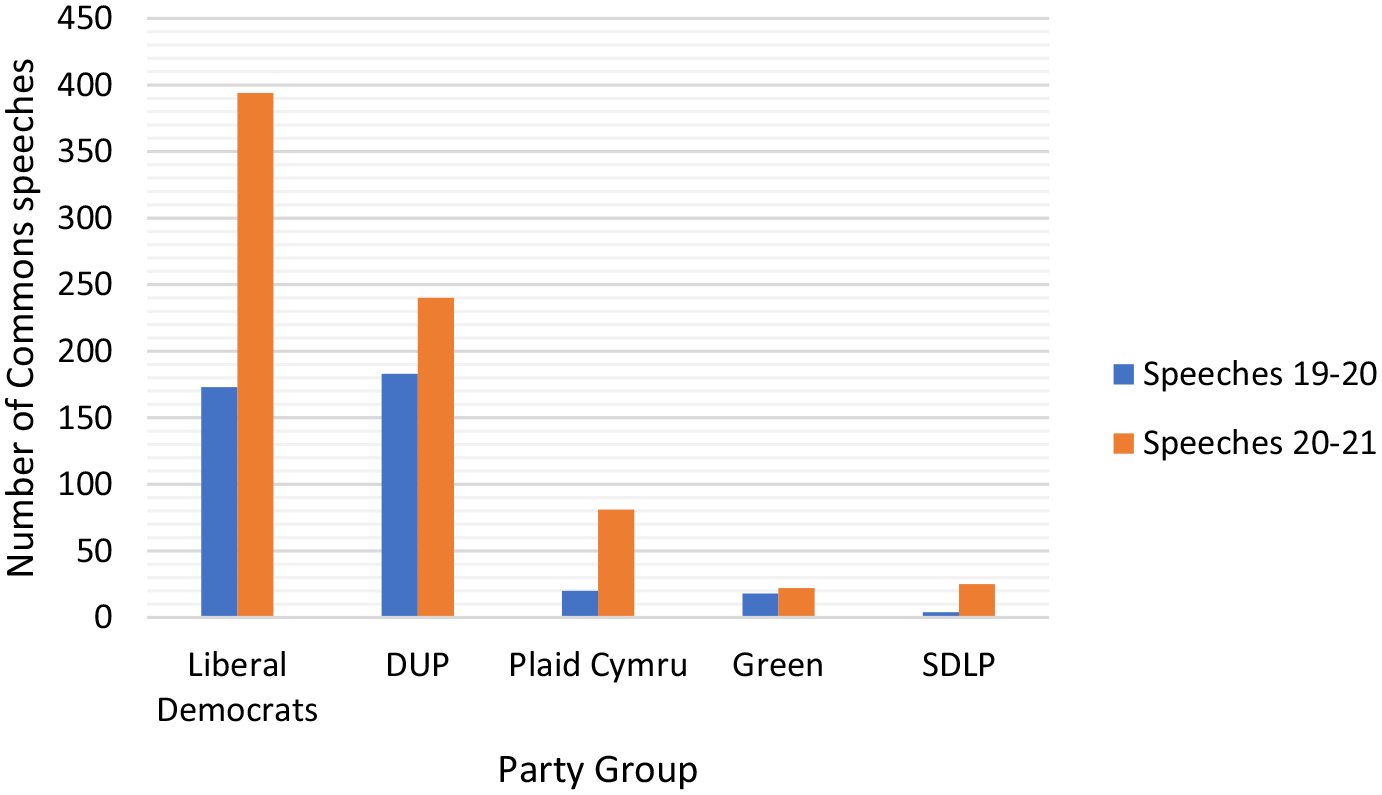
Total Speeches Made by Opposition Party Groups 18 March 2019 to 17 March 2021.
The use of call lists also mitigated some of the disparity between the Official Opposition and other opposition parties in terms of resources, enabling small party spokespersons to prepare a contribution and know that their preparation would not be wasted (Interview 3, SNP; Lucas written evidence CVR 011). The SNP for example began to coordinate their contributions and questions in daily party group meetings as they would know their speaking order. This facilitated a ‘more methodological approach’ to scrutiny (Interview 3, SNP). However, this greater transparency sat alongside reduced spontaneity in debates. The removal of interventions was an unwelcome development where call lists were very long. Parties that had lowered the list had no opportunity to intervene to guarantee parliamentary airtime (Interview 10, DUP; Plaid Cymru written evidence CVR 09). It was thus something of a double-edged sword for these opposition parties, increasing the frequency of their full speech contributions across the pandemic period but removing the pre-pandemic guarantees of a short intervention during oversubscribed debates.
Decision-Making
The government control which is so synonymous with the Westminster model, was exacerbated during the pandemic (Interview 4, Alliance), with consistent cooperation between these three party groups (Jack Brereton, 8 July 2020, Q230). Their leaders, whips and key spokespersons were invited formally to meetings on the Coronavirus Bill and related policies, which were documented regularly by then Secretary of State Matthew Hancock (e.g. 11 March 2020, c378). These meetings constituted the sort of ‘exceptional scrutiny’ that Neal (2012: 274) finds is typical of emergency situations and showed preferential treatment being given to the Official Opposition and the third party.
However, we find two main departures from the standard executive-legislative relations during the initial pandemic period. First, the relationship between government and opposition parties quickly became broader and more multilateral. In line with the experience noted during the UK government’s struggle to pass Brexit legislation (Russell and Cowley, 2018: 21), the executive-legislative relationship broadened, becoming more inclusive of smaller opposition parties. While the usual relationship involves bilateral conversations between the government and an opposition party whip from a single party group (Interview 3, SNP), March and April 2020 saw multilateral meetings about the forthcoming Coronavirus Bill with whips from several opposition parties – including the smaller opposition parties. This was ‘extremely unusual’; an arrangement that the whips we interviewed had not seen ‘even at the height of the Brexit crisis’ (Interview 3, SNP).
Second and most surprising within the Westminster context, it was the government who were proactively reaching out to opposition party groups to open up decision-making spaces (Interview 9, PC). In contrast to the ‘battles’ and ‘plotting’ of Brexit meetings in the 2017 Parliament (Interview 9, PC), these meetings provided a ‘safe space’ within which arguments could be tested in a more informal environment (Interview 5, LD). Such was the level of cooperation that there were ‘no big surprises’ for any opposition party at all during the Coronavirus Bill’s formal scrutiny (Interview 9, PC; Interview 3, SNP). The language used by the government in the Commons reinforced this enhanced cooperation, with the Secretary of State telling MPs that his amendments incorporated ‘ideas from all parties’ (HC Deb 23 March 2020, col 40, emphasis added). This was a change from the previous month when only the Official Opposition’s role was explicitly highlighted by ministers (e.g. HC Deb 11 February 2020, col 734).
The early period of the pandemic therefore marked a temporary pause and a clear ‘reshaping’ of the relationship between the government and opposition parties, similar to that seen elsewhere (Kouroutakis, 2022: 37). Although formal business meetings still privileged those parties with guaranteed participation rights, smaller opposition parties had a stronger institutional presence in decision-making than ever before, albeit at an informal level. Once the Coronavirus Bill had passed, however, this relationship reverted back to its pre-pandemic state, with room for only the two largest opposition parties in decision-making. One MP described how the role of small parties was ‘greatly diminished’ as the governing parties took over more control (Interview 9, PC). While the SNP’s stronger institutional position pre-pandemic meant that they were ‘consulted all the way through’ (Interview 3, SNP), a different picture emerged for the other small parties. For them, the absence of their participation and representation in formal decision-making spaces was felt even more keenly than normal from the summer of 2020 onwards (e.g. Chamberlain, 2020: CVR 13).
The clearest example of this exclusion was seen in the changes to parliamentary business, something which generated inter-party divisions elsewhere too (Malloy, 2020: 2; Siefken, 2023: 5). The decisions made by the UK government to remove hybrid participation in June 2020 excluded small party voices in their entirety. Small parties felt that cooperation between government and opposition here ‘did not work so well’ (Interview 5, LD) and recalled how they ‘were simply told’ what was going to happen by the government without consultation (Interview 10, DUP). Party groups who were unable to travel to Westminster were excluded from key debates on further changes, and their pleas for ‘proper and better consultation’ went unheeded (Alistair Carmichael, HC Debs, 12 May 2020, c924; Chris Elmore, HC Deb, 12 May 2020 c223). One opposition MP summed up the sense of frustration felt throughout the spring and summer of 2020:
‘we were virtually cut off and I’m asking the questions, “when will we decide?”, “I have views on this, when will we be able to feed in?”, and I was getting nothing’ (Interview 5, LD)
Small parties were forced into more coordinated and adversarial activity as they tried to ‘insert [themselves] into the conversation’ with the government (Interview 5, LD). Lacking the ability to put ministers on the spot during question times and without a place on the Commons Procedure Committee or the House of Commons Commission, a number of joint letters were submitted to the Leader of the House and to the Prime Minister, containing the signatures of all small party groups. Although no change was made as a result, party groups felt that it was the only way to register their concerns outside the official parliamentary record (Interview 5, LD).
Oversight
Garritzmann (2017) highlights committees, written questions and oral questions as key oversight tools for opposition parties, yet small parties were constrained in their use of all of these during the pandemic as a result of the pre-existing institutional barriers which underscore the Westminster model. Membership of scrutiny committees is apportioned by political party group size, with limited slots available to small parties. During 2020, this meant that there were no representatives of any small party beyond the SNP on the Health and Social Care committee to provide oversight on the pandemic response. Nor were there any small party representatives on the Commons Procedure Committee investigating changes to parliamentary business. The Procedure Committee’s (2020) inquiry on changes to parliamentary proceedings involved members of the three largest political parties only.
With the Commons going into Easter recess at the start of the pandemic, followed by a restriction in parliamentary sittings, written questions assumed a new importance. All parties, including Government and the Official Opposition, tabled more written parliamentary questions (WPQs) (Lily et al., 2021: 45). WPQs were of immense importance to small parties who found it ‘impossible’ to raise policy matters without them given their lack of guaranteed oral questions in the chamber (Plaid Cymru, 2020 CVR 09) and restrictions on the length of oral questions at the start of the pandemic (Lily et al., 2021: 46). As Table 1 illustrates, most small opposition parties saw a significant increase in the number of written questions (WPQs) asked in the chamber. Plaid Cymru for instance, tabled over 42% more WPQs, compared to the previous year. 4
Oral and Written Questions Asked By Opposition Party Groups 2019–2021.
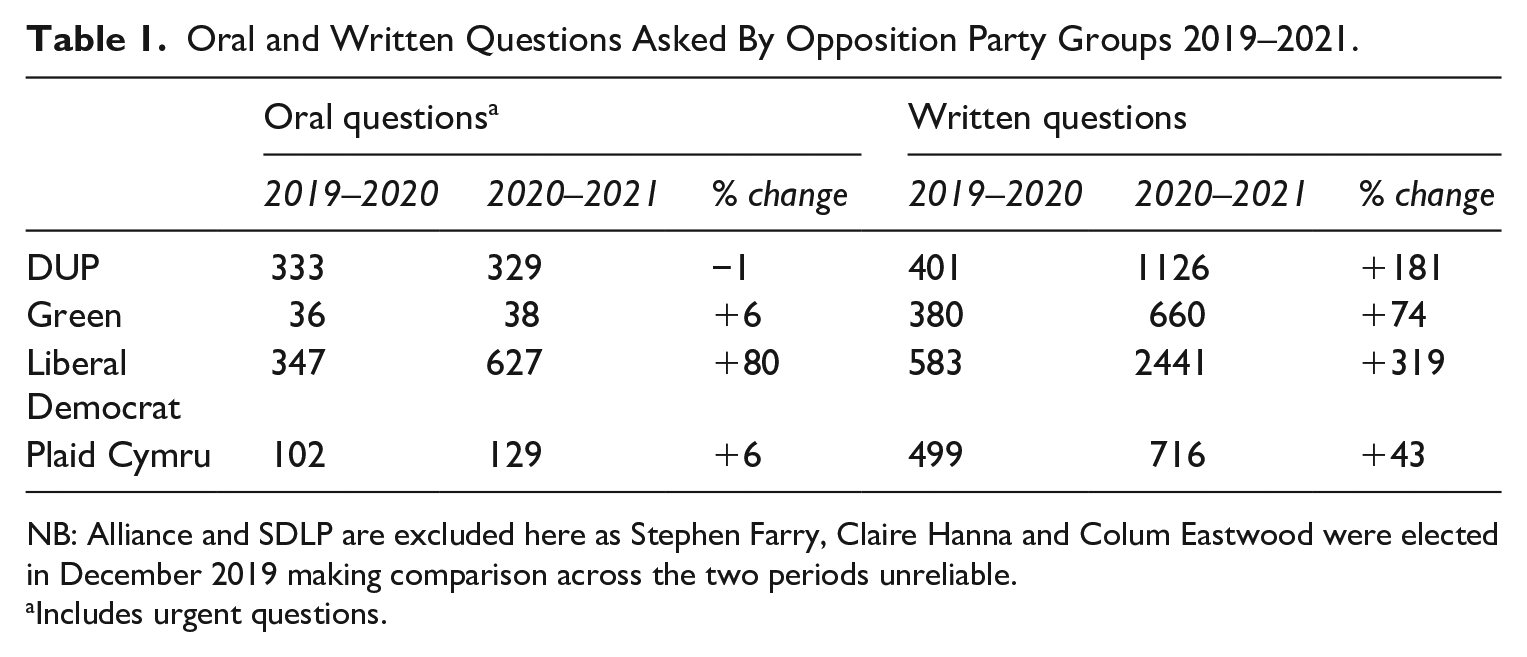
NB: Alliance and SDLP are excluded here as Stephen Farry, Claire Hanna and Colum Eastwood were elected in December 2019 making comparison across the two periods unreliable.
Includes urgent questions.
Ministerial statements provided a more valuable opportunity for small parties to engage in oversight. No statements at all were made by the government between March and May 2020 (Chamberlain, 2020, CVR 13), but from this point onwards they became the primary oversight tool for small parties. The Liberal Democrats in particular stand out here as an opposition party witnessing a surge of 80% in the number of oral questions asked during the pandemic. Over half of acting leader Ed Davey’s pandemic contributions (51%), came as supplementary questions following ministerial statements, proving the value of this oversight mechanism.
Oversight of the government’s coronavirus policies was further hampered by the external political and media context. When the government began daily press briefings in No. 10 rather than coming to parliament (see Kettell and Kerr, 2022: 16–17), the Liberal Democrats asked them to stop pretending that oversight was working as normal (HC Debates, 12 May 2020, c224). The presence of the SNP and the Labour Party in the Scottish and Welsh governments meant that formal meetings between Westminster and the nations also bypassed the smaller opposition parties, including Plaid Cymru and the DUP. The push from these parties for a coronavirus select committee and containing a representative from each parliamentary group was an illustration of how they felt excluded from scrutiny (Chamberlain, 2020 CVR13; Plaid Cymru, 2020 CVR09). Such a committee would have brought all opposition party groups more evenly into scrutiny spaces and put them on a more level playing field in terms of information and access to ministers.
In more formal legislative business then, the greater access given to opposition party groups by the government to pass the Coronavirus Bill came at the expense of any additional oversight mechanisms. Our study finds additional evidence however, of small party groups continuing to be included in informal information forums beyond May 2020 through online extra-parliamentary briefings. Introduced as two separate forums (for the Official Opposition and one for other opposition parties) during the passage of the Coronavirus Bill, the briefings were later merged into one for all MPs, including government backbenchers (Interview 9, PC). Hosted by a government minister, they covered specific pandemic related issues such as PPE and vaccine roll out and ensured that all opposition parties could take part in the ‘fact finding’ which was so crucial to pandemic scrutiny (Griglio, 2020: 55). It marked a sea change in terms of the level of access to, and information provision from government to small parliamentary groups. Being outside the adversarialism of the House of Commons chamber, it additionally brought a change in tone which small parties had never experienced before:
‘when the Secretary of State sits before you, you are able to get to a level of scrutiny that is just impossible in the chamber because they can’t go anywhere and they can’t play to the rhetoric and they can’t start playing to the galleries, you know. They are there, you can pin them down and on occasions get really good information’ (Interview 9, PC)
Attendance at these meetings was far higher than typical for a ministerial statement in the chamber, with over 300 MPs attending a briefing on port disruption on Christmas Eve 2020 (Interview 9, PC).
Although this access was crucial for information provision, it did not bring new permanent oversight routes for opposition parties. Nor did it bring greater responsiveness from the government, who communicated regularly with their own backbenchers through WhatsApp group chats (e.g. HC Debs, 19 November 2020, c467). As with the more formal cooperation between party groups, this inclusion of opposition party groups into these informal spaces was also hidden from public view. Policy discussion and information provision thus took on a more informal, consensual nature behind the scenes away from the chamber, but the public view of oversight within the chamber remained overtly majoritarian and two-party dominated.
Conclusion: Atypical Relationships and an Exacerbation of the Westminster Model
This study enhances the limited literature on the UK’s opposition parties during the pandemic, offering an in-depth account of the role-played by opposition parties beyond the Official Opposition. It makes three contributions to our existing knowledge of the relationship between government and opposition in Westminster systems during the pandemic.
First, this study confirmed our expectations that the government would reach out to a broader range of opposition parties than is the norm under the typical executive-legislative relations of the Westminster model. The inclusion of all opposition parties was atypical of normal times and the proactive manner in which government reached out to all opposition parties demonstrates that they were not the early ‘political casualties’ observed elsewhere (Laflamme et al., 2023: 1). However, the reversion back to the norm from May 2020 onwards suggests that the way in which government expanded opposition opportunities to participate in formal decision-making was very ‘presentist’ (Neal, 2012: 273), being used only while necessary to pass the Coronavirus Bill efficiently. From May 2020 onwards, small opposition parties found themselves even more muted in their scrutiny role than they had been pre-pandemic, particularly in the provision of WPQs and in relation to the decision-making around adaptations to parliamentary business. This is a similar pattern to that observed in parliaments elsewhere (see, for example, Turnbull and Bernier, 2022).
Second and more significantly, our focus on party groups themselves rather than on individual MPs or on ‘opposition’ as a whole shows the inequality between opposition parties, particularly around parliamentary participation. All opposition parties beyond the Official Opposition were vulnerable due to their size and geographical location from Westminster. The need to maintain a parliamentary presence in debates and divisions necessitated extra heavy burdens on just one or two individuals and at times, conflicting national government rules and the changing rules around online parliamentary participation excluded small parties from participation altogether. These vulnerabilities were a much greater hurdle for small parties than the availability of institutional tools cited elsewhere (Chiru, 2023: 28). This finding is particularly significant when considering the future of the constituent nations of the United Kingdom as citizens in Scotland and Northern Ireland, in particular, faced two major barriers to representation: not only did their MPs face lengthy and sometimes logistically impossible journeys to Westminster but the limited participation rights for the smaller parties meant that their concerns could not be raised even if they were able to physically attend. It points to a further avenue of research concerning not just how the impact of the remoteness of individual MPs from Westminster affects parliamentary activity (Willumsen, 2019) but also how the remoteness of party groups can affect the representation and voice of the devolved regions in parliamentary debates. In addition, it suggests that it may be fruitful for parliaments in multi-level political systems to consider the impact of party rights on geographical representation, building on the work of Sheldon (2022), who found that territorial claim-making by MPs with constituencies in Scotland, Wales and Northern Ireland has increased, rather than decreased, since devolution.
Third, this study shows the importance of informal or extra-parliamentary arenas for information provision to all political parties in the House of Commons during the pandemic. We know from Norton (2019) of the importance of informal physical space within legislatures and this was replicated within virtual spaces during 2020 and 2021. Again, this elevated the resources available to opposition parties in a manner untypical of normal times. However, as Griglio (2020: 64) notes, such fact-finding spaces are limited in their utility, particularly as they sit outside formal parliamentary mechanisms and prevent parties from visibly scrutinising or recording their concerns on the record. Emergency situations can normalise new patterns of behaviour (Neal, 2012: 273; White, 2022a: 4), though whether or not this fact-finding will become further entrenched in a post-COVID environment will require further research. Together, these findings suggest that concerns about the marginalisation of the House of Commons from formal decision-making and scrutiny during the pandemic (Russell et al., 2021) are particularly true for smaller opposition parties. The pandemic exacerbated the majoritarian elements of the Westminster model, centralising scrutiny around the two main political parties in a way that could not be mitigated significantly by extra-parliamentary forums.
Footnotes
Declaration of conflicting interests
The author(s) declared no potential conflicts of interest with respect to the research, authorship and/or publication of this article.
Funding
The author(s) disclosed receipt of the following financial support for the research, authorship, and/or publication of this article: This work was supported by the Economic and Social Research Council [ES/R005915/2].
