



Abstract
Candidate selection within parties is a key stage in the political process and provides an important frame for the degree of representation of social groups in parliaments. We seek to develop a better understanding of the effect of intersectionality on candidate selection processes. We do so by examining the effect of candidates’ key socio-demographic characteristics, like their gender and ethnic background, on their chances of getting nominated by their party. We argue that features of the ideological background of the respective nominating party matter for the chances that women and aspirants with an ethnic background win the nomination as their party’s district candidate. We make use of novel data from the 2021 German federal election that provides detailed information on the candidate selection processes of all major parties in the 299 election districts. By doing so, we apply existing theoretical expectations to an untested case and find that female competitors and aspirants with an ethnic background face difficulties being nominated, in particular in the case of parties with rather traditionalist societal policy positions. We also find that intersectionality matters: female aspirants of ethnic minorities are even less likely to be nominated by ideologically traditional parties.
Introduction
Demographic characteristics of citizens and politicians are a central element in explaining the behaviour and decision-making of individuals in legislative processes. The degree to which social groups are represented in political offices significantly affects the respective individuals’ trust in and support for democratic political institutions. For example, if descriptive and substantive representation of ethnical or religious minorities in public offices increases, the degree of perceived integration of citizens belonging to such groups into the political system and the degree of trust they attach to the political institutions are likely to grow (Banducci et al., 2004; Bird et al., 2010). It is therefore important to gain a better understanding of the chances for underrepresented groups to win key positions within parties. Moreover, the effects of intersectionality – the combination of multiple characteristics that people are discriminated against – should garner additional scholarly attention.
We thus take a closer look at the outcomes of candidate selection processes within parties. Candidate selection has a direct impact on the level of representation of various social groups within parliaments and has long been understood as a critical stage in the political process (Medeiros et al., 2019; Ranney, 1981). If parties’ selectorates are less inclined to nominate women or persons from minority groups as their candidates for public office, the chances that disadvantaged social groups are adequately represented in parliaments, legislatures and executive offices decrease significantly. We argue in this contribution that – depending on the ideological background of the respective party – women and ethnic minority aspirants have lower chances to become their party’s nominee in an electoral district, particularly in the case of societally more traditionalist parties. We advance existing work by including an intersectional perspective to our analysis of candidate selection and evaluate our hypotheses by means of novel data from the 2021 German federal election, encompassing detailed information on the candidate selection processes across all 299 election districts. We thus shed light on an important prerequisite to descriptive representation of key social groups in parliament and focus on potentially existing biases towards female competitors and ethnic minority aspirants during the candidate selection process.
To answer our research question, we first develop our hypotheses and argue that women and ethnic minority aspirants face more difficulties in being nominated as candidates. However, the chances of winning a party’s nomination should depend on key contextual features which influence parties’ strategic considerations. Before presenting the findings in a descriptive and multivariate manner in section ‘Results’, section ‘Data and Methods’ provides information on the case we focus on and on the data and methods we use for evaluating our argument. The final section concludes by discussing the findings and the limitations of the study on the one side and by presenting ideas for future research on the other side.
Theoretical Framework
We identify two underlying mechanisms that drive the success of women and ethnic minority aspirants in political parties’ candidate nomination processes and that have been previously tested in other cases. These are, first, gendered and racial biases against female competitors and ethnic minority aspirants, which we can observe not only in candidate selection (e.g. Celis et al., 2014; Medeiros et al., 2019) but also in further stages of the political process (e.g. Bäck and Debus, 2019, 2020). Second, we focus on the parties’ values and ideological backgrounds, in particular on societal affairs and migration (e.g. Benoit and Laver, 2006; Kortmann and Stecker, 2019). The dominant theoretical approach to gendered candidate selection concentrates on a supply and demand model, made prominent by the seminal study by Norris and Lovenduski (1995).
The supply side refers to factors that ‘affect who comes forward as a potential candidate, while demand-side factors determine which of these aspirants are deemed desirable candidates by political elites’ (Krook, 2010: 157). The former includes resources like money and time as well as the motivation to run for a political position. The latter includes parties’ assessments of aspirants’ abilities and their potential performance. Both sides of the model see women as disadvantaged. Concerning supply-side factors, women are more likely to engage in care- and housework, leaving them less time to follow a political career. Naurin et al. (2023) demonstrate that women demobilize from politics and societal issues already during pregnancy and that childbirth rarely leads to political remobilization. Furthermore, despite having the same jobs, women still earn less money than their male colleagues. Even when men and women are equally qualified and come from the same socio-economic background, women are often less likely to see themselves as qualified enough for a political candidacy, resulting in more men than women aspiring to be a candidate. This is due to existing ideas of ‘masculinity’ within politics and the ‘gendered psyche’, a ‘deeply embedded imprint that propels men into politics but relegates women to the electoral arena’s periphery’ (Lawless and Fox, 2005: 11; see for an overview on political entry Gulzar, 2021). Women are overall more conscious towards the cost of elections, making them more ‘election averse’ than men (Kanthak and Woon, 2015).
These factors result in fewer women becoming aspirants for key positions in parties and political institutions than men. We are, however, interested not only in gendered biases but also in racial biases, that is, beliefs in certain traits that not only female but also ethnic minority aspirants face once they have decided to run. Such biases fit strongly in the demand side of the supply and demand model. The demand side includes party elites’ assessment of aspirants’ abilities. These evaluations are strongly affected by the elites’ preferences and opinions which in turn are heavily shaped by gender and racial biases (Norris and Lovenduski, 1995). The economic literature refers to these prejudices as ‘taste-based discrimination’ (Becker, 1957). The mechanism simply refers to the fact that some actors may have a discriminatory taste, for example, that they like men more than women. In contrast to taste-based discrimination, ‘statistical discrimination’ (Arrow, 1972) is based on rational expectations which are formed on the basis of missing, wrong or incomplete information, for example, that women tend to win less votes in elections and thus should not be nominated as candidates. Originally coming from the economic literature, this differentiation was also applied to the analysis of the political process (e.g. Butler and Broockman, 2011).
In addition, political parties have historically been dominated by men, a fact that has gendered the ‘rules of the game’ in a male-favoured way (Lovenduski, 2005: 27; see also Bjarnegård, 2013). Especially in the early stages of candidate selection processes, party elites often informally encourage particular aspirants, with male party elites favouring male candidates and approaching them more often than female aspirants (Carroll and Sanbonmatsu, 2013; Cheng and Tavits, 2011). Even if women decide to run, they face a wide array of discrimination, ranging from gendered assumptions about their abilities to actual sexual harassment (Kenny and Verge, 2016; Lovenduski, 2005). Consequently, these gendered biases diminish female aspirants’ probability of being nominated as candidates.
Although based on different biases, ethnic and religious minority aspirants face similar challenges. Potential ethnic minority aspirants need more encouragement than majority aspirants to compete for a candidacy, with those standing for office then being confronted with racial biases in the form of (in)formal candidacy rules, selectors’ prejudices, and varying methods of candidate selection (Hazan and Rahat, 2010; Shah, 2014). Again, most parties are historically male, white, and – in the case of many European democracies – Christian-dominated (e.g. Dancygier, 2014). Hence, many selectors engage in ‘aversive racism’, which indirectly and subtly affects their actions and decision-making, even among well-intentioned individuals (Pearson et al., 2009; Tolley, 2019; Van Trappen, 2022). Following the number of gendered and racial biases female competitors and ethnic minority aspirants face, we expect the odds of these aspirants being nominated as candidates by their parties to be generally lower.
We refine these baseline expectations by taking the ideological profile of parties and their core supporters into consideration. Ideology should play a crucial role in the nomination process (Höhne et al., 2023; Sobolewska, 2013). Or, as Mügge (2016: 514) puts it: ‘The incentives of political parties to recruit ethnic minorities or women are informed by ideology’. Generally, left-wing and ideologically progressive parties are more likely to promote female representation and the representation of traditionally underrepresented groups (Caul, 1999).
To derive our expectations, we start with the common assumption that the major goal of parties in elections is to win as many votes as possible, so that they increase the chances to capture control over (key) cabinet offices, which then increases the chances that parties can implement their policy goals (e.g. Müller and Strøm, 1999). Parties adopt a coherent policy profile which matches the interests of their core voters and appeals to voters who consider voting for the parties and their candidates. The key policy dimensions on which parties in modern democracies deviate in their positions refer to economic and welfare issues on the one side and questions regarding the order of society on the other side (e.g. Benoit and Laver, 2006). The latter policy dimension covers issues related to women and minority rights, among others, and – given the salience of the migration topic (Green-Pedersen and Otjes, 2019) – increasingly structures the voting behaviour of citizens in modern democracies. We would therefore expect that members of parties, which adopt more traditionalist positions on societal affairs, are against multicultural structures of societies, favour restrictive migration policies and thus have fewer incentives to nominate women and ethnic minority aspirants as their candidates. Furthermore, because parties of the right, and in particular of the radical right, are significantly more often supported by male voters (e.g. Immerzeel et al., 2015), vote-seeking parties with a societal traditionalist profile should – according to the literature on ‘same gender voting’ (Giger et al., 2014) – tend to nominate men as their candidates for public office (Farrer and Zingher, 2018; see for exceptions Weeks et al., 2023). This form of strategic discrimination is statistical discrimination as elaborated on above. We theorize that vote-seeking parties act rationally and thus nominate their candidates ‘based on rational expectations given overall statistical trends’ (Butler and Broockman, 2011: 465). Because the selectorates expect women to perform worse than men in the election, they should be more likely to nominate male aspirants. In other words: ‘Discrimination takes the form of stereotyping based on group membership that results from imperfect information’ (Guryan and Charles, 2013: F418).
A similar mechanism should apply when it comes to the chances of ethnic minority aspirants getting nominated by parties from the right of the centre on a societal policy dimension (Bird et al., 2010). Given that citizens from an ethnic minority tend to vote for parties from the left of the centre (e.g. Goerres et al., 2022), right-wing parties have fewer vote-seeking incentives to nominate ethnic minority aspirants as candidates. In general, the electorate of parties on the right of the centre is ethnically less diverse than the electorate of societally progressive parties, resulting in lower electoral rewards with diverse candidates.
Women and ethnic minority aspirants face similar hurdles when participating in the candidate selection process. In an environment mostly dominated by white men, they are exposed to various prejudices and biases. A scholarly approach that acknowledges such overlapping and reinforcing phenomena is the concept of intersectionality (Crenshaw, 1991). 1 Intersectional theory ‘conceptualises gender, class, ethnicity, race, age and sexuality as interrelated systems’ (Celis et al., 2014: 3) which produce distinctive experiences for intersectional identities. In doing so, the approach allows for the analysis of hierarchical structures and (power) inequalities between and within different groups of society. Importantly, experiences of social identities do not simply add up; instead, intersectional identities constitute specific experiences on their own (Hancock, 2007a). Because of these individual experiences, intersectional identities are subject to specific intersectional stereotypes. In that sense, stereotypes are not added up or multiplied, but form individual sets for each intersectional identity. Freidenvall (2016) makes a strong case that an intersectional lens provides an additional and non-negligible perspective on the candidate selection process, as it identifies (political) experiences of intersecting identities, for instance of ethnic minority women (see also Cassese, 2019). The intersection of gender and race is what we focus on here.
An intersectional perspective allows for deriving two contradicting expectations regarding minority aspirants’ chances for winning a nomination (Mügge and Erzeel, 2016). On one hand, the ‘double jeopardy’ (Beale, 1970) hypothesis claims that belonging to multiple disadvantaged groups can have cumulative negative effects, resulting in, for instance, female ethnic minority aspirants being more disadvantaged than male ethnic minority aspirants. Following our earlier line of argument, this is due to greater prejudice among parties’ selectorates, as gender and racial biases add up to a cumulative disadvantage which ethnic minority women then experience (Black, 2000). On the other hand, studies have shown that in some circumstances intersectional identities can gain ‘complementary advantages’ (Celis and Erzeel, 2017) and the respective individuals face less prejudice than ones who only belong to one minority group. For example, ethnic minority women can, in contrast to ethnic minority men, profit from female networks within parties and are perceived as less threatening. Moreover, taking up the argument of rational vote-seeking parties, selectorates might intentionally prefer female ethnic minority aspirants to their male counterparts because this diversifies the party even more, seeing such nominations as ‘a way to kill two birds with one stone’ (Mügge et al., 2019: 706). We derive the following four hypotheses from these considerations on gender and racial biases, party-specific incentives and intersectionality on the outcomes of candidate selection processes within parties:
H1. Female and ethnic minority aspirants are generally less likely to win a competitive selection process than male and ethnic majority aspirants.
H2. Female and ethnic minority aspirants are less likely to win a competitive selection process in ideologically more traditionalist parties than in more progressive parties.
H3a. Female ethnic minority aspirants are more likely to win a competitive selection process than female ethnic majority or male ethnic minority aspirants.
H3b. Female ethnic minority aspirants are less likely to win a competitive selection process than female ethnic majority or male ethnic minority aspirants.
Data and Methods
We focus on the candidate selection process within parties for the German federal parliament – the Bundestag – for three reasons. First, elections to the Bundestag provide an interesting institutional feature for studying candidate selection in general and for analysing the effects of personal characteristics of aspirants for a candidacy in particular. Within the electoral system for the Bundestag, citizens entitled to participate in Bundestag elections have two votes (Manow, 2015). The first vote (Erststimme) pertains to the nominal tier of the German electoral system and is used to elect the members of parliament (MPs) in 299 single-seat districts according to the first-past-the-post criterion. District party candidates are formally elected either by all members of the respective party on the district level or, more commonly, by delegates from local parties in the respective district at a nominating convention. Compared to the party list candidates who are selected by a state party congress, the national party leadership has less influence on the outcome of the candidate selection process on the district level where instead the local party representatives and their candidate preferences are decisive (e.g. Baumann et al., 2017).
Research has shown that informal processes have already narrowed the field of competitors considerably before the official selection happens. There is much qualitative evidence of local party elites wanting to increase their influence over the final selection and, therefore, encouraging competitors to withdraw their candidacy (Reiser, 2013: 138–139). We cannot study the patterns of intra-party competition in cases where only one aspirant runs for the district candidacy of his or her party. Yet, we can provide information on the share of female (and diverse) aspirants and ones with a visible ethnic background that were nominated by their parties as district candidates without any competition. This perspective allows for evaluating if (and to which degree) female (and diverse) aspirants and ones with a visible ethnic background are underrepresented in candidate selection processes where no other individuals sought the nomination as district candidates of their party. The parties in the districts differ in the number of candidates competing for nomination. For evaluating the hypotheses, we focus on those cases where at least two candidates competed for the nomination by their party at the district level, regardless if the incumbent MP sought renomination or not. In addition, we restrict our analysis to those candidate selection processes where at least one female (or diverse) candidate or at least one candidate with a visible ethnic background competed with other candidates for winning the respective parties’ nomination as their district candidate. 2
Second, there is ideal data available for testing our hypotheses. We make use of the 2021 Candidate Nomination Study (GLES, 2022) of the German Longitudinal Election Study (GLES). This dataset covers information on the number of aspirants who competed for the support of a party to become its district candidate for the 2021 Bundestag election. Furthermore, the data provide information on key characteristics of the aspirants like their gender (male, female or diverse) 3 and their previous political career, for instance, if they were already candidates for the same or another district in the 2017 election and if they already served in parliaments on the federal, state or local level. In addition, the GLES Nomination Study provides information on whether one of the aspirants seeking the nomination by their party in the electoral district also ended up as the party list candidate for the Bundestag election. This variable – candidate on the party list – serves as an important control, because it is a proxy for identifying serious candidates whom the party considers as potential members of parliament.
For the first time, the GLES nomination study systematically collected data on the nomination processes for the district candidates of all parties represented in the national parliament – Christian Democrats (CDU), Christian Social Union (CSU), Social Democrats (SPD), the liberal Free Democrats (FDP), Alliance 90/The Greens (Greens), the socialist Left Party (Left) and the right-wing populist Alternative for Germany (AfD) – in all 299 electoral districts for the Bundestag. The information was collected through research by trained student assistants and through an online survey (CAWI) to collect information about the nomination processes and the candidates by representatives of the parties in the relevant district and local associations. 4
Evaluating H2 implies to differentiate between societally rather progressive and rather traditionalist parties. We refer to two sets of information on the parties’ programmatic background. First, we collected information on whether the parties we focus on had a binding quota for either ethnic minorities or women in place for the 2021 election. Quotas are not mandatory for German parties, but many parties self-impose quotas to increase the diversity of their lists which voters can choose with the second vote (Zweitstimme). SPD, Greens and the Left, all had different binding gender quotas for their candidate selection on the party list level. FDP, CSU and AfD did not have any such quota. The CDU had a so-called Frauenquorum in place, which is a weaker regulation than a quota and is merely based on a non-binding recommendation. De jure none of the parties of FDP, CDU, CDU and AfD had a binding quota implemented in 2021. 5 This divide partially fits with the policy profile of German parties based on recent expert surveys (Bräuninger et al., 2019; Jankowski et al., 2022) which identify CDU, CSU and AfD as those parties that adopt traditionalist positions on societal affairs and restrictive positions on migration and immigration policy, and SPD, Greens and the Left as progressive on societal issues and permissive on migration policy. The FDP does not fit this pattern neatly with progressive positions on societal problems but restrictive attitudes towards migration and integration. Because of their no-quota policy, we assign the party to the group of ‘conservative’ or more right-leaning parties. 6
We furthermore need information on whether an aspirant for a district candidacy has an ethnic background or not. This information is not covered in the 2021 Candidate Nomination Study. We therefore collected further data on the aspirants for a district candidacy that provide information on whether the aspirants who sought the nomination by their party belonged to a ‘visible’ ethnic minority, that is, if they have a physical appearance in terms of, for instance, darker skin tone, or foreign-sounding name (see also Bäck and Debus, 2020; Blätte and Wüst, 2017). In so doing, we follow Auer et al. (2023) who show that candidates with a ‘foreign-sounding’ name are discriminated against by both voters and their parties.
Statistical Model
We aim to explain which of the competitors for the position of a party’s district candidate for the 2021 Bundestag election wins the internal nomination. In other words, the local party – the selection of district candidates is decentralized, for example, determined by local party conventions – decides which aspirant wins the nomination. Potentially, there could only be a single aspirant in a district, so that there is no intra-party competition. Often, however, the number of aspirants is higher, so that a local party convention must choose a candidate among the aspirants for a district candidacy. The number of aspirants can vary across parties and districts. We use a conditional logit model (McFadden, 1973) to explain the outcome of the decision-making process of the conventions of the seven parties in the 299 districts with covariates. The main specification defines each candidate selection process in each party and each district as a separate choice set. The model predicts which of the candidates in each party in each district wins the nomination, taking the gender of a candidate, their visible ethnic background and the other covariates into account. As already mentioned, we focus in the multivariate empirical models only on those cases where more than one aspirant sought the nomination as a parties’ district candidate and where at least one female (or diverse) aspirant or one aspirant with a visible ethnic background competed for the support of the district delegates.
Results
Before evaluating our set of hypotheses employing conditional logit models, we present descriptive information on the amount of competition during the nomination process of a party’s district candidate. We differentiate between the seven parties – CDU, CSU, SPD, FDP, Greens, The Left and the AfD – and look at the share of women (or diverse individuals) belonging to visible minorities among the aspirants for their parties’ district candidacy.
Descriptive Findings
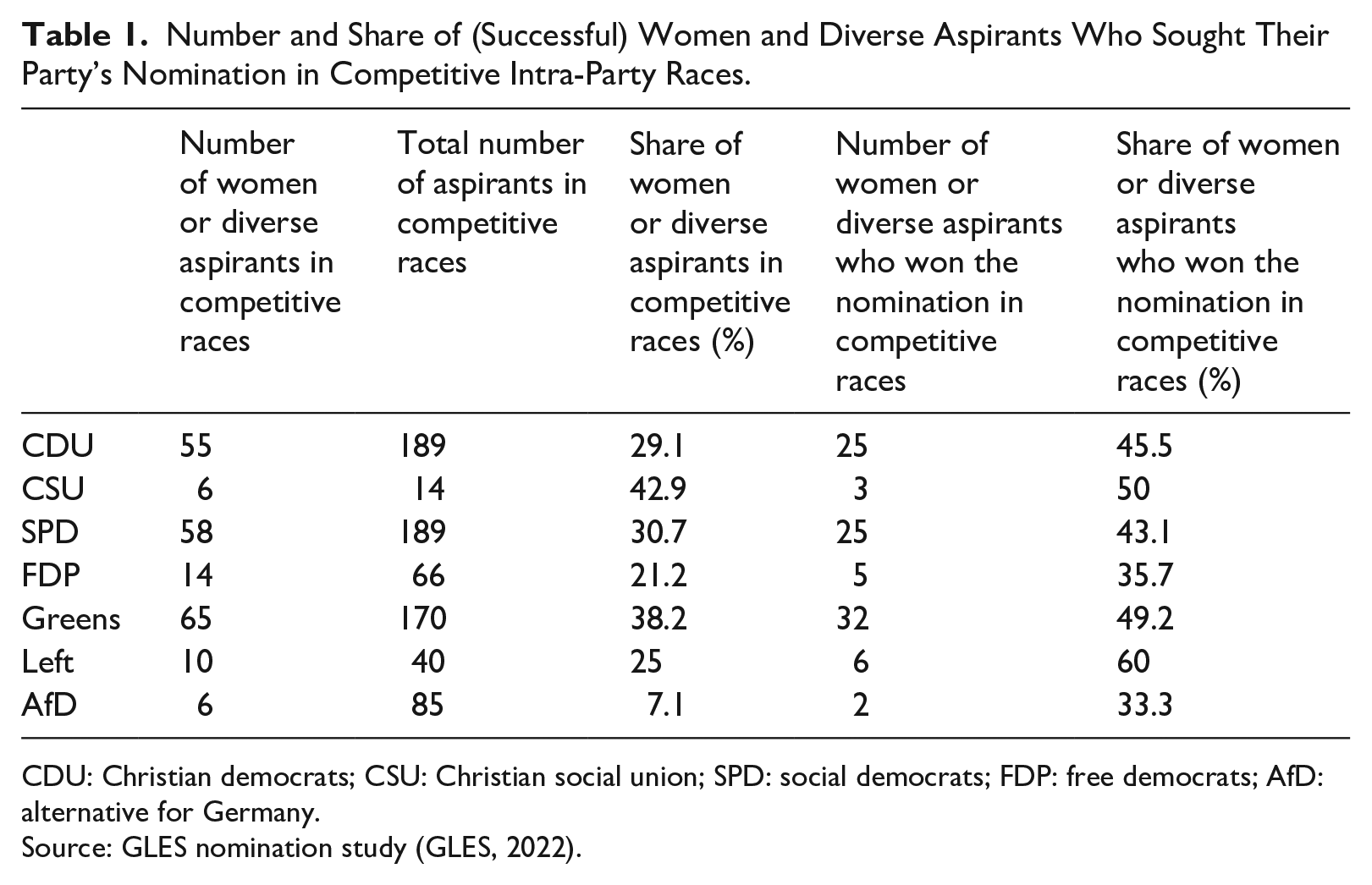
Table 1 provides information on the number of women or diverse competitors in candidate nomination processes on the district level where more than one aspirant was running, meaning that the nomination was competitive. In addition, Table 1 covers data on the total number of aspirants in competitive races for the seven parties under study, and shows, first, the share of women and diverse aspirants among all contenders in competitive district races and, second, the share of women or diverse aspirants who won the nomination in competitive races. The table shows that the share of female aspirants or individuals who identify themselves as diverse varies clearly across parties. While 38% of the candidates seeking the nomination of the Greens as their district candidate in competitive races were women or diverse, only 7% of the candidates who sought the nomination by the AfD as their district candidate belong to this group. While this pattern speaks for a divide between parties on a societal policy dimension, the picture is less clear when looking at the remaining parties. In total, 43% of the aspirants seeking the nomination of the societally conservative CSU in competitive races were women. However, we are dealing here with a relatively small number of competitors. Yet, the share of women aspirants in competitive races in the Social Democratic (31%) and Christian Democratic parties (29%) is not that different from one another; also, the figures for the FDP (21%) and the socialist Left (25%) do not speak in favour of the expectation that women (or diverse) competitors are more present among the aspirants in societally progressive than in rather traditionalist parties. This pattern remains stable when looking at the share of successful women or diverse aspirants who won the nomination in competitive races. Table 1 shows that – as expected for a right-wing populist party with socially traditionalist positions – the share of nominated women candidates in the AfD is the lowest (33%) among all parties and the highest for the Left (60%) and the Greens (49%). There are, by contrast, no strong differences between CDU, CSU and SPD: the share of female aspirants who were successful in competitive races varies between 43% and 50%, while women candidates are less successful in competitive races for their party’s district nomination in case of the FDP (36%).
Number and Share of (Successful) Women and Diverse Aspirants Who Sought Their Party’s Nomination in Competitive Intra-Party Races.
CDU: Christian democrats; CSU: Christian social union; SPD: social democrats; FDP: free democrats; AfD: alternative for Germany.
Source: GLES nomination study (GLES, 2022).
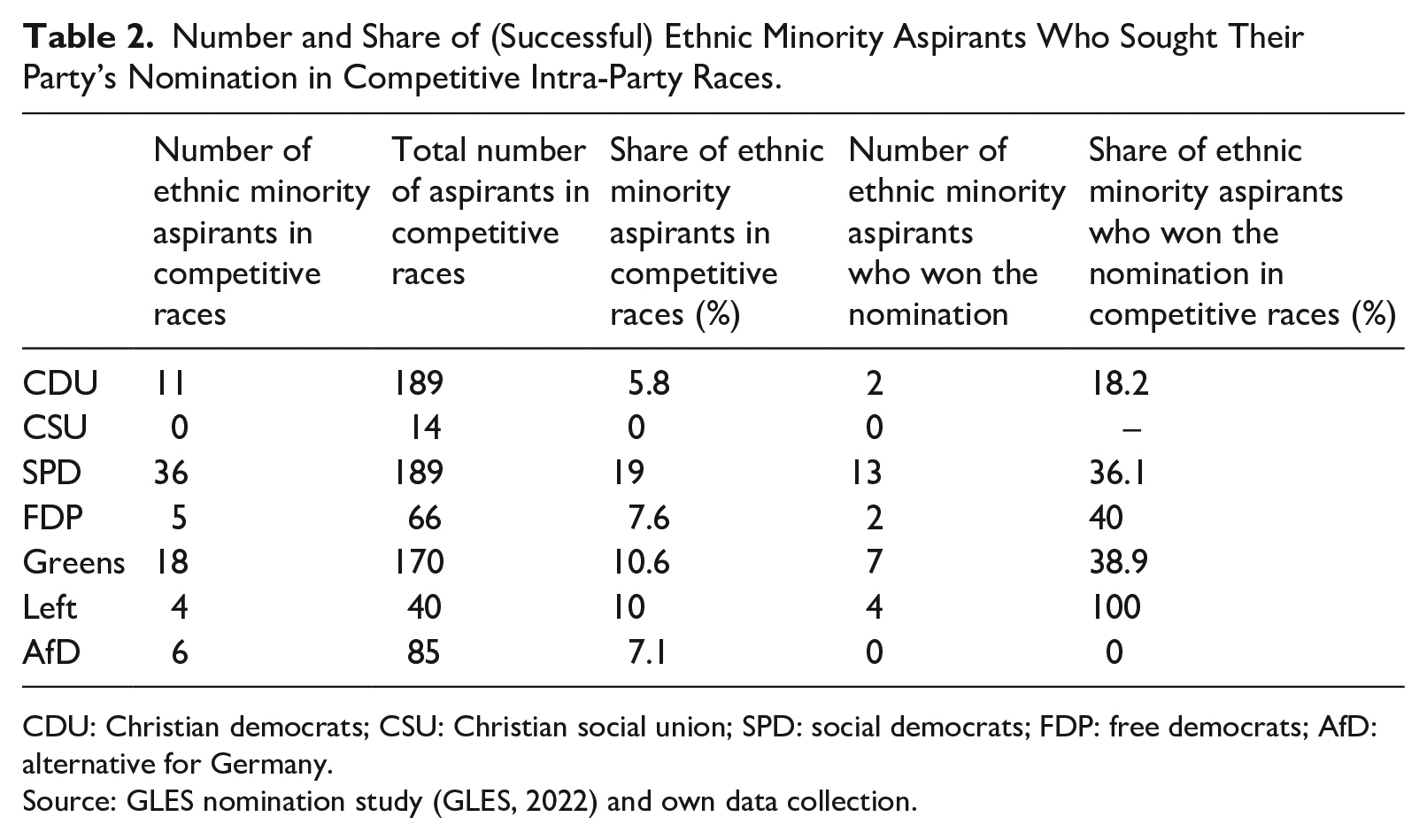
The results are clearer when shifting the perspective to intra-party candidates who belong to a visible ethnic minority. Table 2 shows that the share of candidates with this personal characteristic is higher for societally progressive parties like the SPD (19%), the Greens (11%) and the Left (10%). It is lower for the CDU (6%), the FDP (8%), the AfD (7%) and the CSU where no ethnic minority aspirant sought the nomination in a competitive race. Given that the four last-mentioned parties adopt rather restrictive policy positions on migration and immigration (with the FDP, the slightly more moderate party on that issue; see Jankowski et al., 2022), the results are in line with our expectations. When shifting the perspective to the share of successful aspirants from visible minorities in competitive races, we do, however, see a much clearer picture. While the AfD did not nominate any ethnic minority candidate in a competitive district race, the CDU did it only in two cases (18%). Ethnic minority aspirants were much more successful in the intra-party nomination processes among the societally progressive parties: all four of these competitors won the nomination in the case of the Left, while the share in the case of SPD and Greens varies between 36% and 39%.
Number and Share of (Successful) Ethnic Minority Aspirants Who Sought Their Party’s Nomination in Competitive Intra-Party Races.
CDU: Christian democrats; CSU: Christian social union; SPD: social democrats; FDP: free democrats; AfD: alternative for Germany.
Source: GLES nomination study (GLES, 2022) and own data collection.
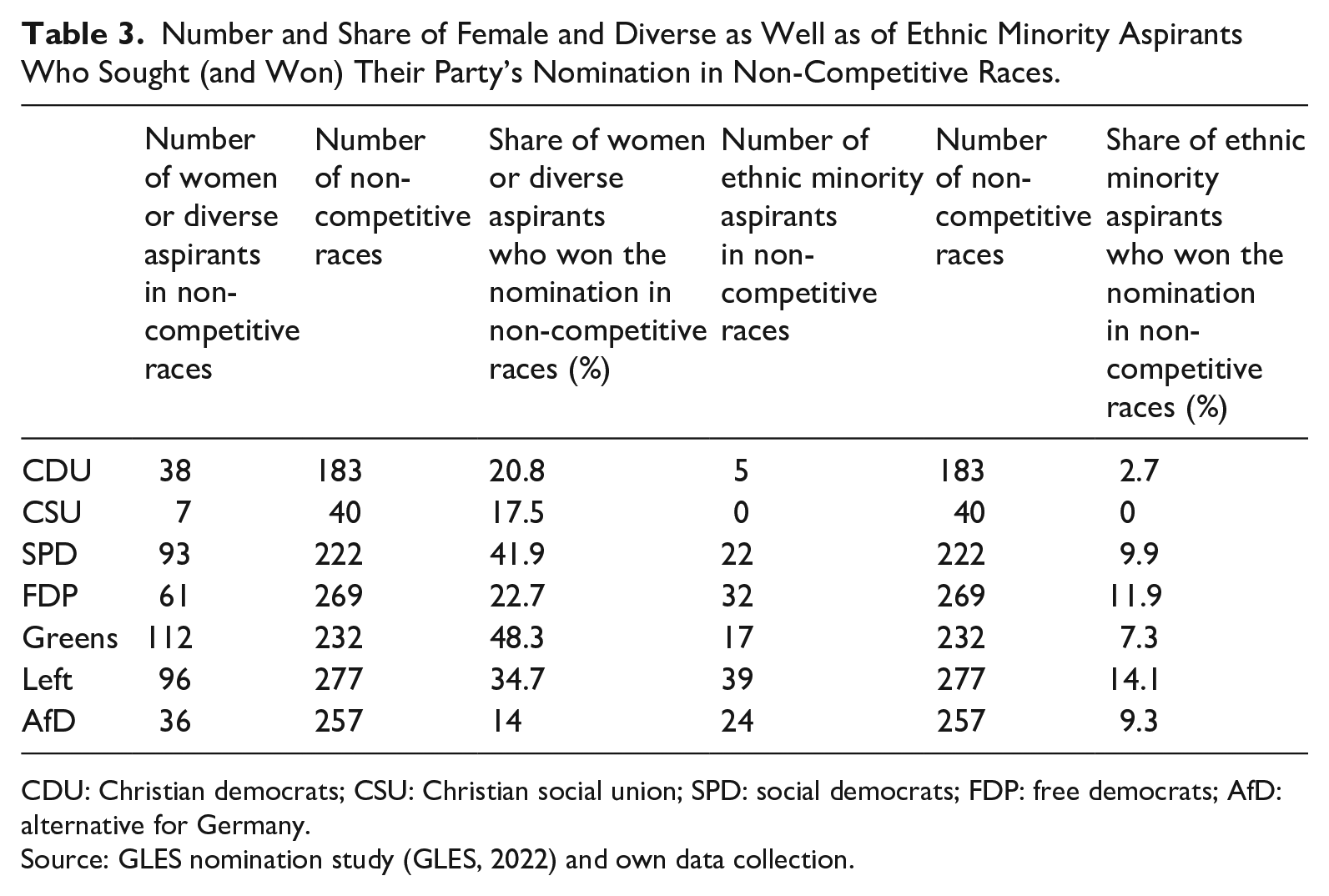
To put this descriptive information into perspective, Table 3 provides information on the share of female (including diverse) and of ethnic minority aspirants who sought the nomination of their respective party for a district candidacy without facing intra-party opponents when the district party members or delegates decided about their district candidate. The findings indicate that the number of female (and diverse) candidates who did not face competition by other politicians seeking the district candidacy of their party were highest among the Green Party and the Social Democrats: in 48% and 42% of the non-competitive district nomination processes, respectively, female (and diverse) aspirants were elected as the district candidates of these two parties. This share decreases when shifting the perspective to the non-competitive district candidate selection processes among the Left Party (35%) and even more so when taking a closer look at the parties that either have no binding gender quota – FDP, CDU, CSU and AfD – or adopt moderate to traditionalist positions on the order of society (CDU, CSU and AfD). While about 23% of the FDP district candidates in 2021 who were nominated without any intra-party competition were female, the share decreases to 21% in case of the Christian Democrats, to 17.5% in case of the CSU and to 14% when analysing the outcomes of the non-competitive district candidate selection within the AfD.
Number and Share of Female and Diverse as Well as of Ethnic Minority Aspirants Who Sought (and Won) Their Party’s Nomination in Non-Competitive Races.
CDU: Christian democrats; CSU: Christian social union; SPD: social democrats; FDP: free democrats; AfD: alternative for Germany.
Source: GLES nomination study (GLES, 2022) and own data collection.
The figures are quite different when looking at ethnic minority aspirants in non-competitive district candidate selection outcomes when only one aspirant was on the ballot. None of the uncontroversial CSU district candidates had a visible ethnic background; the share increases only slightly when shifting the perspective to the CDU (3%). The share of district candidates with a visible ethnic background in non-competitive races and, thus, those who won the nomination of their party was highest among the Left Party (14%), followed by the liberal FDP (12%) and the SPD (10%). Surprisingly, the share of district candidates who got nominated without any opposition on the ballot and who have a visible ethnic background was higher among the anti-immigrant AfD (9%) than among the Green Party (7%). One reason could be that so-called Russian-Germans tend to support the AfD above average and are very well represented within the AfD and its leadership (e.g. Spies et al., 2023).
Multivariate Analysis
In the following, we present the results of a set of conditional logit regression models that allow for evaluating the hypotheses. We start with a baseline model that tests H1 and, thus, if women or diverse aspirants as well as ethnic minority aspirants have lower chances of winning their party’s nomination in competitive intra-party races where at least one non-male or one candidate of visible ethnic background competed for the district candidacy. Figure 1 presents the results of the conditional logit model (the complete results of the regression models are provided by Tables 4, 5 and 6 in the Appendix 1). The results, which are estimated across all parties, show that women (or diverse) aspirants are significantly less likely to win a party’s nomination for a district seat. There is a negative, but not statistically significant effect for competitors with a visible ethnic background. We also find that aspirants who previously served in a state parliament have higher chances to win their party’s nomination, while competitors who made it to the party list for the upcoming election – and were thus considered by the respective party leadership as serious candidates who could represent the party in parliament – have significantly higher chances to get nominated as a district candidate. We thus can partially confirm H1: female (and diverse) aspirants for the role of a party’s district candidate have smaller chances of getting nominated. We do not, however, find a significant effect for ethnic minority aspirants according to the baseline model presented in Figure 1 and Table 4.
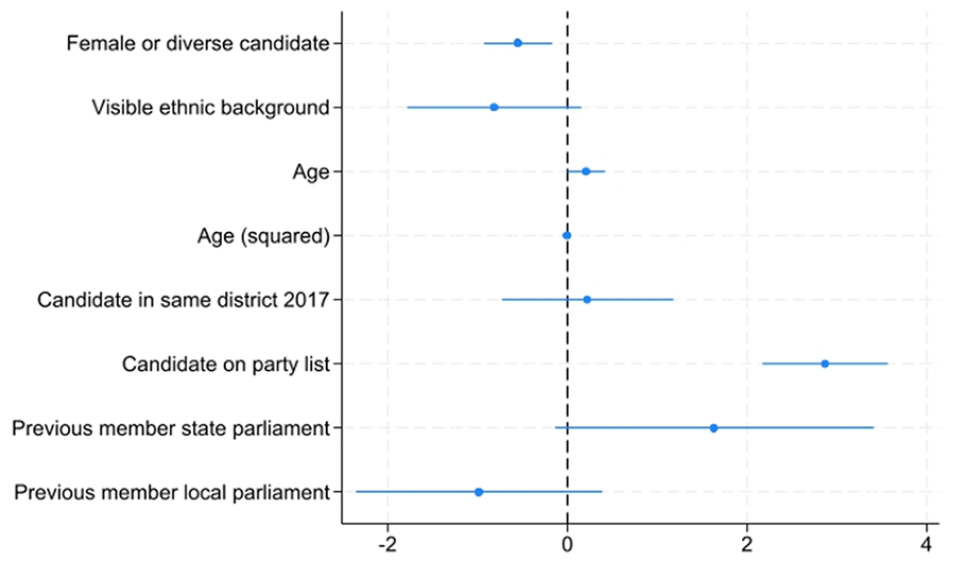
Determinants of District Candidate Selection for the 2021 German Bundestag Election.
We further argued that – for vote-seeking reasons – parties with societally traditionalist and restrictive positions on immigration policy have fewer incentives to present their voters with female or diverse candidates and candidates from ethnic minorities. To evaluate if there is a difference between these two groups of parties, we estimate the regression model from Figure 1 and Table 4 for two samples: candidate selection processes of traditionalist parties without any binding quota (FDP, CDU, CSU and AfD) and of progressive parties which had some form of binding quota in place (SPD, Greens and The Left). Figure 2 presents the results (see also Table 5). While the effect of gender is not significant anymore at the 10% level when differentiating between the two groups of parties, we find that among the four parties with more restrictive positions on migration policy and traditionalist societal policy positions, ethnic minority aspirants have significantly fewer chances to win the nomination of the respective local party’s organization for the district seat. This finding partially confirms H2, as ethnic minority aspirants do indeed have a lower chance of being nominated in more traditionalist parties with restrictive positions on migration and immigration. However, we do not find a significant effect for the variable identifying the gender of candidates.
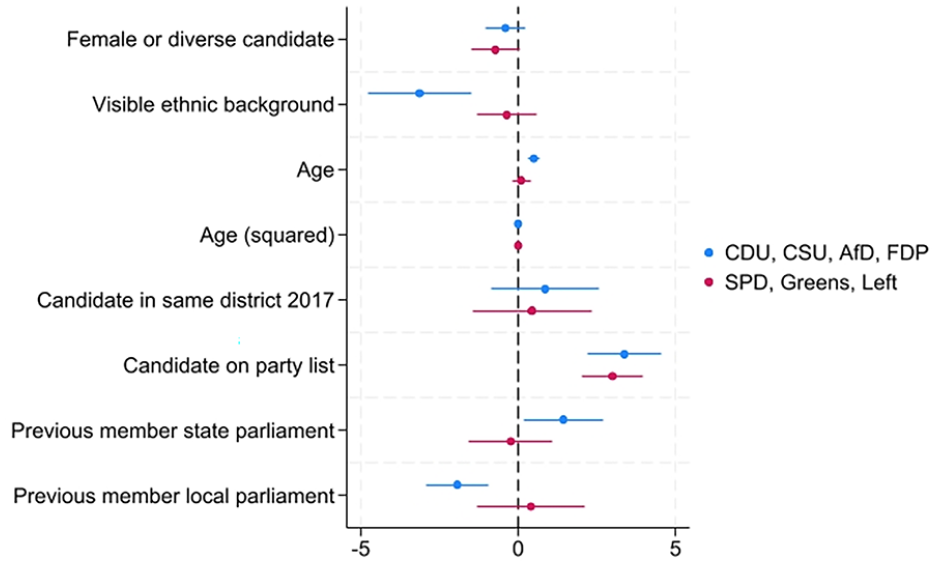
Determinants of District Candidate Selection, Differentiated Between Societally Progressive and Traditionalist Parties.
In the competing H3a and H3b, we argued that – based on intersectional literature – female candidates from ethnic minorities have either a higher or lower chance of winning a party’s nomination. Because of the different theoretical arguments and empirical findings in the literature about the effect of intersectionality on candidates’ success within parties and elections, we evaluate if there is evidence for one of these expected directions. The results presented in Figure 3 show that – when integrating an interaction effect between the gender of candidates and the variable that identifies a visible ethnic background of the candidates – there is neither a positive nor a negative effect on the chances that female (or diverse) candidates from ethnic minorities to win a party’s nomination (see also Table 6). The baseline effect for both characteristics – gender and ethnic minority – indicates that candidates from these groups have lower chances of getting nominated; there is, yet, no significant difference for female (or diverse) candidates with a visible ethnic background to win their parties’ nomination, so that we have to reject H3a and H3b when we ignore the ideological differences between parties that might affect the nomination of minority group candidates.
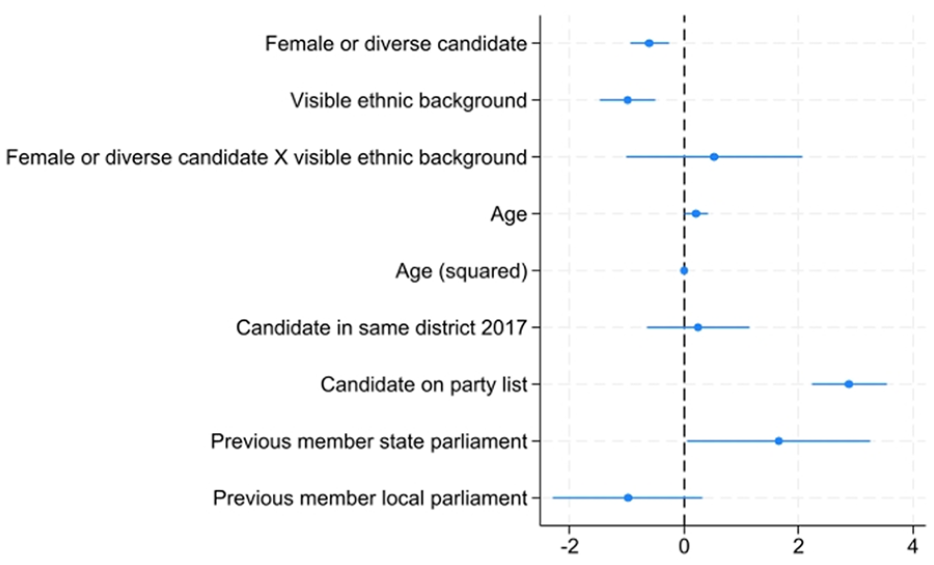
The Effect of Intersectionality on District Candidate Selection.
When taking the theoretical considerations on the ideological background of parties and its effects on candidate selection into account, we find, however, evidence for intersectionality. Figure 4 indicates that there is indeed a statistically robust effect which favours hypothesis 3b: female (or diverse) ethnic minority aspirants have lower chances of winning a party’s nomination, but only in the case of the group of parties with more traditionalist societal and less permissive migration policy positions. There is no significant effect in the case of the three more progressive parties, although the effect points in the other direction and would thus be in favour of H3a. It therefore seems that the effect of intersectionality on candidate selection depends – at least in case of the German Bundestag election in 2021 – on the ideological background of the respective parties. Yet, we have to acknowledge that we here deal with only a few cases as indicated in Tables 1 and 2, so the results have to be treated with some caution.
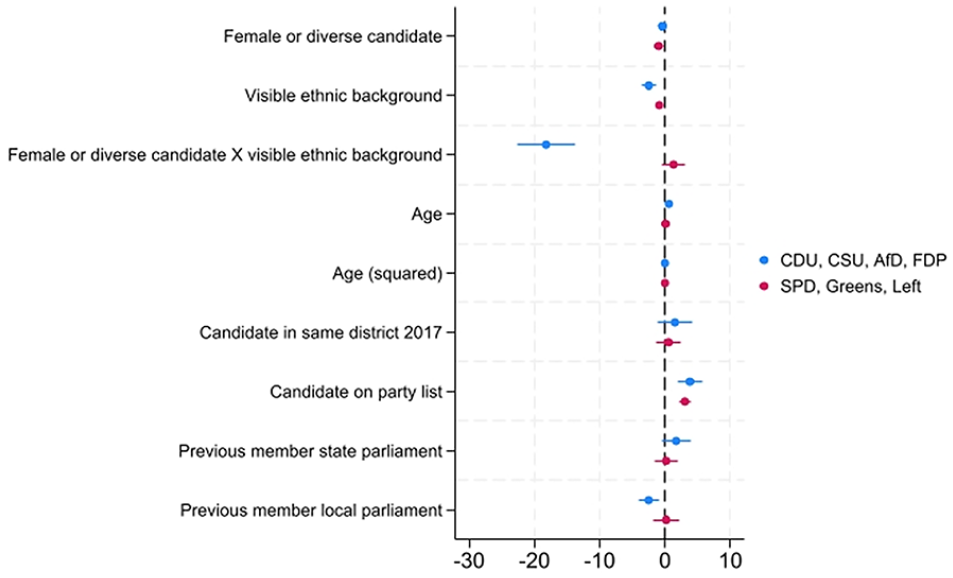
The Effect of Intersectionality on District Candidate Selection, Differentiated by Traditionalist and Progressive Parties.
To summarize, we found mixed evidence for our expectations. It seems that female and diverse aspirants have lower chances of winning a party’s nomination for a district candidacy across all parties, whereas the effect for ethnic minority candidates is also negative, but not significant on conventional levels. Aspirants from a visibly ethnic minority have lower chances of winning a competitive nomination process among parties with a rather traditionalist societal policy profile, namely the FDP, CDU, CSU and AfD. Furthermore, we find that intersectional characteristics of candidates – in terms of gender and ethnicity – matter, but only when differentiating between the ideological backgrounds of parties: female ethnic minority aspirants have lower chances to win their party’s nomination, but only in case of traditionalist parties that are restrictive on migration and integration policy.
Conclusion
This article aimed at studying the impact of aspirants’ gender and belonging to an ethnic minority on the chances to win their party’s nomination in an electoral district in the German context. First, we provided additional proof for existing findings, showing that female competitors and ethnic minority aspirants indeed face difficulties being nominated. The latter have lower chances to be nominated by parties with rather traditionalist societal policy positions. Furthermore, we found that the ideological background of the party – in terms of the programmatic orientation on societal and migration policy – is decisive, in particular when it comes to intersectionality: female (or diverse) ethnic minority candidates have less chances of being nominated by parties with a right-wing profile.
While these findings are in line with existing research (e.g. O’Brien, 2015), they are among the first that show these patterns in the case of the German parties during a period when diversity issues become highly salient in the public debate. However, we deal with a small number of cases when it comes to aspirants from an ethnic minority, and we focus on one case only, that is, the candidate selection process for the 2021 Bundestag election. To evaluate if these patterns are consistent, further studies could, for instance, analyse the candidate selection processes on the sub-national level. This would allow for identifying candidate selection patterns in sixteen states holding the institutional setting – in particular, the electoral system – and the party system context stable, so that it would be possible to identify if parties like CDU, CSU, FDP and AfD are less likely to nominate minority candidates in a large-N design. A further interesting perspective would be to adopt a comparative perspective over time so that one could study whether the impact of gender and belonging to ethnic minorities changed over time. This and the state-level perspective would, however, imply a huge effort in terms of data collection, which was already challenging in the case of the 2021 candidate selection for the Bundestag since there are no official records that document the intra-party selection mechanism on the district level.
We acknowledge that data availability limits us in evaluating potential effects of intersectionality. Hancock (2007b: 251) stresses that an intersectional perspective goes beyond the inclusion of multiple categories of difference. While we recognize that female ethnic minority aspirants face different biases than ‘just’ female aspirants, we would need more fine-grained data to further differentiate between, for instance, specific ethnic minorities like individuals with an Italian, Russian and Turkish migrant background which indeed adopt different positions on key policy dimensions (Debus et al., 2023). Furthermore, we focus on only one out of many intersectional identities. Other identities, such as the intersection of gender and sexual orientation, are faced with different sets of stereotypes (Doan and Haider-Markel, 2010; Turnbull-Dugarte, 2020) that might affect their odds of being nominated as candidates differently than those of other intersections.
There are plenty of further incentives for future research. One could scrutinize whether the point in time when gender and/or minority quotas by the respective parties were introduced influenced the number of women and ethnic minority candidates in decentralized candidate selection regimes like in the case of the German Bundestag. For instance, if a party installed a quota for the party list a long time before the district candidate selection process under study, one would expect that the local units of the party take these rules stronger into account than parties that just recently adopted such an organizational reform. Furthermore, future studies could integrate the degree of competitiveness of an electoral district into the theoretical framework and empirical models. When parties’ posts are desirable – that is, when the party is performing well – male aspirants might be more likely to run for the respective public office. Only when the performance of the party is dropping off, it might be willing to deviate from the status quo, which opens opportunities for minority group aspirants (e.g. O’Brien, 2015). Given, however, vote-seeking incentives of parties in combination with the public pressure to nominate a sufficient share of underrepresented candidates, for example, by introducing gender quotas, one could expect that in particular parties with societally traditionalist positions and restrictive migration policies to nominate candidates of minority groups when these candidates have rather low chances to win a seat in the parliament (e.g. Kulich et al., 2014).
Footnotes
Appendix 1
Determinants of Candidate Selection Outcomes at the District Level, Including Information on the Share of Older People (Aged 60 Years and Older) Who Live in the Electoral Districts.
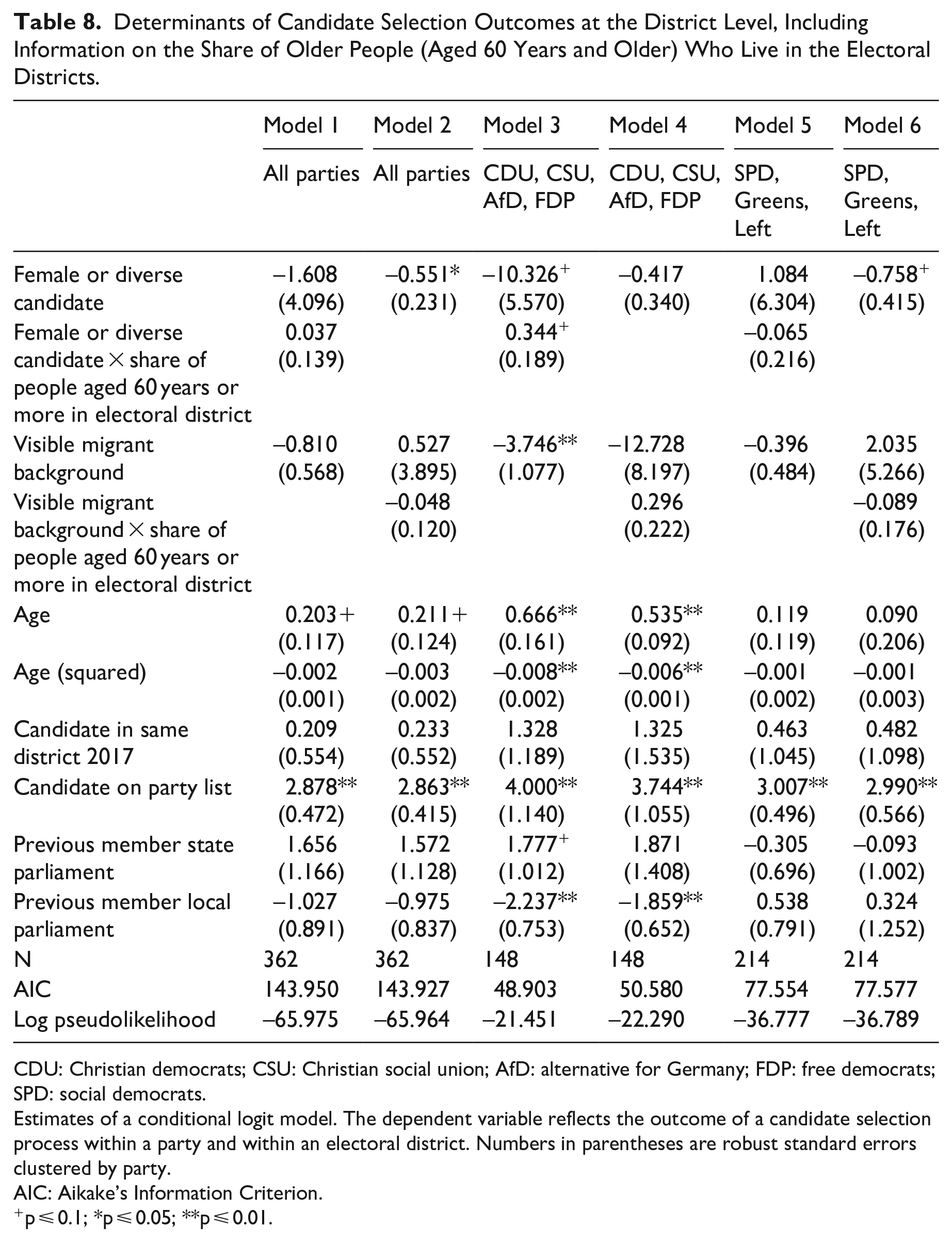
| Model 1 | Model 2 | Model 3 | Model 4 | Model 5 | Model 6 | |
|---|---|---|---|---|---|---|
| All parties | All parties | CDU, CSU, AfD, FDP | CDU, CSU, AfD, FDP | SPD, Greens, Left | SPD, Greens, Left | |
| Female or diverse candidate | –1.608 (4.096) |
–0.551*
(0.231) |
–10.326
+
(5.570) |
–0.417 (0.340) |
1.084 (6.304) |
–0.758
+
(0.415) |
| Female or diverse candidate × share of people aged 60 years or more in electoral district | 0.037 (0.139) |
0.344
+
|
–0.065 |
|||
| Visible migrant background | –0.810 |
0.527 |
–3.746**
|
–12.728 |
–0.396 |
2.035 |
| Visible migrant background × share of people aged 60 years or more in electoral district | –0.048 |
0.296 |
–0.089 |
|||
| Age | 0.203
+
|
0.211
+
|
0.666**
|
0.535**
|
0.119 |
0.090 |
| Age (squared) | –0.002 |
–0.003 |
–0.008**
|
–0.006**
|
–0.001 |
–0.001 |
| Candidate in same district 2017 | 0.209 |
0.233 |
1.328 |
1.325 |
0.463 |
0.482 |
| Candidate on party list | 2.878**
|
2.863**
|
4.000**
|
3.744**
|
3.007**
|
2.990**
|
| Previous member state parliament | 1.656 |
1.572 |
1.777
+
|
1.871 |
–0.305 |
–0.093 |
| Previous member local parliament | –1.027 |
–0.975 |
–2.237**
|
–1.859**
|
0.538 |
0.324 |
| N | 362 | 362 | 148 | 148 | 214 | 214 |
| AIC | 143.950 | 143.927 | 48.903 | 50.580 | 77.554 | 77.577 |
| Log pseudolikelihood | –65.975 | –65.964 | –21.451 | –22.290 | –36.777 | –36.789 |
CDU: Christian democrats; CSU: Christian social union; AfD: alternative for Germany; FDP: free democrats; SPD: social democrats.
Estimates of a conditional logit model. The dependent variable reflects the outcome of a candidate selection process within a party and within an electoral district. Numbers in parentheses are robust standard errors clustered by party.
AIC: Aikake’s Information Criterion.
p ⩽ 0.1; *p ⩽ 0.05; **p ⩽ 0.01.
Acknowledgements
The author would like to thank Michael Diesenhof, Victor Egenti, Frank Tabert, Damian Vassilev and Clara Weller for excellent research assistance and the participants of the ECPR Standing Group on Parliaments conference in Vienna, Austria, 6–8 July 2023, for very helpful comments and suggestions.
Declaration of conflicting interests
The author(s) declared no potential conflicts of interest with respect to the research, authorship, and/or publication of this article.
Funding
The author(s) disclosed receipt of the following financial support for the research, authorship, and/or publication of this article: The findings presented in this paper are produced as part of the DeZIM project ‘Social Conflicts and Dynamics of Party Competition in Migration and Integration Policy’. They acknowledge funding by the German Federal Ministry for Family Affairs, Senior Citizens, Women and Youth (BMFSFJ); funding reference number: 3920405INZ.
