



Abstract
Political elites—like ministers or members of parliament—face numerous phenomena that are characterized by uncertainty. Uncertainty ranges from resolvable to radical, whereby the former can be removed with more or better information, but radical uncertainty cannot. Remarkably, little is known about political elites’ responses to such phenomena, both theoretically (what responses are likely?) and empirically (which responses do political elites display?). This “New Ideas” contribution addresses the theoretical lacuna by presenting a multidisciplinary conceptual map of possible responses to radical and resolvable uncertainty. These responses influence political elites’ effectiveness in solving problems and, thus, how representative democracies function. The article also sketches how to identify the responses empirically.
Keywords
Political Elites Amid Uncertain Phenomena
In March 2020, political elites—that is, elected and appointed representatives who can take binding decisions, such as ministers, parliamentarians, or local politicians—were confronted with a highly disruptive global health emergency. At its start, the COVID-19 pandemic was a textbook example of a radically uncertain phenomenon (Kay and King, 2020). Radical uncertainty is characterized by manifold unknowns, ambiguity and vagueness, with outcomes that are unknown and unknowable. After initially deepening of the state of uncertainty (Boin et al., 2021: 21), aspects of the COVID-19 pandemic with time became resolvably uncertain, with outcomes that are unknown but knowable. Resolvable uncertainty can be removed with more information and/or knowledge, like whether vaccines protect against a new, but known variant of the coronavirus (e.g. Omicron beginning 2022).
Many phenomena faced by political elites are uncertain, ranging from radically uncertain such as the long-term effects of Brexit and exponential technological change, to resolvably uncertain, like the electoral consequences of welfare retrenchment. Empirically, disentangling radical from resolvable uncertainty is challenging; analytically, doing so is useful because an uncertain phenomenon’s “radicalness” or “resolvableness” shapes the opportunities or constraints politicians face in their judgment and decision making. I treat radical and resolvable uncertainty as two ends of a continuum, differentiating between them as a heuristic device.
Whereas research in behavioral economics, political psychology and foreign policy analysis provides insights on decision making under resolvable uncertainty (e.g. Gilovich et al., 2002; Hafner-Burton et al., 2013), it typically does not address radical uncertainty. Studies that examine radical uncertainty or related concepts like true uncertainty (Knight, 1921) or deep uncertainty (Marchau et al., 2019), conversely, tend to focus on how to manage this uncertainty practically (Ansell and Boin, 2019). However, little is known about political elites responses to different types of uncertain phenomena, both theoretically (what responses can we theoretically expect?) and empirically (which responses do political elites display?). Related to the empirical question, Sayers et al. (2023) show that given the pandemic’s first phase of Knightian (i.e. radical) uncertainty, the puzzling domestic policy convergence was a rational response. After the removal of radical uncertainty, policy divergence again was the rational response. However, Sayers et al. (2023) focus only on one possible response to uncertainty and do not address the theoretical lacuna. This “New ideas” contribution addresses the theoretical lacuna by presenting a multidisciplinary conceptual map of six broad types of responses to uncertain phenomena: “avoidance,” “downplay uncertainty,” “comprehensive,” “pragmatist,” “heuristics,” and “opportunistic.” The next section discusses these responses. I also indicate that the responses can have major implications for how representative democracies function by influencing political elites’ effectiveness in solving problems. Finally, I sketch how to identify the responses empirically.
Conceptual Map of Political Elites’ Behavioral Responses
How do political elites respond to radically and resolvably uncertain phenomena? To answer this question, I integrate insights from various disciplines like political science, public administration, decision theory, psychology, and behavioral economics. Theoretical expectations on political elites’ responses differ both across and within these disciplines. For instance, the classic or rationalist approach in decision theory and political science suggests a “comprehensive” response. Crisis management literature, conversely, expects “pragmatist” or “heuristics” responses. Psychology and behavioral economics predict “avoidance,” while some work in political science and public administration anticipate an “opportunistic” response. There is thus no single answer to the question “what responses can we theoretically expect?” necessitating the integration of these multidisciplinary insights. The responses are all behavioral in that they are about what political elites do or refrain from doing. This also means that they leave empirical traces in, for instance, their speech acts or decisions. In addition to more specific ones, drivers that all six responses have in common are as follows: (1) ideology and (2) political calculation. The responses are also broad, thus possibly including sub-types, and can both be strategies that politicians actively and explicitly decide to use, or responses that they display (almost) unconsciously.
“Avoidance”
The literature on agenda setting teaches us that politicians can only ignore a radically or resolvably uncertain phenomenon if it has not yet entered the political or party system agenda (Green-Pedersen and Mortensen, 2015). If there are empirical traces suggesting that uncertain phenomenon are ignored, political elites display the response “avoidance.” An example of “avoidance” is pretending the phenomenon does not exist—the latter possibly through misinformation, as for instance, Bolsonaro did with the coronavirus (Phillips, 2020). Politicians can also actively leave the uncertain phenomenon off the agenda. The number of potential topics on the political agenda is infinite (Baumgartner and Jones, 2015), while it is limited at a specific point in time. Political elites may thus strategically decide to avoid a radically or resolvably uncertain phenomenon that is not on the agenda (yet). In terms of political calculation, this is attractive when they expect the potential political gains (e.g. votes) to be small while the potential losses to be large. Take, for example, climate change. While nowadays many politicians acknowledge that climate change has detrimental effects, these effects are (still) largely invisible, diffuse, and relatively long term. The costs of curbing climate change, conversely, are oftentimes visible, direct, and immediate. This combination makes that, politically, avoiding this topic may be more attractive if it has not (yet) entered the agenda. The response “avoidance” hereby speaks to the literature on policy inaction, with policy inaction referring to a situation in which a policymaker could have intervened because a plausible intervention in their jurisdiction was possible, but did not (McConnell and Hart, 2019: 648). Like the response “avoidance,” also policy inaction can, for instance, by driven by ideology—what McConnell and Hart (2019) call ideological inaction—or political calculation—so-called calculated inaction.
When an uncertain phenomenon has entered the party system or political agenda, politicians’ responses in some way engage with the uncertain phenomenon. The other responses on the map are of this “engage-type.”
“Downplay Uncertainty”
The response “downplay uncertainty” is visible in two main variants. First, political elites can consider something that is radically uncertain as “merely” resolvably uncertain. This is visible in a statement by the Dutch Prime Minister Rutte in one of the first COVID-19 press conferences on 12 March 2020 that, regarding COVID-19, “you have to make 100% of the decisions with 50% of the knowledge [. . .].” 1 This statement suggests that the situation was knowable at the time (i.e. resolvably uncertain), which downplayed COVID-19’s radical uncertainty at the time—including also unknown unknowns—to resolvable uncertainty. In a second variant of “downplay uncertainty,” uncertainty is assumed to be absent. When a phenomenon is, in fact, characterized by uncertainty, this is an example of so-called misplaced certainty (Mitzen and Schweller, 2011). Since people are typically uncertainty averse (Dimmock et al., 2016), the driver to “downplay uncertainty” is oftentimes political calculation.
“Comprehensive”
Political elites display the response “comprehensive” if they apply all available means to address the radically or resolvably uncertain phenomenon. This may seem the most appropriate response, normatively speaking. For one, the response resembles rationalist approaches to uncertainty in political decision making (e.g. Bueno de Mesquita et al., 2003; Riker, 1995). “Comprehensive” is also clearly recognizable in the field of estimative intelligence (e.g. Friedman and Zeckhauser, 2012), a sub-field of foreign policy analysis that aims to eliminate or reduce uncertainty around military operations. Under resolvable uncertainty, with unknown but knowable outcomes, the appropriate course of action is often clear: collect more information to obtain more knowledge. This can, for instance, be done by asking advice from experts or by installing a committee. While thus possibly effective in addressing the resolvably uncertain phenomenon, a comprehensive response is also time consuming and may thus not be possible (or ineffective) when time is of the essence.
However, when information is ambiguous and cannot be translated into action—as under radical uncertainly—the appropriate course of action is typically unclear. In such situations, collecting more information either leads to an unjustified sense of certainty of, or control over, the uncertain phenomenon. 2 This is visible in a statement by Rutte in a COVID-19 press conference on March 2020: “[. . .] of course, we prepare for all conceivable scenarios [. . .]” (emphasis added). This “comprehensive” response suggests that, even though scenarios are needed—meaning that there is no certainty—the situation is under control. This underestimated the radicalness of the COVID-19 pandemic’s uncertainty at the time.
Also when political elites decide to use a so-called Decision Making under Deep Uncertainty (DMDU)-model (for an overview, see Stanton and Roelich, 2021)—for example, in the context of climate change adaptation, this is a “comprehensive” response. While this may seem appropriate, the cognitive and resource requirements involved in applying a DMDU-model are thus high that such models are typically applied for political elites rather than by them. Moreover, also these models may provide an unjustified sense of control over uncertainty.
“Pragmatist”
If political elites regard “uncertainty as something to manage and live with rather than to dispel and conquer” (Ansell and Boin, 2019: 1100), and make small decisions based on the selective testing of interpretations and constant adjustment based on feedback, they display the response “pragmatist.” 3 When facing radical uncertainty, this response may be the most effective one (Ansell and Boin, 2019). Decision makers who successfully display the response “pragmatist” “adopt an attitude of humility towards what they know” (Ansell and Bartenberger, 2019: 31), shielding them from for instance overconfidence. At the same time, the response’s targeted search also averts “delaying action until they have all the information” (idem: 31). Still, a “pragmatist” response takes time (Ansell and Boin, 2019: 1092), as well as “skill and experience” (idem: 1100). It is not a response that will come naturally; instead, “decision makers need to be trained in this first” (idem: 1102).
“Heuristics”
Where the responses “comprehensive” and “pragmatist” “prizes inquiry” (Ansell and Boin, 2019: 1100), albeit of a different kind, the response “heuristics” rather refers to using cognitive rules of thumb facilitating judgment and decision making under uncertainty (Gigerenzer and Selten, 2001; Gilovich et al., 2002). Examples hereof are the initial comparisons of COVID-19 to the flu in Europe and to Ebola in Africa, and the subsequent policy responses.
According to the so-called the fast and frugal (F&F) heuristics tradition to heuristics pioneered by Gigerenzer and colleagues (e.g. Goldstein and Gigerenzer, 2002), heuristics often enable people to make better judgments or decisions in a complex environment (see Love et al., 2023). Against this backdrop, heuristics may be useful under radical uncertainty. Yet, relatively little is known about whether, when and which types of F&F heuristics political elites display (see Vis, 2019). The other tradition to heuristics—heuristics and biases (H&B), pioneered by Kahneman and Tversky (see Gilovich et al., 2002)—conversely, focuses on how and why using heuristics oftentimes results in judgments or decisions that are suboptimal compared to a normative standard. Treating COVID-19 like the flu, for example, was an ineffective response. H&B is especially applicable in the face of known unknowns and risk (Dhami et al., 2019), that is, under resolvable uncertainty.
Whereas H&B typically assumes that heuristics are used automatically or unconsciously, per System I, F&F heuristics are chosen deliberately, per System II (Gilovich and Griffin, 2002: 16–17); the F&F decision tree of which victims of the 9/11 attacks to treat most urgently is an example of the latter (Katsikopoulos, 2021: 585).
“Opportunistic”
A final response on the conceptual map is “opportunistic.” Drawing on Boin et al.’s (2009) work on crisis exploitation, a response is “opportunistic” if politicians purposefully utilize the radically or resolvably uncertain phenomenon to increase support for themselves, their party, or their policies. Empirically disentangling “opportunistic” from other responses is challenging but let me provide some illustrative examples. First, former UK Minister of Health Hancock who wanted to “frighten the pants off everyone” with a new COVID-19 variant (CityA.M., 2023) utilized it as an opportunity to build support for a new lockdown and to increase adherence to COVID-19 measures. Second, political elites who utilize the uncertain phenomena by framing their pet solution as the solution to a problem. They may then claim that “There Is No Alternative” (TINA), as former British Prime Minister Thatcher often did, but also former German Chancellor Merkel in relation to for instance the migration crisis. While framing is possible with both resolvably and radically uncertain phenomena, it is specifically the latter’s information ambiguity that provides an opportunity to frame information, for instance by downplaying possible adverse consequences. Radical uncertainty, then, presents opportunities for electoral or office payoffs.
Conceptual Map of Responses to Uncertain Phenomena and Selected Implications
Figure 1 presents the conceptual map with the six types of responses to uncertain phenomena (resolvable/radical), all of which can be driven by ideology or political calculation. The term map indicates that responses need not be mutually exclusive such as “comprehensive” and “opportunistic.” However, they can be mutually exclusive, like “pragmatist” and “comprehensive.”
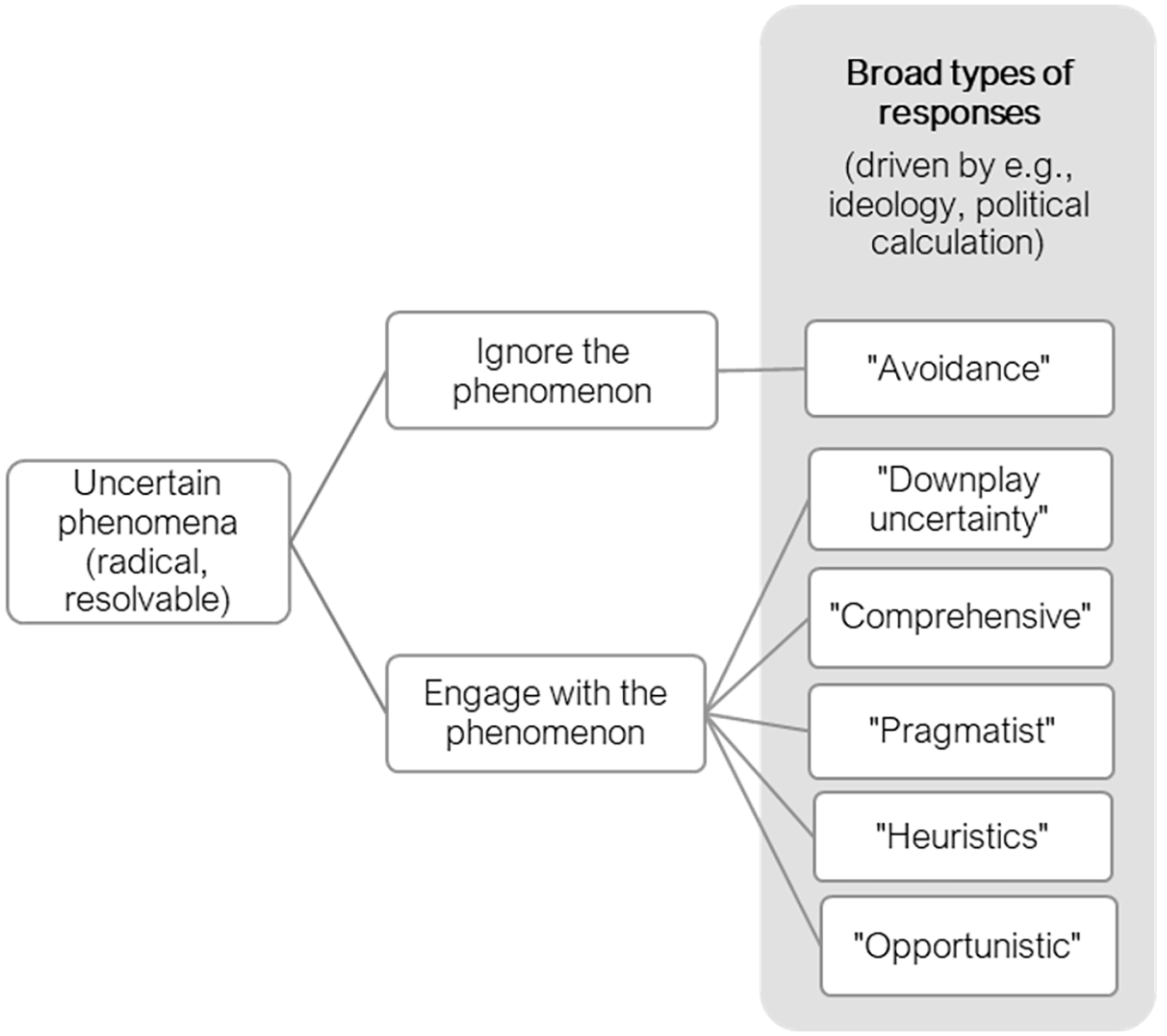
Conceptual Map of Political Elites’ Responses to Uncertain Phenomena.
The specific response(s) displayed can have major implications for the functioning of representative democracies. For example, “comprehensive” is encompassing and may be sensible, but its slow nature can be problematic if an issue requires a fast response, as with the 2015 European migration crisis. “Opportunistic” can be used to promote policies benefiting the greater good, but it may also offer leaders with authoritarian traits opportunities for reaping electoral gains, threatening liberal democracy. And a heuristic like availability may increase inequality by negatively affecting underprivileged societal groups, whose voices are less readily available and may be insufficiently considered in democratic problem solving.
Identifying the Responses Empirically
After having presented a novel conceptual map of six broad responses to radically and resolvably uncertain phenomena that political elites can display, a next step is identifying the responses empirically. This enables revealing which responses political elites display under which conditions. How to do this? There are several routes possible. A first one is extracting responses to uncertain phenomena from political elites’ communication (e.g. tweets, speeches, parliamentary debates) by a form of automated text analysis (for overviews, see Atteveldt et al., 2019; Wilkerson and Casas, 2017). An advantage of this first route is that is enables at-a-distance data collection, which is especially useful given that getting political elites to participate in research is challenging. Such participation is, however, not impossible, and much needed for obtaining direct data from politicians to complement findings from route 1. An option is to present political elites with hypothetical vignettes about a radically or resolvably uncertain phenomenon and ask them about their responses. The vignettes would have to be mundane enough to capture real-world (possible) responses and can be part of a survey, ideally conducted in-person. The latter enables a follow-up interview, for example, asking about contextual factors, and has other advantages (see Vis and Stolwijk, 2021; Walgrave and Joly, 2018).
Before turning to such an empirical endeavor, it is important to stress that it is unlikely that the responses presented here are the only ones that political elites display in response to uncertain phenomena. For one, the six responses are mainly cognitive while there may also be non-cognitive ones, for instance, taking one’s affiliation to others into account (see Janis, 1989). Therefore, further research is needed to extend the conceptual map. Moreover, political elites likely differ in their tendency to display specific responses because of the institutional constraints they face, their ideology, or personality traits. For instance, politicians scoring high on the personality trait conscientiousness—characterized by for instance dutifulness and deliberation (see Bakker and Lelkes, 2018)—may be more likely to display the response “comprehensiveness.” Future research should thus also examine the variation in responses across institutional constraints, ideology, or personality traits. This also holds for the benefits of specific responses for the political elites (e.g. their political standing) or for the public (e.g. how effective a response is in solving societal problems). Such research will contribute to the development of an overall theory of how institutions and individual characteristics influence political elites’ responses to both radically and resolvably uncertain phenomena, and what this means for the functioning of representative democracy.
Footnotes
Acknowledgments
An earlier version of this article has been presented at the 2023 Dutch/Flemish Politicologenetmaal. I would like to thank all participants of the Political Psychology panel for their useful comments and suggestions. In addition, thanks to Marija Aleksovska, Lisanne de Blok, Ella MacLaughlin, Sjors Overman, Naara Ulkme and Olaf van der Veen for insightful comments.
Declaration of conflicting interests
The author(s) declared no potential conflicts of interest with respect to the research, authorship, and/or publication of this article.
Funding
The author(s) disclosed receipt of the following financial support for the research, authorship, and/or publication of this article: This research is funded by the European Union (ERC Consolidator grant, RADIUNCE, #101043543).
