



Abstract
Campaign finance and other political reforms often have redistributive consequences when they improve the position of one group over another. When potentially redistributive reforms are debated or passed, groups may resist or support such reforms depending on their belief about whether the reforms will be advantageous or not to their own position. In dominant party systems such as Japan, we expect that major reforms will have heterogeneous effects for different factions within Japan’s Liberal Democratic Party (LDP). In 1975 and 1994, reformers in Japan introduced major changes that they hoped would reduce corruption and strengthen political parties over factions. In this article, we empirically investigate the asymmetrical impact of the reforms on the total amount of revenue and contributions disclosed by factions in the LDP. We find that the 1975 reform had significant redistributive effects, including a relatively adverse impact on the faction linked to Tanaka Kakuei in terms of total revenue. The 1994 reforms, in contrast, reveal that the Tanaka faction did the best among the factions in collecting revenues and consolidating its power.
Introduction
Campaign finance reform is commonly viewed as a remedy for reducing corrupt incentives of entrepreneurial parties and politicians (Alexander, 1984; Fisman and Golden, 2017; Rose-Ackerman, 1999). Reformers may introduce new regulations to tighten the flow of money and to differentiate the boundaries between legal and illicit actions. Limits on political contributions given to parties or candidates are a common control strategy. Transparency-inducing measures such as disclosure requirements are likewise introduced to enhance accountability and to counter secrecy. Research on the causes and consequences of such reforms is necessary to investigate the facts and provide a “a crucial foundation for efforts to contain the abuses that are always liable to occur wherever competitive elections are held and organized political parties exist” (Pinto-Duschinsky, 2002: 85).
In a study examining the costs of political competition in 18 countries based on estimates culled from the late 1990s, Japan ranked as one of the most excessive spenders along with Austria, Israel, Italy, and Mexico (Nassmacher, 2009: 119). His statistical analysis for these 18 countries showed that one-party dominance and political competition during election years increased levels of party spending. The existence and consequences of dominant parties has attracted considerable scholarly attention in the study of democracies and authoritarian systems (see, for example, Carty, 2022; Friedman and Wong, 2008; Higashijima, 2022; Pempel, 1990). Current or former examples of countries with dominant parties include such places as Italy, Israel, Japan, Mexico, Sweden, South Africa, Botswana, Ireland, and Canada. Many case studies have generally concluded that factionalism flourishes in countries that have dominant parties. In this article, we borrow upon insights from institutional and redistributive theories and analyze the heterogeneous effects of major campaign finance and political reforms on different factions within Japan’s dominant Liberal Democratic Party (LDP).
In a review of the literature on political finance in comparative perspective, Scarrow (2007: 206) acknowledges the need to study individual countries to examine how political finance practices evolve over time. This article focuses on the consequences of campaign finance reforms in the 1970s and 1990s on major LDP factions. Interparty factions in Japan are one of the most critical aspects of national politics (Köllner, 2004; Park, 2001). Factions within the LDP determined who became prime minister, assisted individuals in winning elections, and served as a mechanism for distributing party and government positions. However, the functions of factions have changed over time and in response to two major institutional reforms detailed in this article. It is important to examine the effects of these changes on factions given the significant interest in the study of formal and informal institutions and institutional change (Aoki, 2001; North, 1990).
A common approach in the study of political finance is to focus on a single country and examine how political finance practices have changed over time. Scholars have focused on major campaign finance reforms such as the U.S. 2002 Bipartisan Campaign Reform Act (La Raja, 2008; Malbin, 2006); Britain’s Political Parties, Elections and Referendums Act 2000 (Clift and Fisher, 2004); or South Africa’s 1997 Public Funding of Represented Political Parties Act (Calland, 2016). Such studies typically analyze and compare the period before the reform with the period after with considerable attention focusing on the causes of the reform as well as its impact on the party system or specific political parties. Building upon these studies, we focus on understanding possible redistributive consequences of Japan’s major reform efforts and the challenges of enacting reform in a dominant party system with a highly factionalized dominant party.
The two most significant political reforms in Japan are the 1975 and 1994 reforms examined in this article. The 1975 reforms changed the Political Funds Control Law (PFCL) of 1948, the main law that governs money in politics. The impetus for the reform was corruption linked to a former prime minister and the determination of a reformer to pass significant revisions of the PFCL despite considerable objections within the ruling party. The 1994 reforms passed after the LDP lost power in 1993 to a coalition government. The reforms consisted of a new election system, revision of the PFCL, and a subsidy system for political parties. We seek to understand the consequences of these reforms for Japanese politics and contribute to general efforts to study the effects of political reforms on money in politics more generally. 1
The remainder of this study is organized as follows. The “Factions and the Impact of Reforms” section discusses key theoretical issues, characteristics of LDP factions, components of the 1975 and 1994 reforms, and presents an overview of the financial disclosure reports we collected on factions. The “Assessing the Relative Impact of Reform on Factions” section details the estimate models and explains the empirical results. The “Conclusion” section summarizes the main lessons and concludes.
Factions and the Impact of Reforms
In their review of the field, Norris and Abel van Es (2006: 5) note, “relatively little has been established with any certainty” why major political finance reforms are implemented in any state. They further explain that even less is known about the systematic consequences of implementing major new rules. Recent studies have highlighted the challenges of major campaign finance reforms to achieve specific outcomes such as improving popular perceptions about corruption (Bowler and Donovan, 2013) or raising turnout (Schaffer, 2008). Evaluating the impact of major political reforms is also complicated because there are immediate, medium-term, and long-term impacts to consider.
To address the challenges associated with money in politics, studies of campaign finance reforms are usually based on the premise that rules reflect the interests of incumbents (Benoit, 2004; Bowler and Donovan, 2013). A considerable body of work thus examines the reasons why specific reforms are implemented (see, for example, Clift and Fisher, 2004; Malbin, 2006; Scarrow, 2004). In this article, we investigate how the rule changes implemented in Japan benefit one group over another. Within party systems and within factionalized parties, asymmetries exist in how organizations collect funds to the extent that a rule change may favor one group over another (Ewing et al., 2012: 3). Reformers may appeal to normative goals such as striving for equality and fair competition, but also, they may have strategic goals in seeing some individuals or groups do better than others.
Redistributive Institutional Change
As Tsebelis (1990: 110–111) argues, there are two ideal types of institutional change: efficient and redistributive. An efficient change improves the condition of all individuals or groups in a society. Following the concept of Pareto efficiency, reforms that allow some individuals or groups to get worse off cannot be called efficient. If we apply this definition, most historical reforms should be judged as inefficient institutional changes. When institutional changes are redistributive, however, it improves the condition of one group over another. Such changes serve two purposes: “either they preserve the interests of the dominant coalition, or they create a new majority composed of the previous losers and some previous winners.” Tsebelis claims there are two types of redistributive institutional changes: consolidating and new deal. The former emerges when a majority improves its position. The latter is when the existing coalition breaks apart and losers are transformed into winners.
Factions in Japan are closely linked to Japan’s problems with money in politics and political corruption. The 1975 and 1994 reforms tried to promote party-centered elections while making it more difficult for factions to raise political funds. In each case, the reforms were the product of compromise between various political leaders and based on a mixture of normative and strategic goals. It is important to consider whether these reforms were efficient or redistributive and which groups were the relative winners or losers in terms of collecting funds.
Previous research on the 1975 and 1994 reforms has focused primarily on whether either reform affected the absolute amounts of money in the political system (Iwai, 1990; Krauss and Pekkanen, 2011). While this is valuable, we ask whether the reforms have heterogeneous or redistributive effects on factions. Like parties, factions can be recognized as organizations of political competition, which compete against each other and seek out relative advantages. There have been many efforts to define factions, but one useful effort is from Frank Belloni and Dennis Beller (1978: 419), who define a faction as “any relatively organized group that exists within the context of some other group and which (as a political faction) competes with rivals for power advantages within the larger group of which it is a part.”
Studies of the LDP, the Indian Congress Party, the Italian DC, as well as dominant parties in new democracies (Pridham, 1995) have suggested that factionalism flourishes in dominant parties. Dominant parties have been in power for a long time, control the distribution of power resources, and represent a multitude of socio-economic groups. Factions in strong parties have incentives to fight for control over such resources and may specialize in catering to specific socio-economic groups to assure their funding needs and survival. We would expect that major campaign finance and political reform changes may have heterogeneous effects on different factions particularly in systems with dominant party systems.
In studying the impact of reforms on LDP factions, we expect possible differentiating effects on specific factions. First, individual factions may pursue different strategies for collecting funds such as relying on contributions, loans, or holding fundraising parties. When rules are changed that affect the flow of such income, some groups may fare better or worse going forward. Second, factions may rely on different kinds of contributions such as those from individuals, companies, or donations from specific sectors of the economy. Finally, the faction leaders that helped change the system likely had strategic goals in mind that would help their faction fare better over rival factions. In the case of the 1975 reforms, for example, the prime minister and leader of Japan’s smallest faction spearheaded a major campaign targeting the former corrupt faction leader and prime minister. How much heterogeneity exists within strong factionalized parties may be influenced by historical conditions, political events, and the choices made by political leaders (Friedman and Wong, 2008; Panebianco, 1988).
Factions in the LDP
What factors contribute to factions? A common explanation references cultural explanations such as Fukui (1970) who views factions as being rooted in Japan’s societal structure of vertically organized groups. In contrast to cultural explanations, other scholars have focused on the incentives generated by the election system (Ramseyer and Rosenbluth, 1993; Sato and Matsuzaki, 1992). From 1947 until 1993, the election system used in the lower house was single nontransferable vote (SNTV) with multi-member districts. Under SNTV, candidates from majority-seeking parties faced competition from other same-party candidates as well as competition from other parties’ candidates in districts that averaged from three to five seats.
Factions have been the dominant organizational structure in the LDP. Scalapino and Masumi (1971: 54) describe the LDP as consisting of factional coalitions or alliances, which function as closed “mutual aid” societies or clubs. Ike (1972: 81–83) characterizes the LDP as loose coalitions that organize for campaigning and legislating. In the late 1960s, the number of major factions stabilized from eight to five. From 1972 until 1993, the five major factions helped decide every prime minister. In this article, we confine our analysis to the top five because of their importance in postwar Japan. To simplify the names of factions, we use the name of their leader at the time of the 1975 reforms (Köllner, 2004: 91) and do not rename the faction each time a leader changes.
The first faction was the Tanaka faction led by Tanaka Kakuei who succeeded Prime Minister Satō Eisaku in July of 1972. After he was forced to resign in 1974, Tanaka remained the leader of the LDP’s largest faction until Takeshita Noboru takes over in the late 1980s. The second faction was the Miki faction, which originates from a political group formed by Miki Takeo and Matsuyama Kenzō in 1956. Fukuda is the third faction we examine, which was linked to Fukuda Takeo who succeeded Miki as prime minister from 1976 until the end of 1978. The fourth faction, Ōhira, was linked to Ōhira Masayoshi, who becomes prime minister in 1978 after Fukuda. The final fifth faction belonged to Nakasone Yasuhiro, who becomes prime minister from 1982 to 1987.
Each of these five factions was personalized and organized around a specific leader instead of some specific ideology. The Miki faction was associated with its stance on cleaning up politics but there generally lacked a clear ideological stance across most of the LDP factions. Factional leaders differed in terms of their skills in fundraising as well as their personal connections. Tanaka was legendary for his ability to raise funds and his faction had close connections with bureaucrats in the Ministry of Construction and the Ministry of Post and Communications (Kohno, 1997). Each group competes with rivals for power advantages using its strengths and connections as a faction within the dominant LDP.
The 1975 and 1994 Reforms
Miki Takeo became prime minister in 1974 and managed to pass the most significant changes to the PFCL in Japan’s history. The impetus for reform came from a series of damaging political scandals linked to former Prime Minister Tanaka Kakuei. In the 1974 upper house election, Tanaka pioneered the use of “company-organized” campaigning by having companies sponsor LDP candidates, which led to increased campaign finance spending as well as an increase in the number of election violations. The 1974 election results generated criticisms of Tanaka and the LDP, but the last straw was the emergence of a scandal surrounding Tanaka’s inappropriate uses of money. When the scandal forced Tanaka out of office in 1974, the LDP turned to Miki, the leader of one of the smallest factions, to help revive its reputation.
Aside from Miki’s normative goals to clean up Japanese politics, he likely had other motivations in advocating strongly for stricter campaign finance regulations. For one, his smaller faction might benefit by incurring relative advantages over his main rivals such as the Tanaka faction. The Tanaka faction was the largest in terms of size and in collecting funds from legal and illegal sources. If regulations become more stringent, factions such as Tanaka may struggle more to collect funds. Smaller (and cleaner) factions may thus incur a relative advantage in increasing their revenues. Miki did not publicly articulate these reasons in pushing for the 1975 reforms, but it seems clear that some of the changes would benefit his faction while penalizing Tanaka.
The Miki reforms that passed mandated new quantitative ceilings on political contributions, which were more generous toward parties compared to factions. The law spelled out the limits for corporations, unions, industrial and other associations, and individuals in contributing to parties, factions, or other political organizations. For corporations and unions, the upper limit depends on the size of capital of the company or the number of union members. Corporations falling into the highest capital level (10 billion yen), for example, are allowed to contribute up to 100 million yen ($336,944 in 1975) annually to parties but only up to 50 million (US$168,472) for factions or other organizations. The largest unions (150,000 members or more) can give up to 100 million yen to parties but only 1.5 million yen (US$5,054) to a faction or other organization. The 1975 reforms also added a new layer of transparency related to the disclosure of yearly revenue and expenditure. The reform standardized some of the categories for reporting expenditures and revenue. Most significantly, the reforms required parties to disclose the names and address of donors contributing more than 100,000 yen (US$337 in 1975).
While the 1975 reforms were based in factional rivalries and focused on the PFCL, the 1994 reforms emerged when the LDP lost power in 1993 and seven parties formed anti-LDP coalition government led by Hosokawa Morihiro of the Japan New Party. The Hosokawa government sought to eliminate the old electoral system frequently blamed for sustaining factionalism, corruption, and expensive elections. It successfully passed legislation to implement a new mixed-majoritarian election system initially combining 300 single-member along with 200 proportional representation (PR) seats. The Hosokawa government also passed a new political party subsidy law that requires the government to allocate 250 yen per person times the total population of Japan each year. It also made significant changes to the PFCL such as lowering the disclosure limit for donations as well as requiring politicians to create a fund management agent to receive corporate donations.
If Japan’s previous election system had sustained factionalism, the new election system as well as the other reforms should alter the characteristics of LDP factions going forward. In the new single-member district tier, parties no longer need to field multiple candidates as was necessary under the old system. The new PR tier, based on a closed list system using regional blocs, also eliminates intraparty competition as voters do not express preferences for candidates competing directly under the same party label. Cox et al. (1999) conclude that electoral reform has diminished factional control over nominations and that factions do not seem to aid their followers’ campaigns as before.
Factions and Financial Disclosure Reports
To raise and spend political funds, factional leaders create and register political groups with election management authorities. Faction leaders may use their own political organizations to support the faction or utilize pre-existing political organizations. There is no limit to the number of groups that leaders may create. Factional groups use funds to support the election campaigns of their individual members, to maintain the factional organization, and help the factional leader contest the party presidency. The leaders of each faction are important since their political groups raise much of the crucial funds for their factions.
As Cox and Rosenbluth (1993: 580) note, it is notoriously difficult to ascertain how much money factions collect each year. This is true for two major reasons. First, there is no central database to follow and examine the reports filed by faction leaders. Second, the rules prior to 1975 lacked strong disclosure provisions. Factional groups were required to report total revenues, but higher disclosure limits allowed more donors to remain anonymous. We have sought to reduce any reliability concerns by focusing the analysis on the relative effects of reform rather than on absolute amounts. While underreporting of income by factions is likely, our analysis of the disclosure reports reveals consistent and parallel trends across our sample periods.
Although factions have some affiliated political groups used for collecting funds, much of their finances are linked to groups created by their factional leader. This article measures the financial strength of factions by collecting the disclosure reports of major factional groups along with the major funding groups linked to individual faction leaders. We rely on the disclosures filed with the Ministry of Internal Affairs and Communications in Tokyo. The ministry publishes summary reports for all political groups that operate in more than one prefecture in an official publication called Kanpō (Official Gazette). We used the reports to collect information on the total amount of revenue and contributions. 2 Because political groups used by faction leaders may transfer funds between each other, we also adjusted for such transfers to minimize double counting. To link specific groups to faction leaders, we used a series of campaign finance handbooks (Takeichi, various years).
Figure 1 shows the amounts of contributions raised by factions as well as the LDP headquarters. Previous studies have suggested that the Miki reforms failed to decrease the amount of money in the political system (Iwai, 1990; Krauss and Pekkanen, 2011). However, the overall picture for factions is more complicated. Following the 1975 reforms, some factions struggled to collect contributions immediately after reform. However, most factions raised more contributions in the 1980s compared to the 1970s. In the case of the 1994 reforms, factions in general fared worse in collecting contributions after 1995 compared to the period before. 3
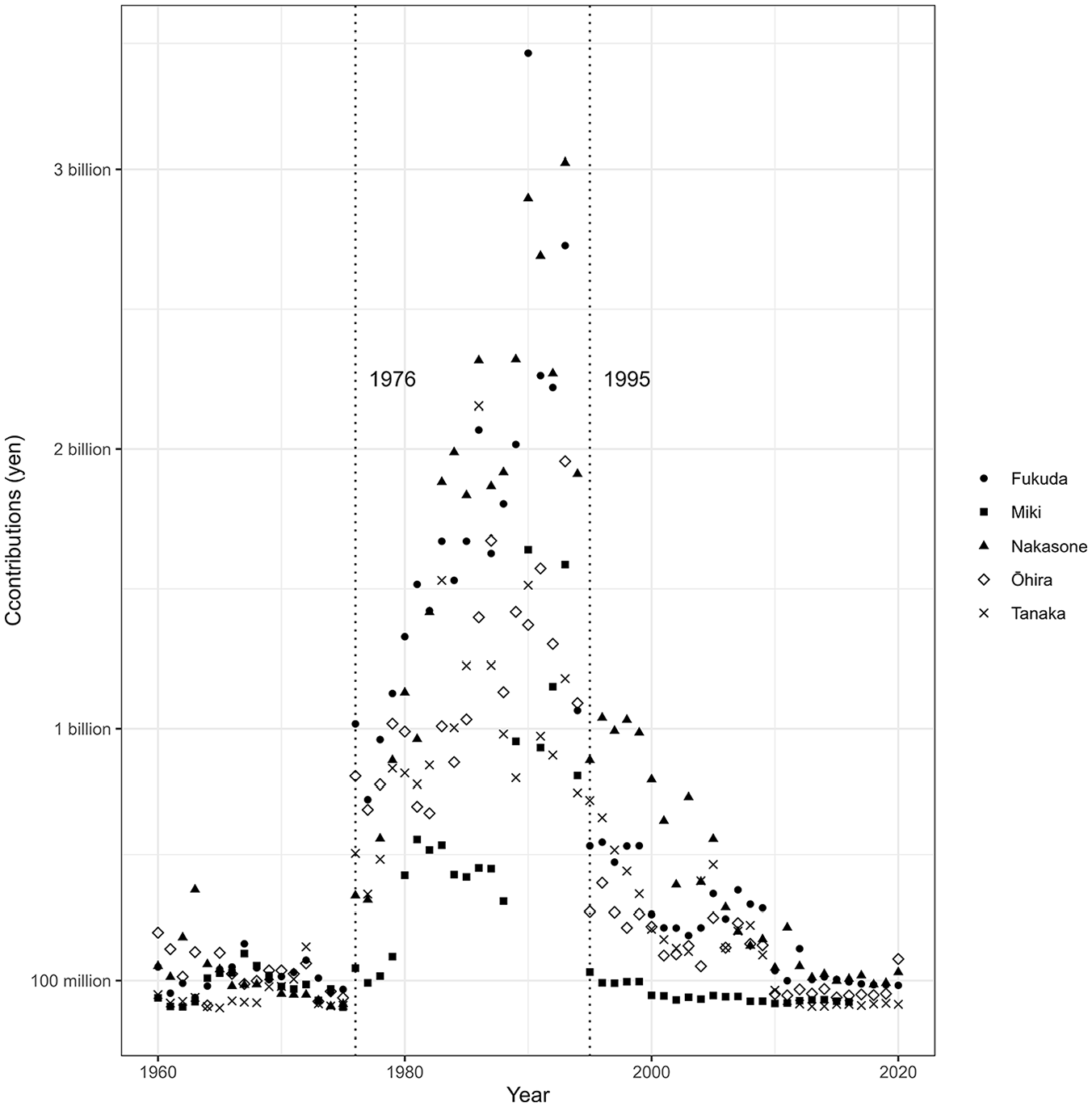
Contributions Raised by LDP Factions.
Figure 2 shows the total revenue reported by each faction prior to and after the 1975 and 1994 reforms. Overall, most factions raised more revenue in the 1980s compared to the 1970s. Besides raising more through contributions, they raised additional funds through such practices as holding fundraising parties, which generated income from ticket sales and additional contributions from attendees. The 1994 reforms included a new election system, party subsidy system, and new campaign finance regulations. The reforms in general weakened the power of LDP factions. After the 1994 reforms, the total revenue reported by LDP factions decreased considerably compared to the period before.
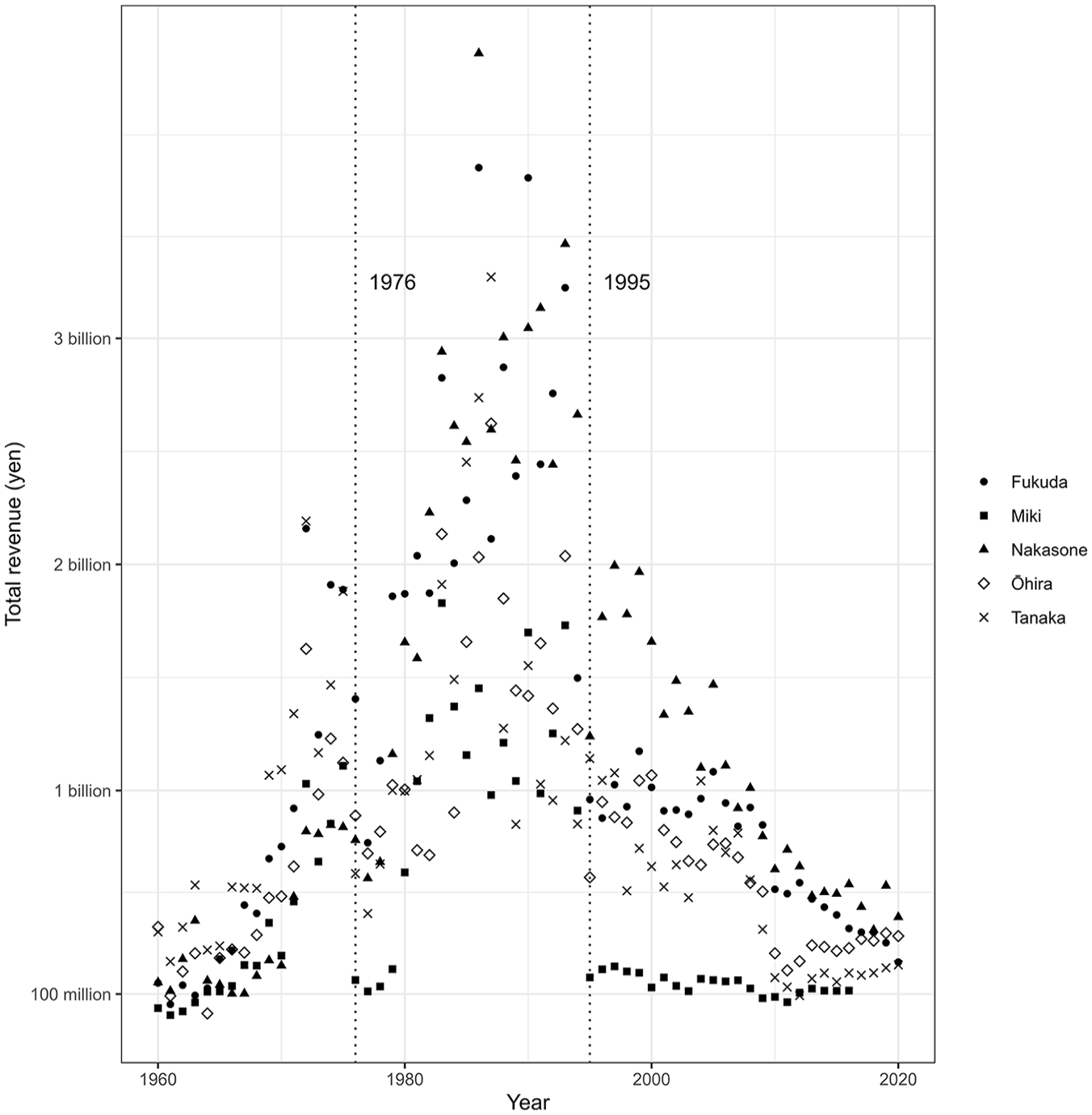
Total Revenue Reported by LDP Factions.
In Figure 3, we have summed the total amounts of reported contributions and revenue for all five major LDP factions and include the amounts reported by the main LDP party headquarters. One of the intended goals of some reformers was to strengthen political parties and weaken the power of factions. The LDP headquarters generally raised more contributions and revenue than the combined totals for the five factions. Like most factions, the LDP headquarters struggled to collect funds right after the 1975 reform. In subsequent years, it has raised considerably more funds than the factions. The advent of the party subsidy from 1995 greatly benefited the LDP headquarters. Following the 1994 reforms, however, the headquarters has struggled to collect contributions.
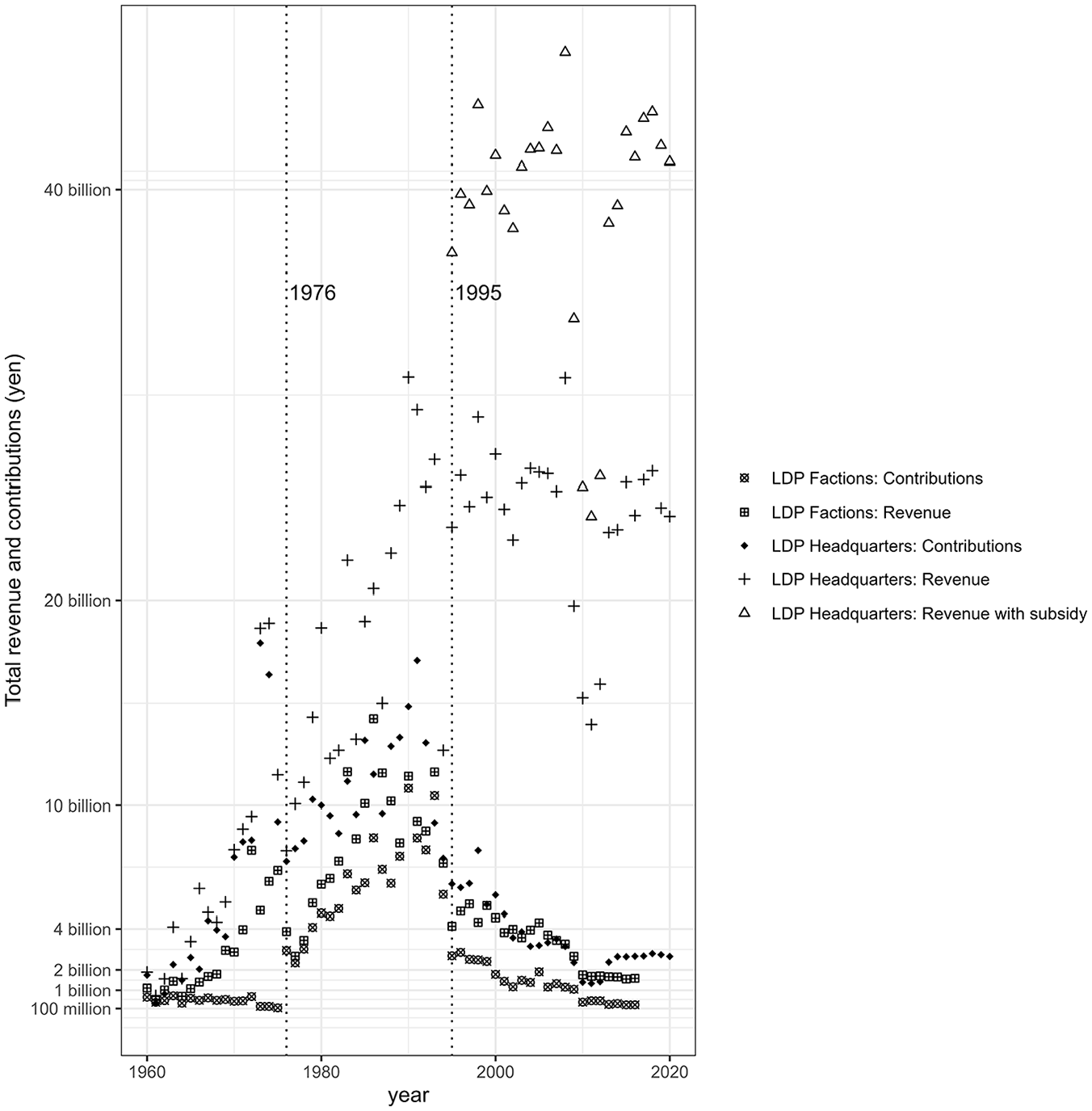
LDP Factions Versus LDP Party Headquarters.
Assessing the Relative Impact of Reform on Factions
To examine the relative impact of the reforms on major factions, we use fixed effects models that control for faction fixed effects. The fixed effects models allow us to control for omitted variables related to faction characteristics that do not vary over time (Gelman and Hill, 2007). As we are interested in evaluating the relative impact of reform, a central part of the analysis focuses on whether there is an effect for the interaction term between the faction controls and the intervention period, which represents the years after the 1975 or 1994 reform. The coefficient of the interaction term helps capture the relative impacts of the reforms on factions against the benchmark we use, the Tanaka faction. We use the 1966–1986 sample period as the window for the 1975 reform and 1985–2005 for 1994—10 years before and after each reform for a total of 21 years. 4
To estimate possible heterogeneous impacts on factions, it is important for the treatment and control groups to demonstrate parallel trends. The factions in our analysis demonstrate parallel patterns before the intervention years, 1976 when the 1975 reforms were enacted and 1995 in the case of the 1994 reforms as shown in Figures 1 and 2. Even if the reforms affected the quality of disclosure, the changes applied to all factions equally and did not favor or restrict one faction over another.
Our analysis begins, as a benchmark, by testing whether the reforms had a significant impact on the collection of funds by factions using the following fixed effects models:


The dependent variable (
Economic growth and inflation should influence the revenues raised by factions. We thus control for nominal gross domestic product, which counts both growth and inflation, using a logarithmic term.
5
The presence of elections will also affect revenue. LDP election is a measure that takes the value of 1 if the presidential election of the LDP was conducted in year
We also include one additional control to account for the initial impact of the Lockheed scandal for the analysis of the 1975 reform. The Lockheed scandal became public in 1976 and led to the arrest of Tanaka Kakuei, when it was discovered that Tanaka accepted bribes from the airplane manufacturer. To control for some of the possible effects of the scandal, the dummy variable Lockheed takes the value 1 if the year is 1976 or 1977. 8
Lastly, μi is dummy variable of faction i to control for faction fixed effects.
Our aim is to evaluate whether the reforms have heterogeneous effects on factions using the following fixed effects models:
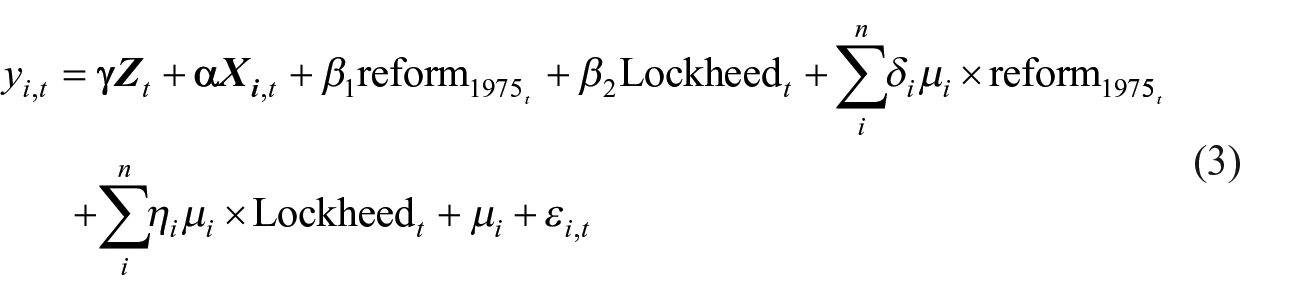

Also in this model, µi is dummy variable of faction
Analysis of the 1975 Reforms
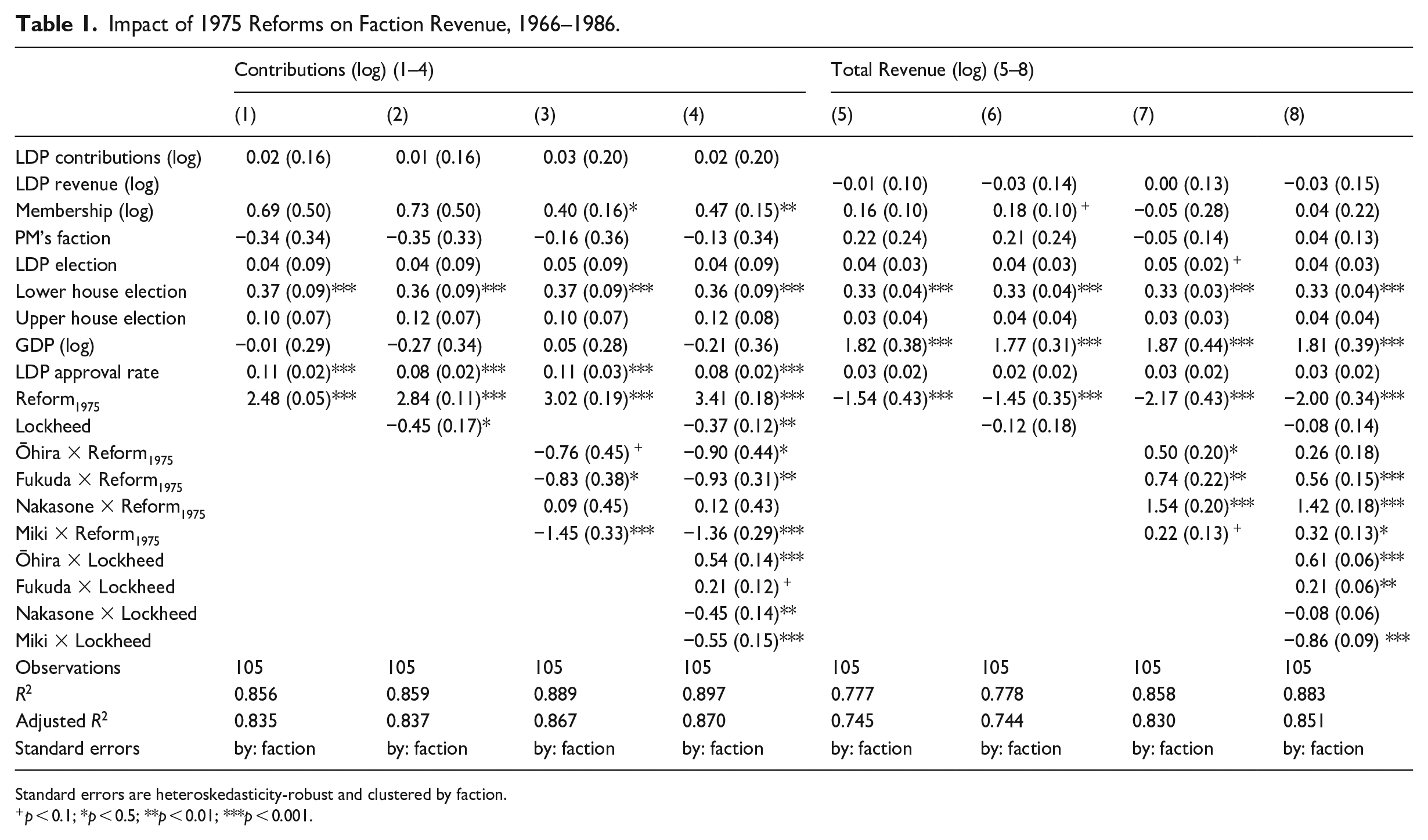
We first examine the common impact of the 1975 reform on the contributions and total revenue raised by the five LDP factions. In Table 1, Models 1 to 4 report the results for contributions. Model 1 shows that the coefficient for
Impact of 1975 Reforms on Faction Revenue, 1966–1986.
Standard errors are heteroskedasticity-robust and clustered by faction.
p < 0.1; *p < 0.5; **p < 0.01; ***p < 0.001.
Models 5 and 6 present the results for total revenues, which includes contributions and all other additional sources of revenue.
11
In both models, the reform intervention dummy
Models 7 and 8 allow us to assess the relative impact of the reform. The coefficients for
Model 8 adds measures for the Lockheed scandal. Controlling for Lockheed, the coefficients of the interaction terms between the faction dummy variable and the reform intervention dummy variable
The 1975 reforms were implemented by the Miki government in response to the corruption and scandals linked to Tanaka Kakuei. By tightening the regulations concerning contributions, the Miki reforms made it more difficult for the largest faction in the immediate period after reform. We might classify the 1975 reforms as a new deal institution since they made it more difficult for the largest faction.
Because the 1975 reforms and the Lockheed scandal both affected the Tanaka faction at the same time, it is difficult to disentangle the effects with certainty. We used controls to capture some of the short-term impact of the Lockheed scandal in Models 2, 4, 6, and 8. The long-term effects of the Lockheed scandal are more difficult to capture since the legal trial lasted for more than a decade.
Analysis of the 1994 Reforms
Unlike the 1975 reforms, the 1994 reforms involve the adoption of a new election system, a subsidy system for parties, as well as changes to Japan’s main campaign finance law. The use of single-member districts and closed list PR reduced the amounts of intraparty competition faced within the LDP while the subsidy and campaign finance reforms increased the flow of funds toward parties and made it more difficult to collect funds from corporations and other industry groups. Cox et al. (1999) argue that the electoral reform diminished factional control over nominations and that factions do not aid their followers’ campaigns as before. Although they do not examine the finances associated with factions, the evidence presented in Figures 1 and 2 shows that contributions and total revenue for factions decreased in the period after reform compared to before.
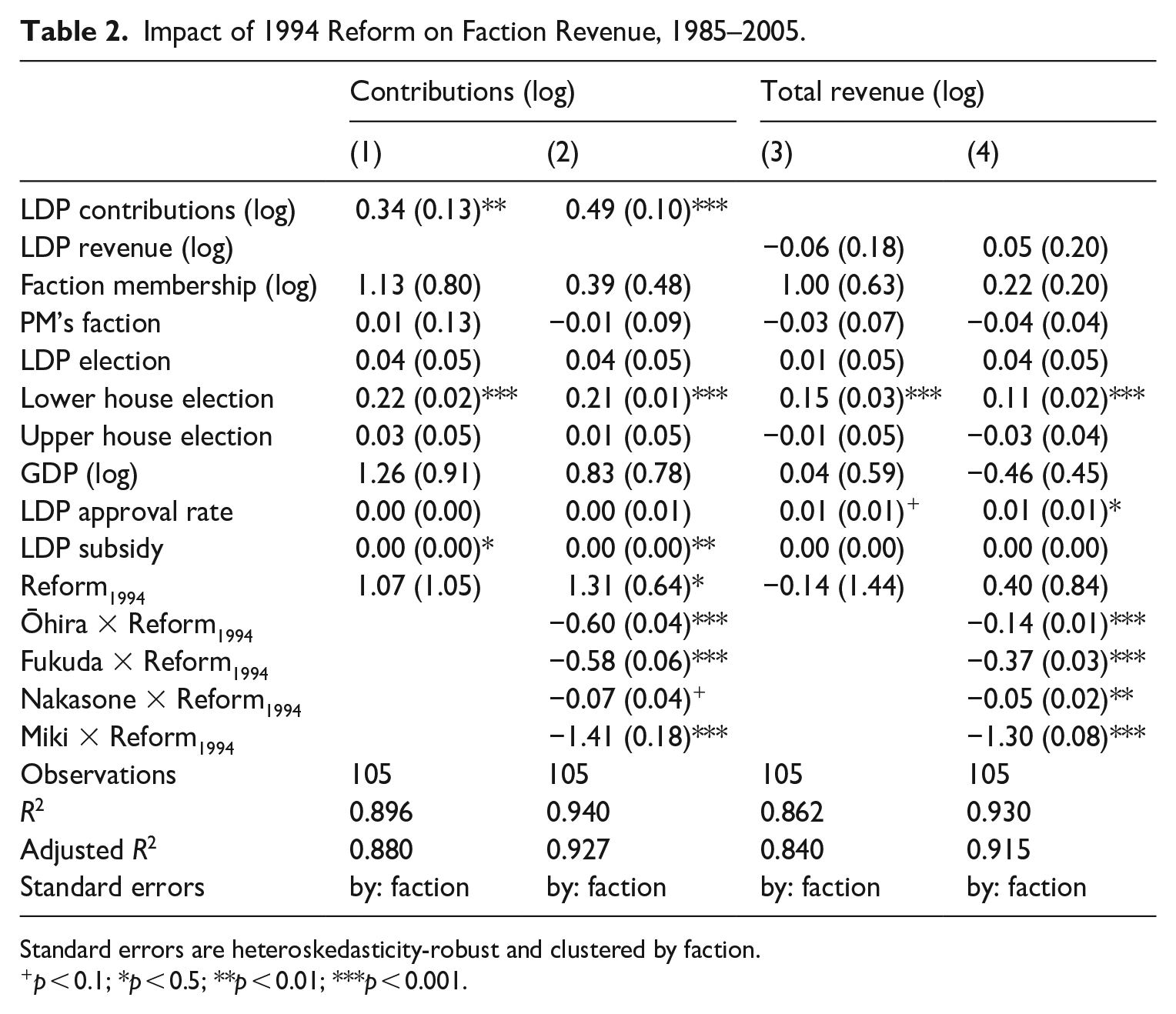
In Table 2, we examine the impact of the 1994 reform on the contributions and total revenue collected by factions using the sample period from 1985 to 2005. The results for contributions are reported first in Models 1 and 2. In Model 1, the coefficient of the reform dummy,
Impact of 1994 Reform on Faction Revenue, 1985–2005.
Standard errors are heteroskedasticity-robust and clustered by faction.
p < 0.1; *p < 0.5; **p < 0.01; ***p < 0.001.
Models 3 and 4 present the results for total revenue. The coefficient of
After Tanaka’s death in 1993, the Tanaka faction produced three prime ministers during the sample period we examined: Takeshita Noboru (1987–1989), Hashimoto Ryūtarō (1996–1998), and Obuchi Keizō (1998–1900). The strong performance of the Tanaka faction in the sample period before and after the 1994 reforms reflects the strengths of these leaders in collecting funds compared to the leaders of other LDP factions after controlling for periods when they were in office using the prime minister’s faction dummy variable. Although Takeshita and Hashimoto were involved in some political scandals, neither appeared to damage the ability of the Tanaka faction to collect funds.
Conclusion
The key architect of the 1975 reforms was former Prime Minister Miki Takeo, who was determined to strengthen the campaign finance system even if he had to compromise on the specifics of the reform. Miki was driven not only by normative goals to clean up Japanese politics but also likely had strategic motivations for introducing stricter rules regarding contributions. His smaller faction might incur relative advantages over its main rival, the Tanaka faction. The Tanaka faction was legendary for raising large sums of funds from legal and illegal sources. By strengthening disclosure rules and placing quantitative restrictions on different types of contributions, Miki may have hoped that larger factions such as Tanaka would struggle to raise funds while smaller and cleaner factions will have less difficulty in transitioning to the new campaign finance regime.
We have previously examined how Japan’s political reforms favored opposition parties over the LDP in terms of collecting funds but did not examine the factionalized nature of the LDP (Carlson and Nakabayashi, 2023). Factions in this party have played a dominant role in selecting the prime minister, allocating cabinet and party posts, and bankrolling and endorsing candidates in parliament. The research conducted here examined the relative impacts of the 1975 and 1994 reforms on the LDP’s five most important factions. In the case of the 1975 reforms, the Nakasone faction was the strongest and the Fukuda faction was the second strongest relative winners in collecting total revenue. The Tanaka faction struggled compared to its major intraparty rivals. We interpret these results as being related to the stricter regulations, Miki’s efforts to target the Tanaka faction, as well as the emergence of the Lockheed scandal and Tanaka’s arrest in 1976. By strengthening disclosure and adding quantitative restrictions on contributions, the Miki government helped weaken the Tanaka faction relative to the other four major factions. The analysis we conducted suggests that Miki was partially successful in achieving some of his normative and strategic goals. The 1975 reform was an important redistributive institutional change that created winners and losers in terms of raising funds.
The 1994 reforms were also important in our analysis. The Hosokawa coalition government initiated the 1994 reforms even though it had to compromise with the LDP on the specifics. These reforms helped reduce intraparty competition, which had helped sustain factions as well as the expensive costs of politics. The revisions of the PFCL also made it more difficult for factions to collect contributions. The analysis of relative differences revealed that the Tanaka faction did the best among the factions in collecting revenues. In that sense, the 1994 reform was consolidating. However, it is also important to note that our measure for common impacts of the 1994 reform on across factions was not statistically significant, suggesting that there is no discernible common difference as far as funds in the period before or after reform. More research is needed to explain why the Tanaka faction did the best.
The 1994 reforms importantly reduced intraparty competition, which helped sustain factions as well as the expensive costs of politics. The revisions of the PFCL also made it more difficult for factions to collect contributions. The analysis of relative differences revealed that the Tanaka faction did the best among the factions in collecting revenues. In that sense, the 1994 reform was a consolidating institution, as the largest LDP faction improved its position for the sample period we examined. After the 1994 reforms, we also noted that factions have struggled to raise contributions and other sources of funds. We view these results as being consistent with claims that factions are no longer as powerful in Japanese politics as they were in the past (Cox et al., 1999). The decline in financial power across all factions also seems consistent with some of the stated goals of reformers to weaken the power of factions in favor of political parties (Curtis, 1999; Krauss and Pekkanen, 2011).
The case of Japan is instructive because scholars have lamented the lack of serious investigation into why major political reform efforts are attempted as well as detailed knowledge about their political consequences. These sorts of study are relevant to former or current dominant party systems which may have factionalized parties, but also to studies of major political reform efforts in established or establishing democracies. There is considerable agreement that major reforms often fail to achieve some of their objectives and that reforms often usher in many unintended consequences (Clift and Fisher, 2005; Schaffer, 2008). In dominant party systems such as Japan, we expected and uncovered evidence that major campaign finance and political reforms had heterogeneous effects on different factions within the ruling party.
Research on Japan’s history with major political and campaign finance reforms is also valuable for considering how to understand or predict the winners and losers of other major reform projects. Determining the consequences of any major reform project is challenging because the advent of new regulations can redistribute power and create winners and losers in often unpredictable ways. Campaign finance and other political reforms have redistributive consequences when they improve the position of one group over another. When potentially redistributive reforms are debated or passed, groups may resist or support such reforms depending on their belief about whether the reforms will be advantageous or not to their own position. Redistributive institutional changes stand in contrast to efficient institutional changes that do not hurt the condition of any individuals or groups in a society. If reform affects everyone equally, there is little resistance to institutional change. These distinctions affect whether and how reforms are implemented, but also shape their political consequences for different actors. The relative impacts of reform can powerfully shape interparty as well as intraparty politics, public perceptions of how politics works, and the selection of political leaders. The relative impact of reform also has important implications for the regulation of political finance, political corruption, and for preventing abuses in the democratic process.
Footnotes
Appendix 1
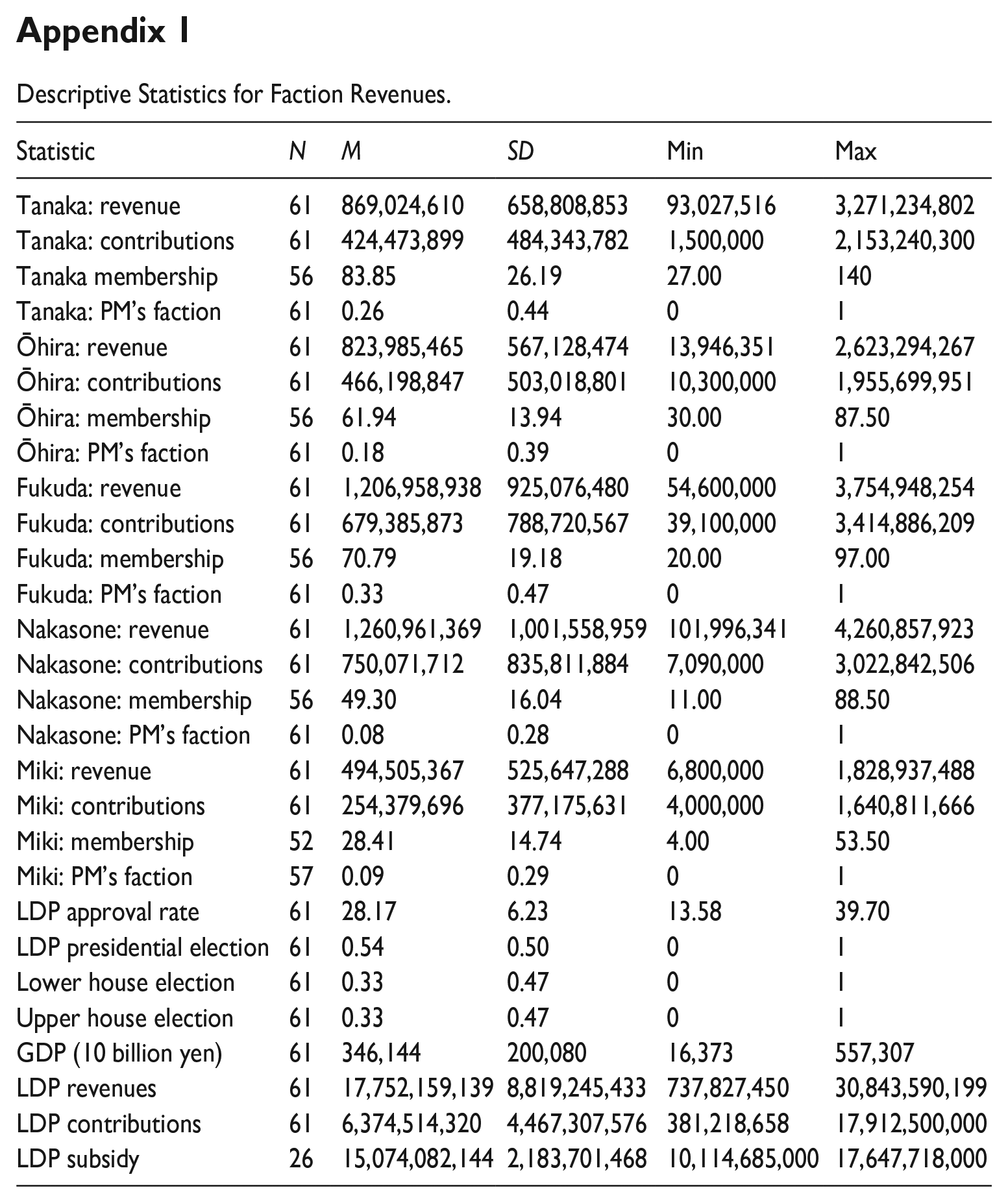
Descriptive Statistics for Faction Revenues.
| Statistic | N | M | SD | Min | Max |
|---|---|---|---|---|---|
| Tanaka: revenue | 61 | 869,024,610 | 658,808,853 | 93,027,516 | 3,271,234,802 |
| Tanaka: contributions | 61 | 424,473,899 | 484,343,782 | 1,500,000 | 2,153,240,300 |
| Tanaka membership | 56 | 83.85 | 26.19 | 27.00 | 140 |
| Tanaka: PM’s faction | 61 | 0.26 | 0.44 | 0 | 1 |
| Ōhira: revenue | 61 | 823,985,465 | 567,128,474 | 13,946,351 | 2,623,294,267 |
| Ōhira: contributions | 61 | 466,198,847 | 503,018,801 | 10,300,000 | 1,955,699,951 |
| Ōhira: membership | 56 | 61.94 | 13.94 | 30.00 | 87.50 |
| Ōhira: PM’s faction | 61 | 0.18 | 0.39 | 0 | 1 |
| Fukuda: revenue | 61 | 1,206,958,938 | 925,076,480 | 54,600,000 | 3,754,948,254 |
| Fukuda: contributions | 61 | 679,385,873 | 788,720,567 | 39,100,000 | 3,414,886,209 |
| Fukuda: membership | 56 | 70.79 | 19.18 | 20.00 | 97.00 |
| Fukuda: PM’s faction | 61 | 0.33 | 0.47 | 0 | 1 |
| Nakasone: revenue | 61 | 1,260,961,369 | 1,001,558,959 | 101,996,341 | 4,260,857,923 |
| Nakasone: contributions | 61 | 750,071,712 | 835,811,884 | 7,090,000 | 3,022,842,506 |
| Nakasone: membership | 56 | 49.30 | 16.04 | 11.00 | 88.50 |
| Nakasone: PM’s faction | 61 | 0.08 | 0.28 | 0 | 1 |
| Miki: revenue | 61 | 494,505,367 | 525,647,288 | 6,800,000 | 1,828,937,488 |
| Miki: contributions | 61 | 254,379,696 | 377,175,631 | 4,000,000 | 1,640,811,666 |
| Miki: membership | 52 | 28.41 | 14.74 | 4.00 | 53.50 |
| Miki: PM’s faction | 57 | 0.09 | 0.29 | 0 | 1 |
| LDP approval rate | 61 | 28.17 | 6.23 | 13.58 | 39.70 |
| LDP presidential election | 61 | 0.54 | 0.50 | 0 | 1 |
| Lower house election | 61 | 0.33 | 0.47 | 0 | 1 |
| Upper house election | 61 | 0.33 | 0.47 | 0 | 1 |
| GDP (10 billion yen) | 61 | 346,144 | 200,080 | 16,373 | 557,307 |
| LDP revenues | 61 | 17,752,159,139 | 8,819,245,433 | 737,827,450 | 30,843,590,199 |
| LDP contributions | 61 | 6,374,514,320 | 4,467,307,576 | 381,218,658 | 17,912,500,000 |
| LDP subsidy | 26 | 15,074,082,144 | 2,183,701,468 | 10,114,685,000 | 17,647,718,000 |
Acknowledgements
The authors thank Kenneth M. McEwain, Kaoru Iokibe, Naofumi Nakamura, and other participants of the Japan History Group Workshop at the Institute of Social Science, The University of Tokyo, and Bilyana Petrova and others from the 2023 Midwest Political Science Association Conference for comments on earlier drafts. The authors also thank Akiho Hayase for her research assistance.
Declaration of conflicting interests
The author(s) declared no potential conflicts of interest with respect to the research, authorship, and/or publication of this article.
Funding
The author(s) disclosed receipt of the following financial support for the research, authorship, and/or publication of this article: This research was supported by the Mitsubishi Foundation (202020020) and the Institute of Social Science, The University of Tokyo.
