




Abstract
The COVID-19 pandemic has reinvigorated debates about the drivers of political trust. Research so far has mainly focused on national-level institutions, during the early stages of the pandemic and using data from established democracies. However, how does this relationship look like if we pay attention to subnational institutions in non-consolidated democracies, and further away from the initial COVID-19 outbreak? To contribute to this line of research, this article focuses on the local level and explores the association between individuals’ satisfaction with COVID-19 performance and political trust in Nepal. For that, it uses novel data collected via telephone interviews (N = 1400) conducted between 25 April and 24 May 2021, during the second wave of COVID-19. Our main results reveal that satisfaction with local institutions’ COVID-related performance is significantly and robustly associated with levels of political trust at the local level. The association holds even when geographical and time specifications are added, trust towards national institutions or expectations about local governments are included in the analysis and the dependent variable is disaggregated to discard measurement biases. The study thereby provides important insights into the role performance plays for institutional trust beyond the national level and in an unconsolidated democracy.
Introduction
Throughout the world, governments have struggled with responding to the COVID-19 pandemic, seeing themselves forced to implement unpopular measures such as lockdowns or social distancing. As the health crisis had a massive impact on people’s lives and required large-scale and often drastic government measures, it offers an exceptional opportunity to investigate the link between government performance and trust, a key question in political science research. The virus kept the world in suspense and many government measures substantially impacted on people’s lives, which facilitated a high awareness of the situation, increasing in turn the odds that people will have formed an opinion on how satisfied they are with the response (i.e. that people truly assess how governments performed in this situation, rather than using heuristics).
While political trust has been used successfully to explain compliance with anti-corona measures, the effects of the COVID-19 pandemic on political trust are still under discussion (Devine et al., 2021). This growing field has produced valuable insights, but studies so far focus almost exclusively on the national level, although, in many countries, subnational government units played an important role in designing and implementing government responses (Dutta and Fischer, 2020; Hirschfeld and Thielsch, 2022). Furthermore, most studies analyse levels of trust in Western democracies following the early stages of the pandemic (see for example Bol et al., 2020; Kritzinger et al., 2021; Schraff, 2020).
Our study uses the COVID pandemic as an exceptional opportunity to contribute to research on political trust by leveraging on the relevance of government action amid this situation of crisis. In doing so, we go beyond previous research by looking at (1) the role the pandemic played for political trust in local governments; (2) analysing the relationship during the second wave of the pandemic, when citizens’ have had time to know and assess government performance; and (3) investigating this link in the emerging democracy of Nepal.
Drawing upon novel data from an original phone survey conducted with 1400 respondents in Nepal, our analysis shows that satisfaction with local institutions’ COVID-related performance is significantly and robustly associated with higher levels of political trust at the local level. The association holds even when geographical and time specifications are added, trust towards national institutions or expectations about local governments are included in the analysis and the dependent variable is disaggregated to discard measurement biases.
The article is structured as follows: after the introduction, we discuss the current state of research and our theoretical expectations that we derive from the literature. The ‘Research Design’ section introduces the research design including case selection, data generation and methodology before we present the analysis and results in the ‘Results’ section. Implications and limitations of the article are discussed in the final section of the article, paying special attention to how we deal with issues of endogeneity and reversed causality.
Crises, Performance and Political Trust at the Local Level
Political trust, broadly defined as ‘a basic evaluative orientation toward the government’ (Hetherington, 1998: 791), is crucial for democracies insofar as it affects several important aspects such as participation, compliance and cooperation (Levi and Stoker, 2000). Accordingly, it is not surprising that a large strand of research has been historically devoted to understanding political (dis)trust (see, for example, Citrin and Stoker, 2018; Zmerli and van der Meer, 2017).
Research on the effects of natural disasters has provided relevant insights into the performance–trust relationship by suggesting that extreme events can alter trust levels both positively and negatively. Hurricane Katrina in 2005 in the United States was found to have had negative effects on trust in the government (Nicholls and Picou, 2013), as did the 2011 earthquake and tsunami in Japan (Uslaner and Yamamura, 2016), and the 2010 Pakistan floods (Akbar and Aldrich, 2015). Others have identified disasters to increase political trust at the national level, including, for example, an earthquake in China in 2008 (Han et al., 2011), as well as wildfires in Russia (Lazarev et al., 2014). Similarly, several studies show that governments’ handling of natural disasters can impact voting behaviour (Bechtel and Hainmueller, 2011; Healy and Malhotra, 2009), and Carlin et al. (2014) found that the Chilean earthquake significantly impacted public opinion towards democracy. This suggests that how governments handle extreme events might be important to explain political trust.
The COVID-19 pandemic provides an exceptional possibility to further study the dynamics surrounding how an extreme event, in this case, a major health crisis, affects political trust. Two major strands of research have developed so far on political trust in the context of the pandemic (Devine et al., 2021). The first looks at how trust influences compliance with disease control measures and suggests that trust in the national government is important to explain citizens’ acceptance of and compliance with suggested measures (see, for example, Bargain and Ulugbek, 2020; Guglielmi et al., 2020; Han et al., 2021; Jørgensen, 2021; Raude et al., 2020 as well as a recent review of this literature by Devine et al., 2023). The second looks at the effect of the implementation of measures against the pandemic (especially social distancing and lockdowns) on trust, and it has provided quite some comparative evidence suggesting that levels of political trust increased at the beginning of the pandemic in several European countries (see, for example, Baekgaard et al., 2020; Belchior and Teixeira, 2021; Bol et al., 2020; Esaiasson et al., 2020; Kestilä-Kekkonen et al., 2022; Kritzinger et al., 2021; Schraff, 2020; Sibley et al., 2020; van der Meer et al., 2023). While some interpret this as a cognitive response of individuals positively assessing the performance of their governments (Esaiasson et al., 2020), others have interpreted it as an emotional response triggered by anxiety and uncertainty in times of crisis, the so-called ‘rally around the flag’ effect (Schraff, 2020). At the same time, first cross-country comparisons and longitudinal analyses suggest that this effect may wane relatively quickly over time or even be negative for those having suffered psychological distress due to the pandemic (Davies et al., 2021; Kim, 2022; Satherley et al., 2022).
In contrast to previous research on COVID-19, which almost exclusively aims to explain changes in trust towards national-level government, we are interested in the effects of the pandemic at the local level. In many federal systems, the local governmental level had wide-ranging competencies in the handling of the pandemic (Dutta and Fischer, 2020; Hirschfeld and Thielsch, 2022). Nevertheless, the local level has not received much attention so far. We were only able to identify two studies that explicitly aim to explain trust in local institutions amid the pandemic. First, Su et al. (2021) studied perceptions towards the local government in China during the beginning of the pandemic. Based on an online survey with 1692 participants, they found perceived preparedness to be associated with respondents evaluating the ‘performance of local authorities in dealing with the COVID-19’ as trustworthy. However, the study also leaves important questions open and yet to be addressed by future research – including longer-term effects, directly studying political trust and doing so in a decentralized, non-authoritarian context. Second, Hirschfeld and Thielsch (2022) analysed the effects of different strategies of crisis communication, based on an online survey experiment with manipulated newspaper articles that were presented to 561 German participants. They did not find different communication strategies to affect whether respondents accepted suggested behavioural measures, but they did alter trust in local politicians – in particular denying the pandemic had unfavourable consequences. While their findings suggest that how local politicians handle the pandemic impacts on citizens’ trust towards them, their study was built on fictional scenarios (including the mayors involved) and focused on the effect of different communication strategies rather than performance. Furthermore, while the two studies hold interesting insights, both were based on voluntary online surveys and neither directly addressed the question of how local governments’ handling of the pandemic impacted on trust. In sum, we conduct the to our knowledge first analysis of how local governments’ handling of the pandemic impacted on citizens’ trust towards them.
The fact that in several countries levels of trust reported towards the local level are significantly higher than those towards the national level suggests that there are important differences between the two (Muñoz, 2017). And Fitzgerald and Wolak (2016) suggest that there are important differences in what drives trust at different levels of government. However, research on political trust has only recently begun to take a closer look at the local level (Fitzgerald and Wolak, 2016; Proszowska et al., 2021; Steenvoorden and van der Meer, 2021). Crucially, an important difference between the two levels of government is that the local level regards much smaller political units, which are perceived as considerably closer by constituents (Muñoz, 2017). Thus, we think the relationship between performance and trust may differ between the local and national levels and will be particularly strong at the local level because the link between citizens and their government is more direct – there is a higher likelihood that citizens know their elected representatives personally, that citizens are more aware of local governments’ activities and hence better able to evaluate their performance. Indeed, existing research indicates that people can differentiate between government levels when assessing trust (Fitzgerald and Wolak, 2016) and that they transfer their trust assessments from those institutions they know better to make trust judgements on those entities they have less knowledge about (Theiss-Morse and Barton, 2017). In this regard, different studies suggest that trust towards local institutions may be more influential for trust towards national institutions than vice versa, contrary to perceptions of the local level as second order (Proszowska et al., 2021; van Assche and Dierickx, 2007).
The causal chain supporting the assumption that the cognitive assessment of the performance of political institutions informs trust is based on a series of consecutive steps. First, political trust is at least in part rational, to the extent to which it is determined by an evaluation of the government’s performance (Hardin, 1999). Second, individuals have to be aware of the measures implemented by governments (Hardin, 1999). Third, the measures have to be considered important enough so that they affect the evaluation of governments’ performance (Van Erkel and Van Der Meer, 2016).
We believe the context triggered by the COVID-19 pandemic benefits the odds that individuals evaluate the actual performance of the government. We expect evaluations of government measures to be particularly relevant in this context because the looming threat of the pandemic rendered measures implemented by governments of the highest importance and ultimately people’s lives depended on them. The suspensions of political and civil rights furthermore directly interfered with and affected people’s everyday lives substantially (Dodds et al., 2020). Furthermore, we can assume a strong awareness about government measures as, among others, the consumption of political news increased in this period (Casero-Ripolles, 2020). While we certainly do not claim all individuals were more informed about politics or that all information received reflected governments’ response in a reliable manner, the situation described is likely to favour that evaluations of performance contribute to explaining levels of political trust. In fact, literature indicates that crisis management is important to explain levels of political trust, also amid the COVID-19 crisis, and variables such as the quality of information provided, the strength of the response and the perception of the usefulness of measures have been found to predict higher levels of political trust amid the pandemic (see, for example, Crepaz and Arikan, 2021; Mansoor, 2021; Oude Groeniger et al., 2021). Overall, these factors render the pandemic an ideal showcase to study the relationship between performance and trust in a clearly delineated domain of high relevance to people’s everyday lives.
Thus, building on the idea that multilevel political systems allow for the existence of distinct responses to political challenges (Rozell and Wilcox, 2020), and considering literature that supports that individuals are able to isolate levels of government and assess their performance separately (Proszowska et al., 2021; Steenvoorden and van der Meer, 2021), we expect that:
H1. Individuals who are more satisfied with local government’s response to the COVID-19 crisis will display higher levels of political trust into local institutions.
Research Design
Case Selection: Nepal
Nepal constitutes an interesting case for our research on the effect of satisfaction with the COVID-19 response on political trust for three main reasons.
First, Nepal is still a relatively new democracy, having experienced a (second) democratic opening only recently, at the end of its civil war in 2006. Ever since, Nepal has been struggling with establishing well-functioning institutions and political stability. Political crises recurringly take place at the national level. This makes it particularly relevant to investigate how trust can be strengthened in such an emerging democracy where typically ‘legal and political institutions remain under-developed, and the quality of democratic governance is still precarious’ (Katz and Levin, 2018: 69). Research from other world regions, for example, suggests that political trust is lower and more volatile in newer democracies (Marien, 2011), and that there might be differences regarding which factors affect political trust (Catterberg and Moreno, 2005).
Second, the new constitution of Nepal, adopted in 2015, introduced federalism and local elections, strengthening the local government units (LGUs) (Government of Nepal, 2015). This institutional design allows us to exploit variations in government performance at the subnational level. LGUs are the lowest of three government units in Nepal – below the federal governments and seven provinces – and comprise 753 urban and rural municipalities. They are further divided into wards, which are the smallest administrative units in Nepal (Government of Nepal, 2015). The local governments are directly elected and responsible for basic health and sanitation as well as disaster management, with ‘the authority to direct resources to counteract imminent threats against the health of their inhabitants’ (Adhikari and Budhathoki, 2020: 961). Moreover, during the pandemic, the central government asked the LGUs to prepare quarantine and isolation facilities, which were quickly set up (Thapa, 2021). Local governments also disseminated information on the virus, oversaw testing, recording and lockdown provisions and provided food relief among other activities (Bhandari et al., 2020; Thapa, 2021). Overall, the LGUs hence played a key role during the COVID-19 pandemic, making it worthwhile to investigate whether their performance affected citizens’ trust in them. Moreover, the fact that the local governments have only been recently established reduces the risk that preconceptions influence trust levels, thereby increasing the plausibility of our assumed relationship, namely that satisfaction with performance influences trust, instead of preconceived institution trust levels driving perceptions of performance.
Finally, Nepal was strongly affected by the pandemic. While the COVID-19 pandemic was initially contained in Nepal, partially due to the strict nationwide lockdown imposed from 24 March to 21 July 2020 (Lamichhane et al., 2022), its lifting as well as border openings – in particular to highly affected India –led to increasing numbers. Especially in mid-April 2021, the infection numbers starkly increased, most dramatically in the metropolitan area of Kathmandu, so that, by August 2021, Nepal had become one of the most affected developing countries worldwide (Lamichhane et al., 2022). We expect this situation will increase the relevance of the health crisis among the population, thus facilitating the performance-trust link detailed in the section above.
Data
We study the effects of the local governments’ COVID response based on a large-N survey consisting of 1400 telephone interviews, 1 conducted between 25 April and 24 May 2021 (during the second wave of the pandemic). The target group of Nepalese adults was selected in a three-step sampling strategy. First, we purposively selected four out of the seven Nepalese provinces, to include areas that are (A) more and less likely to be affected by the pandemic based on population density as well as their proximity with India (which was deeply affected by the pandemic at the moment), (B) more and less remote, (C) populated by different identity groups 2 as well as (D) marked by different levels of violence during the civil war. 3 Combining these criteria led us to select provinces 2, 3, 5 and 6 (see Table 1).
Selection Criteria for Sampling.
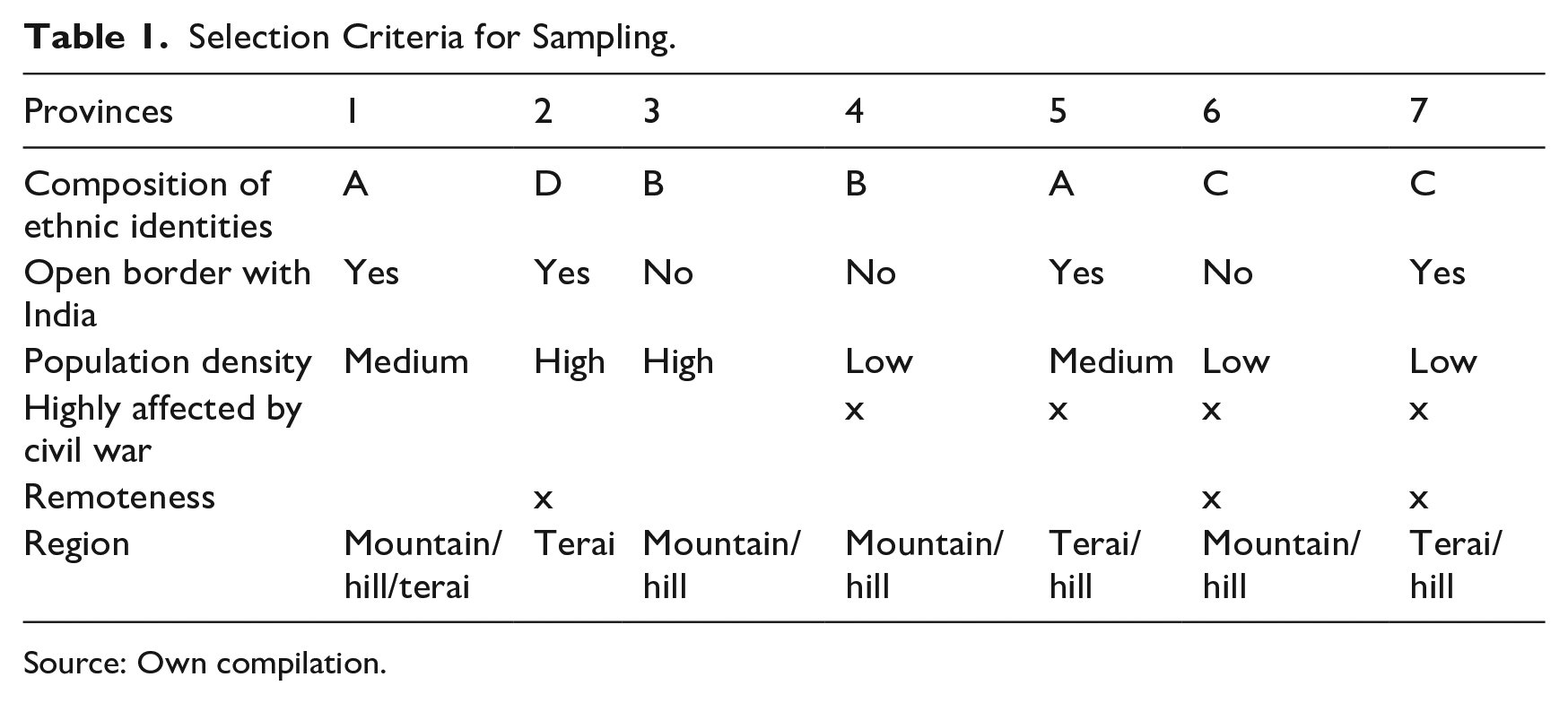
Source: Own compilation.
Second, within the four provinces, we randomly selected 68 LGUs. Because the provinces differ considerably regarding the number and types of LGUs, we first allocated LGUs proportionally to the number of LGUs per province (about 17% of the number of LGUs in 1 province). We then selected different types of LGUs (rural, urban and major cities) proportionally to the share of the population living in different types of LGUs. Due to its large population, Kathmandu was selected three times. Finally, within each LGU, 4 wards were randomly chosen (in Kathmandu 12 were selected to account for its demographic weight in the country).
In the last step, random walks were used to identify households and individual respondents using the ‘last birthday’ method. Respondents were asked to provide phone numbers for conducting the interviews at a later stage. Because some mountainous areas of Nepal are very difficult to reach and struggle with phone connectivity, a limited number of LGUs needed to be excluded before the random selection. 4 Since only 7% of Nepal’s population lives in the mountain region, we consider this justifiable.
The survey is representative at the provincial level regarding gender, age, urban/rural municipalities and ethnic identity based on the 2011 national population census (Nepal Government, 2012). The high penetration of mobile phones in Nepal (on average 1.3 per person) allows to reach most of the population via phone (see https://nta.gov.np/en/mis-reports/#). Questions were asked in Nepali, and in Maithili, which is the second most widely spoken language in Nepal and particularly prominent in the Terai region in which two of our four selected provinces are located.
It is important to note that since the phone survey was conducted during the pandemic, ethical implications were carefully considered. First, to prevent contributing to the spread of COVID-19, interviews were conducted via telephone instead of face-to-face. Second, the collection of the phone numbers through a listing exercise took place in March at a time when infection rates were very low and only required a very short face-to-face interaction. Moreover, the survey firm ensured strict health measures to protect interviewers and respondents during the listing exercise. Third, pressure to participate was minimized by restating at the start of each interview that participation in the survey was voluntary and participants could quit at any time. Finally, respondents received no incentives for participation.
To capture trust at the local level (dependent variable), we used the average of three questions asking respondents about their trust levels in the ward, mayor and deputy mayor (Cronbach’s alpha = 0.85). To measure our key independent variable, the perception of COVID response, we used the following question: How satisfied are you with how the elected officials in the current local government handled the COVID-19 pandemic in the past year? (Responses ranging between 1, very much, and 4, not much; the scale was inverted so that higher values represent higher levels of satisfaction). Overall, satisfaction is at a medium-low level, with 22% indicating very high, 17% high, 45% low and 17% very low satisfaction. The question on satisfaction with the handling of the crisis was asked first in the survey (though not immediately before the question regarding trust). Given the literature on question-order effects, this should increase the chances that performance perceptions did influence answers on trust levels (Schuman and Presser, 1996). 5
We also included different controls in the analysis to make sure reported coefficients are not statistical artefacts due to omitted variable bias. 6 We controlled for self-reported ‘Interest in politics’ (measured on a 4-point Likert-type scale from low to high) and perception of corruption using a question that asks respondents to compare corruption under the current and previous (appointed) government (1 if respondents considered corruption to have stayed the same or being higher than before and 0 otherwise). We also controlled for trust towards national government (from 1, fully, to 4, not at all; scale inverted in the analysis so that higher values represent higher levels of trust), social trust (Generally speaking, would you say that most people can be trusted? Responses ranging from 1, trust fully, to 4, cannot be too careful; scale inverted in the analysis) and incumbent vote in the past local elections (identifying those who voted for the party of the major in each LGU included in the analysis). Finally, we included controls for gender, age, education, ethnicity, rural/urban living area and possession of a smartphone (Theiss-Morse and Barton, 2017).
At the LGU level, we controlled for ethnic fractionalisation, since, similarly to ethnicity, the degree of ethnic fractionalisation might also determine whether policies and institutions are perceived as exclusionary and hence less responsive. We measure ethnic fractionalisation based on the latest census (2011), using the ethnic fractionalization index suggested by Alesina et al. (2003). We also controlled for potential effects associated with the legacies of violence by using data on casualties during the Civil War that took place between 1996 and 2006. Data are taken from Do and Iyer (2010). We also included controls for gross domestic product (GDP) per capita at the district level using data from nepalindata.org as well as the death and infection rate of COVID-19 in each LGU, using figures per 100,000 inhabitants. Descriptive statistics are included in the Online Appendix (Table OA.1).
In parallel to the collection of survey data and in the context of a broader research project, qualitative interviews were conducted in April and May 2021 with national and international experts in Kathmandu, including civil society organizations, politicians and journalists. While we do not adhere to a strict mixed methods design, we believe including these interviews is helpful as integrating findings from different methods can help strengthen confidence in our results (Johnson et al., 2007). In this sense, the interviews serve as a plausibility check for our hypothesized relationship, by investigating whether experts name the COVID response as an important factor for the trust relationship at the local level. 7 All interviews were transcribed, subsequently coded and analysed using Atlas.ti.
Methods
Given the continuous nature of our measure of political trust, we employ ordinary least squares (OLS) regression methods in the analyses. Since a large part of the variation (60%) occurs within units (as opposed to between units), and due to our interest in relationships that happen at the level of the individuals, we focus our interpretation on LGU-fixed effects models that include clustered standard errors at the local unit level (i.e. we account for the clustered nature of our data and consider local variation as a control). However, we also included multilevel regression models because we aim to generalize results to other local units not considered in the sample, to test the association between LGU-level variables and trust towards local institutions (i.e. to try to unpack the variation that is absorbed by the dummy variable in the fixed-effects model), and as a robustness check for the association scrutinized (Bell and Jones, 2015; Clark and Linzer, 2015; McNeish and Kelley, 2019; Möhring, 2012). Satisfaction with local governments’ COVID-19 response remains a powerful predictor of political trust in all the analyses conducted.
Results
The findings presented in Table 2 indicate that more satisfaction with the performance of local governments amid the COVID-19 crisis is associated with higher levels of political trust towards local institutions. The effect is significant when only the key independent variable is included in the analysis, and its importance remains once controls are added. A visual representation of the effects of three key variables to explain trust towards local-level institutions can be seen in Figure 1.
OLS Regression Results With LGU-Fixed Effects and Clustered Standard Errors. Trust Towards Local Level Institutions as Dependent Variable.
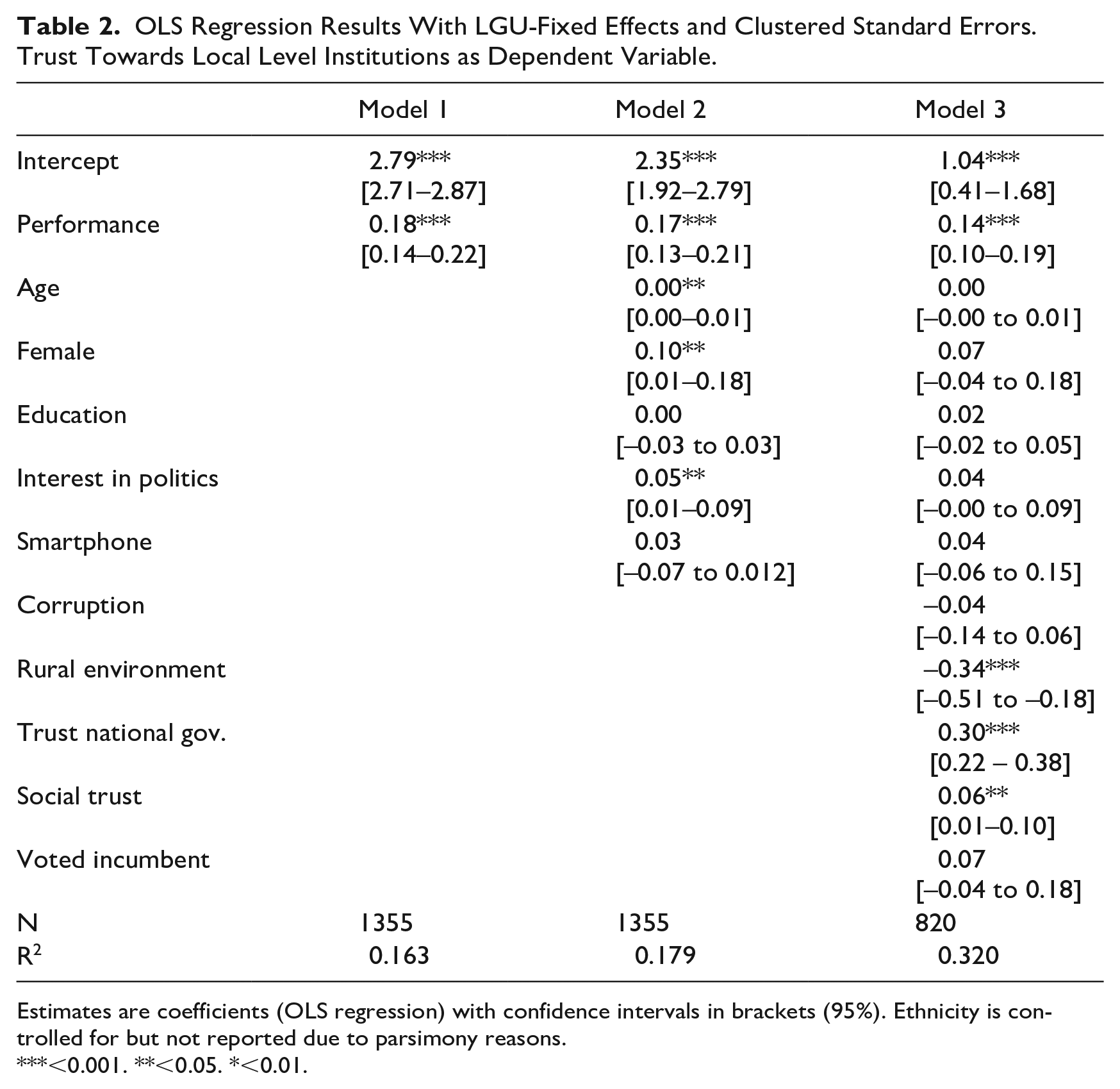
Estimates are coefficients (OLS regression) with confidence intervals in brackets (95%). Ethnicity is controlled for but not reported due to parsimony reasons.
<0.001. **<0.05. *<0.01.
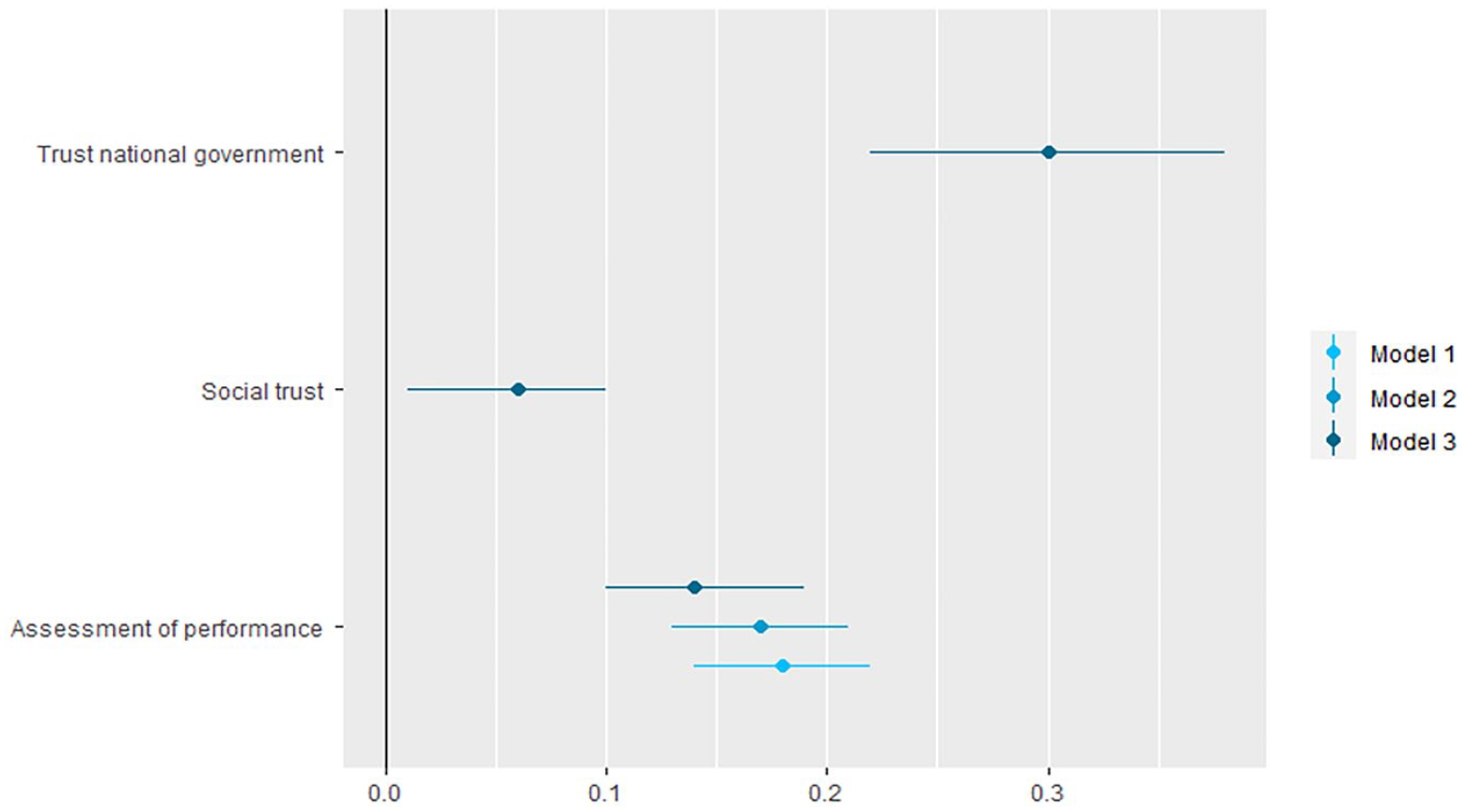
Visual Representation of the Effects of Trust Towards National Government, Social Trust and Assessment of Performance on Local Level Political Trust.
The results included in Table 3 are the outcome of a multilevel regression analysis that includes all individual-level variables considered in the fixed-effects model and adds LGU levels of ethnic fractionalization, GDP per capita, civil war casualties and COVID-19 death as well as infection rates during the first wave. The results again show a significant positive connection between satisfaction with the performance of local institutions and local-level political trust. As for the individual-level controls, social trust and trust towards national-level institutions maintain their significant effect. Furthermore, those who voted for the party of the LGU major also declare on average higher levels of political trust towards local level institutions.
Multilevel Regression Results. Trust Towards Local Level Institutions as Dependent Variable.
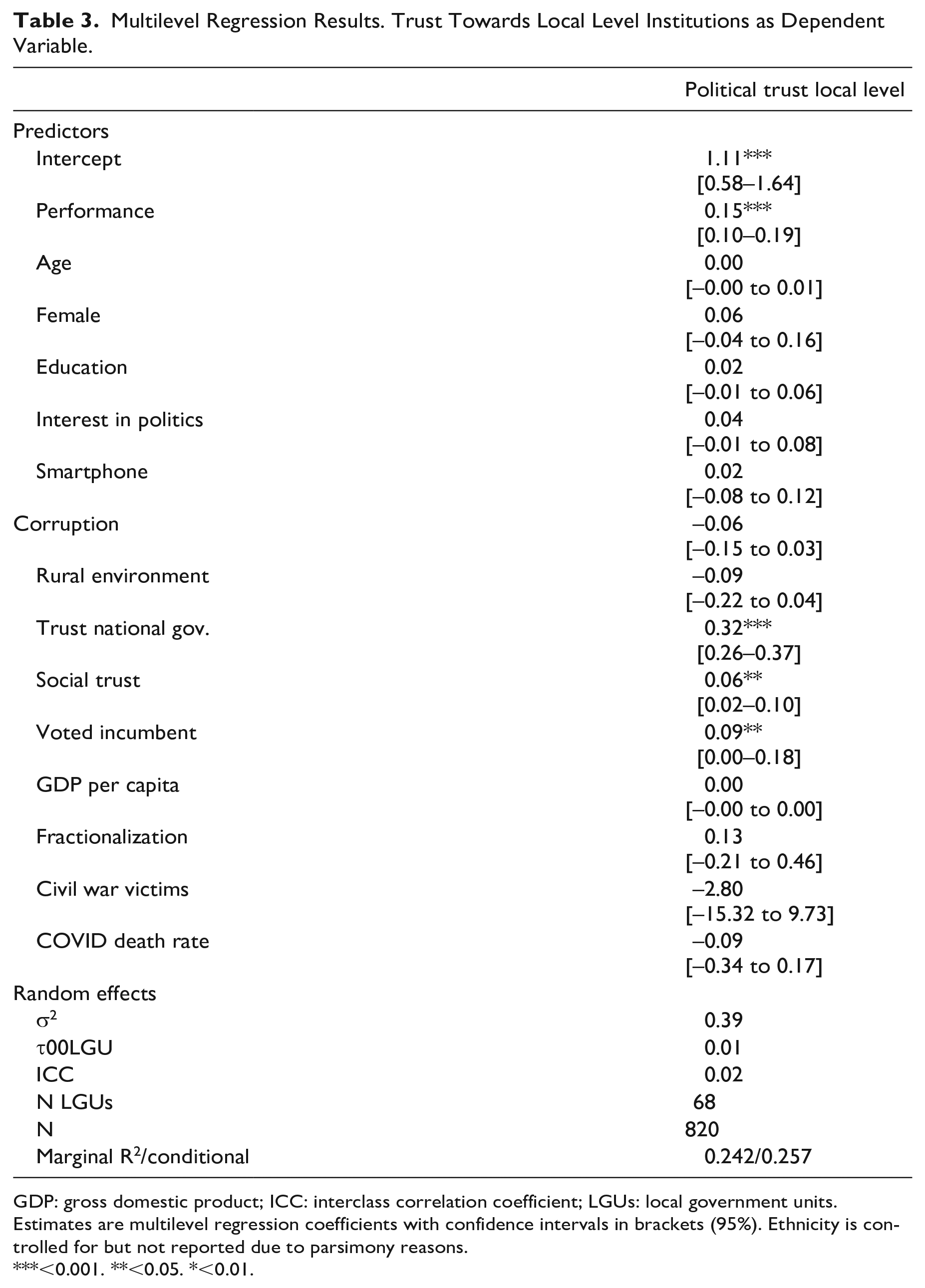
GDP: gross domestic product; ICC: interclass correlation coefficient; LGUs: local government units.
Estimates are multilevel regression coefficients with confidence intervals in brackets (95%). Ethnicity is controlled for but not reported due to parsimony reasons.
<0.001. **<0.05. *<0.01.
In order to test the robustness of our results, we run a variety of tests. First, as we rely on different items to measure local-level political trust, we make sure that our results are not driven by specific institutions. We therefore rerun the analyses using trust towards the different local institutions separately. Second, we excluded all interviews from Kathmandu in an additional robustness test because the proliferation of COVID-19 occurred primarily in Kathmandu and any effect should be most pronounced there and less so in other areas of the country. Third, we also controlled for individuals’ self-reported expectations of the performance of local governments. Finally, we must consider that important political developments took place before and during data collection, as a political crisis engulfed Nepal in the winter and spring of 2020/2021. 8 Although we do not expect these events to affect the association between performance and trust, they may influence our results indirectly via overall levels of political trust. Taking that into account, we run separate analysis excluding responses after 10 May and after 22 May, respectively. All results remain unchanged.
While all these robustness checks make us confident of the relationship between satisfaction with performance and political trust, they are certainly not enough to demonstrate beyond doubt that perceptions of performance shape political trust (reward–punishment model), and not the other way around. Basically, we cannot exclude that people who declare to trust local governments also see their performance under a more positive light (i.e. trust as a heuristic), an issue long ignored in political trust research (van der Meer, 2017). With the cross-sectional data available to us, there is little we can do to rule out this possibility empirically, even if we include some powerful predictors often ignored such as corruption and expectations (van der Meer, 2017). However, we believe there are good theoretical arguments and anecdotal evidence that support our interpretation of the data.
First, the trust-as-evaluation approach we incorporate into our analysis has been tested successfully in many different situations, even under experimental and quasi-experimental conditions that reduce the likelihood of confounding effects (Camussi and Mancini, 2019; Faulkner et al., 2015; Martin et al., 2020). Furthermore, we do not claim that the entire association is explained by performance affecting trust, and we are thus ready to admit that previous levels of trust affect in turn how performance is evaluated. This is in line with a more cautious interpretation of the links between performance and trust based on between-respondent analyses (de Blok et al., 2022). In this vein, the fact that the local governments have only been established in 2017 after a constitutional reform increases our confidence that recent performance played a more prominent role than preconceptions in the Nepalese case.
Second, COVID-19 is ideal to investigate the relationship since it had a very direct and often drastic effect on the lives of a majority of the population. This addresses an important limitation of the trust-as-evaluation approach, namely that citizens are sometimes not informed about what governments do and not all individuals are equally capable of judging their performance (van der Meer and Hakhverdian, 2016). During the COVID-19, citizens developed a ‘need for orientation’ crisis that led to a cross-country rise in news use (van Aelst et al., 2021). This effect may have made it easier for citizens to know about the performance of governments. Education, interest in politics and access to information may influence both performance assessments as well as trust levels, which is why we include controls for these. Interestingly, only interest in politics is significant in one of the models.
Third, we control for trust towards national institutions in our models, which is a strong benchmark for citizens that use heuristics (Steenvoorden and van der Meer, 2021), and we still find a significant association between assessments of performance and local-level trust. Although we are primarily interested in the effect of performance on trust, we cannot (and we do not want to) affirm that there is not also an effect of trust on assessments of performance. However, if assessments of performance did not matter to explain levels of trust, we should see the association weaken or even disappear once we include strict controls that tap into the same idea (incumbent voting, trust towards national government and expectations).
Last but not least, anecdotal evidence derived from the qualitative interviews held in Kathmandu indicates that performance and service delivery are a direct driver of political trust at the local level. One civil society representative, for example, emphasized that:
People have trust in their local governments because they are doing a lot of good things in terms of services. [. . .] The local government is doing well in terms of health and education [. . .] these kinds of things have created trust among the local representatives and the common people (Civil society representative interviewed 15 April 2021).
Similarly, another interviewee observes that ‘all these services provided by the local bodies has created an environment of trust between the local people and local representatives’ (Journalist interviewed 18 April 2021).
Even more to the point, one interviewee when asked about trust at the local level not only argued for a direct link between performance and trust but specifically highlighted the performance during the pandemic:
Trust in the local government and positive appraisal of the local government has been tied to the delivery of certain kinds of public goods and services that have mattered, number one. And number two, in this last year, the response to the crisis, the pandemic, has been exceptional by local governments [. . .] So the responsiveness aspect has created a measure of trust that local government will be responsive in the next thing, if it’s an earthquake or a flood or a snowstorm (Civil society representative, interviewed 23 April 2021).
These examples hence suggest that local governments’ COVID-19 response impacted on people’s relation towards these newly built institutions. More generally, a recent qualitative analysis indicates that the performance and responsiveness of local governments in Nepal have had a clear impact on political trust. 9
Conclusion
Exploiting subnational variation in Nepal, our study demonstrates that positive assessments of COVID-related performance at the local level are significantly and robustly associated with higher political trust in local governments. To the best of our knowledge, we thereby provide the first study of how the management of the COVID-19 pandemic influenced trust at the local level in an emerging democracy. We believe our results have important implications for the literature on political trust, local institutions and crisis response.
First, our research suggests that citizens indeed consider the merits and demerits of local institutions when judging whether they deserve to be trusted. It is also highly noteworthy that we find a link between performance perception and political trust in an emerging democracy and regarding newly established institutions. This is particularly relevant given the predominant focus in the literature on national-level institutions (Katz and Levin, 2018; Muñoz, 2017; Zmerli and van der Meer, 2017), established democracies (Citrin and Stoker, 2018; van der Meer and Hakhverdian, 2016; Zmerli and van der Meer, 2017) as well as ongoing debates on the maleability of political trust through experience (Devine and Valgarðsson, 2023).
Second, our findings contribute to the literature that studies how crises impact political trust, by providing insights from a global health pandemic. The use of original data collected during the second wave of the COVID-19 pandemic allowed us to complement the literature on the rally-around-the-flag effects that are more likely to happen at the beginning of a crisis. Our research suggests that increases and decreases in trust amid periods of (health) crises can be driven by the performance of governments and are not only a by-product of psychological responses (and their exhaustion). One potential implication of this is that major crises or disasters do not per se have positive or negative effects but should be perceived as windows of opportunity for governments to prove themselves and thereby gain political trust.
These findings might have several broader (policy) implications, also beyond the local level. Improving trust at the local level on its own merits may indicate an important avenue to build resilience and stabilize emerging political systems through trusted local institutions as an important counterpoint to recurring political crises – as we see in Nepal – at the national level. Strengthening local political trust can hence be important both for democratic consolidation and stability more generally, as existing research has demonstrated the relevance of local-level trust, for example, in preventing the outbreak of violence (Petrova, 2022; Wig and Tollefsen, 2016). Moreover, local-level government institutions are the state institutions citizens are most likely to have direct contact with, and whose decisions have a more immediate impact on people’s lives. As a consequence, their performance can be expected to influence the perception of state institutions beyond the local level. Improving the performance of local-level institutions might help to increase legitimacy and trust in political systems more generally, as first insights seem to suggest (Proszowska et al., 2021). This can be particularly important amid situations of generalized decline of political trust (Citrin and Stoker, 2018) and for countries characterized by a fragile, unstable political environment. In fact, our results invite further research on the extent to which decentralization and subnational governance may improve levels of trust in politically fragile contexts.
Despite these contributions, our research also has shortcomings. As discussed before, the most important limitation is that we cannot entirely rule out the reverse causality effect (trust affecting assessments of performance and not the other way around). Although we are in line with the wealth of literature arguing that (perceptions of) performance are likely to influence trust (see Citrin and Stoker, 2018), and even though we believe there are good theoretical arguments in favour of this causal path, especially amid the COVID-19 crisis, future studies, experimental in nature, will be needed to clarify the association. Finally, our insights are based on perceptions at the local level collected through original survey data, while we were only able to obtain objective performance measures at the district level. Future analyses using more fine-grained data about performance at the local level could help further disentangle the trust performance relationship and thereby move forward the research agenda on determinants of local-level trust.
Supplemental Material
sj-docx-1-psw-10.1177_14789299231220535 – Supplemental material for COVID-19 and Political Trust in Local Governments: Evidence From Nepal
Supplemental material, sj-docx-1-psw-10.1177_14789299231220535 for COVID-19 and Political Trust in Local Governments: Evidence From Nepal by Charlotte Fiedler, Hugo Marcos-Marne and Karina Mross in Political Studies Review
Footnotes
Declaration of conflicting interests
The author(s) declared no potential conflicts of interest with respect to the research, authorship and/or publication of this article.
Funding
The author(s) disclosed receipt of the following financial support for the research, authorship, and/or publication of this article: We gratefully acknowledge that the research toward this article was funded by the Federal Ministry for Economic Cooperation and Development (BMZ) under the Social Cohesion in Africa project grant. Hugo Marcos-Marne also thanks the Spanish National Research Agency’s Program for its support under Grant PID2020-115562GB-I00.

Supplemental material
Additional supplementary information may be found with the online version of this article.
Content
Table OA.1 Descriptive statistics. Table OA.2 OLS regression models, disaggregated dependent variable. Table OA.3 OLS regression models, without Katmandu. Table OA.4 OLS regression models controlling for expectations. Table OA.5 Sensitivity analysis.
Notes
Author Biographies
References
Supplementary Material
Please find the following supplemental material available below.
For Open Access articles published under a Creative Commons License, all supplemental material carries the same license as the article it is associated with.
For non-Open Access articles published, all supplemental material carries a non-exclusive license, and permission requests for re-use of supplemental material or any part of supplemental material shall be sent directly to the copyright owner as specified in the copyright notice associated with the article.
