



Abstract
Politicians are expressing increasing support for deliberative practices around the world. However, knowledge about their actions beyond expressing support is scarce. To address this gap in the literature, this article aims to explain why politicians do not pick up the results arising from deliberative practices and integrate them into their policies. Our analysis focuses on the 2019 deliberation in Iceland as the most likely case in which we would expect such a process to occur. We use original data from 25 semi-structured interviews conducted in 2021 with Icelandic MPs elected at the national level, which also cover all the party leaders of the eight parliamentary parties in the 2017–2021 term in office. The reflexive thematic analysis finds that, irrespective of their ideological affiliation, politicians are critical of deliberative practices both in procedural and substantive terms. They display a strong belief that political representation achieved through elections must be the rule of the democratic game. As such, deliberation is considered redundant since citizens already have many ways to participate in representative democracy.
Introduction
The implementation of deliberative practices is considered a potential cure for the contemporary democratic malaise. The creation of channels of direct communication with the authorities and the practices that facilitate greater citizen involvement in decision-making could enhance their trust in representative institutions and increase the quality of decision-making (Dahlberg et al., 2015; Dryzek et al., 2019). These practices are characterised by comprehensive, informative and substantive discussions. Through them, citizens – together with politicians and stakeholders – can agree upon how local problems should be prioritised and tackled (Fishkin and Luskin, 2005; Setälä and Smith, 2018). The increasing use of deliberative practices around the world has led to the development of two different strands of literature. On the one hand, previous research focuses on the adoption of deliberative practices, the conditions in which they can take place, and how they are organised (Elstub and Escobar, 2019; Geissel and Michels, 2018). On the other hand, there are studies reflecting the increasing support for deliberative democracy and their relationship with modes of engagement (Bedock and Pilet, 2020; Christensen and von Schoultz, 2019; Gherghina and Geissel, 2017). While these two directions of research cover the procedures and the citizens’ views, we still know very little about politicians’ perspectives. It is important to understand what they think about deliberation since they are the ones who can choose the provisions for deliberation (and thus implicitly set the rules of the game), as well as being those who can decide to act upon the outcomes of deliberation.
To date, the studies explaining politicians’ perspectives about deliberation have emphasised their general support for these practices (Junius et al., 2020; Rangoni et al., 2023; Gherghina et al., 2023). However, we do not know much about their action (or lack of it) beyond expressions of support for deliberation as a concept. Although deliberative processes are organised and people get involved, citizens’ voices in the decision-making process are limited when politicians act as gatekeepers. Understanding the reasons behind such a behaviour can inform us about how long it is likely to be in place, and can help in predicting the role of deliberation to improve the quality of democracy. To address this gap in the literature, this article aims to explain why politicians do not pick up the results from deliberative practices and integrate them into policies. Our analysis focuses on Iceland as a crucial/most likely case, specifically its 2019 deliberative poll.
Usually in a deliberative poll, the results are not in the form of clear recommendations for the government as in many other citizens’ assemblies (Farrell et al., 2018). Instead, the main goal of a deliberative poll is to learn what citizens would think, if they had the opportunity to engage in evidence-based discussions with various kinds of people (Luskin et al., 2002). Although the main goal of a deliberative poll is not to produce precise recommendations for the government to implement, it has been used to influence policy change in some instances (Sintomer, 2018). This was the case with the Icelandic deliberative poll, which was organised to influence policy change. The poll was initiated by the Icelandic Prime Minister who stated before the deliberative poll event in 2019 that the intention was for the results to have a real impact on MPs’ work to change the constitution. The poll’s outcome exposed the will of the participants on several topics; however, their views were not followed by the MPs, and in this article, we seek to explain why this happened.
We use original data from 25 semi-structured interviews conducted in 2021 with Icelandic politicians (MPs) elected at the national level. The interviews also cover all the party leaders of the eight parliamentary parties in the 2017–2021 term in office. This term in office coincides with the moment when the poll should have been implemented. The interview guide was structured using the themes derived from the literature. Our method of data analysis is reflexive thematic analysis that combines themes based on the theory section with those emerging from the answers to interviews.
The first section of the article reviews the literature regarding the attitudes of politicians towards deliberative practices. The second section provides the analytical framework of this article and outlines the existence of several reasons why politicians do not implement the recommendations from deliberative practices. Next, we present the research design of our study by setting out details about the case selection, method of data collection and method of data analysis. The fourth section provides an overview of the deliberative poll in Iceland, while the following section presents the main results of our qualitative analysis. The final section summarises the key findings, discusses their implications for the broader field of deliberation and suggests some directions for further research.
Three Attitudes Towards Deliberation
This section provides a brief review of the literature discussing the three general attitudes that politicians adopt towards deliberative practices: neutrality, supportiveness and opposition. Although distinct from their attitudes towards the implementation of recommendations from deliberation, these attitudes inform us about the political context in which deliberation emerges. Politicians remain neutral to deliberative practices either because of personal values (e.g. a lack of trust in the process) or due to their desire to remain impartial towards their colleagues and the electorate (Overeem, 2005). Neutrality is associated with a lack of action and preservation of the status-quo (Merrill and Weinstock, 2014). Therefore, politicians’ neutral attitudes are disconnected from the development of deliberative processes, which require them to take a stance.
Politicians who support deliberative practices see them as providing access to accurate and quality information, as channels for participation in coordination with policy-makers, and as equal opportunities to build political participation and mutual respect. Along these lines, deliberation enhances citizens’ interest in political activities and boosts their civic responsibility (Abdullah and Abdul Rahman, 2015; O’Doherty, 2013; Raisio, 2010). Politicians value the results of deliberative practices because they are based on social dialogue involving multiple societal actors (citizens, politicians and stakeholders) in deliberative activities. Because of this, the results are comprehensive and encapsulate the standpoints of every category of actors in a society. Politicians can use deliberative practices to take efficient political action, and the policies that follow deliberative inputs are more inclusive, legitimate and representative (Hendriks and Lees-marshment, 2019; Rangoni et al., 2023). Support for deliberation is also rooted in its potential to solve political deadlock. In order to avoid disputes or internal splits, political parties could engage citizens in deliberative practices to identify solutions to these issues (Gherghina and Jacquet, 2023; Landemore and Hudson, 2015). Outside illiberal settings with questionable democratic regimes where deliberation is highly scrutinised by the authorities, the outcomes generated by these practices are generally perceived as being depoliticised (He and Warren, 2011; Oross and Tap, 2021). For this reason, politicians could value them in order to implement neutral solutions to political problems (Macq and Jacquet, 2021).
Another reason why deliberative practices are supported by politicians is their potential to reduce the gap between citizens and the authorities (Caluwaerts and Reuchamps, 2015; Hendriks and Lees-Marshment, 2019; Niessen and Reuchamps, 2020). When the outcomes of these practices are implemented, there are two major consequences: decision-making becomes more transparent and citizens consider the approach to be more accountable (Landemore and Hudson, 2015; Paxon, 2020), and politicians increase their legitimacy and popularity (Caluwaerts and Reuchamps, 2015; Gherghina, 2017). As such, politicians value deliberative practices because they improve their image, enhance citizens’ trust in them and contribute to democratic consolidation (Beswick and Elstub, 2019; Setälä, 2017).
On the other hand, politicians may oppose deliberation because they believe that the implementation of deliberative outcomes could limit their legitimacy and endanger traditional forms of decision-making (Niessen, 2019). In traditional representative decision-making, a small number of legally elected officials have the authority to adopt any course of action based on their judgement (Baldwin and Holzinger, 2019). When external actors engage in deliberative practices that generate political outcomes, the traditional authority of politicians could therefore be limited (Hartz-Karp and Briand, 2009; Vrydagh et al., 2023). Moreover, politicians could be sceptical towards deliberative practices because they consider decision-making to be a complex process that goes beyond citizens’ knowledge or abilities. Political decision-making is a sophisticated process characterised by the careful examination of information from multiple standpoints and access to specific human or material resources. Citizens are often unaware of (or lack access to) information, which is why deliberative outcomes may be discarded by politicians as unrealistic or unfeasible (Hendriks and Lees-Marshment, 2019; Nabatchi and Leighninger, 2015). In addition, politicians could oppose deliberative practices when the results go against their own political views, agendas or strategies (Beswick and Elstub, 2019; Jacquet et al., 2022; Koskimaa and Rapeli, 2020).
Why Politicians May Not Implement the Outcomes of Deliberation
According to Jacquet and van der Does (2021), deliberative practices could generate three main consequences for policy-making. First, they could be reflected in political outcomes and have some level of congruence with the political decisions. Second, they could influence the policy-development stage before the final decision is advanced. Third, they could re-shape the overall political system. Despite their potential, no prior study refers explicitly to the reasons why politicians do not implement the outcomes of deliberative practices. We identified several potential causes in the broader literature on representation and deliberation, and divided these causes into two main categories: those related to the deliberative process and those related to the politician (see Figure 1). Those related to the deliberative process refer to the quality of the participatory infrastructure, the high costs associated with the deliberation, the degree of representativeness and their failure to provide feasible solutions. The causes related to politicians refer to the promotion of their own political agenda, the pursuit of interests belonging to influential groups and the instrumental use of deliberation as a political strategy to gain support.
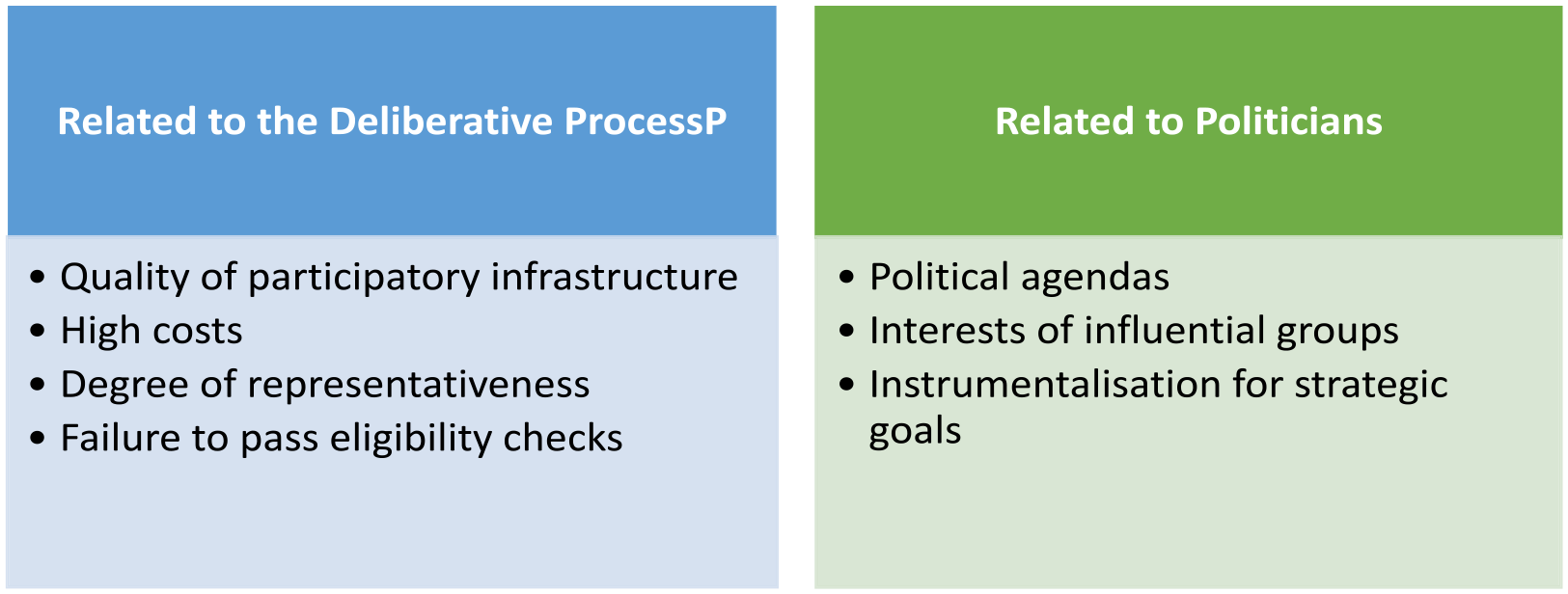
Politicians’ Reasons Not to Implement the Outcomes of Deliberation.
Starting with the reasons related to deliberation, one of these is the quality of the participatory infrastructure. The latter includes an array of elements that support the professionalisation of deliberative practices and their participants. A professional participatory infrastructure is based on a plan for citizen participation which balances the degree of expertise of participants, and has a clear structure and a constant frequency of participatory events (Nabatchi and Leighninger, 2015). The professionalisation of the participatory infrastructure contributes to the overall quality of the process and increases the chances of valuable outcomes (Font et al., 2018). For this reason, politicians may favour deliberative outcomes when they consider that the process was professionally organised (Nabatchi and Leighninger, 2015); however, when these conditions are not met, politicians may disregard the deliberation in general and its outcomes in particular.
Second, even when the deliberation generates valuable recommendations, their implementation could be difficult due to high costs. Citizens are rarely aware that resources are limited (Boulding and Wampler, 2010), and politicians may reject proposals whose implementation goes beyond the available financial resources (Font et al., 2018). A third reason is linked to the idea of representativeness of these outcomes for the overall community (Landemore and Hudson, 2015). Deliberative practices should generate outcomes for the benefit of the entire community, irrespective of its size. When the deliberative practice is not representative of the overall community (e.g. it neglects some categories of citizens; the number of participants is low; and/or the level of engagement is poor), its benefits may automatically be questioned (Newig et al., 2016; Niessen, 2019). Some individuals may consider that the outcomes cannot deliver positive results for the overall community, or that they only portray the interests of particular groups in the community (Newig et al., 2016). Accordingly, politicians may decide not to implement these outcomes to avoid dissatisfaction or uncertainty within the community (Font et al., 2018; Landemore and Hudson, 2015; Niessen, 2019).
Finally, the deliberation may not be implemented due to technical reasons, such as not passing eligibility checks. Even though deliberative practices create a suitable environment for political communication, in many instances the participants only engage in an unprofessional exchange of opinions likely to generate inefficient or unrealistic expectations (Hendriks and Lees-Marshment, 2019; Hovik and Stigen, 2023). Consequently, although the outcomes represent the participants’ efforts, they may not survive eligibility checks, thus rendering them unsuitable for implementation (Hovik and Stigen, 2023).
The first reason related to politicians is their personal agenda. Since citizens do not have full access to these agendas, their recommendations in deliberative settings could go against some politicians’ expectations (Niessen, 2019). When this happens, politicians could maintain their initial direction and disregard the deliberation results because they consider themselves more informed and in a better position to make decisions (Beswick and Elstub, 2019). This argument is indirectly strengthened by Vrydagh and Caluwaerts (2020), who illustrate that politicians’ decision to organise and consider the results of deliberative mini-publics may occur when they have pre-existing policy preferences. Moreover, politicians’ agendas are shaped by their advisors or field-experts so it could be regarded as natural to disregard citizens’ recommendations when they run contrary to professional advice (Hartz-Karp and Briand, 2009; Hendriks and Lees-Marshment, 2019).
The deliberation outcomes may also conflict with the interests of influential actors (protégés) who are important to politicians. Politicians usually strive to implement their policies and maintain office. Apart from votes, they need support from specific actors to gain and maintain access to resources (e.g. influence, finances) to help them to achieve their goals. This support is not unconditional, and requires cooperation between politicians and interest groups. When the deliberative practices produce recommendations that are not in line with these interest groups, the politicians may disregard them (Tinivata and Lim, 2022). This is particularly possible (or likely) when no authority is in place to supervise how these outcomes are managed. When politicians are granted complete control over these matters, they will handle them as they please (Font et al., 2018; Tinivata and Lim, 2022).
There is also the possibility of instrumentalising the deliberative practices to achieve strategic goals such as higher legitimacy, popularity or trust (Miscoiu and Gherghina, 2021). When politicians use practices that appear to provide citizens with more engagement opportunities in decision-making, they appear more open to their needs and may gain support (Chambers, 2003; Wampler, 2008). By doing this, they enhance their legitimacy and popularity (Bayley and French, 2008; Gherghina et al., 2023; Johnson, 2015). Also, by organising deliberative activities, they stimulate citizens to trust these institutions and may use them frequently to attain their objectives (Johnson, 2015; Macq and Jacquet, 2021).
Research Design
To answer the research question, we focus on Iceland as a crucial case for this topic. The country has experience with deliberative practices at the national level above the European average, the deliberation was initiated with policy aims in mind, and the coordination was top-down (i.e. government-initiated). All these factors make Iceland the most likely case in which we would expect politicians not to implement the outcomes of deliberation and not to act along its lines; this approach is suitable for a theory-building endeavour like the one in this article. Our analysis uses a qualitative interpretative methodology. The data come from semi-structured interviews conducted with 25 (out of a total number of 63) members of the Icelandic parliament during the 2017–2021 parliamentary term. The interviewees included all eight party leaders, the Speaker of the parliament, members of all the elected political parties, and eight out of ten members of the standing committee that processed the deliberative polls’ results in the parliament. The eight political parties in Iceland are The Independence Party (XD), The Progressive Party (XB), The Left-Green Movement (VG), The Social Democratic Alliance (XS), The Reform Party (XC), The People’s Party (FF), The Centre Party (XM) and The Pirate Party (XP). The Independence Party, The Progressive Party, and the Left-Green Movement were in a coalition government during this parliamentary term. The interviews were conducted in January–April and October–December 2021. Five interviews were conducted online on Teams due to COVID-19 regulations, and the other 20 interviews were in person, either in the MPs’ offices or in a meeting room at the University of Iceland. All interviews were conducted in Icelandic, then transcribed and translated into English. The respondents were selected to increase variation in terms of partisanship, parliamentary seniority and legislative roles.
The interview guide (see Appendix 1) was created using the themes presented in Figure 1. It was designed to combine a generic discussion about the politicians’ views towards citizen participation and specific elements related to the deliberative poll in 2019, and the constitutional reform process in the 2017–2021 term. Regarding the latter, the MPs were explicitly asked – especially in Questions 9–12 and in the follow-up questions – about their role in working with the output of the deliberative poll, what role the deliberative poll had in the policy-making process, if and how they would use it, and if not, why not. A detailed list of interviewees is available in Table 1. We cannot provide details regarding the party affiliation for reasons of anonymity and confidentiality: some political parties have few parliamentarians and their gender could allow their identification. The interviewees include five members from both the Independence Party (out of 16) and the Left-Green Movement (out of 11), four members of the Progressive Party (out of 8) and the Social Democratic Alliance (out of 7), three members of the Pirate Party (out of 6), two members of the Reform Party (out of 4), one member from the People’s Party (out of 4) and one member of the Centre Party (out of 7). The reason for the low number of respondents from the Centre Party is that we conducted the interviews in the aftermath of the 2021 election in which the Centre Party gained only two seats. The politicians who had recently lost their parliamentary seats or decided not to run again for office did not reply to our request for interviews.
Overview of Interviewees.
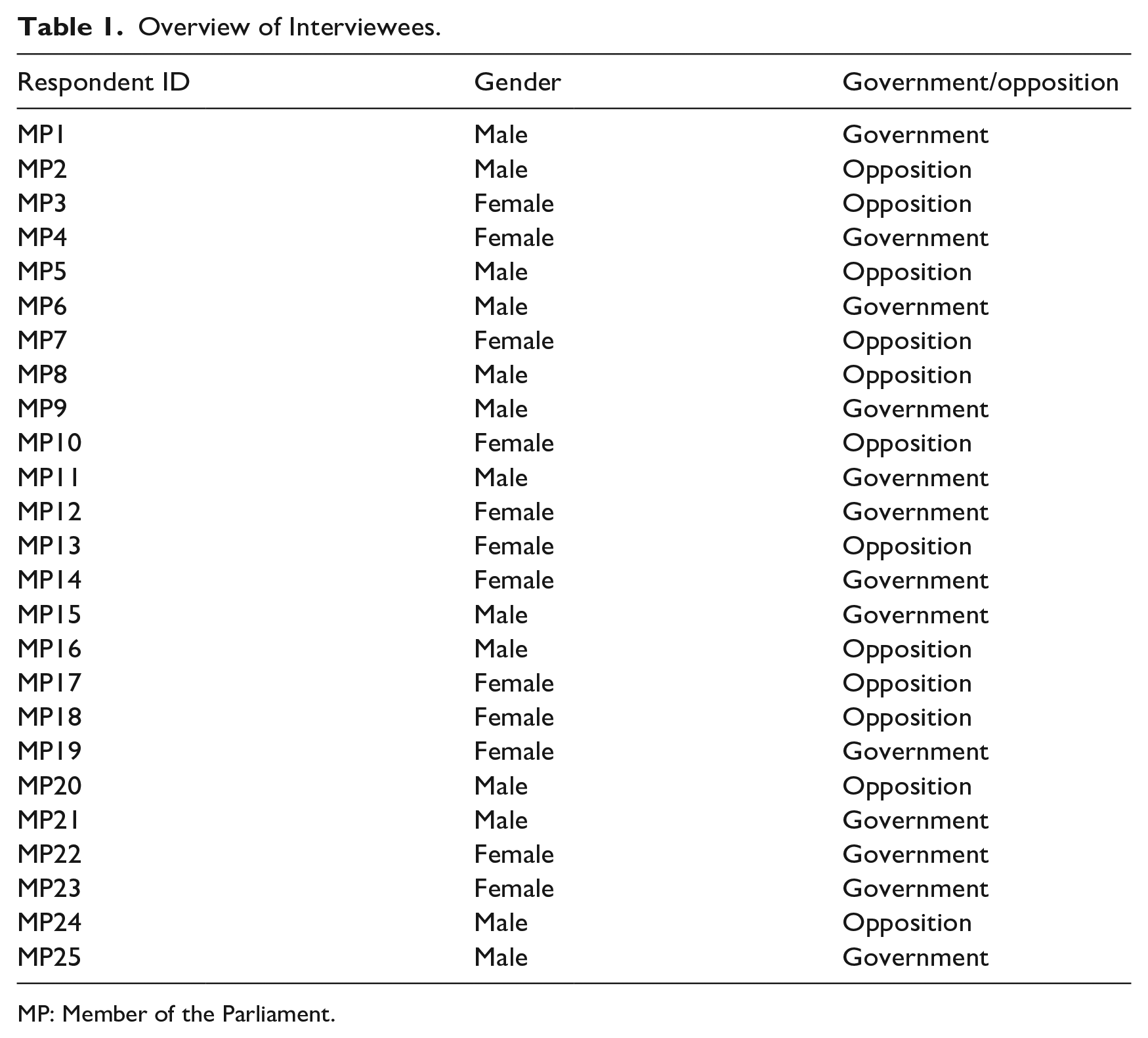
MP: Member of the Parliament.
The interview data were analysed using reflexive thematic analysis along the lines developed by Braun and Clarke (2019). The process of reflexive thematic analysis is not linear, and the interview data used in this article has been analysed in several phases, moving back and forth to fully identify the relevant themes that can provide answers to the research question. We started with a deductive approach, which kept in mind the themes derived from the theories covered in the previous section (themes one and two). To these we added inductive themes derived from the answers given in the interviews (themes three and four). This approach is ‘latent coding’ (Braun and Clarke, 2019) and aims to identify the underlying assumptions or hidden meanings behind the interviewees’ descriptions. The choice of codes was guided by the frequency of idea occurrence, which signals the existence of patterns. Each sentence from the answers provided in the interviews was coded with the help of ATLAS.ti software. After intensive work with the codes to identify how they relate to each other, we identified four main themes relevant to the research question (see Table 2). To ensure the consistency of coding and limit bias, we asked a handful of Icelandic academics (including doctoral students) to code the same random sample from the interviews. The resulting themes were to a very large extent the same as those coded by the authors.
Themes and Coding.
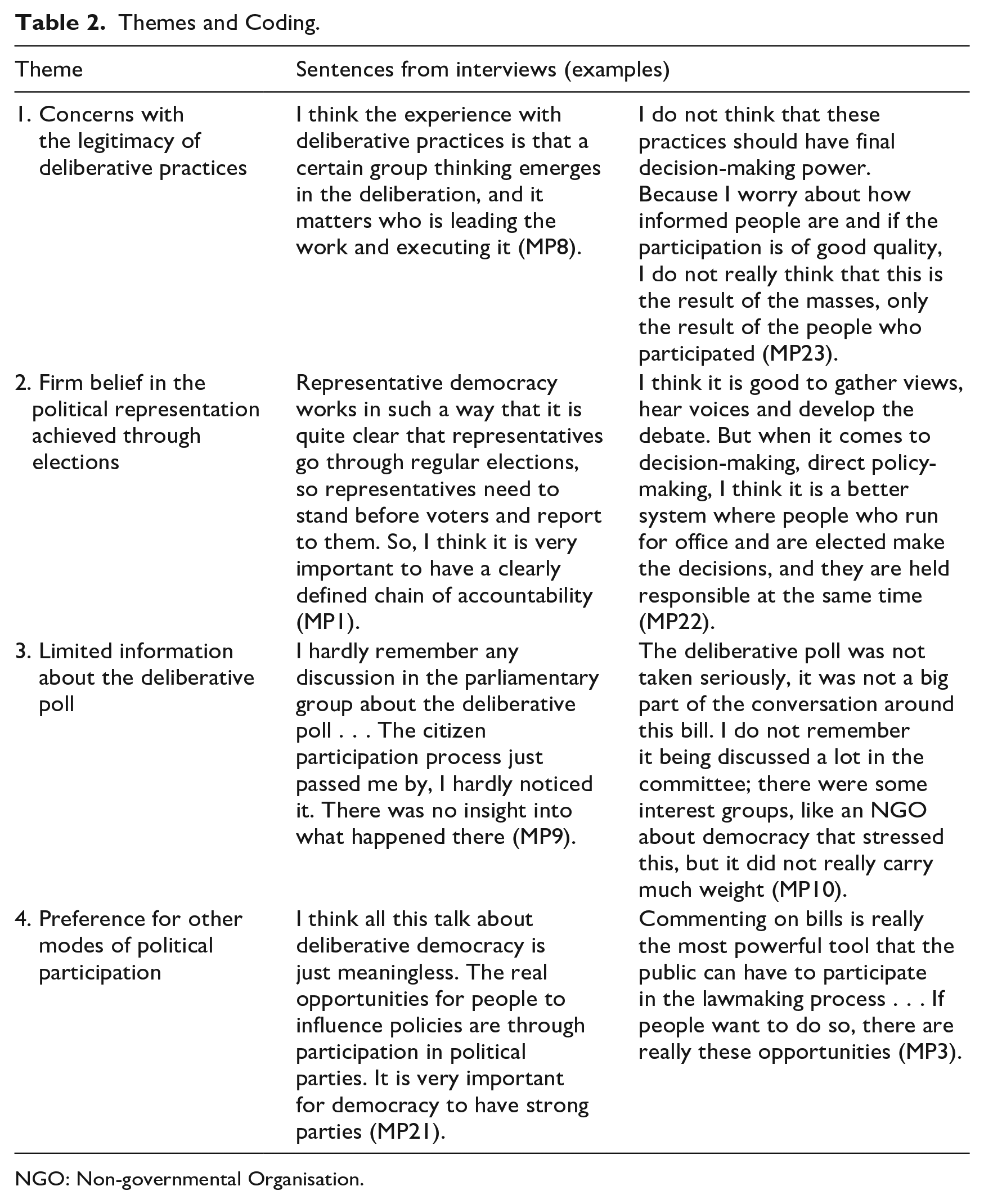
NGO: Non-governmental Organisation.
The Deliberative Poll in Iceland
Iceland has had two extensive participatory and deliberative processes at the national level with the aim of influencing policy change. Both were related to efforts to change the Icelandic constitution, and invited the involvement of ordinary citizens. In 2011, a 25-member Constitutional Council was elected in a popular vote with the aim of drafting new articles of the constitution. After the global economic crisis of 2008 and specifically the crash of the Icelandic banking sector, there was a general distrust towards the political system and politicians (Bergmann, 2016). A demand for more citizen engagement and empowerment became prominent; therefore, the process of constitutional reform was put partly in the hands of the Constitutional Council. The Council used crowdsourcing methods to engage the public to produce an entirely new draft constitution; however, the draft was never put up for a final parliamentary vote (Thorarensen, 2016). A referendum organised in 2012 asked citizens about their views towards the Constitutional Council’s draft, and the result was that 64% of respondents wanted the draft to form the basis for a new constitution (Hudson, 2017). The inability of politicians to implement any changes to the constitution following these processes in 2011 and 2012 sparked anger among those who supported the Constitutional Council’s draft. The public and political debate about this issue has remained intense ever since (Hjartarson, 2019; Sigurðardóttir, 2019). Constitutional changes have therefore become a rather polarised issue in Iceland, and arguably a very challenging topic for politicians.
In the 2017–2021 parliamentary term, the government planned to implement a few constitutional changes, according to a plan of action (Office of the Prime Minister, 2019). As a part of its policy-making process, a deliberative poll was to be held in 2019, to learn the views of citizens towards six constitution-related topics. A randomly selected group of 234 people participated in a two-day deliberative poll, which was supposed to produce recommendations which would be integrated in a new constitutional bill put forward by the prime minister (Þrastardóttir, 2019). The bill included six topics, two of which were discussed in the deliberative poll. However, the deliberative poll did not play a major role in the policy-making process, and again, the bill did not go up for a final vote in parliament, leaving Icelanders with an unchanged constitution and two elaborate national-level deliberative processes which ultimately did not influence any policy change, contrary to the stated goals.
The deliberative poll was initiated by the Icelandic Prime Minister with the support of all the party leaders in parliament. The eight party leaders carried out the work of implementing changes to parts of the constitution in the parliamentary term of 2017–2021. The deliberative poll was supposed to play an instrumental role in the process of changing several articles of the constitution (Office of the Prime Minister, 2019). The deliberative poll was organised along the guidelines designed by Fishkin (Democratic Constitutional Design (n.d.)). Although the main goal of a deliberative poll is not to produce recommendations for the government to implement, it has nevertheless been used to influence policy change in some instances (Sintomer, 2018). The Icelandic Prime Minister stated in a newspaper article that she had high hopes that the deliberative poll would produce constructive results feeding into the politicians’ work on changing the constitution (Jakobsdóttir, 2019). In a media interview, she explained that the deliberative poll was intended to have a real impact on the constitution: ‘This is of course why we are doing this. The party leaders have gotten a presentation of the methodology so of course this will influence our work in changing the constitution, which we will hopefully unite around’ (Þrastardóttir, 2019).
At the beginning of the deliberative poll meeting, the prime minister addressed the participants and explained that the results of the deliberative poll would guide the upcoming work on constitutional change. The prime minister did not distinguish between a deliberative poll and other deliberative practices like a citizen assembly when it comes to using their results to influence policy formation (Jakobsdóttir, 2019). From the answers provided to the interviews undertaken for this article, it was evident that none of the MPs knew the difference between the methodology used in a deliberative poll and in other citizen assemblies. As such, we can consider this deliberative poll as intended to have an impact on policy formation in the constitutional reform process.
The present analysis focuses on the short-term impact of the deliberative poll which took place in 2019, but the parliamentary proceedings on the issue took place in the spring and summer of 2021. New elections took place in autumn 2021 bringing an end to the former elective term. In Iceland, bills that have been put forward in a previous parliament cannot be re-introduced without changes, which means that this effort to implement constitutional changes was brought to a halt before the 2021 elections. It is quite unlikely that the deliberative polls’ results will be brought back to light in the term starting in 2021, since there is no mention of this intention in the current coalition government’s four-year agreement, even though the same parties and actors as before make up the current government. In the agreement, the government seems to have departed from its previous citizen-centred approach, and is now only involving experts in the discussion of changes to certain constitutional articles (Stjórnarráð Íslands, 2022).
Icelandic Politicians and the Deliberative Poll
The reasons why Icelandic politicians did not implement the results of the deliberative poll can be categorised into four themes: (1) concerns about the legitimacy of deliberative practices, (2) firm belief in the political representation achieved through elections, (3) limited information about the deliberative poll and (4) a preference for other (usually more conventional) modes of political participation.
The first theme emerged when discussing deliberative practices in general with the MPs, but also specifically their knowledge, experience with and views about the Icelandic deliberative poll. This theme covers the input (including the ‘procedural’) and throughput legitimacy of deliberative events (Caluwaerts and Reuchamps, 2015). Input legitimacy refers to the recruitment process, and whether the participant group can be regarded as descriptively representative of the overall public (Caluwaerts and Reuchamps, 2015). Meanwhile, throughput legitimacy refers to the quality of the deliberation itself; whether citizens are capable of deliberating on complex issues, and whether they are free to express their opinions. Here, the perceived legitimacy of the people involved in the organisation of the event matters, regardless of whether the convenors and facilitators are trustworthy or not.
In theory, through sortition the participant group is expected to be descriptively similar to the rest of the population (Farrell et al., 2023). In Iceland, the politicians doubted that this had happened. Many MPs did not know that the deliberative poll had been randomly selected, and questioned the representativeness of the participant group (MP1; MP3; MP9; MP12). Several respondents mentioned that politicians cannot just follow the results from an ad hoc event like the Icelandic deliberative poll, because these views are only the views of the 234 people who participated. Their argument was that if another deliberative poll event is held with another 234 people, very different results may emerge (MP6; MP7). Others mentioned that even though there is random selection, the same people participate in this form of deliberation: It became evident after we had the presentation about the methodology behind the deliberative poll that it is always the same people who participate in these events. The same people who are passionate about this and are ready to participate. Out of 350,000 citizens, you see that there is such a small fraction of the whole who want to participate; the rest is not interested (MP3).
Another respondent strengthened this idea by explaining that ‘If you have too many of those deliberative practices, people will lose interest in them. Then you will have a problem with representativeness, you will have a self-selected group, even though that was not your intent’ (MP6). Some respondents also argued that the views of the participant group may not be consistent with those of non-participants: I do not think that these practices should have the final decision-making power. Because I worry about how informed people are and if the participation is of good quality, I do not really think that this is the result of the masses; [it is] only the result of the people who participated. What about those who do not participate, do their views not matter? (MP23)
In a deliberative setting, those who help with the implementation must be impartial and carefully facilitate the discussions. The quality of the deliberation rests in the ability to allow all participants to express themselves freely and to have their views taken into consideration (Reuchamps and Caluwaerts, 2018). Some MPs expressed concerns over these issues: ‘I think the experience with deliberative practices is that a certain group-think emerges in the deliberation, and it matters who is leading the work and executing it’ (MP8); and ‘My feeling is that there will always be someone leading in the group, leading the group discussion in a certain way’ (MP21). This scepticism was shared by several MPs across both the government and the opposition. Sometimes their concerns were based on distrust towards a former participatory process in 2011, which ended up being a highly polarised area of public debate after it took place. For example, MP5 argued that ‘you must trust that deliberative practices are well designed and executed and that has not always been the case in Iceland’. Similarly, MP14 explained that ‘the challenges are that deliberative practices can take a lot of time, and sometimes there is one voice that dominates the whole discussion, you need to ensure that everyone is listened to’.
In brief, the politicians argued that deliberative practices can reflect the interests of influential individuals or groups rather than providing an equal voice to all participants. This is somewhat different from the present study’s theoretical expectations (Figure 1) on the factors impeding the uptake of deliberative practices. The theory indicated that the interests of influential groups surrounding politicians may be an obstacle, but the answers point in the direction of concerns that the content of deliberation reflects the potential interests of influential groups.
The second theme emerged in the discussion about the extent to which politicians should integrate the results of deliberative practices into their policies. The MPs displayed a firm belief in classic representation, in which elected representatives are the legitimate power holders having been elected to implement the policies outlined in their parties’ manifestos. Many of the respondents mentioned that citizens already have plenty of opportunities to express their opinions within the current representative institutions (MP4; MP9; MP14; MP15), while interest groups can ensure that their interests are secured (MP11; MP13). Some wondered whether there is even a demand among citizens for more direct participation because they believe that most citizens prefer traditional representative democracy (MP1; MP21; MP25).
Only three MPs supported the idea that deliberative practices should be empowered to make final decisions and that politicians should implement their results irrespective of their own personal beliefs or party policies (MP2; MP16; MP18). These MPs viewed deliberative practices as legitimate and representative platforms, just like parliament with its elected representatives, and argued that they should have final decision-making power. However, the majority of the MPs opined that elected representatives are the legitimate power holders and the ones held accountable for political decisions through regular elections. Ordinary citizens who are randomly selected to participate in deliberative practices have not been chosen by other citizens to represent them, and cannot be held accountable (MP1; P10; MP11; MP22): You have to realize as a citizen that when you walk into a full stadium of people, you have only one voice and you can raise it, but it does not mean that you are going to decide the results. I think it is good to gather views, hear voices, and develop the debate. But when it comes to decision making, direct policy making, I think it is a better system where people who run for office and are elected make the decisions, and they are held responsible at the same time (MP22).
A few politicians articulated the challenging relationship between elected representatives, their adherence to their own convictions and the implementation of deliberative poll outcomes. The other respondents expressed more polarised views, either that it was impossible for MPs to follow deliberation results or that they should set aside their own views and implement the results. The concerns about integrating deliberation results into a policy had a lot to do with the MPs’ conceptions of representative democracy. Much of the discussion related to the main principle of electoral representative democracy, that citizens should be able to choose their representative – and the observation that in deliberative practices, no one chose these participants to represent their interests. The chain of delegation was mentioned: participants stressed that it must be obvious to citizens who is responsible and can be held accountable for political decisions. In deliberative practices, this chain becomes vague in the sense that politicians may implement policies that are the result of citizen deliberation, but which might not align well with their own political views (MP1; MP11). One respondent argues that in such a situation accountability is not present, and that can endanger the decision-making process: What I think is negative about reaching out to the masses is, among other things, the chain of accountability, who made this decision? Who is going to stand up and be responsible for it and defend it? Who is upholding this issue? Representative democracy works in such a way that it is quite clear that representatives go through regular elections, so representatives need to stand before voters and report to them. So, I think it is very important to have a clearly defined chain of accountability (MP1).
The MPs thus portray themselves as the legitimate power holders in representative government, who develop policies and laws and take responsibility for them. No matter what randomly selected citizens might think about certain issues, other aspects need to be considered. Several MPs argued that results from deliberative practices do not weigh more than policies in their political party manifesto, which have already been discussed and formed by members of their party’s grassroots. The MPs have been given a mandate by their voters to implement certain policies, and they will prioritise these and follow their party line (MP1; MP7). According to them, citizens are less competent to address complex topics: We have the perfect representative democracy, which I think is much more sensible than just asking a random group of people who are never representative. You can have it randomly selected, but you must really dig deep into the issue. There are already people who do that, who have been elected, who are very good at digging deep into things. You are just creating an extra component of democracy which is unnecessary. Representative democracy works well and if you mess it up, you just lose the next elections (MP21)
Several respondents explained that Iceland’s constitution clearly states that members of parliament are only bound by their own convictions (MP15; MP23). They argue that it would be challenging to advocate for the implementation of policies influenced by citizens’ deliberation if the content of those policies went against their personal beliefs: Our system is of course built that way that each MP is only bound by his/her convictions. Then, we can have the situation that a deliberative process produces some results, and the majority of MPs thinks something completely different. It is not unusual, but it is unfortunate (MP15).
All these answers indicate that politicians’ agendas are a relevant reason to reject the implementation of the deliberative poll results. The interviews reflect that the agendas include, apart from the policy and ideological dimensions outlined in the theory section, issues related to accountability, representation and competence. In general, the politicians consider representative democracy to be the appropriate avenue for policy-making and the representation of voters’ interests, rather than the deliberative practices.
The third theme which resulted from latent coding revealed a surprising element of limited information about the deliberative poll that was initially called by the prime minister backed by the party leaders. When asked specifically about their views towards the Icelandic deliberative poll, what they thought of the methodology, the two-day meeting, and the results, the replies varied – some of the participating MPs were not even aware of them (MP9; MP11; MP19). Even among those who had some information about the poll, many lacked clear understanding of the event or the right information. In several interviews, the MPs referred to false information about the number of participants, the cost of the project or the deliberative setting. Some also made assertions about the results that contradicted the actual statistical data described in the final report of the deliberative poll event (MP2; MP3; MP7; MP20). Some MPs mentioned that no attempts were made to provide more specific information about the deliberative poll, or to encourage them to engage with the event and its result (MP9; MP21): I hardly remember any discussion in the parliamentary group about the deliberative poll, but we knew that the prime minister was working with the other party leaders on some constitutional changes. The citizen participation process just passed me by; I hardly noticed it. There was no insight into what happened there (MP9).
Another indication of the limited knowledge about the deliberative poll and how to integrate its results in the policy-making processes was explicitly acknowledged by one respondent: The deliberative poll was not taken seriously, it was not a big part of the conversation around this bill. I do not remember it being discussed a lot in the committee; there were some interest groups like an NGO about democracy that stressed this, but it did not really carry much weight. The committee members listened a lot more to experts who came, like a professor at the University or some other experts (MP10).
A fourth theme also emerged through latent coding, which was that politicians referred to other participatory practices and implied that such alternatives provide a much better way for citizens to have their views heard than deliberative practices. Many respondents considered such practices unnecessary because citizens can use the existing participatory avenues such as voting, party activities or the government’s online consultation portal, all of which are considered possibilities to influence political decision-making (MP7; MP11; MP21). More specifically, the respondents argued that through involvement as members in the activities of political parties, ordinary citizens can influence the party manifesto, which will include policies that may become laws. Most of the respondents further explained that political parties are platforms for citizen participation that fit well into conventional beliefs about representative government, where members of parliament derive their legitimacy from elections, in which political parties play the main role. Since deliberative practices cannot be fitted into the framework of electoral representation, they are not seen as legitimate platforms that must be listened to (MP14; MP19; MP25). One politician stated explicitly that: I think all this talk about deliberative democracy is just meaningless. The real opportunities for people to influence policies are through participation in political parties. It is very important for democracy to have strong parties. In general, I think those deliberative practices are OK, but I do think that citizens can get much more power if they participate in political parties, that is where the main debate occurs and where the issues are decided (MP21).
The politicians also referred to people’s opportunities to comment on draft bills as a way to influence political decision-making. In Iceland, there are two official ways for citizens to comment on draft bills: one is to comment on the bills drafted in the ministries via the government’s online consultation portal and another is to comment on the bills drafted in the legislature that are discussed in parliamentary committees. These two opportunities were mentioned by several MPs as important channels through which politicians can listen to people and take their concerns into consideration (MP3; MP6; MP11). For example, Commenting on bills is really the most powerful tool that the public can have to participate in the lawmaking process. A few friends can come together over a cup of coffee, write and send a comment in which they say, ‘No more of this!’ Then, they are summoned before the committee and get a chance to explain. If people want, there really are these opportunities (MP3).
Several respondents characterised the political environment in Iceland as being open to citizens if the latter wish to share their thoughts on possible policies or laws (MP7; MP9; MP15; MP25). They emphasised that this can be done through unofficial channels such as writing to a newspaper, or more official but conventional modes of political participation like contacting politicians via email or phone. Other MPs mentioned that they would prefer the consultation with citizens to take place early in the policy-making cycle when the policy is being drafted rather than having to implement something that comes directly from citizens (MP1; MP22).
Very few MPs explicitly argued against deliberative forms of participation. Many were neutral towards them, and some were even quite supportive. Those in the latter category referred to other modes of participation with which they are more familiar. Their support for alternatives to deliberation appears to have been formed on two grounds: those practices take place in a way in which politicians control the terms, and there is little consensus about the strength and relevance of citizens’ voices in any of those forms. While most politicians agree that people should have an influence on decisions, they admitted that very often this is not the case. With government-initiated deliberations, there is a great variation in the influence that citizens may have. Also, there was no consensus among the interviewed legislators on what kind of influence citizens views should actually have on policy; that is, whether the results from deliberative practices should be put directly into parliamentary proceedings or perhaps be directly voted on by the public, or should only be added information for politicians to take into consideration if they feel like it.
In Iceland, the public discourse about what influence these practices should have has taken place in the context of the other large-scale deliberative process held in the country, the elected deliberative constitutional citizens assembly in 2011. For this reason, it was not surprising that many of the respondents mentioned that process when they thought about deliberative practices in general, so arguably, the 2011 process has become a model of what kind of influence these practices should or should not have. The public discourse about the 2011 process has since become characterised by polarisation, but there have been very strong demands on the country’s politicians to at least vote on the 2011 constitutional draft drawn up by the citizens’ assembly, including a petition officially signed by 41,000 out of a total of 380,000 inhabitants (Mbl.is, 2020). We found through latent coding of the interview data that due to the expectation that results from citizens’ assemblies should influence policy change, politicians prefer other familiar participatory avenues where there is no expectation or obligation to implement the various concerns that citizens might have.
Conclusion
This article has aimed to understand why politicians do not act upon the results of deliberative practices. The theoretical framework indicated the potential explanatory power of two major categories of reasons: one related to the deliberative process and the other related to politicians. Each of these categories includes several concrete reasons (see Figure 1). The evidence emerging from the semi-structured interviews conducted with Icelandic parliamentarians indicated that some of these reasons can explain why they did not implement the results of the 2019 deliberative poll in their country. More specifically, we found a general reluctance towards the deliberative process both in terms of the representativeness of the participants and its design. Irrespective of their ideology and partisan affiliations, the politicians explicitly criticised the setting as being confined to its participants, as leaving aside the voices of the many, and as being used to pursue the interests of particular groups or more vocal individuals. This view is complemented by their preference for alternative modes of participation that are closely linked to representative democracy. Rather than what they consider to be a problematic deliberative process, many politicians instead expect people to contact them directly, to engage with political parties or to communicate their demands to political institutions. All these modes of participation are more oriented towards a different type of input than that which is offered by deliberation.
Politicians favour citizens’ involvement in the early stages of the policy-making process rather than in the role of policy-makers. This attitude is rooted in the belief that political representation achieved through elections must be the fundamental rule of the democratic game. Our respondents explained that they believed that politicians should make the final decisions since they are accountable for their actions. They argue that their status as elected representatives puts them in a position to decide the course of action, the extent to which they listen to citizens, and how best to pursue their political agenda. Acting on all these priorities does not leave much room for implementing the outcomes of deliberative practices. The interviews also revealed the existence of a reason which we did not anticipate in the theory section. Many respondents explained that they had limited information about the deliberative practice in Iceland, even though it was initiated from the top down, and had the support of their party leader. This reason reflects politicians’ reluctance to seek information about an issue that they do not consider salient.
The implications of our findings reach beyond the case study investigated in this article. Although we have studied a deliberative poll organised in a small country, it has the characteristics of a practice aimed at making policy recommendations and facilitating changes. Its generalisability can apply to small communities, which are specific to most deliberations, in established representative democracies. At a theoretical level, we have developed a framework that can be tested in other political settings. Our explanations for politicians’ lack of action regarding the implementation of deliberative outcomes indicate the existence of several main reasons associated to their perspective about deliberation, their role as elected representatives and the extent of their willingness to stay informed about issues that they consider marginal. These explanations are not context-sensitive, and thus could be replicated elsewhere. Empirically, to our knowledge, this is the first study seeking to explain the behaviour of politicians in the aftermath of a deliberative practice. The findings contribute to the debate about the importance of deliberation to the quality of decision-making processes. Our results outline that the gate-keeper behaviour of politicians relative to deliberative processes is rooted in their perceptions of the process, a reluctance to have citizens actively involved, and their role perceptions about themselves as legitimate elected representatives of the people. This view – that elected representatives are the legitimate power holders so there is no need for citizen input to enhance the democratic legitimacy of political decisions – was widely shared by the interviewees. Almost all the politicians found it difficult to imagine how a group of citizens could represent the interests of other citizens in the absence of a vertical chain of delegation and accountability. This system of beliefs prevents politicians from valuing the results of deliberative practices.
One limitation of our analysis is the focus on the individual-level causes that surfaced in the interviews. Further research could expand the present scope to focus on context-related factors by accounting for the experience with deliberation, the media coverage and/or the role of public opinion in shaping the non-implementation of policy recommendations. Another avenue for research could be to compare the views of elected politicians at the national and local levels in order to identify where and how the outcomes of deliberative practices stand a better chance of being picked up and used in the decision-making process. Our exploratory study marks a first attempt to identify the reasons why the outcomes were not implemented. A further step is required to embed the deliberation in the broader policy cycle. The assessment of a failed output phase could be an integral part of evaluating the democratic potential of deliberative practices.
Footnotes
Appendix 1: The Interview Guide
Note: The main themes/questions are numbered; the follow-up questions are signposted with letters.
Declaration of conflicting interests
The author(s) declared no potential conflicts of interest with respect to the research, authorship, and/or publication of this article.
Funding
The author(s) received no financial support for the research, authorship, and/or publication of this article.
