



Abstract
While numerous explanations for vote-switching have been proposed (e.g. declining rates of partisanship, ideological shifts, partisan ambivalence, change in policy preferences), far less work has examined the personality profile of people more likely to engage in this behaviour. In Study 1, we examined the relationship between both general (i.e. openness, conscientiousness) and antagonistic (i.e. psychopathy, narcissism, Machiavellianism) personality traits and the intent to switch one’s vote in a large sample of Canadian citizens, while controlling for several established correlates such as age, income and political interest. Of all personality traits, only individuals higher in openness reported a greater intent to engage in vote switching. Despite our expectations, Machiavellianism, a trait characterized by its strategic nature, was unrelated to vote switching intentions. In Study 2, we addressed several methodological reasons for why antagonistic traits may have been unrelated to vote switching intentions in Study 1 by examining the traits at the facet level and utilizing a new measure of Machiavellianism among a separate sample of Canadian citizens. Here again, we found little evidence for a relationship between antagonistic traits, including Machiavellianism, and vote switching intentions.
Research over the course of the past two decades reveals that partisanship is declining across many Western democracies (i.e. Clarke and Stewart, 1998; Dalton and Wattenberg, 2000) and that general elections are becoming more volatile as the number of ‘floating’ voters increases (Drummond, 2006; Stiers and Dassonneville, 2019). Simply put, voters are not attached to parties as they once were, and a not insignificant portion of the electorate changes its voting behaviour from one election to the next. A growing body of research has considered some of the underlying correlates of this vote switching, with explanations ranging from the emergence of second-order elections (Carrubba and Timpone, 2005; Reif and Schmitt, 1980), the effects of media priming (Geers and Bos, 2017), the importance of domestic economic factors like unemployment (Kwon, 2010; Powell and Whitten, 1993), ideological incongruence (Bakker et al., 2018), the emergence of new cleavages that allowed for new issues and parties to emerge (Inglehart, 1981; Roberts and Wibbels, 1999), and the lack of political resources of some voters (Berelson et al., 1963). Research, however, has not adequately considered the profile of these voters from the perspective of individual differences in personality (but see Bakker et al., 2016; Erisen and Blais, 2016).
Personality refers to a set of traits that are present in a given individual from an early age, are deeply rooted, and tend to be remarkably stable over time (Larsen and Buss, 2010; McCrae and Costa, 2003). 1 Personality is related to a variety of political behaviours such as candidacy/ambition (Blais et al., 2019; Dynes et al., 2019), turnout (Blais and St-Vincent, 2011; Mondak et al., 2010) and participation (Gerber et al., 2011; Vecchione and Caprara, 2009), as well as political attitudes such as civic duty (Dinesen et al., 2014; Pruysers et al., 2019), candidate evaluations (Nai et al., 2021) and political ideology and attitudes (Barbaranelli et al., 2007; Pruysers, 2021). This growing political psychology literature provides compelling evidence that personality is an important piece of the political behaviour puzzle, and argues that deeply engrained personality traits should be considered alongside standard sociodemographic characteristics. In this way, individuals with different predispositions to take risks, establish emotional attachment and to consider unique or imaginative alternatives should also have different propensities to engage in vote switching behaviours.
To uncover the personality profile of those who express vote switching intentions, we present the results of two studies. In the first, we explore the relationship between vote switching intentions and general (honesty-humility, emotionality, extraversion, agreeableness, conscientiousness and openness) and antagonistic (psychopathy, narcissism and Machiavellianism) personality traits using a large sample of more than 1800 voting-aged Canadians. Here the purpose is to replicate the limited existing findings regarding general personality traits and to explore, for perhaps the first time, vote-switching intentions and antagonistic personality traits. Study 2 drills down deeper on the antagonistic personality traits using a sample of more than 1400 voting-aged Canadians. 2 Utilizing more nuanced measures of personality we consider these relationships at a more fine-grained – or facet – level. Our results reveal a modest role for personality in helping to explain why some individuals plan to engage in vote switching. However, not all of our theoretical expectations are borne out. While creative, inquisitive and imaginative individuals (those scoring higher on the trait of openness) are more likely to report vote switching intentions, individuals who are cold, manipulative and strategic (Machiavellians) as well as individuals who are callous, impulsive and unemotional (those scoring higher on psychopathy) are not. Importantly, these results are consistent across both studies.
Literature and Hypotheses
Institutional features of elections like the composition of the party system, media priming, or the presence of second-order elections can shape vote switching behaviours (Blais and Gschwend, 2010; Geers and Bos, 2017; Reif and Schmitt, 1980; Roberts and Wibbels, 1999). At the same time, there is ample evidence to suggest that individual differences in attitudes, resources, and socioeconomic profiles are also related to the propensity to change one’s vote. More than 50 years ago, for instance, Berelson et al. (1954) noted that floating voters – those who might change their vote from one election to the next – were characterized by their inattention to, and general uninterest in, electoral politics. As Lazarsfeld et al. (1965: 96) write, ‘the notion that the people who switch parties during the campaign are mainly the reasoned, thoughtful, conscientious people who were convinced by the issues of the election is just plain wrong. In fact, they were mainly just the opposite’. Likewise, Zelle (1995) connects vote switchers to dissatisfaction and distrust in politics, 3 Dassonneville (2012) to a sense of political efficacy, and Dassonneville et al. (2015) to factors like satisfaction with democracy. 4 Others have suggested that partisan ambivalence – the tendency of voters to experience internal conflict when their long-term party identification is at odds with immediate party circumstances (i.e. scandal) – is also an important element to political behaviour and potential changes in vote choice (Johnson, 2014; Lavine, 2001; Lavine et al., 2012). Overall, then, there is both a long history of thought and a compelling body of evidence that vote switching is not solely related to institutional factors such as party systems, but that individual characteristics also matter. More recently, differences in personality have also been identified, though there has been limited research in this area to date. Two notable exceptions include Bakker et al. (2016) and Erisen and Blais (2016). To inform our hypotheses, therefore, we consider this research but also consult the broader personality and politics literature. Overall, we put forth three hypotheses.
Individuals who score higher on openness appreciate art and knowledge, routinely engage their imagination, welcome new (and even unusual) ideas, are willing to take risks, and seek out new experiences (Costa and McCrae, 1992). Less open individuals, by contrast, tend to be more closed minded, have tunnel vision, are less likely to seek out new experiences, and are relatively uncreative or curious (Larsen and Buss, 2014). There are good reasons to expect those scoring higher in the trait of openness to engage in vote switching behaviours. Bakker et al. (2016), for instance, suggest that open voters are more likely to imagine political alternatives, update their information/preferences, and take risks for unknown or new candidates/parties. This suggests that open voters would be more willing to switch parties from one election to the next. This may be especially true if contextual factors change between the elections – such as a party leader being replaced or a party’s adoption of a new policy agenda. Similarly, Erisen and Blais (2016: 241) write that ‘those high on openness to experience are more likely to participate in politics and engage in the cognitive tasks that require one’s involvement in calculation of viable candidates’ electoral success’. As such, these authors suspect that open individuals will be more likely to engage in strategic voting. Given their propensity to be creative and unconventional, we expect more open voters to be more willing to switch political parties between elections.
H1: Those scoring higher in openness will be more likely to report an intention to engage in vote switching behaviours.
In their work, Bakker et al. (2016) explore the possibility of a second relationship regarding vote switching and general personality traits. The authors hypothesize a negative relationship between extraversion and vote switching, suggesting that extraverts will be more loyal than other individuals. This is rooted in the fact that extraverts are politically engaged (Mondak et al., 2010), identify as partisans (Gerber et al., 2012), and tend to show a strong commitment to organizations (Erdheim et al., 2006). Despite the theoretical expectations, Bakker et al. (2016) find mixed evidence regarding extraversion and vote switching: the trait is negatively related to vote switching in the Danish case but unrelated to vote switching in their UK sample. Erisen and Blais (2016), studying strategic voting, provide a very different hypothesis regarding this trait. The authors suggest that extraverts would be less loyal (not more loyal as hypothesized by Bakker and colleagues). This expectation is rooted in the fact that extraverts have (politically) diverse networks, take risks, and seek out more immediate rewards when possible (Almlund et al., 2011; Mondak et al., 2010). Despite their expectations, Erisen and Blais (2016) find no evidence that extraverts are less (or more) loyal in their voting. In other words, extraverts did not engage in strategic voting more than others. Given the empirical findings (or lack thereof), we do not expect to find a relationship between extraversion and vote switching.
Turning to the antagonistic traits, we put forward two hypotheses. First, Machiavellianism is expected to be positively related to vote switching. Those scoring higher on the trait of Machiavellianism are characterized as being cunning, manipulative, cold (i.e. low empathy) and self-interested (Christie and Geis, 1970; Collison et al., 2018). There are at least two reasons why we should expect Machiavellians to engage in vote switching. First, unlike other personality traits, Machiavellianism has not been consistently linked to a specific political ideology (as, for example, conscientiousness has been linked to conservatism or openness to liberalism; Osborne and Sibley, 2012). A number of studies have found Machiavellianism to be unrelated to political orientation (Blais et al., 2022; Hart et al., 2018; Hodson et al., 2009; Jonason, 2014). Moreover, early conceptions of the trait suggested that Machiavellians would have low ideological commitment, instead being characterized by flexibility in their pursuit for specific (typically power-related) goals. Christie and Geis (1970: 4), for example, wrote that Machiavellians ‘should be more involved in tactics for achieving possible ends than in an inflexible striving for an ultimate idealistic goal’. Flexibility, a focus on outcomes, and low ideological commitment suggests that individuals scoring higher in Machiavellianism should be more open to engaging in vote switching, especially when it serves their particular goals. Second, Machiavellians are often characterized as having a cold affect while also being manipulative, cunning, and strategic planners (McHoskey, 1999; Miller et al., 2017). Their cold affect and lack of sentimentality suggests that these individuals are less likely to form meaningful psychological attachments and bonds to a specific political party (something that would dampen vote switching). At the same time, their strategic nature and goal orientation suggests they will be more likely to engage in specific political behaviours such as strategic voting.
H2: Those scoring higher in Machiavellianism will be more likely to report an intention to engage in vote switching behaviours.
Finally, we also expect those scoring higher in the trait of psychopathy to be more likely to engage in vote switching. Individuals scoring higher on psychopathy are generally characterized by their cold affect, lack of sentimentality, manipulativeness and impulsiveness (Hare and Neumann, 2009; Hare, 2003). While research has found that psychopathy is often related to a more conservative political ideology (Duspara and Greitemeyer, 2017; Jonason, 2014), we expect that these individuals will have less meaningful attachments to their preferred party, since an inability to form attachments is a core feature of the trait (Lykken, 1995). Indeed, those scoring higher on psychopathy tend to have difficulty in establishing meaningful and positive long-term relationships, instead having relationships that are short-lived, erratic and overwhelmingly negative (Christian et al., 2017; Patrick et al., 2009; Verona et al., 2004). Due in part to their callousness and cynicism, people with psychopathic traits are not interested in forming attachments that require any type of commitment or effort on their part. At the same time, psychopathy is also characterized by a lack of planning, general irresponsibility and a greater tendency towards impulsiveness (Hare, 2003; Patrick et al., 2009). This lack of planning may result in hasty voting decisions. Combined with their lack of psychological attachments, impulsivity should lead to an increased propensity to change their vote.
H3: Those scoring higher in psychopathy will be more likely to report an intention to engage in vote switching behaviours.
Study 1
Data and Measures (Study 1)
Participants for this study were recruited from a national survey panel maintained by Qualtrics. Respondents completed a 25-minute survey that included questions regarding their demographics, political behaviour, policy attitudes, and personality. The recruitment of participants included a number of targets to ensure that the final sample was reflective of the broader Canadian population. This included targets for respondent sex (i.e. 50% men and 50% women) and age (i.e. 45% of respondents being under 44). The final sample includes 2551 Canadians of voting age (Mage = 47.2, SD = 16.4) with an even distribution between men and women (50% male; 49% female; 1% gender non-binary). Twenty-two percent of the sample self-identified as a visible minority or person of Indigenous heritage. Data were collected online via the Qualtrics survey platform between 14 August and 12 September 2019.
We draw upon three different variables in our data to construct our dependent variable of vote switching intentions. First, we asked respondents whether they had voted in the 2015 Canadian federal election (yes, no, not eligible). Given that we are interested in those who intend to switch their vote, we limit our analysis to those who reported voting. Next, we asked respondents which party’s candidate they supported in the election. Finally, we asked respondents how they would vote if a federal election were called at the time of the survey. Limiting our sample to reported voters, we constructed our dependent variable by comparing 2015 reported vote choice to current vote intentions at the time of our survey. If a respondent indicated that they would vote for a different party, they were coded as expressing vote switching intentions, whereas those who indicated the same party across both questions were coded as consistent voters. To be sure, we are not measuring actual vote switching behaviour. To do so would require panel data that includes reported data from multiple elections. Instead, we are measuring the intention to switch one’s vote – or an anticipated vote switch. 5
The primary explanatory variables are general and antagonistic personality traits. To measure general personality traits, we utilize the HEXACO-60 (Ashton and Lee, 2009). The HEXACO-60 is a 60-item self-report scale that assesses six general traits with 10 items per trait: honesty-humility (H), emotionality (E), extraversion (X), agreeableness (A), conscientiousness (C) and openness to experience (O). Cronbach’s alpha coefficients were all within the acceptable range (range: 0.69–0.77). To measure the antagonistic traits (Machiavellianism, narcissism, and psychopathy), we use three separate batteries. To measure Machiavellianism we use the MACH IV, a 20-item scale that is among the most widely used measures (Christie and Geis, 1970). For narcissism, we utilize the 16-item Narcissistic Personality Inventory (NPI-16; Ames et al., 2006). Finally, to measure psychopathy we use the 29-item Self-Report Psychopathy Short Form (SRP-SF; see Paulhus et al., 2016). In total, then, we utilize 65 distinct items to measure the three antagonistic traits. Like the HEXACO, the internal consistency of each antagonistic trait was acceptable (Cronbach’s alpha: Machiavellianism = 0.71; narcissism = 0.76; psychopathy = 0.95). 6
In addition to personality, our multivariate analyses include a variety of theoretically informed controls. The existing literature on vote switching has often emphasized, in addition to standard factors like sociodemographics, a series of politically orientated factors such as political attention/interest (Berelson et al., 1954), efficacy (Dassonneville, 2012), and ideology (Bakker et al., 2016). As a result, our analysis controls for age, sex, 7 education, income, 8 self-report ideology (0–10 scale where 10 is right and 0 is left), political interest (0–10 scale where 10 is a great deal of interest), and political efficacy (1–5 scale where 5 indicates low levels of efficacy). This should provide a good test to consider whether personality adds value to our understanding of vote switching behaviours.
Results (Study 1)
Study 1 includes 1898 individuals who reported how they voted in the 2015 Canadian federal election. Consistent with the actual election results, the Liberals, Conservatives, and New Democrats accounted for the vast majority of electoral support. In fact, these three parties accounted for 91% of support in both the data and actual election results. With that said, our data do overrepresent Liberal voters (49% vs 40%) and underrepresent Conservative (27% vs 32%) and NDP (15% vs 20%) voters to some extent. When asked how they would cast their ballot if an election were called at the time of the survey, more than a quarter (28%) of respondents identified a different party than the one they had actually supported in the 2015 election. This, of course, brings us to the central question: what kinds of individuals are likely to express vote switching intentions?
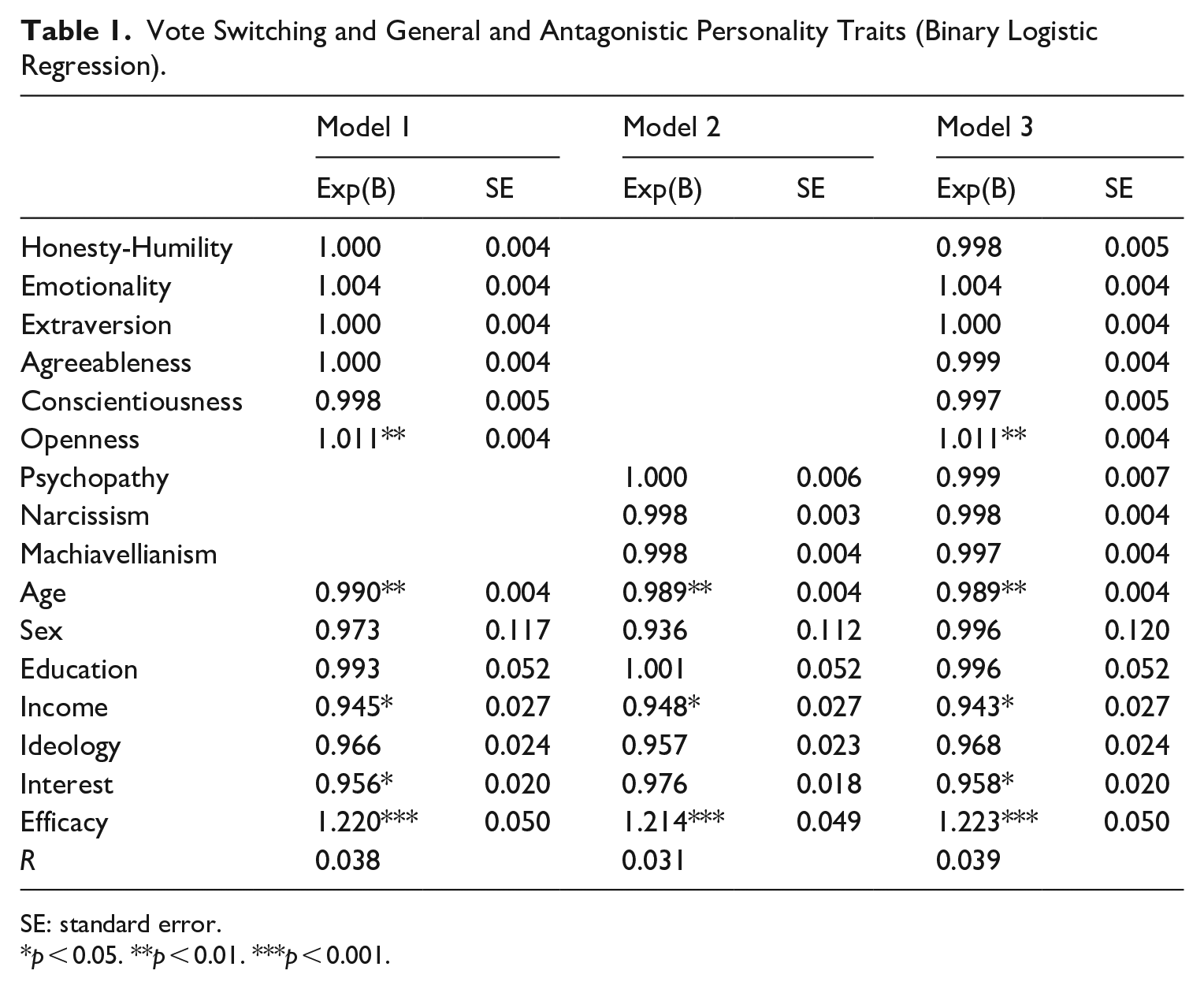
Table 1 provides the results of a series of binary logistic regressions where the dependent variable is an intended change in electoral support. Model 1 includes the six general personality traits of the HEXACO, Model 2 includes the three antagonistic traits, and Model 3 includes both general and antagonistic traits. In all three models we also include a number of controls (age, sex, education, income, ideology, interest, and political efficacy). Beginning with Model 1, we see that older, higher income, and politically interested individuals are less likely to express vote switching intentions. Conversely, those with lower levels of efficacy are more likely to express such intentions. Model 1 reveals that one general personality trait is also relevant. Consistent with the literature, those scoring higher on openness are more likely to report vote switching intentions. Also, in line with our expectations, extraversion is not a significant predictor. Model 1, therefore, provides support for H1 (openness), and provides further evidence that extraversion is unrelated to vote switching intentions.
Vote Switching and General and Antagonistic Personality Traits (Binary Logistic Regression).
SE: standard error.
p < 0.05. **p < 0.01. ***p < 0.001.
Next, we turn to the antagonistic traits in Model 2. We are sensitive to the argument put forward by Sleep et al. (2017) regarding the perils of partialing – that is, concerns about the shared variance of the set of traits. However, when we run the models with each trait separately, the same general pattern emerges: none of the antagonistic traits are significantly related to vote switching intentions. As such, we have presented the simpler results here in which all three traits (psychopathy, narcissism and Machiavellianism) are included in a single multivariate model. Despite our theoretical expectations regarding Machiavellianism and psychopathy, Model 2 provides no support for either H2 or H3. Those higher in Machiavellianism – individuals characterized by strategic planning and ideological flexibility – are no more likely to express vote switching intentions than those scoring lower on the trait. Likewise, those higher in psychopathy – individuals characterized by a callous affect, lack of emotional attachment, and impulsivity – are no more likely to express such intentions either. Antagonistic traits appear to simply be unrelated to our outcome.
Finally, Model 3 includes both the general and antagonistic traits along with the controls. The control variables follow the exact same pattern as earlier model specifications: age, income and interest are negatively related to vote switching intentions, whereas lower efficacy is positively related. As for personality, openness continues to be the only significant predictor in the model. Model 3 therefore provides empirical support for H1 (openness) but not H2 (Machiavellianism) or H3 (psychopathy).
The lack of a relationship between Machiavellianism and vote switching intentions is especially puzzling. After all, this is a trait that is characterized by strategic thinking, planfulness, low ideological commitment, and a general lack of sentimentality or attachment that might keep individuals loyal to a party. These individuals should be expected to engage in vote switching. Despite this theoretical linkage, Machiavellians do not express vote switching intentions at higher rates than other individuals. One possible explanation for this finding is measurement error. While the MACH IV may be the most commonly used measure of Machiavellianism, Miller et al. (2017) examined the ways in which the scale deviates from the original conceptualization of the trait by making direct comparisons to psychopathy. While both traits share an antagonistic core, driven by callousness and a lack of emotion, Machiavellians are supposed to be careful planners and strategic thinkers. Psychopaths, by contrast, should be impulsive risk takers. What Miller et al. (2017) demonstrate is that Machiavellianism, as measured by the MACH IV, is almost undistinguishable from psychopathy and shows relationships with impulsivity that are inconsistent with original trait descriptions. In response to these measurement limitations, Collison et al. (2018) created a new measure of Machiavellianism that more closely aligns with the original trait descriptions, the Five Factor Machiavellianism Inventory (FFMI). In order to fully test H2, it may be necessary to use a more valid measure of Machiavellianism.
Another relevant criticism of this literature is that studies tend to use short, truncated measures that fail to consider the underlying facets that describe different aspects of each antagonistic trait (Miller et al., 2019). Psychopathy, for example, is best characterized by four underlying facets: interpersonal manipulation (glib, superficial), affective (callous, unemotional), lifestyle (parasitic lifestyle, irresponsible) and antisocial (early and diverse rule breaking; Neumann et al., 2007). When examining narcissism, most measures only capture the grandiose type (assertiveness, high self-esteem), despite evidence indicating the presence of a vulnerable type (shame, envy; Crowe et al., 2019). Finally, while Machiavellianism is mostly treated as a unidimensional construct, the FFMI scale recognizes three underlying facets: antagonism (selfish, callous), agency (achievement, competence) and planfulness (deliberation, order; Collison et al., 2018). Failing to account for the underlying facets of each trait could therefore potentially obscure more nuanced relationships with relevant outcomes.
Study 2, as we describe below, addresses these potential measurement concerns. We utilize measures of each antagonistic trait that allow for a facet-level analysis and therefore add a great deal of specificity to the analysis.
Study 2
Data and Measures (Study 2)
Participants for this study were recruited through a national survey panel maintained by Qualtrics. Respondents completed a 25-minute survey that included questions about their demographics, personality, political behaviour and policy attitudes. In order to ensure that the sample resembled the broader Canadian population, quotas were put in place for age, income and sex. The final sample (N = 1725) included 863 women (51%), 854 men (49%), and 8 non-binary individuals with an average age of 49 years (SD = 16.6). The majority of participants identified as White (75.5%), with the remaining 24.5% identifying as a member of a visible minority or Indigenous community. Data were collected online between 29 June 2020 and 22 July 2020.
Consistent with Study 1, our dependent variable is constructed in the same fashion using three items. This time, however, we asked for 2019 federal election voting behaviour as opposed to 2015 voting behaviour given the timing of the survey. Thus, we utilize 2019 reported vote choice and reported vote intention at the time of the survey to construct our dependent variable. All of the same controls (age, sex, education, income, self-report ideology, political interest, and political efficacy) are included in Study 2 as were in Study 1.
Consistent with Study 1, we used individual measures of each antagonistic trait for Study 2. Machiavellianism was measured with the FFMI (Collison et al., 2018), a 52-item self-report measure developed from the Five Factor Model of personality. The FFMI contains three subscales: antagonism (e.g. selfishness, callousness), agency (e.g. achievement, competence) and planfulness (e.g. deliberation, order). In the current sample, Cronbach’s alpha coefficients were acceptable for all three subscales (range: 0.74–0.87). Two aspects of narcissism were measured using the Narcissistic Grandiosity Scale (NGS; Rosenthal et al., 2020) and the Narcissistic Vulnerability Scale (NVS; Crowe et al., 2018). In both of these scales, participants are asked to rate the extent to which a number of adjectives describes how they feel in general and on average (1 – not at all to 7 – extremely). Items tapping into grandiose narcissism include authoritative, dominant and superior while items tapping into vulnerable narcissism include envious, resentful and self-absorbed. Both the NGS and NVS showed acceptable Cronbach’s alpha coefficients in the current study (0.92 and 0.90, respectively). Finally, psychopathy was measured using the Self-Report Psychopathy scale short form (SRP 4 SF; Paulhus et al., 2016) which contains 29 items tapping into the four underlying facets of psychopathy: interpersonal (e.g. manipulation), affective (e.g. callousness), lifestyle (e.g. irresponsible) and antisocial (e.g. delinquent and criminal behaviour). Cronbach’s alpha coefficients were acceptable for all four facets in the current study (range: 0.77–0.82). Rather than total scores, this study draws on the four facets.
Results (Study 2)
Study 2 includes 1431 individuals who reported how they voted in the 2019 Canadian federal election. Consistent with the actual election results, the Liberals, Conservatives and New Democrats again accounted for the vast majority of electoral support. Our data reveal that these parties accounted for 90% of support, whereas the actual election results put these parties at 83%. Our data overrepresent Liberal voters (44% vs 33%) and slightly underrepresent Conservative (31% vs 34%) and NDP voters (14% vs 16%). When asked how they would cast their ballot if an election were called at the time of the survey, nearly a third (31%) of respondents identified a different party than the one they supported in the 2019 election.
For Study 2, we focus on the antagonistic traits and model each trait separately. 9 This allows us to explore various facet-level relationships and their relationship to vote switching (see Table 2). For psychopathy this includes the interpersonal manipulation, affective, lifestyle and antisocial facets (Model 1); for Machiavellianism this includes antagonism, agency and planfulness (Model 2); and for narcissism this includes vulnerable and grandiose narcissism (Model 3). 10 As for our theoretical expectations, we once again explore the possibility that Machiavellianism and psychopathy will be (positively) related to vote switching intentions. Our measures, however, allow us more precision than in Study 1. For Machiavellianism, we are particularly interested in the planfulness facet, whereas for psychopathy we are interested in the impulsivity and callousness facets.
Vote Switching and Antagonistic Personality Traits (Binary Logistic Regression).
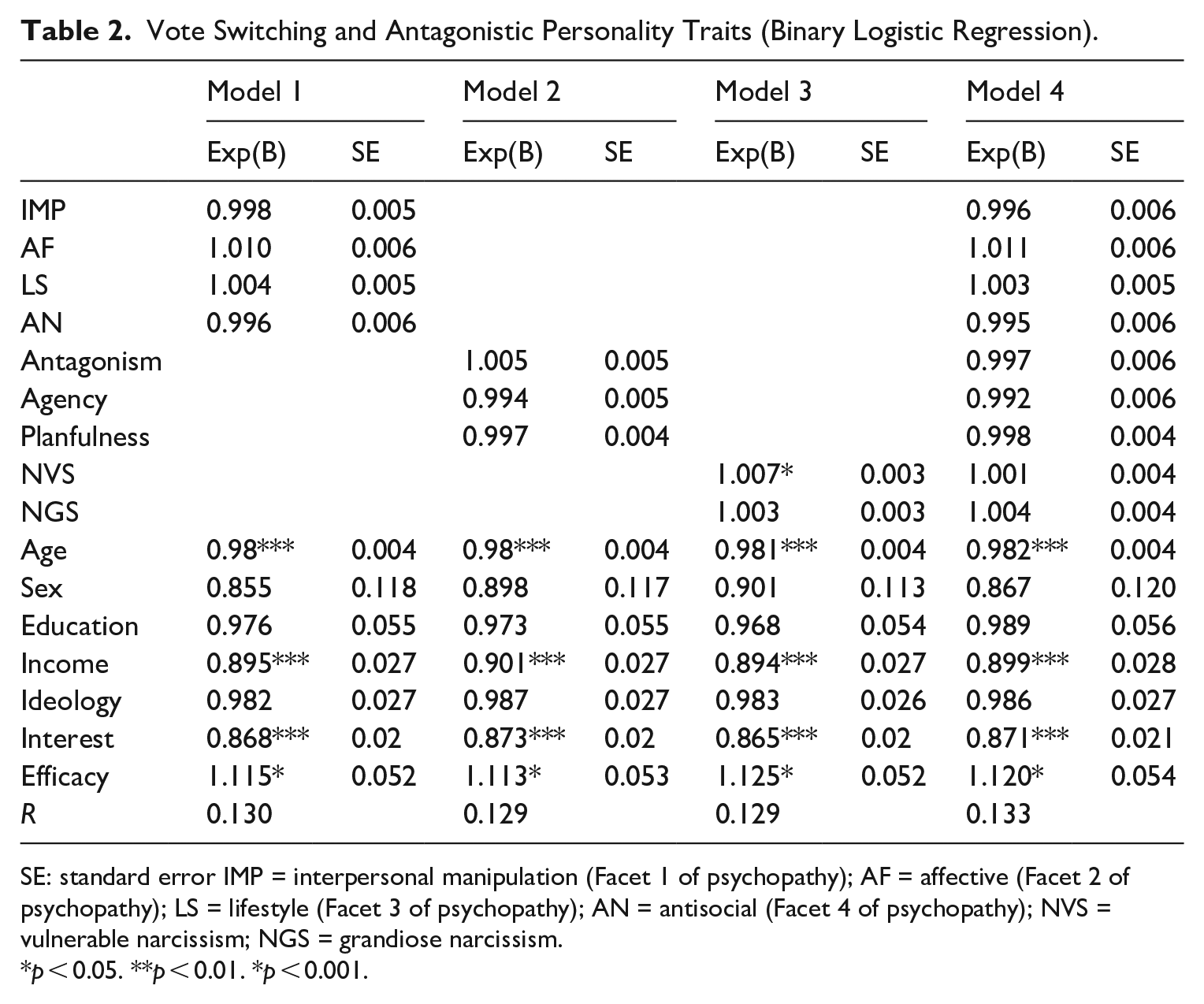
SE: standard error IMP = interpersonal manipulation (Facet 1 of psychopathy); AF = affective (Facet 2 of psychopathy); LS = lifestyle (Facet 3 of psychopathy); AN = antisocial (Facet 4 of psychopathy); NVS = vulnerable narcissism; NGS = grandiose narcissism.
p < 0.05. **p < 0.01. *p < 0.001.
Model 1 reveals that exploring psychopathy at the facet level produces results consistent with Study 1, which utilized a total score: psychopathy is unrelated to vote switching intentions. 11 Model 2 considers Machiavellianism and, consistent with Study 1, we again find no significant relationship between any of the facets and vote switching intentions. Model 3, which includes vulnerable and grandiose narcissism reveals an unexpected finding: vulnerable narcissism is significantly and positively related to intentions to switch one’s vote. Perhaps these individuals are, despite being outwardly confident, unsure of their choices and are therefore prone to vote switching behaviours. Indeed, research suggests that individuals higher in vulnerable narcissism are distrustful, anxious and suffer from low self-esteem and mood changes (Huczewska and Rogoza, 2020), all of which may result in changes in party support from one election to the next. Once all three traits are included in Model 4, however, we find no relationship between any of the antagonistic traits and the propensity to express vote switching intentions. It is worth noting that the controls follow the same pattern in each model: age, income and interest are negatively related to vote switching intentions, whereas low efficacy is positively related. Importantly, this is the exact same pattern that was identified in Study 1. Overall, the results of Study 2 once again fail to support H2 or H3.
Discussion and Conclusion
This study explored the relationship between personality (general and antagonistic) and the intention to engage in vote switching behaviours in two large samples of voting-aged Canadians. While the sociodemographic and attitudinal correlates of vote switching have been a subject of considerable attention (Bakker et al., 2018; Dassonneville, 2012; Lazarsfeld et al., 1965; Zelle, 1995), little of this work has considered the role of personality. Building on the limited literature that does exist, we offered three hypotheses as to how personality traits would be related to vote switching intentions, namely that openness, Machiavellianism and psychopathy would each be positively related to vote switching intentions. Consistent with Bakker et al. (2016), we find that openness is significantly, and positively, related to vote switching intentions (see Study 1). This is also consistent with research by Erisen and Blais (2016), who find that the trait of openness is positively related to strategic voting in experimental settings. Note that our lack of support for extraversion is also supported by the literature insofar as Bakker et al. (2016) find that the trait is only significant in one of their two case studies and Erisen and Blais (2016) find no evidence that it is related to strategic voting. At least in the Canadian case, we find no evidence that extraverts are more or less likely to express vote switching intentions than other voters. Openness, then, appears to be the primary general personality trait at play.
Contrary to H2, Study 1 found no relationship between Machiavellianism and vote switching intentions. Recall that Machiavellians are characterized as being strategic, cunning and ideologically flexible. As such, we expected these individuals to move freely between parties when casting their ballot. Study 1 used the MACH IV, a 20-item scale that is among the most widely used measures, to measure Machiavellianism. Study 2 offered the opportunity to address important criticisms of the MACH IV and to utilize the Five Factor Machiavellianism Inventory (FFMI), a 52-item measure, that captures three separate facets of the trait. Even when exploring the relationships at the facet level, Study 2 reveals no association between Machiavellianism and vote switching intentions. This null finding is therefore replicated in two samples and with two different measures of Machiavellianism. Contrary to H3, our results from both studies also find no evidence that psychopathy is related to vote switching intentions either. This is the case when using total scores (Study 1) and when disaggregating down to the facet level of psychopathy (Study 2). Despite being characterized as callous, unsentimental and impulsive, those scoring higher in psychopathy were not more likely to express vote switching intentions.
How do we make sense of the null findings concerning Machiavellianism, especially given our strong theoretical expectations? Here we offer three possible explanations. One explanation may be that although Machiavellians are ideologically flexible, they are also long-term and strategic planners (Miller et al., 2017). This, combined with their ability to delay gratification, may suggest that Machiavellians are able to adopt a longer-term view of electoral politics that precludes switching parties from one election to the next (even for short-term gains). In this vein, it may also be the case that Machiavellians wait as close to election day as possible (gathering as much information as they can) before making a decision to alter their vote or not. Such a possibility is not captured in the design of the current study. A second explanation for the null results focusses on a possible lack of expected payoffs. Simply put, the benefits of gathering the information needed to engage in carefully planned (strategic) voting in a complex multiparty environment, such as Canada, may not be worthwhile for Machiavellians who might perceive limited personal gains for their efforts. Finally, the null results presented here may be an indication that Machiavellianism is perhaps less of an inherently political trait than we might generally assume, a suggestion that is consistent with recent research (Blais et al., 2022; Chen et al., 2021; Pruysers et al., 2019).
Overall, this study contributes to the literature in a number of ways: it explores a question that has received little attention; it expands the existing analysis beyond general personality traits to include potentially relevant antagonistic traits like Machiavellianism; and it draws upon large and well-validated batteries to measure personality. Ultimately, we find that only openness is a reliable predictor of vote switching intentions. As we end, it is worth highlighting a number of limitations and avenues for future research. First, our data do not capture differences between strategic voting specifically and vote switching more broadly. While similar, the two are not identical as the former suggests a strategic motivation (preferences have not changed so much as strategy), while vote switching may be the result of a wider array of factors (ambivalence, genuine changes in preference, etc.). Future work would benefit from clearly separating the personality correlates of vote switching from the correlates of strategic voting, perhaps in an experimental setting. The null Machiavellianism results in particular raise important questions regarding when and under which conditions voters who are characterized as ‘cunning’ and ‘strategic’ would in fact engage in behaviours such as strategic voting. Building on the time-of-vote-decision literature, for instance, future research could consider when Machiavellians make their voting decisions and examine whether this differs from voters with other personality traits. A second limitation is that our data do not include panel data. Longitudinal data would allow us to capture actual voting behaviour at multiple points in time as opposed to vote intentions. Panel data would push the analysis beyond intentions to actual behaviours. Overall, however, the null results presented here provide important insights and a number of avenues for future research.
Footnotes
Declaration of conflicting interests
The author(s) declared no potential conflicts of interest with respect to the research, authorship and/or publication of this article.
Funding
The author(s) disclosed receipt of the following financial support for the research, authorship and/or publication of this article: The research was funded by a Social Sciences and Humanities Research Council (SSHRC) Insight Development Grant (430-2018-00950).
