



Abstract
Nations are resilient and often taken for granted as an analytical category in most social sciences. Academic literature has highlighted the industrial and capitalistic origins of nationalism, espousing the formation of modern statehood as well as the revitalized re-elaboration of ethno-genetic elements into that same modernity, even when ‘imagined’ and ‘invented’. Certainly, the organizational and ideological capacities of nation-states are sociologically ‘grounded’, yet less attention has been given to nations’ capacity to adapt their sociogenetic identity. This article seeks to interpret and contextualize the issue through the theorization of national resilience as a mid-range concept by offering analytical instruments.
Introduction
Nations comprise a taken-for-granted category that spans most social sciences. The nation-state is a socio-political construction deeply rooted not only in modernity but also in our collective action and imagination. After all, the current structure of most societies, despite the vigilant post-modern critique, remains attached to the nation-state’s cognitive and emotional capacity to generate a strong and comforting sense of belonging in each and every one of us. This is due to the nation’s intrinsic resilience, that is, the ability to face and overcome changes through an equilibrium of adaptation and self-preservation. Consequently, the nation-state evokes stability and incorporates and naturalizes the discourse we often use. The persistent ‘hold’ of the nation is due to its intrinsic resilience, and it owes much of its success to the bicephalous conceptualization of the nation-state’s model alongside historically traceable canons, namely the progressive and systematic rise of capitalism and the industrialization in Western Europe (Gellner, 1983; Hobsbawm, 1975, 1987). Either the fruit of re-elaboration of proto-historical, symbolic and ethnical genealogies (Connor, 1990, 1994; Smith, 1986, 1991) or of collectivizing imaginary implying community invention (and intervention) in the form of rituals, praxis, common knowledge and heritage within modern identities (Anderson, 2006; Hobsbawm and Ranger, 1983; Thiesse, 1999), nationalism has certainly been an efficient socio-political disposition. In this regard, Mosse (1974) has explained very well how the ‘nation’ has been used for the purpose of mass mobilization by some of the largest European political movements. This theory anticipates, to some extent, the theocratization by Brubaker (1996: 83-85) on nationalizing nationalism, in which a ‘core nation(ality)’ is activated to build a strong relationship between the nation and the state. Nationalism entails an organizational and ideological force majeure that postulates much of the structural perseverance of the nation-state, despite domestic and geopolitical changes (especially in contexts of ethnic/territorial conflicts). According to Malešević (2019), the latter is ‘grounded’ in the interdependence of coercive bureaucratization, centrifugal ideologization and development of micro-solidarity networks in modern nationalized statehood. This point, however, must not exclude that even populations whose ‘national’ experiences and trajectories have been centrifuged by domestic conflicts are merely the outcome of top-down indoctrination. Anderson’s (2006) imagined communities traces the cultural emergence (i.e. the maximization and circulation of common foundations providing basic cultural features), aimed at creating and constructing feelings whose ‘international’ viewpoint gave birth to socially ‘organic’ modern nations. Notwithstanding, the set of sociocultural features is susceptible to transformation and re-definition. The self-fostering national postulate is axiomatic, yet it remains intact as long as it engenders content and adapts to novel circumstances in order to occupy the societal political ‘vessel’ of a definable polity. Here, the triadic relation of nation-state sovereignty becomes meaningful. As observed by Galli (2019), national sovereignty is not a once-and-for-all condition. A similar assessment is expressed by Conversi (2020, 2016) who, in front of the epochal challenges of globalization, proposes the conceptualization of ‘liquid sovereignty’ and reassesses the adaptive ‘Janus-faced’ plasticity of nationalism. That is to say that the nation-state consists of dialectical, dynamic and double-edge properties: stability through adaptability and multifacetedness. Hence, the nation shifts between timed aggressiveness (often ethnos-led) and routinized banality, namely hot and cold nuances of its collective actions (Billig, 1995; Skey and Antonsich, 2017) without necessarily excluding the civic-minded constrictive potential of democracies, especially once constitutional republican patriotism is considered (Tamir, 2019; Viroli, 1995). Given the premise of adaptability and multifacetedness, the article seeks to interpret and contextualize national resilience and adopts it as a mid-range concept. The aim is to explain national resilience as a result of nations’ processual formation, stratification and diversification, epitomizing the capacity to adapt and endure, in relation to the state, a complementary socio-political structure by its own right. The article uses the concepts of ‘survival unit’ and ‘habitus’ to bridge sociological and political traditions.
The (Identitarian) National Adaptation. The Habitus and the Survival Units in the Various Levels of the ‘Nation’
Literature has given ample room to the nation-state and its foundational ideology (i.e. nationalism). The ideological and organizational features of the latter encompass several contradictions but make the ‘national’ a highly adaptable category. Nevertheless, the literature focuses on the nation as an integral part of the state. Scholars mainly look at the merging of the ideological appeal of the ‘nation’ and the structure-providing functionality of modern statehood. No doubt the two features are the most transversal and successful political formations, inasmuch as the modern nation-state represents all existing polities, even the most federate ones. Yet, there also exists the proper level of the nation, usually under-estimated by mainstream scholarship. So-called ethno-regional/trans-regional, diasporic and exilic nations find neither collocation within the nation-state model nor interpretative explanatory to their processual formation outside the transformative and progressive axis on which modern statehood has developed. To put it differently, local socio-political identities are often categorized as ‘subnational’, as if the label ‘nation’ consisted of less developed social forms, thus often dismissing political and juridical recognition vis-à-vis the centralized politically hegemonic nation-state. There is almost no escape from this analytical dichotomy. Most scholarship negatively connotes national sentiment with blood and land (the ‘ethnos’) yet positively considers the state’s civic patriotism – which often reduces the ‘national’ to the state’s primitive pretext – while turning a blind eye on different national sociocultural features. Consequently, this state-centric interpretation cuts the richness of political identities short. The aim here is to provide analytical explanations to the parallel processual formation, stratification and diversification of the ‘national’ as the source of resilience alongside the state, without excluding neither the first nor the second.
In order to delineate the long-term processes enabling national resilience, we adopt the sociological concepts of habitus (Bourdieu, 1998; Bourdieu and Wacquant, 1992; Elias, 2000, 2001; Roodenburg, 2004; Sapiro, 2015) and survival unit (Elias, 2000), inasmuch as both explain the generative relations between individual practices as originated in social behaviour. Placed in the context of nation-building, these two concepts bridge politics and society at a meta-level without neglecting either the individual or social levels. Both mutually include a seemingly faint sociocultural “mentality”, precariously relevant to the political order in force or as a purely stereotypic civilizational inevitability between antagonistic polities clashing with one another (Harrison and Huntington, 2000; Huntington, 1996). Nonetheless, there is no doubt that these mental socio-political constructs attest rather different intensities depending on context and circumstances. Although the degree of intensity is subject to change, such mentalities are structured in/by a set of codified dispositions. ‘Habitus’ denotes the creation, interiorization and reproduction of behavioural norms, patterns and identity-defining elements by individuals who are socialized into a specific collectivity. Not only does the habitus explain attitudes, representations and practices, it also traces the dynamic construction of norms and rules, as well as of socio-political strategies, vacillating between interest and rationality, on the one side, to illusio, on the other, between ‘practical sense’ (sens pratique) and cultural manifested preferences (the Bourdieusian ‘taste’ 1 ), from the seemingly transcendental and symbolic to the concreteness of reason and political participation. With such a wide spectrum of classifiable mechanisms forging human conduct, the habitus is a unifying formula whose ‘generative (if not creative) capacity is inscribed in the system of dispositions as an art, in the strongest sense of practical mastery, and in particular as an ars inveniendi’ (Bourdieu and Wacquant, 1992: 122). This psychic ‘personality makeup’ (Elias, 2000) thus implies a process that begins at birth and continues throughout a person’s childhood and adulthood. It is neither formed nor reproduced in a void but rather in a given, continuously evolving, socio-political figuration (Elias, 2000; Van Krieken, 1998). Each and every social construct seeks to secure a viable equilibrium between conservation and novelty vis-à-vis change. Since both are necessary elements for social cohesion, division of functions and social reproduction, continuity and adaptation cannot be but the fundamental features of social resilience. This same resilience contains and fosters the ‘habitus’ by providing a basis for interactions, differentiated power-ratios and interdependencies to take place. Insofar as nations are socio-political collective constructs, their proclivity to foster resilience is not different. The figurational ‘survival unit’ of a specific nation-state not only echoes the need to overcome difficulties from within, namely the traditional antagonistic competition among factions and classes, but it also describes a collective aggregator, whose primary disposition is resilience, given external threats deriving from a risky and hostile environment to cope with (i.e. the international system, global climate change, pandemics, etc.). 2 That is to say that the analytical tools of ‘habitus’ and ‘survival unit’ frame and bridge diverse realities and trajectories, which are intrinsic to modern nation-statehood and to which national identities conform and draw ‘nourishment’ from. Both concepts thus permit to delineate, contextualize and assess the dialectical nation-state relationship and the formation process of the ‘national’, while avoiding reductionism. 3 Furthermore, it is important to note right at the outset that this conceptualization perceives resilience as adaptation and transformation occurring in all types of societies regardless of their scale (Folke, 2016). The twofold dynamics concerning structural continuity and integration of change results in the codification, normalization and routinization of a collective sense of belonging, therefore, in a habitus developing within a determined survival unit which is socially stable.
The National Resilience as a Capacity for Socio-Political Regeneration of the Nations
Massive events in history, such as wars, conquests, the creation/dissolution of states, genocides, pandemics, and so on (Weber, 1976), have continuously transformed social life. Consequently, national identities had to resist, reshape and regenerate themselves, from a socio-genetic point of view – even when they seemed too close to disappearing. National identities generally entail a common basis of beliefs, mutual recognition and self-awareness in more or less homogeneous groups of people (Grosby, 2005: 7-16; Guibernau, 2007: 9–11). As also delineated by the sociological literature on habitus and survival unit (see above), the latter share a set of historical, cultural and socioeconomic characteristics that are socially situated. In this respect, the concept of territory appears central 4 because it is configured as the physical, ethical and political space in which the aforementioned characteristics can be asserted; 5 but it is not the only one. 6 In a primordialist-perennial sense, national identity accompanies, even without the protagonists’ awareness noticing it (Grosby, 1995, 2002) the same human ethnic groups, whose characteristics would then be collectively used for political purposes, almost as national constructions, beyond the intention of the protagonists (Geertz, 1973). Without necessarily adhering to this perspective – or to the ethno-symbolist one – one remains with a modernist approach, 7 which most existing literature on nations and nationalisms leads to. Yet, there is an element that remains an open question: How is it possible that, in objective conditions of weakness, such human groups have maintained a high level of ethno-national awareness? How, although not always politically activated, has a collective sense of belonging been kept in nuce? A first and intuitive answer would concern the creation of modern states in Europe (Conversi, 2012; Tilly, 1975, 1995). In addition, certainly, national identity is an attribute, a prerogative, based on the time present (Breuilly, 1982). National identities represent the starting point of the reasoning that we will try to carry out (Thiesse, 1999: 11-18, 2007: 15–28). The resilience of the nation-state and its identity are fostered by a national habitus. Therefore, there is no real scientific reflection on how nations and national identities have tried to adapt to the changing contexts and not to disappear (or at least, not to change so much that they disappear). It could be argued that national identities are products of the nationalism that created the same states. It appears that ethnic identities, a historicized precondition for national ones to be codified, continue to exist even without statehood (Chandra, 2006). A new concept is analytically needed to describe and explain the ability of nations and national identities to adapt and, more and more often, to emerge victorious from the battle against state centralization. We propose that this concept be that of national resilience. Without any attempt to downsize the three major research perspectives on nationalism, we believe that the concept of national resilience facilitates the study of case studies, regardless of the specific theoretical approach. The driving force of a determined ‘nation’ may change according to ethno-symbolist, primordialist or modernist interpretations; however, national resilience remains an intrinsic property.
We define national resilience as the capacity of a given national group, a population that identifies itself via the construction of common characteristics attributable to a nation (kinship, language, religion, etc.), developing all adaptive strategies, aimed to reproduce, strengthen and transmit national identity through habitus-stratification for the future of the national survival unit (either or inside statehood). The leitmotif of this process lies in a political sphere as it is consensus-based, making opposition necessary for the activation and mobilization of collective resilience. The state is the frame, the multidimensional space, where the phenomena of national resilience materialize. It facilitates these adaptive processes 8 while representing a historically successful bond between the institutional organization of powers and the management of citizens’ lives. However, depending on whether the state is a possible ally (or in any case, a fact that does not represent a problem or a threat) or a rival of the resilient will, we can identify two fundamental specific empirical types. The first type is that of state-centric national resilience. In this case, the protagonists of identity adaptation look to the state either as a fact, hence a polity not to be questioned, or sometimes as a political dimension that can be taken for granted. Moreover, the same undertakes a fight against the state, not so much to eliminate it but rather to change some of its characteristics considered harmful and dangerous for the same national identity. 9 The second type, on the other hand, is that of stateless national resilience. In this other case, on the contrary, the protagonists mobilize against the state, in order to safeguard different specific national identity, albeit characterized by a macro-identity that is nevertheless built at the centre. 10 In fact, often the population or its elites who mobilize along this second level exercise a national resilience of different degrees ranging from the search for a greater degree of cultural autonomy to a resilience resistant to the state, with the aim of overcoming the reference polity. In this other case, we would therefore mobilize against the content as well as against the container that is the state itself. 11 That said, both typologies of resilience (state-centric or stateless) are processually stratified properties of adaptation that develop in time and space in relation to an established state. Unlike state-strengthening or state-subverting nationalism which refers to relations of domination and the enactment of political strategies, as expressed by political movements and drawn from the guiding ideology of nationalism (state-strengthening as a top-down strategy, whereas state-subversion as a bottom-up or grassroot strategy), state-centric national resilience or stateless national resilience are sociological and political features anchored to adaptational capacity rather than specific actions vis-à-vis a determined polity. National resilience is thus a property of the national habitus that is capable of overcoming what Pierre Bourdieu referred to as ‘hysteresis’; that is, a state in which the interiorized dispositions of the habitus clash with the external environment and its objective conditions. According to Bourdieu’s field theory, volatile times, characterized by dislocation and disruption of societal regularities, engender such hysteresis effects (Bourdieu, 1977, 2000) The resilience of the national habitus adapts to these multi-level and multi-temporal structural changes, and consequently allows the re-stabilization of power relations, despite the mismatch between norms and possibilities.
National resilience therefore indicates the set of dispositions that actors may put in place in order to regenerate attachment to a national collectivity. National resilience is characterized by a series of factors (historical-cultural, socio-economic, religious, political, etc.) – which are both internal and external to the nation itself – and which determine and characterize the adaptive strategy of actors in a different way. As if in a living organism subjected to changeable conditions, these actors react, since they are potentially capable of altering the modes of identification with the nation. By means of their national identities, socio-political actors adapt to new situations and overcome moments of systemic crisis (i.e. the adoption of new legal rules, great reforms of policies, changes in international relations, etc.). The first step to take is to recall the reasons that create the need for resilience, or the causes that activate the resilient process, and identify, at the same time, who can be the actors involved. Nations/national identities are subjected to constant change; thus neither mechanic nor identical nor emulation-led but rather a balance between adaptation and preservation. These dynamics are due two types of factors: (1) endogenous and (2) exogenous.
The first kind, the endogenous type, finds its origin within the state-national system. It occurs when there is a mismatch between state and nation. Some examples are in order: a failed juridical-institutional and constitutional adaptation to the changing objective conditions of the context concerned; the establishment of new values and new goals in society and in the entire citizenship; a new design of the education system and training system; a revision of national founding myth of the nation; religious counter-positions; and economic and development cleavages. 12 The second, the exogenous type, is on the contrary traceable outside the state-national system, in this case: the effects of an international redefinition of the borders of a given nationhood; war events and annexation processes; situations of oppression towards a national group not recognized or dealt with by the international community; moments of global economic crisis; migration processes that directly affect the population concerned and/or its territory; flaws in the international law process on the recognition of certain rights; coups d’état and any external responsibilities in the same; particular situations of health, agricultural and environmental crisis such as to jeopardize the survival of the nationality; changes on the geopolitical chessboard; and processes of (de)colonization. We prefer the usage of nationality, over ethnicity or kinship, since the former indicates a sense of belonging that characterizes a specific human group in which individuals are interlinked through either kinship or various collective cultural identities (e.g. language, customs, religion, etc.) and whose identification is self-(re)produced. As asserted by Cox (2021: 33), nationality is a ‘collective and individual identification with a nation, which expresses itself in the beliefs, idioms, and practices that constitute nationalism’ (italics in the original). Hence, unlike the more common, yet often politicized, monothematic and vertical concepts of ethnicity or kinship, ‘nationality’ may include religion, traditions and cultural codes of behaviour shared by individuals with no direct blood relations. Cases such as the Flemish and Walloon in Belgium but also Swiss ticinesi and jurasiens, Greeks, Armenians, Kurds, Palestinians in Asia Minor and the Middle East present components of sociocultural which cannot be labelled through ethnic identification alone. This does not mean that these cases and other are not politically ethnicizied but it means that their national features transcend the mere natural connection and assume social valence.
In this regard, both exogenous and endogenous factors building resilience should be understood in their interdependence and not as exclusive types. Furthermore, the degree of intensity with which they occur can be variable according to the contexts and at the diachronic level; it is at the same time for each context considered. Still, not all nationalities react in the same way – therefore, they perform resilience – in relation to certain historical events and societal transformation. Often, even resistance 13 lies within the resilience, in order to ‘defend’ a nation from decline and disappearance. It requires, in fact, phases of action with phases of inaction (at least apparent). Noteworthy is the fact that any kind of adaptation is process-based and requires political action. Adaptation, in the sense we would like to specify, does not correspond to the absence of action. On the contrary, it is an action that, in fact, consists in adaptive processes rather than of a counter-position. The protagonists of national resilience should not be interpreted as silent actors for most of the time and resigned to change as if it were an unavoidable and unchangeable fact. On the contrary, many resilient strategies therefore show a multiplication of actions on the part of nationality while acting on the identity and its politicization.
However, for this concept to be fully understandable, it is necessary to identify empirical references capable of concretely showing the various aspects of national resilience. In order to be more precise, it seems that the two types of national resilience are useful state-centric and stateless. They constitute the ground, of a multi-level type, on which nations exercise their resilience, with the use of habitus and survival units which have the main purpose, in the Bourdieusian sense, of resisting to the presence of potentially dangerous situations. The latter – as we have seen – engenders tensions on national identities, which we have indicated as endogenous and exogenous types. The habitus is a set of behaviours and models that are used, from both a social and political point of view, by a specific nationality. This same nationality – endowed with specific, albeit not exclusive, characteristics – therefore possesses the resources to activate an adaptive process. With this, the nationalities seek a modification or change taking place concerning one’s own nation/national identity. It is precisely within this corpus and based on the peculiarities ascribed and ascribable to a given nation that we can identify, concretely and empirically, the resilience strategies implemented. Since these processes are dynamic and contain various political aspects, the figuration is socio-political inasmuch as it is characterized by performative national identity. Individuals act as political collectivity which is interdependence vis-à-vis other socio-political groups. The purpose of these actions, adopting the Eliasian sense of the term, is to safeguard the survival units which, being particular forms of social and political union between individuals, in our case correspond – here too – to nations. Nations, following this approach, are therefore survival units which, through certain habitus, employ strategies in order to last.
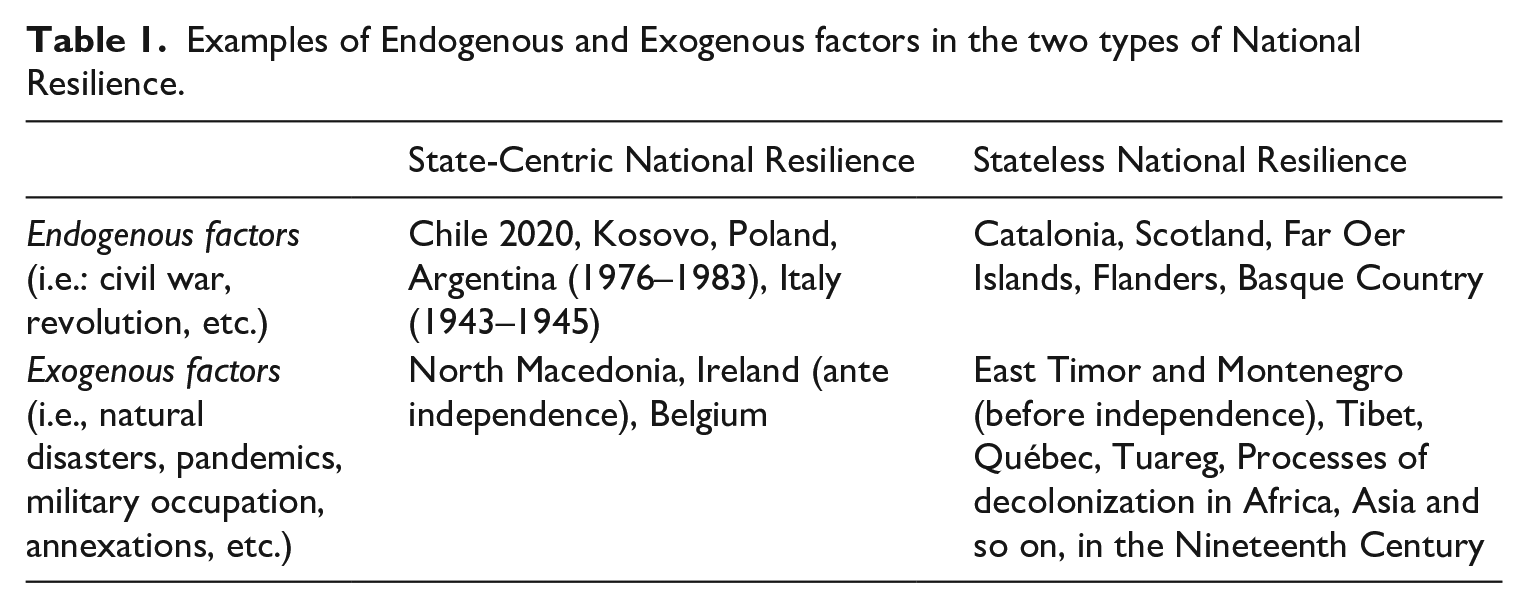
There are two different forms of national resilience: (1) state-centric and (2) stateless. In the first, the state-centric, we find strategies of resilience performed by socio-political actors’ frames by and within the nation-state. Examples are numerous: the requests for total or partial changes to the Constitution (as recently in Chile through the referendum of October 2020) identified as a legacy of the past; from the birth and strengthening of populist and xenophobic political parties founded as a pretext for the defence of one’s national identity (against other identities or identities deemed non-existent, such as that of the EU), to the invitation to recover some symbols of the state considered in danger because they are denied or in disuse (like the name ‘Macedonia’ with the recent quarrel – from 2018 to 2020 − between Greece and North Macedonia which also involved the elders of that community); from an increased role of religion and religious heritage (as in Solidarność Poland and in the Catholics of the pre-independence Republic of Ireland), to the exaltation of specific sports rituals in difficult contexts. In the second case, the stateless form, national resilience is reproduced by stateless nationalities, in which the specific national identity is less and less experienced as the same as that attributable to the centre of the state-national system. In these cases, it is increasingly evident, in today’s reality, which national resilience leads to the creation of a different state organization as a medium-long-term objective. In other words, there is a polity claim aimed either at the recognition of political-juridical powers attributed to that nationality or at the creation tout court of a state in itself. To the supposed attempts to reduce the established powers and one’s own national identity (expressed, for example, through a different language from the one spoken in the centre), a certain survival unit, such as the cultural organizations of Catalonia to the whole of Catalan society in order to implement the creation of a sovereign state, is incorporated. More or less with some variations, this is the same process that also affected Scotland or Quebec, or other nationalities that have obtained greater powers, especially in terms of representation and accountability, even within the same State (e.g. Wallonia or Flanders in Belgium, Swiss cantons, Basque Country in Spain, Corsica in France, Sardinia in Italy, etc.) or to a real independence, with or without war events (from East Timor to Montenegro and so on). In these cases, nationality and one’s own identity have been fundamental in the ‘education’, with a sometimes very long process of political pedagogy, 14 of nations as a whole, through a rediscovery, only apparently ‘harmless’, if we are allowed this forcing, of its historic-artistic and archaeological heritage, together with its founding myths (via the presence of a mythomoteur: Smith, 1986), as in the Far Oer Islands or in the Basque Country.
Table 1 presents the possible linkages between endogenous/exogenous factors and state-centric/stateless national resilience. The theoretical and methodological value of these relations is the intercrossing of objective and subjective conditions that impact the trajectory of a given nationality. In more empirical terms, war against foreign occupation is exogenous to a state-centric national cause, and generates resilience through state-strengthening (top-bottom), whereas endogenous inner-state struggles such as revolutions, civil war and socioeconomic crises put in motion a bottom-up state-subversion. Nonetheless, all these examples refer to macro-phenomena which are built through crossbreeding that is combined in different situations of danger for one’s own nation (threats) and attempts to adapt. Examples of the endogenous kind, namely those of independentist movements and political initiatives (mostly referendums) such as in Catalonia and Scotland portray resilience towards a well-established status of the state whose rights are applied, at least formally, to citizenship but whose nationality has not found full political expression and acknowledgement as autonomous.
Examples of Endogenous and Exogenous factors in the two types of National Resilience.
The usefulness of nationality, in these cases, cannot transcend the simple ‘banality’ of nationalism (Billig, 1995). It is true, in the national resilience processes, very often those aspects of national sentiment that Billig himself placed on a different level, such as flags, national anthems, symbols printed on coins and so on are very often important, sometimes decisive. Symbols are capable of triggering an emotional force in the nationality (in its etymological sense, thus as symbolic-cultural as political) that is decisive for the future resilient mobilization.
Towards Resilient States Because Resilient Nations?
After having defined the relations between national identities that processually engender resilience and thus adapt to multifactorial contexts, it is time to put things in order, to propose an interpretative effort of categorization. Suffice to say that there is no deterministic intent in the following elaboration. Inasmuch as there may be or not conditions for resilient nations to develop, and forms of statehood may easily differ, there is a need to address the issue starting from the premise that the analytical construction here proposed consists of two kinds of ideal-types: the (a) descriptive one, which is an empirical means of stylization, thus, of theoretical generalization beyond the strict singularity of a case study that aims at adding a sort of representation of reality from reality and (b) the ideal type as a speculative methodological tool, based on selectively chosen elements of reality through which enquiry is modelled. As asserted by Gaxie (2013) – while referring to Weber’s own distinction – the two kinds must be distinguished but not opposed, in order to permit a simultaneous and alternative mobilization of the two valid intellectual tools as long as both are in adequate relation to the progressively comprehension and explanation of any socio-political phenomenon. With regard to national resilience, there is also the question of whether existent states are resilient due to their state-centred structure or because of the nation-related capacity to adapt within statehood. Since modern statehood implies the institutional acquis of specific and technical expertise, especially legal and financial (e.g. collection of taxes, judiciary, administrative bureaucracy), the state structurally deploys mechanisms of both social control and socialization (i.e. public schooling, military service, employment in the public sector) and, thus, provides a societal ‘skeleton’ on which collective national identity can grow and develop. Yet, the structures of the state are not the only collectivizing force macro social relations of resilience may originate from. Stateless ‘nationalities’ also show resilience (see above), as the former are structured into habitus-producing survival units, hence possessing the ability to maintain socially and politically relevant dispositions over time, which codify and adjust them in case of adaptation. Hence, the nation-state seems effective and efficient, inasmuch as it encompasses both the technical means and the national identity attached to it. Consequently, one might ask the following questions: What kind of interdependence can we sort, if any between national identity, with or without statehood, and the procedural and administrative construction of the state? Does the former sustain the latter, or do they sustain each other, mutually and equally? The speculative ideal-typical construction permits to tackle these issues, not in a strictly normative and organizational perspective (as Weberian bureaucratization: Blau, 1956; Tilly, 1975) but rather from a vantage point concerning the morphologies and typologies of generalized past experiences of statehood, more or less susceptible to change.
Table 2 contains the morphologies of different polities in terms of collectivizing ‘survival unit’, namely state with one nation (ethnic nation-state), state with more nations (multi-national state), nation with no state (stateless nationalities) and nation with more states (trans-state nationalities). In the latter category, there might be an overcrossing as in the cases of the Kurds or Berbers, whose populations live in different states but have not achieved nation-state sovereignty. These analytical ideal types are generalized as much as generalizable.
Types of Survival Units and Morphologies of Different Polities.
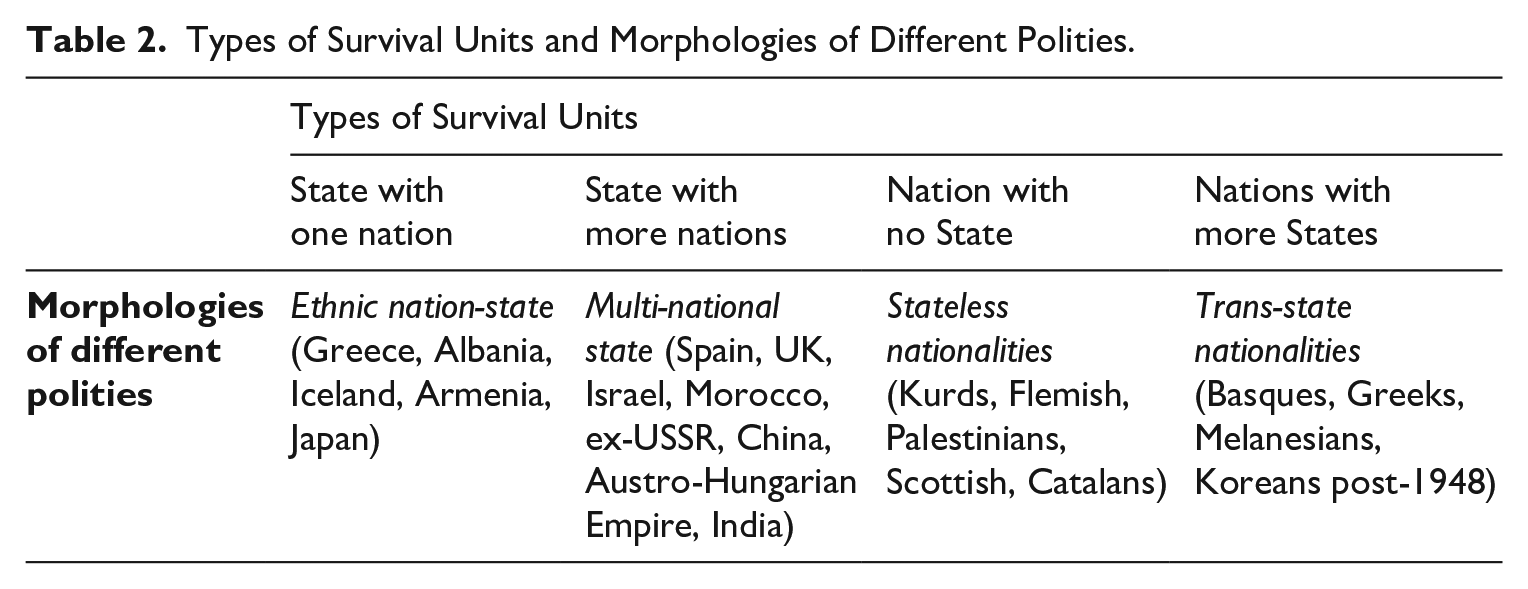
Yet, more importantly, they encompass the following possibilities:
Resilient state consisting of resilient nation, since ethnic and cultural majority is solid (e.g. Austria, Denmark, Finland, Iceland etc.).
Non-resilient states containing resilient nations (multi-ethnic and multi-confessional empires of the past but also contemporary failed states where large minorities are governed by other minorities, i.e. Iraq, Lebanon, Syria).
resilient state, resilient/non-resilient nation: an analytical speculative ideal-type which sees an anchorage to the state but which can host, mutably, either resilient or non-resilient nations. Although apparently void, 15 this category can contribute to the theorization of federalism as a hybrid twofold ‘survival unit’, which bridges features of both nation and state, enabling national resilience in which federate states exercise local autonomy vis-à-vis the federal administration like in cases of consociational democracies 16 or in polycentric culturally differentiated states such as Belgium, Switzerland and even Spain. This ideal-type does not necessarily mean lack of inner tension or conflict.
Non-resilient state and non-resilient nation: this last ideal-type seems empirically null, especially as we all live in a nation-state-bound society (the fortunes of the state-nation model are discussed in Malešević, 2019). However, it is a socially impossible zero-sum that can ideally typically overcome the dichotomous and antagonistic competition between national identities and states’ geopolitical realpolitik. Although hazardous, one may ask whether the twofold lack of resilience, conceptualized as originated neither from state nor nation, is indeed unthinkable or whether it reflects socio-political scenarios, resulting in the hybrid form of federative statehood aimed at avoiding extinction of societal structures, by opting, at least in principio, for a pluralistic citizenry based upon universalistic norms.
Certainly, all these analytical categories depend on changing contexts and on the possibility of evolving socio-political dispositions. Yet, they also bear a methodological value, since they invite to process-trace the interdependencies of ‘contained’ nationality(ies) in a given political entity. This explanatory potential places each case in its particularity, without neglecting the processual stratification of national resilience. The theoretical ideal-type, therefore, is not to be taken deterministically, as all other ideal-types. After all, the resilience characterizing nation-states is the product of historical processes of nation-building and state-building as well as the differentiation of fields that interdependently cross each other. The fundamental point is the viability of balance between adaptation and preservation, modelled by endogenous and exogenous factors. While rethinking the civilizational processes and the appropriation of sociocultural codes shaping human experience as a whole, wider multi-modular social figurations, as conceptualized by Elias (Mennell, 1989), may take form as global survival units in which nationalities and consequent identities engender resilience, not through exclusionary statehood but through societal structures yet to be formed. Utopia aside, there are concrete variations that validate the two types of resilience. Modern statehood replaced, integrated, co-opted and monopolized nationalities into their procedural bureaucratic normative apparatuses and collectivized symbolic discourse (e.g. national anthems, national flags, national food etc.). Yet, neither the 20th century nor the 21st century is free of national conflicts among states or within their borders. The resilience deriving from the nation is a powerful resource that politics and society at large are not timid of using.
Conclusion
National resilience is therefore the capacity of a national collectivity to maintain equilibrium between the adaptability to change and the preservation of structural features, in order to transmit and reproduce its political identity. We conceptualized this socio-political mechanism taking inspiration from political studies on nationalism and processual sociology regarding identity and state-building. The concept, consisting of the dialectic combination of continuity and adaptation, is an advantageous analytical instrument to better frame the interdependencies and interrelations of the stratification and mutable dialectics between nationhood and statehood. Questions such as how nations respond to internal and external challenges are conceptualized through dispositions of adaptation, layered by a national habitus and structured by a political survival unit. National resilience is thus a processual dynamic adaptation to changing circumstances. Such actions are constructed in relation to exogenous and endogenous factors and thus engender different morphological combinations, witnessing the nation and state in their complex socio-political identities. Moreover, as stratified non–deterministic relations, national resilience presupposes the continuous socialization of actors whose aim is to safeguard national identity in different contexts. National resilience may find expression vis-à-vis the state by nations which identify themselves as stateless or by full integration of nation-state relationship (the success of the nation-state model). As each nation develops forms of resilience, their capacity of facing change may be as important as the organizational capacity of the state apparatus towards the contemporary challenges we live in. The aspect that seems noteworthy is that national resilience draws its origins from both ethno-cultural identity and from the state structure (i.e. administrative, legal and bureaucratic systems). This approach enables the study of the nation and reveals the processual figuration of nation and state building from a socio-political long-term analysis. Although a first attempt of novel conceptualization – result of an interdisciplinary dialogue between political science and sociology – the interpretative key of national resilience and the dynamic dispositions involved in the adaptation and survival of the former seem to bridge the traditionally separate studies on nationalism and state. Inasmuch as globalization poses human society before transnational challenges (climate, ecology, pandemics, terrorism etc.), engendering more intricate and tighter interconnections and interdependencies there might be required to find novel ways to channel both kinds of resilience and transform them into global constitutive collective dispositions, a sort of bridge between different nationalities and polities. Studying national resilience while keeping a close eye on the state might inspire both theoretical and empirical enquiries, regarding national identity and statehood in contemporary politics.
Footnotes
Declaration of conflicting interests
The author(s) declared no potential conflicts of interest with respect to the research, authorship, and/or publication of this article.
Funding
The author(s) received no financial support for the research, authorship, and/or publication of this article.
