




Abstract
This research analyses the demand-side of politics in Southern European countries, investigating how three relevant voting determinants have changed throughout time. The focus is on Greece, Italy, Portugal and Spain, and the examined variables are the European Union, immigration and state intervention in the economy. The period of analysis is 2009–2019 and we identify the structure of political conflicts from the point of view of voters. We find that the electoral support of parties has been increasingly influenced by party positions on immigration (with the partial exception of Portugal), but not on the European Union. Moreover, the issue of ‘state control and regulation of the economy’ is boosting its explanatory power in all the countries investigated in this study. Thus, new issue determinants have gradually reshaped the system of voting preferences across Southern Europe, with voter demands becoming more likely to match party supply on immigration and economic interventionism.
Introduction
Southern European (SE) countries have been at the centre of many studies, which have been conducted under the general framework of the post-Grand Recession (GR) period. The financial crisis of 2007–2008 reshaped SE politics, enhancing political conflicts and making it possible for new parties to come about and succeed in a generalised process of political realignment. Most of the scholarly focus has been on the economic and cultural dimensions and their intertwined relationships with the political spectrum, particularly on the supply-side of politics.
This article aims to analyse the demand-side of politics in SE countries and investigate how three of the main voting determinants have changed over time. The focus is on four SE countries (Greece, Italy, Portugal and Spain), and the examined variables are the European Union (EU), immigration and state control and regulation of the economy. The research goal is to estimate the changing impact of these determinants over time. Specifically, we have analysed new trends in issue voting, identifying the structure of the underlying political conflicts from the point of view of voters. Since parties shape their political agendas on these determinants, what about the citizens’ side? How do the economic and cultural dimensions of politics (with the specific variables of immigration, the EU and state intervention in the economy) change as a source of conflict in these countries? What was the impact of the ‘EU’ issue on voting preferences in 2009, 2014 and 2019? Did the ‘immigration’ issue become more or less important in the 10 years under study? And, finally, what about ‘state regulation and control of the economy’?
In the aftermath of the GR and the refugee crisis, parties increasingly cued SE voters on the issues of immigration and European integration, potentially affecting their electoral calculations. Additionally, SE voters’ priorities started to revolve more intensely around a demand for greater state intervention in the economy, in order to address the negative consequences of the financial crises in their countries (Charalambous et al., 2021).
This article contributes to ongoing research on issue voting, showing that immigration and state interventionism in the economy became more prominent voting predictors in SE between 2009 and 2019. The research is based on data from European Election Studies for the demand-side and from Chapel Hill Expert Surveys (CHES) for the supply-side. It analyses various positional distance measures to predict voter support for a given party. The unique contribution of this article is to highlight evidence that in SE, while EU issue voting remained stable, there has been an increasing electoral mobilisation of pro-immigration voters and economic (non-)interventionism. The findings are innovative as these changing voting patterns may mirror the politicisation of a new conflict (immigration) and the resurgence of an old one (economic interventionism). Finally, results suggest that the electoral mobilisation of European integration has not increased in these party systems, even if Europhile parties have improved their electoral potential on EU issues.
The article is organised as follows. After this brief introduction, the second section illustrates the aspects of the demand-side of politics, and the third section focuses on the post-GR situation in the SE countries. Specific literature is then reviewed and the working hypotheses presented. The fifth section illustrates our data and methods, with the subsequent part of the article being entirely devoted to empirical analysis. Finally, some conclusive remarks summarise the main findings of our work and discuss their theoretical relevance.
The Demand-Side of Politics and ‘Issue Voting’
In understanding political competition in Europe, it is important to know the two models of political dimensionality. While several scholars have focused on the supply-side of politics (political parties) (Bakker et al., 2012), demand-side studies (focused on the orientations of the ordinary voter) have been less frequent. De Vries and Marks (2012: 187–188) clearly illustrated these two approaches. The supply-side believes that the policy space and its featured dimensions are the results of a strategic struggle between parties, which shapes the policy space by determining whether or not a particular issue is salient. This ‘top-down’ method for identifying dimensions has used expert surveys to position parties on certain issue areas (Bakker et al., 2012), analysed party manifestos (Stoll, 2010) or draws on roll-call votes (Hix et al., 2006). ‘Demand-side’ can be considered a sociological or ‘bottom-up’ approach that assumes that political competition is based on historically embedded conflicts within society. It typically draws on opinion surveys, cumulative data that explore the effects of certain value orientations on party choices (Henjak, 2010) and it dates back to the seminal work of Lipset and Rokkan (1967) on social cleavages. Demand-side and supply-side approaches are intrinsically linked, and they can be seen as two sides of the same coin. If it is demand that creates supply, we would expect that changes in the way ideological dimensions are configured on the demand-side (i.e. at mass level), will drive any corresponding changes on the supply-side (i.e. at the party level).
The main advantage of focusing on demand-side data is the ability to infer dimensions from a large number of observations (respondents). However, obviously, we would not necessarily expect the demand-side to correspond to the supply-side. Voters are less influenced by ideology than they were in previous decades (Rogowski, 2014), and their opinions are thus less coherent (and often more contradictory) than party positions, which are designed to be more ideologically consistent. It is then possible that the policy space, as defined by voters, will only correspond poorly with that defined by parties. Nevertheless, because we believe that the evolving preferences of voters are what ultimately drive party strategies, we hold that understanding the policy space from the demand-side is critical to understanding the changing face of politics in Europe – and, in this case, SE countries specifically.
We focus on the demand-side of politics, that is, the structure of political conflicts, from the point of view of voters. In particular, we refer to the phenomenon of issue voting, defined as the process requiring ‘that a voter assess his or her own issues preference and calculate the relative position of parties and candidates’ (Carmines and Stimson, 1980: 82). Nowadays, parties increasingly gain electoral support based on the positions that they adopt on specific issues, rather than on long-standing social identities. Consequently, the contemporary structure of political conflicts is seemingly grounded in the issue competition, with parties drawing attention to the conflicts where they expect to receive more votes (Green-Pedersen, 2007). Indeed, political actors tend to mobilise voters by prioritising the issues they own, and shelving those issues that could provide electoral advantages for their opponents (Bélanger and Meguid, 2008). Our empirical analysis uses issue-voting as an indication of the transformation of relevant political conflicts in SE based on the observation of the party–voter positional congruence on a set of issues – EU integration, immigration and economic interventionism.
To address the phenomenon of issue voting, we rely on the proximity or minimum distance theory (Downs, 1957), postulating that voters choose parties that are closer to their own position within the political space. This proved a flexible approach, allowing for estimating voter–party proximity or congruence on different policy issues (De Sio et al., 2016). The changing magnitude of the party–voter congruence on a set of issues may reflect the increasing (or decreasing) importance of political conflicts from the point of view of voters. We seek to capture the partisan/ideological divides on these issue dimensions by looking at the electoral patterns of the different party families in SE. This will allow for understanding if ideological differences explain the fluctuations of issue voting in SE.
Post-GR Politics in SE Countries
Political science literature has convincingly illustrated the impact of the GR and the transformation of the political space all over Europe. This trend has been particularly significant in SE where the GR hit hard, with austerity measures impacting national public opinions and with the EU often being perceived as a key negative player that imposed tight economic measures on Member States (Alonso and Ruiz-Rufino, 2018).
The post-GR political environment in SE countries has been characterised by the success of new parties and radical movements which have capitalised on consensus based on a dissatisfaction with the EU, and where the right of the national political environments campaigned against immigration. However, on the left, there has been a revival of economic redistribution. Scholars argued that mainstream political forces of centre-left and centre-right seem to have lost their links with civil society [. . .] in the South, the populist left has found a favourable environment to put forth demands against austerity, rising inequality and impoverishment in favour of re-including the marginalised social strata. (Ramiro and Gomez, 2017: 108)
Lower levels of political trust, dissatisfaction with democracy, ideological extremism, the weakening of social ties and Euroscepticism have been hypothesised to ‘foster support for populism in SE and to describe an electorate unattached to mainstream parties’ (Pauwels, 2014: 58). These traits match those of the globalisation ‘losers’ depicted by Kriesi et al. (2008, 2012) where globalisation generates three new political conflicts – ‘economic competition, cultural diversity and political integration – that create groups of “losers” and “winners”’ (Ramiro and Gomez, 2017: 113).
Studies on SE have found that austerity policies increase the salience of traditional socio-economic dimensions (Grittersová et al., 2016), that fiscal retrenchment favours social unrest and that the effects of deficit reduction policies are important for the re-election prospects of incumbent parties (Bosco and Verney, 2018). Hutter et al. (2018) concluded that both economic and political issues are key to understanding the structure of political competition in SE in the early 2010s, as all countries experienced varying significant conflicts over both austerity and old versus new politics.
Greece, Italy, Portugal and Spain represent a homogeneous group of EU countries that dealt with a strong confrontation between pre-existing political crises and successive economic crises, unleashing popular Eurosceptic sentiments and resulting in the electoral success of the protest parties (Hutter and Kriesi, 2019). While SE countries had often looked to the EU as a modernising force helping them to overcome the legacies of their difficult pasts (Medrano, 2010), in a reaction to EU institutional intervention in their economic policies, a resistance against Europe in economic terms began to emerge. The impact of the Euro crisis has also been ‘complemented by the arrival of refugees across the Mediterranean’ (Biermann et al., 2019: 256) which has created a consistent divide between anti-immigration right-wing parties and the more ‘welcoming’ left-wing policymakers. Both the economic-based Euro crisis and the so-called refugee crisis constituted critical moments in EU integration, contributing to its politicisation and reinforcing a third structural conflict associated with the EU (Statham and Trenz, 2015).
Thus, these multiple shocks (GR and refugee crisis) have seemingly resulted in a ‘special’ attention of the public on the EU, immigration and economic interventionist issues, providing parties with more incentives to cue voters on these issues (Hutter and Kriesi, 2019; Morlino and Raniolo, 2017). The scholarly discussion on the impact of party cues has been based on the assumption that citizens use party endorsements when shaping their policy opinions (Adams et al., 2011). In line with several studies concluding that policy shifts guide opinions (Bisgaard and Slothuus, 2018) and that citizens do respond to party strategies of selective emphasis (Bélanger and Meguid, 2008), we predict an increasingly close match between party policy positions and voter policy opinions. In short, the crises and the resulting cueing activity of parties may have sparked off more intense electoral responses on the issues of European integration, immigration and economic interventionism.
The Theoretical Framework
Hobolt and Leblond (2014) argued that the outbreak of the GR in 2007–2008, followed by the Euro crisis and migration crisis disseminated a set of new concerns that pushed voters and parties towards more Eurosceptic positions. The Euro crisis-affected parties’ opportunity structure and influenced party issue salience. De Sio and Weber (2014) found that conditions of crisis have increased the relevance of the distributional axis of political competition, especially in SE countries.
Before the outbreak of the Euro crisis, Greece, Italy, Portugal and Spain exhibited clearly pro-EU attitudes, with their political elites and public opinion being strongly Europhile (Conti et al., 2010). However, after the crisis, EU-driven austerity became a major driver that prompted a surge in newly branded Eurosceptic entrepreneurship. Here, the literature has often illustrated a left-biased Euroscepticism (Kriesi, 2016), embodied by the early post-GR electoral success of parties such as SYRIZA in Greece and Podemos in Spain, only later counter-balanced by the electoral successes of organisations such as the League in Italy and VOX in Spain.
Scholarly literature has highlighted the concept of politicisation in order to illustrate the process of more publicly visible contestation related to the various dimensions of European integration (De Wilde et al., 2016; Hutter and Kriesi, 2019). The politicisation of Europe intensified during institutional and policy-related events at the European level (such as Treaty changes or European summits) and at the national level (such as national referendums on European issues), involving two types of conflicts that fed into each other – intergovernmental conflicts at the European level and inter-party conflicts at the national level (Hutter et al., 2016). Thus, a conflict over the EU has moved from backstage to the political forefront (Hooghe and Marks, 2018) and putting, as a result, the national political communities under strain (Treib, 2020).
SE party systems have increasingly started to politicise the European integration conflict, with both party types colliding on the pro-/anti-EU issue. After the Euro crisis, this pattern has persisted, steadily continuing during the multiple crises period (Carrieri, 2020; Pirro et al., 2018). Focusing on the demand-side of politics and building upon these authors’ findings, this discussion leads us to the first hypothesis that we will test below:
H1. SE voters increasingly support parties based on their positions on EU issues.
Kriesi et al. (2012) found that ‘European integration and immigration issues structure political conflicts in the EU member states’ (p. 73). According to them, the globalisation winners – highly educated people and socio-cultural specialists – are far more supportive of opening up borders than those with lower levels of education and unskilled workers. However, the globalisation losers demonstrate, in response to the economic and political integration, a stronger identification with their national community. Feeling threatened by economic openness, political integration, and increased competition with immigrants over jobs and welfare benefits, lower-educated workers tend to support populist parties (Kriesi et al., 2012: 12–15).
In a subsequent effort, De Vries (2018) identified a cosmopolitan-parochial divide that influences people’s voting decisions independently of their left–right view. Crucially, she also observed a rising scepticism directed towards open borders among voters. The refugee crisis has had a long-lasting impact on SE countries, and ‘it served to link the twin issues of European integration and immigration in a particularly explosive way that is likely to have politicised both of them’ (Hutter and Kriesi, 2019: 1001). Thus, we expect that:
H2. SE voters increasingly support parties based on their positions on immigration.
Traber et al. (2018) argued that during the GR the salience of economic policies increased for voters in almost all advanced capitalist democracies. In a similar effort, Bremer et al. (2020) illustrated many instances of retrospective economic voting in EU countries. In SE, ‘the focus on the [EU-IMF] bailout and its conditions did not politicise Europe in a cultural-identarian way, but rather replaced the economic left-right divide by a new divide related to European austerity’ (Hutter et al., 2018: 20). We consider the issue of state intervention in the economy as a proxy for the socio-economic dimension, with several parties re-politicising and re-branding it in their own political debates.
SE countries suffered significantly from a lack of domestic responsiveness, with the external responsibility of the EU/Troika being prioritised (Alonso and Ruiz-Rufino, 2018) and the severity of the economic crisis leading many right-wing parties to increase their emphasis on economic issues. Far-right parties took ‘a clear position against neo-liberal values, bail-out agreements and austerity’ (Charalambous et al., 2021: 6). At the same time, left-wing parties such as the PCP in Portugal and SYRIZA in Greece, and populist organisations such as the M5S in Italy showed a similar rhetoric by creating economic conflicts over income distribution preferences and the role of the government in the market (Pardos-Prado and Sagarzazu, 2019). Contestation over the role of the state in the economy has put mainstream parties of the centre-right and the centre-left against more radical movements on both sides of the political spectrum (Schäfer et al., 2020). It is on the economy – the issue with the highest return – that voters’ attention is focused (De Sio and Weber, 2014). ‘Parties seek to respond to that existing or newly emerging demand because it is electorally rewarding’ (Charalambous et al., 2021: 5). This leads us to formulate our third hypothesis:
H3. SE voters increasingly support parties based on their positions on state economic interventionism.
In brief, we predict that all three positional issues have increased their impact on voter preferences over time in SE. The growing importance of these issues on party support may depend on the concomitant decline of the so-called ‘partisan voting’, as partisan loyalties were gradually eroded in SE (Lisi et al., 2021).
Data and Methods
This work relies on two main data sources to test these hypotheses. First, to cover citizens’ positions on the EU, immigration and state control and regulation of the economy, we have used the 2009, 2014 and 2019 European Election Studies (EES) (Egmond et al., 2013; Schmitt et al., 2016, 2020). These surveys include crucial information on the voting preferences of SE citizens, covering all the relevant parties in these systems (for the list of parties, see Table A.1 in the Appendix of the Supplemental Material). The EES is a post-electoral survey that was conducted in the aftermath of the European Parliament (EP) elections, allowing us to analyse the changing impact of the voting determinants over time in our four countries. Second, we have used the 2010, 2014 and 2019 CHES (Jolly et al., 2021), which provide us with party positional scales concerning these issues which are matched with individual-level scales, allowing us to develop the party–voter distance variables.
We use the Propensity to Vote (PTV) as the dependent variable, dubbed as ‘voting probability’, ‘party preference’ or ‘party support’ (Van der Brug et al., 2007), which is an 11-point continuous variable, ranging from 0 (‘not at all probable’) to 10 (‘very probable’). This measure offers us a set of advantages. First, PTV is suited to neutralising context-related variations in voting behaviour (Van der Brug et al., 2007). This is very important in our study, as the EES provides us with voting choice items in the EP elections, potentially reflecting the over/under-performance of certain parties due to the second-order voting (Reif and Schmitt, 1980). Second, the PTV addresses the problems related to the (low) number of cases, by multiplying the number of individual cases by each party under analysis, controlling for the size of the parties (Van der Brug et al., 2007). Third, PTV measures the electoral utility of voters, that is, ‘the attractiveness of the parties and candidates as options for choice’ (Van der Eijk et al., 2006: 426), rather than focusing on party choice. Therefore, it allows for measuring the electoral potential of parties at a given moment, irrespective of the specific context in which the elections were held. Even if PTVs cannot capture the actual determinants behind the vote choices, they do allow for identifying the effect of issue congruence on the configuration of the electoral opportunities of parties controlling, at the same time, for the mediating impact of contextual factors (De Sio et al., 2016; Lefkofridi et al., 2014).
By using the PTV, we have reshaped our dataset into a stacked (by party) data matrix, which allows us to simultaneously test the impact of our independent variables against the PTV for a large number of parties. Each individual respondent has been multiplied by the number of parties under analysis (individual respondent × party number), transforming the unit of analysis into the party–voter dyad.
As for our independent variables, we have developed a set of party–voter distance variables to test our hypotheses. These distance measures stem from the Downsean ‘proximity’ or ‘smallest distance’ theory (Downs, 1957), which assumes that voters are more likely to electorally support those parties that are closest to their own positions, thus maximising their electoral utility. The empirical goal is to understand if, and then how much, a set of distance variables can change their impact on voting preferences over time. To achieve this objective, we have calculated the absolute distance between party positions and voter positions on immigration, the EU and economic interventionism, accounting for the party–voter issue congruence or discrepancy on these major policy issues. For the immigration distance variable, EES provide us with citizens’ positions on a pro-/anti-immigration scale, varying from 0 (fully in favour of a restrictive policy on immigration) to 10 (fully opposed to a restrictive policy on immigration), and the CHES provides us with the parties’ positions on the same scale. In regard to the EU integration distance variables, the EES surveys capture individual positions on a pro-/anti-EU scale, ranging from 0 (European unification has already gone too far) to 10 (European unification should be pushed further), while the CHES utilises a scale of party positions on general European integration policies. Finally, for the economic interventionism distance variable, the EES place individual-level positions on pro-/anti-‘state control on the regulation of the economy’ scale, ranging from 0 (Being fully in favour of state intervention in the economy of your country) to 10 (Being fully opposed to state intervention in the economy of your country), while the CHES provides party positions on a left–right economic scale. 1 To make the individual-level and party-level positional scales congruent, these have been standardised in order to obtain distance variables ranging from 0 to 1.
Thus, these Immigration, EU integration and State interventionism distance variables allow us to identify the positional congruence between voters and parties, providing us with all the existing combinations in positional distance across the voter–party dyads. It is worth noting that the three proximity variables – immigration proximity, EU integration proximity and ‘state intervention in the economy’ proximity – are very weakly correlated, warranting our selection of these variables. 2 To test H1, H2 and H3, we plugged interaction terms into one single model (Model 2), multiplying each of the distance variables by the time points analysed, allowing us to verify if the impact of the distance variables had increased or decreased over time. The time variable has been operationalised as a trichotomous variable, with 0 being 2009, 1 being 2014 and 2 being 2019. We have established 2009 as our reference category, as this time point occurred directly before the popular backlash against austerity measures implemented in the South of Europe, mirroring a ‘business as usual’ attitude in party competition (De Sio et al., 2016). We predict that our distance variables will have significantly increased their explanatory power by the 2019 time point, controlling for the intermediate step of 2014. Thus, to corroborate our hypotheses, we expect to find a significantly higher coefficient in 2019 compared with that of 2009, without necessarily expecting that this increase has been significant between 2014 and 2019. It is worth noting that to show an increase, the coefficients must be significant and negative.
To capture the cross-national variations in the impact of the distance variables between 2009 and 2019, regression models were performed separately for each country, including the same interaction terms as the baseline model (see: Models 3, 4, 5 and 6). The effects of the interaction terms have been plotted, allowing us to present and discuss the findings on the four countries under analysis.
To identify the ideological factors behind the changing effects of the distance variables, we performed regression models for party families, interacting distance variables by the time variable (see Appendix 3, Table A3.5, of the Supplemental Material). Following Hutter and Kriesi (2019), party families are grouped into four summary types 3 – radical left parties (RLPs), 4 radical right parties (RRPs), 5 centre-left parties (CLPs, including social democrats, greens, and social liberals) and centre-right parties (CRPs, including Christian democrats, conservatives, conservative liberals). In the main text, we have plotted the effects of the interaction terms, discussing the findings for each party family.
Several control variables have been included in these models. Party closeness represents a proxy of partisanship, though it cannot be equated with the concept of party identification, and it is operationalised as a dichotomous variable. The increasing effects of the distance variables may have occurred to the detriment of the ‘partisan voting’. To account for this, Model 2 includes an interaction term between party closeness and the time variable. By using 2009 as a reference category, we expect partisanship to decrease its explanatory power over time (the coefficient should turn out to be significant and negative).
We control for the citizens’ retrospective evaluations of the economic situations in their own countries, which may affect voting preferences (Lewis-Beck, 1986). Moreover, we have plugged several socio-demographic controls: gender, age, years of education and unemployment status. 6 As these socio-demographic variables do not vary by individual and remain stable for each individual-party dyad in a stacked data matrix, these have been summed up as affinity measures accounting for the relation between the respondent with certain characteristics and all political parties under analysis. These affinity measures are known as y-hats, built as the predicted values of multiple party-specific bivariate ordinary least squares (OLS) regression models of PTVs (Van der Brug et al., 2007).
Results and Discussion
By using the PTV as a dependent variable, we have developed linear regression models (OLS) to test these hypotheses, including country dummy variables to verify the generalisability of our findings. Table 1 presents the models which test our three hypotheses. Model 1 includes all the socio-demographic controls, party closeness and the three distance variables – EU integration, immigration, state control and regulation of the economy – in 2009, 2014 and 2019. All the distance variables have yielded explanatory power, affecting electoral preferences in SE, with Model 1 reaching 0.349 of explained variance.
Determinants of PTVs in Southern Europe, 2009, 2014 and 2019 (OLS Regression Models).
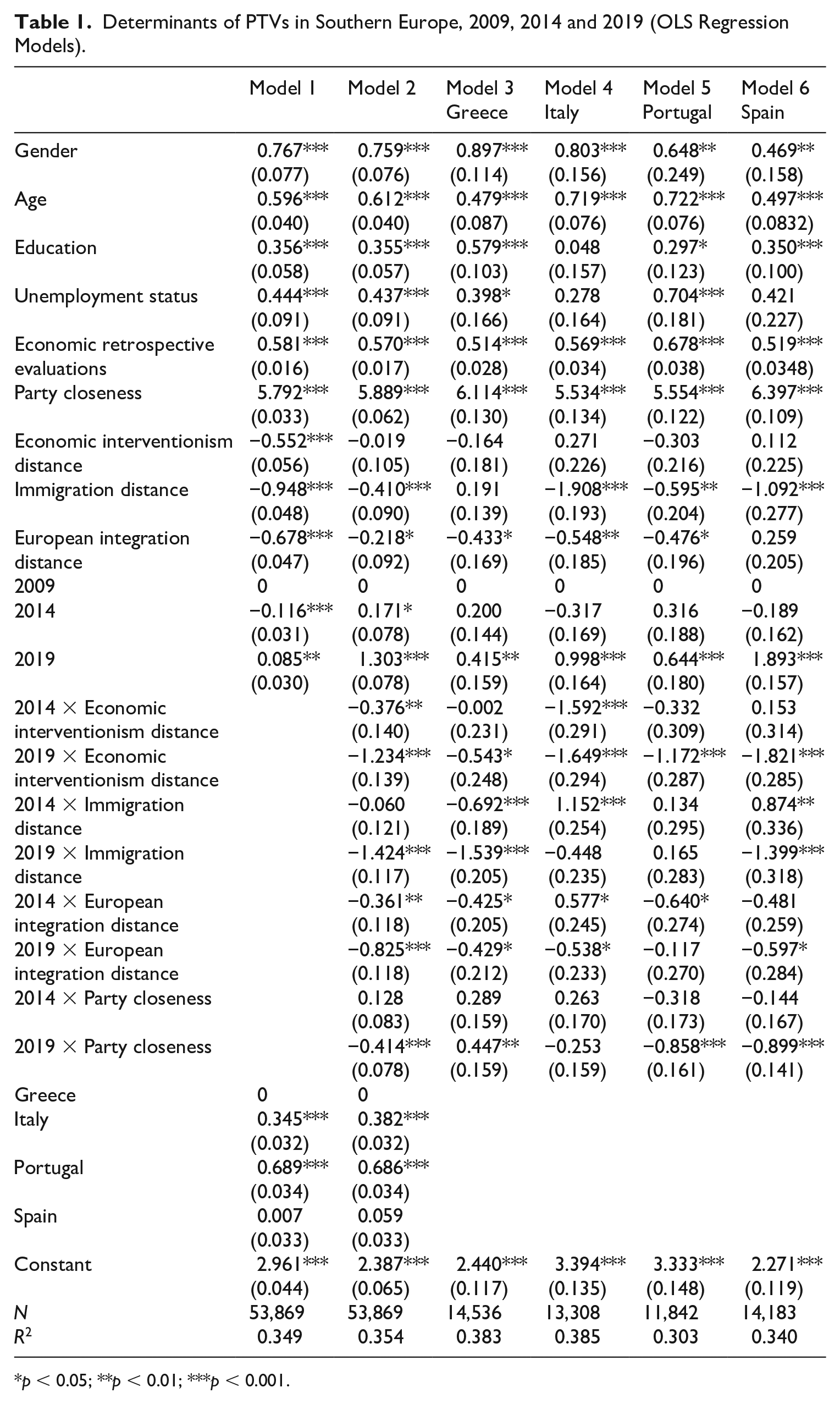
p < 0.05; **p < 0.01; ***p < 0.001.
To test our hypotheses, interaction terms of the three distance variables and time have been included in Model 2, with the effects being plotted in Figure 1. H1 expects SE voters to increasingly support parties based on their positions on EU issues. The interaction coefficients are both significant and negative, showing the growing effects of EU distance on party preferences in 2014 (−0.361**) and 2019 (−0.825***). Figure 1 plots the average marginal effects of the EU distance variable on the PTVs by the three time points, substantially supporting these results.
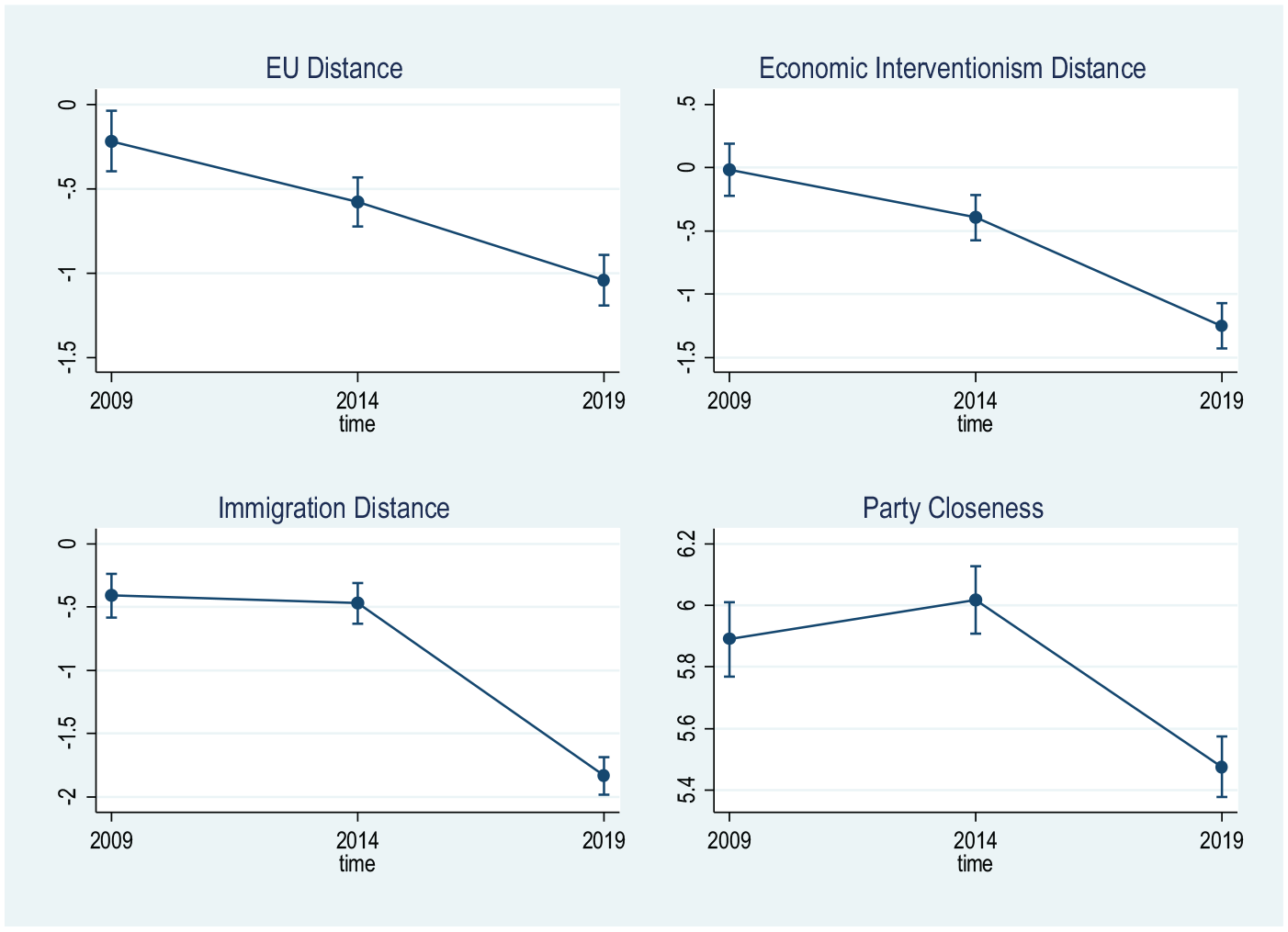
Average Marginal Effects of EU Distance by Time, Economic Interventionism Distance by Time, Immigration Distance by Time and Party Closeness by Time with 95% CIs.
However, by plotting the same interaction term separately for each country (Figure 2), this scenario reverses, rejecting H1. In fact, the results do not substantially hold up for Greece, Italy, Portugal and Spain, with the EU distance not increasing its effects on voting preferences over time. Greece, Italy and Portugal did not display any significant variations in their patterns of EU issue voting, with the impact of this distance variable on PTVs remaining stable (and significant) over time. Instead, the Spanish case epitomises the lack of any impact of EU issues on voting preferences, with the effect of this variable never reaching statistical significance throughout the entire period. Therefore, H1 is hereby rejected and we maintain that Southern European voters are stable in their EU issue voting and they do not increasingly support parties based on their positions on EU issues.
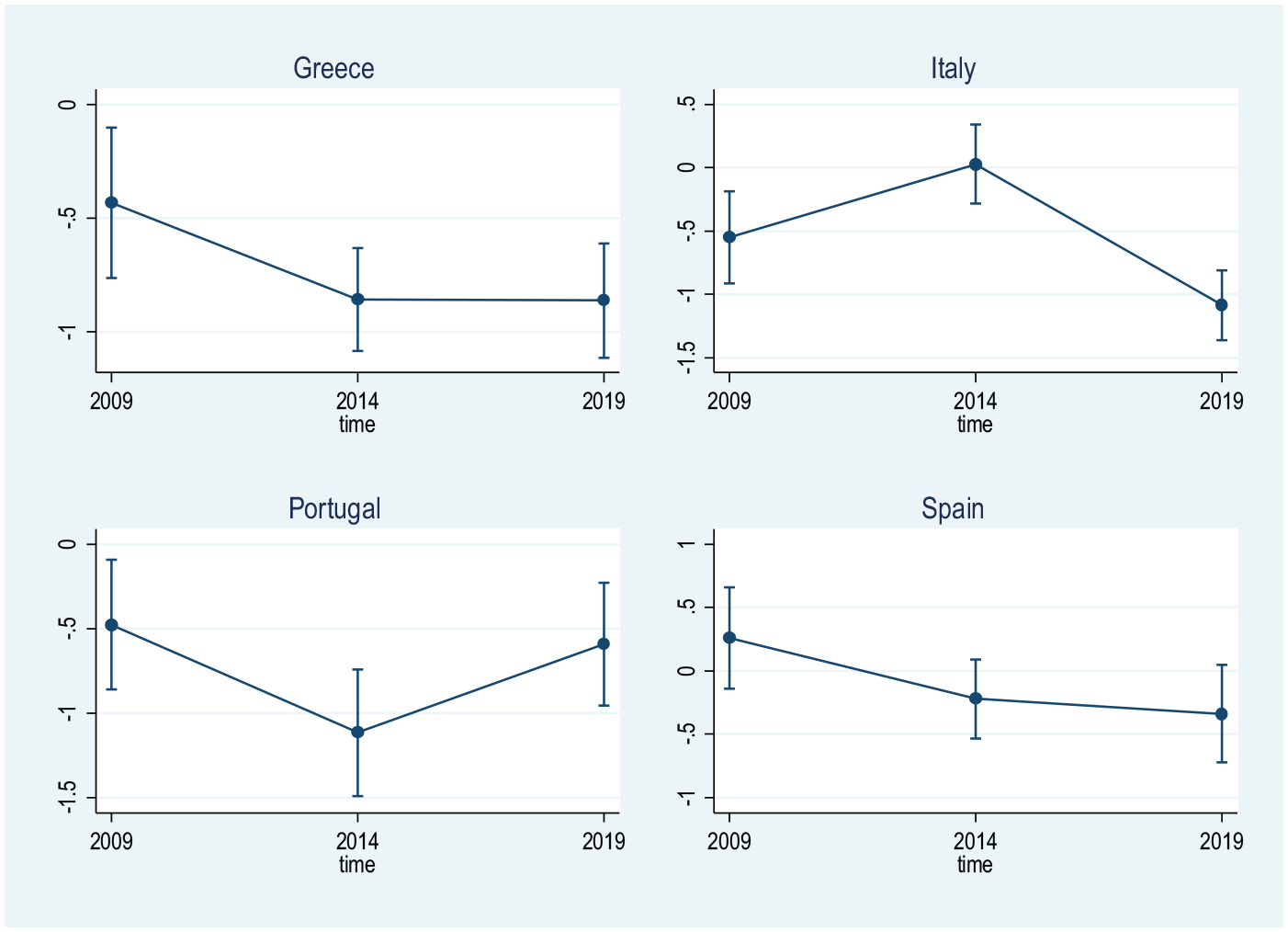
Average Marginal Effects of EU Distance by Time in Greece, Italy, Portugal and Spain With 95% CIs.
The electoral patterns of the different party families allow us to better understand the ideological factors behind the stagnant impact of EU issues on SE voting preferences (see: Figure 3). SE voters increasingly supported CLPs and CRPs based on their EU positions, but not the RRPs and RLPs. The CLP and the CRP endorsed the process of European integration, according to the data, becoming more likely to benefit from a pro-EU voting over time. Instead, both left-biased Euroscepticism (RLPs) and right-biased Euroscepticism (RRPs) failed to draw growing electoral responses from SE voters. 7 Thus, our findings show that EU issue voting significantly increased its impact when parties/voters held Europhile values, but not when they held Eurosceptic values. This asymmetric electoral mobilisation may explain the stagnation of the impact of EU issue voting in SE, where the impact of Euroscepticism may have reached its ceiling.
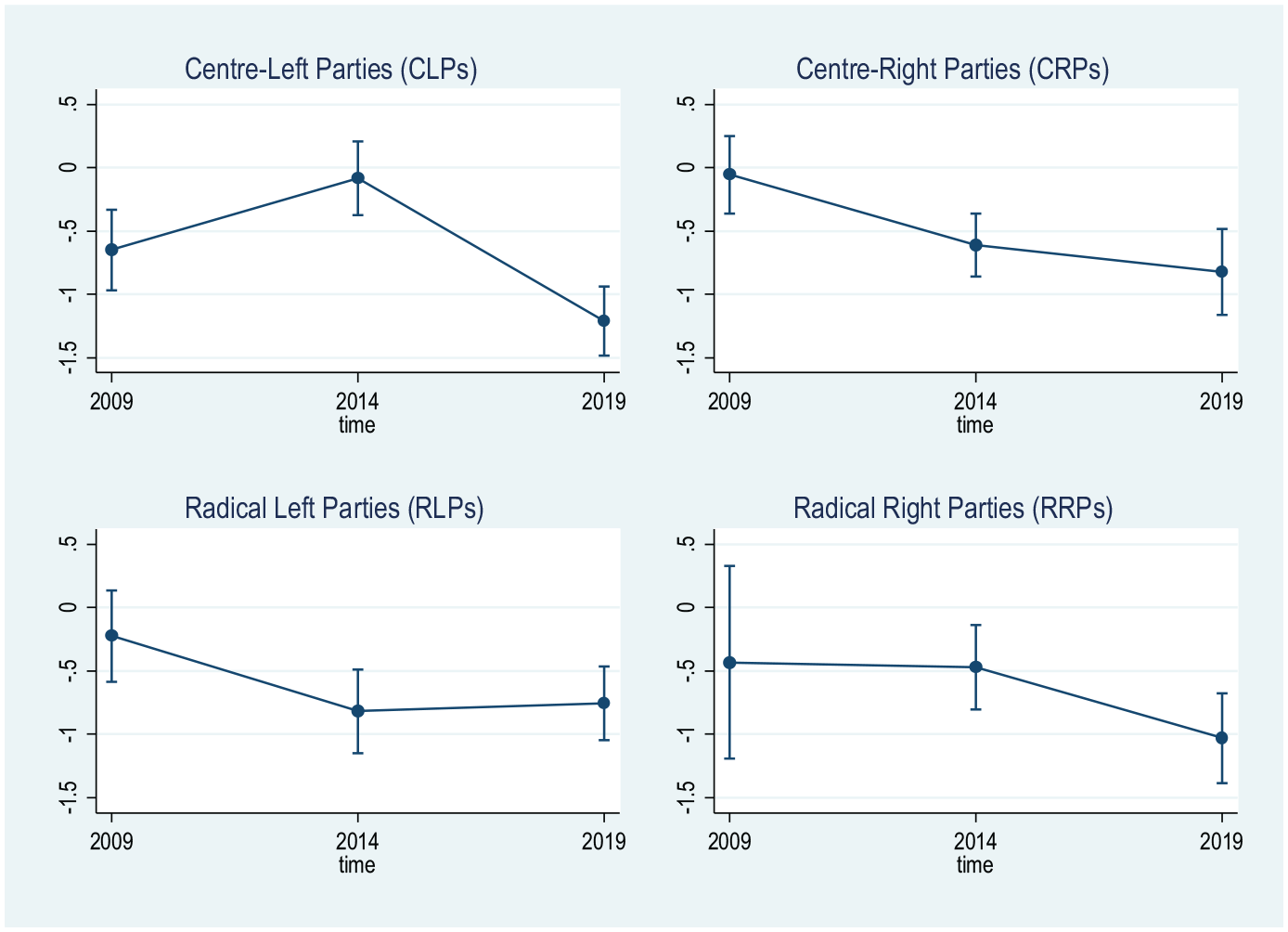
Average Marginal Effects of EU Distance by Time for Party Families with 95% CIs.
As for H2, which tests the impact of the immigration distance on voting preference, Model 2 shows a cross-time increase of this electoral predictor. Indeed, this voting determinant did not improve in 2014, but then it went on to greatly boost its impact on PTVs by 2019, with the interaction coefficient becoming very significant (−1.424***). This result is supported by the plotting of the average marginal effects of this distance variable on the PTVs by time (Figure 1), with the 2019 time point marking a prominent leap in the effects of immigration on the electoral potential of parties in SE.
However, the effects of immigration on the PTVs are more nuanced when we consider individual countries (Figure 4), revealing some cross-national differences. Greece epitomised a pattern of gradual increase in immigration voting over time, with each time point representing a significant improvement in the effect of this variable. In Spain, the immigration distance became indeed a more meaningful voting determinant in 2019 compared to 2009. Even if Italy did not experience a significant cross-time increase in the impact of this variable, the immigration conflict reached a very prominent level of influence in 2019, reshaping the electoral potential of parties. Instead, Portugal deviates from this general voting pattern occurring in the other SE countries, with the impact of immigration issues not undergoing any significant changes over time. All things being considered, H2 has received empirical support and, therefore, we advance the following statement: Southern European voters increasingly support parties based on their positions on immigration issues, with the exception of Portuguese voters.
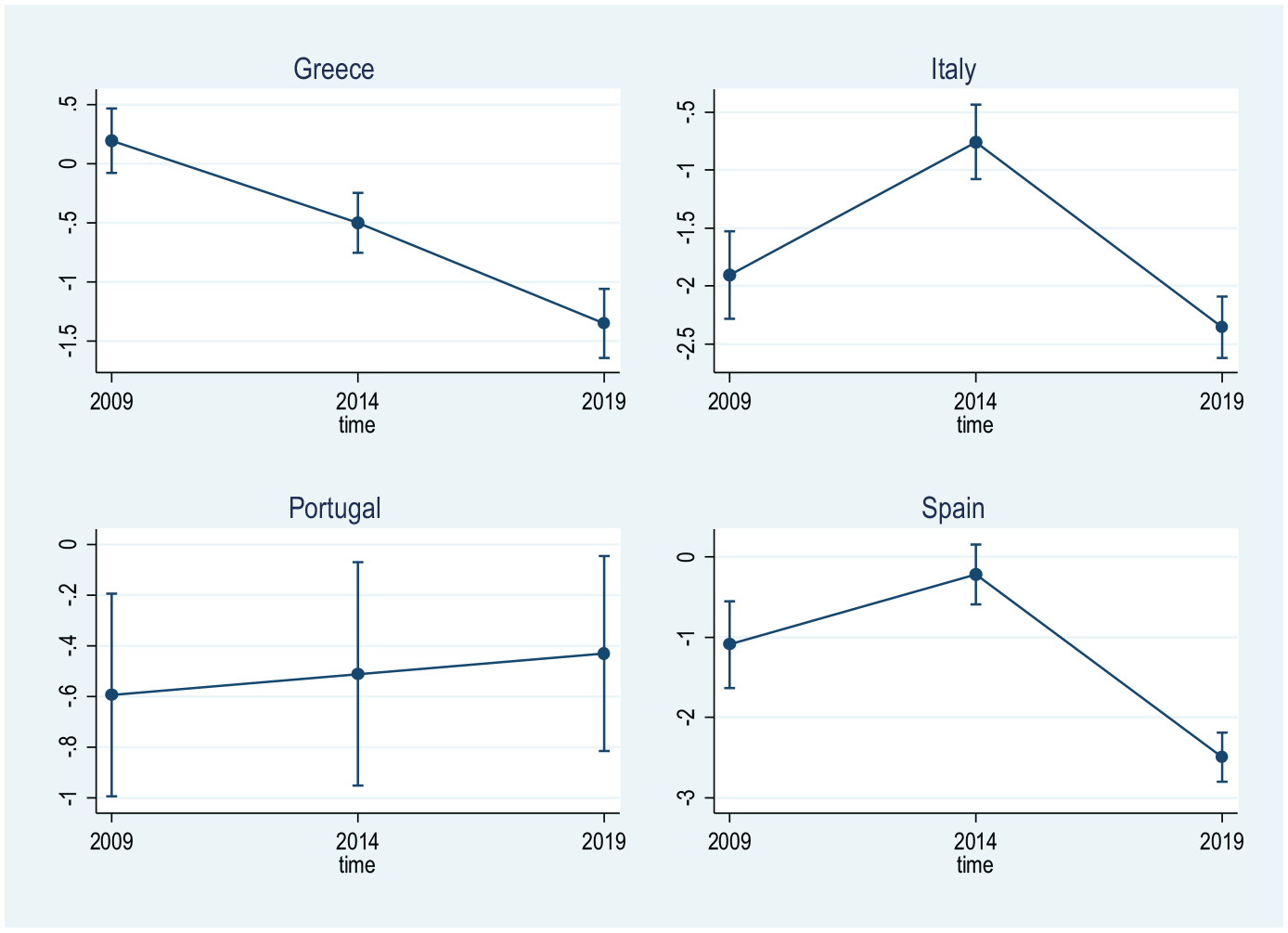
Average Marginal Effects of Immigration Distance by Time in Greece, Italy, Portugal and Spain with 95% CIs.
By controlling for party families, we can identify the ideological drivers behind the changing effects of the immigration issues. Figure 5 shows that voters did not increasingly support CRPs and RRPs based on their (more restrictive) positions on the immigration policies. These party families had already benefitted from this voting predictor in 2009, with anti-immigration attitudes not boosting their explanatory power over time. On the contrary, voters increasingly supported CLPs and RLPs based on their (more progressive) positions towards immigration policies. Indeed, this predictor did not notably explain the electoral support for these party families in 2009, but it has become significant over time, with the exception of Portugal. This voting pattern seems to reflect the presence of two opposing ideological camps colliding on immigration, with RRPs–CRPs electorally mobilising on anti-immigration values and RLPs–CLPs electorally mobilising on pro-immigration values.
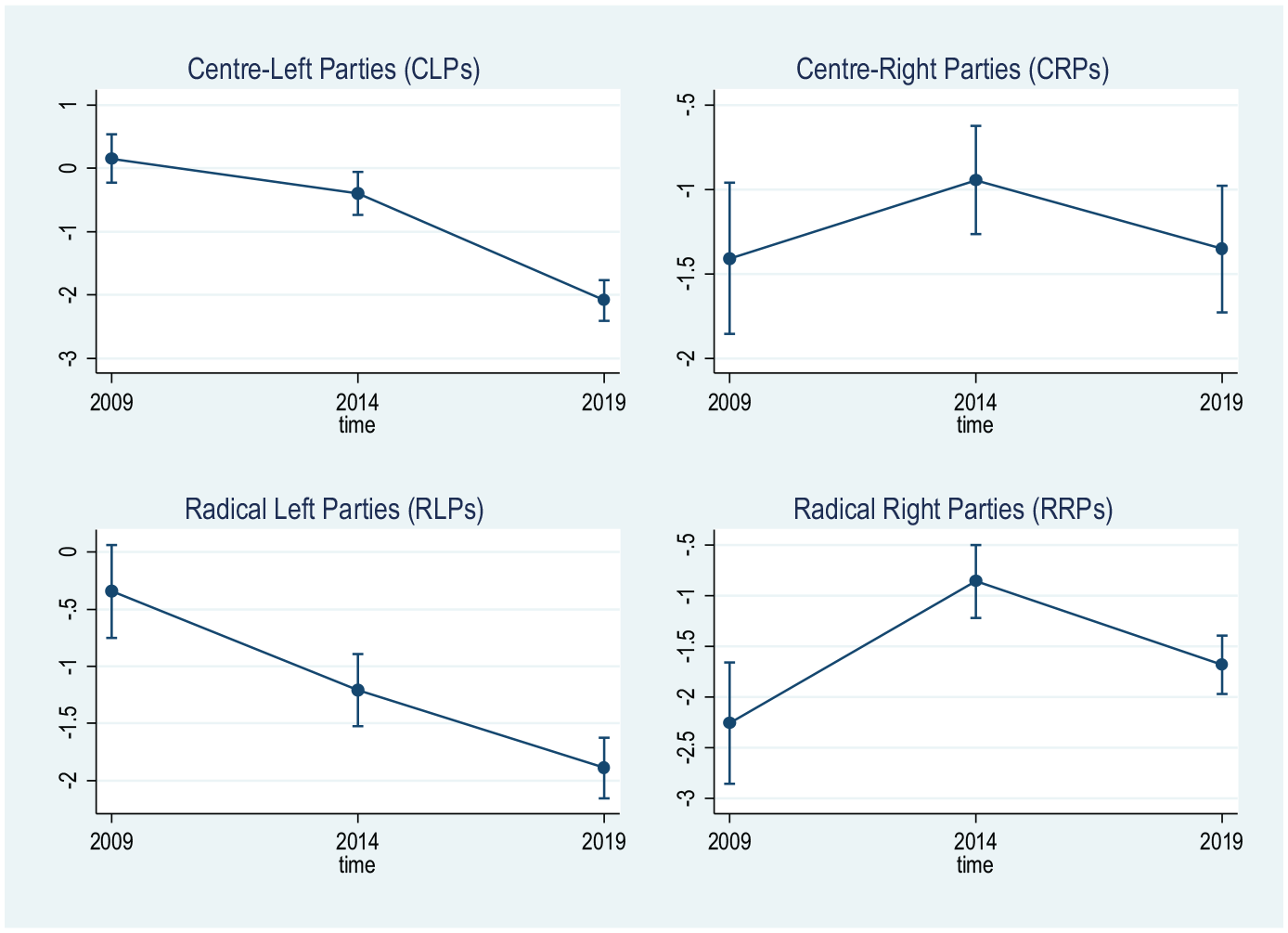
Average Marginal Effects of Immigration Distance by Time for Party Families with 95% CIs.
H3 expects South European voters to increasingly support parties based on their position on the issue of state (non-)intervention in the economy. Model 2 includes the interaction terms between the ‘state control and regulation of the economy’ variable and time, showing that its impact grew significantly in 2014 (−0.376**) and 2019 (−1.234***). Figure 1 plots the average marginal effects of economic interventionism on the PTVs by the time variable and discloses interesting findings. In point of fact, this determinant had held a null effect on electoral preferences in 2009, with the traditional economic predictor not affecting the decision-making process of voters. This scenario reversed in 2014 and 2019, with economic (non-)interventionism gradually enhancing its impact on the electoral potential of parties.
By analysing the single countries (Figure 6), no national case has substantially deviated from this voting trend, further corroborating H3. All four countries have shown the non-significant effect of this distance variable in the time point prior to the crisis (2009). In Italy, the impact of economic interventionism was already apparent in 2014, stabilising its explanatory power in 2019. On the contrary, in Portugal and Spain, the effects of this distance variable reached their peaks in 2019, becoming more significantly politicised in their respective electoral arenas by that time. Even if Greece displayed no significant cross-time increase in the impact of this variable on the PTVs, economic interventionism turned out to be statistically significant by 2019. These results allow us to support H3 and we maintain that: Southern European voters increasingly support parties based on their positions on the issue of state (non-)intervention in the economy.
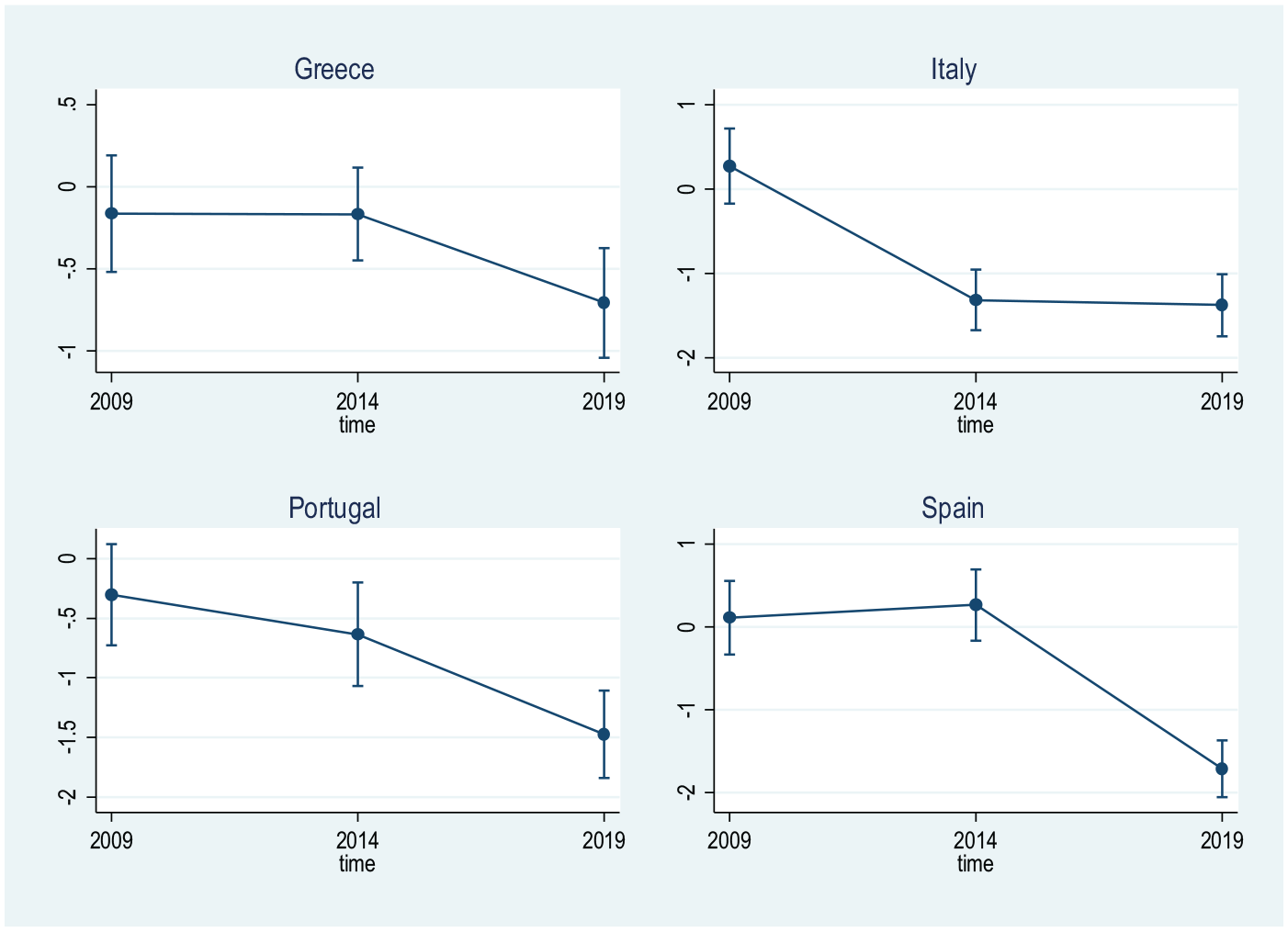
Average Marginal Effects of Economic Intervention Distance by Time in Greece, Italy, Portugal and Spain with 95% CIs.
By advancing the party family control, we can observe a surprising pattern behind the ideological mobilisation of this conflict in SE (see Figure 7). This issue did not affect the electoral support for the CLPs, which have been consistently in favour of economic interventionism throughout the entire period (but maybe on this issue they have been considered less credible by voters than the RLPs). Conversely, SE voters increasingly supported CRPs on their positions on the issue of non-interventionism in the economy. This party family mobilised conservative values on this issue which, somewhat unexpectedly, proved to be electorally profitable during a critical stage for the SE economies.
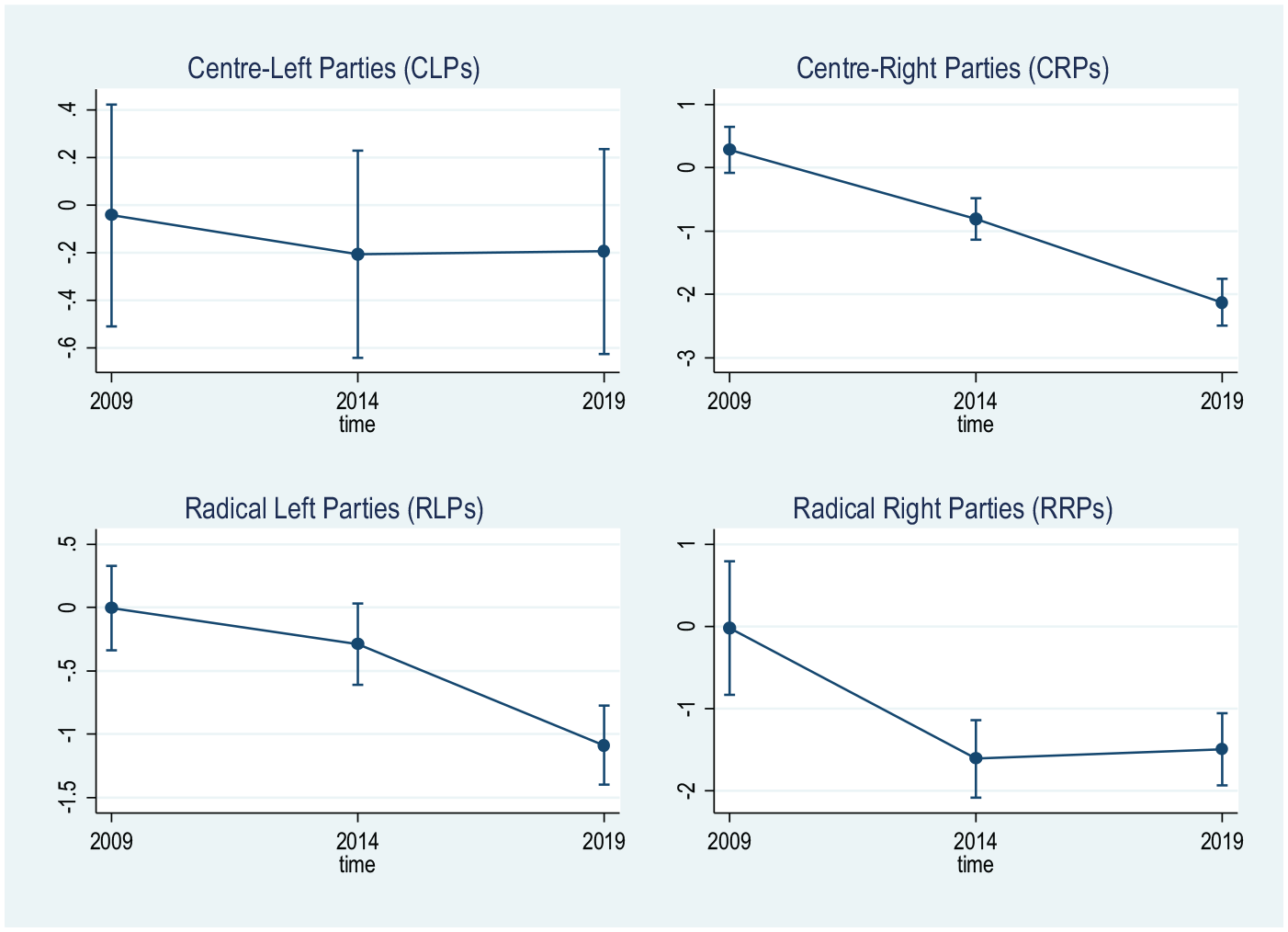
Average Marginal Effects of Economic Intervention Distance by Time for Party Families with 95% CIs.
This predictor also significantly enhanced its impact on the support for RLPs, which successfully mobilised voters who demanded greater economic interventionism. Moreover, SE voters increasingly supported RRPs based on their positions on this issue. However, this party family lacked a positional cohesion on economic interventionism, with the League, Brothers of Italy (FdI) and Vox adopting a social conservative position, and Golden Dawn (XA) a progressive stance. In brief, the growing effect of this issue on the PTVs has not been simply related to a larger demand of economic interventionism among SE voters, but also to a socio-economic conservatism upheld by a coalition of parties/voters.
Finally, Model 2 includes an interaction term between party closeness and time, allowing us to understand if the increasing impact of immigration and economic interventionism may be explained by the declining impact of partisanship. The effect is null for 2014, but it becomes negative and significant in 2019, showing us a decreasing impact of party closeness on electoral preferences in SE. This finding is confirmed by plotting the average marginal effects of party closeness by time (Figure 1).
Nevertheless, national-based variations emerge, mirroring a differentiated set of changes in the impact of partisanship across countries (see Figure 8). Declining effects of partisan voting hold in Portugal and Spain, where new trends in issue voting may have replaced the traditional party attachments. In Italy, party closeness did not reduce its impact on PTVs, seemingly not affecting issue voting. Finally, contrary to the expectations, Greece reflected a growing pattern of partisan voting, perhaps occurring under the form of ‘mass negative partisanship’, which is a form of intense distrust among party–voters towards the opposite party (Tsatsanis et al., 2021). In brief, the decline of partisan voting occurred in the Iberic peninsula, probably unleashing new trends in issue voting, but it did not take place in Greece and Italy.
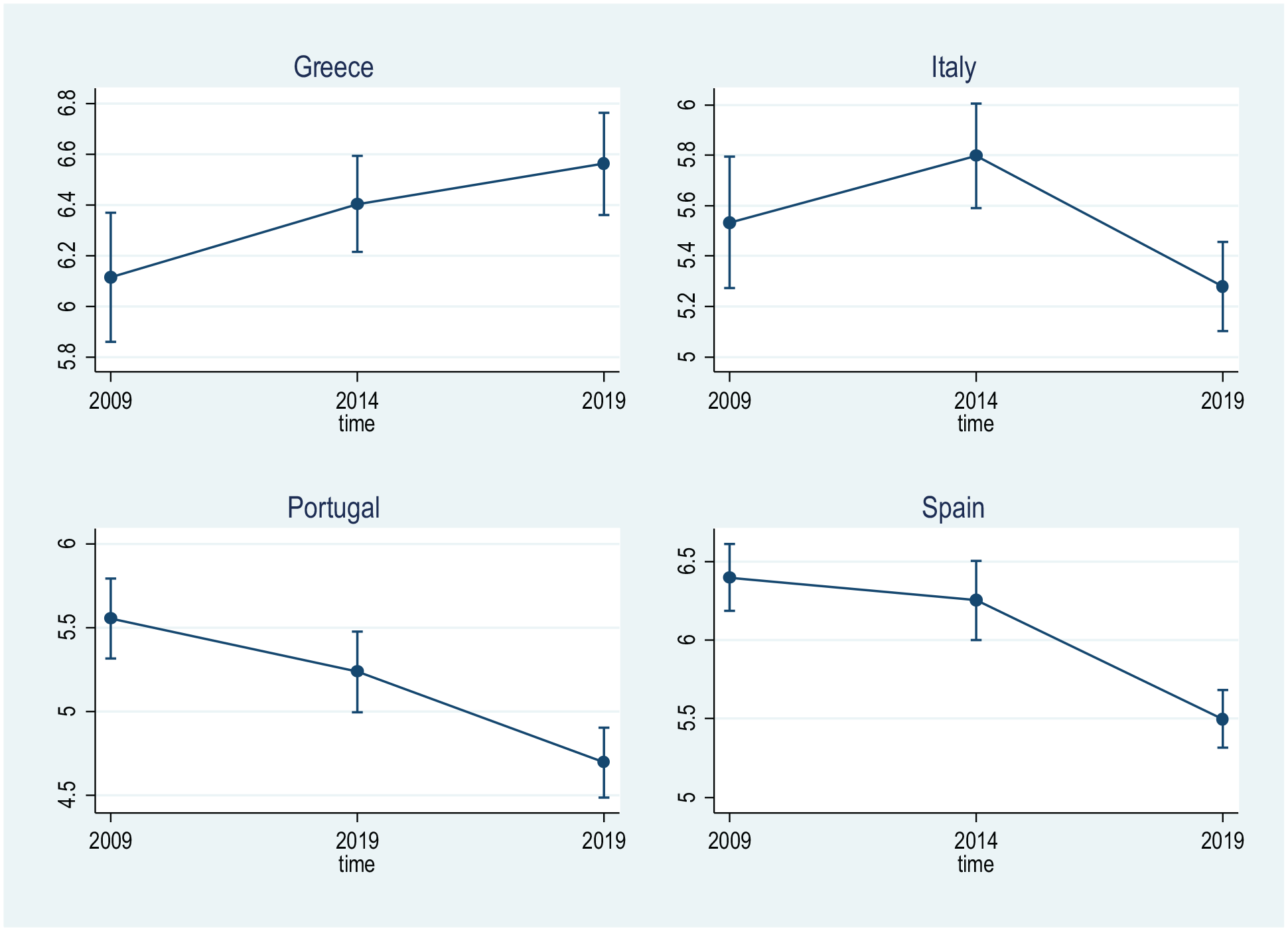
Average Marginal Effects of Party Closeness by Time in Greece, Italy, Portugal and Spain with 95% CIs.
To summarise, two voting explanations – immigration and economic interventionism – have gained ground in SE over time. With the only exception of Portugal, SE voters paid increasing attention to party positions on the issues related to immigration. Unexpectedly, this voting pattern depended on a significant electoral mobilisation of pro-immigration voters, rather than the anti-immigration ones who had already been mobilised on this issue in 2009. This finding is meaningful as it potentially mirrors the emergence of a new conflict based on immigration in these party systems, linking parties and voters across the entire ideological spectrum.
As well, another transformation occurred, with a proxy of the socio-economic dimension – economic (non-)interventionism – boosting its explanatory power in these countries. Voters increasingly rewarded RLPs (but not CLPs) for their progressive positions on these policy issues, probably demanding a reversal of the austerity policies. However, in the aftermath of the GR, social conservatism has also been electorally mobilised, with an alternative bloc of parties/voters opposing the greater role of the state in the economy. Finally, EU issue voting remained stable in SE: this mainly depended on the electoral stagnation of Euroscepticism, even if the impact of Europhile attitudes generally improved.
Conclusion
In SE, in the 2009–2019 decade, the electoral support of parties was increasingly influenced by party positions on immigration, state intervention in the economy, but not on the EU. By providing a detailed analysis of issue voting in SE, we can illustrate the changing structure of the demand-side of politics. Measured throughout a full decade in a specific coherent context, these emerging political divides appear to reflect a set of transformations related to conflict configurations from the voter point of view.
First, this study has revealed an intriguing finding, namely, the growing importance of the immigration issue as a voting determinant in SE, with the chief exception of the Portuguese case. The refugee crisis appears to have presented a major window of attention, potentially reinforcing an electoral conflict between those in favour of more restrictive and those supporting more permissive policies. Even if this political divide became more electorally politicised in SE, the major driving force behind this process was the mobilisation of pro-immigration voters. The effects of pro-immigration values have become more meaningful, as clearly seen in the electoral pattern of CLPs and RLPs. Conversely, the electoral mobilisation of anti-immigration attitudes did not change over time, with the support for RRPs and CRPs remaining stable on this issue.
RRPs attempted to politicise a restrictive approach to immigration policies, aiming at matching the popular dissatisfaction over the growing number of asylum-seekers (Pirro et al., 2018). However, pro-immigration parties may have strategically responded, successfully mobilising a coalition of libertarian/integrationist voters in SE. By acting as genuine pro-immigration entrepreneurs, RLPs and CLPs were probably able to consolidate the politicisation of the immigration conflict, winning over votes on this dimension.
The second finding concerns the growing importance of the issue of state intervention in the economy as a voting predictor. In the years preceding the GR, this economic determinant had shown little effect on voting preferences, but its impact has become more pervasive in all SE countries. We posited that the electoral market could have become more susceptible to the growing demand for state interventionism, in the aftermath of the GR. Nevertheless, SE voters have become more confrontational on this issue and increasingly supported parties based on both conservative and progressive positions on this issue. On the one hand, RLPs, pledging to reinstall state control over the economy (Charalambous et al., 2021; Pardos-Prado and Sagarzazu, 2019), have been rewarded by voters for their progressive stances on this issue dimension. On the other hand, CRPs, being more ideologically committed to curtail the deficit-spending (Alonso and Ruiz-Rufino, 2018), have gained voting support on their conservative positions on this issue.
Instead, CLPs have been the main electoral losers in the economic conflict, probably because they had actively been involved in the implementation of austerity policies during the GR, especially when they were holding government cabinet offices (Alonso and Ruiz-Rufino, 2018). Our analysis shows that the growing ideological polarisation across this issue dimension has contributed to electorally politicising economic (non-)interventionism, which has gradually gained a structuring power in SE.
Finally, we found that EU issue voting has been stagnant in SE, with this result being consistent across all SE countries. Before the onset of the crisis, EU issues had had little effect on the electoral calculations of voters, with pro-EU consensus being resilient in these countries (Conti et al., 2010). After the outbreak of the GR, EU-related attitudes entered into the decision-making processes of pro-EU voters only, who increasingly supported Europhile parties along this ideological divide. Conversely, even if RLPs and RRPs cued voters on the anxieties linked to EU integration in the aftermath of the crisis (Hutter and Kriesi, 2019; Kriesi, 2016), the electoral mobilisation of Eurosceptic voters remained weak in SE. This may be due to the growing politicisation efforts of the Europhile party families (Carrieri, 2020), or to the stability of the pro-EU attitudes of SE voters (Conti et al., 2010). Furthermore, the result of the ‘Brexit’ referendum may have worsened citizens’ anxieties over the spillover effects outside the United Kingdom of this disintegration process, making ideological Euroscepticism less electorally profitable (Delis et al., 2020).
The growing impact of immigration and economic interventionism issues (but not of the EU) have been relatively homogeneous across the four countries. Nonetheless, some cross-country differences do emerge. First, these fluctuations of issue voting may have depended on the erosion of partisanship, with the importance of this heuristic decreasing in Portugal and Spain only. Second, Portugal was an outlier for what concerns the non-impact of immigration, as immigration remained a marginal issue (Fernandes and Magalhães, 2020), and only in 2019, Chega – a RRP (with a clear anti-immigration platform) – gained national representation. Instead, elections from the early 2010s were fought under a high level of campaign polarisation around the issues of austerity and liberalisation, with the economy at the centre of the domestic debate (Magalhães, 2017).
We cannot predict if these conflicts will stabilise, becoming long-lasting, or if they simply reflect a context-dependent and volatile dynamic of issue voting. We recognise that we have analysed emerging phenomena in terms of issue voting, which may become ‘full’ cleavages only if these are confirmed as persistent phenomena within national political systems over a longer period of time. Therefore, future research could build on the present study and address whether these political divides will last and satisfy the defining characteristics of social cleavages, including shared identities and institutional linkages.
Supplemental Material
sj-docx-1-psw-10.1177_14789299221138030 – Supplemental material for The Changing Structure of Political Conflicts in the South of Europe: An Analysis of Issue Voting in Four Countries
Supplemental material, sj-docx-1-psw-10.1177_14789299221138030 for The Changing Structure of Political Conflicts in the South of Europe: An Analysis of Issue Voting in Four Countries by Luca Carrieri and Marco Morini in Political Studies Review
Footnotes
Author contributions
All authors contributed equally to this work.
Declaration of conflicting interests
The author(s) declared no potential conflicts of interest with respect to the research, authorship and/or publication of this article.
Funding
The author(s) received no financial support for the research, authorship and/or publication of this article.

Supplemental material
Additional supplementary information may be found with the online version of this article.
Appendix 1: List of Parties Table A1. List of parties. Source: CHES Appendix 2: Correlation Matrix among Distance Variables Table A3. Correlation Matrix among Distance Variables Appendix 3: Party Families Table A4.1. List of Centre-Left Parties (CRPs) Table A4.2. List of Centre-Right Parties (CRPs) Table A4.3. List of Radical Left Parties (RLPs) Table A4.4. List of Radical Right Parties (RRPs) Table A4.5. Determinants of PTVs in Southern Europe for Party Families, 2009, 2014 and 2019 (OLS Regression Models). Table A4.5. Determinants of PTVs in Southern Europe for RLPs by excluding the M5S, 2009, 2014 and 2019 (OLS Regression Models). Figure A4.1. Average marginal effects of EU distance by time, economic interventionism distance by time, immigration distance by time and party closeness by time for RLPs with 95% CIs. Appendix 4: Variable Operationalisation
Notes
Author Biographies
References
Supplementary Material
Please find the following supplemental material available below.
For Open Access articles published under a Creative Commons License, all supplemental material carries the same license as the article it is associated with.
For non-Open Access articles published, all supplemental material carries a non-exclusive license, and permission requests for re-use of supplemental material or any part of supplemental material shall be sent directly to the copyright owner as specified in the copyright notice associated with the article.
