



Abstract
Does posting negative social media messages incur costs to politicians in a polarized society? While extant literature finds that politicians’ negative rhetoric on social media increases audience engagement, this seemingly positive feedback from social media users will, in fact, amplify the real cost. Leveraging a YouGov dataset and applying Natural Language Processing techniques, I find novel evidence that negative social media messages by the political elite do generate tangible costs to the political elite. Negative rhetoric, while increasing the spread of information, negatively impacts the audience’s evaluation of the content. This research also finds that the effect is mediated by policy topics. This research advances our understanding of the limitations of politicians’ negative messaging on social media and contributes to the debate about the effect of politicians’ negative social media communication, a growing political phenomenon in the United States and in democracies worldwide.
Introduction
Social media, despite substantial differences across platforms with respect to how user-friendly they are, has become one of the major tools for political elites to engage with their followers and disseminate their messages to the public. Two puzzling questions then appear: what explains political elites’ sometimes negative social media presences? What are the consequences of their negative social media communication? These are the research questions that I will answer in this research.
There are two key elements of social media: (1) “many-to-many” communication, in which people are both producers and consumers of content alongside multiple others, and (2) non-addressed audiences, with which the message is “not being sent to specific other people, but to some class of people, such as all Twitter followers (Hogan and Melville, 2015).”
Tone is an essential part of messaging, as the public reacts to both the content and the tone of political leaders’ messages (Box-Steffensmeier and Moses, 2021). Existing literature has found that elite politicians’ negative communication on social media is positively associated with public engagement and information spread (Box-Steffensmeier and Moses, 2021; Mallipeddi et al., 2021; Ouyang and Waterman, 2020). Literature in political communication provides an explanation: compared with messages with a neutral or positive tone, messages with a negative tone are more engaging and eye-catching (Fiske, 1980).
Existing research suggests that “going negative” on social media is beneficial to elite politicians because they receive more public attention by doing so. This may partially explain why some politicians choose to write negative posts on social media. For example, during Donald Trump’s presidency (1461 days), there were an average of 6.7 New York Times articles per day mentioning Trump’s tweets (for a total of 9755 articles over the course of his presidency). Despite the tremendous public attention President Trump’s tweets received, approximately 60% of Americans viewed Trump’s use of Twitter as inappropriate throughout his presidency (see Figure 1). From this, it appears that public disapproval does not impede the spread of a politician’s social media communication. How do we understand and test these two seemingly contradictory phenomena? Is “going negative” beneficial for elite politicians hoping to summon public support? Does negative social media communication incur any costs to the politician posting it?
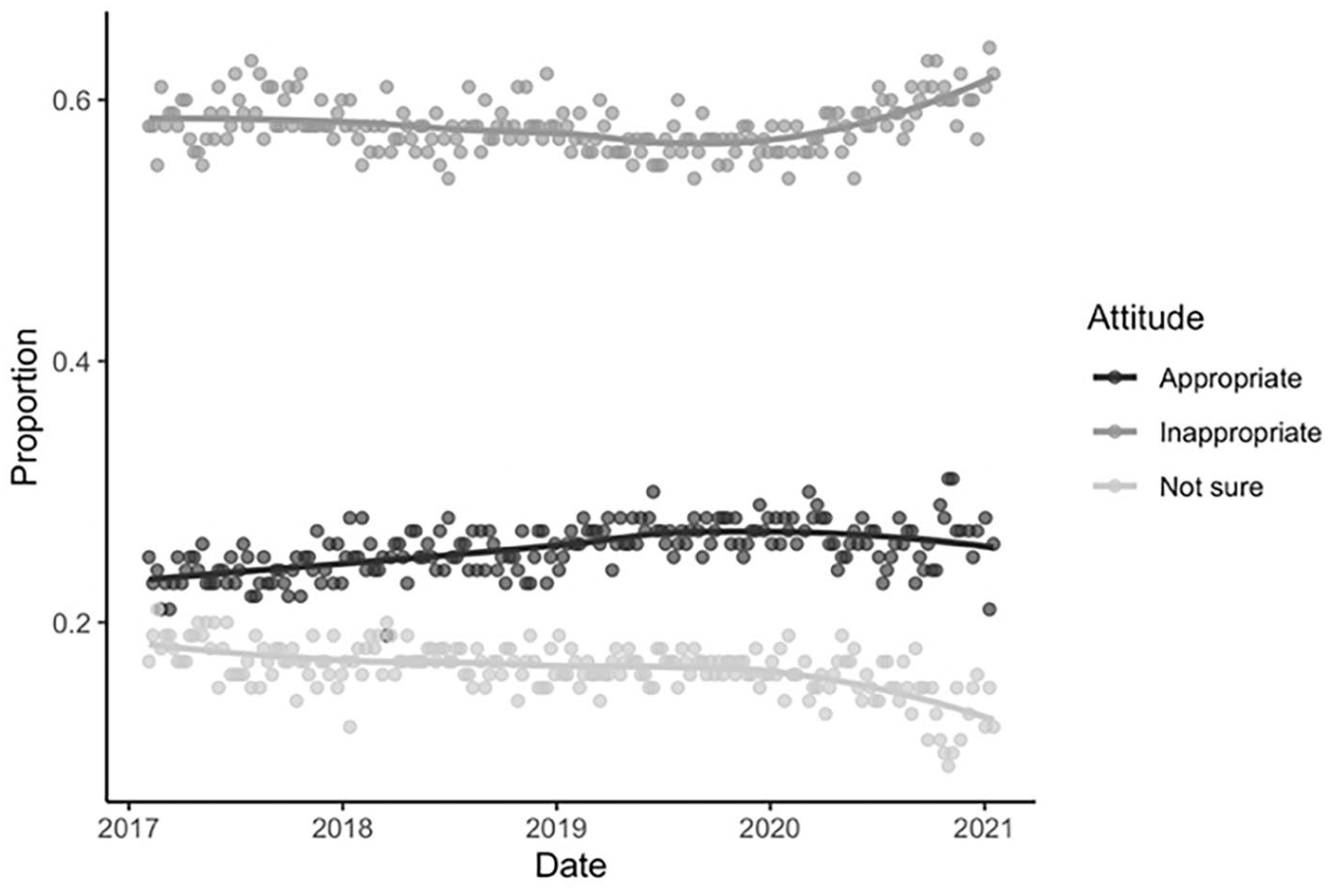
American Attitudes Toward President Trump’s Use of Twitter.
I argue that posting negative content on social media can backfire, in the same way that the literature has shown that sponsoring a negative advertisement in an election can backfire on a politician. While it has some face-value benefits, “going negative” can backfire on the politician. My theory is built on research that seeks to understand why people dislike negative information during elections. Research on negative campaigning has suggested that voters usually feel uncomfortable and even angry about negative advertisements, and they may go so far as to punish the sponsor of a negative ad campaign in elections (Krupnikov, 2011; Morisi, 2018). A study using meta-analysis confirmed the backlash effect in 33 out of 40 studies on negative advertisements, representing 82.5% of the sample (Lau et al., 2007).
I build on this theory of negative campaigning and propose an extension that posting negative social media content backfires for political elites as well. My theory suggests that negative social media communication from politicians, in general, may undermine how individuals across the political spectrum evaluate these messages. I posit that this is true, even though negative social media messages are more engaging to the public. I tested this theory using YouGov’s Trump Tweet Index. This dataset includes variables that show how major partisan groups reacted to each of President Trump’s tweets. I found evidence that, in most cases, Trump’s negative social media communication was positively associated with social media engagement and information spread; however, the more negative the tone of the post, the more negative the reaction of the public, including members of his own political party.
Furthermore, policy topics can mediate the effect. I found that, for former President Trump, being more negative in social media posts about foreign affairs generated fewer costs compared with negative posts on domestic affairs, based on partisan evaluation of these posts. The effect of negative tone on people’s evaluation of Trump’s tweets was not statistically significant when it came to Iran, impeachment, and terrorism, however.
These findings suggest that negative social media rhetoric has repercussions, and what existing literature sees as positive (i.e. negative tone facilitates the spread of the message) is mostly harmful for elite politicians because it invites more people to dislike the messages. This finding also contributes to an ongoing debate about ways to mobilize one’s political base, demonstrating that going negative in social media posts cannot really engage one’s co-partisans.
This work makes several contributions to the current literature. This research provides novel evidence showing the cost of going negative on social media to political elites. My findings carry relevance beyond the Trump administration. President Trump is not the last politician, nor the last US President, to use social media to deliver messages to the public. Current US President Joe Biden tweeted his first message the second he was sworn in as the 46th US President. Additionally, elite politicians’ use of social media is increasingly common worldwide. Over 85% of world leaders have employed social media (Barberá and Zeitzoff, 2018). This research also confirms that tone still matters in social media communication despite intensifying political polarization. This research sets a foundation for future research on how political leaders’ use of social media impacts the broader public.
Negative Tone and Social Media Engagement
Tone, as a form of rhetoric, impacts how people perceive or react to the messages of their political leaders (Jacobs and van der Linden, 2017; Lau et al., 2017). Tone is an essential component in framing and shaping public attitudes toward policy issues (Jacobs and van der Linden, 2017; McCombs and Shaw, 1972). For example, Jacobs and van der Linden find that news tone has a significant impact on people’s attitudes toward immigrants. Beyond tone’s impact on public opinion, empirical evidence has shown that social media messages with negative tones, compared with neutral or positive tones, reach broader audiences (Box-Steffensmeier and Moses, 2021; Mallipeddi et al., 2021).
By measuring social media posts from members of the US Congress, Box-Steffensmeier and Moses (2021) provide convincing evidence that the tone of these Congress members’ Facebook messages is positively associated not only with social media engagement but also with those messages’ spread (i.e. more social media users shared these messages). Their result implies that “going negative” on social media is an effective way for elite politicians to make themselves seen or heard on social media.
However, there are some concerns about what social media engagement (e.g. the number of likes and shares) really represents. The first concern is self-selection bias. People who self-selected to follow a specific politician’s social media account and then like or share that politician’s posts may have different attributes from those who did not. When there is a positive association between negative tone and social media engagement, we may be less confident in the validity and generalizability of this finding because we do not know whether those who did not self-select to follow a politician’s social media account (or remain “silent” followers) may still react like “active” social media subscribers.
The second concern is about the meaning of sharing a post. Social media users can share posts for two opposing reasons. They can share a post because they sincerely endorse the message; they can also do so because they really dislike it (sharing the message to mock or criticize it on their newsfeed). Fundamentally, then, we must question what the number of shares really tells us. Nevertheless, shares (no matter who did it for what purpose) do facilitate the spread of political messages. Social media engagement does make political elites’ social media messages more likely to be seen by more people. Liking a post, compared with sharing a post, is less controversial in what it represents. People who dislike the message, in general, are less willing to like that social media message. Of course, several social media platforms provide various reaction types, expressing either positive or negative emotions. Facebook, for example, provides the like, wow, haha, love, sad, and angry reactions, whereas Twitter and Instagram only provide the like reactions for its users.
In fact, on social media platforms, some of their users have developed ways to express their approval or disapproval by manipulating their engagement. For example, on Twitter, “the ratio” of a tweet, or the number of Replies/Comments compared with the number of Shares and Likes, is widely used as a measure of the level of unpopularity of that tweet. To express their disapproval, Twitter users may actively reply to a tweet they highly dislike, thus increasing “the ratio” of that tweet. A “ratioed” tweet means a tweet with more Comments than Likes and Shares combined. Although the discussion of the ratio on Twitter is beyond the scope of my research, it is important to acknowledge how some social media users are strategically manipulating their engagements with a tweet to express their opinions.
While I estimated the cost of negative social media communication, I re-tested Box-Steffensmeier and Moses’ hypothesis—there is a negative association between negative tones and Likes—with my dataset (more details about the dataset in the next section) to see whether the result holds outside of the context of Facebook communication by members of Congress during the pandemic. However, as people only Like posts they view positively but might Share a post when they view the post either positively or negatively, I tested the effect of negativity on Shares and Likes with two separate research hypotheses. H1a explores the effect of negative tone on Likes; H1b tests the effect on Shares. While H1a hypothesized that there is a positive association between negativity and Likes, H1b hypothesized that there is no significant association between negativity and Shares as the effect will be canceled out by people’s opposite motivations to Share.
H1a (tone & Likes): The more negative the tone of a political elite’s social media messages, the higher the number of Likes on those social media messages.
H1b (tone & Shares): There is no significant association between the level of negative tone of a political elite’s social media messages and the number of Shares of these posts.
On the one hand, existing literature portrayed the association between negative tone and social media engagement as positive; politicians’ social media messages with a negative tone can increase people’s engagement to these messages, which existing research posits is a good thing for politicians. Existing literature, however, has not answered how the public actually reacts to elite politicians’ negative social media messages. My research can bridge this gap by showing that, in reality, negativity undermines how the public evaluates an elite politician’s social media messages, even as this negative tone might increase people’s engagement with these messages. Taken altogether, this leads to the question: are there costs to politicians posting negative messages on social media? Or does elite politicians’ negative social media communication backfire? The short answer to these questions is “Yes,” and I will prove my point with empirical evidence in this article. In the next section, relying on existing research on the backfire effect of negative campaigning, I will build my theory on how elite politicians’ negative social media communication can backfire as well.
A Theory on Why Negative Social Media Communication Can Backfire
Can negative social media communication from politicians, like negative campaigning, also backfire? Despite numerous theories explaining the dynamic interplay of social media, public figures, and public opinion (Barberá and Zeitzoff, 2018; Baum and Potter, 2019; Edgerly and Thorson, 2020), how the tone of communication impacts public engagement is still understudied by political scientists (Box-Steffensmeier and Moses, 2021). In the case of Trump’s tweets, the role of negative rhetoric has not yet been fully explored (Yarchi et al., 2021).
Why can posting negative content on social media backfire? Literature on negative campaigning provides important insights. Negative campaigning or advertisements may backfire because this negative information makes electorates angry or uncomfortable with both the message and messenger; electorates, therefore, are motivated to punish the candidate who initiates the negative campaign or sponsors the ads when they vote (Haddock and Zanna, 1997; Houston et al., 1999; Lau et al., 2007; Roese and Sande, 1993). For example, Haddock and Zanna study the effects of negative political advertising in the 1993 Canadian federal election and find that participants in their survey evaluated the victim (or the target) of negative political advertisements more highly than before and evaluated the sponsor more poorly after exposure to the advertisements. The fact that negative communication bothers the broader audience explains why negative social media communication can backfire for political elites. The public may find some of a politician’s negative social media messages embarrassing, inappropriate, or even disgusting; consequently, a negative tone may negatively impact how people evaluate these messages (Perloff, 2013).
However, some scholars see the value of negative campaigning. For example, John Geer, in his In Defending Negativity, argues that going negative in elections increases accountability in democracy. His theory is that in order to attack a candidate in an election, the attacker, who is usually also another candidate in that election, needs to provide more factual evidence about why the target is bad. As a result, voters are able to evaluate the candidate with more factual information.
Scholars’ varied findings of the impact of negative campaigning are not necessarily contradictory; instead, these findings make up a complete picture of negative campaigning. Research on the backfire effect of negative campaigning shows how going negative may “harm” the sponsor of negative advertisements (reducing voters’ evaluations of the sponsor), even as negative campaigning may give voters more opportunities to learn factual information about candidates.
Despite this debate on the value of negative campaigning, one thing is clear: voters usually dislike negative information from candidates. I relied on this empirical finding to build my theory about the backfire effect of elite politicians’ negative social media communication. If voters usually dislike negative political advertisements and may even punish the sponsor of the advertisements in elections, then it is fair to believe that people may dislike negative political messages, including negative social media posts by politicians, even after elections. In this way, I use evidence from existing literature on negative campaigning to explain why elite politicians’ negative social media communication can backfire as well.
During the Trump presidency, it was expected that Democrats would criticize Trump’s tweets, but the level of negativity even brought criticism from President Trump’s own party. In an MSNBC interview on 22 October 2019, Rep. Mike Gallagher (R-Wis.) responded to a question about Trump’s tweet comparing his impeachment inquiry with a lynching: “That rhetoric [in Trump’s tweet] shouldn’t be used. Plain and simple.”
By contrast, others argue that tone does not because partisanship mostly determines how people react to politicians’ social media messages (Rogowski and Sutherland, 2016). For example, Republicans may respond positively to messages by their own party members no matter their content or tone. If this argument is true, then we should see a null result in the association between tone and people’s evaluation of politicians’ social media messages.
Furthermore, others posit that politicians’ negative social media communication is positively associated with how people view these messages. Negative information, such as ads and messages, increases support for the poster (Fridkin and Kenney, 2004; Kaid, 1997). If this competing argument is correct, we should expect this messaging to have a positive effect on people’s evaluations of that politician’s social media posts.
Based on above discussion, I list another two research hypotheses. H2a generally tests my theory that there is a negative association between negative tone and people’s evaluations of an elite politician’s social media messages. H2b, however, tests how partisanship may mediate the effect of interest. Specifically, although the effect of negative tone may still be negative, the effect of interest on co-partisans, compared with the effect on people who are independent or belong to another political party, is smaller.
H2a (tone & evaluation): The more negative the tone of an elite politician’s social media messages, the lower the public’s evaluation of these messages, regardless of the audience’s party affiliation.
H2b (tone, evaluation, & partisanship): The effect of negative tone on one’s evaluation of an elite politician’s social media message will be smaller if the audience and the elite politician are co-partisans than if they belong to different political parties.
Research Design
In this work, I focus on Trump’s Twitter account because it is an important case to study elite politicians’ negative social media communication. The Trump case is important not only because Trump was President of the United States but also because some politicians have now adopted his playbook online. Understanding the Trump case can have implications for the future as Trump considers his return to politics and politicians like him adopt his social media methods. YouGov has a dataset collecting Americans’ evaluations of each of Trump’s tweets. This dataset provides critical information for estimating how people, including those who outside of Trump’s social media network (e.g. those who did not self-selected to follow Trump’s Twitter account), rated his tweets. This dataset allows us to answer an interesting question with empirical evidence: how does negative tone affect people’s evaluation of elite politicians’ social media messages?
Some people may argue that focusing on Trump’s tweets is too narrow and that the results may not be generalizable to another case of American politician’s use of social media. However, Trump’s use of Twitter is an important case in American politics and the study of political communication, and is, therefore, still worth researching. Second, I argue that the influence of negative tone identified in the case of Trump’s tweets can be generalizable. It is true that Trump’s tweet-writing style is unique compared with other US presidents; however, I argue that people’s reactions to his tone can be generalized, regardless of his specific style. Then, the next question is whether American perception of President Trump differed significantly from other US presidents. While it seems that most mainstream news media disliked President Trump during his presidency, and he lost in his re-election, so far, there is no convincing evidence showing that his approval rating was significantly lower or higher than other US presidents. As a result, I argue that studying the public reaction to Trump’s tweets is still valuable for us to understand the impact of negative social media messaging from politicians.
Of course, this research project can continue to expand if more data like YouGov’s Trump Tweet Index become available. As far as the author knows, there is no other main survey institute in the English-speaking world surveying public attitudes toward all social media messages of a real-world elite politician. An alternative way to study this is by conducting survey experiments to explore how negative rhetoric may impact citizens’ attitudes. Both approaches have merits but unavoidably suffer external validity concerns. YouGov’s Trump Tweet Index provides a rare opportunity for us to understand how people really reacted to Trump’s tonally negative tweets and whether Trump’s negative social media communication actually hurt his political support.
Dependent Variables
There are two dependent variables in the research: social media engagement (likes and shares of Trump’s tweets) and ratings of Trump’s tweets (from YouGov’s survey data). Likes and shares measure Twitter users’ expression of their reactions to a tweet; ratings measure the reactions of audiences from a broader population pool that extends beyond Trump’s Twitter network.
Figure 2 conceptualizes the overlap of Trump’s Twitter followers and partisan groups. Trump’s Twitter followers could come from President Trump’s fellow Republicans, Independents, or Democrats. But the pool of Trump’s Twitter followers is smaller than the total pool composed of all Republicans, Independents, and Democrats.
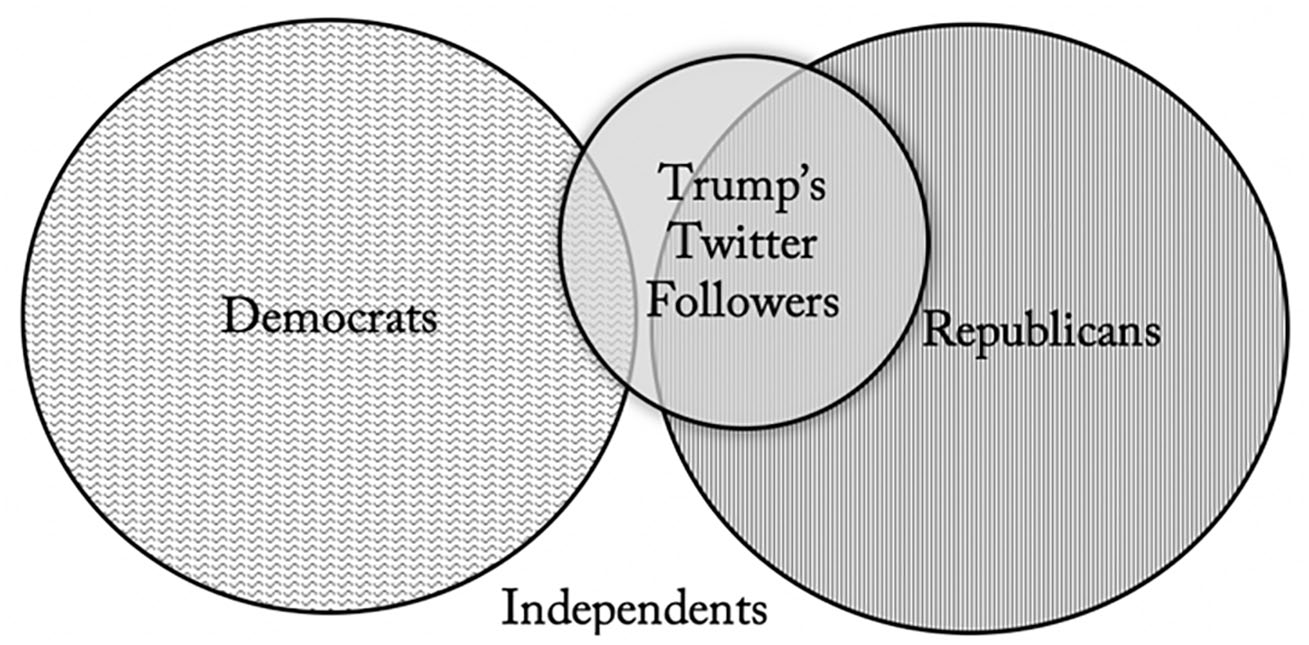
Trump’s Twitter Followers Are Not All Republicans.
My first dependent variable focuses on the behavioral aspects of online engagement, though social media engagement also has an affective/cognitive component (Brodie et al., 2013). According to Van Doorn et al. (2010), the behavioral component of social media engagement consists of user-generated comments and the number of likes and shares. This behavioral component is both observable and can be measured objectively; therefore, in this article, I focus on the behavioral aspects of engagement.
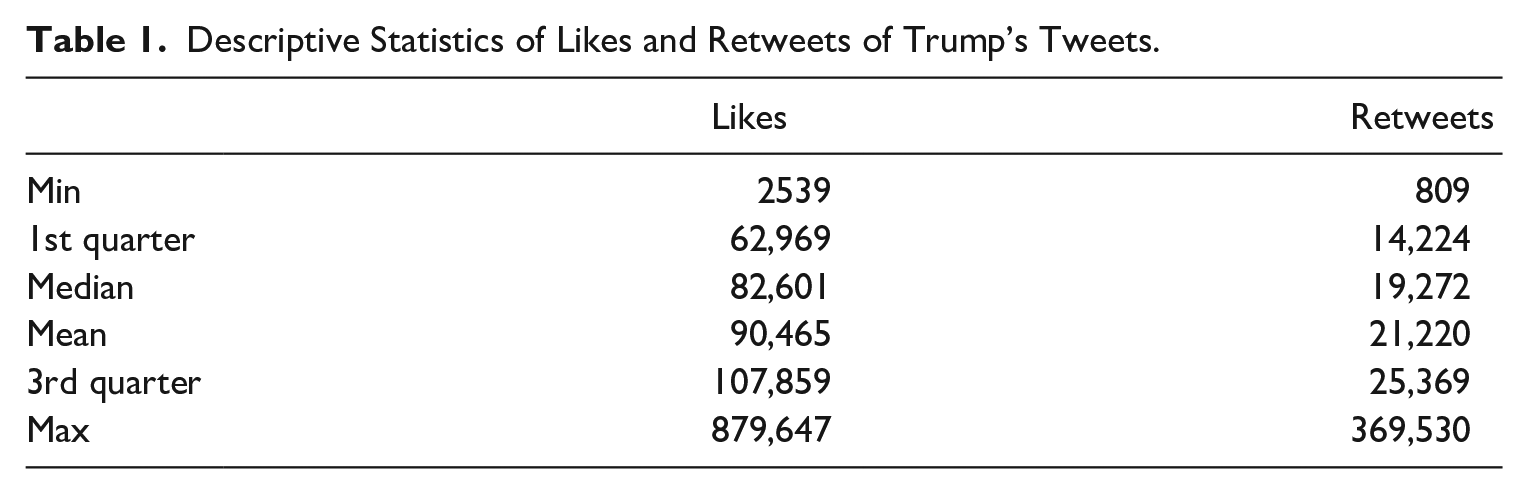
The likes and shares of Trump’s tweets (Table 1) represent the levels of Trump’s Twitter followers’ online engagement: the higher the number of likes and shares, the higher the extent of online engagement. I scraped Trump’s tweets from February 2017 to January 2021, including their number of likes and shares, through Twitter’s Application Programming Interface (API). Although people might share tweets that they disagree with, people who dislike a tweet are extremely unlikely to like that tweet. As shares and likes are a widely used measurement of online engagement, I follow this standard but am aware of the different meanings that sharing a post may represent.
Descriptive Statistics of Likes and Retweets of Trump’s Tweets.
The second dependent variable is how Americans rated Trump’s tweets. This dependent variable is essential because it shows how audiences beyond Trump’s Twitter followers reacted to Trump’s tweets. In the survey sent to respondents, YouGov prompted respondents: “Here are some comments Donald Trump made on [date]. Please rate them.” Below the prompt, respondents will see a complete Trump tweet with numbers of likes and shares (but without the comment section). Then, YouGov asked respondents to rate President Trump’s daily tweets on a scale of “Great” (a rating of 2), “Good” (1), “OK” (0), “Bad” (−1), and “Terrible” (−2).
YouGov reports four kinds of rating for each tweet. The first type is the combined average rating given by Democrats, Independents, and Republicans. The other three types are ratings given by each of these three political groups. YouGov multiplies the original ratings by 100, meaning these ratings can range from −200 (if all respondents considered the tweet “Terrible”) to + 200 (if all respondents unanimously thought the tweet was “Great”).
I do not use the total ratings here because ratings of Trump’s tweets are divided along partisan lines (see Figure 3). Additionally, extant research has found that foreign policy divisions among US citizens are just as ideologically driven as in domestic politics. Conservatives and liberals disagree with each other on several domestic and foreign policy issues (Gries, 2014). The average score across all political groups, therefore, offers limited information.
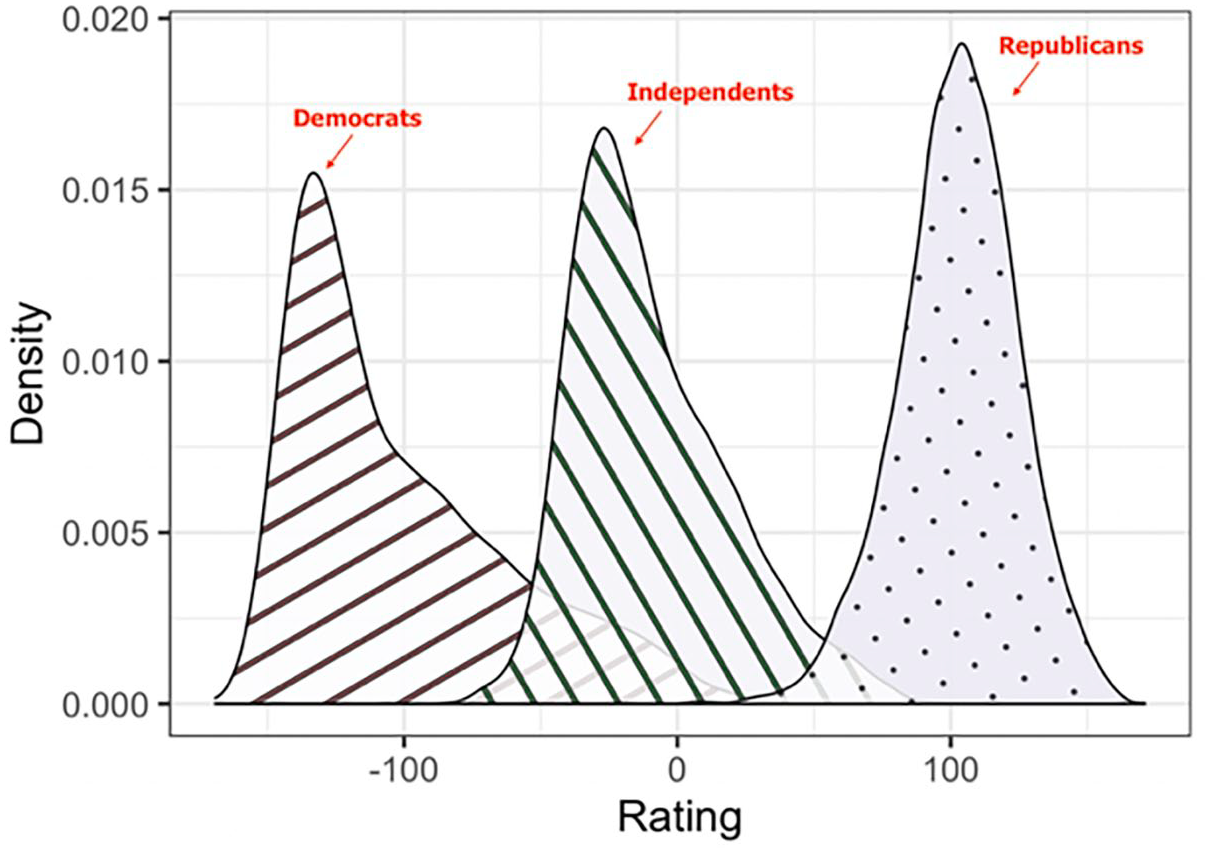
Rating Density Plot.
There are 12,580 rated tweets in the dataset, excluding retweets, from 1 February 2017 (when YouGov first conducted the survey) to 8 January 2021 (when President Trump’s Twitter account was suspended by Twitter). As Figure 3 shows, ratings given by Republicans are higher on average than those given by Independents and Democrats. This distribution of ratings is understandable as Trump was the leader of the Republican Party. It is also understandable that Democrats, compared with the other two political groups, rated Trump’s tweets more poorly because of their more distant political views.
YouGov’s Tweet Index is a valuable dataset but, like many datasets, is imperfect. It provides a valuable opportunity for us to acquire a possible answer to the influence or consequence of political elites’ negative social media communication, an increasing political phenomenon in the United States and other democracies. One concern is its survey question. YouGov’s survey states: “Here are some comments Donald Trump made on [date]. Please rate them.” I have some reservations about the wording of this prompt. In particular, I question the evaluative processes that may be reflected in the YouGov measure. For example, respondents might “rate” the tweets based on different conceptions of the word. They might rate the tweet according to its accuracy (e.g. whether his tweets were spreading misinformation), its use of inappropriate language or analogies (e.g. comparing his impeachment inquiry with a lynching), a pre-existing opinion regarding the topic of the tweet (e.g. building a wall at the US-Mexico border), or an overall evaluation of his presidency and policies (e.g. Trump’s job approval rating).
Despite this potential concern, the dataset is still quite valuable for at least four reasons. For one, it expands our knowledge to a more representative US sample, moving us beyond examining only Trump’s Twitter followers. Additionally, no matter what evaluative process respondents had in mind, the rhetoric or tone exists in the “treatment” assigned to Trump’s tweets. The rhetoric or tone of Trump’s tweets directly or indirectly impacts how respondents rate his tweets.
Moreover, despite potential measurement concerns, the YouGov Tweet Index is the most comprehensive dataset collecting partisan reactions to almost all of Trump’s tweets during his presidency. YouGov also collected these responses in a timely fashion, sending the survey within 24 hours after Trump tweeted, meaning this survey captures how the general public reacted to his tweets in almost real time. As a result, the YouGov Tweet Index provides a unique chance for researchers to find a plausible answer to a puzzling question: how does negative social media communication from elite politicians impact public reaction?
Independent Variable
The independent variable is the level of negativity of a Trump tweet. I obtained Trump’s tweets through Twitter’s API. The tweets I downloaded are the same tweets used in the YouGov survey. To estimate this explanatory variable, I used the Lexicoder Sentiment Dictionary (LSD), which has a wide range of applications in the social sciences and has been used for analyzing newspaper stories regarding public policy issues (Kraft et al., 2020; Young and Soroka, 2012). The sentiment analysis was implemented using the quanteda package in R (Benoit et al., 2018). The level of the negative tone in each Trump tweet is the difference between the number of negative and positive words in a given tweet. The larger the value, the more negative the tone of a tweet.
In my dataset, the maximum tone value is 15, and the minimum is −12. Figure 4 displays the distribution of level of negativity across all of Trump’s tweets. The result shows that most of Trump’s tweets are close to neutral in tone, with a score of 0. Table 2 shows a few examples of Trump’s negative and positive tweets. While many people may be surprised by these frequencies, it is likely that news media tends to overreport those highly controversial and negative tweets, and that these “famous” tweets thus constitute most people’s understanding of Trump’s Twitter presence (Ouyang and Waterman, 2020).
Samples of Trump’s Negative and Positive Tweets.
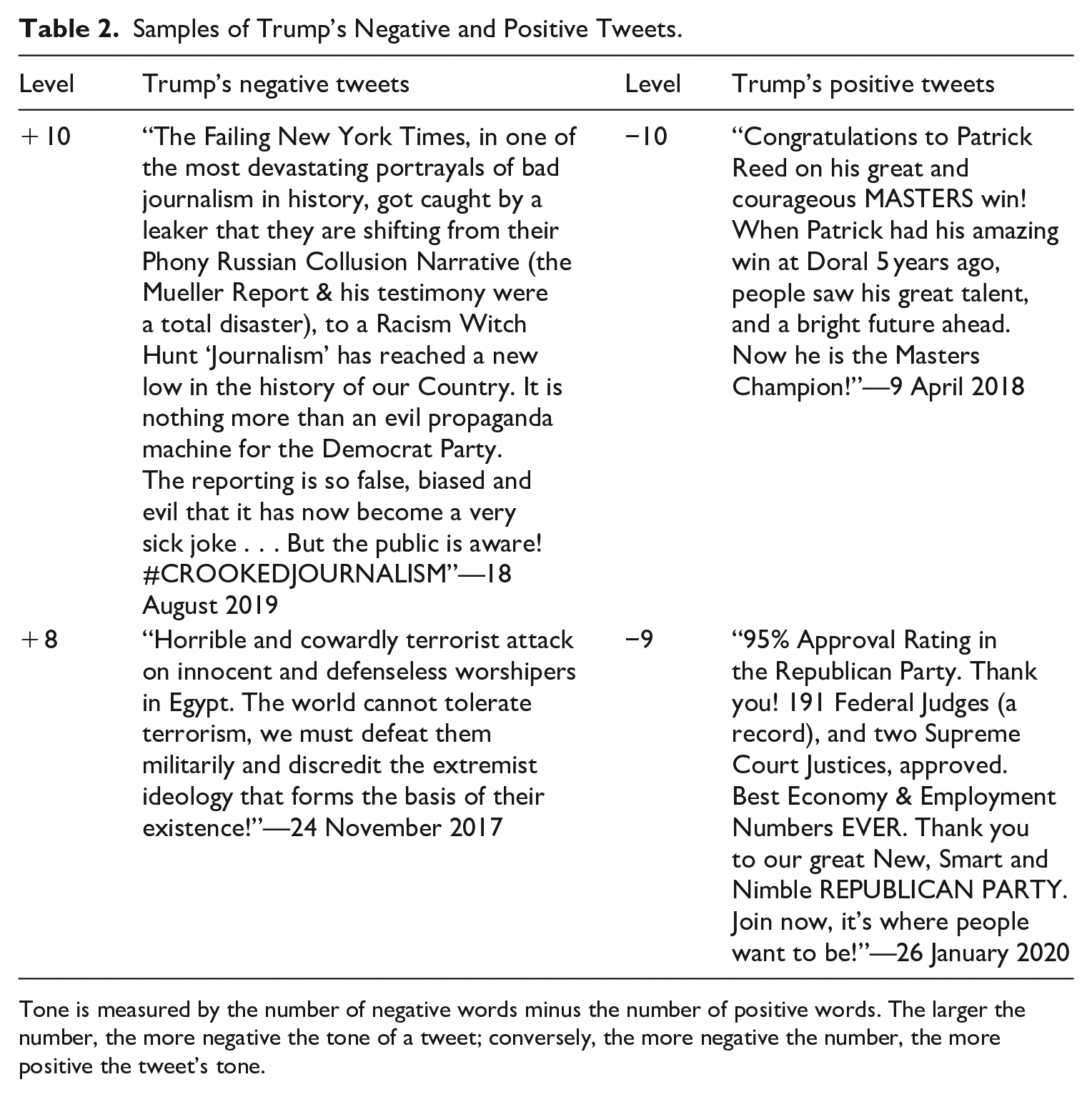
Tone is measured by the number of negative words minus the number of positive words. The larger the number, the more negative the tone of a tweet; conversely, the more negative the number, the more positive the tweet’s tone.
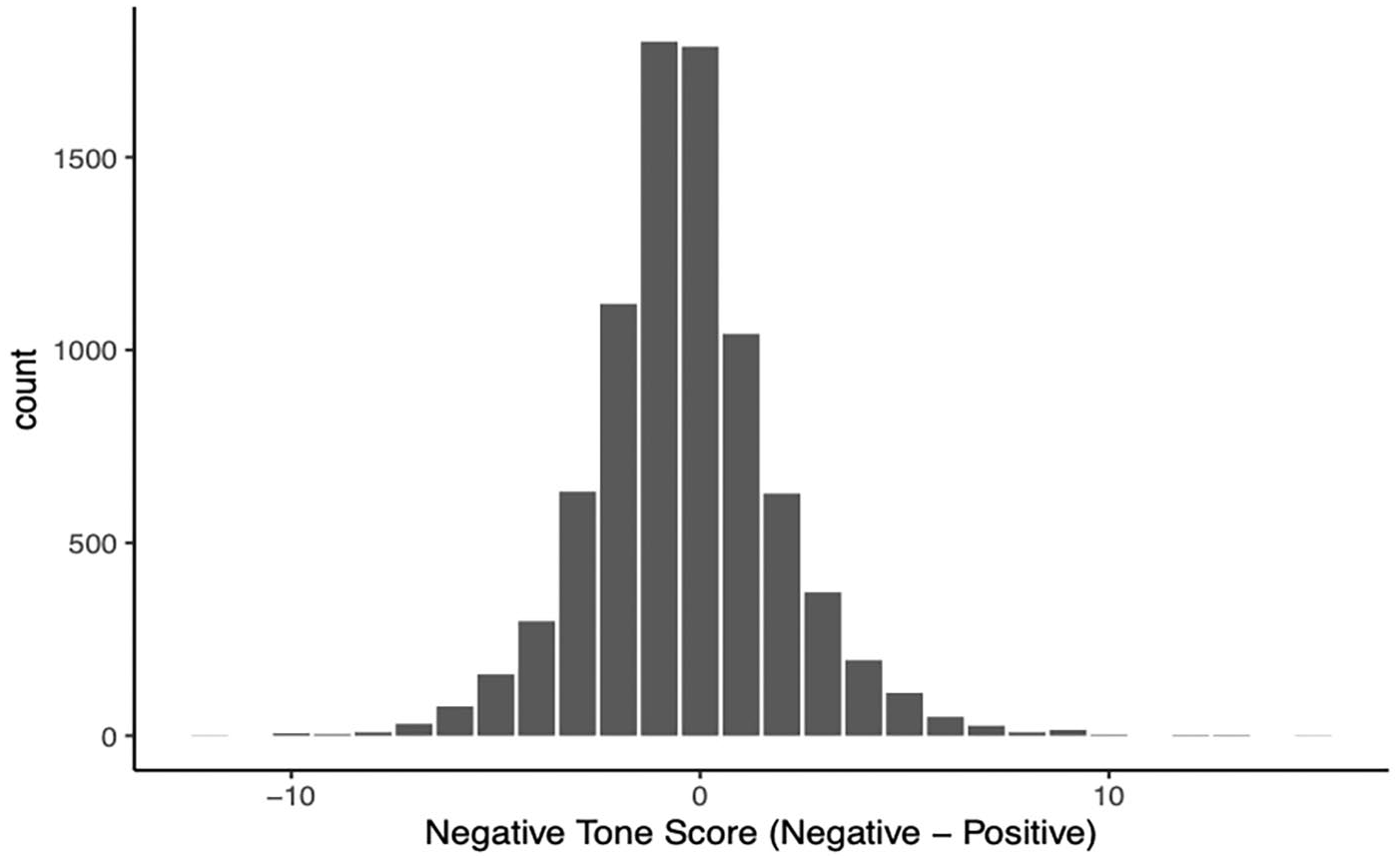
Distribution of Negative Tone Across Trump’s Tweets.
To provide a further robustness check, I also analyzed Trump’s tweets with other widely used sentiment dictionaries, including the Bing dictionary and the Loughran dictionary. These results are all consistent with that of the LSD and can be found in the Online Appendices.
Control Variables
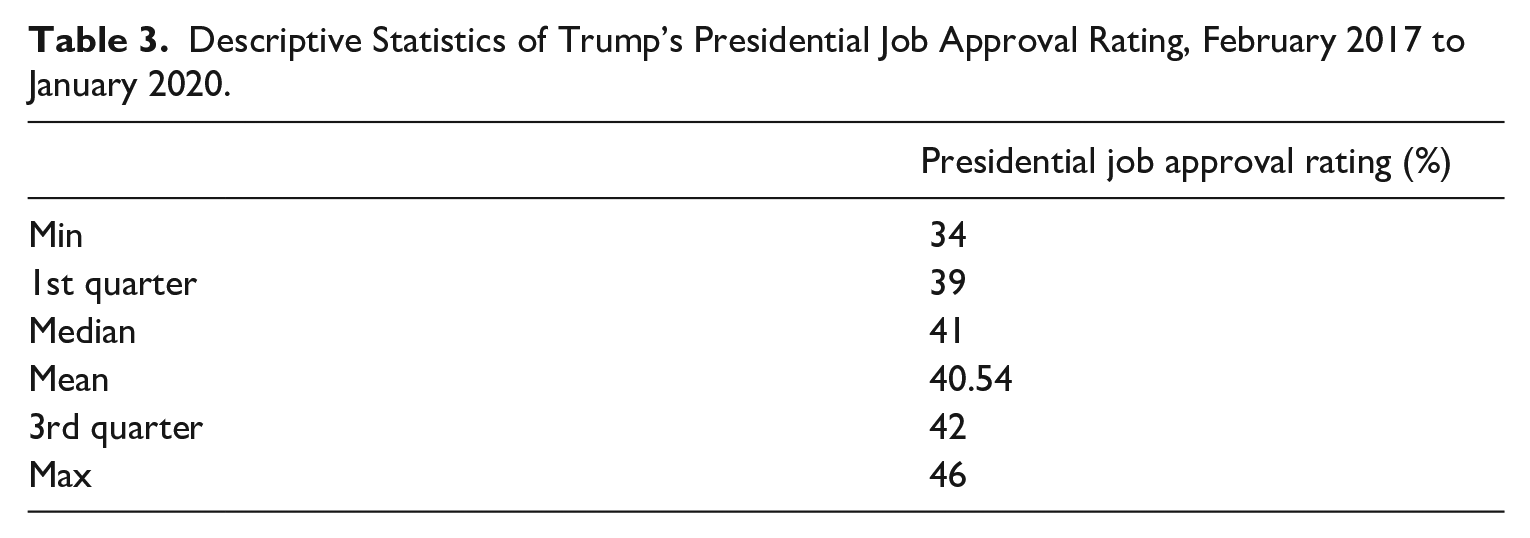
Control variables are selected according to the need of a given model and data availability. I use three sets of control variables. First, I assume that Trump’s popularity influenced the President’s tweet writing strategy and how people perceived the former president and his tweets. However, Trump’s tweets might also affect his popularity, and there might be a two-way relationship between Trump’s tweets and his popularity and how people evaluated his tweets. I acknowledge the possibility of this two-way effect, but exploring this potential two-way effect is beyond the scope of this research. To measure popularity, I used YouGov’s US President daily job approval rating data. As Table 3 shows, by the end of January 2020, Trump’s minimum job approval rating was 34%, while the maximum was 46%.
Descriptive Statistics of Trump’s Presidential Job Approval Rating, February 2017 to January 2020.
For the second grouping of control variables, I selected 14 control topics in the models. I did not use original topic modeling to estimate topics because tweets are too short (Tang et al., 2014), but future research may consider the use of more advanced topic modeling strategies, such as structural topic modeling (Roberts et al., 2019). Figure 5 shows the word cloud of Trump’s tweets, posted from February 2017 to January 2021. I mostly chose policy topics based on frequent topic words in Trump’s tweets as well as my understanding of important political themes that happened during Trump’s presidency. These 14 chosen topics include China, Korea, Russia, Mexico, Iran, terrorism, the border wall, impeachment, the media, the economy, the Democratic Party, the Republican Party, the military, and foreign affairs.
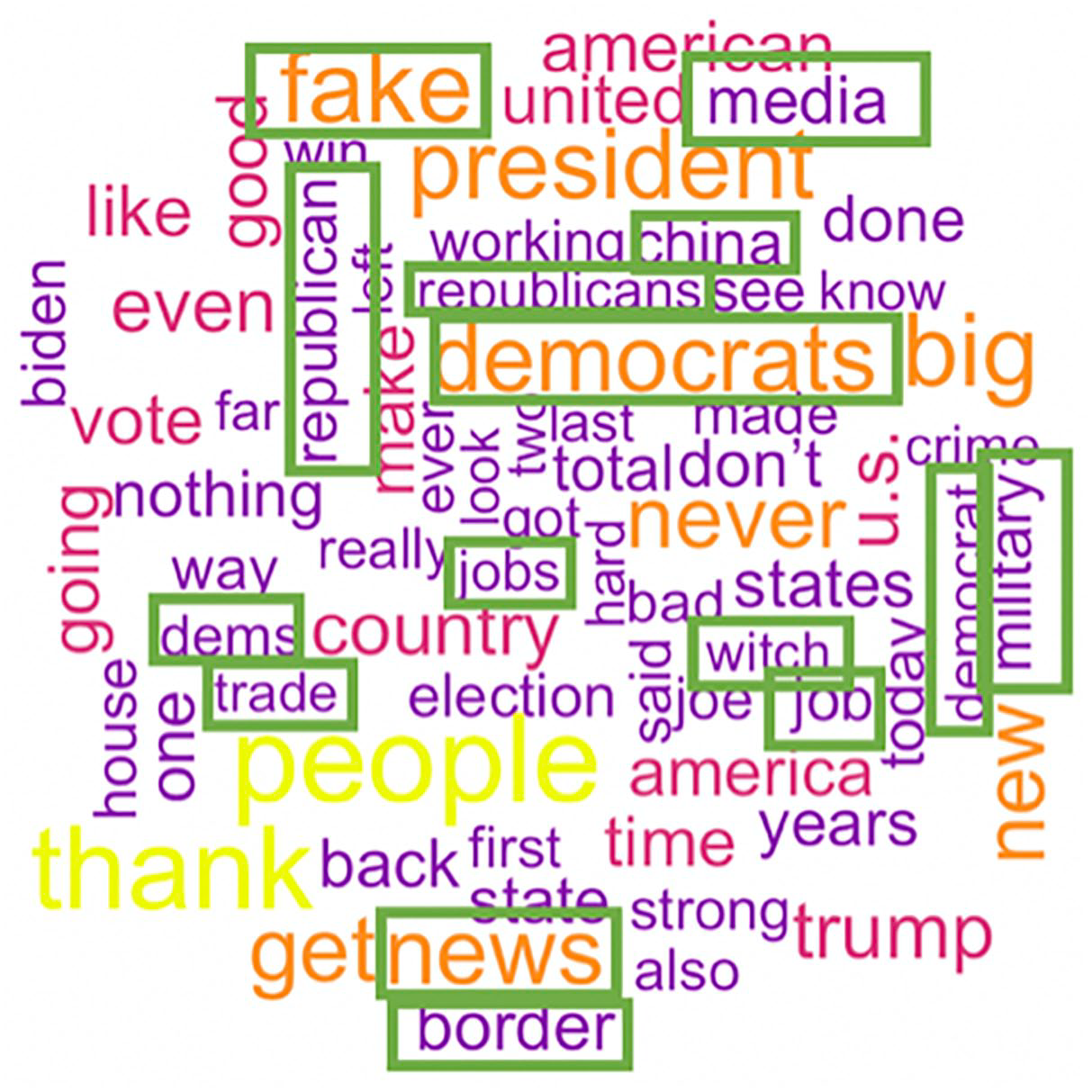
The Word Cloud of Trump’s Tweets, February 2017–January 2021.
To find keywords that targeted tweets related to a specific topic and reduce my potential personal bias in the keyword selection, I hired 100 human coders from Amazon MTurk, who self-reported that they have taken at least one course on International Relations in college. I asked them to come up with keywords related to these 14 topics. I only selected keywords mentioned by more than 50 coders. The list of keywords for all 14 topics is in Online Appendix A. I treated these topics as separate dummy variables because several of Trump’s tweets contain multiple topics. For example, on 16 April 2017, Trump tweeted, “Why would I call China a currency manipulator when they are working with us on the North Korean problem? We will see what happens!” This tweet covers at least two topics: China and Korea, meaning I coded it as 1 in both dummy variables related to the topics.
The third set of controls, partisanship, can be a critical factor determining how people reacted to Trump’s tweets. Partisanship has become more influential in political life due to heightened polarization (Peterson and Iyengar, 2021). As Figure 3 shows, on average, Democrats rated Trump’s tweets much lower than did Republicans. While YouGov does not release each respondent’s party identification information, the data structure of the YouGov Tweet Index controlled for partisanship. YouGov reports ratings of each of Trump’s tweets given by Democrats, Independents, and Republicans. As a result, it is similar to the function of blocking in experiments, where participants are grouped according to certain features that may confound survey results and, therefore, must be controlled. 1
I did not control for respondents’ demographic characteristics beyond partisanship because that information is unfortunately not available. However, this concern is lessened to some extent because YouGov randomly selected a representative sample to participate in the survey. This randomization can eliminate the potential influence of confounders related to other demographic factors. Finally, YouGov provided incentives to participants through YouGov membership points that can be redeemed for gift cards. This largely reduces the potential bias that people who did the survey were merely interested in politics or in Trump.
Modeling Strategy
There are two statistical models in this research. The engagement model (EM) estimates the effect of Trump’s negative Twitter rhetoric/tone on online engagement (H1a and H1b). The perception model (PM) estimates the influence of the level of negativity of Trump’s tweets on how people rated those tweets (H2a and H2b). To better understand the influence of the tone of Trump’s tweets under different policy topics, in these two models, policy topics were interacted with the independent variable, the tone of Trump’s tweets.
The Engagement Model
The EM tests H1a and H1b. Two dependent variables of this model are the logged number of likes on each of Trump’s tweets, and the logged number of shares of his tweets. As mentioned, the way that I constructed the independent variable shows the negative tone level of Trump’s tweets, ranging from positive (scores smaller than zero) to negative (scores larger than zero). A zero tone in the independent variable means the tone of the tweet is neutral. 2 So, in this EM, if the coefficient of interest is positive, this means that in Trump’s tweets, there is a positive association between negative tone and engagement. As both likes and shares are continuous integers, I’ve applied multiple linear regression models with robust standard errors to estimate the coefficients.
As mentioned, YouGov does not release the data of each response for every one of Trump’s tweets but only releases each tweet’s aggregated ratings given by Democrats, Independents, and Republicans. The structure of the YouGov data dictates the way we can build our models. As shown in equation (1a), I estimated the effects of interest on these partisan groups separately. After three rounds of analyses (replacing rating scores), there were three coefficients of interest, representing the effects of the negative tone of Trump’s tweets on Democrats, Independents, and Republicans. I controlled for Trump’s daily job approval rating, the number of likes, the number of retweets, and topic dummies, with month-fixed effects used to reduce possible omitted variable bias.
The EM:

where the dependent variable,
To better understand this model, I let the tone value interact with selected policy topics, including China and Foreign Affairs. The model is shown in equation (1b). The model with an interaction term (policy topics) allows us to observe how negative social media communication on a specific policy topic may affect audiences’ evaluation of that information. In the analysis section,
The EM With Topic Interaction Terms:

where the dependenty variable,
The Perception Model
The PM tests H2a and H2b, estimating the effects of the tone of Trump’s tweets on different partisans’ perceptions of his tweets. By perception, I mean the rating score of each of Trump’s tweets given by different partisan groups. I demonstrate two equations. The original one (equation (2a)) estimates the effect of the tone of Trump’s tweets on partisan groups’ rating scores for these tweets. The second equation (equation (2b)) contains an interaction term, in which the tone of Trump’s tweets was interacted with policy topics. As the dependent variable is continuous, I apply multiple linear regression models with robust standard errors to estimate the coefficients.
The PM:

where the dependent variable,
Next, equation (2b) is similar to equation (2a). The only difference is the function of the topic variables. In equation (2a), the topic variables serve as control variables, whereas in equation (2b), each of the 14 topic variables interacts with the independent variable, the tone of Trump’s tweets, separately.
The PM With Topic Interactions:

where the dependent variable,
Analyses
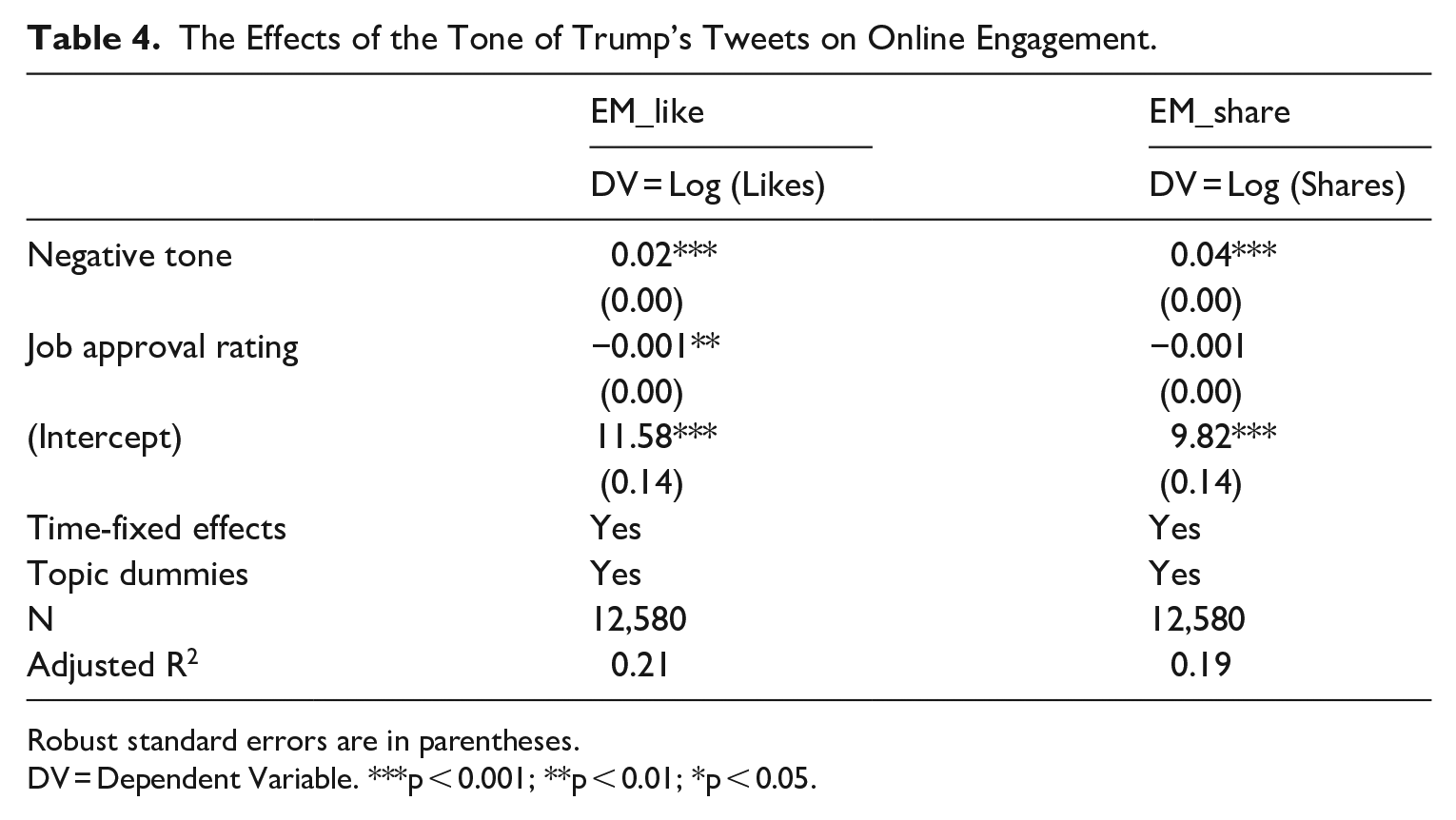
Table 4 shows the coefficients of the EM (EM_like and EM_share). To address the skewness of the values of likes and shares, I’ve logged both likes and shares as dependent variables. The coefficient of negative tone in EM_like is 0.02 and is statistically significant, which means that adding one additional negative word is associated with multiplying the number of likes by a factor of 1.02, on average. In other words, for Trump, an additional negative word in a tweet is associated with a 2% increase in the average number of likes.
The Effects of the Tone of Trump’s Tweets on Online Engagement.
Robust standard errors are in parentheses.
p < 0.001; **p < 0.01; *p < 0.05.
EM_share estimates the influence of Trump’s negative rhetoric on shares. The coefficient of interest for shares is 0.04, meaning that an additional negative word is associated with multiplying the number of shares by an average factor of 1.04. For former US President Trump, writing one more negative word in a tweet is associated with a 4% increase in the number of shares of the tweet, on average, after controlling for all control variables. The number of likes and shares represents the level of social media engagement, and the results of EM_like and EM_share verify H1a: the negative tone of elite politicians’ social media messages is positively associated with the number of Likes. The results, however, do not verify H1b, which states that the negative tone of elite politicians’ social media messages does not impact the number of Shares.
Some might argue that the topic of Trump’s tweets may mediate the effect of tone on audiences’ willingness to like or share his tweets. In this research, I selected two important policy topics, China and foreign affairs, to interact with the tone of Trump’s tweets and test whether H1a is still valid in these scenarios. Figures 6 and 7 show the results.
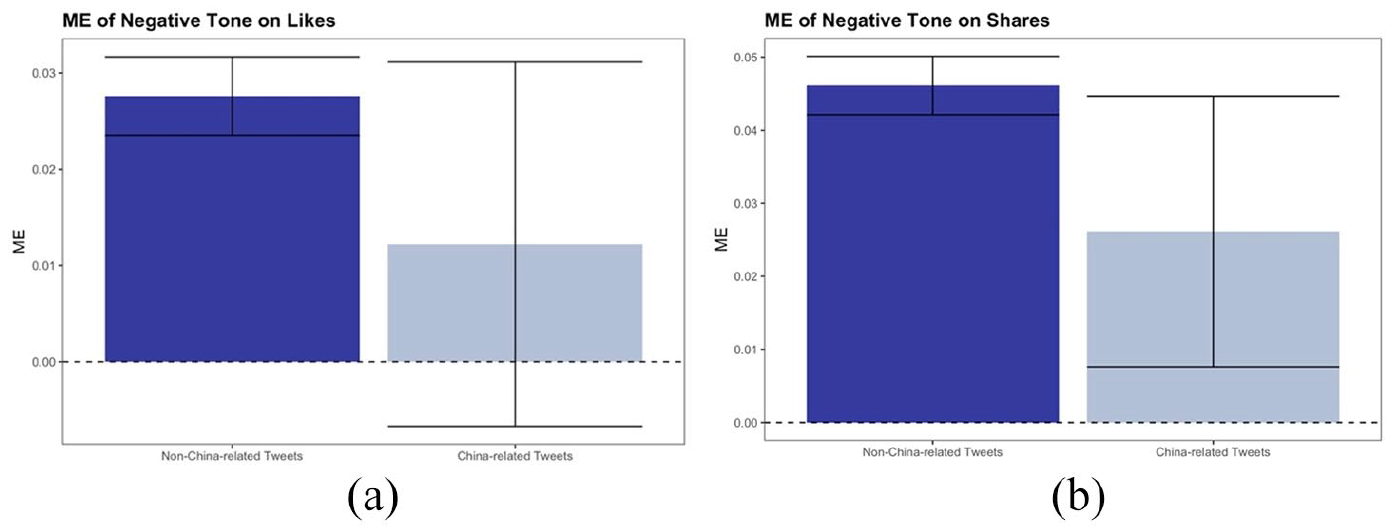
The Marginal Effect of Tone on Engagement (Mediated by Topic = China): (a) DV = Likes and (b) DV = Shares.
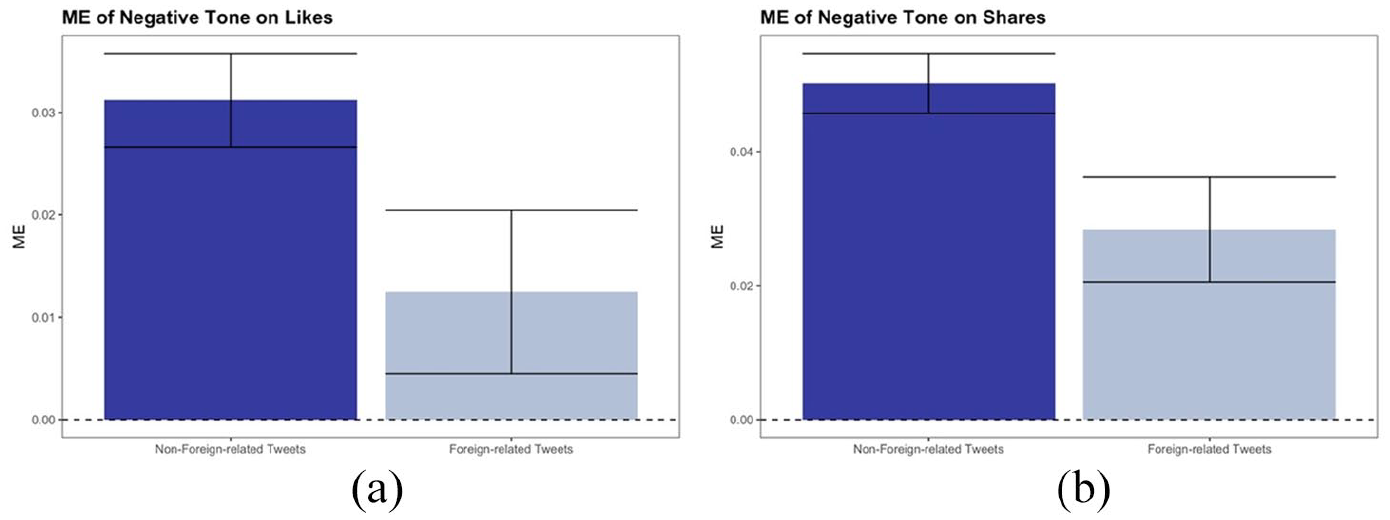
The Marginal Effect of Tone on Engagement (Mediated by Topic = Foreign Affairs): (a) DV = Likes and (b) DV = Shares.
Figure 6(a) shows how the effect of tone on the number of likes is mediated by the topic of China. The effect of negative tone on likes is positive if it is a non-China-related tweet; however, the effect of interest, while positive, is not statistically significant if it is a China-related tweet. For Trump, adding negative words to China-related tweets could not effectively motivate people to like his tweet.
Figure 6(b) shows how the effect of interest on the number of shares is mediated by the topic of China. Different from the likes case, the shares case shows that adding negative words to both China-related and non-China-related tweets can increase the spread of the tweets (i.e. increase the number of shares). Another interesting finding is that adding negative words to non-China-related tweets, compared with doing so to China-related tweets, better motivated Trump’s Twitter followers to share the information.
Figure 7 shows the mediation effect of the topic of foreign affairs. According to Figure 7(a) and (b), for Trump, adding negative words in foreign affairs tweets and non-foreign-affairs tweets can increase the number of likes and shares of these tweets. But the effect is stronger (i.e. generating more likes and shares) in Trump’s non-foreign-affairs tweets than in his foreign affairs tweets.
After analyzing the EM, let us turn to the PM. As mentioned, the PM tests the validity of H2a and H2b, estimating the effect of negative tone on partisan groups’ evaluation of Trump’s tweets. This PM can help us understand how Trump’s negative words in his tweets may affect people’s evaluation of these tweets.
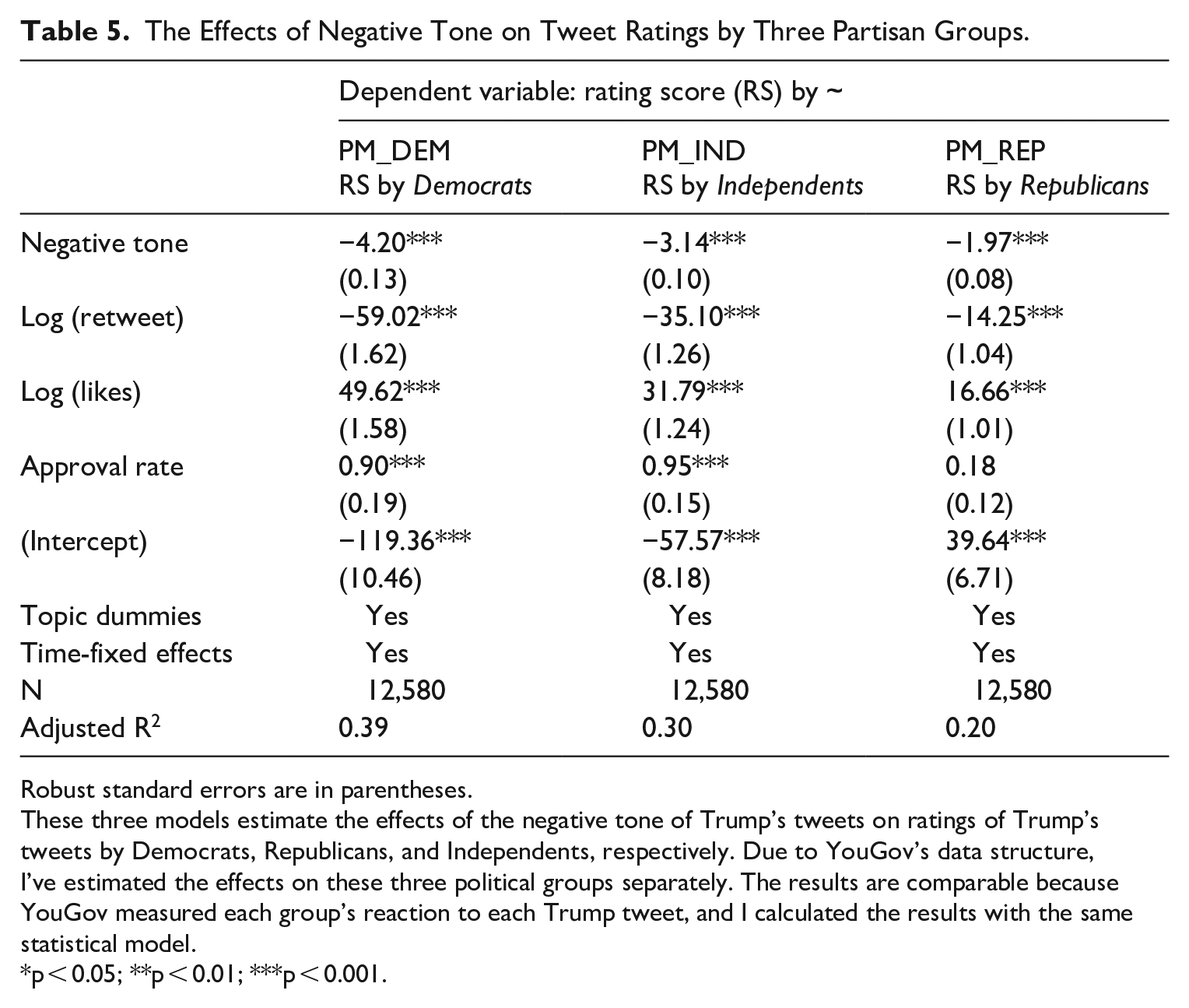
Table 5 has coefficients of PM_DEM (Rating Scores by Democrats), PM_IND (Rating Scores by Independents), and PM_REP (Rating Scores by Republicans). According to these results, on average, after controlling for the 14 topics, retweets, likes, Trump’s daily approval ratings, and time-fixed effects, a single additional negative word in one of Trump’s tweets is associated with a 4.32-point decrease in ratings of his tweets by Democrats, a 3.19-point decrease in ratings by Independents, and a 1.99-point reduction in ratings by Republicans. All three results are statistically significant. Because the associations between negative tone and ratings given by these three different political groups are all negative and statistically significant, the results verify H2a.
The Effects of Negative Tone on Tweet Ratings by Three Partisan Groups.
Robust standard errors are in parentheses.
These three models estimate the effects of the negative tone of Trump’s tweets on ratings of Trump’s tweets by Democrats, Republicans, and Independents, respectively. Due to YouGov’s data structure, I’ve estimated the effects on these three political groups separately. The results are comparable because YouGov measured each group’s reaction to each Trump tweet, and I calculated the results with the same statistical model.
p < 0.05; **p < 0.01; ***p < 0.001.
The negative coefficients in these three results show that Democrats, Independents, and Republicans all dislike negative social media communication by Mr. Trump when he was serving as US President. The results show how negative social media messaging can backfire—even Republicans, Mr. Trump’s co-partisans, may evaluate Trump’s tweets more negatively as Trump used more negative words in his social media messages. Republicans are not insensitive to the tone of Trump’s tweets.
While the effects on these three partisan groups are all negative, the magnitudes are different—the effect of negative tone is the largest on Democrats, then Independents, and then Republicans. The result verifies H2b. Based on this result, we can infer that Democrats, compared with Independents and Republicans, are more sensitive to the tone of Trump’s tweets. I argue that partisanship is not a cue or a factor explaining everything. While we usually believe that partisanship largely determines how people view or evaluate an elite politician’s messages, this research finds that the tone or words used in the message still matter a lot in people’s evaluation and perception of the message. The effect of tone is larger for the audience with an opposite political view compared with a co-partisan audience. An audience with an opposite political view is more sensitive to the tone and words used in a politician’s social media messages.
While the result of the original model already provides important insights into how tone influences people’s evaluation of Trump’s tweets in general, it is equally important to dive into different policy topics and see whether the effect may be mediated by those topics. I constructed a topic-interaction model in which each of the 14 policy topics interacts with the independent variable, the tone of Trump’s tweets. These results can help us further understand whether H2a and H2b are valid across different topics. I present the marginal effects in Table 6 and their plots in Figure 8.
Marginal Effects of Tone, Conditional on Topics.
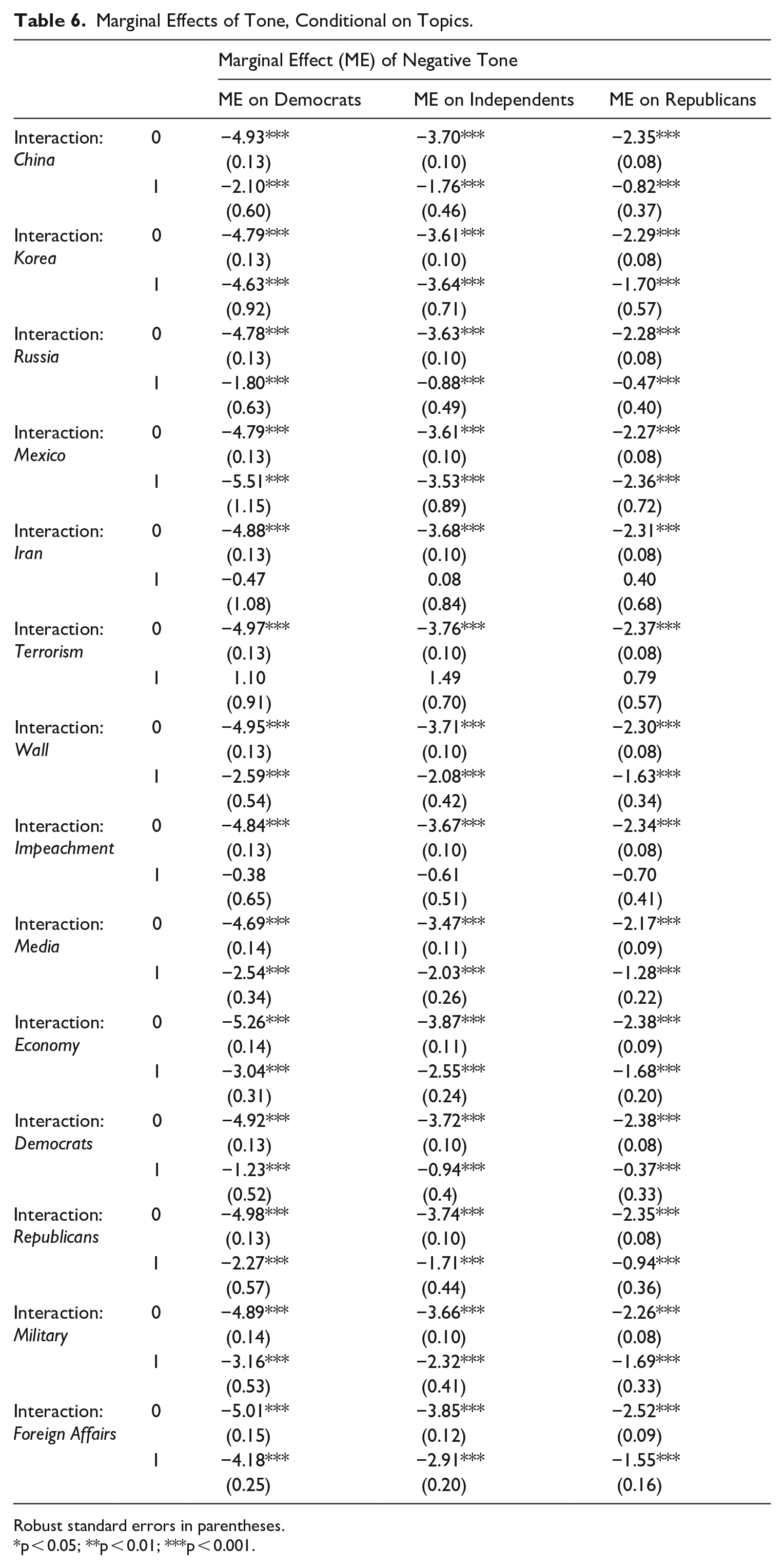
Robust standard errors in parentheses.
p < 0.05; **p < 0.01; ***p < 0.001.
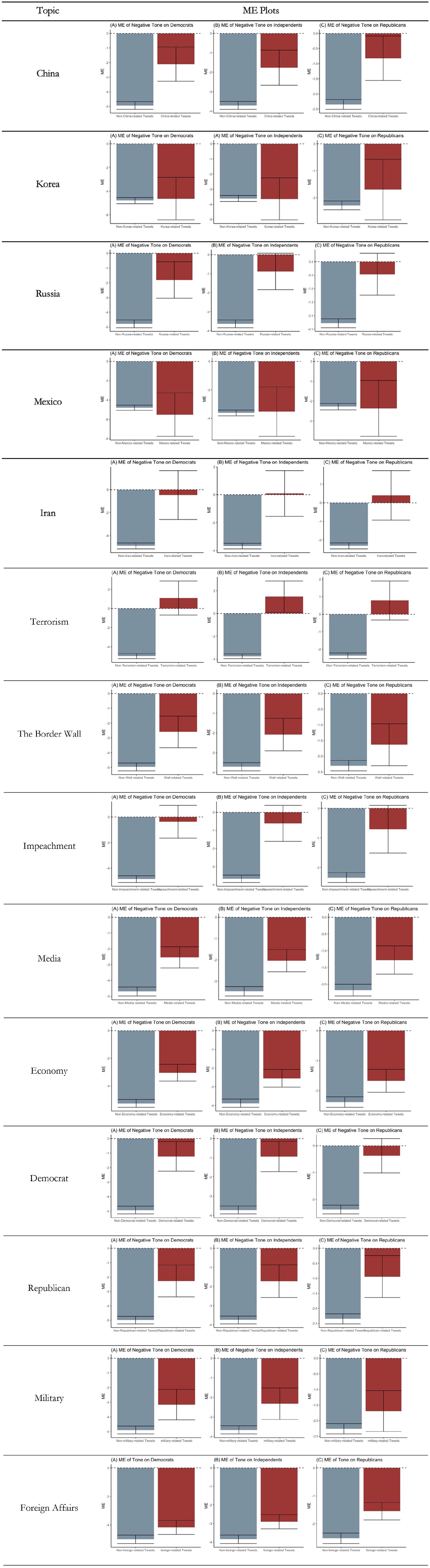
ME Plots for the Influence of Tone, Conditional on Topics.
In this analysis section, due to the length of the research, I selected the foreign affairs topic and three other important foreign policy topics during the Trump administration—terrorism, the border wall, and China—to illustrate the marginal effect of tone on people’s evaluations of Trump’s tweets about these four topics. To better interpret the meaning of the results, I shall describe these marginal effects in two distinct ways: within political groups and across political groups. First, I have compared reactions by members of the same political group with Trump’s tweets on a specific topic with their reactions to tweets on other topics. Second, I have compared reactions with the negative tone of Trump’s tweets on a specific topic across all three political groups.
When it comes to the comparison made within political groups, as Table 6 shows, holding all other things equal, if Trump adds one more negative word to tweets on terrorism, it will not change how any of the three partisan groups evaluate or rate these tweets. This means that tone does not have a statistically significant influence on people’s evaluation of Trump’s terrorism-related tweets.
However, tone matters in people’s evaluation of Trump’s tweets on the border wall. Holding other things equal, if Trump adds one more negative word to tweets on the issue of the border wall, the negative impact is smaller than in those tweets on non-wall issues. This effect holds across all three political groups. Specifically, for Democrats, the effect of border wall issues is −2.59, on average, but the effect is −4.95 for Democrats regarding tweets about non-wall issues. For Independents, the effect of Trump’s wall tweets is −2.08, while it is −3.71 for his non-wall tweets. Likewise, the effect for Republicans is −1.63 for Trump’s wall tweets and −2.3 for non-wall tweets. All of these findings are statistically significant, and what they boil down to is this: while using negative words in tweets is harmful to Trump in general, Trump’s negativity on the wall issue hurts him less than negativity on non-wall issues. (By “harmful” or “hurt,” I mean the decrease of rating scores of Trump’s tweets.)
This effect also holds when Trump tweeted on foreign affairs. While adding negative words may have undermined all partisans’ general perceptions of Trump’s tweets, negativity in tweets about foreign affairs had less of an effect. Moreover, adding one more negative word to Trump’s tweets on China, compared with adding an additional negative word to his non-China tweets, was less harmful to Trump (see Table 6 for coefficients).
We can interpret the marginal effects in another way, across political party affiliation, by comparing the effects of negative tone on different political groups under a given topic. In this way, under a specific topic, we can observe how Trump’s negative words have influenced these three political groups’ reactions to his tweets. In Trump’s foreign affairs-related tweets, compared with Independents and Republicans,’ Democrats’ ratings of Trump’s tweets deteriorate more if Trump added one more negative word to his foreign affairs tweets. Specifically, if Trump adds one more negative word to a tweet on foreign affairs, the effects are as follows: on average, the Democrats’ ratings decrease by −4.18 points; the Independents’ ratings decrease by −2.91 points, and the Republicans’ ratings decrease by −1.55 points.
Focusing on the topic of China, we can observe another interesting pattern: adding a negative word to Trump’s tweets on China has a similar effect on Democrats (−2.10) and Independents (−1.76), on average, and the effect on Republicans is only −0.82. This implies that Trump’s negative tone in tweets about China did not largely influence how Republicans evaluated these tweets. Likewise, adding negative words to Trump’s tweets on the border wall has a similar negative effect on Democrats and Independents, but the negative effect on Republicans, while statistically significant, is slightly smaller than those on Democrats and Independents. Regarding Trump’s tweets on terrorism, as the results are not statistically significant, we were not able to make a cross-partisan comparison.
Put together, while the general model shows that a negative tone has a negative impact on all three partisan groups’ evaluations of Trump’s tweets, I found that policy topics can mediate the effect. Some partisans showed certain levels of insensitivity to the tone of Trump’s tweets on certain policy topics. By insensitivity, I mean the limited or insignificant impact of policy topics on the influence of tone on people’s evaluation of Trump’s tweets. This insensitivity to the tone of Trump’s tweets on a policy topic demonstrates that, within that topic, other factors, such as partisanship or the policy topic itself, dominate how people evaluate Trump’s tweets. For example, Independents and Republicans have been insensitive to Trump’s negative tone in tweets on Russia. It might be because Independents and Republicans already have had a strong pre-existing view on the Russia-related issue or how Trump was handling Russia, so their evaluations about Trump’s Russia tweets were not affected by the tone of these messages.
Likewise, Republicans, Trump’s co-partisans, were insensitive to the tone of Trump’s tweets on the Democratic Party. There were three policy topics in which all three partisan groups were insensitive to the tone of Trump’s tweets: Iran, impeachment, and terrorism. Potential explanations can be that all partisans have strong prior views on Iran, impeachment, and terrorism or on how President Trump was dealing with these three issues, and their pre-existing opinions were so strong that their evaluations about these related tweets were not affected by other factors such as how President Trump framed the issues in his tweets. Future research can further explore what factors caused this insensitivity across all three partisan groups under the three policy topics.
Elite Politicians’ Negative Social Media Communication Does Backfire
My analysis shows that the level of negative tone in Trump’s tweets, in general, is positively associated with the number of likes and shares of these tweets. These positive associations imply that Trump’s more negative tweets are likely to receive more attention. That more negative tweets receive more likes increases the likelihood a social media post will be seen because (1) social media algorithms may “bubble up” popular content, 3 (2) a public post liked by a user can be seen by that user’s social media friends/followers, and (3) more people can see a public social media post if more people share that post.
Then, the next question is whether the high visibility of negative social media posts is a positive or negative thing for political elites. In the case of Mr. Trump, a negative tone spreads his tweets further and appears to have benefited Trump as his political messages reached a broader audience. But my analysis finds that “going negative” on social media can backfire on politicians like Trump.
The evidence that “going negative” can backfire can be found at PM_DEM, PM_IND, and PM_REP. The results of these three models show the potential cost of Trump’s negative social media communication. By “potential cost,” I mean any negative impact on an individual’s evaluation of President Trump and his messages. This research finds that Trump’s negative tweets decreased how people evaluated his tweets, which is a potential cost for Trump’s “going negative” on Twitter.
Republicans, Independents, and Democrats all responded more negatively with an increase in negative words in Trump’s tweets. Going negative on Twitter did not help President Trump improve how the public evaluated his tweets. The more people read his negative tweets, no matter their party identification, the higher the cost President Trump had to pay. The spread of his negative tweets, in reality, hurts his potential political support. For Trump, going negative on Twitter—while it did ensure more people saw his tweets—hurts how people evaluated his messages. It is reasonable to infer that, holding other things equal, compared with those who viewed no tweets, people who viewed Trump’s negative tweets were more likely to lower their evaluation of Trump himself. Negative tweets made his supporters like Trump less, Independents approve of Trump less, and Democrats dislike Trump more.
Some may argue that people who disliked Trump’s negative tweets might still have positive evaluations of his job as president. There are two possible explanations for this inconsistency. First, this type of person evaluated Trump’s tweets and his job performance separately and independently, meaning people’s evaluations of Trump’s tweets did not impact how they evaluated Trump’s job performance. Second, people’s evaluations of Trump’s job as president, as I assume, are general evaluations based on their evaluations of Trump’s performances in many arena, including his economic policy, foreign policy, and public talks (including his social media communication). People might factor all of these areas into their final evaluations of his job as president. If people’s evaluations of Trump’s social media performance were negative, then their general evaluations of Trump as president could be undermined; however, please note that whether these people evaluated Trump positively or negatively in the end depends on the interaction of these factors. If the effect of going negative was smaller than other positive effects, then we would see people who hated Trump’s tweets but still held a positive view on Trump as the President. If the effect of negative tone was large enough, then we would see people who hated Trump’s tweets also hold a negative view on President Trump.
In addition, this research finds that tone still matters in studying political elites’ social media communication. Partisanship, while a critical factor in influencing people’s perception of political elites’ messages, cannot override the influence of tone. Despite the polarization of politics in the United States, tone still significantly affected how people perceived and evaluated President Trump’s tweets. In fact, even Republicans were not indifferent to the tone of Trump’s tweets, reacting more negatively as his tweets became more negative.
Furthermore, this research also explores the mediation effect of policy topics. In the EM, where the dependent variable is the number of likes and the independent variable is tone, the tone does not have a statistically significant effect on people’s willingness to like Trump’s tweets when his tweets are about China. However, the effect of interest exists in Trump’s foreign affairs tweets, but the magnitude of the effect in Trump’s foreign affairs tweets is smaller than that in his domestic affairs (those non-foreign-affairs-related) tweets. Likewise, in the PM, where the dependent variable is people’s evaluation of Trump’s tweets and the independent variable is the tone of Trump’s tweets, while negative messaging may backfire in most policy topics discussed in the model, a negative tone does not have a statistically significant effect on how people evaluated Trump’s tweets on Iran, impeachment, and terrorism.
Conclusion
In conclusion, challenging existing understanding of the benefit of negative social media communication for elite politicians, I find that the cost of “going negative” on social media does exist and that tone still matters in the public’s evaluation of politicians’ social media messages. This research finds that what existing literature treats as beneficial for elite politicians in their negative social media communication—helping the spread of information—in fact has negative consequences for politicians. While a negative tone facilitates the spread of messages, people across the political spectrum react negatively to negative social media messages—meaning more people receive and respond negatively to those messages.
This research has a few limitations. First, YouGov’s survey question may have some measurement error. People might rate Trump’s tweets according to different aspects they cared about, such as whether a tweet’s information was correct or whether a tweet’s content is appropriate. In addition, we can control more demographics in the models if YouGov provides individual responses for each of Trump’s tweets, but these data are not publicly accessible. Regardless, this YouGov dataset still has tremendous value in helping us understand the big picture of how people across the political spectrum reacted to Trump’s tweets.
This research has several important implications and contributions. First, it shows that going negative on social media can backfire—what existing literature found positive about this strategy hurts politicians in reality. Second, this research proves that tone still plays an important role in affecting citizens’ perceptions of elite politicians’ social media messages. Political polarization has not overridden the effect of tone on people’s evaluation of politicians’ social media information. Studying negative social media communication from politicians still has value.
Future research can explore more current topics, such as the Black Lives Matter movement and COVID-19. Additionally, future research should consider adopting a more sophisticated tone-classifying method. For example, differentiating the target of negativity in Trump’s tweets—attacking people or attacking policy—can deepen our understanding of Trump’s Twitter rhetoric strategy and its influence on public opinion. Finally, it is worthwhile to test the theory’s validity via experiments and analyze whether the cost of negative social media communication holds beyond the context of Trump.
Supplemental Material
sj-docx-1-psw-10.1177_14789299221134935 – Supplemental material for Does Politicians’ Negative Social Media Communication Backfire? A Case Study of Former US President Trump
Supplemental material, sj-docx-1-psw-10.1177_14789299221134935 for Does Politicians’ Negative Social Media Communication Backfire? A Case Study of Former US President Trump by Hsuan-Yu (Shane) Lin in Political Studies Review
Footnotes
Acknowledgements
The author thanks the Editor and two anonymous reviewers for helpful comments and suggestions on the manuscript. The author also thanks Dustin Tingley, Joshua Kertzer, Siva Vaidhyanathan, Philip Potter, Todd Sechser, John Owen, Davide Morisi, Chana M. Solomon-Schwartz, Yu-Tzung Chang, Hans Tung, Jason Kuo, Yao-Yuan Yeh, Dana Moyer, Ruixing Cao, Chris Dictus, Carl Huang, Tolu Odukoya, John Robinson, Chen Wang, Laura White, Alexis Jihye Yang, and all participants in the 2021 ISA “The Use of Media in Foreign Policy” panel and the 2021 MPSA “Elite Cues, Issue Framing, and Public Opinion” panel for useful comments and suggestions. All errors are my own.
Declaration of conflicting interests
The author(s) declared no potential conflicts of interest with respect to the research, authorship, and/or publication of this article.
Funding
The author(s) disclosed receipt of the following financial support for the research, authorship, and/or publication of this article: The author gratefully acknowledges the financial support of the Fairbank Center for Chinese Studies at Harvard University and the Democratic Statecraft Lab at the University of Virginia.

Supplemental material
Additional supplementary information may be found with the online version of this article.
Appendix A: Keywords for the 14 Topics. Appendix B: Word Clouds of Trump’s Tweets on the 14 Topics. Figure B: Word Clouds of the 14 Topics. Figure C: Presidential Approval on the Economy (Q1 in the Re-election Year).
Notes
Author Biography
References
Supplementary Material
Please find the following supplemental material available below.
For Open Access articles published under a Creative Commons License, all supplemental material carries the same license as the article it is associated with.
For non-Open Access articles published, all supplemental material carries a non-exclusive license, and permission requests for re-use of supplemental material or any part of supplemental material shall be sent directly to the copyright owner as specified in the copyright notice associated with the article.
