



Abstract
In the wake of the 2020 Black Lives Matter protests, racial disparities in elite educational attainment have received widespread attention. Universities expressed their commitment to racial diversity, but university policies aimed at rectifying historic disadvantages were also met with criticism. Critics expressed concerns that efforts to achieve racial equity would disadvantage academically successful Asian students. With this article, we examine how Black and Asian student representation has changed over time. Time series enrolment data show a continuing increase in the representation of Black students at elite universities following Black Lives Matter protests. Medical school enrolment saw a similar trend of increased representation of Black students. Contrary to concerns that Asian student representation has declined as a result of growing enrolment rates of Black students, we observe a steady increase in the representation of Asian students alongside increases in the representation of Hispanic students over the past decade. Black Lives Matter coincided with increased Black enrolment in highly selective universities, without affecting broader trends towards greater representation of minority students.
Calls for diversity in elite education abound. Following the Black Lives Matter (BLM) protests in 2020, hundreds of universities expressed their commitment to campus equity efforts with the aim of increasing the representation of historically disadvantaged minorities (Wesley et al., 2021). We assess whether these promises have translated into greater enrolment rates among Black students. We then evaluate concerns that academically successful Asian students were negatively affected by university policies intended to rectify historic injustices and provide enrolment trends for the main ethnic categories in the US. We visualize trends in racial enrolment for two types of elite institutions: elite undergraduate colleges and medical schools. These time trends allow us to identify associations between the racial representation of Black students and the salience of the BLM movement, and to track the enrolment rates for different racial categories over time. We go beyond existing analyses that have either investigated Asian American representation trends in isolation or for undergraduate colleges alone (Carnevale and Quinn, 2021).
Repercussions of BLM in Universities
The protest wave that followed the murder of George Floyd was unprecedented. Millions of protesters brought renewed attention to demands of the BLM movement which first emerged after the killing of Trayvon Martin in 2012. Since then, the movement has decried police violence against Black people, it has called for ending the legacy of Jim Crow and slavery, and it has denounced institutional racism.
Universities in the US were quick to condemn racial inequalities, to discuss their implications in racism and imperialism, and to express commitments to diversity, equity and inclusion. For example, Harvard College expressed its ‘solidarity with these [activist] students and support[ed] their work to end systemic racism in this country’ (Harvard College, 2020). This commitment was followed by calls for action: ‘As the Admissions and Financial Aid Office of Harvard College, we will continue to champion the profound importance of diversity in higher education, and advance educational equity and access’, being ‘committed to inclusive admissions’ (Harvard College, 2020). Academics across renowned universities were on strike to express similar commitments. The Strike of Black Lives on 10 June 2020, allowed ‘Black academics a break and to give others an opportunity to reflect on their own complicity in anti-Black racism’ (Subbaraman, 2020), not without demanding concrete steps for action, such as ‘increasing recruitment and retention efforts, supporting African American Studies programmes and anti-racism education, and providing more funding to support Black faculty and students’ (Subbaraman, 2020). Antiracism has entered the institutional mainstream of American academia.
University responses to BLM activism predate the largest protest wave in US history. Brown University, for example, responded to student protest in 2015 with an action plan ‘to establish a set of concrete, achievable actions that will make Brown more fully diverse and inclusive’ (Friedersdorf, 2015), and ‘nearly two dozen colleges have (campus activists) demanded a more diverse faculty’ (Somashekhbar, 2015). For nearly a decade, BLM has shaped the universities through campus protests, sustained campaigns, and through winning administrators and faculty as social movement allies.
Recent scholarship has demonstrated the effect of BLM protests on public opinion (Reny and Newman, 2021), reductions in police violence (Campbell, 2021) and state legislation for police reform (Ebbinghaus et al., 2021). The influence of the BLM movement in the universities, however, has largely escaped scholarly attention. This is unfortunate as movements can have important institutional consequences, often through influencing the organization of political institutions from the inside (Amenta and Polletta, 2019). For example, activism aiming to introduce Women’s Studies, Asian American Studies and Queer/LGBT (Lesbian, Gay, Bisexual and Transgender) Studies proved particularly successful when it was supported by administrators who worked within institutions (Arthur, 2011), and nondisruptive protest has proven effective in introducing Black study programmes in the 1970s as it received support from administrators (Rojas, 2006). By focusing on the relationship between social movements and racial admission practices in elite education, we contribute to this literature and offer evidence on a subject that is of interest to scholars and practitioners alike.
BLM’s institutional influence in the universities is twofold. First, social justice activism can be persuasive. Members of admission committees are exposed to student activists within their universities. Direct exposure may increase the chances for successful interactions with the potential to affect social and political attitudes among university staff. Second, universities have begun to publicly support BLM, to offer diversity training for academic staff, and to create scholarship schemes that benefit disadvantaged students (Wesley et al., 2021). Although diversity administrators and communication officers do not make admission decisions, they shape the university’s political outlook in support of the BLM movement and social justice. Awareness of the university’s broader values and the presence of passionate students who measure the university by their actions may create conformity pressures among admission board members (Bernheim, 1994). Acting against these values or leaving them unaddressed could risk avoidable criticism. The BLM movement may thus have contributed to admissions that place increased emphasis on the candidates’ racial background. It is beyond the scope of this article to directly test these considerations, but the following analysis will shed descriptive light on trends in racial enrolment in the decade of the BLM movement.
Case Selection
We focus our analysis on elite education for two main reasons. First, admission to elite education often involves scrutiny of individual application documents. Unlike formal tests, these admission practices open avenues for admission decisions that account for candidates’ social and racial backgrounds. Second, elite education bestows status and privilege. By affecting admission practices in elite education today, social movements can affect the composition of elites tomorrow. We focus on elite education which is particularly important in the production of advantage: elite universities. To generalize our findings beyond selected cases and to a different type of education, we also investigate enrolment data for medical schools. Medical school prepares for high-status occupations, thereby fulfilling our criterion for elite reproduction, and unlike other types of elite education, data on medical school enrolment include information on applicants’ and matriculants’ grades by racial characteristics. It allows us to test whether potential increases in the enrolment of Black students were driven by sudden changes in applicants’ performance rather than changes in admission practices.
Data and Measures
Our university enrolment data span the years from 2011 to 2020. We use the standardized Common Dataset (CDS) which reports racial and ethnic categories. We exclude international students who are placed under ‘non-resident aliens’. The data encompass the aggregated numbers from seven Ivy League schools, Massachusetts Institute of Technology (MIT), and Stanford. 1 The annual number of admitted students is approximately 15,000 for all Ivy League universities, MIT, and Stanford. Data on medical school enrolments by race cover 12 years from 2009 to 2020. Both applicant and enrolment numbers were obtained directly from the Association of American Medical Colleges (AAMC). Our data consist of approximately 20,000 annually admitted students. Using the GDELT database, we retrieve data on TV coverage of 109 local and national television channels including ABC, Bloomberg, CNN, CBS, FOX and NBC (Leetaru and Schrodt, 2013).
To identify differences in the relationship between the enrolment of Black students and the BLM movement, we measure the varying salience of the BLM movement through news coverage. News coverage has been shown to correlate with common measures of the size and disruptive activity of movements and is a good ‘measure of discursive presence or influence in the production of culture’ (Amenta et al., 2009). We focus on mentions of BLM in TV news coverage as 68% of Americans receive their news from Television, which is far higher than for Radio or Print (Shearer, 2021). We measure TV coverage as the average number of mentions of the term ‘Black Lives Matter’ within 1 hour of news coverage for a given month. Hourly mentions are estimated using automated transcripts. For June 2020, for example, the average news broadcast contains nearly two mentions of ‘Black Lives Matter’ during 1 hour of broadcasting. 2 We should highlight that any correlation between enrolment rates of Black students and the salience of the BLM movement does not imply causality (Figure 1).
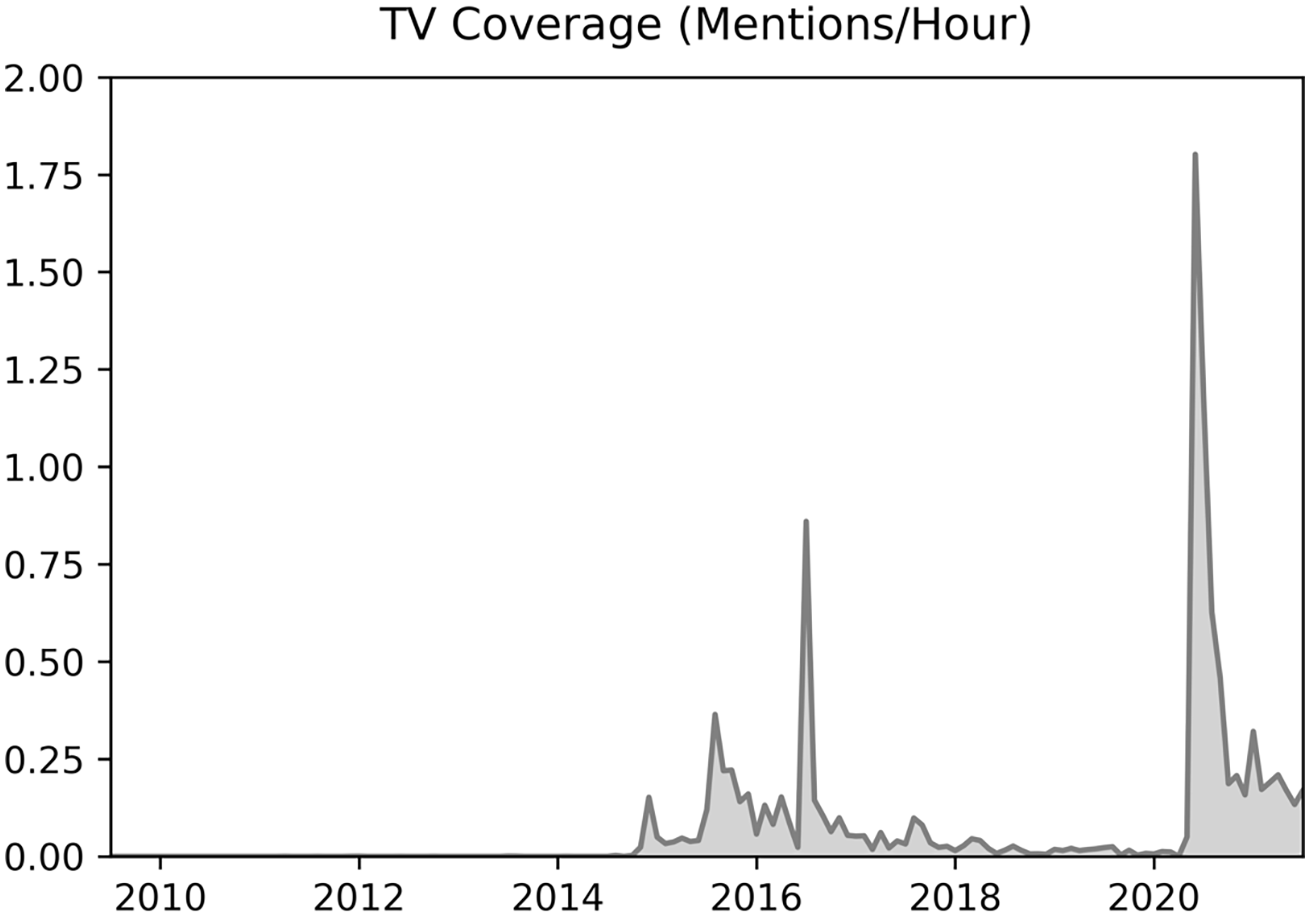
Mentions of BLM in TV Coverage.
BLM and Undergraduate Enrolment
Figure 2 shows that news mentions of ‘Black Lives Matter’ correlate with an increase in the enrolment of Black students in elite universities. Enrolments between 2015 and 2016 remained at around 6.5% of the total student population, but increased to 7.7% in 2017 (left graph in Figure 2). The proportion of Black students as a share of the general student population remained fairly stable thereafter but increased to 8.5% in the admission round that followed the murder of George Floyd. The vertical red line in the figure indicates the date at which George Floyd was killed.
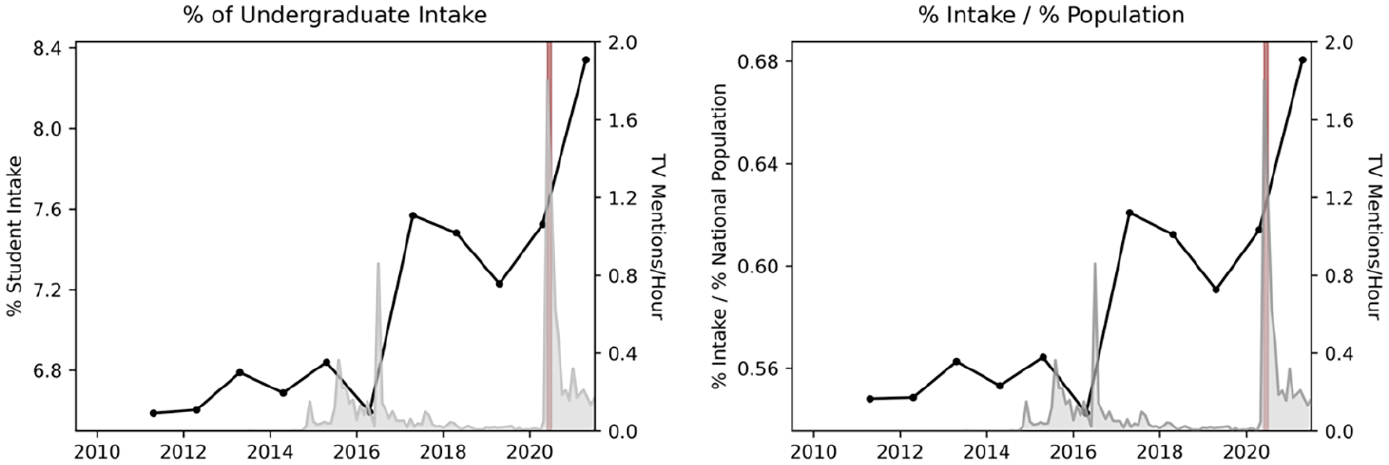
Black Student Enrolment in Elite Universities.
To better interpret the magnitude of these percentages, we also plot the percentage of Black students as a share of the proportion of Black people using yearly demographic census data (right graph in Figure 2). Although the share of Black people has increased, Black students are still underrepresented in elite universities. The Black student population in 2020 represents less than 70% of the proportional representation of Black people in the American population.
BLM and Medical School Enrolment
To assess the generalizability of our findings for undergraduate elite education, we repeated the analysis for medical school enrolments. Figure 3 reveals a similar trend, although the increase in Black enrolment in medical school may have started slightly earlier than for elite undergraduate colleges. It seems that the salience of the BLM movement is indeed associated with increases in the representation of Black students. Black students are similarly underrepresented in medical schools than they are in elite universities.
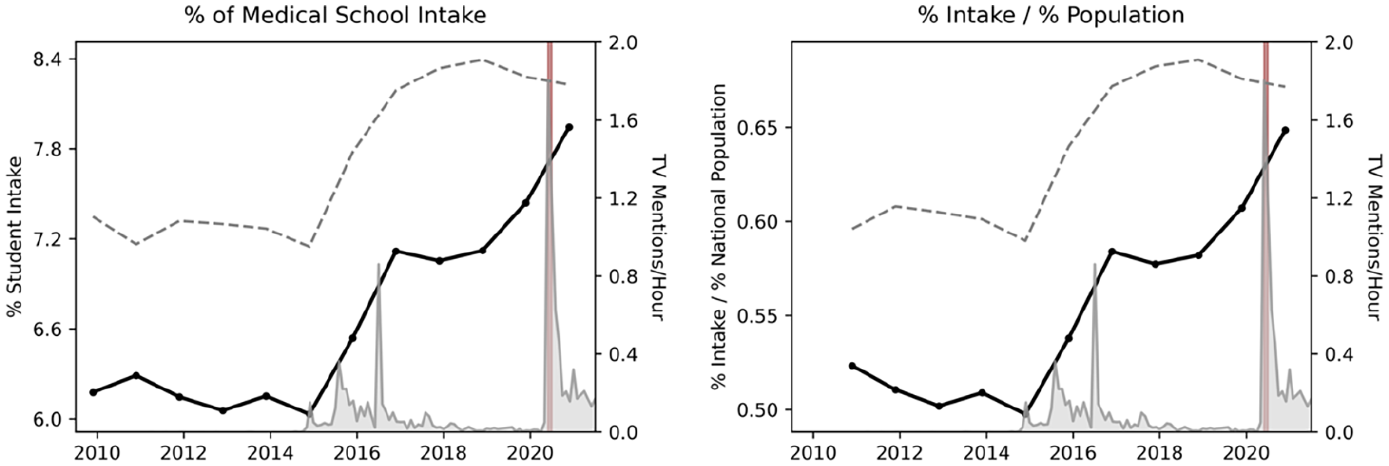
Black Student Enrolment in Medical Schools.
Increases in the representation of Black students may be the result of an increase in the share of academically successful Black applicants, instead of changes in selection practices. The data on medical school enrolment allow us to assess whether Black applicants’ grades increased with higher acceptance rates. To this aim, we plot applicants’ grades for medical school by racial categories. The graphs show that Black students’ grades did not improve relative to their peers. Increases in the enrolment of Black students cannot be explained by their academic performance prior to entering medical school. Instead, admission processes themselves may have become more inclusive (Figure 4).
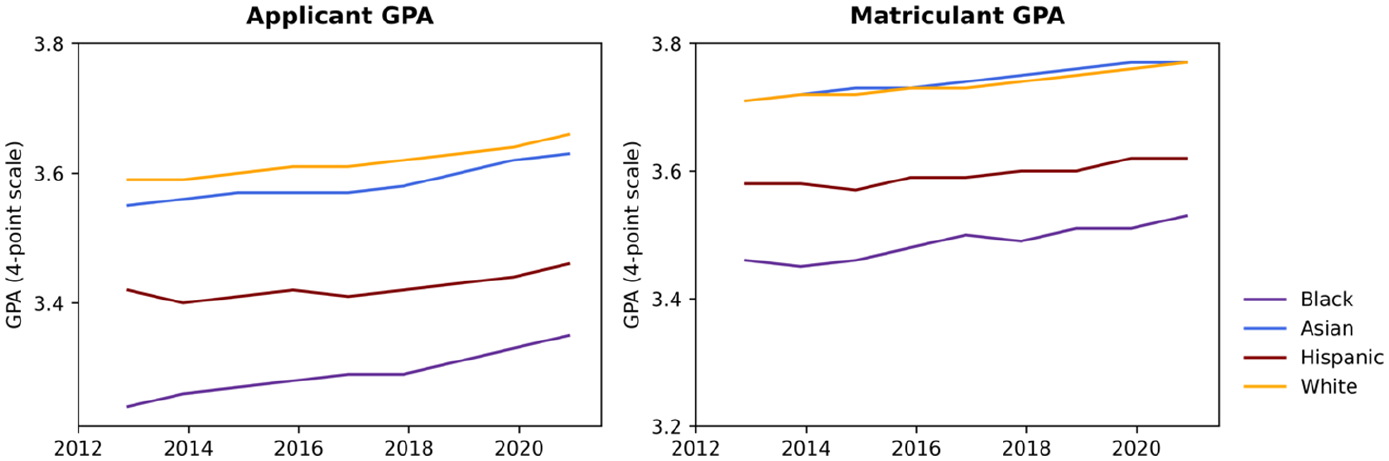
Medical School Applicants and Matriculant GPA by Race and Ethnicity. Hispanic Applicant GPA in 2018 Was Computed Using Mean Imputation Due to an Error in the AAMC Reporting.
In Response to Critics
One objection to greater representation of Black people is that one form of discrimination is simply replaced by another. Asian Americans are thought to be disadvantaged by increasing the representation of Black students (Chang, 2018). Recent lawsuits against Harvard University are powerful expression of this concern (Millhiser, 2021). We can test whether this assumption holds for elite educational attainment by tracking the enrolment data for Asian Americans relative to the enrolment of other minority students. Figure 5 shows that the representation of Asian students increased steadily for both types of elite education – the opposite of what critics feared. Dividing the percentage of enrolled Asian students in 2020 by the percentage of Asians in the US population we find enrolment to population ratios of 4.3 in elite universities and 3.68 in medical schools. A value above 1 indicates that the share of Asian students is larger than the Asian population share. The representation of Hispanic students increased as well, which leaves us with a clear picture: Enrolment rates for the three largest minority groups in America have increased over the past decade. The spikes in Black student representation following spikes in the salience of the BLM movement did not affect broader trends towards greater representation among other minority groups.
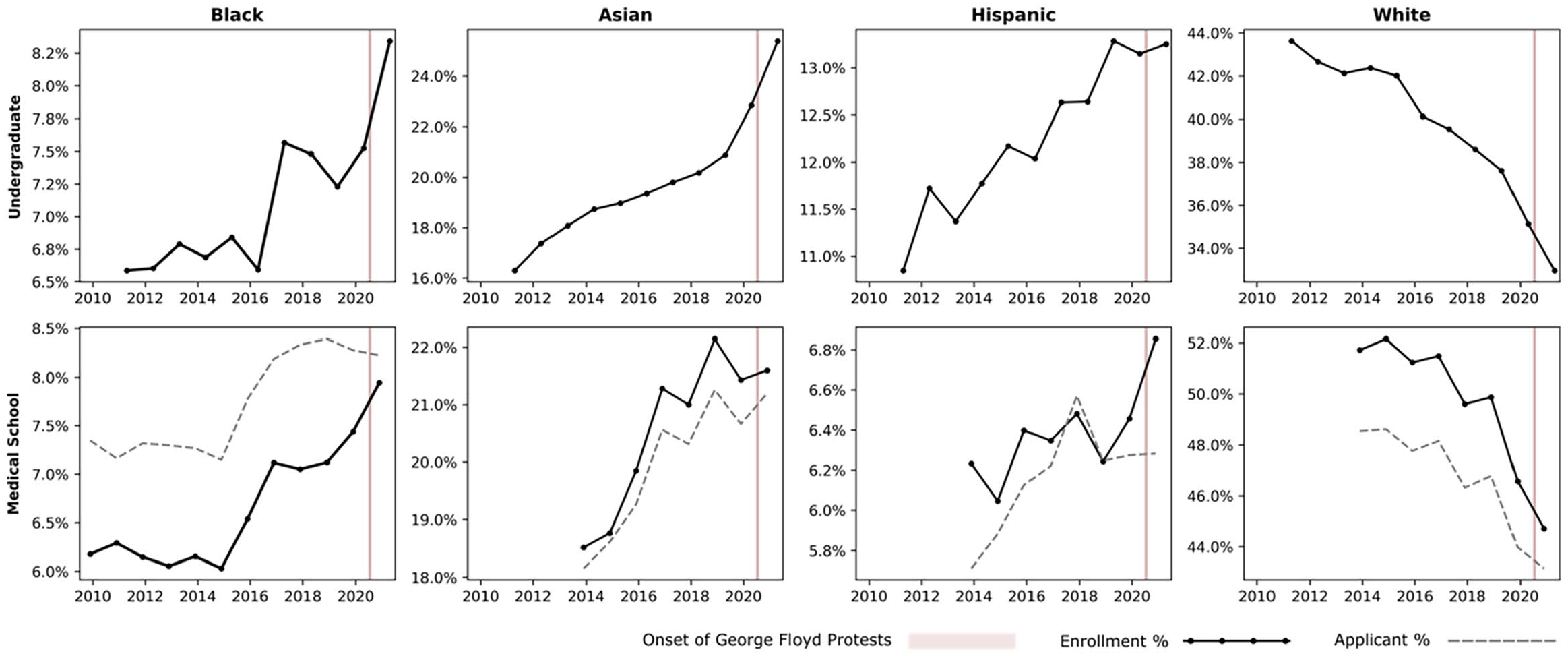
Enrolment Trends for Undergraduate and Medical School by Race.
Conclusion
Our analysis offers descriptive evidence for the growing Black enrolment following BLM activism. 3 Increases in the shares of Black students in undergraduate and medical schools have coincided with the growing influence of the BLM movement between 2015 and 2018, as illustrated by TV news coverage for BLM. Another uptick occurred for undergraduate and medical school enrolments after the BLM protests in 2020. The waiving of formal admission tests for undergraduate and medical school during the coronavirus pandemic might have opened avenues for realizing goals of BLM activism because holistic selection criteria played a more prominent role in university admissions. This interpretation is supported by disaggregated data showing trends towards greater representation of Black students across most schools that waived admission tests. Only Brown University and the University of Pennsylvania did not see an increase in Black enrolment in 2020, two institutions that did not waive their formal admission tests. BLM can give impetus to greater diversity, but it is structural conditions that facilitate immediate social change. However, even in the absence of changing admission requirements, Black enrolment rates increased after the first wave of BLM protests.
We also assess whether trends towards greater representation of Black students led to decreases in the representation of Asian American students. The evidence suggests otherwise. Asian representation in elite universities and medical schools has increased over time, making Asian Americans the only overrepresented racial group across medical schools and elite universities. Indeed, in 2020 around four times as many Asian students were enrolled in elite universities and medical schools than would be proportional to their representation in the population. For Hispanics, the other major minority group, we observe increases in their enrolment rates over the past decade. While enrolment rates for the three largest minority groups in the US have increased over the past decade, enrolment rates for White students continuously decreased.
Our visualizations offer descriptive evidence on the institutional outcomes of the largest protest movement in the US history and display broader trends of diversity in university enrolment. We encourage scholars to build on these descriptive analyses by examining the social mechanisms that underpin trends in racial representation. As more enrolment data become available, we will be able to better assess the cultural force of the BLM movement.
Footnotes
Acknowledgements
We thank Liliana Andriano, Michael Biggs, Horst Ebbinghaus, and Dan Snow for helpful suggestions. We are also indebted to Tina MacAulay, Connor Egan, Tim Green, and Indigofera Rosen-Hunt who helped improve the article through useful criticism and lively tutorial discussions. Ilana Axelrod provided excellent assistance.
Author’s note
Sihao Huang is also affiliated to St Catherine’s College, University of Oxford, Oxford, United Kingdom.
Declaration of conflicting interests
The author(s) declared no potential conflicts of interest with respect to the research, authorship and/or publication of this article.
Funding
The author(s) disclosed receipt of the following financial support for the research, authorship, and/or publication of this article: Mathis Ebbinghaus received support from the German Academic Scholarship Foundation, the Arts and Humanities Research Council and Nuffield College, University of Oxford.
