



Abstract
This article analyses the public support for the social model of democracy by focusing on the gap between what citizens expect democracy to deliver in the social realm and how they do evaluate its achievement in the practice. Using data from the European Social Survey Round 6 (2012), the results reveal that individuals with a lower socio-economic background, those positioned on the left and those who are more distrustful of political institutions tend to be more supportive of social democracy, while they evaluate its performance more negatively. The data also demonstrate that individuals’ social expectations and evaluations are moderated by their country’s institutional configuration of the welfare state, and more particularly, its degree of universalism. Overall, the results support the intuition that the alleged crisis of social democracy does not exist generally across Europe, but only in those countries where the welfare state has been unable to close the gap between expectations and evaluations.
Introduction
The aftermath of the Great Recession has witnessed a revival of interest in the old debate about the future of social democracy in Europe. 1 In a moment when it could be expected a greater electoral success of those parties promoting regulatory and/or redistributive economic policies due to the collapse of the neoliberal model, social democratic parties were swept away from office by the Euro crisis. In most general elections that took place between 2008 and 2014, social democratic parties lost office or remained in opposition. 2 Still 10 years later, there are very few left-of-centre parties in power in Western Europe. At the time of writing, only Spain, Portugal, Belgium, Sweden, Finland and Germany have social democratic parties in government, all of them in coalition – with the exception of Portugal. Also quite notably, the share of the Party of European Socialists’ seats has fallen by around 15% in the past three European Parliament elections.
For most observers, the alleged crisis of social democratic politics finds expression in the confluence of two distinctive circumstances. One has to do with the triumph of austerity policies as the solution to overcome the recent economic and financial crises, with the well-known consequences over the dismantling of the public services and welfare model. This policy agenda involved mainly reductions in government spending and/or changes in government programmes such as limiting the terms of unemployment benefits, extending the eligibility age for retirement and health care benefits, and cutting programmes for the poor. Although the measures adopted were tougher in those countries most severely hit by the crisis, all across Europe the politics of the Great Recession was largely marked by austerity. 3 The second lies in the massive abandonment of its core electorate, which – either having moved to the right daunted by a scenario of increasing social insecurity, or to the left disappointed with social democracy’s real capacity to solve people’s problems in tough times – has mainly sought refuge in new populist and challenger parties (both of the left and right). In this context, Giddens’ query in his 1990s analysis of the (then) crisis of the left as to ‘whether social democracy can survive at all as a distinctive political philosophy’ remains, for many, a valid diagnosis (Giddens, 1998: preface).
All the while political scientists and commentators have amply debated about the prospects for social democratic politics in Europe, we know very little about the demand side for social democracy, that is, how the ideal of social democracy is conceived of and evaluated by the public. The scholarly literature has paid scant attention to questions such as whether citizens support the normative ideas that social democracy underpins, and the extent to which they are satisfied with the actual implementation of these norms in their respective countries. This is quite a remarkable omission, given that discerning whether ‘social democracy is in terminal condition in Europe’ (Keating and McCrone, 2013) hinges, to a large extent, on the support for its core constitutive values expressed by the citizenry. In this article, we argue that a relevant illustration of the individuals’ support for the social democratic ideal is expressed in the belief that matters relating to social inequality and justice are relevant features of democracy. But what leads some citizens to hold these democratic ideals? And how do they connect such expectations with their evaluations of what their democratic system provides them with in this area? These are the central questions addressed in this article.
Using novel data from the European Social Survey Round 6 (ESS-6), the article focuses on examining two aspects of individual attitudes towards democracy that tend to be overlooked in the literature: the expectations citizens have concerning what the democratic system should do, and actually does, regarding social inequality. In other words, why, and under what conditions, do citizens think that it is democracy’s responsibility to provide material equality for all, and to what extent do they feel that their actual democratic system is succeeding in achieving this goal? These two perceptions capture individual support for what in democratic theory and public debate is known as a social notion or a social model of democracy; in other words, the idea that the political system should compensate individuals for the unjust disadvantages generated by the economic system. More particularly, the article analyses how European citizens connect their social democratic expectations with their evaluations of performance, and to what extent that connection is determined by individual and country-level factors. Thus, although the article does not provide an account of individuals’ support for social democratic parties, it helps to understand the circumstances that contribute building support for social democracy – that is, the democratic institutions and government structures that address matters of social inequality and justice – which might, in turn, benefit social democratic parties.
Analyses of data from 29 European democracies reveal that citizens’ attitudes about the social model of democracy are strongly connected with the social predispositions traditionally discussed in the literature on welfare state attitudes: Both expectations and evaluations for social democracy may arise from the individuals’ economic self-interest and/or their ideological preferences. A third, additional factor is also considered; namely, the generalized feelings of trust in the democratic system. Consistent with our expectations, the results show that individuals who are potential economic beneficiaries of welfare state policies, those who position themselves on the political left and those who are more distrustful of political institutions tend to be more supportive of the social model of democracy, while they evaluate its actual performance more negatively. Thus, we discuss that although the normative ideal of social democracy still can count on the support of these three social groups, who are considered to be its core traditional supporters, it seems to be suffering from a crisis of public legitimacy as it largely disappoints them in the practice.
However, the data also demonstrate that the negative effect of individuals’ high expectations on their performance evaluations can be mitigated by the degree of universalism of their country’s welfare state. Substantively, the results contribute to circumscribing the debate on the public legitimacy of the European social model at the institutional level, rather than at the level of individuals’ rising expectations. In other words, it is shown that the legitimacy crisis of social democracy does not exist generally across Europe, but in those countries where the welfare state provides a less universal protection to citizens, as well as has proved unable to satisfy the demands of some of social democracy’s traditional supporters, such as women and left-wing voters.
The article proceeds as follows. We begin by discussing the hypothesized effect of individual and country-level factors on attitudes about social democracy. Next, we expose the issues of data measurement and analysis, and then present the results. The significance and implications of the findings are considered in the concluding section.
The Determinants of the Expectations and Evaluations of Social Democracy
In the last few decades, the scholarly literature has paid increasing attention to the need to disentangling what is on the citizens’ minds when they think about democracy. While most studies assume that democracy has a polysemic nature to citizens, they have tended to classify citizens’ opinions into two broad democracy dimensions: a liberal or procedural dimension, hold by those individuals who value aspects of democracy such as free and fair elections, media freedom or multiparty competition, and a social or substantive dimension, hold by those who value democracy by the social outcomes it produces such as social justice and social equality (see e.g. Bratton and Mattes, 2001; Canache, 2012; Ferrín and Kriesi, 2016). 4 However, while this body of research has been fundamentally focused on understanding why citizens attach different meanings to democracy, with special attention to whether or not they support a liberal democratic notion, little is known about what leads some citizens to understand democracy in social democratic terms.
As argued above, the issue of what citizens expect democracy to do with regard to social inequality both in practice and in the abstract is theoretically connected with two types of individual-level factors: the usual social predispositions that make individuals support the normative principles of the welfare state, on one hand, and their general attitudinal orientations towards the democratic system, on the other.
As for the first group of variables, a review of the extensive literature on public attitudes towards the welfare state leads us to identify two types of individual-level factors that dominate as accounts for why citizens support redistribution and other similar welfare policies (e.g. Kaltenthaler et al., 2008; Linos and West, 2003). These can be characterized as economic, self-interest explanations, and cultural, ideological explanations. According to the self-interest argument, individuals tend to support economic redistribution depending on the calculus they make of their own expected gains. Thus, they will hold a positive attitude towards redistribution if they are recipients, or are at risk of becoming recipients, of social benefits or programmes – such as unemployment, child benefits, or sick care – whereas they will be less supportive if they are unlikely to receive such benefits. Thus, certain social categories such as women, the unemployed, the elderly, and lower-income groups are predicted to be more supportive of welfare state benefits and services.
The second argument suggests that support for welfare policies depends on individuals’ ideological beliefs. As Hudson et al. (2015: 6) state, social provision hinges on the answers to normative questions such as ‘why someone should care about others?, who deserves our care? and what should be done by governments?’, which reflect diverse understandings of human nature. Most citizens reply to these normative dilemmas with the help of the values that are expressed by political ideology. Right-wing political orientations are associated with values such as conservatism and economic openness, which tend to give a rational justification of inequality and favour minimal state intervention. 5 Previous research has found that political conservatism is strongly connected with people’s propensity to justify the status quo and rationalize inequality, in the sense that people are seen as deserving the outcomes and treatment they receive (Jost et al., 2003). In turn, left-wing orientations are linked with values such as egalitarianism and openness to change (Schwartz, 1992). An egalitarian view of society entails that people recognize each other as moral equals, are inclined to in-group cooperation, and are concerned with everyone’s welfare (Arikan and Ben-Nun Bloom, 2015: 434). Moreover, individuals who locate themselves on the political left tend to see inequality as the result of the skewed economic opportunities generated by market economies, which can only be altered by growing state intervention and redistribution.
Drawing on the two theoretical arguments exposed above, we similarly contend that the demand for social democracy is likely to vary among voters according to their economic self-interest and their ideological view of how a just society should look like to them. First, we hypothesize that those individuals who are potential beneficiaries of welfare state policies 6 will have higher expectations of the social model of democracy (H1a), as they are more likely to benefit from a democratic system that takes responsibility in reducing poverty and income differentials. However, we generally expect that the relationship between citizens’ expectations and evaluations of democracy’s social dimension will be negative, as quite often performance fails to live up to expectations. In other words, the more an individual thinks that democracy should deliver socially beneficial outcomes for everyone, the worse that individual will evaluate the performance of democracy in this area. 7 Thus, we also contend that due to their higher social expectations, welfare state’s individual beneficiaries will tend to judge the actual performance of social democracy in their country more negatively (H1b).
Second, we hypothesize that those individuals who are more left-wing will support a social understanding of democracy (H2a), insofar as they endorse values such as universalism, egalitarianism, and state intervention, which are coherent with this democratic view. Also, however, they will tend to be more critical of the performance of democracy in the social area (H2b).
In addition to economic self-interest and ideological predispositions, people’s thinking about social democracy may be driven by their attitudes towards the democratic system in more general terms. For instance, Canache (2012), in a work on public conceptualizations of democracy in Latin American countries, shows that those individuals who understand democracy in terms of social and economic outcomes tend to be less supportive of the democratic system and display more positive attitudes towards illegal protest. In a similar vein, Ceka and Magalhaes (2016) find that both interpersonal and political trust drive down the propensity of respondents to conceive the social component as a crucially important element of democracy, or, stated differently, those who are more (socially and politically) distrustful tend to give more importance to the social justice democratic view.
Following Ceka and Magalhaes (2016), we similarly contend that political trust should be likely to impact on individuals’ understandings and evaluations of democracy’s social dimension. Briefly, political trust can be understood as the belief that the core institutions of political representation (i.e. parliaments, politicians and political parties) are reliable. Therefore, if one claims to trust the basic representative institutions, one is basically expressing the belief that the institutions of liberal democracy are doing ‘a good job’ most of the time. In line with this, the third hypothesis claims that more distrusting citizens will be more supportive of a social model of democracy (H3a), because they consider that the liberal model is not doing its job properly so that an alternative democratic model is desirable. Due to their higher expectations and their more critical attitude towards the democratic system in general, it is likely that they will evaluate the performance of their democratic system in the social dimension more negatively (H3b).
But does this presumed effect of the structural factors (economic self-interest, ideology and political distrust) on the individual expectations and evaluations of social democracy work independently of other external influences? As the discipline has well recognized, there are reasons to think that expectations and evaluations towards the social model of democracy will fluctuate widely across countries, given the vast national-level variations in institutional and contextual settings that may influence the formation of both sorts of attitudes. Country-level factors operate as settings that constrain or facilitate citizens’ opportunities to go ahead in life and shape the frames they use to form political opinions, thus influencing their judgements about the desirability and functioning of social democracy. Among the most common national-level indicators that have been discussed in the literature so as to shape people’s orientations about social inequality and redistribution are the degree of economic development and/or income inequality in the country (Dion and Birchfield, 2010; Loveless and Whitefield, 2011), and the type of welfare state institutions (Edlund, 2007; Linos and West, 2003; Loveless and Whitefield, 2011; Svallfors, 2003).
In this article, we discuss the effect of the political institution par excellence that aims to implement the principles of social democracy: the welfare state. Drawing on Esping-Andersen’s (1990) classic work on worlds of welfare capitalism, scholars have suggested that different types of welfare regimes produce distinct cleavages among socio-economic groups that lead to differences in popular attitudes. For example, citizens of Scandinavian universalist welfare states are found to be strongly supportive of redistribution, whereas in liberal welfare regimes, based on a social delivery system only to those who are in need, support for social welfare is low among the general population but high among the most disadvantaged (Arts and Gelissen, 2001; Svallfors, 2003).
The different configuration of welfare regimes in Europe is approached here by a measure tapping the extension of universalism in the welfare state. As Rothstein and Stolle (2003: 196) observe, ‘the basic principle of a universal welfare policy is not to discriminate between citizens on economic grounds, [but to deliver services] for the whole population on the principle of equal access’. Universalism can be considered a relevant feature of welfare states as it determines how many citizens can benefit from the welfare policies and services, or – in other words – the extent to which citizens are separated, on the basis of bureaucratic discretion, into ‘the needy’ and the rest.
In this sense, it is reasonable to expect that a more universal configuration of the welfare state will have positive effects on both social expectations (H4) and evaluations (H5), as it will tend to promote a more positive view of social democracy among citizens. In other words, enjoying a highly universalistic welfare state will make individuals to consider social democracy as a relevant feature of democracy 8 and be more satisfied with its performance in practice than those individuals living in systems with a low degree of universalism.
In this article, we argue that contextual factors not only have a direct impact on democratic attitudinal considerations (expectations and evaluations), but also condition the effect of individual characteristics on those attitudes. This is what Anderson and Singer (2008) denominate as an interactive effect – also called conditional or contingent effect – in multi-level relations, which occurs when some structural feature acts as an ‘intervening variable (y) that helps determine the relative impact of an independent variable (x) on the dependent variable (z)’ (Anderson and Singer, 2008: 6–7). 9 In this line of reasoning, we speculate that the contextual factors may serve a palliative function in that they reduce the negative perceptions about social democratic performance among those people with high expectations about social democracy. 10 To confirm this, we expect a cross-level interaction between the institutional context and the individuals’ background and attitudinal characteristics to have a positive effect on the evaluations of the social model of democracy. More particularly, it is expected that potential beneficiaries of welfare state policies, left-wing voters and politically distrustful citizens in nations with highly universal welfare states will tend to evaluate the performance of the social model of democracy positively, instead of negatively (H1c, H2c and H3c).
However, the context of economic and financial crisis that affected Europe recently makes it difficult to talk about welfare state policies, and public perceptions about them, without considering the country’s economic conditions. It is widely known that the severe austerity measures adopted by many national governments as a response to their financial and debt crisis seriously undermined their welfare provision and contributed to generate a discontent climate among their citizenries. Despite this scenario, it is posited here that those welfare states that display higher levels of universalism have the capacity to mitigate the negative consequences of the economy on citizens’ evaluations of social democracy (H6). In a nutshell, the universalism of the welfare state may make citizens less vulnerable to adverse economic conditions.
Data and Measures
The Dependent Variables: Citizens’ Expectations and Evaluations of the Social Model of Democracy
Public attitudes towards social democracy are measured by several questions taken from the ESS-6, 2012, which includes a specific module of questions tapping into Europeans’ understandings and evaluations of democracy’s different dimensions in 29 societies. The survey includes four items that ask respondents to identify both the extent of their preference in the abstract and their degree of satisfaction with their actual democratic system’s role in promoting equality, concretized in the ideas that the government should protect people against poverty and reduce income differentials. Specifically, the respondent is asked to answer the following two questions concerning their social democratic expectations: ‘Please tell me how important you think it is for democracy in general. . . (1) That the government protects all citizens against poverty; (2) That the government takes measures to reduce differences in income levels?’ And these other two in relation to their democratic evaluations: ‘Please tell me to what extent you think each of the following statements applies in [country]: (1) The government in [country] protects all citizens against poverty; (2) The government in [country] takes measures to reduce differences in income levels?’ Using a 10-point scale, potential responses range from not at all important for democracy in general (0) to extremely important for democracy in general (10) in the case of the expectations questions, and from does not apply at all (0) to apply completely (10) in the case of the evaluation questions.
Two indices of social democratic expectations and evaluations are constructed from these four questions. Regarding expectations, the two items are averaged into a single scale ranging from 0 to 10, where higher values entail higher expectations regarding the desirability of a social model of democracy, and lower values lower social expectations. The resulting scale has high reliability, as shown by a Cronbach’s alpha coefficient of 0.77. As for evaluations, we have similarly averaged the two evaluations items into a single 0–10 scale, in which higher values represent more positive evaluations, and lower values poorer evaluations. Cronbach’s alpha of the evaluations scale is 0.88.
The country scores of the two attitudinal indicators can be seen in Table A1 in Appendix 1, which displays no relevant differences in the mean levels of expectations and evaluations of the social democratic model between the regions included in the sample (i.e. Southern, Western and Eastern Europe).
The Independent Variables
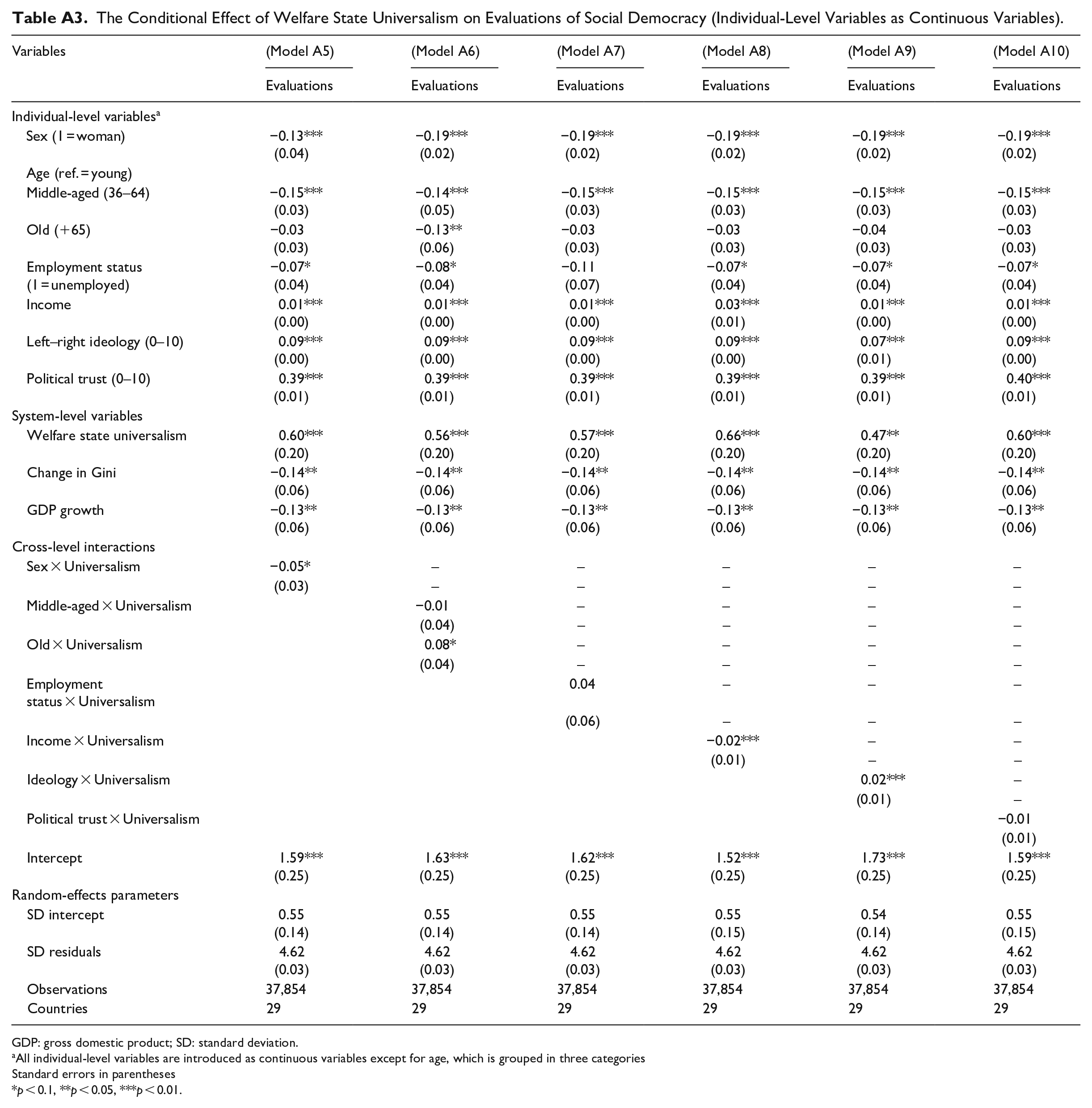
The independent variables are measured at the level of individuals and countries. At the individual level, our variables of interest are gender, age, employment status, income, ideology and trust in political institutions. All are measured as dummy variables, indicating whether the respondent holds the intended category or not. Thus, the ‘gender’ variable identifies whether the respondent is a woman, ‘employment status’ whether the respondent is unemployed, ‘income’ whether the respondent earns a low income (measured as whether she is positioned within the first to third deciles), ‘ideology’ whether the respondent position herself on the political left (0 to 3 on the 0–10 ideological scale), and ‘trust in political institutions’ measures whether the respondent distrust political institutions (0 to 5 on the 0–10 trust scale). The only exception is the variable on age, which is divided into three groups: the youngest group is composed of those respondents up to 35 years old, the middle-aged group is those between the ages of 36 and 64, and the elderly are those aged 65 years and above. The reason to include all individual-level variables (except for age) as dummies rather than as continuous variables in the analyses is to facilitate the interpretation of the results for our categories of interests, which in all cases represent a group of individuals against the rest. This analytical strategy, however, does not affect the results of the analyses, as can be seen in Tables A2 and A3 in Appendix 1. 11
Our main institutional variable, welfare state universalism, is measured by an indicator coming from the Varieties of Democracy (V-Dem) dataset, which taps how many welfare programmes in the country are means-tested and how many benefit all (or virtually all) members of the polity. This includes education, health, retirement, unemployment and poverty programmes. According to the V-Dem project’s definition, means-tested programmes are those designed to deliver welfare selectively to citizens who cannot in any other way provide for themselves, whereas universal programmes seek to cover the entire population throughout the different stages of life and based on uniform rules and equal access. The defining characteristic in universal welfare states is that practically everyone is a beneficiary, or potential beneficiary. This is an ordinal measure that ranges theoretically from −3 to 3, although in our sample of countries it runs from −0.2 (Kosovo) to 3 (Sweden).
The country’s economic context is here measured by four variables. The first one is the total level of inequality, measured by the Gini index, 12 which taps the extent to which the distribution of income among individuals or households within an economy deviates from a perfectly equal distribution. The second measure is the change in inequality in the country since the onset of the economic crisis (i.e. 2007–2012), as this indicator can capture more accurately citizens’ experiences with the effect of the crisis in their life chance conditions. Although the ‘objective’ level of inequality is traditionally used in the literature to measure crisis effects, it might be relatively constant and hence ‘unperceived’ by the citizens.
The two other economy indicators are the change in the unemployment rate for each country between 2007 and 2012, and the gross domestic product (GDP) per capita growth rate in 2012 (annual %), 13 which can be considered as good measures of potential problems in ‘rich’ democracies. All the contextual indicators are measured most recently to the collection of the survey data at the micro level (2012). The country scores of all the country-level variables can be found in Table A1 in Appendix 1.
Empirical Results
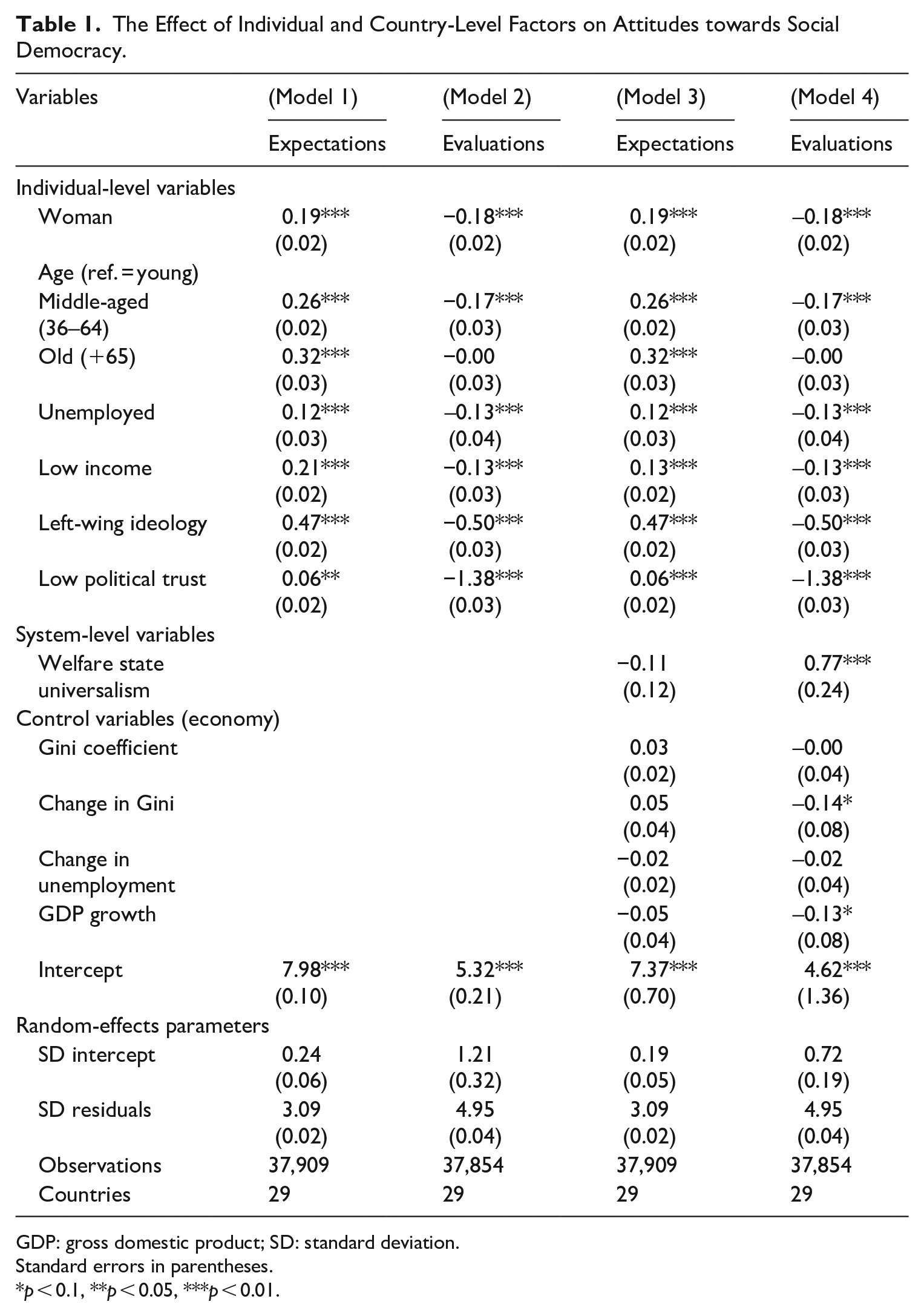
The statistical analyses are based on two-level linear regression models with random slopes at the level of individuals and nations on our two dependent variables: individual expectations and evaluations of the social model of democracy. The models are run in several steps, starting with the individual-level variables, and adding first the contextual factors and second the cross-level interaction terms. Tables 1 and 2 present the results of these analyses.
The Effect of Individual and Country-Level Factors on Attitudes towards Social Democracy.
GDP: gross domestic product; SD: standard deviation.
Standard errors in parentheses.
p < 0.1, **p < 0.05, ***p < 0.01.
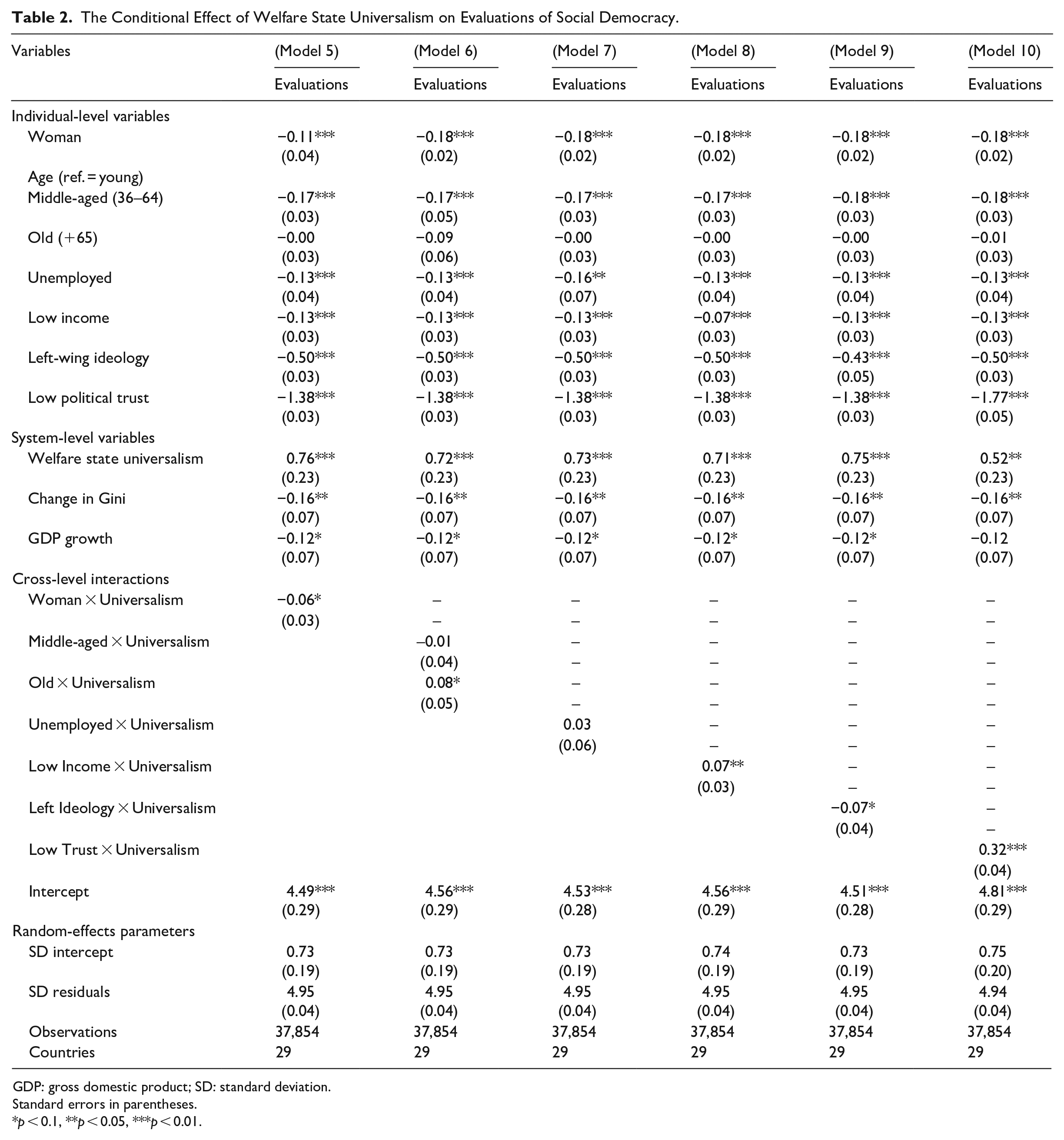
The Conditional Effect of Welfare State Universalism on Evaluations of Social Democracy.
GDP: gross domestic product; SD: standard deviation.
Standard errors in parentheses.
p < 0.1, **p < 0.05, ***p < 0.01.
The findings present strong evidence for the hypothesized effect of all the individual-level variables on the attitudes towards social democracy (Models 1 and 2). In line with H1a and H1b, the data show that those individuals who are potential beneficiaries of welfare policies (women, the unemployed, old people and low-income groups) tend to have higher expectations regarding the social model of democracy than those who are not potential beneficiaries, but, as predicted, are more critical of its actual performance in their respective countries. The same positive evidence is found in favour of H2a–b and H3a–b: both left-wing identifiers and politically distrustful citizens have higher prosocial democratic expectations, but negative evaluations of performance. These effects can be seen in the opposite signs that the coefficients of the models for expectations and for evaluations display, and confirm our expectations about the negative discrepancy between the two attitudes when they are cognitively processed by the individuals.
A puzzling finding regarding the influence of the socio-demographic factors is that the young people, who are, in principle, socially and economically worse off than (at least) the middle adults and can potentially benefit more than them from welfare policies, have weaker preferences for a social vision of democracy than the two older generations, while their performance evaluations are not significantly different from those of the elderly group – meaning that they are not more or less critical of performance than that group. There are two potential explanations for this counterfactual effect. The first is that the social model of democracy might have lost appeal among the youngest, and they rather tend to give prevalence to other models of democracy more connected to post-materialistic values such as a direct model of democracy. The second explanation is that this age group takes social democracy for granted as they have grown up enjoying well-established welfare state institutions, so that they do not see social democracy as a crucially important element of democracy and, consequently, do not tend to be so critical with its performance. In turn, middle-aged adults tend to be highly disappointed with the practice of social democracy in their respective countries, a negative view which might be favoured by their negative expectations regarding the future of retirement programmes and/or the current use they make of diverse social welfare benefits (such as unemployment or child benefits, to name but a few).
By contrast, Models 3 and 4, which test the direct effect of the contextual-level variables, provide only mixed evidence in support of our hypotheses. First, the results in Model 3 show that expectations for social democracy are insensitive to the country’s economic and institutional conditions, as no single predictor reaches statistical significance at conventional levels when all the contextual-level variables are controlled among each other. Thus, our core expectation that the degree of universalism would have impacted significantly (either positively or negatively) on individuals’ social expectations (H4) is not met.
Regarding evaluations (Model 4), the general interesting finding is that the welfare state indicator does reach statistical significance as a predictor variable, entailing that evaluations of performance are on average more positive in countries with good levels of welfare state universalism than in those with lower ones. The ‘change in inequality’ indicator also makes a significant impact on the evaluations of one’s country social democratic model, entailing that the higher the growth of inequality in the country since the beginning of the economic crisis, the lower the public’s evaluations of social democracy performance. The GDP growth rate is also significant but produces a somewhat counterintuitive effect: citizens in countries where the GDP growth has been lower (i.e. negative) tend to be happier with the performance of the welfare state than those in countries with positive growth. To understand this, Figure 1 plots the GDP growth rate against the mean evaluations of social democracy by country. As can be seen from the graph, this effect is driven by several Eastern European countries that, at the time of the survey, were enjoying on average quite high growth rates (namely, Estonia, Lithuania, Russia, Kosovo, Albania and Poland), but where the respective citizenries displayed low levels of satisfaction with the performance of social democracy.
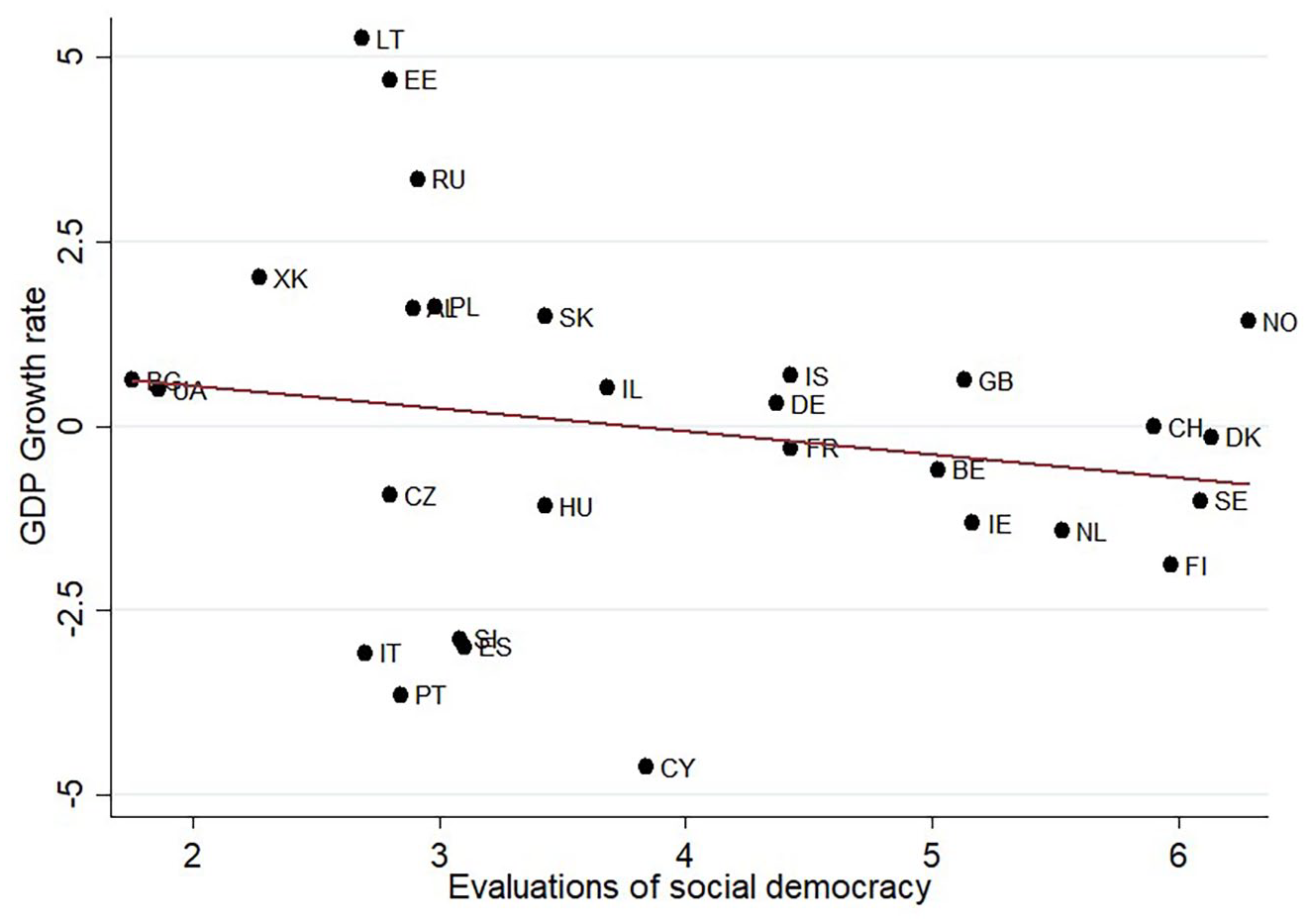
Evaluations of Social Democracy Versus GDP Growth Rate.
In general, the fact that the measure of welfare state universalism manages to beat the effect of the set of economic variables, as well as to reach high statistical significance (at the 99% level) can be taken as a robust result for the case of our institutional variable. Therefore, it seems reasonable to further investigate the different ways in which it may affect the individuals’ attitudinal considerations over social democracy.
As argued above, in this article we are not only interested in the direct effect of the welfare state institutions on the attitudinal considerations, but also in their conditional effects. In particular, these effects occur when institutions moderate the impact of the individual-level characteristics on people’s views of the democratic system. In order to test this, we have run six new models of multilevel regression with the evaluations index as a dependent variable, and testing one by one the cross-level interaction between the individual-level factors and our measure of welfare state universalism. All the models are controlling for the effect of change in the magnitude of social inequality and the GDP growth rate, which, as shown above, act as relevant predictors of the evaluations of social democracy. Table 2 presents the results of these multilevel analyses.
The results show that the cross-level interaction of the welfare state universalism with the socio-demographic and attitudinal factors is significant in five out of the six models, but only in three of them in the hypothesized direction. As expected, old people, low income groups and politically distrustful citizens are all positively affected by the quality of their welfare regime, that is, they tend to evaluate in a more positive fashion the performance of social democracy in contexts with high levels of welfare state universalism (H6). In technical terms, this means that universalism has a significantly more positive effect on the evaluations of performance among these three social groups than among the others. In other words, although all social groups tend to evaluate the performance of social democracy more positively in contexts of high welfare state universalism than in those countries where universalism is low, such a positive effect is stronger among the three aforementioned groups.
These effects are further illustrated in Figure 2, which plots the predicted values of the evaluations of the social dimension of democracy at different levels of country-level universalism by our three individual-level characteristics. The graph shows that all the three groups improve to a larger extent their evaluations of social democracy in contexts of high welfare state universalism than any of the omitted categories (namely, middle-aged and young generations, trustful citizens and high-income groups), as demonstrated by a much steeper slope in the respective panels. Thus, three relevant pictures emerge from the panels: (1) the older generation moves from having the second lowest evaluations (and close to the lowest) in the least universalistic systems, to having the most positive evaluations in the most universalistic ones; (2) the gap between the low-income group and the high-income group present in the least universalistic systems tends to disappear in the most universalistic systems; and (3) the gap between the evaluations of distrusting and trusting citizens appears to halve as we move from the least to the most universalistic systems.
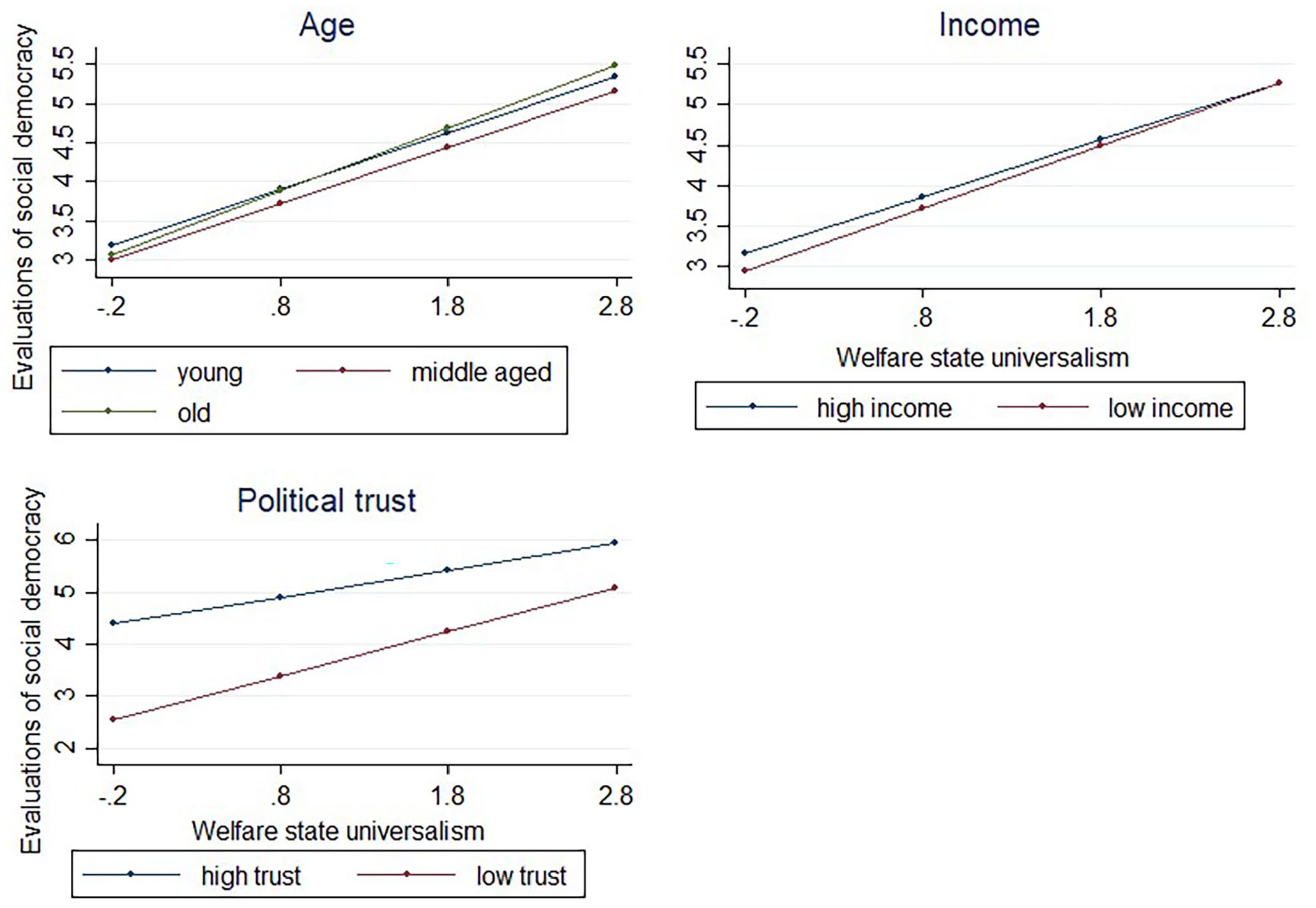
APPs of Evaluations of Social Democracy Contingent of the Welfare State’s Universalism.
In the case of the elderly and low-income groups, such a positive effect may have to do with their more intense use of the welfare state services, which makes them more sensitive to a more universal configuration of the system. However, it is also relevant to highlight that the degree of universalism also contributes to ease the middle-aged group’s disappointment with social democracy in practice, although, as already noted, the effect is weaker than among the oldest generation. As for distrustful citizens, it is interesting to see that welfare state universalism significantly alleviates negative perceptions among this group, who, by definition, tend to be quite critical of the performance of public institutions and services.
However, as mentioned above, one of our interactions between individual-level and contextual-level variables does not reach statistical significance in the analyses, and two do but in the direction opposite to our expectations. This is the case, on one hand, of the unemployed, who are not differentiated in their evaluations of social democracy from employed citizens. On the other hand, it is also the case of women and left-wing voters, who still tend to hold more negative evaluations than men and those on the ideological right, respectively, even in contexts of highly universalistic welfare regimes. That is, welfare state universalism’s positive effect on people’s faith in the performance of social democracy is muted among these three groups.
To conclude, it is worth noting that these results are robust to the tradition of the welfare state in the country. It is well known that citizens in Scandinavian welfare states tend to be happier with their system than citizens in other welfare regimes (see Sirovátka et al., 2019; Svallfors, 2003), so it is likely to be expected that they might be driving high levels of satisfaction within highly universalistic welfare states. However, while a high level of universalism is certainly a defining characteristic of Scandinavian welfare states, countries in other welfare regimes also enjoy highly universalistic policies – see, for instance, Spain (2.01), Germany (1.7), Switzerland (1.51) or Lithuania (1.51). To test this conjecture, we have re-estimated all the models excluding from the sample the five countries with a socio-democratic/Scandinavian configuration of the welfare regime, namely Denmark, Finland, Norway, Sweden and Iceland. The results of these analyses can be found in Tables S1 and S2 in the Online Appendix. All the results stay basically the same except those in Models 3 and 4, which test the direct impact of the country-level variables on individuals’ attitudes towards social democracy. The results in these models show that both expectations and evaluations about social democracy are quite sensitive to the country’s changing level of inequality, which is the only predictor that reaches statistical significance in both models when all the contextual-level variables are controlled among each other.
Thus, ceteris paribus, the more pronounced the growth of inequality in the country, the more likely its citizens are to support a social democratic model, as well as to evaluate negatively its actual performance. However, although the degree of welfare state universalism does not make a direct impact on the average individual’s expectations and evaluations of social democracy when Scandinavian countries are not considered, the results in Table S2 in the Online Appendix show that the conditional effects of universalism on the attitudinal orientations of those who have been defined as the core supporters of social democracy (i.e. potential beneficiaries of welfare policies, left-wing voters and distrustful citizens) do remain the same. In other words, the quality of the welfare state does matter for those individuals who are more concerned about social democracy, independently of the configuration of the welfare regime.
Discussion
As Europe has undergone an era of economic and political transformation, marked by severe austerity policies and the emergence of new parties contending in the national political arena over how and among whom to distribute (increasingly scarce) state resources, the issue of whether the social model of democracy is in a crisis has been forcefully revived in public and academic debates. Contrary to the initial optimistic expectations that the crisis triggered by ‘over-liberalized markets’ could be used as an opportunity to return to ‘keynesian policies’ 14 (Bailey and Bates, 2012), the aftermath of the Great Recession has brought about a scenario of major setback for social democracy in several respects. All around Europe, social democratic parties have suffered massive electoral losses, while austerity and neoliberalism managed to defeat the social democratic programme as the remedy to overcome the crisis. Moreover, in many countries new competitors from the extreme left and right have come to appropriate the welfare redistribution discourse typical of social democracy, even taking over its traditional electoral constituencies. In this context, the question of ‘whether social democracy can survive at all as a distinctive political philosophy’ that Giddens posed in his 1990s-analysis of the (then) left crisis remains open (Giddens, 1998: preface).
This article has offered an answer to this question from the citizens’ perspective. Using novel data on public expectations and evaluations of democracy’s many dimensions coming from the ESS-6, we have asked whether the social model of democracy finds normative support among those citizens who are expected to be its most ardent supporters, and the extent to which they are satisfied with its actual performance in their respective countries. To address this question, the article started by testing the effect of a series of socio-demographic and attitudinal factors related to individual-level support for the social democratic model. In accordance with our expectations, we find that individuals who are potential beneficiaries of welfare state policies (women, the unemployed, old people and low-income groups), those who position themselves on the political left and those who are more distrustful of political institutions are more supportive of the social model of democracy, while evaluating its actual performance more negatively.
The article has also sought to disentangle how much of these negative evaluations of the social democratic model come from citizens’ rising aspirations about what democracy should deliver, and how much are due to the specific economic and political structures in their countries. In line with our initial beliefs, the results of our models turned out to be quite insensitive to the context of economic crisis. Furthermore, we also found support (albeit only partial) for our political–institutional explanation of the effect of welfare state universalism. Although there is no evidence that universalism matters for the social normative expectations of the citizens, it does for their evaluations. Thus, individuals living in countries with high levels of welfare state’s universalism are more satisfied with social democracy than those in countries with less universal welfare states.
Finally, the article discussed the conditional effects of universalism and individuals’ social and attitudinal traits on performance evaluations. In particular, it has been shown that universalism not only has a direct effect on evaluations, but also contributes to moderating the negative impact that certain individual-level factors have on people’s assessments of social democracy. This finding, however, does not hold equally across all social categories, since the elderly, low-income people and those who are more distrustful of institutions are particularly influenced by welfare state universalism when evaluating democratic social performance.
Overall, the results support the intuition that the social model of democracy is not undergoing a major legitimacy crisis in Europe, or at least not one that cannot be mitigated by further advancing the institutions of the welfare state. In line with this claim, it could be interpreted that the quite widespread public discontent with social service delivery that many European countries, and especially those in Southern Europe, witnessed at the onset of the financial crisis was more a consequence of (poorly universalistic) welfare state institutions rather than of rising public aspirations, that is, excessive public demands that cannot be fulfilled by the system. Therefore, the alleged legitimacy crisis of social democracy affecting many countries in Europe may be overcome with more universal welfare policies.
However, this optimistic conclusion should be taken with caution. First, the results have warned us that if the inequality gap continues to grow in European societies, welfare institutions will have a much harder time in alleviating the citizens’ negative perceptions of social democracy. Second, it has also been seen that not all social categories are affected equally by welfare state institutions, but some of them remain quite critical even under conditions of high universalism. This is the case of women and left-wing voters, who are traditionally among the strongest supporters of the social-democratic model. If social-democratic institutions do not manage to satisfy these social groups, then there could be reasons for concern about the future of social democracy in Europe.
Supplemental Material
sj-docx-1-psw-10.1177_14789299221117458 – Supplemental material for A Crisis of Social Democracy in Europe? An Answer from the Citizens’ Perspective
Supplemental material, sj-docx-1-psw-10.1177_14789299221117458 for A Crisis of Social Democracy in Europe? An Answer from the Citizens’ Perspective by Irene Palacios in Political Studies Review
Footnotes
Appendix 1
The Conditional Effect of Welfare State Universalism on Evaluations of Social Democracy (Individual-Level Variables as Continuous Variables).
| Variables | (Model A5) |
(Model A6) |
(Model A7) |
(Model A8) |
(Model A9) |
(Model A10) |
|---|---|---|---|---|---|---|
| Evaluations | Evaluations | Evaluations | Evaluations | Evaluations | Evaluations | |
| Individual-level variables a | ||||||
| Sex (1 = woman) | −0.13***
(0.04) |
−0.19***
(0.02) |
−0.19***
(0.02) |
−0.19***
(0.02) |
−0.19***
(0.02) |
−0.19***
(0.02) |
| Age (ref. = young) | ||||||
| Middle-aged (36–64) | −0.15***
(0.03) |
−0.14***
(0.05) |
−0.15***
(0.03) |
−0.15***
(0.03) |
−0.15***
(0.03) |
−0.15***
(0.03) |
| Old (+65) | −0.03 (0.03) |
−0.13**
(0.06) |
−0.03 (0.03) |
−0.03 (0.03) |
−0.04 (0.03) |
−0.03 (0.03) |
| Employment status (1 = unemployed) | −0.07*
(0.04) |
−0.08*
(0.04) |
−0.11 (0.07) |
−0.07*
(0.04) |
−0.07*
(0.04) |
−0.07*
(0.04) |
| Income | 0.01***
(0.00) |
0.01***
(0.00) |
0.01***
(0.00) |
0.03***
(0.01) |
0.01***
(0.00) |
0.01***
(0.00) |
| Left–right ideology (0–10) | 0.09***
(0.00) |
0.09***
(0.00) |
0.09***
(0.00) |
0.09***
(0.00) |
0.07***
(0.01) |
0.09***
(0.00) |
| Political trust (0–10) | 0.39***
(0.01) |
0.39***
(0.01) |
0.39***
(0.01) |
0.39***
(0.01) |
0.39***
(0.01) |
0.40***
(0.01) |
| System-level variables | ||||||
| Welfare state universalism | 0.60***
(0.20) |
0.56***
(0.20) |
0.57***
(0.20) |
0.66***
(0.20) |
0.47**
(0.20) |
0.60***
(0.20) |
| Change in Gini | −0.14**
(0.06) |
−0.14**
(0.06) |
−0.14**
(0.06) |
−0.14**
(0.06) |
−0.14**
(0.06) |
−0.14**
(0.06) |
| GDP growth | −0.13**
(0.06) |
−0.13**
(0.06) |
−0.13**
(0.06) |
−0.13**
(0.06) |
−0.13**
(0.06) |
−0.13**
(0.06) |
| Cross-level interactions | ||||||
| Sex × Universalism | −0.05* | – | – | – | – | – |
| (0.03) | – | – | – | – | – | |
| Middle-aged × Universalism | −0.01 | – | – | – | – | |
| (0.04) | – | – | – | – | ||
| Old × Universalism | 0.08* | – | – | – | – | |
| (0.04) | – | – | – | – | ||
| Employment status × Universalism | 0.04 | – | – | – | ||
| (0.06) | – | – | – | |||
| Income × Universalism | −0.02*** | – | – | |||
| (0.01) | – | – | ||||
| Ideology × Universalism | 0.02*** | – | ||||
| (0.01) | – | |||||
| Political trust × Universalism | −0.01 | |||||
| (0.01) | ||||||
| Intercept | 1.59***
|
1.63***
|
1.62***
|
1.52***
|
1.73***
|
1.59***
|
| Random-effects parameters | ||||||
| SD intercept | 0.55 |
0.55 |
0.55 |
0.55 |
0.54 |
0.55 |
| SD residuals | 4.62 |
4.62 |
4.62 |
4.62 |
4.62 |
4.62 |
| Observations | 37,854 | 37,854 | 37,854 | 37,854 | 37,854 | 37,854 |
| Countries | 29 | 29 | 29 | 29 | 29 | 29 |
GDP: gross domestic product; SD: standard deviation.
All individual-level variables are introduced as continuous variables except for age, which is grouped in three categories
Standard errors in parentheses
p < 0.1, **p < 0.05, ***p < 0.01.

Declaration of conflicting interests
The author(s) declared no potential conflicts of interest with respect to the research, authorship and/or publication of this article.
Funding
The author(s) received no financial support for the research, authorship and/or publication of this article.
Supplemental material
Additional supplementary information may be found with the online version of this article. Table S1: The Effect of Individual and Country-Level Factors on Attitudes towards Social Democracy (Scandinavian Countries Excluded). Table S2: The Conditional Effect of Welfare State Universalism on Evaluations of Social Democracy (Scandinavian Countries Excluded).
Notes
Author Biography
References
Supplementary Material
Please find the following supplemental material available below.
For Open Access articles published under a Creative Commons License, all supplemental material carries the same license as the article it is associated with.
For non-Open Access articles published, all supplemental material carries a non-exclusive license, and permission requests for re-use of supplemental material or any part of supplemental material shall be sent directly to the copyright owner as specified in the copyright notice associated with the article.
