




Abstract
Research in politics uses fictitious politicians to explain different processes. In experimental designs, the participants know that these politicians do not exist. However, we know little about what happens when people are not aware about this, and it remains unclear if they distinguish between fictitious and real politicians. Our article aims to explain what makes citizens identify a fictitious party leader. We use individual-level data from a survey conducted in Romania on a probability representative sample. Our analysis tests the extent to which characteristics associated to two opposing groups in society influence the identification of a fictitious party leader. The empirical evidence bears important implications for the literature on political sophistication and for the research emphasizing social desirability bias.
Introduction
Research in politics resorts to fictitious politicians to explain several processes and dynamics. Some studies use experimental designs with fictitious candidates to illustrate the psychological mechanisms behind candidate evaluation. They find that voters do not rely on the specific information retrieved from long-term memory to evaluate politicians (McGraw et al., 1990). The use of fictitious candidates also allows to uncover clear links between name recognition and higher candidate support (Kam and Zechmeister, 2013) or the attitudes about maverick politicians (Ditto and Mastronarde, 2009). Other analyses reveal how candidates’ behaviour in electoral campaign in the form of flattering their opponents in speeches can influence people’s likelihood to vote for them (Cavazza, 2016). A different study matches voters’ ideological preferences with fictitious politicians’ personality traits and concludes that powerful politicians are more appreciated by conservative voters, while the warm politicians are preferred by liberal voters (Laustsen, 2017).
In all these experimental designs, the participants were informed that the politicians were fictitious. However, we know little about what happens when the participants are not aware that the politicians are fictitious. It is unclear if they can identify them as such and when they are more likely to identify them as fictitious. Our article addresses this gap in the literature and aims to explain what determines citizens to identify a fictitious candidate among a list of real candidates. The answer to this question is relevant for two different strands of literature and audiences. First, it sheds light on voters’ level of political sophistication and knowledge. It outlines voters’ ability to tell real political phenomena from fictitious ones in an era of multiple sources of information. This is closely linked with the ways in which citizens discern (or not) fictitious political information as reflected in the fake news research. Understanding the level of this ability may have important consequences for subsequent analyses conducted on voters’ behaviours and information processing. Second, it speaks directly to the literature on social desirability bias. Respondents may have a tendency to over-report knowledge and answer questions about candidates that they do not recognize in order to be viewed favourably by others. If citizens rate fictitious candidates due to this bias, the reliability of survey responses in estimating average attitudes or individual difference, predicting election outcomes and explaining voting behaviour is questionable.
We use individual-level data from a survey conducted in Romania in the aftermath of the 2016 legislative elections. The survey uses a national probability representative sample of 1106 individuals. It asks the respondents to indicate how much they like party leaders. The list of party leaders includes eight real party leaders leading the parliamentary or extra-parliamentary parties in the country and a ninth fictitious party leader; all nine politicians were presented to all respondents. Slightly more than 55% of the respondents indicated that they did not know the fictitious party leader. Since not knowing can be due to several reasons, we seek to understand who these respondents are and how they differ from those who claim to know the fictitious leader. Drawing on research in the fields of political participation and information processing, we argue that there are two opposing categories of citizens that identify the fictitious party leader. On one hand, the citizens who are highly interested and engaged in politics are familiar with the party leaders and can spot the odd one out. On the other hand, the citizens who are dissatisfied with and alienated from the political system have limited knowledge about politics. They provide an accidental correct answer; they do not know about the fictitious politician because they know little about real politicians in general.
The next section reviews the literature and formulates six testable hypotheses. The second section outlines the research design, while the third presents the analysis and interprets the results. The discussion and conclusion summarize the main findings and cover the main implications for the broader field of study.
Two Groups of Citizens and Fictitious Politicians
The citizens in contemporary democracies can be depicted on a continuum that has at its extremes two groups. At one extreme, there is the group of people with high interest in politics, who are well informed and actively engage in politics (Norris, 1999). It includes both citizens, who support greatly the political system and its institutions (Klingemann and Fuchs, 1995), and also dissatisfied democrats, who aim to reform and improve the quality of democracy through democratic means. Critical citizens strive to influence the governments through certain actions (e.g. protests) because they have high expectations and want the political system to work well (Dalton, 2013; Doorenspleet, 2012; Kim, 2010).
These different categories of citizens and our general theoretical approach mirror the concept of political sophistication. The latter refers to a system of individual political beliefs that is shaped unconsciously through the accumulation of political information over time (Luskin, 1987). That is why political sophistication is usually perceived as being dependent by innate abilities and individual decision to engage in such activities (Gordon and Segura, 2014). Political sophistication explains the mass public opinions and political behaviours, facilitates political participation and helps citizens to link their values to political actions and opinions (Highton, 2009). The degree of political sophistication is measured mainly by the citizens’ level of political information – something on which we elaborate further in this research note – but it could be influenced by social values, level of education (Highton, 2009) and public deliberation (Gastil and Dillard, 1999).
The degree of political sophistication is reflected in the citizens’ attitudes and behaviours towards politics. More sophisticated citizens usually take better decisions due to their high level of political knowledge (Enns and Kellstedt, 2008). Politically sophisticated citizens get involved in politics to a higher degree, identify and pursue their political interests. They are more attentive to the discourses and well-argued political statements, are resistant to persuasive messages and their interest is directed towards political issues and not to the candidate’s image when they vote (Luskin, 1990). Conversely, less sophisticated citizens could be manipulated easily, do not pay an extensive attention to their political interests and are not as engaged in political processes as more sophisticated ones are (Luskin, 1990). At the same time, less sophisticated citizens base their actions mainly on information concerning the economic sector while more sophisticated ones analyse political information from a variety of dimensions and that is why they evaluate properly the realities on the political scene (Enns and Kellstedt, 2008; Luskin, 1990).
Sophisticated and Engaged citizens
Citizens who are actively engaged in politics are usually well informed and politically sophisticated (Anderson and Goodyear-Grant, 2010). They have high levels of political efficacy in understanding how the system works and how it can be changed. Actively engaged citizens inform themselves from multiple sources (e.g. media, lobby groups, past performances of the politicians and government or candidate’s reputation; Benz and Stutzer, 2004). Discussions with other citizens highly interested in politics enhance their political knowledge and help them to take informed political decisions (Eveland, 2004).
The interest of citizens in politics is emphasized not only by the possessed information but also by their level of political participation (Ekman and Amnå, 2012). Similar to voting, citizens’ decision to engage actively in politics is motivated by common interest and self-relevance (Acevedo and Krueger, 2004). They seek to express opinions, to make a change, and to influence their peers to engage more in political processes (Ekman and Amnå, 2012). These characteristics are associated with high levels of political efficacy according to which people understand politics, can participate and can influence politics (Catterberg and Moreno, 2006; Hansen and Pedersen, 2014). Accordingly, the desire to engage in political activities, to convince your peers about the relevance of this behaviour and the tendency to inform from multiple sources are traits that make the difference between those who know about the realities on the political arena and those who have no clue about what happens there. These qualities help the individuals to differentiate genuine from fake information, and for these reasons, we hypothesize as follows:
H1: We expect that citizens are more likely to identify a fictitious party leader if they have high interest in politics.
H2: We expect that citizens are more likely to identify a fictitious party leader if they believe that their vote matters.
H3: We expect that citizens are more likely to identify a fictitious party leader if they are actively engaged in politics.
Dissatisfied and Apathetic citizens
At the other extreme, there is the group of those citizens who are dissatisfied without making attempts to change things, are politically alienated or apathetic, do not know how politics works and their expectations from the government are not realistic. They are passive citizens and have very little or no interest in politics (Stoker, 2006; Stone, 1965). Political alienation combines detachment and discontent: people display a tendency to retreat from politics and develop hostile behaviour towards it (Aberbach, 1969). Political alienation is motivated by two behavioural traits, that is, discontent and sense of insignificance. Therefore, individuals’ alienation takes place either because they believe that involvement in politics is unworthy or they consider themselves as being insignificant and their participation does not help them achieve their goals and change their socioeconomic status. These behaviours enhance individuals’ isolation from any kind of political participation and enhance their dissatisfaction towards politics (Olsen, 1969). Political apathetic citizens could get involved in political processes, but they do not display much interest towards what happens there. They are passive citizens and their behaviours are guided by the idea that political involvement produce only neutral or negative outcomes. In this sense, politics is too sophisticated to be understood by ordinary citizens and the means on engaging into political processes are not suitable to them (Curato and Niemeyer, 2013).
The main difference between apathetic and alienated citizens lies in the lack of motive or desire of the first to engage in political activities and as a result their involvement cannot provide valuable outcomes (Dahl et al., 2018). Alienated and apathetic citizens possess usually poor information regarding politics (e.g. do not know politicians, political processes), and in the few cases when they participate in political life, they express only their frustrations and discontent via referendums (Stone, 1965) or invalidate their votes (Singh, 2017). They try to signal the government that they are not satisfied with the way by which governance is made and by the alternatives offered by the political system (Damore et al., 2012).
Citizens tend to support those politicians and institutions that promise economic and financial prosperity (Kinder and Kiewiet, 1979) and vote according to the achievement of national or individual economic ideals (Feldman, 1982; Nadeau et al., 2002). When citizens believe that their economic expectations cannot be reached, their discontent and alienation increase (Benton, 2005). Unemployment, inflation and economic instability enhance political alienation and disinterest (Feldman, 1982). Moreover, economic inequalities affect citizens’ desire to engage in politics. Those citizens who have poor economic condition think about themselves as not being as important in the political processes as the wealthy. They become dissatisfied with the unequal distribution of economic resources and the overall economic development of the country (Solt, 2008).
Furthermore, citizens tend not to trust politicians when their image is associated with acts of corruption (e.g. bribery, deception) and their lack of trust spreads to political institutions and is converted into lack of support and engagement into politics (Bowler and Karp, 2004). Economic discrepancies between politicians and citizens fuel the discontent of the latter and enhance the perception that politicians are unreliable and corrupt (Schumacher, 2013). Alienated and apathetic citizens have limited knowledge about political activities in general and politicians in particular. This could make it difficult for them to differentiate consciously between genuine and false political information. Also, the distrust towards politicians and the precarious economic condition limit the desire to accumulate political information and to engage in political activities. For these reasons, we hypothesize as follows:
H4: Citizens can only accidentally identify a fictitious party leader if they have poor knowledge about party leaders in general.
H5: Citizens can only accidentally identify a fictitious party leader if they consider politicians to be unreliable.
H6: Citizens can only accidentally identify a fictitious party leader if they are dissatisfied with the economic development of the country.
Research Design
To test these hypotheses, we use individual-level data from a survey field in Romania after the 2016 legislative election. The timing is relevant for the goal of this article because respondents were exposed to various party leaders shortly before the survey. Romania used in those elections a proportional representation with closed lists in which the campaign was party centred and party leaders were prominent. The data collection took place from December 2016 to January 2017 and used a representative probabilistic sample at national level (1106 respondents). The sampling used a two-stage procedure that combines probability proportional to size on the polling stations and random sampling on electoral lists. The survey was conducted face-to-face by a research institute and met the ethical standards of the institution carrying out the research. This includes consent from respondents and information about the confidentiality of answers.
The dependent variable of this study is dichotomous, recoded from a question that asks respondents to indicate how much they like a party leader who is fictitious. The respondents saw a list of party leaders out of which the first eight were real and the ninth was fictitious. They were not informed about the possibility to have fictitious candidates or situations in the questions. The fictitious party leader was a male to reflect the dominant share of male party leaders in the country. His first and last names were different from that of real party leaders in post-communist Romania. The respondents could either indicate how much they liked the fictitious leader on a 11-point ordinal scale (from ‘not at all’ to ‘very much’, standard survey question) or say that they did not know him. We code 0 for all those respondents who picked a number on the ordinal scale and 1 for all those who say that this leader is unknown to them. The latter is a proxy for the correct identification of the leader as being fictitious. This coding partially measures ‘don’t know’ as an indicator for correct identification of the fictitious candidate. This answer can be due to several other reasons such as survey satisficing, lack of knowledge about politics and political leaders, or genuine belief of respondents that this politician is real but they know insufficiently about him. The survey satisficing is difficult to test in general not only relative to this answer but also to the other two possibilities covered by the design. More precisely, one of the hypotheses is about the limited knowledge in politics, while the analysis and discussion explicitly refer to the accidental identification of fictitious leaders.
Interest in politics (H1) is measured on a 4-point ordinal scale with ascending values from ‘not at all’ to ‘very interested’. The degree to which the vote matters in politics (H2) uses the usual question from international surveys, and answers are recorded on an ascending 5-point scale with values from ‘my vote does not matter’ to ‘my vote matters very much for how things will evolve’. Engagement in politics (H3) is a cumulative index that reflects five modes of participation (e.g. protest, voting and petition) in the previous year. Poor knowledge about real party leaders (H4) uses the same question as the dependent variable. We look at the party leaders of the first three parties in the 2016 elections, which were the most visible, and code the same as dependent variable: 0 if they rank them and 1 when respondents did not hear about them. This results in a cumulative index with values from 0 (knowing all top three party leaders) to 3 (knowledge about none). Unreliable politicians (H5) is measured with the answer to the statement ‘Most politicians are reliable’. The answers range from completely agree (1) to completely disagree (5). Dissatisfaction with economic development (H6) asks respondents about how the economy is compared to 1 year before. The answers are recorded on a 5-point scale that ranges from much better (1) to much worse (5). We also control for age (measured as categories), education (three levels: secondary school, high school or university, and post-university) and gender (1 is male and 2 female).
Results and Analysis
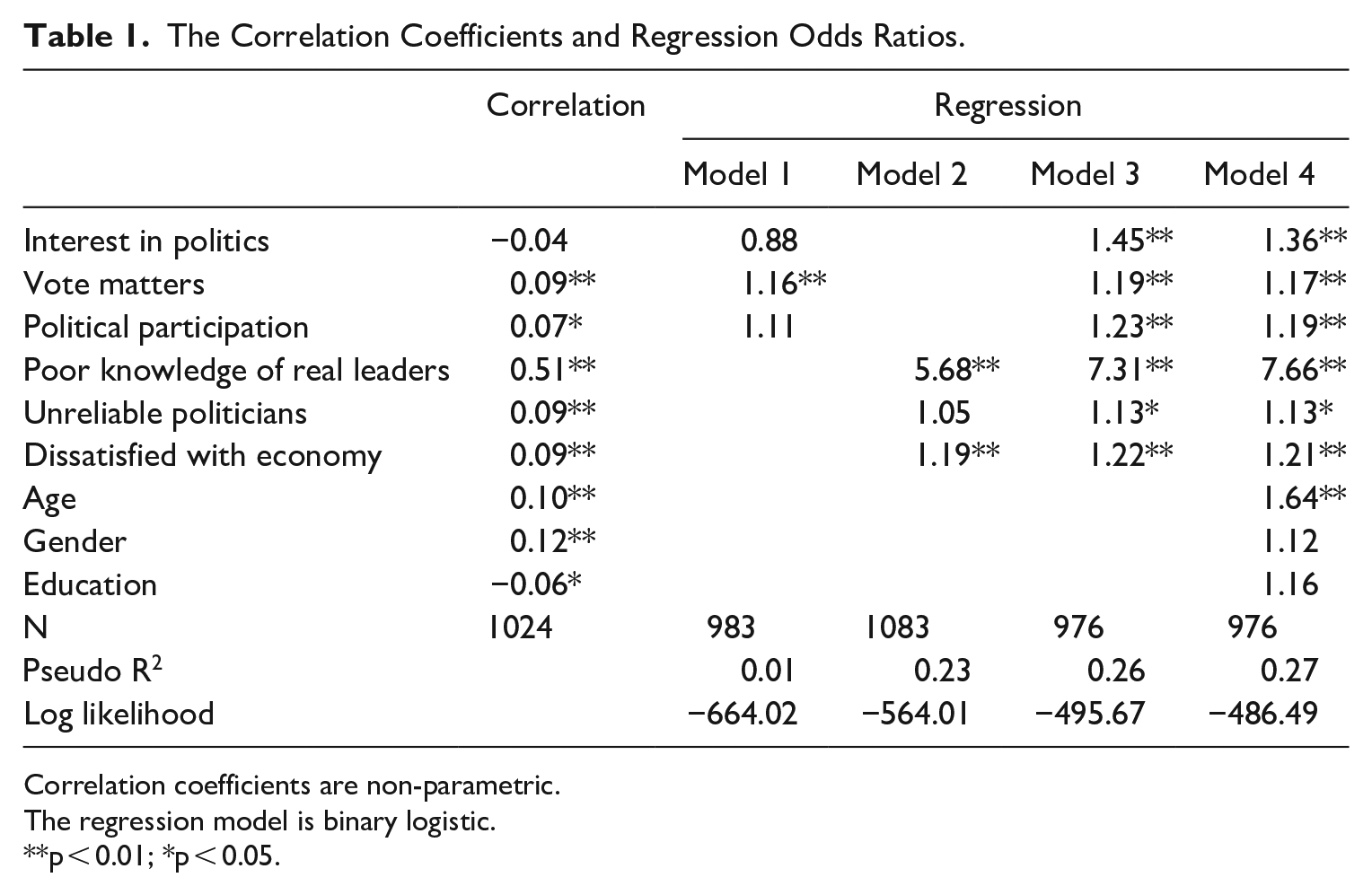
The bivariate analysis (the correlation in Table 1) indicates empirical support for five out of the six hypotheses. With the exception of interest in politics, all the other variables correlate positively and are statistically significant with the identification of the fictitious candidate. The strongest correlation is for H4 in which the respondents who did not know the most prominent party leaders also declared that they do not know the fictitious candidate. Interest in politics correlates very weakly with the dependent variable and lacks statistical significance: It also goes against the theoretical expectation.
The Correlation Coefficients and Regression Odds Ratios.
Correlation coefficients are non-parametric.
The regression model is binary logistic.
p < 0.01; *p < 0.05.
For a more comprehensive test of the hypotheses, we run a binary logistic regression (Table 1). The attitudes and behaviours in the first three hypotheses appear to be theoretically related, and thus we test for multicollinearity, including all other independent variables and controls. The multicollinearity test indicates that there are no reasons for concern: The highest variance inflation factor (VIF) value is 1.31. There are four regression models, and all are available in Table 1: one with the three hypotheses for informed citizens, one with the three hypotheses for alienated citizens, one with all six main effects and another that includes the control variables. The pseudo R2 in Model 1 is low, indicating a minor improvement of the model with the three variables associated to knowledgeable citizens (H1–H3) over the null model. The pseudo R2 values for the remaining three models in Table 1 show that they fit better the outcome data than Model 1.
In Model 1, there is empirical support for the hypothesis according to which citizens who believe that their vote makes a difference (H2) are more likely to identify a fictitious candidate. The other two variables either go in the hypothesized direction but lack statistical significance (H3) or go against the theoretical expectation and lack significance (H1). Nevertheless, in Models 3 and 4, all three variables find empirical support; the voters who are highly interested in politics, who consider that their vote matters and who participate more in politics than others are more likely to identify a fictitious candidate. In these models, the political interest has the highest likelihood to predict the identification of a fictitious candidate among the three variables.
Model 2 provides empirical support for the hypothesis about poor knowledge of real party leaders (H4) and dissatisfaction with the development of economy (H6). Those individuals who do not know any of the three prominent party leaders are 5.68 times more likely to identify a fictitious candidate compared to the respondents who know all three real party leaders. This variable has the highest likelihood across all four models. The assessment of politicians as unreliable (H5) does not have an impact on the likelihood to identify a fictitious candidate. In Models 3 and 4, there is empirical support for all the hypotheses. Compared to Model 2, there is a change in the strength of effect and statistical significance for all variables in H4–H6. Among the controls (Model 4), only age has a statistically significant effect with older respondents being 1.64 times more likely to identify fictitious candidates when compared to younger respondents.
Figure 1 presents the adjusted prediction of political interest and poor knowledge of real leaders. These are the variables with the highest effect for each group of citizens in Models 3 and 4: H1 and H4. The horizontal axis displays the values for the dependent variable. Figure 1(a) shows that respondents with very low and those with very high political interest are more likely to correctly identify the leader as fictitious. This observation strengthens the theoretical discussion according to which we have two distinct groups of citizens who identify this leader for different reasons. Those with no interest in politics do not assign meaning to the fictitious leader because they are distant from the process and do not assign to other leaders in general (Figure 2).
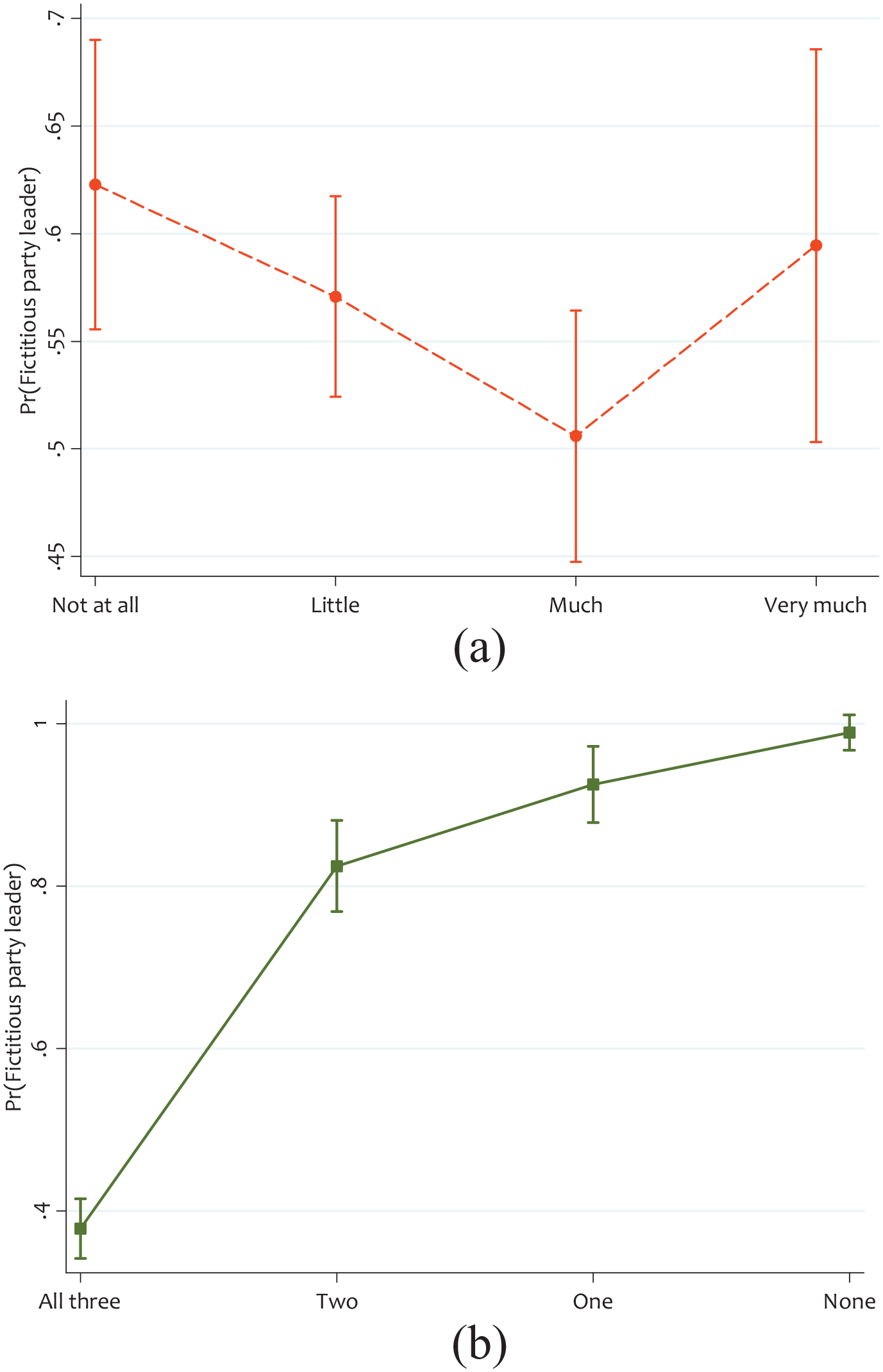
Adjusted Predictions of Political Interest and Knowledge of Real Leaders. (a) Political Interest, (b) Knowledge of Real Party Leaders.
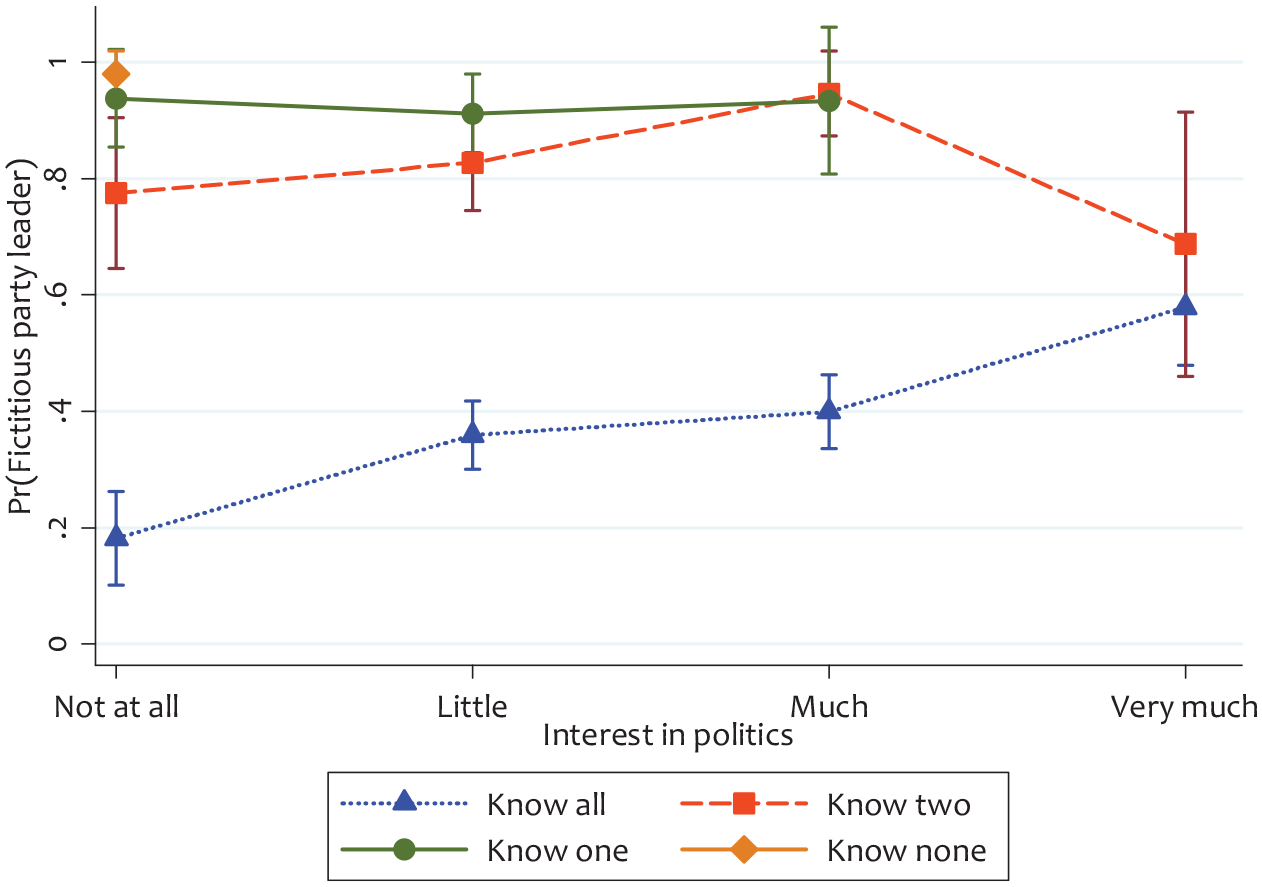
Predictions of an Interaction Effect: Political Interest and Knowledge of Real Leaders.
Figure 1(b) shows that the likelihood of getting the fictitious party leader right increases dramatically for those voters who know two real leaders as opposed to knowing all three. In comparison, the marginal effects for the other categories – knowing none of the leaders or just one – are considerably lower. This indicates that the identification of a fictitious leader is due only to a limited extent to the poor knowledge of no real party leader. Instead, a real problem lies with the respondents who know all three leaders and do not identify the fictitious party leader (see the discussion that follows).
With this complex picture in mind, we ran an interaction effect between these two variables to understand better the driving mechanisms. This interaction is driven by the empirical evidence instead of theory. It is something that we did not expect in the beginning when we hypothesized a linear effect of the two variables. That is the reason for which we do not have a separate hypothesis for it. Figure 2 depicts on the vertical axis the values of the dependent variable, on the horizontal axis the values of political interest and the four categories in the graph are the values for knowledge of real party leaders. There is overlap between the respondents with no political interest and no knowledge of real party leaders, which explains the odds ratios in Models 3 and 4 (Table 1). More important, the graph illustrates that the respondents who know all real party leaders and have no interest in politics have low ability to recognize the fictitious candidate. This ability gradually increases for levels of political interest. At the same time, the respondents with much political interest who know two real party leaders are more likely to identify the fictitious leader than those who are very much interested in politics. In this case, when knowledge is not perfect, high political interest trumps their ability to distinguish real from fictitious party leaders.
Discussion and Conclusion
This article explains under what circumstances citizens can identify a fictitious party leader. The analysis uses individual-level data from a survey conducted in Romania and shows that there are two groups of citizens who have not heard about a politician who does not exist. These groups reach the same outcome on different grounds. On one hand, there are the citizens with high levels of political interests, who participate in politics and who believe their voice matters. These identify a fictitious party leader due to the insights they have into politics, to their attitudes and behaviours. On the other hand, there are the citizens who are dissatisfied and feel alienated from politics. They have not heard about a fictitious leader – and thus accidentally identify him as such – because they stay away from politics.
These findings have important implications for two strands of research. First, they are relevant for the debate about voters’ levels of political sophistication and knowledge. As indicated by previous research, a large share of society does not belong to the groups with either very high or not at all political sophistication; instead, it is positioned somewhere in between. Our findings indicate that the citizens placed in these two groups with extreme values of political sophistication stand a better chance to identify a fictitious leader. This means that those in between can hardly distinguish a fictitious from a real politician. This observation matches the reality; the distribution of respondents in our sample shows that roughly 45% of the voters like someone who does not exist. Moreover, Figure 1(a) illustrates how those citizens with moderate political interest are inclined to like a fictitious party leader. Our results indicate a basic problem that reflects the widening gap between politicians and citizens in a form that has been so far under-studied. If voters with average levels of sophistication do not identify a fictitious politician, it is likely to have a low motivation to engage in decision-making processes that may complement the work of real politicians.
Second, this study outlines the problem of social desirability bias in surveys. It is likely that respondents rated the fictitious politicians due to such a bias, which infects survey responses and correlates with many of the independent variables used in our analysis (Ansolabehere and Hersh, 2012; Dahlgaard et al., 2019; Karp and Brockington, 2005). Our results show that the most significant effect that explains who detects fictitious politicians are those who already do not know any of the real party leaders. This means that those who answered ‘Don’t Know’ are likely to continue answering the same for other politicians for convenience reasons. By contrast, those who know real politicians but are unfamiliar with the fictional leader are less likely to answer ‘Don’t know’ because they do not want to appear less knowledgeable, that is, not knowing all party leaders. This raises important questions about the validity of self-reported survey responses and the importance of social desirability bias. Our analysis on this specific question about fictitious leaders brings evidence that social desirability bias exists and can seriously alter the reliability of survey answers. This kind of question should be included as checks to detect participants who have social desirability bias from those who genuinely answer the question.
Footnotes
Acknowledgements
The authors are grateful to Claudiu Tufiș for providing access to the dataset used in this analysis. The authors would like to thank Adrian Florea, Michael Scanlan and the anonymous reviewers of the journal for their careful reading of the manuscript and constructive suggestions.
Declaration of conflicting interests
The author(s) declared no potential conflicts of interest with respect to the research, authorship, and/or publication of this article.
Funding
The author(s) disclosed receipt of the following financial support for the research, authorship, and/or publication of this article: The work for this article was supported in part by the grant PN-III-P1-1.1-TE-2019-0460, awarded by the Romanian Executive Agency for Higher Education, Research, Development and Innovation Funding (UEFISCDI).
