



Abstract
The article illustrates that legislators’ constituency orientation can be enhanced through electoral system personalization, even in political systems that have used the party-centered closed list proportional representation for several elections. Leveraging a quasi-natural experiment, created by the 2008 electoral reform in Romania, the study investigates the frequency and determinants of parliamentary questions dealing with constituency issues and whether the reform has stimulated different forms of responsiveness toward constituents. The analyses run on a matched sample of legislators show that while the reform has not modified the proportion of all constituency questions, it has increased substantially the share of questions inspired by allocation responsiveness. Moreover, the effects of some determinants of constituency orientation changed after the reform: previous socialization in local politics loses its significance while we also observe an increased negative effect of non-local candidatures.
Introduction
The personalization of electoral systems via reforms that enable preference voting, lower thresholds in flexible list systems or introduce single-member districts (SMDs) is a phenomenon ever more present in both young and consolidated democracies (Renwick and Pilet, 2016). Sometimes, these electoral changes are introduced specifically to improve the representatives’ accountability toward their constituencies, but one cannot take for granted that MP behavior would change accordingly, given the existence of other driving forces like the preferences of party principals or the power of role socialization. This article will assess the results of such a reform, while distinguishing between the types of responsiveness that are fostered in the process. The setting chosen displays the parameters of a quasi-natural experiment. This within-country approach keeps constant many institutional and political culture factors that could confound the analysis and hence ensures a more robust estimation of the consequences of electoral reform than cross-sectional studies (Blais et al., 2011; Crisp and Ingall, 2002; Motolinia, 2021).
In 2008, after five electoral cycles under closed list proportional representation (PR), Romania switched to an original mixed-member proportional electoral system. In the PR era, each of the 42 counties was a multimember district, with magnitude varying between 4 and 28. The reform meant that all MPs would be elected in SMDs: some after obtaining an absolute majority of votes and others depending on the proportion of votes won by their party in the county (Giugăl et al., 2017). 1 The electoral system reform was specifically promoted in the media as an encouragement to vote for people not parties, in order to increase individual accountability and the quality of MPs (Coman, 2013). Citizens would finally have the chance to punish corrupt or lazy MPs that were previously protected by the closed electoral lists.
Moreover, focus groups organized at the time showed that citizens hoped the electoral reform would strengthen the linkage between the representatives and their constituencies, through two mechanisms. First, the MP would be obliged to keep more in touch with their voters and, second, the electoral reform would facilitate the election of more local candidates and fewer carpetbagger MPs, that is, politicians imposed by party leaders on eligible positions in counties they had no connection with (Badescu et al., 2008).
Given these aspects, the research question of the article is: “Can electoral reform strengthen legislators’ constituency orientation even after a party-centered closed list PR system has been in place for several cycles?” It tests whether the reform increased the overall engagement in constituency service or whether it had a differential effect on types of constituency-oriented responsiveness (e.g. casework, allocation responsiveness, organized interest representation). In addition, I explore changes in the main determinants behind constituency service orientation under the two electoral laws. The former can be understood as direct effects of the reform, while the latter as indirect or redistributive effects. Through its focus, the article contributes directly to the literature on decentralized personalization (Balmas et al., 2014) by assessing the effects of an institutional personalization reform on legislators’ behavior.
The introduction is followed by a review of the literature on electoral rules and legislative behavior and a discussion of the study’s hypotheses. The research design introduces the data, the variables’ operationalization and the methods. The third section analyzes the frequency and types of constituency questions asked in the two periods. Next, I discuss the findings of the multivariate analyses performed separately on the matched data and on all MPs to assess the direct and redistributive effects of the reform. The conclusion reviews the findings and points to further directions of research.
Electoral Rules and Legislative Behavior
A wide range of political science studies evaluate the extent to which the variation in electoral rules explains the variation in legislators’ behavior. Thus, scholars have analyzed how electoral systems affect parliamentary voting unity (Carey, 2007; Depauw and Martin, 2008; Kam, 2009), party switching (Klein, 2018), MPs’ engagement in legislative speeches (Proksch and Slapin, 2012), or their choice of committees (Riera and Cantú, 2018). Another substantive part of this literature concentrates on the incentives that electoral systems create for cultivating a personal vote (for reviews, see André et al., 2014b; Zittel, 2017). There is consensus that closed list PR should top the party-centered end of the scale, but substantive disagreement regarding which electoral system motivates MPs the most to search for a personal vote (Carey and Shugart, 1995; Mitchell, 2000; Nielson, 2003; Shugart, 2001). In an original contribution to this puzzle, André et al. (2016) have compared legislators’ own perceptions of personal vote-seeking incentives of electoral systems, drawing on survey data from 15 countries and 69 parliaments. They found that closed list PR created the weakest incentives, followed by flexible lists. Open lists appeared to induce only a moderate motivation, while single-member plurality and two-round systems would create a strong motivation for cultivating a personal vote. Finally, the single transferable vote (STV) was associated with the strongest such incentives.
But what happens when the electoral rules are changed and there is considerable difference between the past and the current incentives to cultivate a personal vote? Radical electoral reforms are unusual in consolidated democracies. This is why legislative scholars need most of the time to compare different countries in order to disentangle the effect of electoral formulas and district magnitudes on the MPs’ constituency service orientation (André and Depauw, 2013; Heitshusen et al., 2005; Pilet et al., 2012). Leveraging a quasi-natural experiment by evaluating legislative behavior before and after electoral reform has the advantage of keeping constant other possibly intervening factors such as the degree of localism in a society (Bogdanor, 1985: 299) or a center-periphery cleavage (Valen et al., 2000).
The electoral reform in Romania provides a relevant such case to study. Previous articles have used a before-after research design to analyze the impact of the Romanian electoral reform on the MPs’ voting cohesion (Coman, 2012; Gherghina and Chiru, 2014), on their willingness to stand for re-election (Chiru et al., 2013), and on their co-sponsorship patterns (Chiru and Neamtu, 2012). For this article, it is interesting to note two particular findings. First, Coman (2012) concluded that after the reform, MPs were more likely to initiate legislation and to address parliamentary questions than under PR. Second, the replacement of closed list PR with an SMD-based mixed system did not bring more co-sponsorship between MPs representing constituencies located in the same county (Chiru and Neamtu, 2012). However, no study has assessed directly whether the electoral reform has achieved its goal of strengthening individual territorial representation. The article fills this gap by analyzing the direct effects, measured via changes in the share of all local questions and in the share of types of local questions, and indirect effects of the electoral reform, measured via changes in the determinants of constituency orientation.
There are rather ambivalent expectations with respect to the effect that the electoral reform had on the constituency orientation of MPs. On one hand, the fact that each seat was attached to an SMD has contributed to the localization of electoral campaigns (Popescu and Chiru, 2020), which in turn could inspire legislative behavior focused on the needs and wishes of the constituency (Chiru, 2018). Moreover, the reform could enhance constituency orientation through a change in the expectations about the appropriate representational roles that an MP should play. From a rational choice perspective, MPs who served several terms under closed list PR are much more likely to see the party leadership as their main principal at the expense of voters (Bawn and Thies, 2003) and organized interests in the constituency. Under such electoral rules and given also that in Romania legislative recruitment was generally centralized (Stefan, 2004), office and re-election depended almost exclusively on party leaders. For these reasons, MPs should have been more reluctant to engage in local representation during the PR era, while the electoral reform could increase the constituency orientation by empowering an additional principal, composed of voters, party members, and activists in the constituency. Finally, the reform could have a positive effect by facilitating the election of locals and politicians with local experience, mechanisms which will be discussed in more detail when introducing the hypotheses on specific individual determinants of engagement in constituency service.
On the other hand, the long PR socialization and the fact that MPs still have to please party leaders for nomination in an SMD that can facilitate election could negatively affect the time spent on asking constituency questions. Failing to observe any difference in the frequency of local questions after the reform could also happen for a very different reason. Thus, the talk about the electoral reform and its popularity among voters might have incentivized MPs, even before the actual change of electoral system, to use parliamentary questions to raise awareness about or attempt to solve problems in their counties. Another factor that could drive behavior in the same direction during the PR era is the increased localization of Romanian politics after 2000, a process marked by the parties’ reliance on “local barons” for vote mobilization and party funding. These are controversial local political entrepreneurs that have used “patrimonial rule” (Culic, 2006: 80) and clientelism to consolidate personal power and advance their political and business interests. Given their role in legislative recruitment (Chiru, 2010), one could expect some MPs to act as agents of these barons, pursuing local interests in the parliamentary arena before the 2008 reform:
H1. MPs elected after the electoral reform will be more constituency-oriented than those elected before.
One of the main conclusions of the theoretical model built by Bawn and Thies (2003), which assessed incentives created by electoral systems and nomination procedures, was that election in SMDs makes legislators much more responsive to unorganized voters and less responsive to organized interests, compared to MPs elected through closed list PR. A similar conclusion was reached by empirical studies conducted in Scandinavia (Esaiasson and Heidar, 2000) and the Netherlands (Thomassen and Andeweg, 2004). Consequently, it is reasonable to expect after the electoral reform a growth in the number of parliamentary questions which deal with problems of individual constituents, at the expense of representing the interests of organized interests.
It is also more likely that the introduction of SMDs would make legislators more interested in inquiring about the state of public work projects and other investments in their counties. This derives from the fact that, in the new electoral setting, the campaign logic, both in terms of promises and credit claiming, is likely to be re-focused on the welfare of the district, rather than on national policies. Empirically, the concern of individual MPs with financial allocations directed toward their counties has increased, as indicated by the rise in amendments brought after the electoral reform to the draft budget law: from under 1000 until 2008, to 5016 in 2009 and 11,400 in 2011 (Lupea, 2013):
H2. Allocation and casework responsiveness will increase after the electoral reform.
Next, we will discuss the hypotheses related to the indirect or redistributive effects of the electoral reform. Under closed list PR, the incentives to develop a personal reputation vary inversely proportional to district magnitude (Carey and Shugart, 1995). This hypothesis was corroborated by comparative studies with respect to the MPs’ likelihood of adopting a constituency representation role (André et al., 2011), the importance given to representing individual constituents (Farrell and Scully, 2007) and to the time a legislator spends in her district (André and Depauw, 2013). Besides, district magnitude was shown to influence in the same manner the likelihood that legislators exhibit personal vote earning attributes, such as being local (Shugart et al., 2005) or having local politics experience (André et al., 2014). In turn, these attributes, as we will discuss below, are also among the usual determinants of a constituency servant profile:
H3a. The smaller the district magnitude, the more constituency-oriented an MP will be under closed list PR.
After the electoral system change, there is zero variance in district magnitude, but the number of MPs elected from the same county should still be important for non-legislative behavior. First, in smaller counties, a partisan voter who would like to address a petition to an MP from her party would have considerably fewer options (possibly limited to one) compared to large counties that elect many MPs. Second, because it is very likely that casework and pork-barrel activities would target the whole county and not only the SMD, credit claiming can be much more effective in smaller counties, where the boundaries of the two units coincide to a higher degree. However, a reverse effect might be possible because the electoral system introduced an element of intra-party competition: candidates not winning the seat directly compete for the “redistributed” mandates with co-partisans. The criterion on which these mandates are allocated is the raw number of votes received by each candidate. Nevertheless, because there is significant variation in the number of voters that live in each district within a county, the real intra-party competition is for nomination in a more densely inhabited SMD, 2 thus for the favor of party gatekeepers. The nominations 3 at both the 2008 and 2012 parliamentary elections have shown that politicians understand this key feature of the electoral system:
H3b. The fewer legislators elected from the same county, the more constituency-oriented an MP will be after the electoral reform.
Experience in local politics is a fine predictor for constituency service engagement (Zittel et al., 2019). One of the mechanisms behind the relationship builds on the connections that the MP has developed at local level with voters, officials and other politicians (Freeman and Richardson, 1996; Tavits, 2010). These networks may be activated as parallel channels for service and casework demands. Another mechanism has to do with the norms regarding representation roles that politicians may bring with them in the national legislature after being socialized in local politics (Norris, 1997). In the context of the constituency-centered Romanian electoral reform, differentiated effects can be expected for the pre- and post-2008 MPs. Since the SMD-based formula favored candidates with high name recognition and political and business connections at local level, a significant increase in the number of local politicians elected as MPs was likely and this could probably diminish the overall importance of this type of career background. Also, the explanation regarding the projection of local representation roles into national politics could be affected by voters’ expectation that after the reform all MPs, irrespective of their background, would develop a constituency servant role:
H4. MPs having local politics experience will be more constituency-oriented than the rest before the electoral reform but not after.
As already indicated, being a resident of or having lived in the district is considered one of the most important personal vote earning attributes (Zittel, 2017). In contrast, carpetbagger MPs, that is, candidates imposed by the party leadership and who have never lived or worked in the district are likely to perceive fewer incentives to pursue a constituency agenda than local representatives. They may lack prior knowledge about local problems and are badly positioned with respect to the networks that would help them to acquire such knowledge. In the absence of local credentials and given the cost of acquiring them, it is reasonable to expect that these politicians would either try to develop other valence advantages, such as policy expertise or better name recognition (Groseclose, 2001; Stokes, 1992), or to conserve their privileged relationship with party leaders. In Romania, the large scale of the carpetbagger MP phenomenon (Stefan, 2004) was a key criticism raised against the closed list PR system by civil society activists. Again, one could expect a differentiated effect for the MPs elected after the change of the electoral system, but unlike in the case of local politics experience, this relationship should be stronger after 2008 because of the likely election of fewer non-local candidates. Thus, those politicians who manage to secure nominations despite the preference of post-reform selectorates for local politics experience and name recognition (Chiru, 2010) and also to get elected despite the rhetoric against carpetbagger MPs probably enjoy the type of resources discussed above (i.e. policy expertise, good relations with party leaders) and do not need to cultivate a personal vote based on constituency service:
H5. Carpetbagger MPs will be less constituency-oriented than local MPs and the effect should be stronger after the electoral reform than before.
In addition to the hypothesized effects, I control for parliamentary experience, party socialization, electoral security, the average parliamentary vote attendance, party switching, party leadership positions, the government-opposition status, gender, and party affiliation. Some of these controls directly target other changes happening simultaneously with the electoral reform, such as the 2008 economic crisis.
A longer MP career during the PR era might socialize MPs into pleasing their party principal first and foremost, while after 2008 both newcomers and veteran MPs are faced with the need to show some responsiveness to constituents if they fancy re-election. The same reasoning applies to the party socialization control. This additional indicator of organizational socialization, less demanding than parliamentary experience, is needed given that the Romanian legislature had in each term a turnover rate larger than 55%.
Lack of electoral security could trigger more constituency service in SMD-based systems than under closed list PR. In the former, electorally marginal MPs can hope to improve re-election prospects by cultivating a personal vote (Carey and Shugart, 1995) through casework and allocation responsiveness. Conversely, under closed list PR, the rational strategy for marginal MPs would be to convince national party leaders that they deserve a safe list nomination. Displaying parliamentary voting loyalty or developing policy expertise is a better strategy in such a situation than engaging in constituency service.
The average vote attendance is used to assess whether the most active MPs are also the ones who care the most about local issues. Party switching needs to be controlled for because defecting toward the end of the term to parties that can ensure easier re-election makes constituency service superfluous. Alternatively, after the reform, switching could be motivated by having access to pork for constituents.
Holding a leadership position could matter for engaging in constituency service. Local party leaders acquire more knowledge about constituency problems because of their meetings with other party officials such as mayors. On the contrary, national leaders and Parliamentary Party Group (PPG) leaders are expected to be more interested in shaping national policies, and also to invest more time in party affairs at central level.
The extensive set of austerity measures the government adopted in 2010 in the wake of the economic crisis might make opposition MPs devote more effort to exposing the deleterious effects these had on their constituencies. Finally, because of life experience differences, male MPs may engage less in constituency service than female representatives (Freeman and Richardson, 1996).
Research Design
The constituency orientation of MPs is measured with the share of parliamentary questions and interpellations submitted on issues from their constituency out of all parliamentary questions and interpellations of an MP. This proxy has several advantages over other legislative behavior indicators or self-reported data (Martin, 2011; Russo, 2011).
The primary data includes 4644 questions and interpellations asked by the members of the 2004–2008 Romanian Chamber of Deputies and 7843 questions and interpellations submitted by the deputies of the next legislative term. These are all the questions and interpellations asked by the MPs in the first 2 years of terms. I focus on the first 2 years because coding the data for the full terms was unfeasible given the resources available.
The resulting 12,487 questions and interpellations were analyzed in a two-stage process. First, Python was used to match their text with geographical names from the county where the MP was elected, drawing on geographical markers from the GeoNames database. A score was then assigned based on the number of associations found. Second, all the questions were manually checked to decide whether the question did indeed refer to local issues and to code their topic (more details in the section below). In doing so I applied the framework for coding localism developed by Martin (2011).
Variables’ Operationalization
Parliamentary experience and party membership are measured in years until the start of the term. Local politics experience is a dummy indicating whether the MP held in the past local or county offices. “Carpetbagger MP” was coded “1” if the MP represents a county where she never lived or worked.
I adapt the indicator proposed by Olivella and Tavits (2014) to have a measure of electoral security that is comparable across the two electoral systems. Thus, electoral security is computed as the difference between the party list share of mandates (for the 2004 term) or the candidate share of votes (for the 2008 term) and Lijphart’s (1999) effective electoral threshold, which is
MPs are considered local or national party leaders if they held such offices at the time of the 2004 and 2008 elections, respectively. The reference time for the PPG leadership and party switching variables is the entire period analyzed from each term (i.e. 2005–2006 and 2009–2010). Average vote attendance indicates the percentage of parliamentary votes the MP has attended.
Methods
All parliamentary questions and interpellations were content-analyzed to establish their constituency orientation and the type of local topic addressed. In order to answer the questions about the effect of the reform on the frequency of all constituency questions and on specific types of constituency questions corresponding to the various forms of responsiveness, I preprocessed the data using genetic matching (Ho et al., 2007). Because of the nature of the dependent variable (DV), that is, fraction data, I use a fractional logit estimator. 4
Constituency Questions’ Frequency and Content under Two Electoral Rules
Romanian MPs have the right to submit questions and interpellations to any Minister or head of state agency, who are obliged to answer within 2 weeks. Like the general upward trend in non-legislative activities of Western European MPs in the last decades (Green-Pedersen, 2010), Romanian MPs have asked more questions and interpellations with each term.
Figure 1 above illustrates the longitudinal dynamic of parliamentary questions and interpellations, considering the total number submitted every year and the number of constituency-oriented questions. The texts of questions are available online starting from 1998, hence this is the starting point for coding.
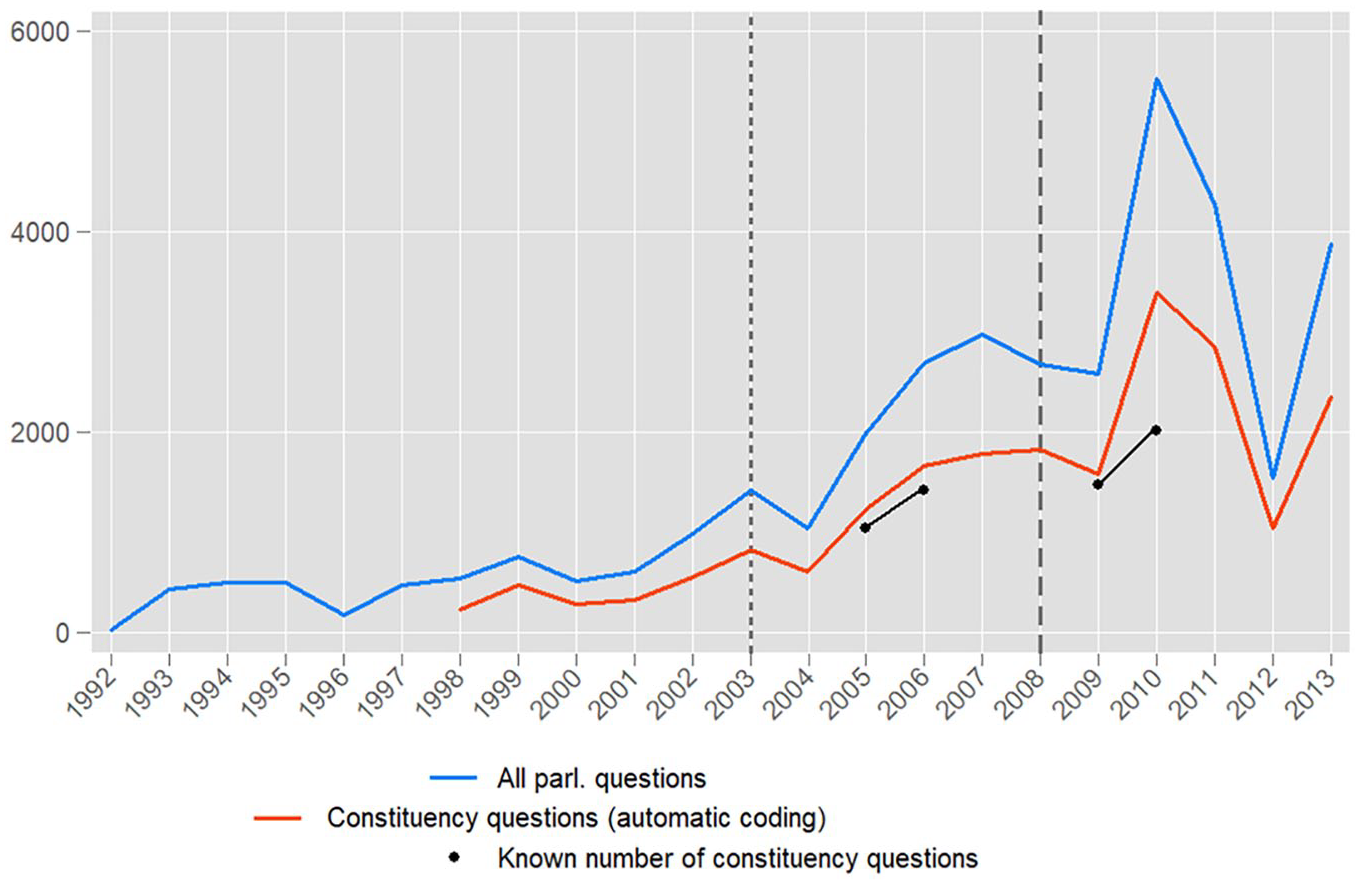
Evolution of Constituency PQs (1998–2013).
The first sharp growth in the number of constituency questions corresponds to 2003, the year in which the first serious attempts were made to change the electoral formula to a candidate-oriented system (Popescu, 2005). Moreover, the talk about electoral reform that continued throughout the entire 2004–2008 term was paralleled by a steady increase in the number of local questions. In election years, there is a constant decline in the number of constituency questions the MPs ask, reflective of the fact that the MPs are busy campaigning.
The increase of the number of constituency questions with each term might illustrate a long-term process of personalization and political localization. Therefore, to isolate the effect of the electoral reform I focus not on the raw number of constituency questions, but on their share for each MP in the two terms.
Overall, 53.2% of the 4644 questions and interpellations asked in the first 2 years of the 2004–2008 term referred to matters from the MP’s county. The equivalent proportion for 2009–2010 is 44.5% but from a total of 7843 questions. This importance given to local issues by MPs elected in a closed list PR system is unusual. Thus, the 53.2% is far above the share of constituency questions, 39.3% (Russo, 2011), found in the Italian 15th Parliament (2006–2008) elected under a similar electoral system.
The mean number of constituency-oriented parliamentary questions has increased from 7.9 for the 2005–2006 legislators to 11.1 for the 2009–2010 MPs. However, this increase is due to a small number of MPs: 4.1% of the legislators have asked together almost half of all constituency questions in 2009–2010. Moreover, the proportion of MPs that have not asked any constituency questions remained the same in both terms, at approximately 32%.
To assess the topic of constituency questions, I used five categories, which correspond to the key components of constituency service: casework (petitions), allocation responsiveness (local infrastructure questions), symbolic representation (questions about local events), and representation of local organized interests (with a further distinction between business and non-business interests). All questions were coded manually.
Thus, all questions dealing with requests or cases surrounding individuals living in the MP’s county were labeled “petitions.” The local organization category comprises problems of local authorities and institutions (city halls, hospitals etc.) and issues concerning local non-governmental organizations (NGOs). If the question referred to public works in the MP’s county then it was included in the local infrastructure category. Finally, I coded whether the issues mentioned in questions related to local businesses (e.g. problems of local farmers) and local events (e.g. a local festival). Questions addressing two types of issues simultaneously were coded under two categories.
Figure 2 below illustrates the frequency of the five types of issues in the parliamentary questions analyzed for the two samples of MPs. The mean number of parliamentary questions asked about local facilities (e.g. investments in roads, educational or medical infrastructure) has increased from 2.2 in the term before the electoral system change to 4.2 after. This represents a first corroboration of the hypothesis that the interest of individual MPs in financial allocations directed toward their counties has increased after the electoral reform.
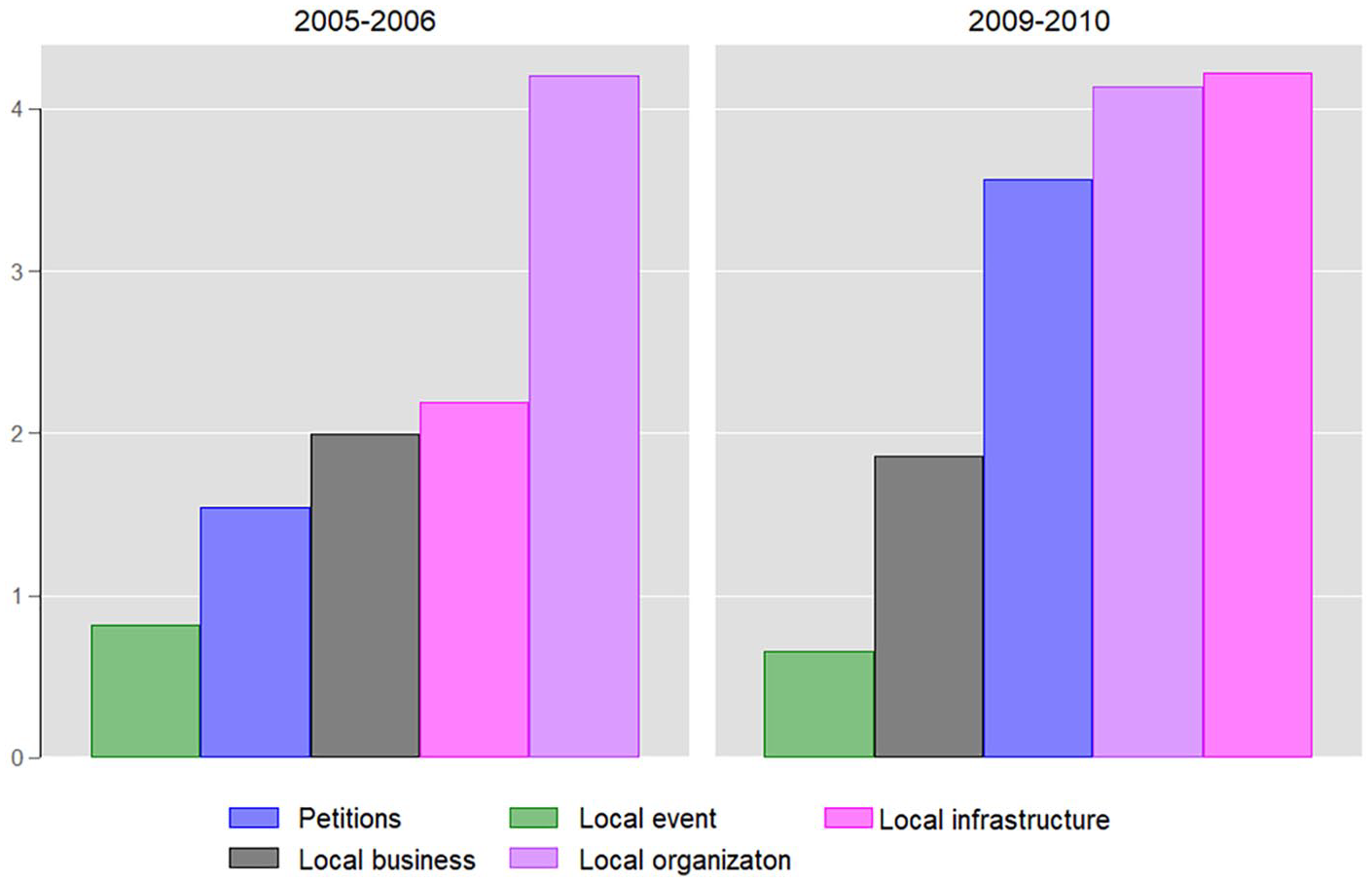
What Types of Issues Are Promoted by Local PQs?
In addition, the average number of questions and interpellations following petitions of citizens, or discussions with them at surgeries more than doubled: from 1.5 to 3.5. These questions referred frequently to pension recalculation, property restitution and citizenship issues. It could be that citizens felt more entitled to petition their representative because of the enhanced logic of individual representation and accountability brought by the electoral reform. Or the SMD-elected MPs were organizing more surgeries and were generally more accessible. For the other categories there are virtually no changes in the quantity of questions and interpellations asked.
Multivariate Analyses
To isolate the impact of the electoral reform, which can be considered the treatment, the pre- and post-reform MPs needed to be matched on all relevant characteristics that could influence their engagement in constituency service. In line with the advice in the literature, the variables affected by the treatment—in our case, local politics experience, party leadership office, and party affiliation—were excluded from the matching model to avoid post-treatment bias (Ho et al., 2007; Stuart, 2010). The judgment was that local politicians (i.e. those having served in local political offices or local party leaders) were much more likely to get elected as a consequence of the electoral reform, since the SMD-based formula favored candidates with high name recognition and political and business connections at local level. Moreover, one could also expect different probabilities of winning a seat for politicians of parties that have opposed the reform (Greater Romania Party (PRM)) compared with those which have supported it (Democratic Liberal Party (PDL) and National Liberal Party (PNL)) (Gherghina et al., 2013).
The matching procedure achieving the best balance was genetic matching. Out of the 313 treated cases (MPs elected after the reform), 308 were matched to 135 of the 312 control units (MPs elected before the reform). Thus, fewer than 2% of observations in the treatment group did not receive matches and were discarded. Table A1 and Figure A1 in Appendix 1 illustrate the closeness of the matched groups and the good balance achieved through the matching procedure.
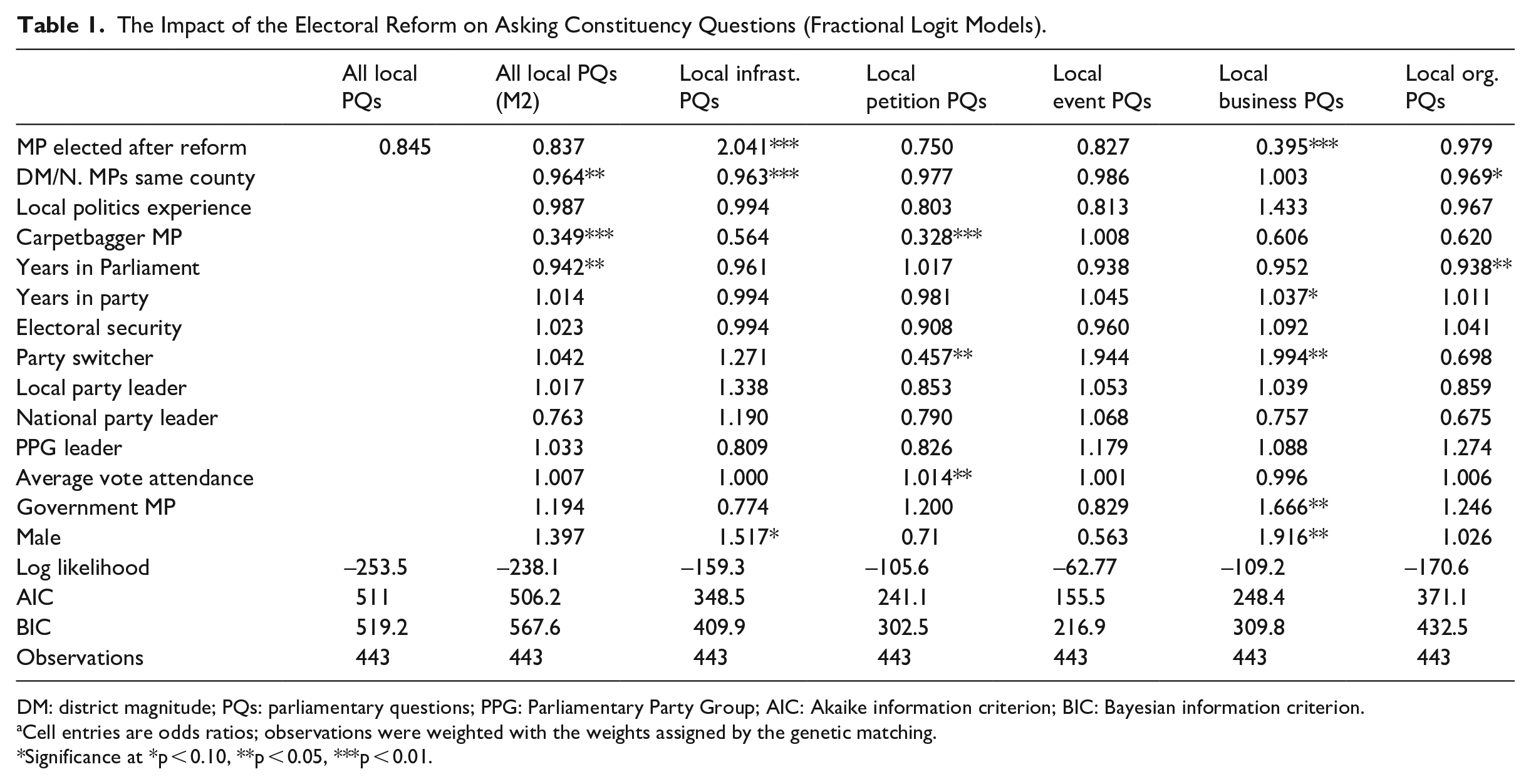
Table 1 below includes the results of the fractional logit regressions run using the matched dataset. Neither in the baseline, nor in the full model accounting for the total share of constituency parliamentary questions did the treatment variable achieve statistical significance, although the estimates point in the expected direction.
The Impact of the Electoral Reform on Asking Constituency Questions (Fractional Logit Models).
DM: district magnitude; PQs: parliamentary questions; PPG: Parliamentary Party Group; AIC: Akaike information criterion; BIC: Bayesian information criterion.
Cell entries are odds ratios; observations were weighted with the weights assigned by the genetic matching.
Significance at *p < 0.10, **p < 0.05, ***p < 0.01.
Thus, it appears that by itself the reform has not increased the share of constituency-oriented parliamentary questions. Because of this, it is safe to reject Hypothesis 1 and to consider plausible the explanation regarding the effect of the talk about reform. An additional explanation can be discovered by comparing the findings of the other five models presented in Table 2, which assess whether the treatment influenced the usage of constituency questions for different types of responsiveness.
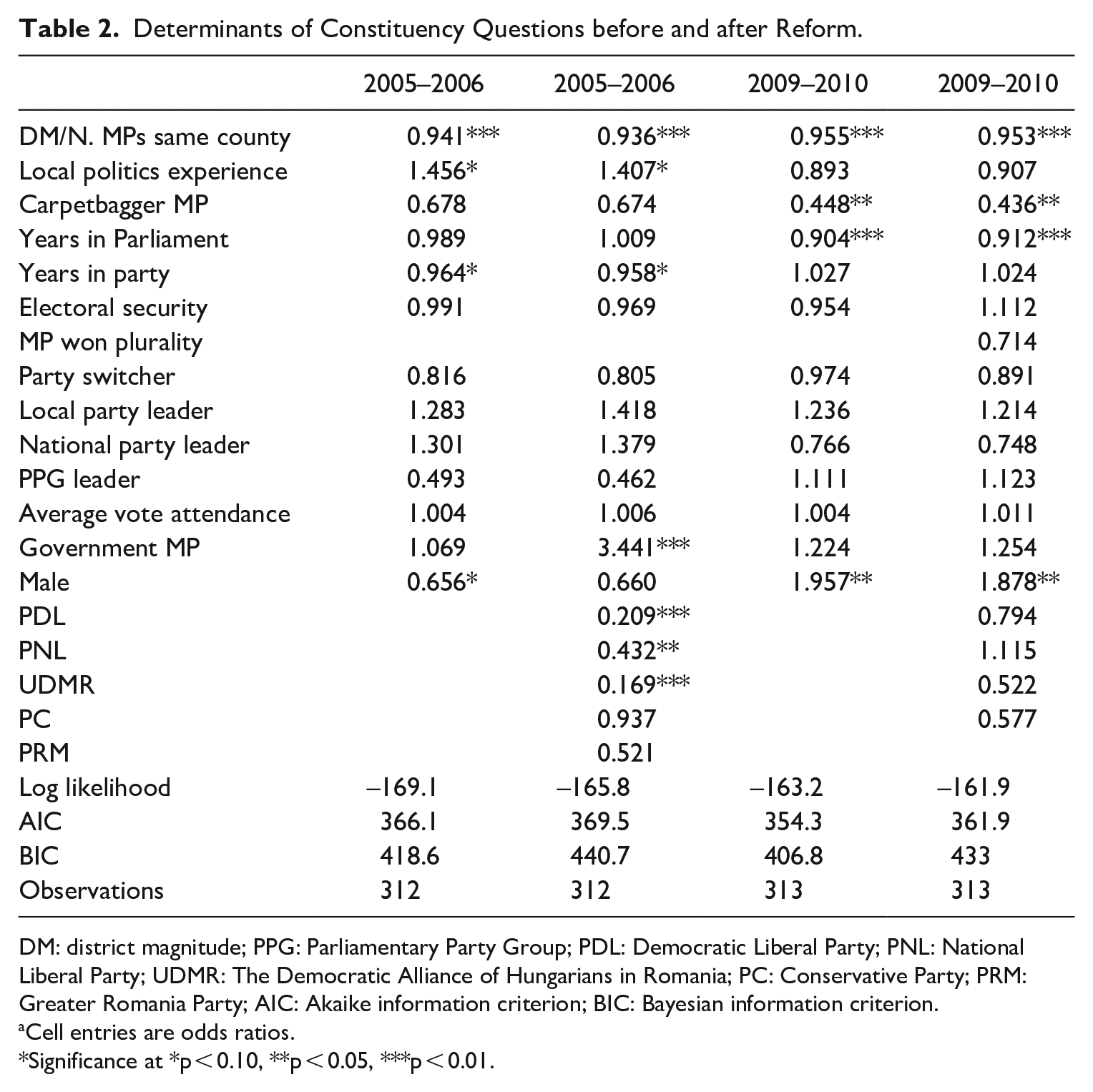
Determinants of Constituency Questions before and after Reform.
DM: district magnitude; PPG: Parliamentary Party Group; PDL: Democratic Liberal Party; PNL: National Liberal Party; UDMR: The Democratic Alliance of Hungarians in Romania; PC: Conservative Party; PRM: Greater Romania Party; AIC: Akaike information criterion; BIC: Bayesian information criterion.
Cell entries are odds ratios.
Significance at *p < 0.10, **p < 0.05, ***p < 0.01.
First, these models partially corroborate Hypothesis 2: for MPs elected after the electoral reform, the share of questions and interpellations referring to local infrastructure issues is two times larger than that of their colleagues elected prior to the reform. We do not observe, however, any difference in the share of questions and interpellations following citizens’ petitions. Therefore, we can conclude that the electoral reform has increased significantly only allocation responsiveness, 5 but not casework responsiveness.
Second, for the other types of responsiveness, the effect of the reform is rather negative, but it reaches conventional levels of statistical significance only for the share of questions on local businesses. Thus, the proportion of such questions is roughly 2.5 times lower after the reform. Figure 3 below illustrates the magnitude of the two effects. These opposing effects could cancel out when one only considers the aggregate number of constituency questions. This fact emphasizes the error that previous studies have committed in failing to differentiate between parliamentary questions based on the triggering mechanisms or the type of actor whose interests are being represented.
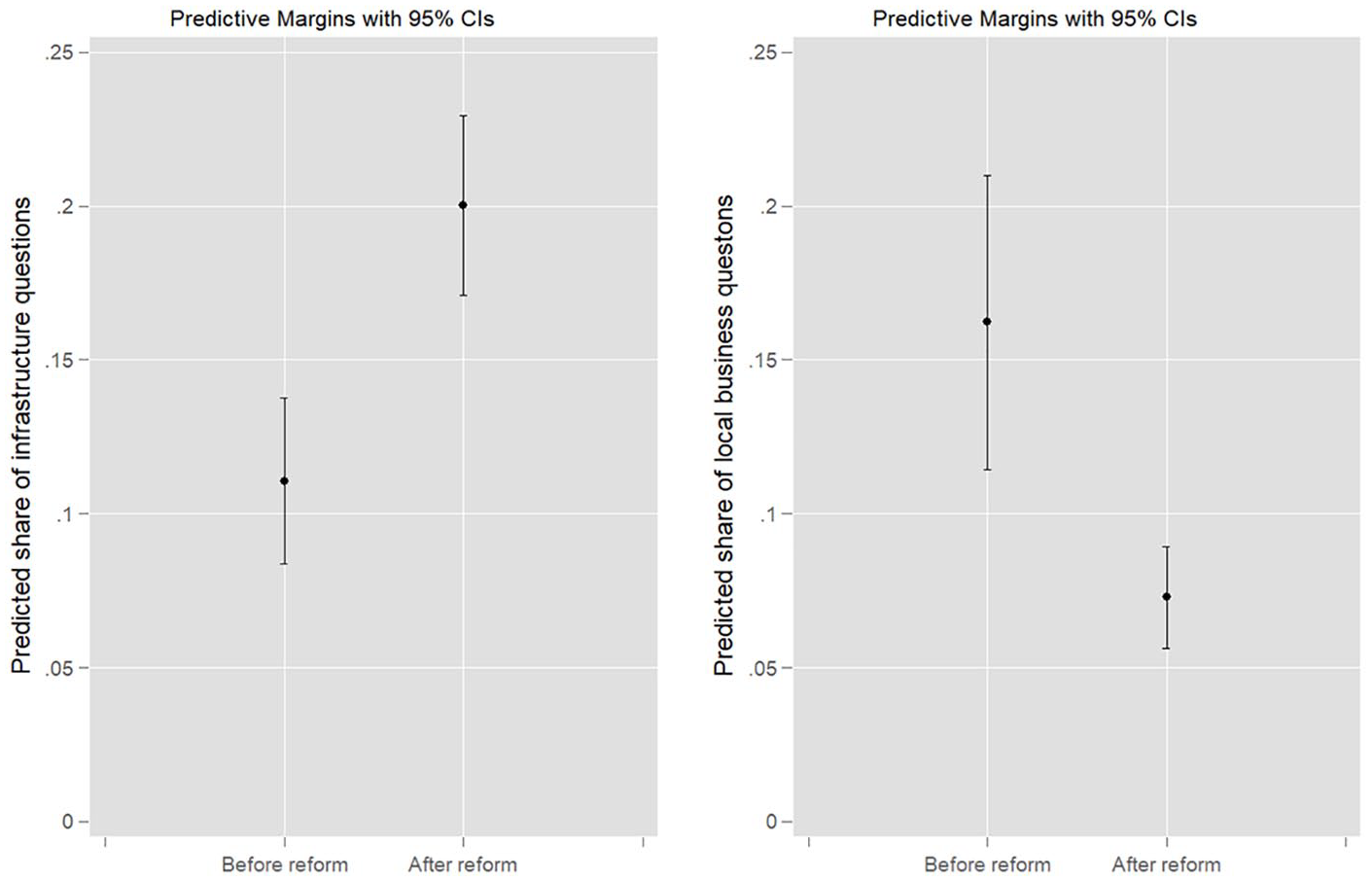
The Share of Infrastructure and Local Business Questions before and after Reform.
Redistributive Effects of the Electoral Reform
The fractional logit regressions in Table 2 use the entire samples of MPs to establish whether the various constituency service determinants have different effects under the two electoral systems.
The Carey and Shugart (1995) district magnitude hypothesis is corroborated for the closed list PR sample. Thus, computing predicted probabilities with the margins command indicated that, on average, half of the questions of an MP who represented a district with the magnitude of 4 were on topics related to her constituency. This share decreases to around 38% for a parliamentarian from Prahova (magnitude 12) and to only 18% for a Bucharest MP (magnitude 28).
After the electoral reform, a similar phenomenon takes place: thus, the higher the number of representatives elected from the same county (i.e. what represented the district magnitude prior to reform), the weaker the MP’s constituency service orientation. Running margins indicated that, on average, 47% of the questions of an MP who represented a district with the magnitude of 4 were on topics related to her constituency compared to 38% for an MP from a county with 12 representatives, and 23% for a Bucharest MP (the capital was divided into 28 SMDs). Figure 4 below illustrates these effects.
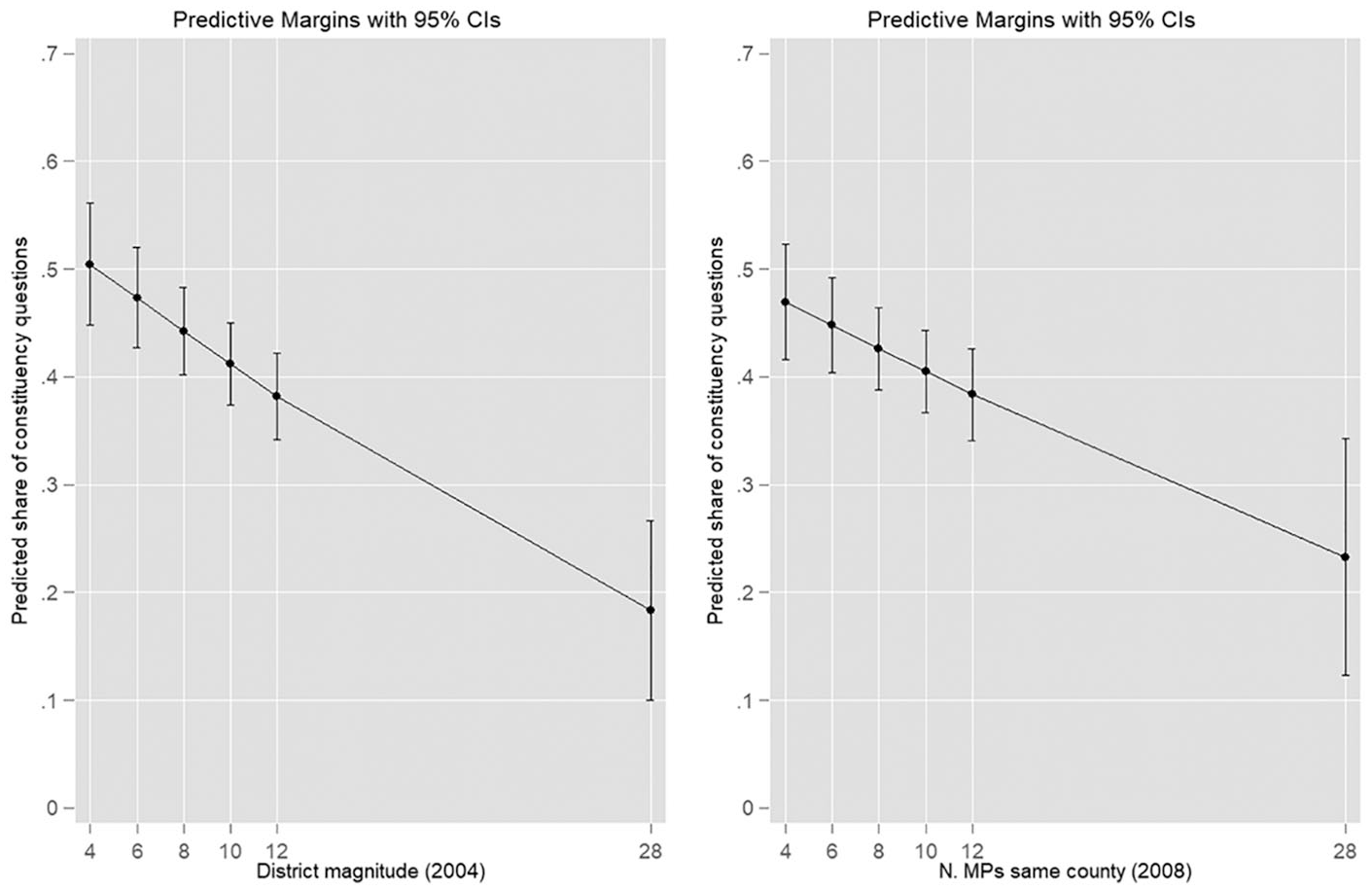
Effects of District Magnitude and N. MPs from the Same County.
This happened because MPs still perceived the entire county as their constituency. A proof of this is the fact that only a small fraction of the local questions refer strictly to issues in the SMD that elected them. In turn, this situation is either a result of inertia or of adaptation to the demand side of politics: citizens petition and visit the surgeries held by MPs representing their county, but not necessarily their district (Coman, 2013: 484).
The same models were also run alternatively with the share of constituency questions corresponding to each of the five types of local issues as the DV (see Tables A2.1 and A2.2 in Appendix 1). These regressions show that allocation responsiveness, and partially casework responsiveness and the representation of organized interests in the constituency, decrease as district magnitude increases. These additional findings corroborate, drawing on legislative behavior data, the results of analyses based on MP survey data (André and Depauw, 2013).
As expected, local politics experience makes a difference for submitting constituency questions only before the electoral reform. Thus, the share of local oriented questions of the pre-reform MPs that had experience in local politics was 1.4 times higher than that of the rest. The electoral system change facilitated, as expected, the election of more politicians who worked in local politics: after 2008, 52.7% of the MPs are local politicians compared to 38.5% in 2004. This increase and the change in the expectation regarding representation roles have probably diminished the importance of this variable.
Before the electoral reform, MPs representing other counties than those where they lived seemed less constituency-oriented than local MPs, but this effect does not reach conventional levels of statistical significance. The number of such legislators has not declined dramatically after the electoral system change: from 34 to 30 legislators. Nevertheless, the effect of this variable is substantive after the reform: the share of local questions of the carpetbagger MPs was only 26% compared to 43% for the local MPs, all other things being equal. The profiles of the MPs who make up the former group corroborate the explanation advanced earlier: resource-rich politicians, who did not need to cultivate a personal vote based on casework and constituency service. Thus, one finds on this list ministers, politicians specialized in various policy domains, or MPs who enjoy strong ties to party leaders. The models run with the different types of parliamentary questions as DVs (see Tables A2.1 and A2.2) show that carpetbagger MPs asked a considerably smaller share of questions on behalf of constituents both before and after the reform.
The impact of the socialization variables is mixed and does not suggest a clear pre- versus post-reform pattern. Running margins showed that MPs who were absolute newcomers in the first Parliament elected after the reform asked on average 46% of their questions on constituency issues, whereas the corresponding share was 27% for their colleagues who had already been in the legislature for 10 years before the 2008 election. These differences seem to be driven by a lower level of engagement of veteran MPs with individual constituents and local organizations as shown by the models in Table A2.2. In the pre-reform models, the length of parliamentary socialization makes no difference.
During the PR era, a 10-year difference in party socialization translated into a 10% lower share of constituency questions for party veterans as opposed to newcomers. The effect disappears altogether after the electoral reform.
Electoral security did not influence constituency orientation under closed list PR, but contrary to our expectations, the effect does not appear after the electoral reform either. Introducing another proxy for the post-reform model, whether the MP won the plurality of votes in the district or not, does not make a significant difference either.
Conclusion
While electoral studies scholars often argue that electoral reforms fail in reaching their goals (Farrell, 2011; Katz, 2005), this article leverages a quasi-natural experiment to illustrate a case of electoral system personalization that changed legislative behavior in a direction that was desired by the advocates of the reform.
All but one of our hypotheses regarding the effects of the 2008 Romanian electoral reform on the MPs’ constituency orientation were corroborated. The most important finding is that the reform has not modified the share of all local questions, but it has increased substantially the proportion of local questions triggered by allocation responsiveness and decreased responsiveness to local organized interests.
Moreover, the effects of several determinants of constituency orientation changed after the electoral reform. Thus, the introduction of SMDs virtually canceled the impact of previous socialization in local politics and in the party and increased the negative effect of “carpetbagger” candidatures.
This article speaks directly to the literature on electoral system reforms by collecting various dimensions of change in the behavior and types of responsiveness of legislators and by distinguishing between the effect of the talk about reform and that of the reform itself. All these uncover a much more complex picture than the one usually assumed not only by the agents of such reforms: — politicians and activists, — but also by the scholars dealing with them.
Nevertheless, this experiment ended after only two terms. The effect the electoral reform had on party discipline: — making MPs toe the party line allegedly became significantly more difficult, — motivated party leaders to decide to return to the closed list PR system in 2015. Investigating the trade-offs between gains in individual accountability and loses in party cohesiveness brought by personalization reforms is a promising direction for further research. Similarly, more attention should be given to voters’ perceptions and expectations with respect to such reforms.
Footnotes
Appendix 1
The genetic matching procedure was implemented using the “matching” (Sekhon, 2011) and “rgenoud” (Mebane and Sekhon, 2011) R packages. Table A1 evaluates the closeness of the matched groups using summary statistics and two balance tests. Both tests are based on the rule that absolute standardized differences of means should not be higher than a “caliper”: 0.25 of the standard deviation of the control group (Stuart, 2010: 12; Ho et al., 2007: 220).
The first measure of bias is computed by subtracting the absolute value of the mean difference of the treated and control groups from what amounts to a quarter of a standard deviation of the control group. The result should be positive and this is the case for all variables.
The second measure of bias is computed by dividing the mean difference of the treated and control groups by the standard deviation of the control group (Lyall, 2010). This standardized difference of means should not be higher than 0.25, and indeed this rule is met for all the variables.
The relatively good balance achieved is also illustrated by the distribution of propensity scores in Figure A1: there is an adequate overlap between the propensity scores of the two matched units.
Declaration of conflicting interests
The author(s) declared no potential conflicts of interest with respect to the research, authorship, and/or publication of this article.
Funding
The author(s) received no financial support for the research, authorship, and/or publication of this article.
