




Abstract
In many countries, members of parliament receive publicly funded allowances to communicate with the electorate. Some hope that ensuing parliamentary communication engages the people with politics and increases electoral participation. Others worry that such use of public funds might create an unfair advantage for incumbents and affect electoral results. Yet, the consequences of this practice remain unknown. Data from the UK House of Commons suggest that both the hopes and the worries are baseless: there is no evidence that parliamentary communication allowances increase electoral turnout or affect incumbents’ vote share. If these allowances are not effective, both parliaments and their members might want to reconsider their use and usefulness.
Introduction
From informing the people to educating them about political affairs, communication has always been a function of parliaments (Bagehot, 1867). At a time of public disengagement with politics, the parliamentary communication function is now acknowledged more widely than perhaps ever before (Kelso, 2007; Leston-Bandeira, 2016). Indeed, many parliaments have developed new communication strategies in the last couple of decades (Leston-Bandeira, 2013; Power, 2012). One of these strategies is to provide the members of parliament (MPs) with allowances to spend on communicating with the electorate (Auel and Umit, 2018). A lot is being invested in this strategy, in terms of both money and expectations, but we still do not know whether parliamentary communication allowances are effective in increasing public engagement with politics.
The stakes are high for parliaments. Parliamentary allowances, as well as salaries, are a source of public controversy in general (Kelso, 2009). Any new allowance comes with an increased risk of public cynicism towards MPs, and it takes a minority of them to misuse that allowance to create a scandal (Kelso, 2009; vanHeerde-Hudson and Ward, 2014). Such risks are particularly high for communication allowances, not least because the line between parliamentary communication (i.e. use) and political campaigning (i.e. misuse) is dangerously thin. It is also because, even within its intended use, some believe that communication allowances give incumbents an unfair advantage in elections (Kelly, 2009: 68), distorting the will of the people at their own expense. Yet, again, we do not know whether there really is such an electoral advantage.
This article analyses the Communications Allowance of the British House of Commons to provide quantitative evidence on the effects of parliamentary communication allowances. It is motivated to address the fact that ‘in the absence of clear evidence about the impact of all that money on the performance of MPs specifically and the effectiveness of [parliaments] in general, most people will continue to look on in disbelief’ (Kelso, 2009: 334). The results are most compatible with the null hypothesis that parliamentary communication has no important effect on the differences in turnout or vote share.
Context
MPs have long had free stationery and postage-paid envelopes in the United Kingdom, but these had to be used only for solicited communication with individual constituents. After a series of reports on the disconnect between the public and the parliament, emphasising – among other issues – the decline in electoral participation (Puttnam, 2005; White, 2006), the House of Commons established 1 a new allowance in 2007 for MPs ‘to assist in the work of communicating with the public on parliamentary business’ (Tebbit, 2007: 54). With the Communications Allowance, therefore, MPs could communicate with all constituents proactively, without worrying about its cost, at least, up to a certain limit.
The allowance provided MPs with £10,000 for the 2007–2008 parliamentary year, raised to £10,400 for the following 2 years, 2 to pay for ‘regular reports and constituency newsletters, questionnaires and surveys, petitions, targeted communications, contact cards, distribution costs including direct mailing and postage, websites, [and] some capital purchases’ (House of Commons, 2007: 6). Figure 1 suggests 3 that most was spent on producing and delivering publications. With considerable shares of expenditures on advertising, websites and equipment as well, MPs nevertheless used the entire scope of the allowance.
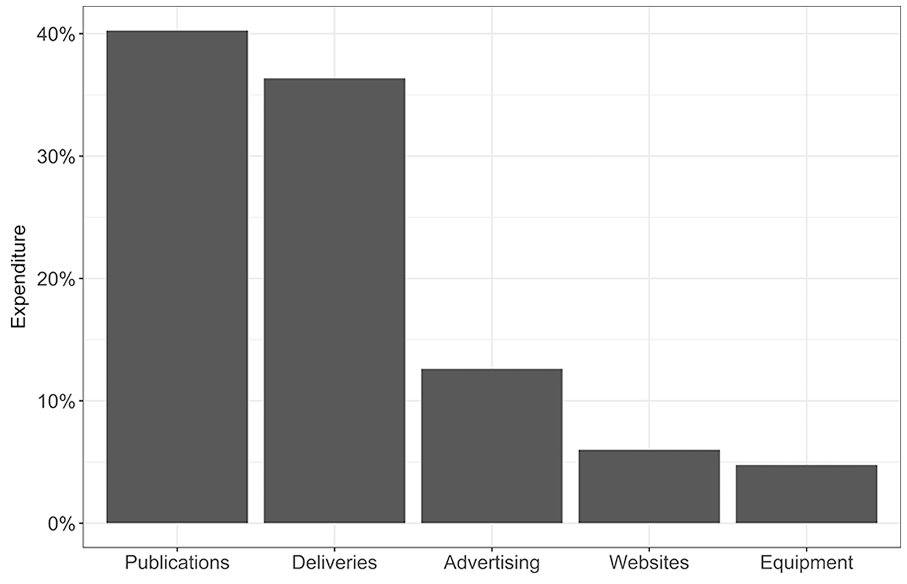
Expenditure of the Communications Allowance (2009–2010) by Area.
Before long, and amid the scandal around the parliamentary expenses in 2009, 4 the Committee on Standards in Public Life, an advisory public body on the ethical standards of public office holders, called for the Communications Allowance to be abolished. Unrelated to the scandal per se, the Committee nevertheless deemed the allowance more of an unfair electoral advantage for incumbent MPs and parties than a boost to public engagement with politics (Kelly, 2009: Chapter 8). Acting on this advice, the House of Commons abolished the allowance in 2010.
Over its 3-year lifetime, £13.8 m was claimed from the Communications Allowance, 5 with MPs spending on average about £7100 per year to communicate proactively with their constituents. Studying their expenditure behaviour, Auel and Umit (2018) found that MPs seeking re-election spent significantly more of their allowance than those standing down, especially if their seat in Parliament was at greater risk. For example, compared to their colleagues with a 10% electoral majority, MPs barely winning the previous election invested about £690 more per year on parliamentary communication (Auel and Umit, 2018: 742).
What remains unknown is (a) whether, as the proponents of the allowance hoped, the disconnect with politics decreases with the parliamentary communication financed by the taxpayer and (b) whether, as the opponents worried, the electoral prospects of incumbents increases with it. Indeed, in the absence of such empirical evidence, the recommendation to abolish the Communications Allowance was based on arguments that were ‘difficult to evaluate’ (Kelly, 2009: 69). In fact, the allowance was introduced with a similar lack of evidence in the first place.
Communication Allowances and Electoral Outcomes
There are good reasons to expect that communication allowances might have significant electoral consequences. Although there is so far no evidence from communication allowances per se – a gap which this study helps fill – the literature on parliamentary communication suggests that MPs’ personal contact with their electorate can affect turnout and vote choice.
First, communication allowances can increase turnout due to information effects. Evidence shows that voters learn from parliamentary communication (Larson, 1990; Lipinski, 2001). Lipinski (2001), for example, shows that if the members of the US House of Representatives publicise their votes in constituency newsletters, their constituents are more likely to know their policy positions. Given that informed voters are more likely to turnout in elections (Lassen, 2005; Palfrey and Poole, 1987), and assuming that communication allowances are used, and used for parliamentary communication, it is reasonable to expect these allowances to affect electoral turnout.
Second, communication allowances can affect the choice of the voters who turnout as well, likely in favour of the incumbents. This is not only because informed citizens vote differently from uninformed ones (Bartels, 1996), but also because constituents develop favourable impressions of their representatives who reach out to them (Cover and Brumberg, 1982). As a result, if legislators make the effort to communicate with their constituents, they see the rewards at the following elections (Cover, 1985; Jackson, 2008; Lipinski, 2004). For example, Jackson (2008) finds that newsletters help British MPs cultivate a personal vote as some subscribers change their mind to vote for them after a while.
Finally, the literature suggests that these effects depend on the amount, rather than the substance, of parliamentary communication. Recent experiments show that communicating simple positional cues to constituents – without any explanations and irrespective of the positions taken – work well for incumbents (Broockman and Butler, 2017; Bullock, 2011). Besides, Cover and Brumberg (1982) show that incumbents can increase their re-election prospects even with non-political communication, such as posting government booklets to the parents of newborns. What seems to matter the most is the frequency of contact; the benefits of parliamentary communication increase with the number of times incumbents contact their constituents (Cover and Brumberg, 1982; Grimmer et al., 2012; Matsubayashi, 2013).
Data and Methods
The claims in this analysis are based primarily on a combination of data from the (2005 and 2010) UK general elections and the Communications Allowance. The data on constituency-level electoral results come from the UK Electoral Commission. A complication is that there was a boundary change for most of the constituencies in England, Wales and Northern Ireland at the 2010 election, and only 138 constituencies – 59 of which were in Scotland – remained unchanged from the time when the allowance was in use. To address this complication, I use notional results – estimations from the wards that make up each constituency – for constituencies with boundary change.
The dependent variables are the constituency-level turnout and vote shares in the 2010 UK general election, the election that followed the allowance, which took place in 650 constituencies under the first-past-the-post system.
The independent variable of interest (Communication) is the amount of money, in £1000s, claimed from the Communications Allowance in its entire existence. The data for this variable come from the UK House of Commons. Figure 2 plots these data, showing how much was spent for parliamentary communication in each constituency, using the new boundaries.
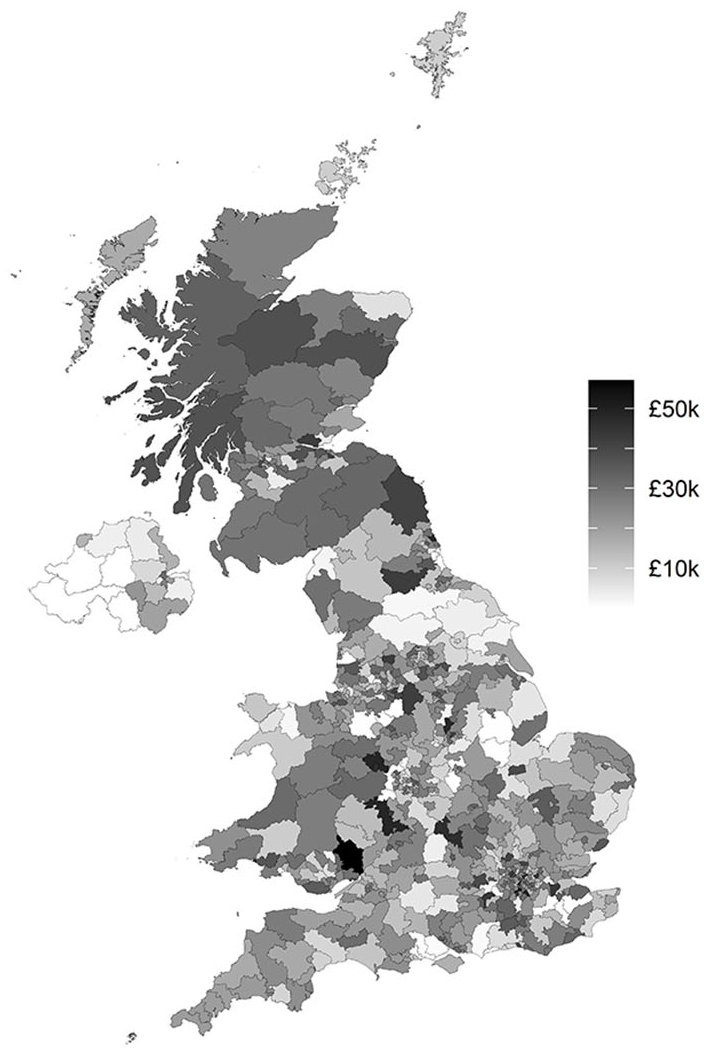
Expenditure of the Communications Allowance (2007–2010) within the 2010 constituency boundaries.
Exploring the potential relationships between parliamentary communication on one hand and turnout and vote share on the other, I estimate ordinal least squares (OLS) regressions, here in the main body of the article, with data from all constituencies. In the Supplemental Appendix, I re-estimate the same regression models for only the constituencies without a boundary change. All models are with fixed effects, limiting the analysis to within regions for turnout or to within parties for vote share. In addition, final models include lagged dependent variables and a number of other controls for (a) boundary changes, (b) campaign spending, (c) incumbent candidates and (d) constituency majority. For more details on these variables, see the Supplemental Appendix.
Results
Table 1 presents the regression models of turnout. Here Communication is a constituency-level measure, indicating the total amount of allowance spent in each constituency. 6 In all models, the point estimates for Communication are small, and the 95% confidence intervals around these estimates include zero. These suggests that, if there is a relationship between parliamentary communication and electoral turnout, it is – substantively and statistically – an insignificant relationship. According to Model 3, the best estimate is that the average constituency, upon receiving 21.3 thousand pounds worth of communication, saw about a (21.3 × 0.009) 0.2 percentage point increase in turnout. If MPs are to spend all of their allowance of around £10,000 per year, consistently for, say, 5 years between elections, this increase would not be more than half a percentage point – a change that is likely to go unnoticed after rounding.
(OLS) Regression Models of Turnout – Summary Results.
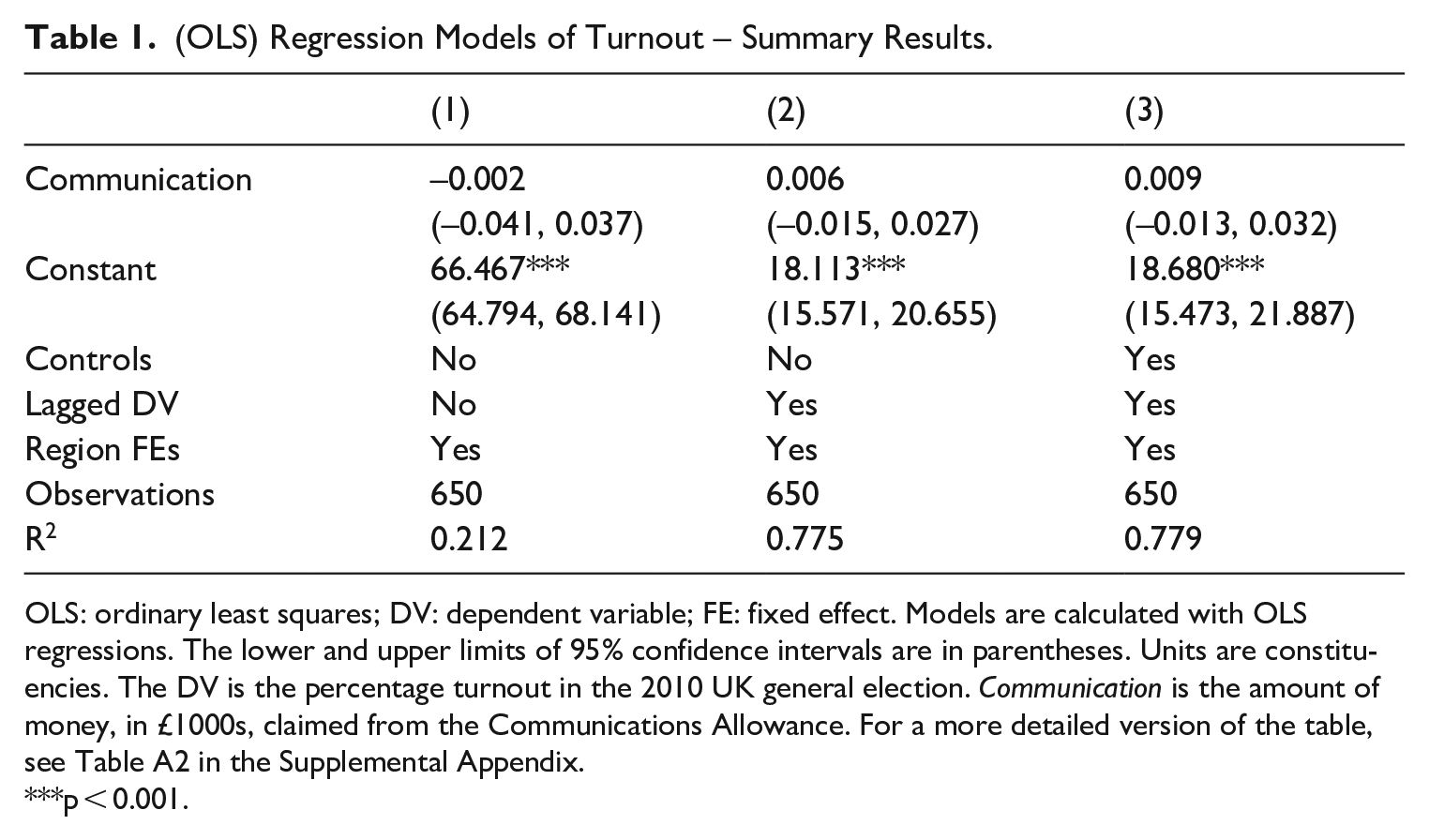
OLS: ordinary least squares; DV: dependent variable; FE: fixed effect. Models are calculated with OLS regressions. The lower and upper limits of 95% confidence intervals are in parentheses. Units are constituencies. The DV is the percentage turnout in the 2010 UK general election. Communication is the amount of money, in £1000s, claimed from the Communications Allowance. For a more detailed version of the table, see Table A2 in the Supplemental Appendix.
p < 0.001.
The results from vote shares, as Table 2 shows, are similar. Here Communication is a party-by-constituency-level measure, indicating the total amount of allowance spent by one or more MPs from each party in each constituency. 7 While Communication is associated with a significant increase in vote share in the basic model, this decreases dramatically with the lagged dependent variable and disappears completely with the controls in the final model. In Model 3, the estimates do not only include zero, they also centre almost exactly on it. Accordingly, where MPs spend £10,000 for parliamentary communication, their party could see a change ranging between a 0.39 percentage point decrease and a 0.37 percentage point increase in their vote share.
(OLS) Regression Models of Vote Share – Summary Results.
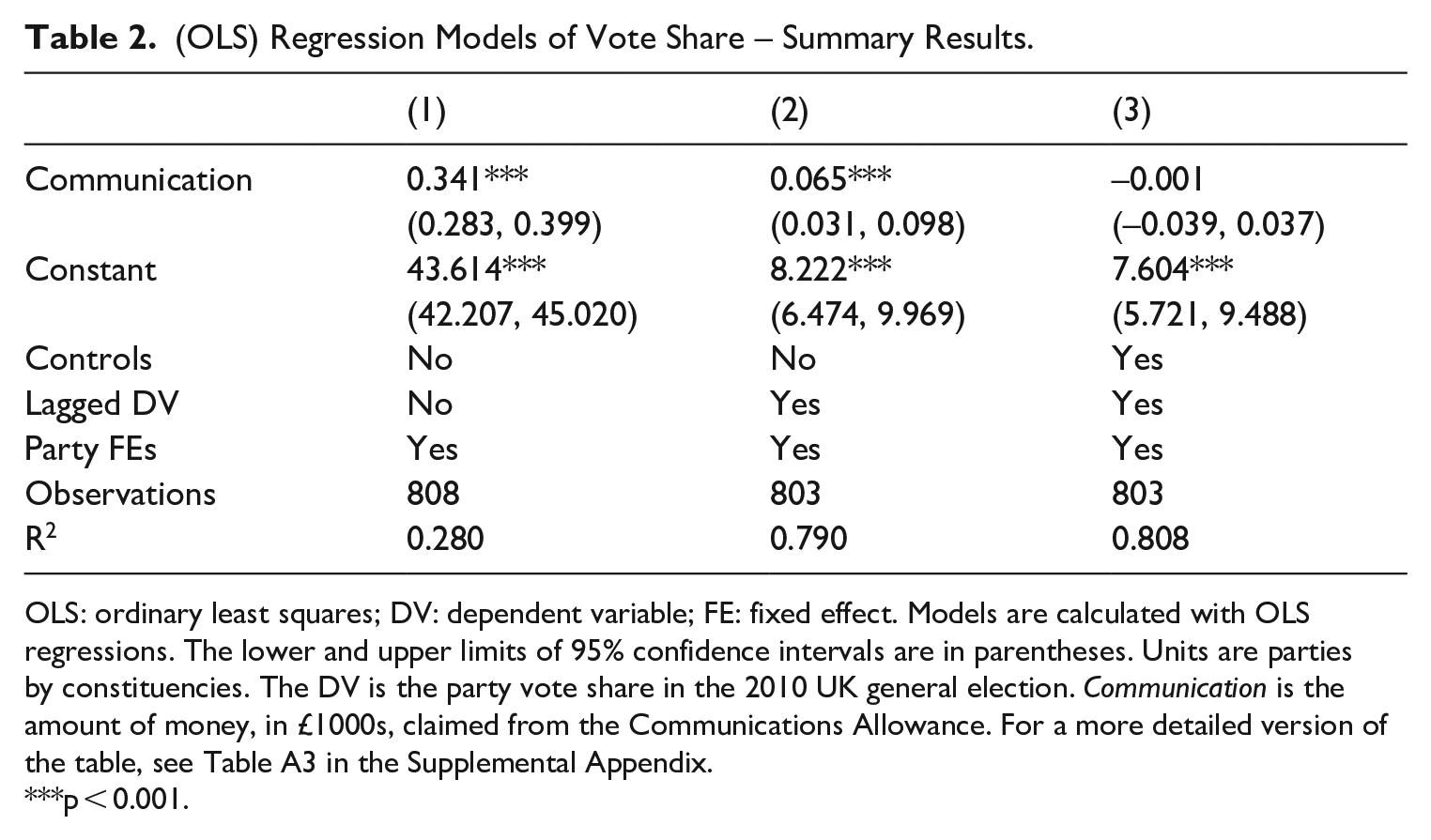
OLS: ordinary least squares; DV: dependent variable; FE: fixed effect. Models are calculated with OLS regressions. The lower and upper limits of 95% confidence intervals are in parentheses. Units are parties by constituencies. The DV is the party vote share in the 2010 UK general election. Communication is the amount of money, in £1000s, claimed from the Communications Allowance. For a more detailed version of the table, see Table A3 in the Supplemental Appendix.
p < 0.001.
If parliamentary communication leads to a ‘personal vote’ (see Cain et al., 1987) for communicators alone, pooling the electoral races with and without an incumbent candidate could be misleading. To explore the null results further, Figure 3 therefore visualises the average marginal effects of Communication on turnout and vote share, for incumbent MPs standing down versus running for re-election at the end of their term. It shows that incumbency does not change the results. In all cases, the average marginal effect of a unit increase in Communication is indistinguishable from zero: the average communication effort can have a small, positive or negative, effect on the results but they can as well have no effect at all – and the incumbents’ presence among the candidates seeking re-election does not change this fact.
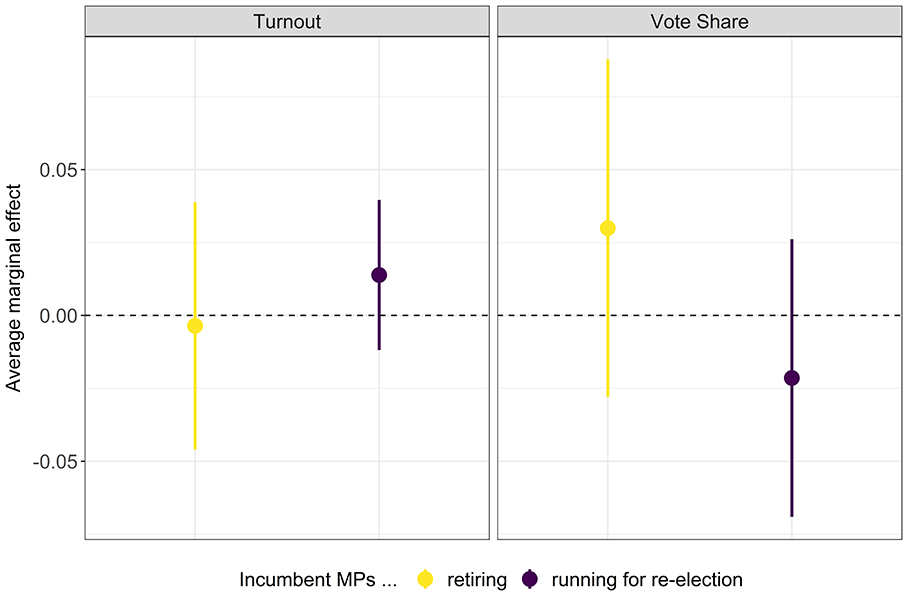
Average marginal effects of parliamentary communication.
Additional robustness checks, presented in the Supplemental Appendix Table A9, suggest that these results are not sensitive to the level of analysis or the choice of outcome measures. Individual-level analyses of a survey by the British Election Study (Whiteley and Sanders, 2014) – conducted at the end of the allowance period in 2010 – return similar results, compatible with the null hypothesis. For example, the results suggest that parliamentary communication has no meaningful effect on the public perception of MPs, parliaments, elections, politics or democracy. In other words, the results from the constituency level analysis of turnout and vote share presented here replicate in the constituent level analysis of five additional outcome measures.
Conclusion
In this article, I looked for the anticipated effects of publicly funding parliamentary communication from MPs to their constituents. The UK House of Commons experimented with this idea between 2007 and 2010, at a cost of at least £13.8 m to the taxpayer. However, the results suggest that the money spent on parliamentary communication did not have a meaningful effect on electoral participation or incumbent vote share. This is good as well as bad news for actors looking to engage the public with politics through parliamentary communication.
On one hand, it is bad news as communication allowances seem ineffective in terms of desirable indicators, such as increases in electoral turnout. If this is the case, it would be harder for policy-makers to justify the money and effort that goes into parliamentary communication.
On the other hand, the results are good news as communication allowances do not seem to give incumbents an unfair advantage through public funds. Hence parliaments can push back on the claim that communication allowances distort the will of the people. This might, however, lead to another problem: parliaments might find it harder to encourage MPs to spend their time and effort, if not their own money, for parliamentary communication, if there is no electoral incentives for them to do so.
Supplemental Material
sj-pdf-1-psw-10.1177_1478929920967588 – Supplemental material for Parliamentary Communication Allowances: Good for Nothing?
Supplemental material, sj-pdf-1-psw-10.1177_1478929920967588 for Parliamentary Communication Allowances: Good for Nothing? by Resul Umit in Political Studies Review
Footnotes
Acknowledgements
I am grateful for comments on previous versions of this manuscript by Katrin Auel, Lawrence McKay and the audiences at the following events: the Workshop on Constituency Service in Europe (Tampere, June 2019) and the Conference on Comparative Research on Political Elites (Berlin, November 2019).
Declaration of conflicting interests
The author declared no potential conflicts of interest with respect to the research, authorship and/or publication of this article.
Funding
The author received no financial support for the research, authorship and/or publication of this article.

Supplementary information
Additional supplementary information may be found with the online version of this article.
Content Codebook of Variables Table A1: Descriptive Statistics. Detailed Tables Table A2: Detailed Results for Table 1 (Turnout). Table A3: Detailed Results for Table 2 (Vote Share). Robustness Checks Table A4: Models of Turnout in Unchanged Constituencies. Table A5: Models of Vote Share in Unchanged Constituencies. Table A6: Interaction Models for Figure 3. Table A7: Models with Interactions between Communication and Majority. Table A8: Generalised Variation Inflation Factors. Table A9: Models of Individual-level Analyses.
Notes
Author Biography
References
Supplementary Material
Please find the following supplemental material available below.
For Open Access articles published under a Creative Commons License, all supplemental material carries the same license as the article it is associated with.
For non-Open Access articles published, all supplemental material carries a non-exclusive license, and permission requests for re-use of supplemental material or any part of supplemental material shall be sent directly to the copyright owner as specified in the copyright notice associated with the article.
