




Abstract
This introduction provides an overview of the gendered nature of politics and international relations, before a brief summary of the articles that make-up this special issue.
In 1961, members of the Political Studies Association (PSA), the major professional body promoting the study of politics in the UK, were invited to a dinner at the Reform Club in London. One of their numbers, Margherita Rendel, was refused entry to the Club because at the time they did not admit women. She subsequently wrote about her treatment to the then Secretary of the PSA, John Day, who replied, ‘I must confess that it never occurred to me that you would be excluded from the Reform Club, although I have heard such clubs were masculine institutions’ (cited in Grant, 2010).
Almost 60 years after its occurrence, this anecdote still has much to tell us about the status of women in Politics and IR (PIR) in the UK. That women might be excluded from the main event is unsurprising; that it would ‘never have occurred’ to John Day that there might be an issue with a woman’s presence is equally to be expected. This special issue explores the contemporary gendered make-up of Politics academia in the UK. Like Rendel’s apparently solitary presence, we know that there is a continued underrepresentation of women in the discipline, including a paucity of women (and particularly women of colour; Rollock, 2019) in senior positions, and an overrepresentation at the lower end of the professional scale (see Bates et al; Briscoe-Palmer and Mattocks; and Akram and Pflaeger-Young, all this volume). As the articles in this special issue illustrate, it is disproportionately women who are often to be found at the helm in terms of tackling these issues across institutions, and leading on initiatives such Athena Swan and Race Equality Charter submissions (Tzanakou and Pearce, 2019: 12–15; see also Caffrey et al., 2016), as well as calling out day-to-day gendered discrepancies in teaching and welfare provision.
For women within the discipline, there therefore remains the dual task of both bringing these problems to light, and then fighting to better them. This special issue brings together four articles which map the gendered terrain of the contemporary disciplines of Politics and International Relations in the UK; take stock of existing and new research on gender and the profession; and point us in the direction of strategies for change.
Where are Women in PIR Academia in the UK?
The continuing numerical underrepresentation of women in the profession has been well-documented, including in this special issue (Bates et al., in particular). As a result, we focus less on that here in our introduction. However, we would like to draw attention to the gendered make-up of one of the major professional organisations in our discipline in the UK, and the one which publishes this journal – the PSA. 1
As Table 1 and Figure 1 show, women remain a minority within the contemporary membership of the PSA, and are best represented in the category of early career researchers (ECRs). However, as can be seen in Table 1, numbers of women do appear to be holding steady, although they continue to make-up less than a third of the overall membership (and these data have not been consistently collected by the PSA over time). While the data on race and ethnicity are only partial, the percentage of members who identify as Black, Asian and Minority Ethnic (BAME) is around 4% (PSA Membership Statistics report, January 2018). 2
PSA Membership by Gender, 2015–2018 (%, Rounded).
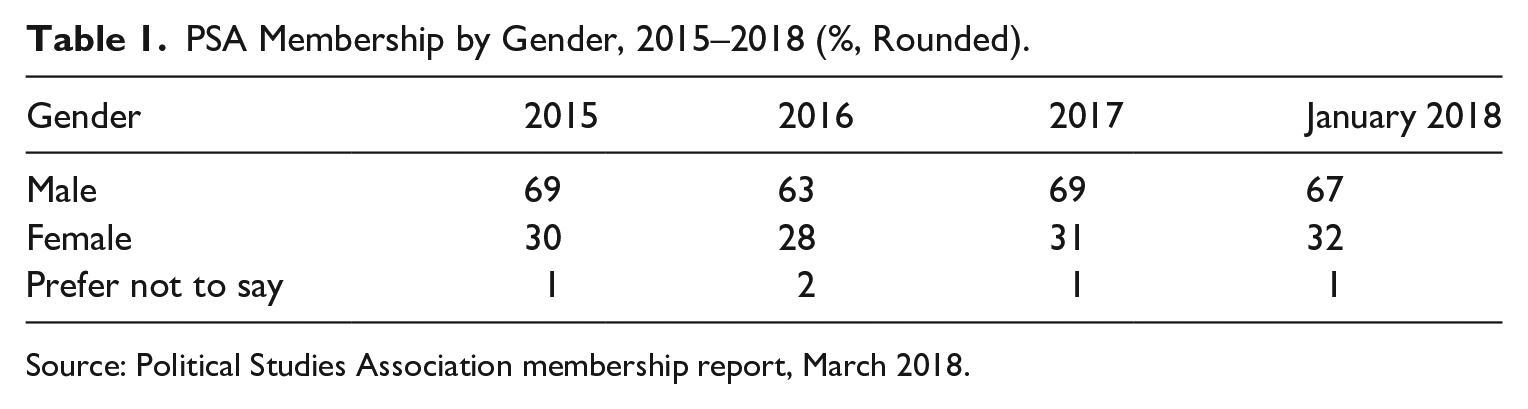
Source: Political Studies Association membership report, March 2018.
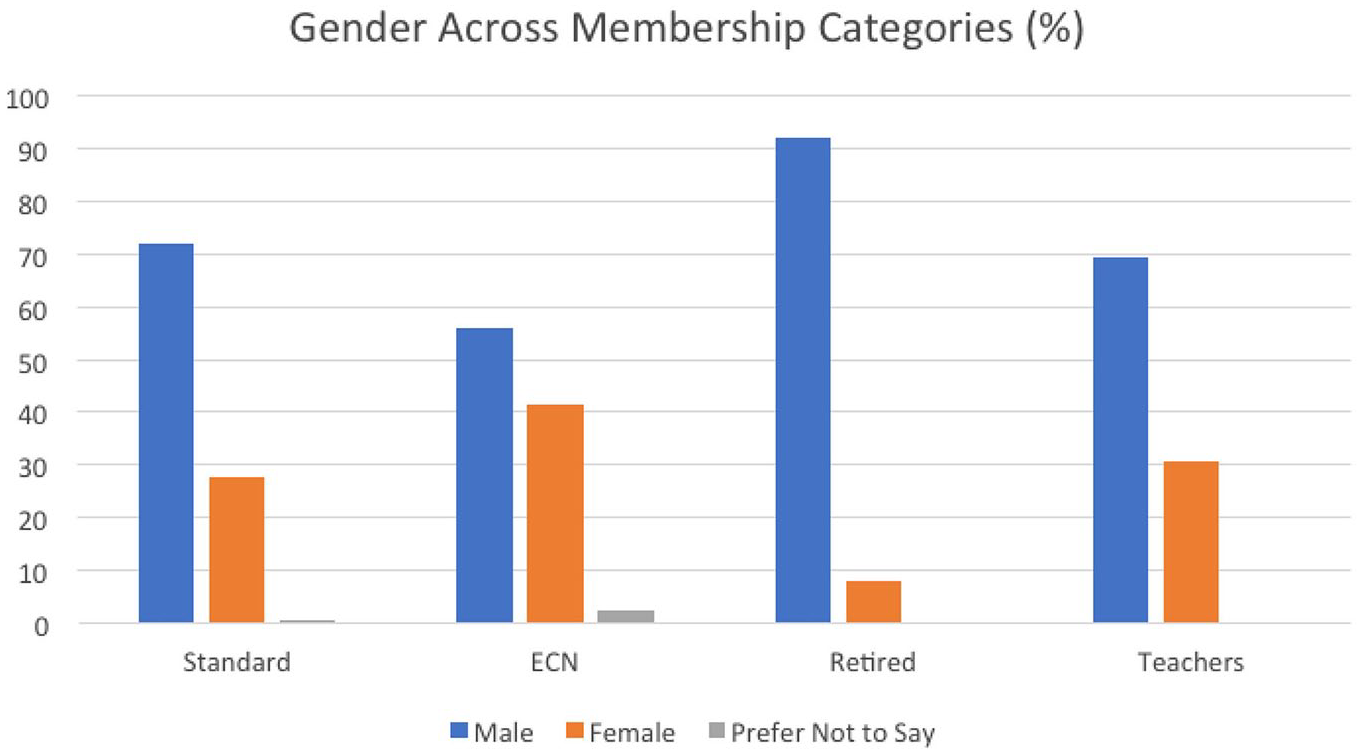
Gender Across Membership Categories in the PSA, January 2018.
As outlined in Rosie Campbell and Sarah Childs’ (2014) collection Deeds and Words (ECPR Press), women in the PSA – as chairs, trustees, specialist group leaders and ordinary members – were and have been feminist institution builders within the discipline. They have created links and networks not only within the PSA, but also across Europe and internationally, and many of the early pioneers in the discipline were (and still are) heavily invested in mentoring a second and third generation of women PIR scholars.
Much of this early work happened through the long-standing PSA Women and Politics Specialist Group. The group was established at the 1977 PSA Annual Conference with the aims of promoting research on women, gender and politics, while also seeking to combat sexism in the profession. It included among its founder members pioneering feminist political scientists like Joni Lovenduski, Judith Evans, Jean Wooddall and Vicky Randall. ‘Sympathetic males’ were also welcomed to attend (Grant, 2010). In addition to creating spaces for women within the discipline, these pioneers also worked through ‘mainstream’ bodies – with Joni Lovenduski joining the PSA Executive Committee in 1978, along with Vicky Randall as Secretary. In 1981, in a paper prepared for the PSA Executive drawing on a survey she had done of the profession, Joni Lovenduski cited the low presence of women in PIR, who were at that time only 11% of the profession (Grant, 2010). She also highlighted systemic patterns of disadvantage involving higher teaching and service loads for women, gendered publication patterns, lower earnings, leaky pipelines, gendered paths to promotion, and the continuing masculine biases of the subject itself – which as Lovenduski observed was still largely ‘concerned with the study of men rather than of persons’ and biased towards elite politics and the study of public power (cited in Grant, 2010).
Despite these initial inroads, it took more than 40 years for a woman to reach the top of the PSA. Since its founding in 1950, there have only been three female chairs of the association: Professor Elizabeth Meehan (1993–1996), Professor Vicky Randall (2008–2011) and Professor Angelia Wilson (2017–2019). To date, all chairs of the PSA have been White. In the same time period, from 1993 onwards – though they only serve 1-year terms – the American Political Science Association has had nine women Presidents, including the first Black woman to serve as APSA President, Dianne Pinderhughes.
In recent years, the PSA has made substantial strides in institutionalising equality and diversity commitments. Vicky Randall established an ad hoc equality and diversity working group in late-2008 with James Chiriyankandath. During Matthew Flinders’ tenure as PSA Chair (2014–2017), equality and diversity were formalised as a key strand of the PSA’s 10-Year Plan; and formally institutionalised as a PSA sub-committee in 2017, lead by then-Trustee Meryl Kenny. The E&D Committee also led a major review of PSA prizes in 2017, which included the launch of new prizes named after women (Kenny, 2017). Under Angelia Wilson’s Chairwomanship, the Diverse Voices Doctoral Scholarship Fund was established in 2019, and the PSA published its first official anti-harassment and discrimination policy. Recent conversations about decolonising the curriculum have been encouraged by female members (Begum and Saini, 2019), some of whom have also been pivotal in establishing the Specialist Group on Race, Migration and Intersectionality (the first specialist group within the organisation focussed on the study of race). 3 Although a numerical minority, women have often been at the forefront of encouraging a more diverse and representative professional organisation and, by extension, discipline as a whole.
Mapping Formal and Informal Obstacles to Change
The contributions in this special issue focus on what change might be enacted within the discipline to make it more gender-equal through both formal and informal measures. Change means both a formal seat at the table, but also unsettling the informal, often invisible ways that allow those for whom it has ‘never occurred’ to think about gendered inequalities to continue to do so.
The main formal and UK-wide mechanism for addressing women’s underrepresentation in academia remains the Athena Swan Charter, an equality charter for universities and colleges managed by Advance HE (formerly the Equality Challenge Unit). Athena Swan is now clearly institutionalised within UK academia and is the main means through which institutions display commitment to the discourse and institutional practice of gender equality. Emerging in 2005 with 10 member institutions, by 2015 there were 128 (Tzanakou and Pearce, 2017: 5). Following submission prepared by the relevant institutions themselves, awards of Gold, Silver and Bronze can be made to both universities as a whole and individual academic departments. Although it began in the physical sciences and engineering, in 2015, the programme moved to include the arts, humanities, business, law and the social sciences, and is now also present beyond the UK, in Ireland and Australia (Tzanakou and Pearce, 2017: 5).
Despite the fact that it is now an embedded feature of the higher education (HE) landscape, its effects and the perception of it by HE staff varies. There is a broad understanding that the advent of Athena Swan forces universities and departments to face up to gendered imbalances and encourages conversations around gender in HE institutions (Tzanakou and Pearce, 2017: 9–11). Some data suggest that an award from the scheme is linked to women’s sense of visibility and self-confidence within their university (Munir et al., n.d.: 22). The Athena Swan process also acts to create ‘hard’ quantitative data around women’s presence in universities (Tzanakou and Pearce, 2017: 9–11) which can be a catalyst for policy change – for example, support for new parents returning from parental leave or the increased hiring and promotion of women to senior roles (Pearce, 2017; Tzanakou and Pearce, 2017: 9–11).
Yet, there is also evidence to suggest that preparing submissions to Athena Swan creates more work for women (Caffrey et al., 2016); appears to have little impact on the gender pay gap in universities (Amery et al, 2019); and that the Charter does little to tackle systemic, structural inequalities within HE (Ovseiko and et al, 2017). Furthermore, although attempts have been made to add to Athena Swan in order to ensure an intersectional perspective to its work and greater inclusion of trans academics, there are still critiques of this ‘binary, simplistic approach to gender’ (Tzanakou and Pearce, 2017: 11), which can exclude the experiences of staff and students who do not identify as women or men (see also Heath-Kelly in this volume). As the framework has expanded beyond the STEMM disciplines – including departments where a higher proportion of academic staff are women – the emphasis of the application process has shifted from ‘women’s progression’ to ‘gender parity’. In practice, this sometimes leads to a focus on men, for instance, through encouraging more male students to study ‘feminised’ disciplines in the humanities and social sciences (Pearce, 2017).
While this shift in focus is not in itself a problem per se, it sometimes comes at the expense of analysing intersectional differences even within feminised disciplines. Indeed, Nicola Rollock’s work on Black female professors in the UK shows the problems of seeing women as a monolith. Her ground-breaking study, based on in-depth interviews with 20 out of only 25 Black women who hold such positions in the UK, found that ‘some white female academics were seen to contribute to the exclusion of Black female academics despite an expressed commitment to feminism’ (Rollock, 2019: 4) and highlighted the extent to which wider higher education initiatives had failed to take seriously experiences at the intersection of both race and gender. In short, Athena Swan’s ability to impact the formal gendered ‘rules of the game’ in UK HE remains highly contested.
Furthermore, beyond the more obvious formal inequalities which Athena Swan works around, women’s underrepresentation in the profession is also sustained by informal mechanisms, including gender stereotyping and assumptions. These include gendered assumptions about teaching and pastoral versus research roles (Monroe, 2013; Monroe et al., 2008), as well as widely documented evidence of gender and racial bias in teaching evaluations (for a selection, see Boring et al., 2016; MacNell et al., 2015; Storage et al., 2016; Wagner et al., 2016). These stereotypes and assumptions have clear links to formal promotion and reward processes. In spite of the wealth of evidence in this direction, teaching evaluations continue to be linked to promotion (at least informally) in many HE institutions in the UK. Evidence from elsewhere also suggests that women academics perform more service (particularly internally) than their male colleagues and are unequally rewarded for this service; which has impacts on research productivity, the activity that generally counts most towards career advancement (Guarino and Borden, 2017; Misra et al., 2011).
Informal networks and patronage continue to be a central feature of the academic profession – with career advancement partly dependent not just on what you know, but also who you know (and who knows you). A key element of this is the importance of inclusion in collaborative research and publication networks, which have increased over time in the discipline. Yet, the evidence suggests that women are not benefitting from these networks equally. A recent study, for example, finds evidence of an academic gender citation gap, demonstrating that women are systematically cited less than men in international relations journals – a pattern which the authors attribute to the fact that women cite their own work much less than men do (Maliniak et al., 2013; see also Phull et al., 2019). Meanwhile, though there is a wider trend towards multi-authored publications in top political science journals, most of this co-authored work is coming from teams made up of only men (Teele and Thelen, 2017). This in turn, of course, matters in terms of wider relations of power. If women are not cited as much as men, and are not included in crucial publication networks; and if promotion committees or research evaluation exercises, for example, consider citation counts and journal rankings, then women will not get promoted at the same rate.
Meanwhile, the ‘impact agenda’ in UK PIR has, on the one hand, offered opportunities for women, and in particular, for feminist political science, which has always sought to engage with the real world of politics (Campbell and Childs, 2013). Yet, research also highlights the ways in which the impact agenda reifies traditional academic elites – with impact case studies, for example, dominated by senior White men (Smith and Stewart, 2017). Added to this are the threats of abuse and harassment that women often experience when engaging in public-facing impact work or when cultivating an online research presence – particularly women of colour (Savigny, 2019). We run the risk that impact incentive structures continue in some ways to encourage, in the words of Les Back(2015: 1; see also Hayton, 2018) ‘an arrogant, self-crediting, boastful and narrow’ form of academic work that positions ‘big research stars’ as ‘impact super heroes’, most of whom are senior White men within the Westminster bubble.
Taken together, these continuing trends and persistent inequalities paint a relatively negative picture. Yet, beyond the research conferences to which we contribute and the faculties in which we exist as colleagues, we see a very different conversation about equality and injustice happening among our respective student bodies. Student interest in courses on gender appears to grow from year to year, along with a greater ease in discussing issues around feminism, intersectionality and inequality, and a growing interest in calls to diversify and, more radically, decolonise the curriculum (Begum and Saini, 2019; Emejulu, 2019). Whether this will cement itself within the academy to enact permanent change to the descriptive make-up of departments and the substantive nature of teaching and research remains to be seen; in Robbie Shilliam’s (2015) words ‘the architecture of the building has hardly changed’. Indeed, for those aiming at a career in UK PIR academia, working on what may be seen as ‘new’ or ‘unconventional’ topics (which may include race and gender) in doctoral and ECR research may hinder job prospects: ‘getting any kind of permanent academic job is difficult but that goal is made much harder by a prevailing assumption that one’s work does not matter or that one might not “fit” with the “culture” of a given department’ (Emejulu, 2019: 203).
The Special Issue
In light of this context, this special issue of Political Studies Review looks at women across PIR departments in the UK, focussing variously on ECRs, parental leave, women of colour and feminist management.
We open with Stephen Bates et al.’s updated research from 2011, looking at a database of 2253 political scientists in the UK. While they find that the proportion of female academics has increased, women continue to represent a minority in the profession, and they remain overrepresented at the lower ends of the academic hierarchy and underrepresented in positions of seniority. Bates et al. uncover a picture of change with UK PIR departments which is occurring all too slowly – as present rates, they write, there will not be equal numbers of male and female political scientists in the UK until 2041.
This is followed by a short rejoinder from Charlotte Heath-Kelly, probing the gendered binary underpinning Bates et al.’s research. She asks whether this binary, which is further reinforced by HE equality directives such as Athena Swan, acts to erase many in the profession who do not identify as male or female. In their response, Bates and co-authors acknowledge that this is a potential pitfall of their methodology, but argue that it remains justified as it provides the most appropriate method to capture UK HE as a whole. This brief conversation is illuminating, highlighting the methodological difficulties and ethical quandaries that remain for researchers working to capture the lived experience of gender identities.
Shardia Briscoe-Palmer and Kate Mattocks’ (2016) article also updates previous work they have conducted on doctoral researchers in the UK. Their article here turns to look at ECRs in the UK, through a large-scale survey and a smaller range of in-depth interviews. Framed around the issues of skills based training, mentoring and networking and isolation and exclusion, their article concurs with other research which argues that women and minorities face visible and invisible barriers at the entry level of the academic career. They conclude by arguing that, although the academy has become better at acknowledging these issues, there remains a clear need for action and that too little has been done to support the employment and career progression of those who do not fit into the dominant characteristics of the profession.
Sadiya Akram and Zoe Pflaeger-Young also look at the ECR community and the impact that maternity and paternity leave have at the early stage of the academic career path. Through a survey of Heads of PIR Departments and ECRs, their article uncovers the difficulties faced in terms of access to the full remit of maternity/paternity/parental leave benefits by ECRs in short-term employment, and the paucity of formal institutional support on return to work. Instead, the system is predicated on support which must be organised by the individual, often burdening the individual ECR with further responsibility to negotiate her or his own workload during this time. Adopting a feminist institutionalist framework, they argue that formal (research leave, dedicated breastfeeding/lactation spaces) and informal measures (a more supportive culture, differing expectations in terms of conference attendance) need to be implemented to fully support ECRs returning to work after maternity/paternity/parental leave.
Finally, Fiona Mackay’s contribution to this special issue turns to consider the experience of feminists in UK university management. Writing from an auto-ethnographic perspective, she reflects on her own experience as Head of School at a research-intensive institution. She explores the difficulties faced by academic feminists as being both managers and feminists, and the opportunities (and constraints) for change that feminists might enact within positions of university management. Reflecting on the stresses and difficulties (but also the triumphs) during her time in senior management, Mackay concludes by arguing that, despite the current flaws and shortfalls in HE managerial culture, feminists need a seat at the table.
This special issue thus addresses the status of women in contemporary UK PIR departments across multiple dimensions. Change is occurring, but it is slow and uneven; and the articles in this Special Issue highlight the distance yet to be travelled to achieve gender equality in the profession. Yet, we take heart from the fact that this journal has devoted an issue to this theme, building on two featured panels at successive PSA conferences.
Challenging times lie ahead for the discipline; not least in the impact of Brexit and the COVID-19 pandemic. Already, these crises have had gendered and intersectional impacts that require attention, with the potential for long-lasting effects for those on fixed-term and temporary contracts in particular, who have been hard hit in the initial months of the COVID crisis, and are more likely to be women and BAME staff; as well as PhDs and ECRs who may be facing a shrinking job market across the UK and internationally. In the early months of the pandemic, some journals reported widening gender disparities in manuscript submissions, with many noting a significant drop in submissions by women authors (particularly single-authored manuscripts), likely due in part to school/nursery closures and increased care responsibilities. These kinds of ‘crisis moments’ provide a stark reminder of the gendered disparities that persist in Politics and International Relations – and draw attention to the important role that individuals, groups and institutions – including professional associations like the PSA – can play in recognising these inequalities, and working towards a more equal and inclusive discipline.
Footnotes
Declaration of conflicting interests
The author(s) declared no potential conflicts of interest with respect to the research, authorship and/or publication of this article.
Funding
The author(s) received no financial support for the research, authorship and/or publication of this article.
