



Abstract
Supporting increasing equality and diversity in the recruitment and retention of Early Career Researchers from the widest pool of talent available is high on the agenda of universities and policy makers. Notwithstanding this, the demanding nature of academic careers has a disproportionate effect on Early Career Researchers, who may face indirect obstacles in their career development particularly following a period of maternity or parental leave. Our research seeks to expose the nexus of challenges, from job insecurity to the pressures of raising new families that Early Career Researchers face during this critical juncture in their career trajectory. Focusing on Politics and International Studies Departments in the United Kingdom, we document the institutional mechanisms that exist to support Early Career Researchers returning from maternity and parental leave through a Heads of Department and an Early Career Researcher survey to gain an understanding of needs and the impact of institutional measures. Adopting a feminist institutionalist analysis, we map gendered outcomes in the university, through formal and informal rules, which mitigate against those Early Career Researchers taking maternity and parental leave. We end by identifying specific measures which would help to ensure that the university is more supportive of Early Career Researchers taking maternity and parental leave.
Introduction
Scholarly interest in the university has burgeoned in recent years and has benefitted from the insights of new institutionalism. Adopting a new institutionalist perspective means accepting that the university is not a stable essence but is a series of processes or practices, which need to be explained. In this article, we document and explicate the institutional mechanisms which exist to support Early Career Researchers (ECRs) returning from maternity or parental leave. We do this by presenting two perspectives: the institutional perspective as represented by a Heads of Department (HoD) survey and the ECR’s experience of support as captured in an ECR survey. In doing so, we aim to show what support exists and also what is missing and the effects of gaps in support. We adopt a feminist institutionalist perspective because this reveals how gender is sustained and embedded within the university to ensure differential gendered outcomes. It is widely accepted that women are the primary takers of maternity and parental leave; hence, provision in this area disproportionately affects women. We aim to contribute to the emerging literature on the interplay between formal and informal institutions. In the context of myriad formal policies relating to gender equality in the university, through our empirical research, we make visible a series of informal practices relating to ECRs and maternity and parental leave. While there is an emerging literature on maternity and parental leave practices and the university, we argue that ECRs have been neglected in this debate but represent a crucial subgroup of academic staff who experience a unique series of challenges, ranging from job insecurity to the pressures of raising new families during a critical juncture in their career trajectory.
The article is structured as follows: first, we discuss gender inequality in higher education to provide context to this debate. We then outline our theoretical framework drawing on feminist institutionalism. The third section specifies the formal policy context, which frames this debate. In the fourth section, we discuss questions of methodology, while the fifth section presents our research findings before moving on to the ‘Discussion’ section. The article concludes with a future agenda outlining policy recommendations. First, we define what we mean by an ECR.
Defining an ECR
An ECR is a member of staff at the beginning of their academic career, although there is no single definition. UK Research Councils and funding bodies tend to define an ECR in terms of length of time since completion of a doctorate, with a range extending from 3 to 10 years. For example, British Academy Postdoctoral Fellowships are open to those within 3 years of the award of a doctorate and Leverhulme Trust Early Career Fellowships to those within 4 years of submitting their doctoral thesis. In both cases, extenuating circumstances may now be given to those who have taken a career break due to illness or parental/caregiving duties. The Arts and Humanities Research Council’s (AHRC) formal definition of an ECR is an individual within 8 years of the award of their PhD and the Economic and Social Research Council (ESRC) has recently overhauled the way it supports ECRs, recognising three distinct ECR stages. So, there is little consensus on who or what classifies as an ECR within the academic community, although there is increasing recognition that this period may be prolonged due to exceptional circumstances and that previous definitions may have been overly rigid.
For the purpose of this research, we have included ECRs up to 7 years of being awarded their doctorate. The ‘early career’ stage can often assume steady employment and continuous research and professional development, with a transition to postdoctoral researcher or a permanent lectureship. However, this does not always reflect the lived experience of many ECRs, especially those who combine the challenges of early career development with the caring responsibilities of children (Bosanquet, 2017: 73). As we are interested in those ECRs who have experienced a period of maternity or parental leave, we adopt 7 years to incorporate those who may have taken extended periods of time out from their career development.
As argued by Thwaites and Pressland, the term ‘early career’ is contested in higher education and is laden with politics. Especially in the current context of the increasing neoliberalisation of university management and the casualisation of the workforce, the title comes with particular expectations, but often little benefit or prestige (Thwaites and Pressland, 2017: 8). We draw on, and contribute to, a growing field of cross-disciplinary research, which focuses on the experiences of ERCs in the university. Laudel and Gläser (2008) highlight the transition phase that occurs as ECRs manage the shift from apprentice to colleague, while White (2006) highlights that the transition phase is experienced differently by the genders and that a ‘leaky pipeline exists’ for women as they tend to enter academia at lower levels or in casual positions; focus on teaching rather than research; and, due to under-representation at middle levels, do not achieve a critical mass in senior academia (see also Ackers and Gill, 2005). There has also been increased attention paid to the growing casualisation of the academic labour force and experiences of precarity, which is particularly acute among ECRs (Lopes and Dewan, 2014; Standing, 2015; University and College Union (UCU), 2016). While there is a growing focus on ECRs and the gendered experience of early career academia, there has been limited attention paid to date to ECRs and the challenges they face when returning to academic careers following maternity or parental leave.
Gender Inequality in Higher Education
There is a growing body of work concerned with gender inequality in higher education institutions (HEIs). Our research is concerned with understanding the ways in which these issues may be particularly acute among ECRs combining this challenging point in their career with parenthood. Existing research has documented gender pay gaps and the under-representation of women in senior positions, the ‘chilly’ institutional climate that women face as well as the gendered cultures and systematic gendered barriers experienced in universities (Allen and Savigny, 2016; Bates et al., 2012; Bird, 2011; Henehan and Sarkees, 2009; Savigny, 2014). Within the extant literature on ECRs, there is increased recognition that female ECRs experience a unique set of challenges and are more likely to face barriers in completing their postgraduate study and establishing their academic careers due to a lack of supportive environments, a lack of mentoring as well as increased likelihood of being trapped in teaching heavy roles (Ackers and Gill, 2005; Crabb and Ekberg, 2014; White, 2006). Research has also explored the challenges of combining academia and parenthood, with evidence suggesting that women with children face a ‘motherhood penalty’ and experience difficulties in managing work–family conflicts (Baker, 2010, 2012; O’Laughlin, 2005; Ward and Wolf-Wendel, 2004). This research tends to focus on those within permanent full-time positions, exploring issues of promotion and career progression. There is limited literature examining the particular challenges faced by ECRs when reconciling career development with parenthood (for a notable exception, see Bosanquet, 2017).
Although academic positions may have the advantage of a flexible work schedule, academics often experience role strain that can exacerbate work/family conflict, with expectations to fulfil multiple roles within the work setting, including teaching, research, administration and consultation, and to fulfil work obligations at home in the evening or at the weekend (O’Laughlin, 2005). Ward and Wolf-Wendel (2004: 241) refer to the ‘silver linings and dark clouds’ associated with the experience of mothers with young children in academia. On one hand, academics can take an autonomous and flexible approach to their work, setting their own schedules that allow individuals to combine work with the care of young children. On the other hand, the price of this freedom and flexibility is an increased pressure to be productive and ambiguous expectations about working hours, workload and what is required for promotion (Ward and Wolf-Wendel, 2004: 243–247).
Academic mothers face challenges associated with a culture of ‘hegemonic masculinity’ (Bird, 2011: 208–209; Savigny, 2014: 803) and normative expectations that academic careers are considered to be a ‘calling’ and characterised by a single-minded pursuit on status enhancing research (Van Engen et al., 2015). Success is typically achieved by working long hours as well as through networking and travel to conferences and workshops to develop personal relationships, improve research recognition and provide opportunities for collaboration (Baker, 2010: 319). As HEIs become increasingly performative and competitive, with ‘excellence’ measured through publication and funding targets (Taberner, 2018), this can intensify gender inequalities and the conflicts experienced by academic mothers.
The UK higher education has experienced restructuring along neoliberal lines with the marketisation, commercialisation and financialisation of the sector, affecting the ethos and culture of the university and subordinating academic activity to commercial goals (McGettigan, 2013; Taberner, 2018). As well as pressures to perform and intensified workloads, this has also led to a growing casualisation of the workforce with an increased number of academics employed on low-paid, temporary contracts (Standing, 2015). While all academics experience this growing pressure to perform, those in the early stages of their careers often find themselves with a disproportionate allocation of teaching and administrative roles, which can undermine their well-being, career progression and the quality of their teaching (Thwaites and Pressland, 2017: 1–2). Employed on fixed short-term or hourly paid contracts, they can experience a lack of job security, with limited access to benefits such as sick pay and holiday pay, and weaker maternity and parental leave rights. According to 2017/2018 data from the Higher Education Statistics Agency, just under 33% of academic staff in the United Kingdom are on fixed-term contracts and 29% are on teaching-only contracts (Higher Education Statistics Agency, 2019). As argued by the UCU, this is likely to be under-representative due to a lack of reporting on hourly paid and atypical staff. It also obscures the concentration of these insecure forms of employment among those located in early to mid-career roles. UCU analysis of the data reveals that 75.5% of research and teaching assistants are on fixed-term contracts as opposed to 16% of lecturers and senior research fellows and 7.7% of senior lecturers and readers (UCU, 2016: 6).
The myriad issues experienced by academics become all the more problematic when the increasingly prolonged and insecure early career period is combined with the challenges of combining academia and parenthood. For example, ECRs are less likely to have access to maternity and parental leave provision, which are often although not exclusively aimed at permanent members of staff (Epifanio and Troeger, 2019: 1). While these challenges are predominantly experienced by women, following the introduction of shared parental leave in 2015, there is a growing number of men combining parental leave with early career academia. To better understand the nature of the problem, we turn to feminist institutionalist analysis, which we discuss next.
The Gendered University: A Feminist Institutionalist Analysis
What is an institution and what kind of institution is the university? New institutionalism tells us that institutions are ‘processes or sets of processes’ (Ahmed, 2017), whose existence needs to be explained rather than assumed. This not only means that institutions can change but also contrasts with more static conceptions of institutions, which emphasise their stability and where the state of mere existence confounds their right to exist. Institutions, then, need to be described and accounted for, and this may include a focus on the formal ‘routines, procedures, conventions, roles, strategies, organisational forms, and technologies’ (March and Olsen, 1989: 22) as well as informal rules or norms, which create the ‘rules of the game’ (Bourdieu, 1977) adhered to by actors that shape behaviour. Yet, as Ahmed (2017) reminds us, in the case of the university, institutional realities can become ‘doxa’ 1 (Bourdieu, 1977), meaning that they are taken for granted, existing in the background and normalising rules or norms by taking them out of the realm of perception. The challenge for scholars is to uncover the ‘hidden life’ (Chappell and Waylen, 2013) of institutions in order not only to give an account of what the institution is – in our case the university – but also to explain how it formed over time and to bring it from the background to the fore thereby highlighting adverse processes.
We apply a feminist institutionalist lens to the university because this permits a focus on how ‘gender regimes’ (Connell, 1987, 2002) are incorporated within the institution to ensure differential gendered outcomes. When looking at post-maternity and parental leave provision for ECRs, our aim is to map the formal and informal conventions, rules and norms of the university which structure how it has responded to the issue, before exploring the effects of these rules and norms on women and also in some cases men.
A specific concern of this research is to interrogate the relationship between formal and informal institutions, or the formal rules and regulations that characterise the university as well as the informal ones that shape its daily reality. The more recent literature on informal institutions argues that there is often a relationship between formal and informal institutions and that informal institutions can help us to understand resistance to formal institutional change (Chappell and Waylen, 2013; Waylen, 2014, 2017). When once informal institutions were linked to developing polities, and it was thought that informal institutions would give way to formal ones that were more robust, it is now thought that informal institutions can be durable and are not necessarily filling a void waiting to be filled by formal rules (Azari and Smith, 2012; Radnitz, 2011). In applying such insights to the case of maternity and parental leave, we explore the question of to what extent, given the lack of formal guidance on how to respond to ECRs returning from maternity and parental leave, this has created a need for informal arrangements.
A feminist institutional analysis ‘genders institutionalism’ (Lovenduski, 2011), showing how institutions privilege malestream ways of working, highlighting how bias exists and can be understood as stereotypes, norms, opinions and work–place culture (Kenny, 2014; Mackay et al., 2010). Accordingly, gender norms operate within institutions and institutional processes construct and maintain gender power dynamics, which occur through formal and informal rules. The feminist institutionalist analysis of organisations has stressed that rather than being neutral, public organisations are in fact gendered. They are characterised by hierarchical organisation, a division of labour and technical rationality, meaning they privilege task-oriented rather than relational skills (Johnston, 2017; Mackay and Rhodes, 2013). A masculine culture of authority abounds, while femininity is associated with emotional and relational activities (Mackay and Rhodes, 2013). In their research, Mackay and Rhodes (2013) analyse the everyday practices of gender norms in central government departments and find that unthinking and ‘taken for granted’ rather than purposive rules, practices and beliefs reflect and reproduce unequal gender relations (Mackay and Rhodes, 2013: 586).
From a feminist intuitionalist perspective, the ECR’s predicament when juggling institutional commitments on the return to work post-maternity and parental leave is best understood if we recognise the university as an increasingly ‘greedy institution’ (Coser, 1967, 1974). As Coser argued, greedy institutions demand commitment, time and energy, securing ‘total allegiance’ from workers in a situation where there may be competing demands on time and loyalty. Within a climate of ever-increasing neoliberalisation, greediness and productivity are conflated in the contemporary university, leading to the normalisation of a culture of long working hours, unrealistic workloads and competition between universities for students and funds (Bone et al., 2018; Currie et al., 2000; Sullivan, 2014). Greater productivity, however, comes at a cost, requiring the sacrifice of personal, family and social time.
If the university as an institution has no fixed essence, but is capable of change, then what kind of institution should the university aim to be? As a public institution, which serves the needs of a diverse group of people, one answer to this question is that the university should be representative of the public it serves. Representative bureaucracy theory argues that public institutions will be more responsive to the public if their personnel reflect the demographic characteristics – the gender makeup – and by extension the values – of the public they serve (Mosher, 1982; Pitkin, 1967). This can be done passively by reflecting the demographic origins of the public or by actively implementing policies that promote the interests of constituent groups through street-level discretion (Sowa and Selden, 2003). As such, gender inequality as reflected in a leaky gender pipeline is a problem that needs to be addressed. Similarly, Awesti et al. (2016) remind us that diversity and inclusion are linked and that we must identify those sites where exclusion takes place which will help in devising strategies for greater inclusivity.
Drawing the threads together, we argue that a feminist institutionalist analysis provides a way of interpreting the formation of institutions that specifically address the gendered stigma and outcomes that come with institutions. In summary, the purposes of this research are to document the range of support mechanisms available to ECRs returning from maternity/parental leave, to explore HoDs’ views on support mechanisms and to document ECRs’ experience of taking maternity/parental leave.
The Policy Context: Equality and Diversity in UK HEIs
Before we proceed, it is important to set out the formal policy context within which debates about gender equality take place and which inform the broader sociolegal framework within which the university sits. Equality and diversity in UK HEIs have increasingly become a policy priority, driven by the agenda to improve the recruitment and retention of researchers. The Concordat to Support the Career Development of Researchers was launched in 2008 and signed by all major UK funders of research with the aim of setting out principles that ‘provide a framework of good practice for the management of all researchers and their careers’ (Concordat, 2008: 4). Principle 6 of the 2008 Concordat states that ‘diversity and equality must be promoted in all aspects of the recruitment and career management of researchers’ (Concordat, 2008: 14). It acknowledges ‘the demanding nature of research careers has a disproportionate effect on certain groups’ and therefore the UK research community should work to actively address disincentives and indirect obstacles these groups may face. It recommends that employers should recognise that for parents and others who have taken career breaks, ‘the “early career” period may be prolonged, and this may be a time where the risk of attrition from the research path is most acute’ (Concordat, 2008: 14). However, the 3-year review of the implementation of these principles notes that while institutions appear to be motivated to address equality and diversity, women continue to be under-represented in senior positions and there is ‘clear evidence that organisational cultures in major research disciplines can discriminate against women and under-represented groups’ (Vitae, 2012: 13).
An increased focus on gender equality policies in HEIs has contributed to improvements in female-to-male enrolment ratios among students at both the undergraduate and postgraduate level, but change at the organisational level has been slower (David, 2015; Morley, 2013). According to the Advance HE’s annual report on equality in higher education for students, 56.7% of all students studying in UK higher education are female, with 55.7% at the undergraduate level and 60% at the taught postgraduate level (Advance HE, 2018b: 154). In contrast, only 48.3% of research postgraduates are women; this is despite a higher proportion of women receiving a first or 2:1 than their male peers (Advance HE, 2018b: 148). These ratios among students have not necessarily led to improvements in employment and gender inequalities persist at the research level and among academic staff, particularly at the more senior levels. The Equality Challenge Unit’s (ECU) annual report on equality for staff found that while 54.2% of all staff working in UK higher education are women, 59.8% of women are on full-time contracts compared to 77.1% of men and men account for a high proportion of senior managers (69.0%) and professors (75.4%) (Advance HE, 2018a: 198). There is little comment on the disparity between these two reports in terms of gender equality among students and staff (David, 2015: 15).
Studies into UK political science indicate that while there has been an overall increase in the number of women in the profession to about 30%, a significant ‘seniority gap’ persists (Awesti et al., 2016; Bates et al., 2012). This under-representation of women at the senior levels is not just a matter of numbers, it also links to wider practices and behaviours in the discipline. Women are under-represented in mainstream political science journals, are less likely to be cited and are more likely to be given teaching, administrative and pastoral roles (Allen and Savigny, 2016). Increased recognition of the persistence of gendered inequalities, despite formal equality legislation, has led to a growth in additional measures in the United Kingdom designed to address the gender pay gap and advance the careers of women in academia, such as the Athena SWAN Charter launched in 2005 and expanded in 2015 to include the social sciences, arts and humanities. 2 Linked to funding eligibility, member institutions and departments must demonstrate progress towards promoting gender equality through an internal assessment and action plan to address the identified issues. However, concerns have been raised that such policies based on ‘performing diversity’ may serve to improve the competitiveness of the institution or department in a neoliberal context, rather than addressing wider institutional practices and social norms (Tzanakou and Pearce, 2019). It is also important to acknowledge the wider policy context beyond the university, which in the United Kingdom is characterised by a long and low-paid maternity leave, a disproportionately short paternity leave and low uptake of shared parental leave (O’Brien et al., 2019), as well as complex childcare provision based on a mixed economy with weak regulation, shortfalls in government funding and problems of quality and affordability (Lewis and West, 2017).
Given these organisational, structural and behavioural barriers to research and career development, there is a pressing need to understand how the increasingly prolonged early career period and challenges of combining early career academic with starting a family can impact progression. How effective are existing measures to support ECRs on their return from maternity/parental leave?
Methodology
To document the range, scope and examples of formal and informal practices that exist to support ECRs returning from maternity/parental leave, a two-stage approach was taken to collecting data. First, we collected data on support mechanisms introduced by UK Politics and International Studies Departments to support ECRs returning to work post-maternity/parental leave. The HoD survey was sent to all Politics Departments as listed in the Political Studies Association (PSA) Directory 2016, a total of 95. Following three interspersed data calls, 17 responses were collected, which is a response rate of 18%. The survey was designed with brevity in mind, as we recognise that HoDs are busy and we wanted to encourage their participation. The survey comprised four questions enquiring into support for all parents returning from maternity/parental leave, specific forms of support for ECRs, wider forms of support available to parents, and measures the HoD thought would help to support ECRs returning from maternity/paternity leave. The survey was designed to capture formal and informal forms of support as well as HoDs’ views on what further measures could be implemented.
We complemented the HoD data with an ECR survey on post-maternity and parental leave provision to offer a more rounded account of the difference such support makes when it is present, and the unique challenges faced by ECRs when such support is not in place. This online survey comprised of a mixture of closed and open-ended questions and was promoted to ECRs based on Politics and International Studies Departments who were within 7 years of completing a PhD and had taken a period of maternity or parental leave. The survey was disseminated through the PSA and the British International Studies Association (BISA) mailing lists and websites, their specialist group mailing lists as well as through the PSA Early Careers Network. In total, 34 eligible individuals responded to the survey, including 30 women and 4 men as well as 2 PhD students whose responses we have discussed separately. The survey included questions on employment situation prior to and after taking maternity/parental leave, financial support received during the period of leave and any changes in time allocated to teaching, administration and research when ECRs returned from leave. Open-ended questions enabled individuals to document mechanisms of support available to ECRs returning from leave at a range of institutional levels, as well as any challenges they experienced while on leave; their experiences of good practice following maternity/parental leave and what, in their opinion, would have improved their return to work.
Research Findings
HoD Survey
Responses to the HoD survey offered a degree of representation across different size and types of university, with 6 from post-1992 universities and 11 from pre-1992 universities. The survey respondents were asked whether their department offered any specific forms of support for parents returning to work after a period of maternity/parental leave as well as whether there were any wider forms of support available. Among the six responses from post-1992 universities, one stated a policy of research leave and reduced teaching commitments to ease returning staff back into work. In this case, money is available at an institutional level linked to Athena SWAN. The other five responses stated that while their departments had no specific policies, returning staff could make use of existing flexible working policies and research leave schemes.
Two of the 11 pre-1992 universities stated reduced teaching commitments for staff returning from leave, agreed on an ad hoc basis. In these cases, there is also access to a university-wide sabbatical scheme as well as a university research development fund that has a special category for returners. One had no formal policy, but in practice made informal arrangements relating to research leave and reduced teaching commitments for those returning to work after a period of maternity/parental leave. This flexibility enabled the department ‘to go beyond the institutional norm’ and to respond to the individual circumstances of a particular case. The remaining responses had no specific policies for post-maternity/parental leave but aimed to help those returning to work through flexible timetabling and supporting returns to part-time work. Three had sabbatical schemes that returners could make use of and in three cases maternity leave counted towards sabbatical entitlement. Another response stated reduced research commitments, especially flexibility on research-related travel obligations. As noted by one of the respondents, management of workloads and flexible timetabling tend to be down to departmental discretion. Relevant factors acknowledged in the responses included the size of the department, the number of staff taking leave at a given time as well as departmental culture.
The respondents were also asked whether they had any particular forms of support targeted towards ECRs returning from maternity/parental leave. Only one of the 16 responses to the question stated that they tailored support to ECRs, but this is done informally and organised on a case-by-case basis. Five responses stated that while there are no specific policies for ECRs returning from leave, ECRs are entitled to reducing teaching loads during their first 2 years of permanent service. Two responses referred to the importance of mentoring for ECRs; while this is available to all ECRs and is targeted towards publications and researching bids, one response mentioned that this mentoring could be used to discuss issues ECRs may face on their return to work. Ten responses had no forms of support for ECRs. One of these stated that they are considering introducing a policy for ECRs returning to work as members of staff are starting to take up shared parental leave. Departmental support for shared parental leave is crucial if the low uptake to date is to be addressed (O’Brien et al., 2019), an important step in normalising flexible working and reducing gender inequalities in childcare.
While our responses cover a relatively small sample, they do indicate that there is significant variety in the provision of support for ECRs returning to work post-maternity leave. Where there are particular policies designed to support parents returning to work, these tend to be arranged on an informal or case-by-case basis. As noted above by one of the respondents, these can give HoDs the ability to tailor arrangements to the needs of that individual. However, this does raise the issue of whether there is equal access to these arrangements and to what extent financial resources are available to support them. Flexible arrangements may work where there are small numbers of staff taking leave but may become strained if a more significant number of staff take leave at a similar time. Given the likelihood that ECRs may find themselves in a more precarious or fixed-term employment position, they may not be in the same position to negotiate post-leave arrangements as a permanent member of staff with years of service, an issue we explore in our ECR survey. A formal policy of research leave or reduced teaching commitments with automatic eligibility for any parent returning to work is more likely to benefit ECRs. It is also imperative that a system of funding is in place to ensure that the burden does not fall on other members of the department.
Several responses indicated that those returning to work can make use of existing schemes of research leave, such as university-wide sabbatical schemes, with maternity leave counting towards sabbatical allowances in some cases. However, these are likely to only be available to permanent members of staff and usually require a certain number of years of service. They also would not apply to those on teaching-only contracts. Therefore, these may not necessarily be available to ECRs returning to work, depending on the circumstances of their employment. Similarly, access to flexible working policies can depend on an individual’s ability to negotiate as well as sufficient provision within the department to allow flexible working. Individuals only have the right to request flexible working arrangements, which can be rejected if, for example, the department is understaffed or there is pressure on the timetable. It is therefore important to determine the eligibility criteria and access to existing provisions of support for parents returning to work in order to ascertain the coverage of ECRs. The purpose of our ECR survey is to document ECR experiences and to examine the effectiveness of existing provision in supporting ECRs on their return from maternity/parental leave.
ECR Survey
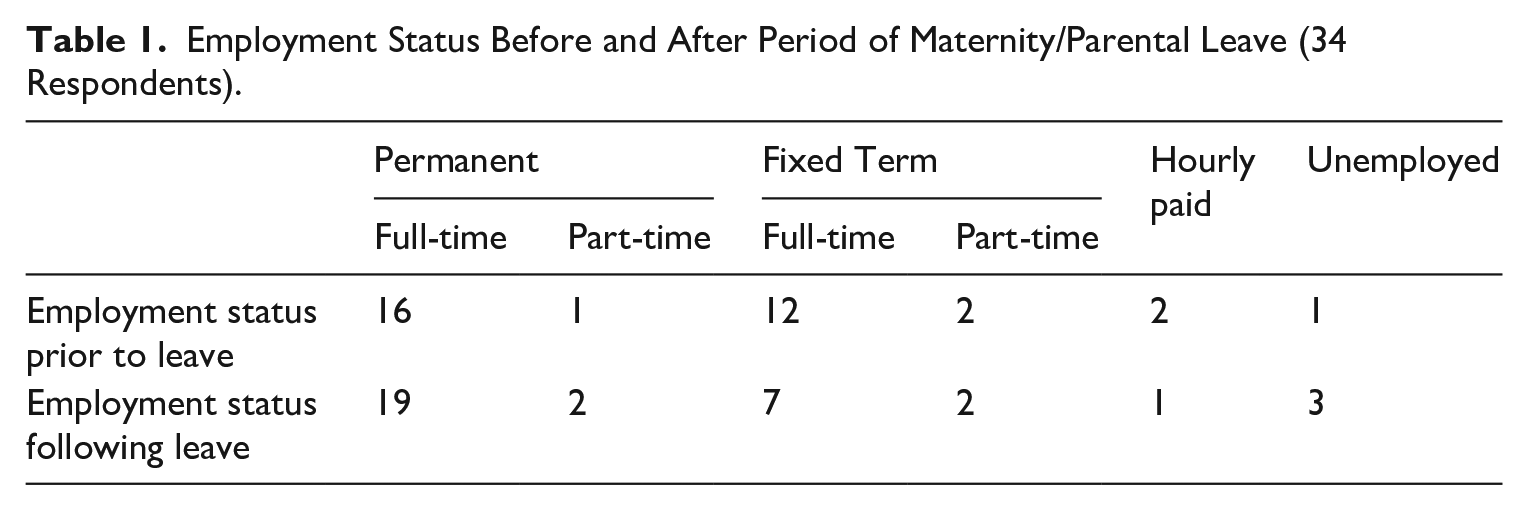
Our ECR survey supports existing research on the precarity of employment (Ackers and Gill, 2005; Thwaites and Pressland, 2017; White, 2006). Of the 34 responses to the survey, half were employed on a permanent full-time or part-time basis (17) prior to maternity/parental leave. Just under half of our respondents were employed on a fixed-term, part-time, or hourly paid basis (16), and one was unemployed (see Table 1). When asked for their employment status following the return to work, this increased to almost two-thirds employed on a permanent full-time or part-time basis (21), but this leaves around a quarter of those returning to work on full-time or part-time fixed-term contracts (9) and 4 either unemployed or hourly paid. For just under a quarter of our respondents (8), the job they returned to after their period of leave was a new position.
Employment Status Before and After Period of Maternity/Parental Leave (34 Respondents).
Respondents identified issues both in terms of eligibility for maternity/parental leave benefits and access to forms of support on the return to work; 23 of our respondents received some form of enhanced maternity/parental leave pay, but 6 only received statutory pay or maternity allowance and 5 received no payment. Those who had recently started new positions or were on fixed-term contracts found they were not eligible for enhanced pay. In some cases, rules about continuous employment left some respondents that were either hourly paid or on non-continuous fixed-term contracts with no access to statutory pay from their employing university, although some could access maternity allowance from the government depending on their status. A particular issue was raised by one of the PhD respondents about their employment status, which means they are not eligible for statutory pay nor government childcare support. Even between those who qualify for enhanced pay, there is significant variation with, for example, responses ranging from 6 months full pay and 3 months statutory pay to 6 weeks full pay and 12 weeks half pay. Given that statutory pay is currently only £145.18 a week, this significantly impacts those on temporary- or fixed-term contracts and those moving between jobs. Research into maternity benefits and women in academia found ‘an unambiguously strong relationship between the generosity of maternity pay and an increase in the share of female professors’ (Troeger, 2018: 9).
From the 34 responses to the ECR survey, only four identified specific forms of support offered by their department and these individuals were all employed on a permanent basis. Three of these four were formal schemes of reduced teaching or research leave for one term and in the other case there was an informal arrangement of a reduced teaching load for 5 weeks, although the respondent noted that they were then given 6 months of new lectures to write following this. The three formal examples also included access to internal funding specifically for returners as well as other forms of good practice, such as flexible timetabling and in one case additional conference funding for partners for childcare purposes. Two respondents noted they were aware of schemes of support available to permanent members of staff, which they were not eligible for as fixed-term or hourly paid staff. Therefore, our ECR survey confirms a lack of access to formal forms of support for ECRs. Even though there is some evidence that new schemes are being introduced, as identified in the HoD survey, there is a lack of access for ECRs that are not employed on a permanent basis or have recently started a new job.
Furthermore, a significant issue indicated by the survey is an increase in workload experienced on the return to work, either because individuals have started a new position, for example, moved to a permanent position, or in some cases even within same job. There were 32 responses to the set of questions on work responsibilities following the return to work. Two respondents to the survey did not return to work because they became unemployed. Of those that did return to work, 10 respondents experienced an increase in their administrative load on the return to work, including 6 where this increase was over 20%. The majority of these were within the same permanent position, with those coming back from leave being given a large administrative role on their return. For example, one respondent stated, ‘I was appointed a programme director as it was “my turn” despite the fact that I wanted to refocus on my research’. Changes in teaching responsibility were more mixed, with 5 experiencing an increase and the same amount experiencing a decrease. A small number of respondents were able to move to a more-research focused position with less teaching responsibility, but others found the move to a new job, such as a permanent position, involved an increase in their level of teaching. One respondent noted that they were only able to secure a new permanent position by signing two new book contracts while they were on maternity leave. Therefore, while it is significant that four of our respondents were able to secure permanent contracts on their return from leave, this can be due to pressures to use maternity leave for research.
In the case of research allocation, 26 found it stayed the same and 2 saw a decrease. Those who experienced an increased in their research allocation had been able to move to a more research-focused position. One respondent who saw a decrease in their research allocation stated that their research time ‘decreased proportionate to my decrease in hours, though I wouldn’t say expectations of what was required of me decreased, just the time allocated to do it’. The same respondent experienced an increase in their administrative load despite this shift from full-time to part-time, and therefore ‘found it very difficult to keep up with research and find a new rhythm for working’. A key issue identified by respondents was finding the time for research, especially for those who had experienced an increase in their teaching and/or administrative responsibilities on the return to work as well as those who moved to part-time. Juggling childcare with often long commutes and the day-to-day commitments of teaching and administration are significant challenges faced by those returning to work in keeping up with their research. As several respondents noted, a meaningful reduction in expectations around, for example, what is required for promotion, attendance at evening events and conferences, as well as research outputs, would be helpful during the transition period after returning to work.
Discussion
The findings from our HoD and ECR survey broadly corroborate each other to the extent that they reveal the absence of a formal policy for dealing with ECRs returning to work after maternity and parental leave. Although some departments have informal policies for supporting permanent members of staff who return from maternity and parental leave, this does not automatically extend to ECRs on fixed-term or hourly contracts. In place of formal and systematic support mechanisms for all parents, we document an important role for informal and ad hoc forms of support for ECRs, which include inter alia research leave, reduced teaching commitments, access to mentoring and access to wider institutional support such as sabbaticals and funding. The institutional norm is for case-by-case decision-making, which is tailored to the individual, but must be negotiated by the individual; thus, the onus falls on the individual to make a case for why they should be supported during the return to work period. While tailored support has benefits in terms of flexibility and recognition of personal circumstance, there are two important implications which follow: first, there is lack of equality in provision and, second, cases are judged on merit rather than automatic right. Consequently, given that maternity and parental leave is largely taken by women, this constitutes a gendered structural disadvantage. Acknowledging it as such is imperative if we are to identify ways to mitigate against it.
In adopting a feminist institutionalist approach, we began with the question – what kind of institution is the university? Feminist institutionalism permits us to see how gender is embedded within the university to produce unequal outcomes. We argue that the university is characterised by a series of norms and practices, which adversely affect parents. Unlike formal institutions, informal institutions do not pertain to formal written rules and so they need to be documented through research such as this to identify and bring to the fore institutional practices. As such, this research identifies the informal practices, which shape maternity and parental leave for ECRs. Our research builds on existing scholarly work to emphasise a complex relationship between formal and informal institutions. The university is characterised by formal policies pertaining to gender equality such as The Concordat to Support the Career Development of Researchers (2008) and Athena SWAN, which were discussed earlier, but we should note that there is also an important role for informal policies in the university. As Helmke and Levitsky (2004) argue, formal and informal practices can be complementary and accommodating, or they can be contradictory and undermining. In addition, and this corroborates our findings, informal institutions can exist in lieu of formal policies thereby completing provision that would ordinarily fall under the remit of formal institutions (Azari and Smith, 2012).
Furthermore, our ECR survey supports the finding that universities in the shadow of neoliberalism are increasingly greedy institutions (Coser, 1967, 1974), demanding more time, commitment and energy from their staff. This makes for a particularly inhospitable environment for those returning to work following maternity and parental leave. Rather than being greedy institutions, this research suggests that returning to work following maternity and parental leave constitutes a critical juncture when returnees require enhanced support, resources and the understanding that their productivity may be slower than was previously.
Echoing the insights of existing scholarly work (Thwaites and Pressland, 2017; Troeger, 2018; Ward and Wolf-Wendel, 2004), our research finds that maternity and parental leave constitutes a penalty which academic parents must negotiate, and that this often affects women most. This research supports the findings of existing literature on academic parenthood, but extends it to focus on ECRs. We argue for acknowledgement and recognition of ECRs as a distinct group who face a particular nexus of challenges involving balancing careers with family life while also experiencing employment insecurity, which may leave them vulnerable. Drawing on Young (1990), we highlight the importance of recognising and according significance to relationships of domination and oppression. In contrast to an idea of equality as the elimination of differences, Young argues for a ‘politics of difference’ whereby we recognise that the ‘participation and inclusion of all groups sometimes requires different treatment for oppressed or disadvantaged groups’ (Young, 1990: 158). The difference we seek to highlight refers to the recognition that ECRs are often in a precarious employment position, with access to less resources and rights compared to more permanent members of academic staff. The fact that maternity leave is predominantly taken by women means that the penalty disproportionately affects women.
The ECR period can be challenging transition phase as an individual moves from apprentice to colleague (Laudel and Gläser, 2008), and when aligned with returning to work following a period of maternity and parental leave, this critical juncture or transition can become even more complicated. As stated by one response to the HoD survey in which there has been a proactive approach to supporting returners, the issue is not necessarily addressed by increasing financial support, but concerns creating a culture in which those returning from work feel that they remain an integral part of the department and are not sidelined. For example, measures such as introducing breastfeeding breaks during lengthy meetings can help to improve inclusivity as can providing dedicated rooms where mothers can express milk. Proactive support here also means ensuring transparency and a set of guidelines, which all members of staff can access. The support of the PSA, the discipline’s professional association, would add legitimacy to promote cultural change sooner rather than later. Respondents in the HoD survey and the ECR survey noted there being a lack of guidance on this matter, which leads to inconsistency in approach. Dedicated guidance from the PSA would address this problem.
An Agenda Going Forward
Building on the existing research on women and parents in academia, this article contributes to the literature on the institutional practices of the university and how they adversely affect ECRs. Our research finds that a significant proportion of ECRs experience impartial and insufficient support from their institutions following maternity and parental leave, and would welcome greater support, consistency and transparency.
With regard to policy development, we call for a formal, systematic approach to ECR returning to work after maternity and parental leave, which will ensure consistency, transparency and accessibility. It should not be up to the individual to argue their case based on merit. We ask the PSA to provide guidance for HoDs, which would feed down to all members of staff. Our HoD and ECR survey identifies a number of examples of good practice as well as some important suggestions for how provision could be improved. We recommend adoption of the following principles to ensure adequate and comprehensive support for ECRs returning from maternity and parental leave:
Dedicated research leave following maternity/parental leave
Dedicated funding to support post-maternity/parental research leave to ensure the burden does not fall on existing staff
Access to occupational maternity/parental pay schemes from Day 1 of employment
Mentoring (from academic staff who are parents) to help parents manage return to work
Supportive environment/culture
Short notice cover provision, for example, to cover parents with sick children
Reform of appraisal processes
Dedicated breastfeeding/expressing breaks
Early notification of timetabling
Early confirmation of teaching allocation for those on casual contracts
Feminists have long fought for recognition and acknowledgement of difference, whereby impartial application of rules disguises inequality (Young, 1990). If the discipline is serious about supporting ECRs, women and parents more broadly, then it will be open to discussing an issue, which affects us all. An ECR after all may not remain an ECR, and will one day become a permanent member of staff. Investing in ECRs means investigating in the future of the discipline. Although maternity and parental leave may not be an issue that affects all members of staff for those who do take it, it can represent a critical juncture in an academic’s life and they will need to be supported on return to the same institution. Being treated differently in this case would mean being treated equally insofar as the university has a commitment to support all staff.
The challenge is resource-related and there would need to be funds in place to support systems such as research leave, but there is also an issue as to what reasonable support looks like especially for those ECRs who are on fixed-term contracts. There is now an emerging body of research which, in our view, makes the convincing case that (permanent) staff require more support when returning from maternity and parental leave. These support systems should extend to ECRs who are permanent members of staff, but there should also be support systems in place for those who occupy precarious roles. To neglect them is to under-invest in women, in parents and thereby to negatively impact the representative potential of the university.
Footnotes
Declaration of conflicting interests
The author(s) declared no potential conflicts of interest with respect to the research, authorship, and/or publication of this article.
Funding
The author(s) received no financial support for the research, authorship, and/or publication of this article.
