




Abstract
The argument that representative democracies are experiencing an age of depoliticisation has become increasingly prominent. However, there has been too little reflection on the assumptions made about politics within the depoliticisation literature. This has led to a lack of precision in terms of how we identify (de)politicisation empirically and the grounds upon which we can normatively critique it. To address this, the article changes the terms of the depoliticisation debate and asks not what we can learn about politics by thinking more about depoliticisation, but what we can learn about depoliticisation if we think more about politics. How politics is defined, in spatial, temporal and activity terms, hugely influences how we might understand depoliticisation. Three prominent and contrasting definitions of politics are shown: politics as the institutions of government (politics lens 1), politics as choice and contingency (politics lens 2) and politics as the apparatus of order and consensus versus ‘political’ moments of antagonism (politics lens 3). By considering these ontologies of politics, the article teases out some of their strengths and weaknesses in capturing the depoliticisation ‘crisis’. The article concludes by considering the benefits of a multi-lens approach to depoliticisation as a preliminary step to encourage greater reflexivity and debate.
The argument that representative democracies are experiencing an age of ‘depoliticisation’ (Flinders and Wood, 2014; Hay, 2007) or ‘post-politics’ (Mouffe, 2005; Rancière, 2001) has become increasingly prominent. While the claims are clear enough, there has been too little reflection on the sometimes quite implicit assumptions about politics within the various strands of the depoliticisation literature. Consequently, there is a lack of precision in terms of how we recognise depoliticisation and politicisation empirically and the grounds upon which we can normatively critique it. This impedes both more extensive and fine-grained research on the subject. In short, while the literature on depoliticisation provides a damning critique of contemporary – neoliberal – politics, there has not been enough debate on what politics is and what it should become in the light of this phenomenon.
This article turns the depoliticisation debate on its head and asks not what we can learn about politics by thinking more about depoliticisation, but what we can learn about depoliticisation if we think more about politics. How politics is defined, in spatial, temporal and activity terms, hugely influences how we might understand depoliticisation. Yet, a thoroughgoing and explicit discussion on definitions of the political in the depoliticisation debate has yet to occur (Wood and Flinders, 2014). Looking across the literature, three prominent and contrasting definitions of politics are identified and compared: politics as the institutions of government (politics lens 1), politics as choice and contingency (politics lens 2) and politics as the apparatus of order and consensus versus ‘political’ moments of antagonism (politics lens 3). Placing the focus on these definitions of the political advances the depoliticisation debate by foregrounding a discussion of how they shape understandings of (de)politicisation.
Ontologies of the political can be understood as relating to political being, ‘to what is politically, to what exists politically, and to the units that comprise political reality’ (Hay, 2013: 4, emphasis in original). An ontological turn in the depoliticisation debate should lay bare the normative judgements, acknowledged and unacknowledged, which shape our answer to the question: ‘What is the nature of the (…) political reality to be investigated?’ (Hay, 2013:4). While the radical political theorists (e.g. Rancière and Mouffe) characteristic of politics lens 3 are open about their normative commitments, scholars in the more grounded governance-focused literature (politics lenses 1 and 2) have remained relatively non-committal, particularly on ways forward. To encourage greater reflexivity, the article closes by suggesting that researchers might consider a multi-lens approach to depoliticisation. This should not be seen as an end objective in itself, but a preliminary step beyond chronicling depoliticisation towards a more explicit consideration of what we understand politics to be, in the light of depoliticisation, and the forms of political renewal we favour or oppose.
More pragmatically, a keener sense of the possible ontologies of the political enables the researcher to better locate the range of contexts, forms and effects of the (de)politicisation ‘crisis’ in representative democracies. An ontological turn in the ‘depoliticisation’ debate should also lead to an overdue engagement with analytical and methodological questions in depoliticisation research. As is shown, the lenses have varying foci and blind spots, and in some ways they are complementary, at least in analytical terms. To advance the depoliticisation discussion, the article lays out some preliminary markers for conducting empirical research through these three lenses. While making research on depoliticisation more precise and systematic, focusing on the spatial and temporal and activity dimensions of the political has the advantage of opening up a broad, multifaceted and inclusive discussion on (the decline of) politics and (de)politicisation. Overall, then, by addressing its own ontological politics, the depoliticisation debate will move onto a set of normative as well as methodological questions with which it has yet to fully engage.
The article is structured as follows. The next section reviews briefly the main strands of the contemporary depoliticisation debate, outlining three lenses on politics and their spatial, temporal and activity dimensions. The following section considers what the strands of literature tell us about moving beyond the depoliticisation crisis. The section ‘Researching the Depoliticisation Crisis’ teases out some of the analytical and methodological implications of adopting the various understandings of politics and in the final section it is suggested that the lenses imply a variety of research strategies, which might be combined in a multi-lens approach. Given the tensions that arise from such a step, its preliminary, exploratory nature is stressed.
Three Lenses on Politics: Depoliticisation in Space, Time and Activity
Overview
This is not the first period in recent history in which theorists have identified systematic depoliticisation as a condition of and threat to politics (also, from very different political standpoints, Carl Schmitt in the 1930s and Herbert Marcuse in the 1960s). What is unusual perhaps about present discussions is the intensity of debate in political science on, most notably, depoliticised modes of governance and ‘post-politics’. The former concern has been most apparent in UK-based and -focused research, which has analysed the tangible strategies and effects of depoliticisation on contemporary governance. Its strength is that it has engaged with the complexities of depoliticisation and politicisation dynamics (e.g. Hay, 2007) and the contingency of democratic politics (Kettell, 2008: 632).
Generally, depoliticisation is understood as the denial of political choice, the delegation of decision-making to technocratic experts and growing public disengagement from politics (see Flinders and Wood, 2014). Useful conceptual approaches have been developed to apprehend, for example, the ‘principles, tactics and tools’ (Flinders and Buller, 2006) of depoliticisation, the three – societal, discursive and governmental – ‘faces’ of depoliticisation (Wood and Flinders, 2014) and how depoliticisation varies across levels of governance (Jessop, 2014; Wood, 2015). Up until now, however, the literature has remained relatively narrow in empirical depth and scope (Hay, 2014), its conceptual tools developed largely in relation to British national politics (e.g. Flinders and Buller, 2006; Kerr et al., 2011), while non-state actors and (re)politicisation have often been overlooked (Donmez, 2014). Beyond the still limited empirical research agenda on depoliticisation, there has been a lack of both conceptual debate and clarity on notions of politics thus far utilised in research (Jenkins, 2011). This is in stark contrast to the more theoretical work on depoliticisation. Here, notions such as ‘post-democratic’ (Rancière, 1998; compare Crouch, 2004) and, particularly, the ‘post-political’ (Mouffe, 2005) have been used to capture a democratic condition in which genuine contestation and conflicting claims about the world are perceived to be no longer apparent. Generally, in this literature, the focus is on the political itself as an antagonistic condition and its inherent and increasing precariousness in the face of the rigmarole of institutionalised politics.
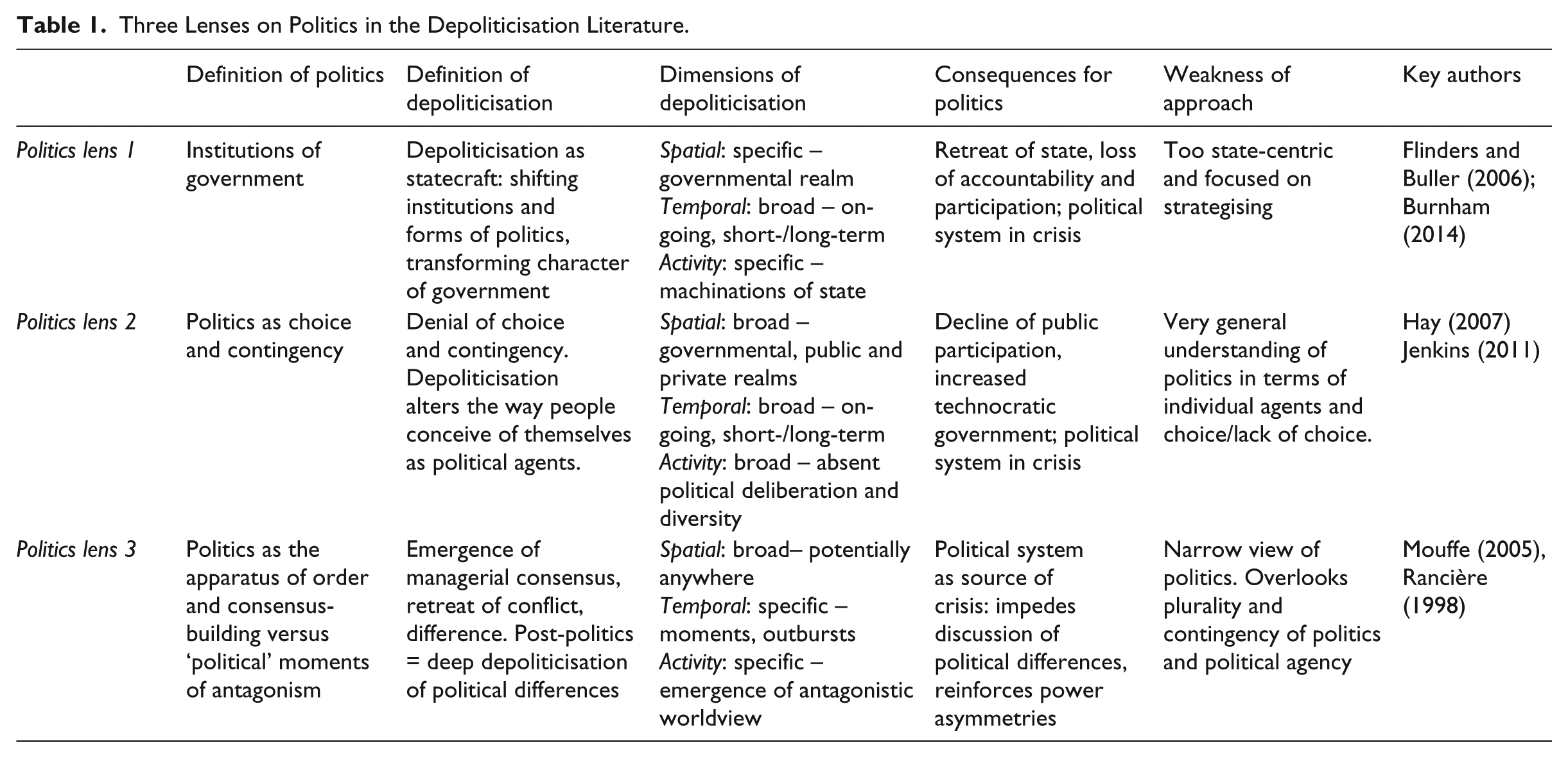
These strands of literature are in relative agreement on the foremost sources and effects of contemporary depoliticisation: economic globalisation/global corporate power, the dominance of neoliberal thinking and the rise of consensus-orientated and technocratic governance. Hence, it is straightforward to delineate depoliticisation as a research field, and recent articles provide excellent critical surveys (e.g. in this journal, Wood, 2015). However, the differences apparent in the treatment of politics and their implications for the understanding of the nature of the contemporary depoliticisation problem have yet to be fully teased out. It is thus to the latter point that this brief review of the literature pays most attention. As shown in Table 1, the intention is to review critically the ontologies of the political and their implications as lenses on politics for depoliticisation research: politics lens 1: statecraft and the institutions of government, politics lens 2: choice and contingency, politics lens 3: politics as the apparatus of order and consensus-building versus ‘political’ moments of antagonism.
Three Lenses on Politics in the Depoliticisation Literature.
Politics Lens 1: Statecraft and the Institutions of Government
This lens on politics is the most narrow and conventional. In fact, often in this strand of literature the links between (de)politicisation and politics and the political are under-explored and/or under-theorised (Jenkins, 2011). In large part, politics is only implicitly and narrowly defined as the institutions of government. From this, depoliticisation is understood as a form of statecraft, whereby governments alter the arena and character of political decision-making (Flinders and Buller, 2006; compare Burnham, 2001). Such narrow definitions do provide clarity and thus some empirical traction (Jenkins, 2011: 158–159). But defining depoliticisation as a governance strategy, as a ‘process of placing at one remove the political character of decision-making’ (Burnham, 2001: 128), confines the discussion of depoliticisation both spatially (at its source, if not in its effects, to formal political institutions) and in terms of activity (as a practice of statecraft). It also implicitly confines it in temporal terms, as depoliticisation is seen as emerging from the machinations of the state. Even if its spatial effects span aspects of society and hence provide longevity, depoliticisation is a strategy, one conceived in specific space and time boundaries (e.g. policy processes).
Depoliticisation (of policies, issues and claims) can certainly be viewed as an age-old strategy of statecraft. But politics as practised today is far too multifarious for such a constricted view of depoliticisation – instances of politicisation and depoliticisation can emerge from and span across the social (and not just the political) realm (Hay, 2007). Peter Burnham (2014) may be right to argue for the methodological advantages of a narrow definition, and his own research adopting this lens has provided refined insights on depoliticisation as statecraft. Ultimately, however, utilising this lens eliminates from view much of contemporary political activity, the sources of and realms through which (de)politicisation occurs, that is, the political itself. Hence, it restricts the scope of empirical enquiry into depoliticisation. It also risks reifying a conventional understanding of representative politics despite its intention to normatively critique it.
Politics Lens 2: Choice and Contingency
Colin Hay’s (2007) work has been perhaps the most influential in this strand of the depoliticisation literature and is noteworthy in providing a – broad – definition of politics as ‘the capacity for agency and deliberation in situations of genuine collective and social choice’ (Hay, 2007: 77). It has been adopted (e.g. Beveridge and Naumann, 2014) or adapted (e.g. Jenkins, 2011; Kuzemko, 2014) by other researchers. Hay defines depoliticisation and politicisation as the movements of issues between an arena of fate and necessity (the non-political), where nothing can be done (depoliticisation), to one of deliberation and contingency (the political), where action and change are possible (politicisation) (Hay, 2007: 81). This politics lens 2 unlocks the political from the confines of the state (politics lens 1). By conceiving of the political in terms of governmental, public and private spheres, it expands exponentially the possibilities of the political in spatial, temporal and activity terms. Hence, the range for empirical enquiry into (de)politicisation is far broader than in politics lens 1.
However, it might be argued that there are problems with Hay’s understanding of politics and depoliticisation in terms of issues, which become political, in different forms, depending on the capacity to span private, public and political realms. For instance, there is little sense of how these issues are constituted. Depoliticisation and politicisation are ultimately seen almost in policy-cycle terms, as the capacity of individuals or groups to force their issue onto the policymaking agenda. Wittingly or unwittingly, this reifies the formal institutional processes of representative politics, as well the general claims to democratic legitimacy on which it is based – the representation of issues in the political process is the ultimate determinant of their ‘politicalness’. In addition, the view of the ‘political’ as being about capacity for agency may be seen as both too general (as choice and agency can occur anywhere across the spectrum of social activity) and too actor-focused (as choice must be determined by participants in social contexts). By implication, it might be argued that Hay’s broad inclusive lens on politics has encouraged a tendency in the literature to define depoliticisation by default, and very generally, as the ‘absence of politics’ (Burnham, 2014: 1). A broad a priori definition of politics may be useful for inductive explorative research on (de)politicisation. However, it can lead to conceptual and normative ambiguity (hence, Burnham’s appeal for a narrow definition), that is, how do we identify the spatial and temporal effects of (de)politicisation on politics and whether they are (un)desirable without first clearly delineating the content and contexts of the political itself?
In short, while politics lens 2 offers a strong critique of contemporary politics, there is sometimes only a general notion that politics should function in a different way – that is, be more open or public, provide more choice and be more politicised. However, for such a critique to hold, it surely needs to articulate more precisely what politics is and how this influences our understanding of (de)politicisation. This brings the discussion to the third, more theory-based and normative strand of the literature on depoliticisation.
Politics Lens 3: Politics as the Apparatus of Order and Consensus-Building versus ‘Political’ Moments of Antagonism
Post-foundationalist political theorists have drawn a theoretical distinction between the ‘political’ as a radical and rarely occurring state of conflict, where democracy unfolds, and ‘politics’ as the institutionalised everyday practices of contemporary political systems (Mouffe, 2005: 8–10), or what Jacques Rancière calls the police order (see Marchardt, 2007). One purpose of this distinction is to deny representative political systems the very essence of their claims – to provide for the political and ensure democracy. Another is to highlight the temporality of the political: the fleeting moments of ‘politicalness’ and, by contrast, the routinised, everyday, omnipresent and on-going politics of the system. The term ‘post-political/-politics’ is used to emphasise the deep-rootedness of depoliticisation, the apparent elimination of political choice and contestation, and hence democratic potential. Resonating with, while critiquing the end of ideology discussions from the 1990s (Dean, 2009: 20), some of this work (especially Mouffe, Žižek and Swyngedouw) rests on a further temporal assumption that politics has entered a new era of diminished political and democratic possibilities. The understanding is that the post-Cold War period has witnessed a neoliberal settlement centred on the norms and interests of the global market, which has foreclosed proper political debate (Žižek, 2008). Political apathy and (economic) elite control are seen as commensurate to the rise in populism and urban protest (Swyngedouw, 2014).
A strength of this political theory literature lies in seeing the political as the reassertion of fundamental differences. For example, Chantal Mouffe (2005) draws on – and reinterprets within a leftist perspective – Carl Schmitt’s (2007) notion of the political as resting on friend/enemy distinctions. Hence, politicisation is the random and rare return of antagonistic worldviews which destabilise the existing order. This focuses the researcher’s gaze beyond spatially bounded notions of politics and onto politicisation wherever it occurs, while underscoring the limits to and desirability of consensus. It shows that a key component of depoliticisation is the absolute disavowal of the legitimacy of some actors’ worldviews; the denial of their claims to the ‘political’, the rejection of their concerns as not being of general interest (e.g. Rancière, 1998, 2001).
However, while politicisation is simple to define and locate (if rarely seen) in this view of politics/political, problems emerge in relation to depoliticisation. On the one hand, depolticisation might be the suppression of political moments as they emerge. This would be easy enough to observe in spatial, temporal and activity terms. However, when the assumption is that politics per se is the means through which the political remains marginalised and repressed, then the entire apparatuses and practices of contemporary (post-)politics are ultimately depoliticising. Making politics synonymous with depoliticisation represents a serious challenge to empirical research on depoliticisation (and perhaps explains why there is little empirically-grounded work in this field). As the reach of contemporary representative democracies is great, depoliticisation is thus inherent to most social activity. Consequently, depoliticisation can potentially occur in any space in which political order is apparent, in any timeframe (short-term or long-term) and take any form of activity (discourse or institutional practice). Ultimately, depoliticisation might be everywhere but not necessarily on view given its embeddedness in the current political order.
Beyond the difficulties this represents for empirical research, there are further problems with this blanket view of politics as inherently depoliticising and the assertion that we are experiencing a post-political age of democratic politics. In the end, the binary understanding of real political/politics as police may be seen to negate the grey areas and contingencies of contemporary politics (Marchardt, 2011; compare Jessop, 2014: 1). It reduces the form genuine politics can take – the activities that may be understood as political. The multiplicity of political agency is, a priori, eliminated; ‘real’ political agency is confined to the contestation of institutional politics/police (Darling, 2014: 74–75). Furthermore, the apparent all-powerfulness of the post-political order diminishes the possibilities for the political to emerge (Beveridge and Koch, 2016).
Hence, although the political is seen as not being spatially bounded – at least in its potential appearance if not in its ultimate effects – its limited temporality (its rareness and briefness) markedly shrinks the possibility of politicisation of the political order. However, even according to its own reading of the age, there is a politics to the post-political age – neoliberalism – and the key features of this condition (e.g. formal political consensus on the benefits of the global economy) are contested and best seen as on-going political achievements (Dean, 2009: 23). Thus, it might well be argued that we have never really had a post-political condition (McCarthy, 2013), although we may have long had depoliticisation (Schmitt, 2007).
Moving beyond the Depoliticisation ‘Crisis’
As well as providing contrasting understandings of how (de)politicisation works, the strands of literature discussed provide varying views of the most crucial issue at stake: how do we exit the depoliticisation crisis? This section reflects on what the varying lenses on politics offer in terms of getting out of the depoliticisation ‘crisis’ (assuming we accept the argument that there is one). The differences apparent in the literature turn on the merits of formal representative democracy, ‘anti-political’ sentiment and extra-formal political agency. Again, they reveal different ontologies of the political.
In the – largely UK-based and -focused – literature concerned with modes of depoliticisation in governance (resting on politics lenses 1 and 2), there are very prominent works that engage broadly with depoliticisation and anti-politics within the context of a perceived democratic malaise (Flinders, 2012; Hay, 2007; Stoker, 2006). All of them, in their varying ways, fall back on a reassertion of the merits of representative democracy, and hence a quite narrow, conventional and perhaps even exclusionary understanding of what politics should and can be. The overriding message in these works is that despite its problems, representative democracy can and should be saved. The onus is on the ‘people’ and political institutions to work together better to reinvigorate politics, to overcome anti-political sentiment. While the many people who have been failed by and protest against representative democracy are sometimes addressed in these works, the arguments for substantial change, for alternative forms of politics, are not really considered.
Beyond these well-known books, the literature on modes of depoliticisation in governance has very little to say about escaping the depoliticisation crisis, even when it provides good empirical and conceptual accounts of how it operates (e.g. Flinders and Wood, 2014). While this is no doubt tied up with the more open and less pre-ordained view of depoliticisation dominant in these strands and the advantages this can have in terms of tracing depoliticisation, the lack of a real vision of change is surely problematic in a debate about political decline and democratic crisis. In other words, the relative lack of attention to political ontology in this strand of the literature, and the commensurate emphasis on empirically ascertaining how politics and (de)politicisation function, leave it with a blunt normative edge.
Politics lens 3 sets itself up in opposition to the reformist spirit arguably apparent in politics lenses 1 and 2 and representative democracy per se, denying both a place in the ontology of the – true –political. Instead, outbreaks of radical political contestation and change are the genuine momentary realisations of the political. Political change occurs only outside of and always in opposition to the formal political system (which seeks the depoliticisation of the hegemonic order). Scholars (e.g. Swyngedouw, 2014) employing this perspective have thus devoted much attention to the diverse, usually urban, uprisings from 2008 onwards (e.g. the Arab Spring, anti-austerity movements in Southern Europe, Occupy), the strategies employed to realise new political worlds (by denying the veracity of existing political worlds) and the novel forms of organisation which have emerged (e.g. parallel institutions in Greece and Spain).
Although the narrow ontology of the political, especially the too-easy dismissal of institutionalised politics, is problematic, politics lens 3 speaks to some of the most novel forms of democratic politics that have emerged in recent years. These instances of politicisation are ultimately often bound up with an outright rejection of the current political system. The urban movements in Greece and Spain and elsewhere in 2011 were not merely contesting the post-democratic neoliberal settlement but also the political system, which they saw as integral to it. In some ways, then, politics lens 3 captures more of the depoliticisation crisis because it accounts better for politicisation in the wake of and in opposition to perceived political decline. Furthermore, it interlinks depoliticisation and politicisation; the two correspond dialectically. Political change, moving from depoliticisation, an era of post-politics, is bound up with the politicisation of politics (and hence of representative democracy) itself. Where politics lenses 1 and 2 tend to obfuscate, politics lens 3 frames and floodlights the causes of the depoliticisation crisis (the inadequacies of institutionalised politics) and the path to political change (the articulation of antagonistic worldviews).
Researching the Depoliticisation Crisis
Each of the lenses provides a portrait of the political, focusing on specific activities, moments or places (and not others). Hence, these lenses on the political might be seen as providing partial glimpses of the contemporary depoliticisation crisis. They also suggest the deployment of particular analytical strategies and research methods.
Politics lens 1 (statecraft and the institutions of government). Being the most conventional understanding of politics, research here might entail an emphasis on following or reconstructing institutional processes of political decision-making to understand how, for example, city-wide climate plans have become bound up with arena-shifting (the delegation of some decision-making responsibility to climate scientists and urban policy entrepreneurs). The most appropriate approach here might include (a) expert interviews with politicians, public servants, representatives of environmental non-governmental organisations (NGOs), businesses, and so on, and (b) analysis of media and official documents from the international, national and urban levels to capture the multi-level nature of climate governance, the broader political context in which city governments act.
Politics lens 2 (choice and contingency). Being both spatially broader (potentially across governmental, public and private realms) and a very specific personal perception of a situation (how can a situation be changed?), this lens necessitates a flexible analytical approach. Analysis needs to focus on both macro and micro processes, for example, capturing through discourse analysis how political debate narrows over time in the governmental realm, while also perhaps observing through ethnographic research (e.g. participant observation) how the capacity for agency (dis)appears in specific fora of the public realm (e.g. local stakeholder meetings on plans for fracking). Interviews with selected actors will also probe their perceptions of issues or processes, seeking their subjective views on their own decision-making capacities.
Politics lens 3 (politics as the apparatus of order and consensus-building vs ‘political’ moments of antagonism). Here, the challenge is to observe and, where possible, draw links between everyday politics and the extra-ordinary political. In part, this may involve similar methods to politics lens 1, through following/reconstructing institutional processes to achieve consensus and order in a particular place and time as well as analysing the discursive strategies used in the media over longer periods of time to see how order is maintained. To grasp moments of political antagonism (and their negation), ethnographic methods may be used to trace how particular contestatory representations of and claims about, for example, the effects of austerity are silenced or simply never become part of formal political discourse. There is also a strong temporal dimension to this view of the political – so research needs to observe or reconstruct political moments and how they recede. To find these silenced antagonistic voices, a first step may include analysis of alternative media and online sources, as well as becoming embedded in particular contexts of actions where conflict might be expected to take place (e.g. in urban areas where rents are increasing and social benefits are being squeezed).
Outlook: Towards a Multi-Lens Approach?
While other lenses on the political could be considered (e.g. a Marxian, materialist understanding of depoliticisation would provide a fresh view on the current depoliticisation debate), the three lenses outlined above can be considered key definitions within the existing depoliticisation literature and provide a basis for developing diverse and innovative analytical strategies. A plural, multi-lens approach could help to capture more of the actualities of contemporary politics and, hence, tell us more about (de)politicisation. Such a perspective would share Matthew Wood and Matthew Flinders’ (2014) concern to promote a multi-layered understanding of the ‘political’ in depoliticisation research, and there are some parallels between the three lenses on politics discussed here and their ‘three faces of depoliticisation’: governmental, societal and discursive. However, the starting point here (definitions of politics rather than depoliticisation) is different, as is the overall intent: to provide greater precision in terms of how these processes work and how they might best be researched. While Wood and Flinders delineate the general types of depoliticisation found in the literature (for a critique, see Hay, 2014), a multiple lens approach would be more clearly about conducting research around the analytical and methodological implications of different definitions of politics for our understanding of how (de)politicisation shapes the political.
The proposal of a plural, multi-lens approach should preferably be seen as a first step, one aimed at promoting reflexivity in research and more open political debate. It is by no means a coherent standpoint because, ultimately, adopting multiple ontologies may be equated with adopting multiple, and often incompatible, commitments. For instance, the multi-lens approach to politics and (de)politicisation does, in itself, rest on a simple but important assumption about the depoliticisation crisis: that depoliticisation remakes rather than annihilates the political (Beveridge and Koch, 2016). From such a standpoint, the boundaries of the political cannot be wholly fixed in essential terms and become a matter of empirical work rather than an a priori definition. This is a quite different understanding to that of politics lens 3, with writers like Rancière (1998) tending to present the truly political as a largely unsullied and distinct realm. There are, then, uneasy and inherent tensions apparent in pursuing a plural approach to politics and (de)politicisation.
Hence, in order to work, at least in an exploratory fashion, a multi-lens approach does not assume one ontology of the political but tries to accommodate multiple ontologies of the political. It might develop research strategies from them, even if this may not be entirely consistent with the commitments and purposes of the original works. Thus, such a step should be seen as promoting a sense of the ontological politics of depoliticisation research and, ultimately, encouraging reflexivity and debate. Our ontological stances shape epistemological and methodological commitments and do themselves politicise and depoliticise through including or excluding particular approaches, objects and methods (Hay, 2013: 2). Political research will always be partial in both its scope and normative persuasion. This is inevitable and should be recognised as such in our evaluations of the decline of the political.
Footnotes
Funding
The author(s) received no financial support for the research, authorship and/or publication of this article.