



Abstract
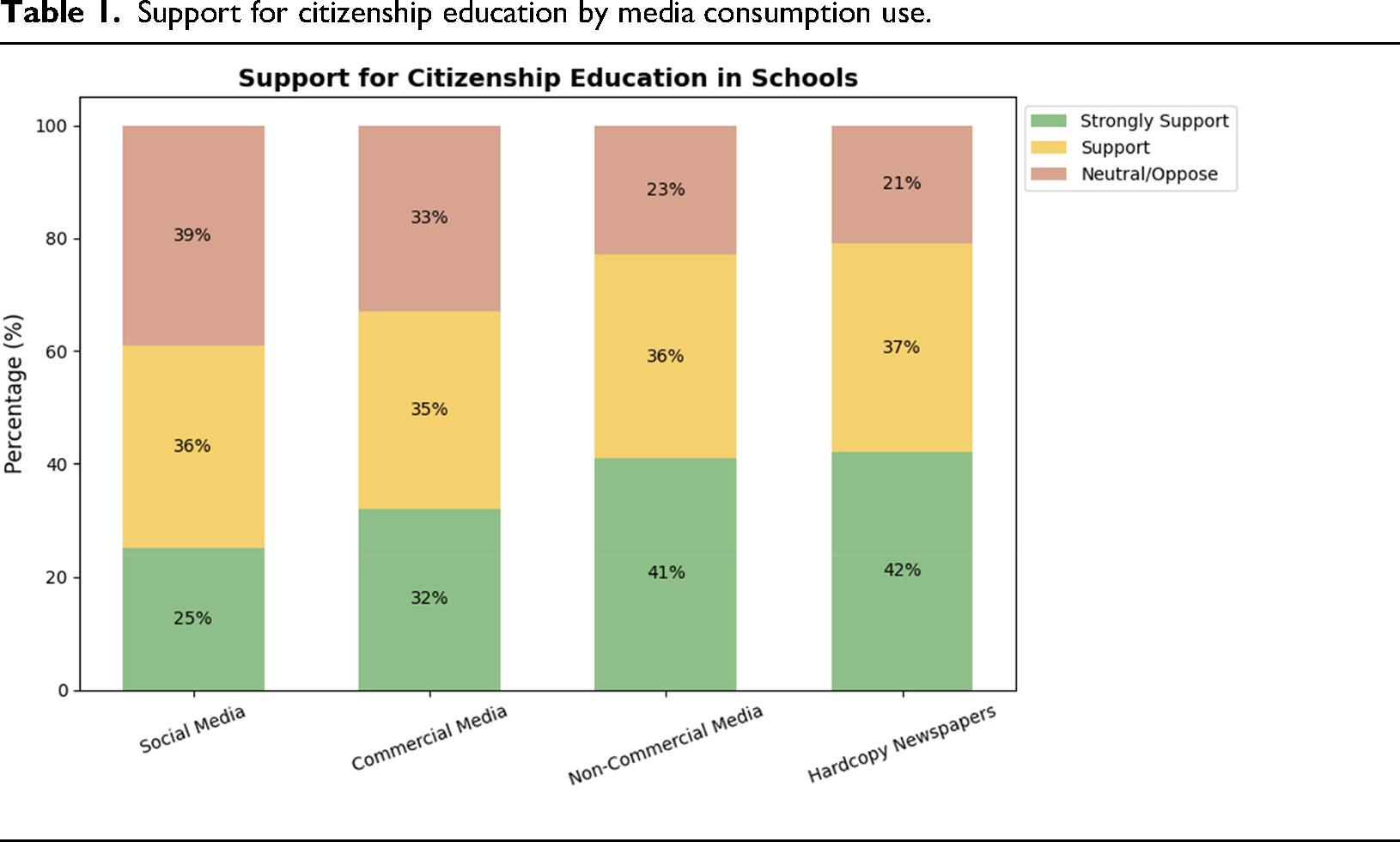
The article discusses the results of an empirical study that indicated commercial and social media use correlates with lower civic values and lower support for citizenship education fundamental to democratic citizenship. The research is based on original quantitative and qualitative research, conducted in 2024, that included 10 focus groups of 65 participants, and surveyed 2046 Australians, on their media habits, and civic attitudes. Our data revealed that those who use non-commercial media, such as public broadcasting (as opposed to commercial and social media) as their primary source of information are more likely to support teaching citizenship education in schools (41% to 32%) and are more committed to civic values. We argue for further commitment to citizenship education that would include the development of abilities to critically navigate news, as the main commercial platforms are structured in ways that are directly antithetical to civic values: they promote hyper-individualism and self-branding, engagement is privileged over accuracy; and the format is too short and fast for meaningful, civic deliberation.
Introduction
For the last decade, at least, youth democratic engagement and citizenship education have been of concern across the globe, since country after country reports the decline in citizenship education, public trust, and media awareness (Evans et al., 2024; Harris et al., 2022). However, democratic citizenship is not something that comes naturally. As all functional democracies understand, it is something that needs to be cultivated, nurtured and passed on. A society that cannot inculcate basic democratic values and practices in its citizens will not remain a democracy for long. Gershberg & Illing (2022) write that it is important to understand democracy not just as a system of government but also as an open communicative culture that cultivates civic values. They argue that citizen education is crucial to fostering the open communicative culture that democracy requires. This type of education focuses on the ways a society's members learn about the world, debate, develop civic values, and ultimately deliberate whether to change the structures of their world or not. While many assume that the knowledge, values, dispositions and skills are also acquired in informal spheres, it is education and media that remain key spaces where citizenship identity is being formed (Bobba and Coviello, 2007; Kymlicka, 2001).
In an increasingly media saturated society, communicative culture depends heavily – more so than ever – on the character of the contemporary media environment. A media culture that undercuts the communicative practices and values of civic life raises profound concerns for the future of democracy. While there are multiple reasons for arguing why this might be the case, there has been little systematic empirical evidence to back up such a claim. Our study tests the relationship between media use and civic values, pointing to two key findings that relate to the theme of civic education: a correlation between low scores on a measure of civic values and a reliance on social media (along with other highly commercialized media). At a time when addressing the pathologies of the contemporary media environment requires citizens’ robust civic values and attuned information literacy skills, the very media that exacerbate such a need thwarts its realization.
Citizenship education is a crucial component to digital media literacy, integral to address the concerns raised by the contemporary information environment. It is not enough to be able to distinguish between accurate and inaccurate information, truth and falsehood. We know from existing research that plenty of people who circulate false information do so knowingly or without being interested in the distinction. What matters just as much as the ability to adjudicate between rival accounts of reality is the upstream understanding of why it is important to do so – not just at the individual level, but at the societal one. We are not isolated individuals out among the tumbleweeds on the prairie; we live in conditions of increasingly complex interdependence. The preservation of democracy in the face of dramatic changes in the media environment depends on our ability to make sense of information in ways that are shaped by recognizing our interdependence. Recognizing our interdependence involves the understanding that it must be shareable in principle – not just an idiosyncratic, gut feeling or article of unquestionable faith (de Zúñiga et al., 2024). Without an understanding of the importance of information to our collective civic life and our ability to recognize shared interests and common goals, digital media literacy becomes unmoored, bereft of motivation. This role lies not just in the importance of discriminating between rival accounts of reality, but in doing so in ways that are shareable and communicable. In other words, a civic disposition recognizes the importance of being able to both listen and explain – tools for arriving at some kind of shared consensus in non-coercive fashion. This disposition is grounded in the recognition of the irreducible interdependence of shared life in society: that our decisions and actions do not affect us alone, but have implications for others. The same is true of the actions of others with respect to us. By contrast, the commercial logics of social media, reliant on surveillance-based targeting and customization, suppress this recognition of irreducible societal interdependence: the recurring message is that everything is simply about, “me, me, me”: my personal device, my customized feed, my individual taste, biases and preconceptions.
In times of decaying trust in news and journalism at large, combined with the emergence of online news and fake news stories shared online (Pickard, 2021), there is an ongoing threat to norms and civic values. Andrejevic & Volcic write that the “growing resistance to countervailing facts and opinions” may be correlated with “the degradation of people's ability to see themselves as part of an imagined community in which the concerns and interests of others, both individually and collectively, matter to one's own thriving and thus to one's deliberative decision-making process” (2019: 19–20).
Fostering young people's ability to see themselves as a part of communities, and equipping them with citizenship education in a digital media world is a growing priority, since schools remain key spaces where the civic identities and practices of diverse young people are fostered and nurtured; where citizenship is learned, connection to one's country is formed, and importantly, a sense of global citizenship is created (UNESCO, 2014).
We situate our Australian-based study within a context in which civic knowledge appears to be in decline. According to the Australian Curriculum, Assessment and Reporting Authority (2025), Australian students recorded the worst ever citizenship knowledge results. These assessments measure students’ understanding of topics including Australia's civic institutions, its system of government, the rights and obligations of Australian citizens, and the tenets of democracy that underpin Australia's multicultural society. According to the assessment, 72 per cent of students did not understand the basics of democracy (ACARA, 2025). Commenting on these results, some scholars point to Australian students’ excessive reliance on social media for news while pointing out that this leaves them vulnerable to foreign interference (ABC, 2025). Our own research shows that in Australia, over half (53%) of younger Australians of eligible to vote (aged 18 to 34) get most of their information about news and current events from social media. Indeed, a significant portion of this group (38%) are heavy users (3 h or more per day) of social media. Elsewhere, social media are the main source of news in Malaysia (44%), the Philippines (42%) and Indonesia (42%) (see also e.g., Corbett et al., 2023; Nevezie et al. 2022; Park et al., 2024; Social Research Centre, 2023). In the United States, more than half of adults say they at least sometimes 1 get their news from social media, and the trend line continues to increase (Pew Research, 2024).
Some media scholars note that social media can offer potential benefits for civic engagement (Clark et al., 2024; Harris and Johns, 2021; Harris et al., 2022; Heggart, 2020) while showing how social media provide opportunities to engage in intercultural learning and anti-racist civic action (see also Johns and McCosker, 2015; Mihailidis et al., 2021). However, scholarship now shows how the main commercial social media platforms are structured in ways antithetical to democratic deliberation (Morozov, 2012; Pickard, 2021). These platforms (such as TikTok, Instagram, YouTube, for instance) promote hyper-individualism and self-branding, emphasizing the ability to promote oneself rather than to engage in meaningful forms of discussion and deliberation. The platforms’ algorithms privilege engagement, attention, and “stickiness” over accuracy and truth. Further, their format is too short with a too high turnover for meaningful deliberation, incentivizing attention seeking over knowledge building.
If, in the mass media era, democracies relied heavily on media gatekeepers, editors, and writers to enact some version of civic values, in the free-for-all of the social media world it is now up to each user. This makes civic education more important than at any other time in recent history. There is no more relying on baked-in traditions in the newsroom, even if those have existed in tension with economic imperatives. The dominant social media platforms are devoid of any civic DNA in their makeup: their goal is to attract attention and make money by any data-driven means necessary. This is the flip side of the decline of the gatekeepers. However, the democratizing potential and promise of social media – due to more people than ever before having access to the means of communication – can only be fulfilled if the people are interested in using it in ways that support democracy. Providing everyone with a bullhorn is not inherently democratizing. On its own, it is simply a recipe for techno-Babel. Everyone screaming at each other does not a democracy make.
People are not born with a commitment to democratic values, practices, and institutions – there is little indication that democracy comes “naturally.” Rather, it requires the cultivation of such commitments through processes of education, justification, and application (Dewey, 1916; Björklund and Sandahl, 2021; Pratte, 1988a). It took societies several hundred years along with political and philosophical revolutions to assemble the political formation of modern democracies. It is not enough to invent democracy – it needs to be maintained, and this is the role of a range of social institutions in addition to political ones including both the media and the education system. In capitalist systems where consumer demand plays an important role in shaping the commercial media environment, education needs to come first. We cannot rely on the media to prioritize civic values over commercial ones if their audiences do not. Perhaps even more alarmingly, a media system that systematically underlines democratic commitments even as it becomes increasingly ubiquitous and pervasive can threaten the commitment to civic education itself. Unfortunately, we know how this goes. The scripts have been written and are currently being staged in places where “parents’ rights” become code for ensuring that classrooms are stripped of “political” content. This includes instruction in democratic values and commitments that might conflict with the vociferous objection by right wing, to teach the history of civil rights movements, for example. Thus, even as the need for civic education is becoming more important than ever before due to shifts in the media environment, these shifts may very well play a role in challenging education in the values that might hold them in check. This is, in short, what our research on civic values set out to test: the extent to which patterns of media use correlate with levels of support for civic education. Our findings confirm concerns about how shifts in the media environment undermine democratic commitments. At this point, such findings may not come as a huge surprise, and yet, there is very little empirical evidence backing up persistent and vocal claims about the pathological impact of hyper-commercial media on democracy.
In this article we explore the empirical evidence and consider its implications for the democracy sustaining role of civic education in the face of a rapidly shifting media environment. If we were to ask, in other words, what the purpose of media literacy is, in democratic societies facing the threat of polarization and increasingly extremist authoritarian populism, one of its purposes must surely be to secure democracy and the institutions and practices of a healthy civic life.
News literacy has been conceptualized as a form of civic literacy and a necessary skill for citizens in a democracy. For example, Hobbs (2017) explores how media literacy supports civic engagement in the digital age (see also Buckingham, 2003). She emphasizes the importance of developing students’ ability to critically use, analyze, and create media messages for active participation in responding to news and current events consumed on social media. Furthermore, De Xivry and Culot (2016), Notley & Dezuanni, 2019, and Heggart (2024) argue for the integration of media literacy with citizenship education. They write that citizenship education needs to teach Australian values, Indigenous history, and media skills to increase the knowledge of and engagement with civics and democracy. There is a lack of studies, however, focusing on how (especially commercial, social) media contribute (or not) to civic values, and civic disposition – how social media structure our disposition to information, and to each other. That is why we build here on the concept of “civic disposition”, which comes from the educational realm, emphasising the importance of citizenship education to prepare students for life in a media-saturated, democratic society. As the education researcher Pratte (1988a: 308) put it, a civic disposition incorporates, “a willingness to act on behalf of the public good while being attentive to and considerate of the feelings, needs, and attitudes of others.” What matters, then, is not just the amount or type of news and information to which one is exposed, but the disposition one brings towards this information. Much of the debate of so-called “filter bubbles” and “echo chambers” has tended to focus on the content of the information to which one is exposed without factoring in the disposition one brings toward this information. This is a familiar distinction in the social media era. The problem of online polarization is not that people do not see information that challenges their prejudices and preconceptions, but that there is a tendency to dismiss this as “fake news,” lies, and disinformation (Chouliaraki and Al-Ghazzi, 2022). The related problem, of course, is that the institutions and practices we once relied upon, as a society, to adjudicate between rival accounts of reality, have lost their efficacy. One of the tasks of civic literacy is to provide the resources for understanding the need and resuscitating the conditions for collective strategies for distinguishing between such rival accounts of reality.
In the following sections we provide an overview of citizenship education and link it to what we are calling, following Pratte, civic disposition. We then explore the results of our study that links patterns of media use to civic attitudes and, in particular, toward citizenship education. Our findings reveal a correlation between those who possess higher civic disposition and their strong support for teaching citizenship education in Australian schools. We conclude with an analysis of the most important correlations between media usage and support for citizenship education, while arguing for teaching citizenship education – especially in this particular moment – that is relevant, engaging and foundational for media literacy, since this helps young people to participate effectively and actively in civic life (Björklund and Sandahl, 2021).
Citizenship (and) Education
Many studies (Boulianne, 2020; Doecke and Huo, 2024; Kerr, 2000; Culp et al. 2023) document the relationship between civic participation and economic, educational, and political wellbeing and success. When citizens do not participate or care, disengagement, polarization, and alienation threaten democratic political processes, which depend heavily on public participation (Kymlicka, 2001; Black, 2017; Mutch, 2011; 2002). Citizenship education plays a crucial role in nurturing informed, responsible, and active citizens, which is essential for the functioning of democratic societies. Citizenship education is known by different names: such as “civics” in the United States; “education for democratic citizenship” in European contexts, and “citizenship education” in Australia. The main goal is to help prepare young people to become informed, engaged, caring, and responsible citizens who can be active citizens in a democratic society. Perspectives on active citizenship (Kymlicka and Norman 1994, 353) understand the extent and quality of one's citizenship to be a function of one's participation in a community. Such participation is based on civic values, that includes not only young people's rights, responsibilities, conditions and opportunities, but also cultural identity, solidarity, recognition, belonging and “the felt aspects of community membership” (Bosniak, 2000: 479). Core to civic participation and engagement is an understanding of the irreducible forms of interdependence that constitute a society. It is one thing to note the inevitability and irreducibility of interdependence and another to recognize and acknowledge it. This recognition grounds the need not just to express ourselves, but to listen to one another, to take into account the interests and concerns of others, because, as social beings, our interests and lives are interconnected.
In a large society permeated by customized messaging and personal devices, it is possible to overlook this interconnectedness, to imagine that we are all just our own self-contained individuals struggling with the impositions others attempt to foist upon us. The invitation to misrecognise interdependence is what makes civic education so crucially important. Cogan, for example, understands citizenship as a social activity and argues that young people need to develop the skills that allow them “to engage in public debate and discussion, to participate in public life, to deal with the problems and issues that face them” (2000: p. 23). Staeheli (2008) discusses active citizenship practices as having (personal and social) transformative power. Moreover, citizenship education, as Brett et al. show (2024), plays a crucial role in developing active and informed citizenship amongst young people (see also Black, 2017; Davies et al., 2018; Heggart et al., 2019; Kennedy, 2019; 2007; Kerr, 2000).
Theorists have long argued that citizenship education can help to create educated, informed, and caring citizens who will be able to discuss public matters, deliberate, and participate in democratic processes (Davies, 1998; Hahn, 1998). McLaughlin (1992) and Davies (1998; also Davies et al. 2018) explored citizenship education around the world – mostly in the form of an academic subject in primary and high schools – and point to the changing nature of citizenship in today's extremely mediated society. Citizenship education is an integral part of the school curriculum in most countries and/or it is also offered through extracurricular activities (Cogan and Derricott, 1998; Geboers et al., 2013; Hébert and Sears, 2001; Zúñiga et al., 2020). Mutch (2011: 182) shows how citizenship education teachers in New Zealand are crucial as they play a key role in modelling democratic values and citizenship principles. Zúñiga et al. (2020) examine the role of citizenship education in Latin America, with a focus on Chile, while Geha and Horst (2019) offer an examination of civic education in the Middle East and parts of Africa. Research has shown (Davies et al., 2018) that education helps students to understand public issues and view political engagement as a means of addressing communal challenges. Scholars from diverse disciplines show how citizenship education encourages active participation in civic and community life, since it allows individuals to engage in various forms of civic participation (Xenos and Bennett, 2007; Kennedy, 2019; Geboers et al., 2013) and to become meaningfully involved with their communities (Westheimer and Kahne, 2004).
Doecke and Huo (2024) detail how the Australian Curriculum defines citizenship education. It is included in the national Australian Curriculum, but it is not obligatory. Rather, citizenship education remains under the control of state governments in Australia (Fozdar and Martin, 2020). The topics taught include how democracy and laws work, human rights, government, multiculturalism, diversity and national identity, and how to critically evaluate different sources of information in the media. In the current context, of course, the latter skill is crucial. It is not enough to know what one believes. As the long tradition of democratic deliberation suggests, it is crucial to be able to test these beliefs in conversation with others – and to be able to communicate them in ways that are amenable to shared forms of assessment. It is one thing to express how one feels about an issue, and another to explain the ways in which it has purchase on others.
Our research takes place in the Australian context, but the findings suggest it would be useful to consider whether similar trends characterize the anglophone world and beyond. In the Australian context, Harris et al. (2022) assess citizenship education and write about the role of media in forming global citizenship and the need for the cultivation of global civic responsibilities. Doecke and Huo (2024) show how in Australia there is a positive link between student achievement on the citizenship assessment and their participation in school governance and extracurricular activities. Print et al. (2004) have demonstrated how citizenship education makes a positive difference to young people's political and critical media participation. Similarly, some of the participants in our study reflected these views. As one informant pointed out (43 years old): “And if we have a government that can support public education, in my opinion, then at least you can learn to be a critical consumer of information.” Heggart (2020) calls on us, as educators, to “be taking our role in developing the next generation of Australian citizens much more seriously, and this means we should try to cultivate the kinds of intelligence that will best suit citizens of the future.” (45)
Brett et al. (2024), in depth, point to the growing distrust by young people and Australians more broadly in democratic institutions such as government, media, and business (175). This is especially relevant, because globally, and in Australia in particular, interest in news has been falling: In 2016, 64% of Australians reported high interest in news but that number has dropped to 54% in the intervening decade. The fall in interest has been greatest among under 35s (Park et al., 2024). Heggart (2020) notes that the nature of participation and engagement in the public sphere has changed due to the rise of (social) media. What is further needed is to take into consideration not just the level of interest, but people's attitude toward news about public issues and current events. It is possible to envision a highly informed populace that is, nonetheless, indisposed to engage in the forms of deliberation crucial to democracy. Content is just one ingredient in a mix that also includes people's attitudes toward news and media, the context of their media use, and the way this use is incorporated into the rhythms of daily life. For example, the fact that media content is increasingly experienced by individuals on personal devices has led scholars (Fortunati, 2023) to argue that solitary, short-form news experiences contribute to social and political isolation, and fragmentation by subtracting the social element of participation (Lottridge et al., 2022).
Citizenship education and digital media
There is little doubt that citizenship education relies on media literacy; that is, the need to foster critical thinking skills, help students understand social media, analyze information from various sources, explore how public issues are framed by digital media, and to make informed decisions on civic matters. Recent approaches to news literacy stress the importance of attuning one's skills “to exercise some control over their relationship with news” (Tully et al., 2021: 5). Scholars such as Xenos and Bennett (2007); Rheingold (2008); Westheimer and Kahne (2004); Mihailidis et al., (2021); Weissman et al., (2024); and Malak-Minkiewicz and Torney-Purta (2021) are all interested in exploring the role of (digital) media in education, civic participation, and engagement. Some see social media in particular as providing new avenues for education that would encourage civic participation and engagement. In particular, they claim social media platforms offer opportunities for educating people about political discourse, information sharing, and mobilization (Clark et al., 2024). Others see digital (social) media enabling young people to voice their perspectives, share information, and mobilize others on civic and political issues (Hoggan-Kloubert et al., 2023). Importantly, some see digital technologies as facilitating learning, expression, and active participation in civic life (Anderson & Mack, 2017).
Commercial and social media can play a role in fostering civic engagement (Shirky, 2011), but critics argue that ‘engagement’ on social media platforms often occurs primarily on platforms owned by global multimedia corporations that seek to commodify participation rather than further democratic norms and practices. Critics argue that social media encourage shallow and entertainment focused forms of engagement and foster fragmentation and polarization (Putnam, 2007; Chouliaraki and Al-Ghazzi, 2022). Scholars also note that unequal access to digital media can exacerbate existing inequalities in civic participation (Clark et al., 2024; Krupnikov, 2022).
Introducing the concept of civic disposition
The ongoing conversation about filter bubbles and echo chambers misleadingly focuses all too single-mindedly on the content to which people are exposed (despite the arguments of the authors who got the ball rolling, Cass Sunstein and Eli Pariser). What is equally important is the disposition people bring to this information. Drawing on previous scholarship, we define civic disposition as the way in which a citizen exercises (considers, develops, articulates, enacts) their civic identity along a scale which, at the one end, involves investment and agency in the relational, expressive, and communicative action of civic engagement, and at the other end, involves a lack thereof, or a disinterest toward one's participatory role in contributing to the body politic or civic life. “Disposition” can be defined as a person's prevailing way of feeling or behaving; the tendency or inclination to act in a certain manner. In the case of media engagement, the definition would focus on the attitude people bring to the information they encounter, and to the interactions they have with respect to it. Anyone who has spent any time following political interactions on social media would readily recognize the attributes of “un-civic” disposition: an unwillingness to subject one's own views to critical scrutiny, even when presented with credible evidence that challenges it; a tendency to take pleasure in a mocking and dismissive attitude toward even the most benign or moving countervailing arguments; a commitment to one-upmanship rather than to listening, learning, or taking into account the concerns of others. It is much harder to find evidence of the opposite – a civic disposition – in online discussions: this is more likely to be found in longer, more in-depth and reflexive or contemplative offline exchanges. The social media format does not lend itself to this type of interaction.
Connected to Pratte's idea of “relative civic competence”, a civic disposition incorporates “civic conscience” and care for others (Pratte, 1988a: 163). Pratte's similar terms for civic disposition include “civism”, “good citizenship”, and “civic competence”. He lists four layers of “civic competence”, seeing them as being formed within education through the process of civic development: civic conscience, which is a conscience toward moral matters of the public, not merely the private (167); the practice of social norms such as rule obeying and following (168) and “shoulds and oughts” (170); reflective thinking, or the disposition toward a critical attitude (174); and the practice of persistent questioning, for democracy is in a constant state of negotiation (176). Dahlgren (2009), as well as Diani et al. (2001) have also theorised civic disposition as it relates to education and its role to help to create the citizen's relationship to morality and “good” citizenship. These scholars write that it is important to define the democratic conditions that beget a civic disposition, or lack thereof. Following Dewey (1916) this approach affirms that, “A democracy is more than a form of government; it is primarily a mode of associated living, of conjoint communicated experience” (93). That is, in looking at democratic life as a way or mode of living, it is important to play close attention to the modality of the social fabric – habits and dispositions, or what De Tocqueville (2016) describes as “manners”. This point is crucial: democracy is not simply a set of legal institutions – it relies completely on the democratic disposition and practices of citizens – and civil servants and politicians.
We propose that conditions or markers of a strong civic disposition are fostered through education that informs citizens about their role in the society and the functionality of systems of government – this is through media, schooling, et. cetera, promoting discussion (deliberation, questioning, listening). Civic education contributes to developing civic literacy – that is, an understanding of how and why democratic institutions were developed, and the justification for their deployment. This justification in turn, informs a civic disposition: the willingness to participate and engage in the political processes, or push and pull, of democracy. One's identity as a relational citizen-self within the context of a community of citizen-selves is integral to civic disposition.
Thus, the civic values scale we propose in this research asks people about their level of trust in media institutions and the government, as well as their participation in civic/public life, and openness to considering perspectives that challenge their own. It measures their support for public services, their trust in democracy, and their belief in a shared or common good. We have described the scale as a measure of “civic disposition” because the attitude people bring toward the information they encounter is as important as the content to which they are exposed.
Research methodology
To develop this scale, we consulted the existing literature on topics closely related to civic disposition: political polarization, social cohesion, and affective polarization. We also led ten focus groups which included six participants each (selected to represent a target audience across Australia), to explore the relationship between people's media habits and their levels of civic engagement. We followed the methodologies of Dawson (2020); Krueger and Casey (2015); and Lunt and Livingstone (1996), treating the focus groups as a means of gathering insights into how people participate, consume and interact with various forms of media. As our focus groups were conducted online, we adapted these methodologies accordingly (see Bolin et al., 2023). The sessions lasted 1.5 h; they were all recorded and transcribed. The main topics covered include time spent on different media (e.g., TV, radio, internet, social media); types of content consumed; devices used for media consumption; levels of civic participation and trust; and support for citizenship education. Our analysis of the narratives from the focus groups informed our survey questions. An online, nationally representative survey of 2046 people was conducted from 1st to 14th November 2024. Participants were all aged from 18 and above and quotas were applied to be representative of the target population by gender, age and location. The questions used to measure participants’ civic disposition were based on our working definition of civic disposition, which consisted of four key factors: Trust, Civic Identity, Civic Values and Political Views and Engagement.
Data collection
Our investigation into civic disposition was divided into two sections. First, we collected data on patterns of media use. That is, how people spend their time engaging with different media. Because there is not always a clear distinction between news seeking behavior and other forms of media use, we used overall media use as one of our key metrics. In other words, we know that people are often exposed to news content on platforms that they may not be using primarily to inform themselves about current events. Facebook, Twitter, YouTube and other platforms may include current events and news clips in their news feeds, scrolls and autoplay feeds that seep into, for instance, entertainment content. The second section – our rubric of civic values - was divided into four subsections. The first, “Trust” gauged people's level of trust in other people as well as government and media institutions (a full list of questions is included in Appendix 1). The second, “Civic Identity,” probed the distinction between consumerist and citizen self-understanding. We asked people, for example, whether they took into account social issues and consequences when making major purposes. The third, “Civic Values, Attitudes, and Duties,” focused on people's understanding of civic responsibilities and commitments: whether they supported public services with benefit externalities like public health care and public service media. We also asked about their understanding of the obligations and responsibilities of citizenship. The fourth, “Political Views” focused on questions regarding freedom of speech, democracy, and the willingness to share information online without verifying it. We approached this Civic Values scale not as a definitive measure, but as an indicative one that we hope further research will continue to develop.
Results: heavy use of commercial and social media correlates with low civic disposition
Our overall findings indicated that heavy use of both social media platforms and commercial broadcast media correlated with a lower score on the Civic Values scale. This finding is suggestive insofar as it does not isolate social media as potentially problematic. Rather it suggests a synergy between commercial social media platforms and the commercial media that shape the landscape in the aftermath of the mass broadcast era. The results were similar with respect to support for civic education – which bears out the concern that the very media that contribute to the urgent need for civic literacy may contribute to the lack of support for it. Our findings investigate correlation rather than causation, so if people increasingly rely on social media to access news, the concern is that the pattern of lower civic disposition would remain consistent.
Recent research reveals that half of Australians (50%) use social media to access news (Park et al., 2024). In terms of general media habits, not surprisingly, our own survey shows that commercial and social media are the most popular primary sources of information for all participants, and higher numbers of heavy users (3 h or more) use them, compared to other sources: roughly 23% of all participants use commercial media heavily (for 3 h or more per day); and close to 20% of all participants use social media heavily (over 3 h or more per day), compared to 14% of all participants that use non-commercial media heavily. Over half (53%) of younger people (aged 18 to 34) get most of their information about news and current events from social media. Younger people (aged 18 to 34) are heavy users (3 h or more per day) of both social media (38%) and video games (17%).
Specifically, regarding the correlation of media use and civic disposition (with a focus on the support for citizenship education and civic participation), our results indicate that those with high civic disposition are more likely to primarily use online newspapers and non-commercial media (in Australia, this refers to the main public broadcasters, the Australian Broadcasting Corporation or ABC and the Special Broadcasting Service or SBS), whereas those with lower civic values scores are more likely to use commercial and social media. When distinguishing between overall media use and media use specifically devoted to news and current events we found the correlation was consistent across both categories. Primary use of commercial media and social media for news and current events also correlates with lower civic values scores. Results also indicate that almost half of participants (45%) whose main source of news is social media scored in the bottom half of the civic values scale. But only 7% whose main source of news is non-commercial media (which includes the ABC) were in the bottom half. The findings bear out claims that commercial platforms are associated with a view of oneself less in terms of citizenship and more in terms of the type of individualism associated with consumer sovereignty. For example, 54% of participants who get most of their information about news and current events from non-commercial media agree that Australians have a duty to inform themselves about political issues. On the contrary, participants who reported commercial media and social media as their primary news source only 40% and 47% respectively agreed that Australians have a duty to inform themselves of political issues. Below is a brief summary of some relevant results, with a focus on the correlations between media usage, support for citizenship education and civic values.
A) the use of commercial and social media correlates with lower support for teaching students citizenship in schools
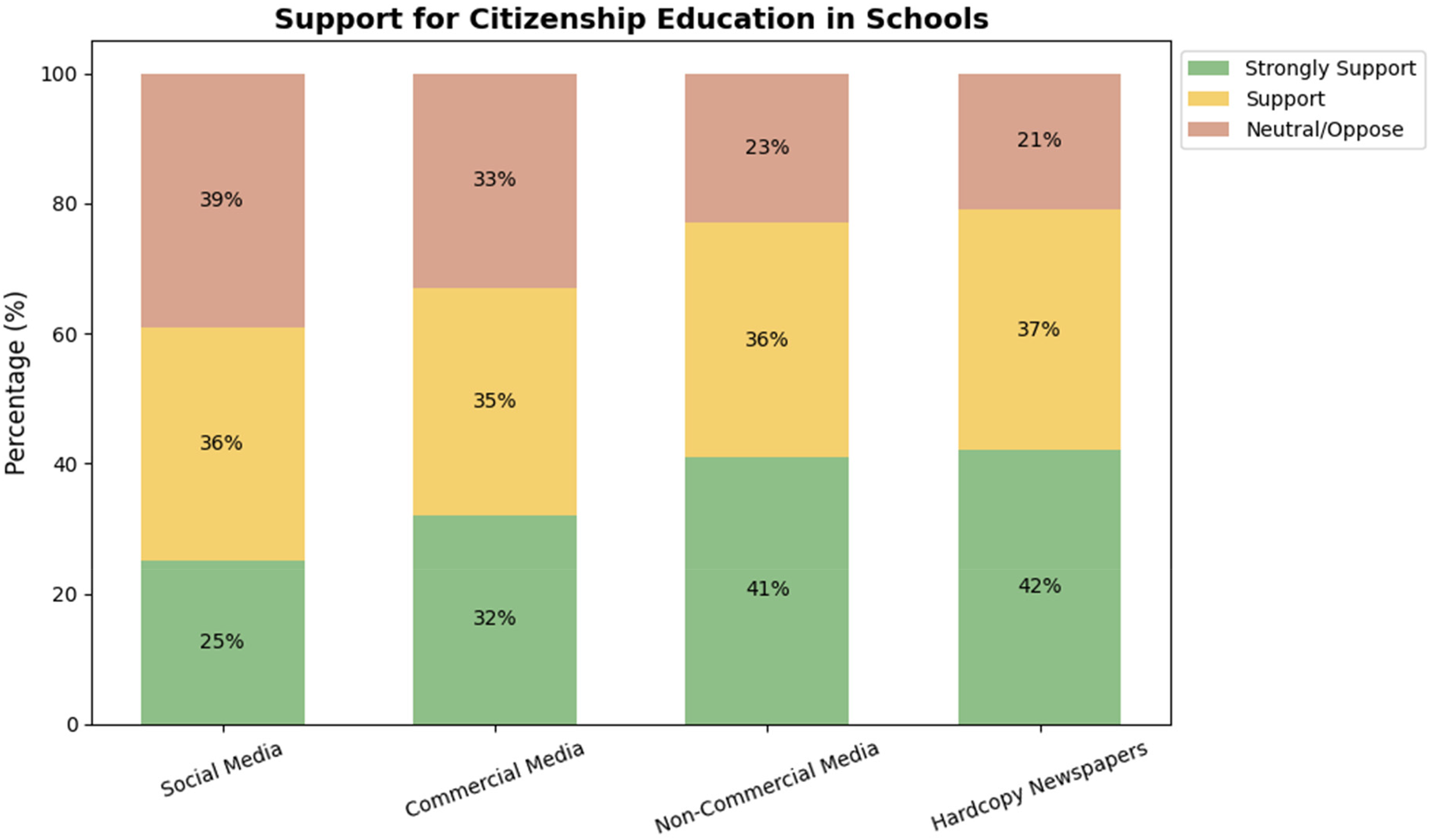
The strongest support for civic education came from respondents whose primary source of news was hard copy newspapers. Given the age of these respondents being much higher, it seems likely there is a generational effect. Those who relied primarily on hard copy newspapers had a median age over 60, whereas those who relied primarily on social media had a median age in the low 30 s. Older respondents were more likely to have received civic education themselves and thus may be more likely to support it. The lowest support was from those whose primary source of news is social media, perhaps reflecting the decline in civic education in recent years. Nonetheless, it is worth considering the possibility that those who have been subjected to the claim that social media are inherently democratic (because of the widespread access to the ability to publish one's own thoughts and to respond to public figures) might not desire a deeper understanding of what democratic deliberation entails, as they could consider their online engagement with others as democratic participation (Table 1).
Support for citizenship education by media consumption use.
B) strong(er) civic identity correlates with support for citizenship education
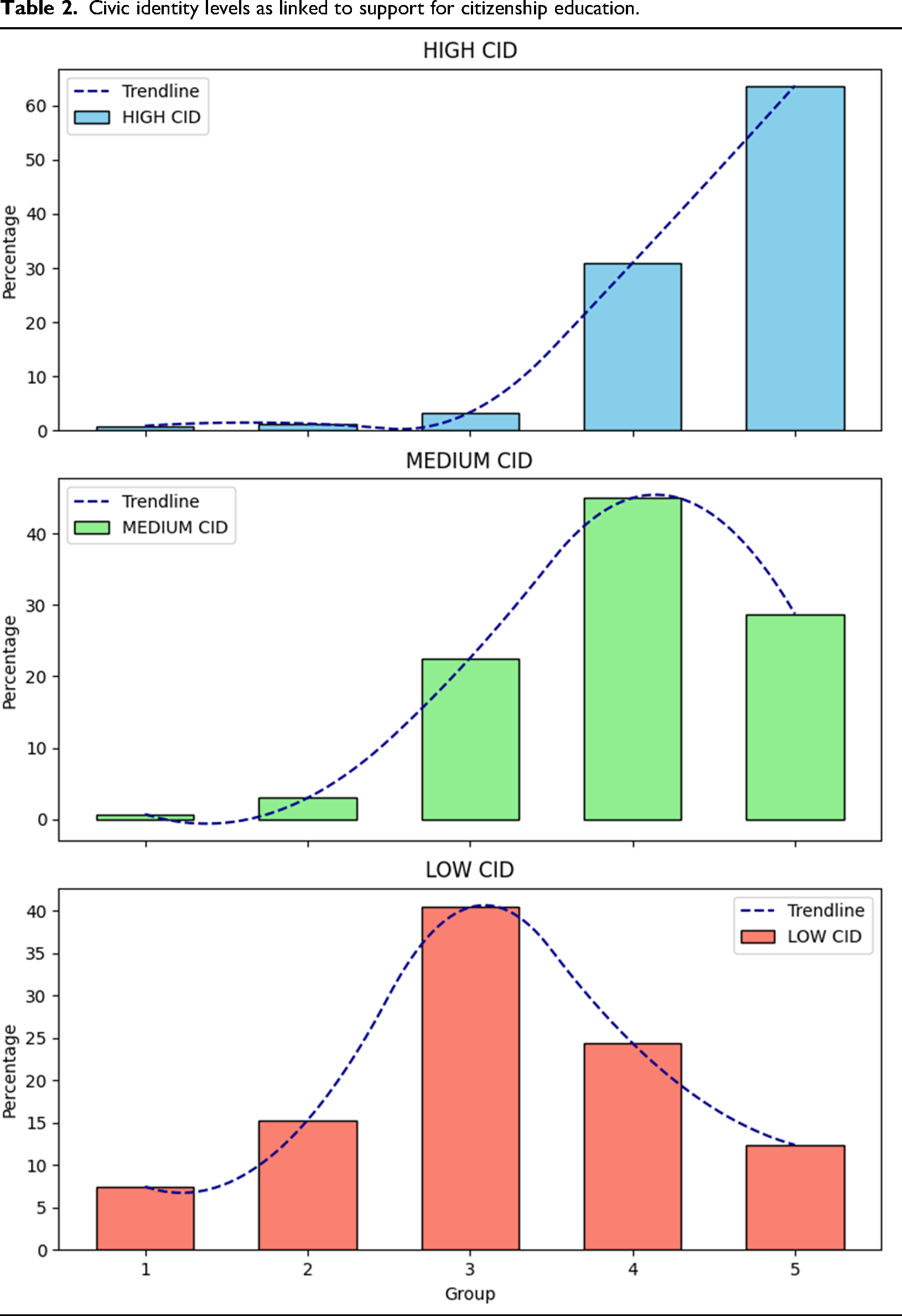
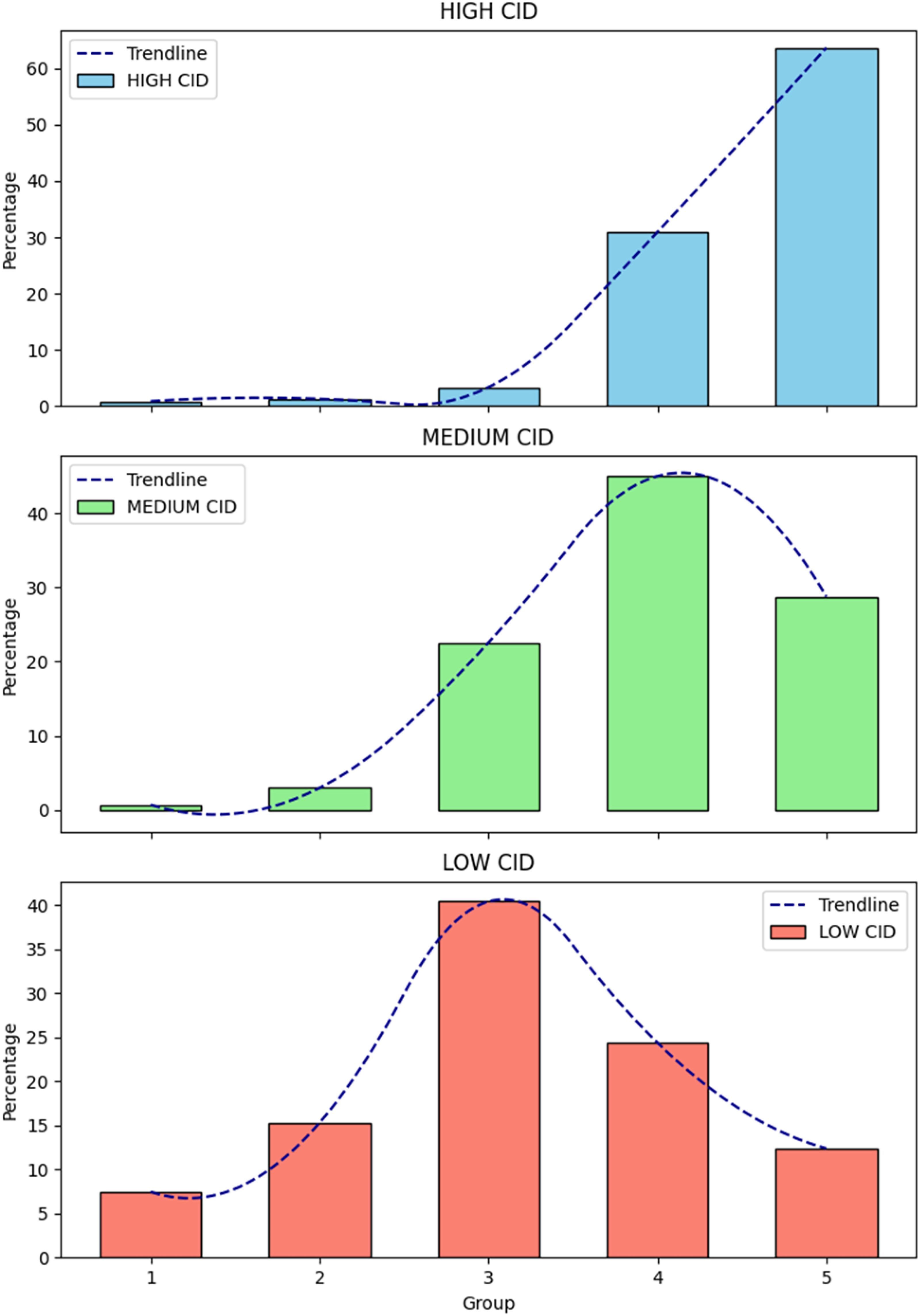
Observing and analysing three civic identity groups identified within the survey (high, medium, low), there was a strong correlation between civic identity of the participants and their support for citizenship education in schools. 0.8% of high and 0.7% of medium civic identity participants (making up 75% of participants) strongly disagreed with citizenship education, whereas 7.5% of participants, identified to be of low civic identity, strongly disagreed with citizenship education in schools altogether. Furthermore, 64% of the high civic identity group strongly agreed with the statement that schools have a duty to teach citizenship responsibilities to students. Only 29% of medium and 12% of low civic identity participants strongly agreed. In figure 1 (below), we can see that as civic identity increases (split into low, medium, high groups) so too does participants’ belief in citizenship education in schools. Those with low civic identity split in agreement with the statement, whereas medium and high groups tended towards agreement (Table 2).
Civic identity levels as linked to support for citizenship education.
C) strong support for primary and secondary schools to have a duty to teach citizenship responsibilities correlates with very high and high civic disposition
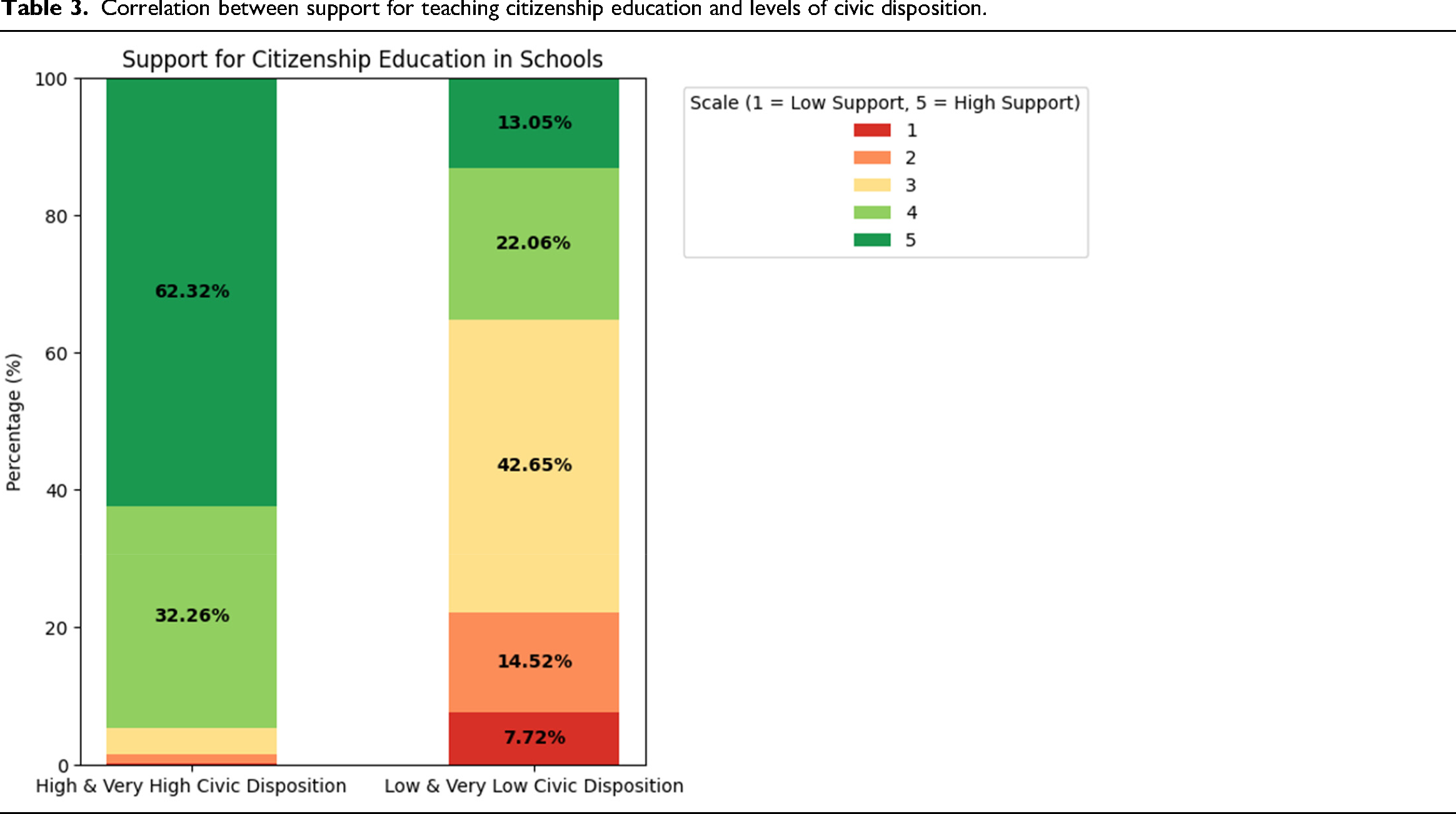
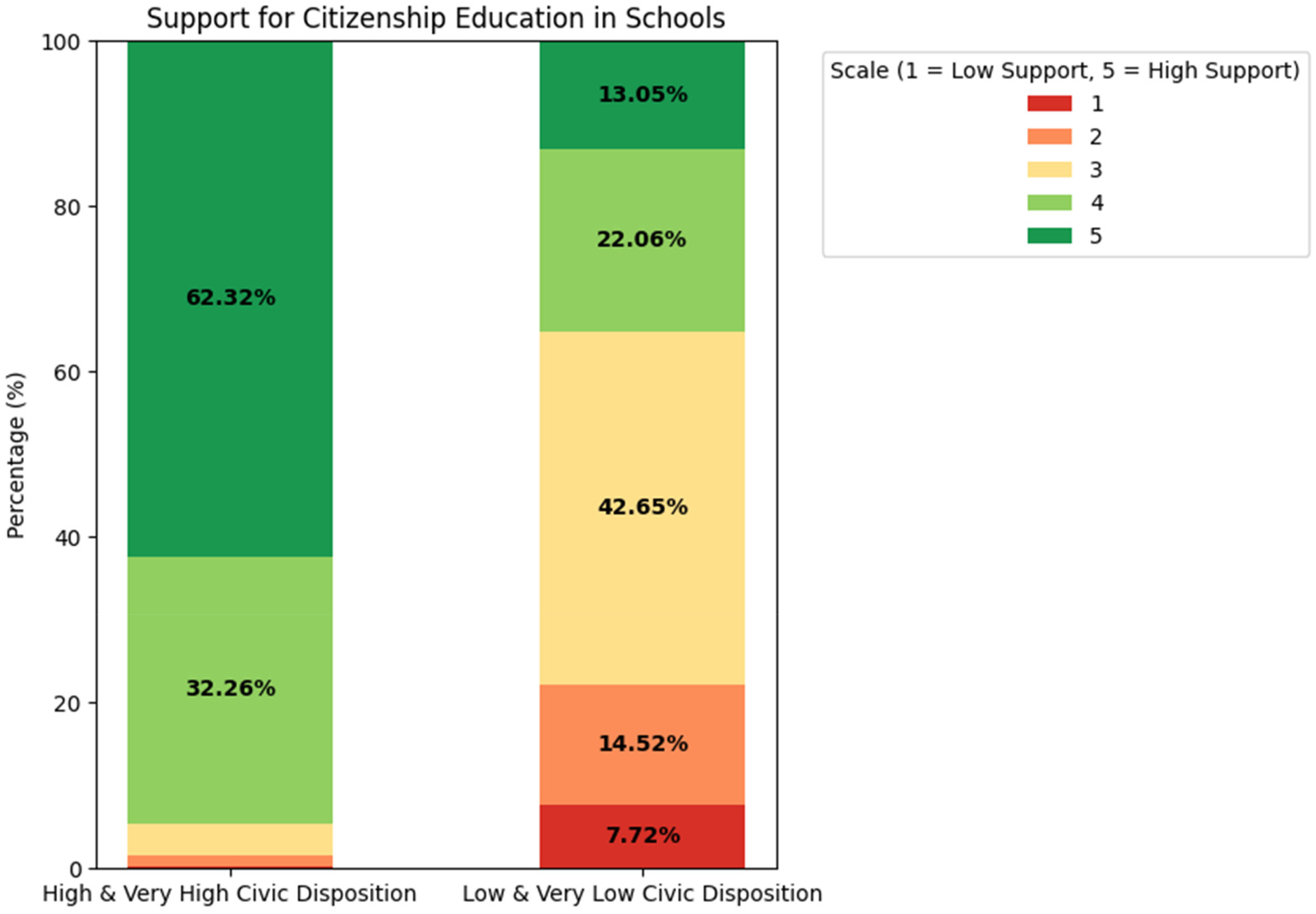
When we split our participants into quartiles on the civic disposition scale, only 35% of those in the bottom half support citizenship education in the schools. By contrast, more than 94% of those in the top half indicated support or strong support for citizenship education. When it comes to strong support for citizenship education, the difference is evident: only 13% in the bottom half of the scale compared to 62% in the top half (Table 3).
Correlation between support for teaching citizenship education and levels of civic disposition.
D) there is a correlation between commitments to both public good and shared interest and support for teaching citizenship
The notion of a shared public good or common interest is one way of recognizing the irreducible independence that characterizes social life. Clearly there are competing interests in any society, but there are also forms of mutual dependence. One of the questions we incorporated into the civic values scale is whether respondents recognize the existence of common goods or public interests. Of those who answered on the negative side of the scale, only 3 percent strongly supported citizenship education in the schools. By contrast, of those who answered on the positive side of the scale, indicating that they felt there was such a thing as a shared or common good, over 60% supported citizenship education.
E) there is a correlation between those who believe that it is a responsibility to pay attention to global issues and their support that schools should be teaching citizenship
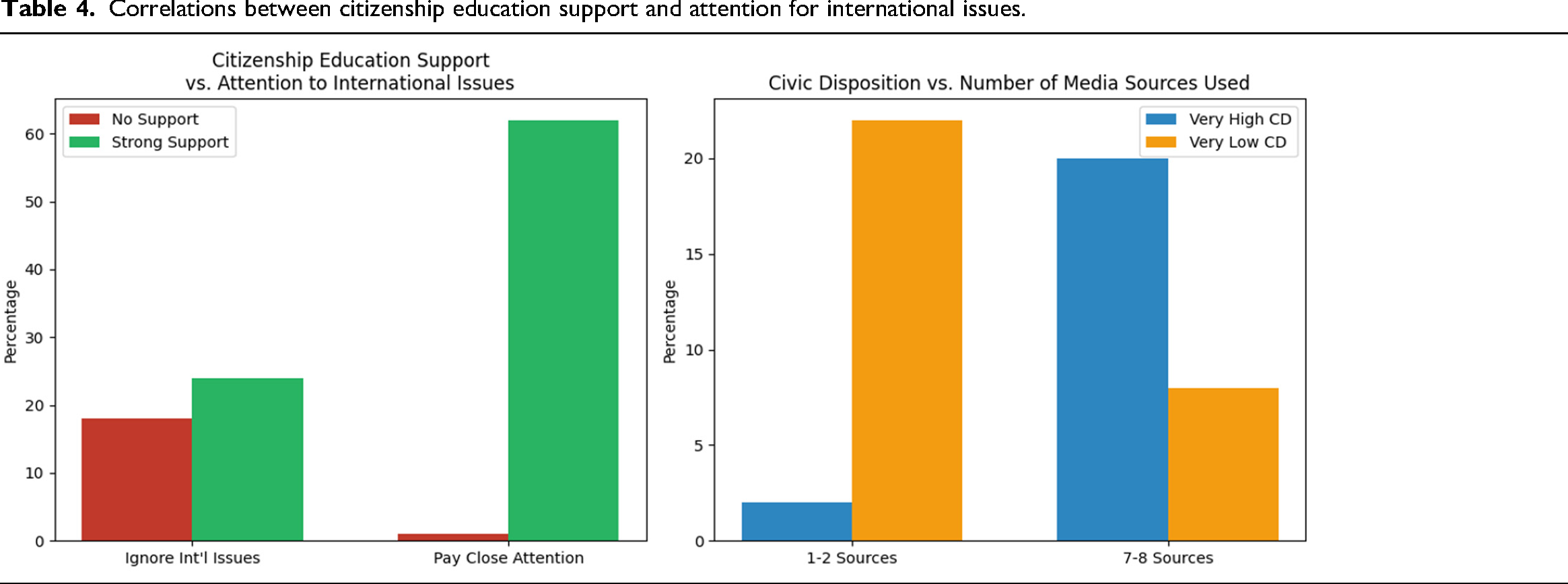
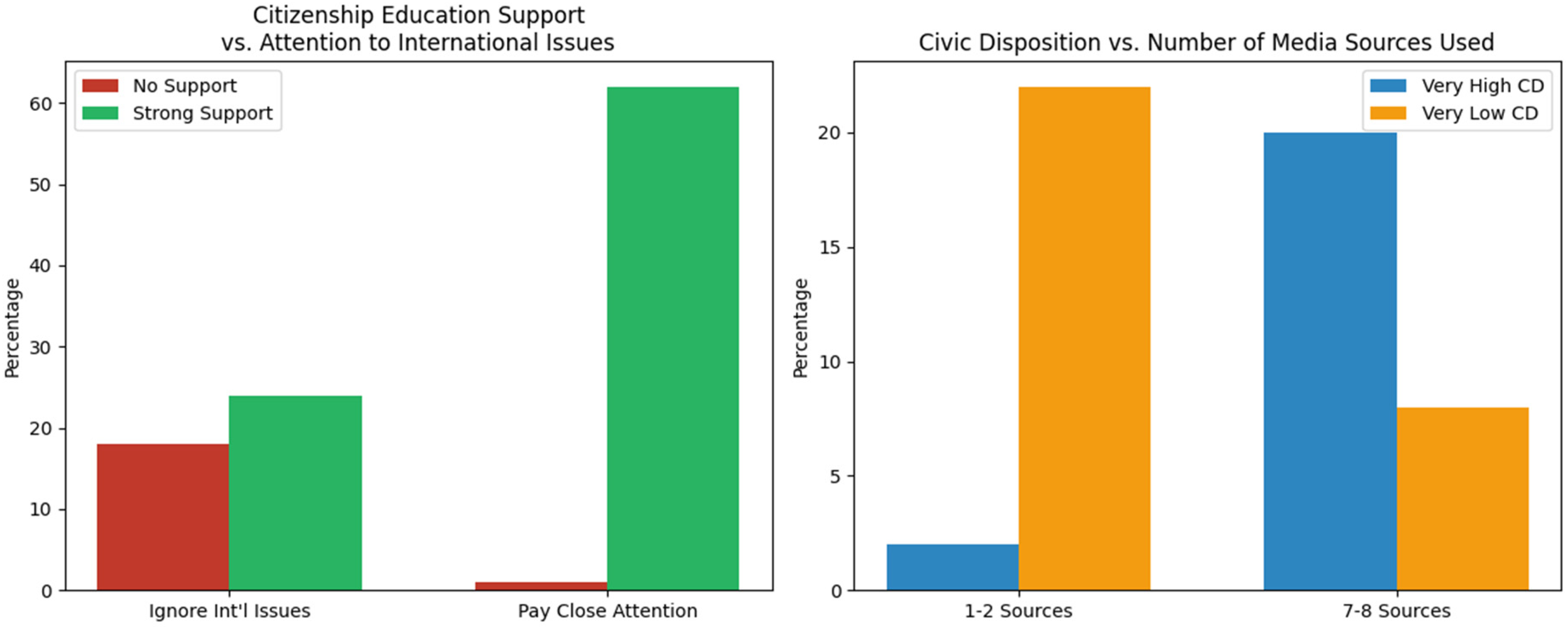
As a global citizenship approach focuses on ongoing social processes of the cultivation of global civic responsibilities and ethics (De Andreotti, 2011) and participation, engagement, claim-making and expression in shared spaces, it is key to understand how participants value the importance of participation in global political and civic life. 18% of people who claim: “I don’t pay much attention to international issues because what happens overseas does not have much impact in Australia” also do not think schools should be teaching citizenship. In striking opposition, only 1% of those that pay close attention to international issues share that point of view, with 62% instead in strong support of teaching citizenship in schools – compared to only 24% of those who ignore international issues (Table 4).
Correlations between citizenship education support and attention for international issues.
Conclusions
The use of both commercial and social media has a significant influence on how citizenship is not only understood, but also practiced and connected to the support for teaching citizenship education in schools (more in Johns and McCosker, 2015). As young people predominantly rely on social media for their news and information, they should be taught to identify and resist the anti-civic tendencies built into the platforms. This means understanding how they work and being able to envision alternatives – ways of being that are more civic and less consumer focused. Above all, perhaps, it means cultivating an approach to news and information that incorporates civic values and understandings. The notion, for example, that political perspectives are matters of personal taste and preferences that are exempt from deliberation, modification, and education is deeply anti-civic. In the current information environment, there is a pressing need to ensure that people understand the relationship between democracy and forms of discussion and deliberation that build on an underlying sense of interdependence and rely on generalizable forms of argumentation and evidence. Following Kennedy (2019; 2007) — young people need to be equipped with the capacity to not just evaluate information critically, but to cultivate their disposition towards information. As Pratte puts it, “civic virtue is not a matter of mere behaviour; it is a matter of forming a civic disposition, a willingness to act on behalf of the public good while being attentive to and considerate of the feelings, needs, and attitudes of others” (1988b: 17). A robustly civic attitude toward news and information is difficult to achieve without citizenship education. It does not come naturally but is the result of social cultivation – in the home, the schools, and the media. Given that we cannot expect it from the hyper-commercial media that are coming to dominate the information space, there is a need for increasing reliance on civic education in the schools. Resources are needed that will allow for a recognition of social interdependence and the related possibility of imagining a shared, public interest. The formation of such a disposition relies upon the cultivation of practices that foster turn taking: the ability to place oneself in the position of others, a talent for listening carefully, for discussing in ways that make recognizable claims on a shared sense of reasoning and a sense of common or shared interests. In the words of one of our participants (28 years), “…how can we bring people together or be more inclusive… I think it would come down to education. So give everyone the option… to know where they might sit and then make their own informed decision.”
Our concern is this article is to highlight the challenge posed by an increasingly commercial information environment in which emerging patterns of media use correlate with a lack of support for the very forms of knowledge and education that might counter the pathologies of that environment. On the basis of quantitative and qualitative methods, exploring Australians’ media habits and their civic disposition, we have found that people who rely on social media for their news score significantly lower on a civic values scale than those who rely on non-commercial broadcasters and newspapers. Both commercial and social media use correlate with lower civic values. By contrast those who rely primarily on public service media are much more likely to think schools have a duty to teach citizenship values (41% to 32%).
We argue for the need to continue to commit to teaching citizenship education, with inclusion of critical media awareness. Research indicates that levels of media and political knowledge affect the acceptance of democratic principles, attitudes toward specific issues, and political participation (Galston, 2001). Building on Livingstone et al. (2007), we argue that in the current digital media moment, media literacy is not enough: it must be supplemented with civic literacy and a corresponding civic disposition.
Footnotes

Ethical Considerations
This study was approved by the Monash University Human Research Ethics (Project ID: 41352) on February, 22, 2024).
Funding
This research was supported by the Australian Research Grant, DP230103037.
Australian Research Grant, DP230103037., (grant number DP230103037.).
Declaration of Conflicting Interests
The authors declared no potential conflicts of interest with respect to the research, authorship, and/or publication of this article.