



Abstract
The current study aims to examine students’ and teachers’ voices and views on the outcomes of the implementation of a curriculum as relevant and appropriate to enhance students’ citizenship skills by engaging them in dialogic and argumentative practices. To achieve the aim an innovative curriculum, consisting of 15 lessons per education level (pre-primary, primary and secondary) was developed. These lessons involved teachers and students in dialogue and argumentation around themes of citizenship education as cultural literacy using dialogue and argumentation as tools. The sample consisted of the responses of 134 teachers and 78 secondary school students. Overall, the curriculum was successful on supporting students on dialogue, argumentation and cultural literacy. A second finding has to do with teachers identifying changes in their practices related to dialogue and argumentation during the enactment of the curriculum. Furthermore, teachers underline the aspect of student enjoyment of the curriculum during the implementation. This finding supports the democratic and participatory aspect of the curriculum and adds a successful example of citizenship curriculum to the literature. Students emphasize as important aspects of the curriculum the fact that it makes the connection to everyday life, and is different from usual classroom related issues.
Introduction
Citizenship is a concept that is complex and fluid and has different meanings for different people (Joppke, 2007). Citizenship education as presented in schools currently seems to no longer meet the needs of society, and has been commented as being limited (Hummrich, 2018). Most of the traditional citizenship education curricula focus on legal aspects of being a citizen, rather than on the skills and dispositions necessary to become a citizen (Larrain et al., 2021). Furthermore, most of the curricula on citizenship education are developed within local educational systems, placing an emphasis only on topical issues (Branden, 2022) rather than on global skills and competences that are necessary for future citizens (Reynolds et al., 2020). Reports on democratic education (Merkel, 2014) suggest that an emphasis on skills and dispositions related to democratic competences can potentially support future citizens to navigate in a changing world (Michel, 2015). In our work we support that dialogue and argumentation can be used as curriculum tools to discuss values and dispositions and support students to develop skills related to citizenship that will help them live in the changing landscape (Fortes et al., 2022; Kuhn and Halpern, 2022; Rapanta et al., 2021).
Based on the argument that a new view of citizenship education “is now considered of crucial importance for building Europe by helping young people to become active, engaged, informed and responsible citizens” (Joris et al., 2022, 486), our group developed a curriculum for 5–15 year-old students focusing on the practical aspects of being a citizen in its natural sense. These practical aspects include for example belonging in a community, understanding the other, negotiating a shared understanding, and respecting others’ ideas in a community (Rapanta et al., 2021). The curriculum is based on the idea of citizenship education as cultural literacy, that is a set of values and dispositions developed through dialogue and argumentation, and was implemented in seven countries across three different age groups. The current study aims to examine students’ and teachers’ voices and views on the outcomes of the implementation of the curriculum as relevant and appropriate to enhance students’ citizenship skills by engaging them in dialogic and argumentative practices.
The implementation of this curriculum was challenging both for students and teachers. Students are expected to understand complex societal issues, develop a stance towards them, and articulate and support their views. At the same time, they are expected to try to engage with other viewpoints and negotiate meaning in order to identify synergies with their own stance. Teachers, on the other hand, are challenged in the sense of creating an appropriate classroom culture, use dialogue moves that aim to explore students’ ideas and, once these are expressed, find ways to handle multiple, possibly contrasting, viewpoints. These challenges make it imperative that we examine both students’ and teachers’ views and voices on the implementation of the curriculum with the goal of improving this further. The importance of the study lies on the fact that it focuses on the outcomes of a citizenship education curriculum that places an emphasis on skills and dispositions rather than on knowledge. Furthermore, the evaluation of the curriculum respects teachers’ and students’ voice, giving agency to participants who have a unique perspective on the implementation of the program (Cook-Sather, 2015). The research questions guiding this study are:
What are teachers’ views on the outcomes of a curriculum focusing on citizenship education as cultural literacy? What are students’ views on the outcomes of a curriculum program focusing on citizenship education as cultural literacy?
Citizenship education and what we have learned
Conceptualizing citizenship education
The concept of citizenship refers to people's joint and public activities that concern their common values and common purposes (Reynolds et al., 2020). Citizenship education focuses on how to instill citizenship to students (Althof and Berkowitz, 2006). A traditional division in this field is between civic education and citizenship education. The former refers to factual knowledge that students should develop about the government, the institutions, their own legal status and their constitutional rights (e.g., voting process) (Heggart et al., 2019; Reynolds et al., 2020). Concerning citizenship education, although it includes civic education, it places emphasis on the active engagement and participation of citizens in society (Reynolds et al., 2020), and in debates on public policy issues. As Mellor and Meiers (2010) put it, civics is about the cognitive understanding of being a citizen, whereas citizenship education is about developing a disposition towards that. Classroom discussions, therefore, do not only focus on ‘legal or juridical discourse focusing on rights and responsibilities’ (Reynolds et al., 2020: 65) of individuals, but also discourse on how individuals can participate in citizenship.
In order to place more emphasis on students’ engagement with society, and active participation in society, researchers argued for the term ‘active citizenship’ which provides more opportunities for students to express their opinions, make joint decisions and enact social actions ‘as an expression of civic responsibility’. Active citizens were defined by the UK Advisory Group (1998) as ‘people to think of themselves as active citizens, willing, able and equipped to have an influence in public life’ (7). Educating people to become active citizens, therefore, refers to both the political domain, as well as the social domain, which includes ‘”willingness to volunteer”, “confidence in the ability to make a difference in the social environment”, and/or “willingness to protest against injustice”’ (Geboers et al., 2013: 160). In the English context, Peterson and Knowles (2009) argued that active citizenship was associated with participation and volunteering, while in the US it was associated with service learning.
Citizenship education overlaps with moral education and character education. In fact, many authors have argued that ‘true democratic citizenship entails moral development’ (Althof and Berkowitz, 2006: 509). Morals refer to ‘thoughts, desires and actions that go against or suppress self-interest for the sake of promoting the interest of others’ (Meindl et al., 2018: 4). Moral education concerns the development of shared values, such as empathy (Hofmann, 2019), altruism (Eisenberg and Mussen, 1989), as well as their development. Character education, on the other hand, aims to improve student behaviour by reducing in-school violence, disorder or other disciplinary problems (Chen et al., 2021; Meindl et al., 2018). Therefore, it involves the development of ‘one's own identity, which is, by definition, a value-loaded endeavor’ (Geboers et al., 2013: 160).
The fluidity of contemporary societies and the changing nature of citizenship creates different levels of student engagement, that is local, national and even global (Reynolds et al., 2020). While being involved in school councils is a local type of engagement, a discussion around inclusion of all marginalised or excluded individuals and groups in society has global perspectives too. Furthermore, for citizens of the European Union, the concept of national citizenship does not only concern their own countries but their European citizenship as well. In the study of active citizenship, therefore, global dimensions emerge too (Reynolds et al., 2020). During the past decade, attention has been turned to citizenship education in schools as the response to diverse social issues of democracy (Joris and Agordag, 2019). In particular, UNESCO highlights global citizenship education (GCE) as a strategic area and uses it as a response to human right violations, inequality, poverty, threatened peace, and sustainability (Chen et al., 2021). It aims to help learners understand that these are global, not local issues and to become active promoters of more peaceful, tolerant, inclusive, secure, and sustainable societies (UNESCO, 2019).
Thus, the contemporary conceptualization of citizenship education has the goal of, not only creating citizens who understand civic life, but creating informed and active citizens, who are willing and well-equipped to engage in public dialogue and act towards the common good. Citizens who possess moral integrity and understand and promote values, such as democracy, tolerance, empathy, and justice. Such citizenship programs are sometimes described as democratic citizenship (Naval et al., 2002) and “aim to develop their [young people] capacity for thoughtful and responsible participation as democratic citizens in political, economic, social and cultural life” (p.110). An example of such an approach is the Education for Democratic Citizenship Project which aimed to provide knowledge, skills and competences for participation in democratic society, to create opportunities for dialogue, communication and conflict solutions and to support citizens to understand their rights and responsibilities (Council of Europe, 1998; 2018). The Council of Europe continued supporting the idea of democratic citizenship and in 2018 published the Reference Framework of competences needed for a democratic culture which described the context and concepts expected by learners in the EU to be able to live together in diverse democratic societies (Joris et al., 2022). Highlight the need for students to become ‘active and informed’ citizens (Reynolds et al., 2020), moving therefore in a model of democratic dispositions and active responsibility.
What we know about citizenship education programs
Policies across the world have been pushing for citizenship education that focuses on taking action, applying the participatory approach, and developing critical consciousness (Leahy, 2014). The changes in citizenship education are mostly driven by the international decline in participation in politics and elections (Guerin et al., 2013) and by the changes taking place in society, including amongst others, globalization, concerns for human rights, movement of population across countries and issues of social justice (Rapanta et al., 2021). Therefore, the biggest issue that citizenship curricula are currently trying to address is to engage in the process disengaged youth (Heggart et al., 2019).
Citizenship education programs around the world have been evaluated in order to identify characteristics and guidelines for successful citizenship education curricula (see Ahmed and Mohammed, 2022 for a systematic review). Tibbitts and Torney-Purta (1999) identified as the main limitation of citizenship education programs in a Latin America report the lack of linking education to issues of concerns to the students. In the same report the authors suggest that citizenship education curricula should focus on the following: have clear reference to goals linked to values, skills and knowledge; on democratic culture as a wholistic approach; involve students in community related issues; and on teachers as learners and that should be trained.
A report by Guerin et al. (2013) is using findings from the Eurydice (2015) report and the International Civic and Citizenship Study (ICCS) to summarize that critical thinking skills, values and attitudes are difficult to develop through current citizenship education curricula, especially since these require broad and complex thinking, and special training and support for the teachers to enable them to implement them in their classrooms. Furthermore, the aspect of active participation is also complex, especially since teachers might lack the necessary skills to engage students in such activities. On the other hand, Ahmed and Mohammed (2022) in a systematic review of global citizenship education programs present positive findings linked to successful citizenship education programs: participation in such programs supports achievement of students from all backgrounds, supports students’ independence, personal development and respect towards the other. Extra-curricular activities as a way to enhance citizenship education learning have also been explored and report positive results (Campbell, 2005; Keser et al., 2011). According to the same researchers, informal learning and extra-curricular activities involve being active in the community and predict greater civic involvement in the future.
Other than the effectiveness of citizenship education on students’ understanding and skills, researchers have also explored teachers’ voice on the implementation of such programs with findings showing that lack of teacher education opportunities and teaching resources make teaching citizenship education difficult (Kim, 2019). Furthermore, teachers’ beliefs and views on the aims and scope of citizenship education reveal a diverge understanding as to what should be included as part of citizenship education programs, with teachers in Western Europe supporting knowledge transmission and teachers in more developed and democratic countries emphasizing the need for independent thinking (Reichert and Torney-Purta, 2019). A more recent study focused on teacher practices in citizenship education of outstanding teachers in Chile (Zúñiga et al., 2020) and concluded that successful teachers have the willingness to introduce citizenship education topics, they use open learning environments and monitor learning through classroom interactions.
Nevertheless, despite the various studies in the field, a wholistic evaluation of a citizenship education program focusing on experiences of teachers and students is missing from the literature (Ahmed and Mohammed, 2022).
Dialogue and argumentation for citizenship education
Dialogue and argumentation skills are clearly fundamental to citizenship and especially active citizenship (Ackermann and Kavadarli, 2022; Advisory Group on Citizenship, 1998; Fortes et al., 2022). In order for citizens to be able and equipped to participate in public dialogue, deliberation and decision making about issues that concern them, they need to be able to engage effectively in dialogue and argumentation. We use the term dialogue’ to refer to specific forms of dialogue that have been identified as optimal for students’ development of understanding (Vrikki and Evagorou, 2023; Alexander, 2011). During dialogue students are expected to provide their own contributions, pay attention to other ideas being expressed, challenge other ideas, build on them, and pursue a common understanding without necessarily reaching consensus (Vrikki and Evagorou, 2023). Argumentation is a special form of dialogue aimed at justifying or defending a standpoint for an audience (Van Eemeren et al., 1996) and refers to the process of assembling the components of an argument. Essentially argumentation is a process of social construction of knowledge, in which people collectively discuss and decide on the construction of shared social knowledge (Evagorou and Osborne, 2013). Learners engaging in argumentation need to evaluate alternative perspectives and opinions and select a solution that is supported by evidence and explanation (Cho and Jonassen, 2002). Hence, one of the main distinctions between dialogue and argumentation is that in the latter participants need to evaluate alternative solutions or scenarios and, based on evidence, decide on a course of action. In dialogue students do not necessarily need to reach consensus, but they can agree that they disagree on some aspects. In this study both dialogue and argumentation are used as terms since citizens must understand that there are multiple perspectives on moral and social issues and that their own view is only one of many possible viewpoints (Geboers et al., 2013). Additionally, citizens should appreciate that in some cases evidence can lead to specific decisions and multiple viewpoints are refuted (Evagorou and Osborne, 2013). Having realized that, citizens should be able to deal with the diversity of viewpoints, but also a possible intrapersonal conflict; this can happen when individuals are being exposed to alternative and convincing views, which makes them doubt their own view. In addition, citizens should develop a critical stance towards other views by weighing evidence before positioning themselves in a debate (Advisory Group on Citizenship, 1998)
The desired dialogue and argumentation skills of citizens have an impact on the choice of pedagogy that is suitable for citizenship education. Althof and Berkowitz (2006) acknowledge that students need social and participatory skills for effective citizenship. These include ‘the ability to reason, argue and express own views in political discussions’ (503), as well as conflict solution skills. Similarly, teachers should be able to lead ‘debates on controversial issues’ and create ‘open and enlightened classroom discussions’ (Liu et al., 2021: 4). In addition, teachers are responsible for ‘establishing a secure classroom climate, in which all students are open and willing to express points of view which disagree with those held either by their peers or teachers’ (Liu et al., 2021: 4). These pedagogical goals can be achieved through the “participatory approach” to teaching citizenship education, in which students ‘exchange and co-construct their political knowledge, build up an identity in the group, and learn to achieve a common target by collaborating with their peers’ (Liu et al., 2021: 10).
Dialogue- and argumentation-based pedagogies
The value of dialogic and argumentative practices has been acknowledged in recent years due to the links identified with student learning gains and with twenty-first century skills, such as critical thinking (Puig and Jiménez-Aleixandre, 2022). Dialogic classrooms are student-centred, meaning that students are encouraged to contribute extensively in discussion, build on ideas, identify links between ideas, justify their views and work collaboratively towards resolving disagreements, where possible. Knowledge is jointly constructed in such classrooms, as students have the opportunity to express ‘half-baked’ thoughts and allow others to help them develop them further. In this environment, the teacher's role is to facilitate such practices mainly by posing open-ended questions, encouraging students to act as described above, and creating opportunities for groupwork. Groupwork is a core activity in dialogic classrooms because in small groups more students have the opportunity to actively engage in productive discussions.
Challenges in implementing dialogic and argumentative practices
Despite the acknowledged value of dialogic and argumentative practices and the increasing amount of evidence associating them positively with student learning gains, there are challenges in implementing them in practice. Observational studies have shown that classroom interactions are still dominated by teacher-centred, authoritative talk with little opportunities for students to engage in productive discussions (Haneda, 2017). In a large-scale study measuring naturally occurring dialogues in British primary schools, Howe et al. (2019) reported that lessons were dominated by turns involving non-dialogic discussion. Even in the cases of intervention studies, where researchers aim to promote dialogic teaching through professional development efforts and then measure its effect, it is clear that there is no ultimate success. In a Dialogic Video Cycle programme, Pehmer et al. (2015) found no change in teachers’ questions and students’ talk, although change was observed in teachers’ feedback. In Lefstein and Snell's (2014) one-year programme promoting interactional awareness assessed teachers’ questions (e.g., open, closed, uptake), teachers’ feedback (e.g., elaborated, non-elaborated), and students’ contributions (e.g., response to teacher, spontaneous contribution, choral response). The sole increase was openness in teachers’ questions. It is clear, therefore, that implementing dialogic and argumentative practices has its challenges.
First, an appropriate classroom culture or, as it is called, a dialogic ‘ethos’ is essential (Wegerif, 2020). This refers to an environment where students feel safe to express their ideas, knowing that all ideas are being respected and are considered to be valuable. The discussion of citizenship education topics, related to issues of morality, justice, tolerance, empathy and inclusion, often yield multiple views, that participants in dialogue have to reflect on and evaluate (Rapanta et al., 2021). Changing classroom culture is one of the challenges of implementing dialogic teaching.
After examining dialogic teaching in Czech lower secondary schools, Sedova et al. (2014) discuss other challenges, because although teachers praised the benefits of dialogic teaching, they were not capable of fully implementing it in their teaching. The authors argue that one challenge is the openness of the lesson plan of dialogic lessons, which allowed unexpected responses from the students. Handling such situations required teachers who were very knowledgeable in their fields, as well as skills in managing spontaneous questions (Sedova et al., 2014). Another challenge related to the collective nature of dialogic teaching (Alexander, 2011), which refers to collective participation in classroom discussion; this clashed with the ‘strong heterogeneity of students’ (282) in terms of their interest in the subject and their aptitude. Teachers’ scaffolding in these situations was difficult to plan because of the required individual diagnosis. A further challenge related to the purposeful dimension of dialogic teaching, which refers to teachers teaching is oriented towards specific educational goals (Alexander, 2011). Teachers viewed dialogue ‘as carefree conversation whose aim is to make a lesson enjoyable rather than deepen the students’ understanding’ (Sedova et al., 2014: 283) and, thus, that it took time away from covering the subject matter. The authors concluded, therefore, that while ‘the concept of dialogic teaching is satisfactorily developed in theory, it is only infrequently realised in everyday teaching at Chezh schools’ (283). Teachers seem to be ‘limited by the curricula of their schools and their own skills’ (283).
Summarize the gaps
Most of the studies evaluating citizenship education programs place an emphasis either on students or on teachers, ignoring a more wholistic approach of including the voice of all stakeholders in the process (see Ahmed and Mohammed, 2022). Findings from previous studies show that citizenship education programs can be successful in supporting students to understand the fluidity of their identities and accept others, especially when these programs are focusing on active participation (i.e., Guerin et al., 2013). Despite the success of some programs, teachers continue finding it difficult to implement them as they seem to lack the necessary teaching resources and support (Kim, 2019). Our study seeks to address this gap by exploring both teachers’ and students’ views about the outcomes of a citizenship education curriculum who was structured in a way to support teachers through a professional development program to introduce citizenship in their classes.
Methods
This paper is part of a larger European research project called (thereafter, X). Taking place in pre-primary, primary and secondary schools in seven countries the project aims were twofold: (a) to engage students in citizenship education as cultural literacy, which was defined by values such as empathy, tolerance and inclusion, and (b) to emerge teachers in practices related to citizenship education.
Sample
The sample of the current study consisted of the responses of 134 teachers and 78 secondary school students who had participated in the project and had completed the online questionnaires that were administered towards the end of the project. The teacher questionnaire was completed online after the end of the PD, in which in most of the participant countries was completed before the pandemic. The teacher participants came from seven countries who implemented the curricula (Cyprus, Germany, Lithuania, Israel, Portugal, Spain, UK). Of those 134 teachers, 35 (26.1%) taught in pre-primary schools, 60 (44.8%) in primary schools, and 39 (29.1%) in secondary schools. All 78 students were secondary school students (14–15 year-old) who responded to the questionnaire online during the pandemic lockdown. Based on the initial design of the project, questionnaire data would be collected by all student participants. However, the implementation of the curriculum was interrupted by the first global lockdown and because of ethical approvals the research groups in the partner countries were only able to collect anonymous data from secondary school students from six countries (Lithuania, Israel, Portugal, Spain, UK). The students who participated in the implementation of the curriculum all came from public schools, with the majority (69%) from urban school environments.
The curriculum
To achieve this aim of engaging students and teachers in citizenship education as cultural literacy, an innovative curriculum, consisting of 15 lessons per education level (pre-primary, primary and secondary), was developed. These lessons aimed to involve teachers and students in dialogue and argumentation around themes of citizenship education as cultural literacy using dialogue and argumentation as tools. All lessons used a story (from a wordless text) to introduce the issue. The lesson plans proposed practices identified by the literature as beneficial for the successful development of dialogue and argumentation; they included suggested open questions for teachers to ask in whole-class contexts, groupwork activities around ‘talking points’ for students to engage in, and the development of ‘ground rules for talk’ (Mercer and Littleton, 2007). One of the initial goals of the curriculum was inter-country and intra-country collaboration between the teachers and students, something that was not realised because of the pandemic lockdown which interrupted the program. The development of the program and its content is presented in detail elsewhere (for more information see Rapanta et al., 2021). The curriculum was the outcome of a collaboration between researchers and teachers using a bottom-up approach for the design.
A professional development program (PD) was designed to support teachers to engage their students. The PD aimed to develop teachers’ understanding of the concept of citizenship education as cultural literacy, and practices of dialogue and argumentation. Teachers were introduced to aspects of dialogue and argumentation and instructional practices to support them during the implementation of the program. Furthermore, all teachers were provided with the 15 lesson plans (the curriculum) and other materials to use during their teaching. Almost all teachers who participated in the PD in the seven countries implemented the program with their students and data from the classroom implementations were collected. The implementation of all 15 lessons was interrupted by the March 2020 school lockdowns because of the pandemic. Most of the teachers implemented 8–10 lessons from the program before the school closure, and the professional development courses in all seven countries were completed either before the lockdown or in some cases online.
Teachers’ questionnaire
At the end of the PD a questionnaire was administered to the teachers. The questionnaire was created to collect teachers’ voice about the implementation of the program consisted of four main sections. The first section aimed at obtaining information on teachers’ views on the professional development program. The second section aimed at identifying how the program was implemented. The third section aimed at measuring the outcomes of the program, while the fourth section aimed at obtaining information on whether teachers had plans to use the program in the future. The questionnaire was mostly composed of Likert type items on a 5-point scale, (1 = strongly disagree, to 5 = strongly agree), while eight open-ended items were also included to supplement the questionnaire with richer qualitative data. For the purposes of this study only data from third part of the questionnaire are used.
Student questionnaire
A student questionnaire was developed for collecting data on students’ voice. Due to the school closures because of COVID-19, the questionnaire was administered online and only secondary school students were invited to complete it. Younger students in the project (i.e., pre-primary and primary school students) would not have the literacy or technical skills to complete the questionnaire, especially online. Secondary school teachers offered to share the questionnaires online with their students. The student questionnaire consisted of two sections and aimed to collect students’ voice on the outcomes of the implementation of the program. The first section of the questionnaire consisted of 4-point Likert scale items (1 = strongly disagree, to 4 = strongly agree) that aimed to collect students’ responses on their enjoyment of the program, their learning and their development of skills and dispositions linked to citizenship education. The second section consisted of two open-ended questions which asked the students to state what they liked and what they disliked the most from the implementation of the project.
Analysis of teacher and student questionnaire
To analyze the teacher and student questionnaire the following steps were followed separately for each questionnaire:
Step 1: The questions were grouped together based on three categories: (a) dialogue and argumentation questions, (b) cultural literacy questions, and (c) enjoyment. The categories were formed based on the design of the questionnaire. Step 2: The responses for the Likert scale questions were added in SPSS and the mean for each statement was calculated. Then questions in each category were ranked from highest to lowest. The descriptive statistics of this analysis are presented in the results. Step 3: The open-ended questions in both questionnaires were read looking for themes related to dialogue and argumentation, cultural literacy and enjoyment. Based on the open coding of the teacher questionnaire two main categories were formed, namely what students learned, and difficulties and challenges from implementing the program. The open coding of the student questionnaire focused on the two open ended questions asking the students to identify what they liked and what they disliked about the program. Based on the responses six categories were identified. The categories with representative quotes are presented in the results section of the paper.
Results
The descriptive statistics of the items that compose the teacher questionnaire are presented in Table 1. Specifically, Table 1 presents the average in three different categories: (a) views related to teaching practices and student outcomes in dialogue and argumentation, (b) views related to teaching practices and student outcomes in cultural literacy, and (c) teachers’ perception of student enjoyment with the program.
Descriptive statistics of items in teacher questionnaire.
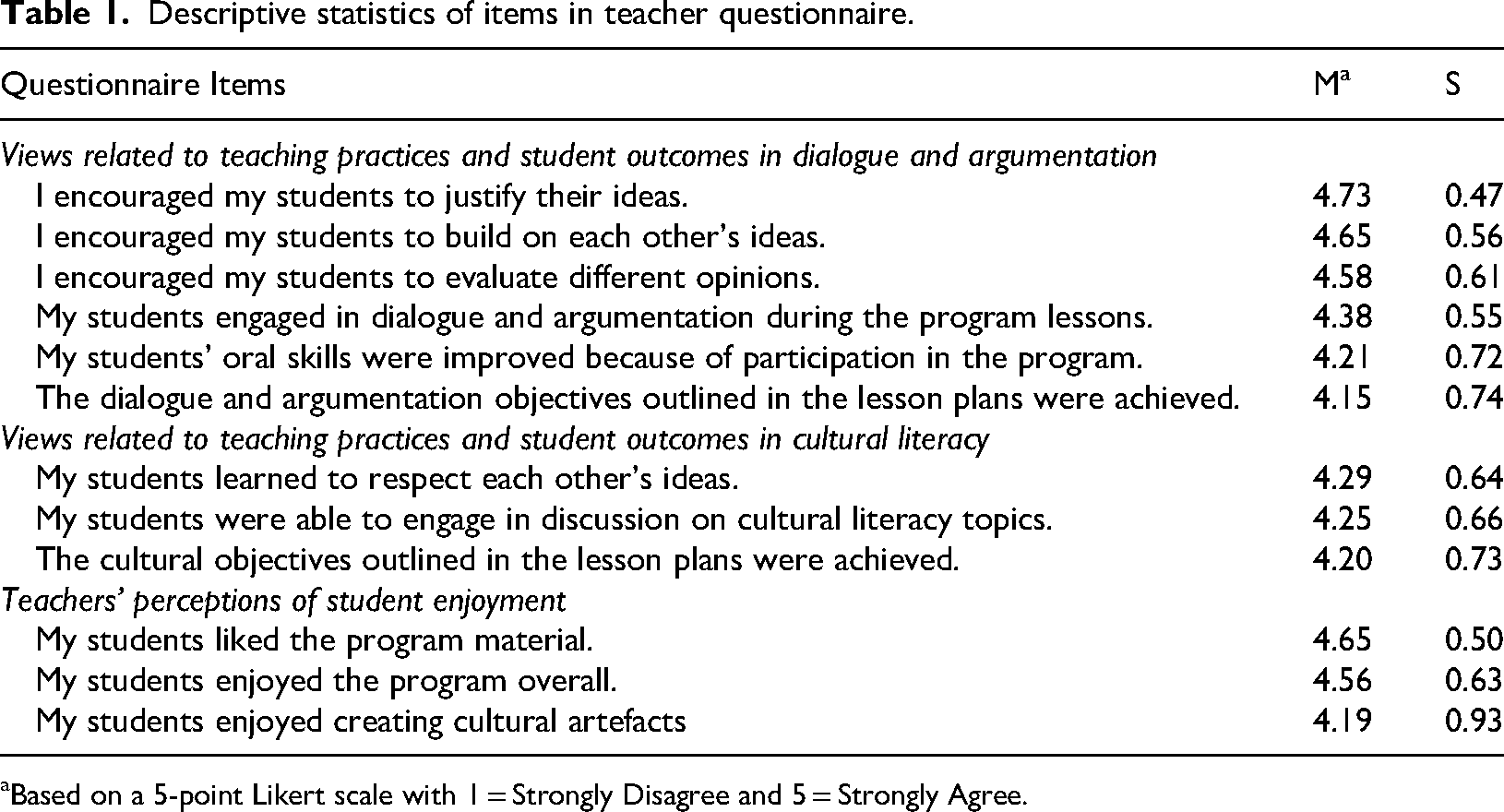
Based on a 5-point Likert scale with 1 = Strongly Disagree and 5 = Strongly Agree.
Overall, based on the teacher responses, the program was successful with items ranging from 4.73 on “I encouraged my students to justify their ideas” as the highest, to 4.15 that was the lowest referring to “Dialogue and argumentation objectives outlined in the lesson plans were achieved”. Furthermore, teachers evaluate their teaching practices in dialogue and argumentation, and student enjoyment of the materials and program very high. Teachers evaluate student outcomes in dialogue and argumentation and in cultural literacy somehow lower (i.e., My students’ oral skills were improved because of participation in the program, with 4.21), but the evaluation is still high.
The descriptive statistics of the items that compose the student questionnaire are presented in Table 2. The student questionnaire was presented in a 4 point Likert scale (in contrary to the teacher questionnaire that was presented in a 5 point Likert scale). Table 2 presents the average in students’ views in three different categories: (a) their outcomes on dialogue and argumentation, (b) their outcomes on cultural literacy, and (c) their enjoyment of the program.
Descriptive statistics of items in student questionnaire.
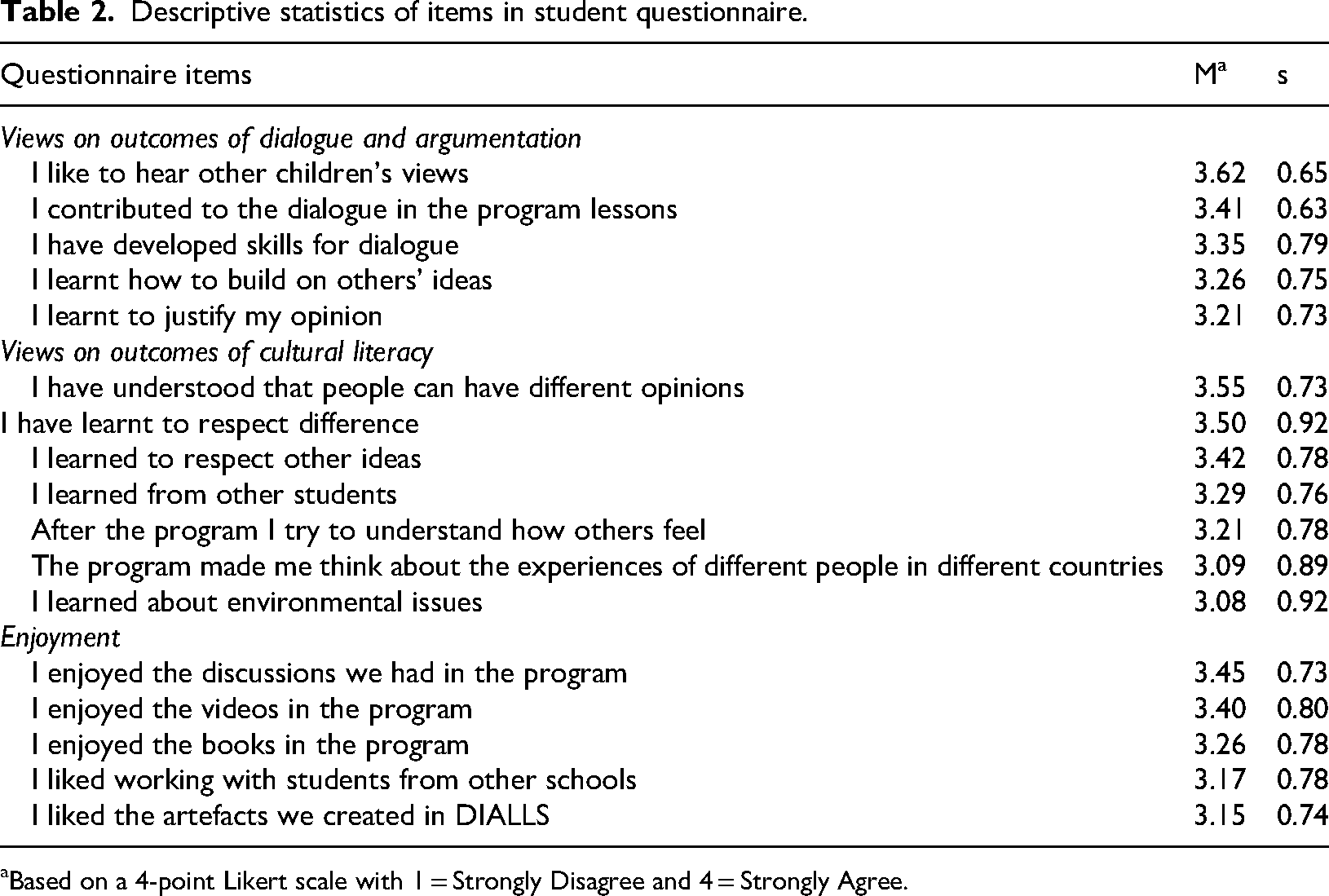
Based on a 4-point Likert scale with 1 = Strongly Disagree and 4 = Strongly Agree.
Overall, based on the student responses, the program was successful with items ranging from 3.62 on “I like to hear other children's views” as the highest, to 3.08 that was the lowest stating “I learned about environmental issues”. Student responses indicate that they have learned to respect other people, different opinions and ideas and differences, and that they have developed their dialogue skills, whilst at the same time enjoying the curriculum. Aspects of the curriculum with lower scores had to do with learning about environmental issues and learning about the experiences of people in different countries.
To explore teachers’ and students’ voice in detail, the open-ended questions from the questionnaire were analyzed. Table 3 below presents teachers’ voice regarding what students learned as part of the program, and the difficulties and challenges in implementing such a program.
Teachers’ voice regarding the curriculum.
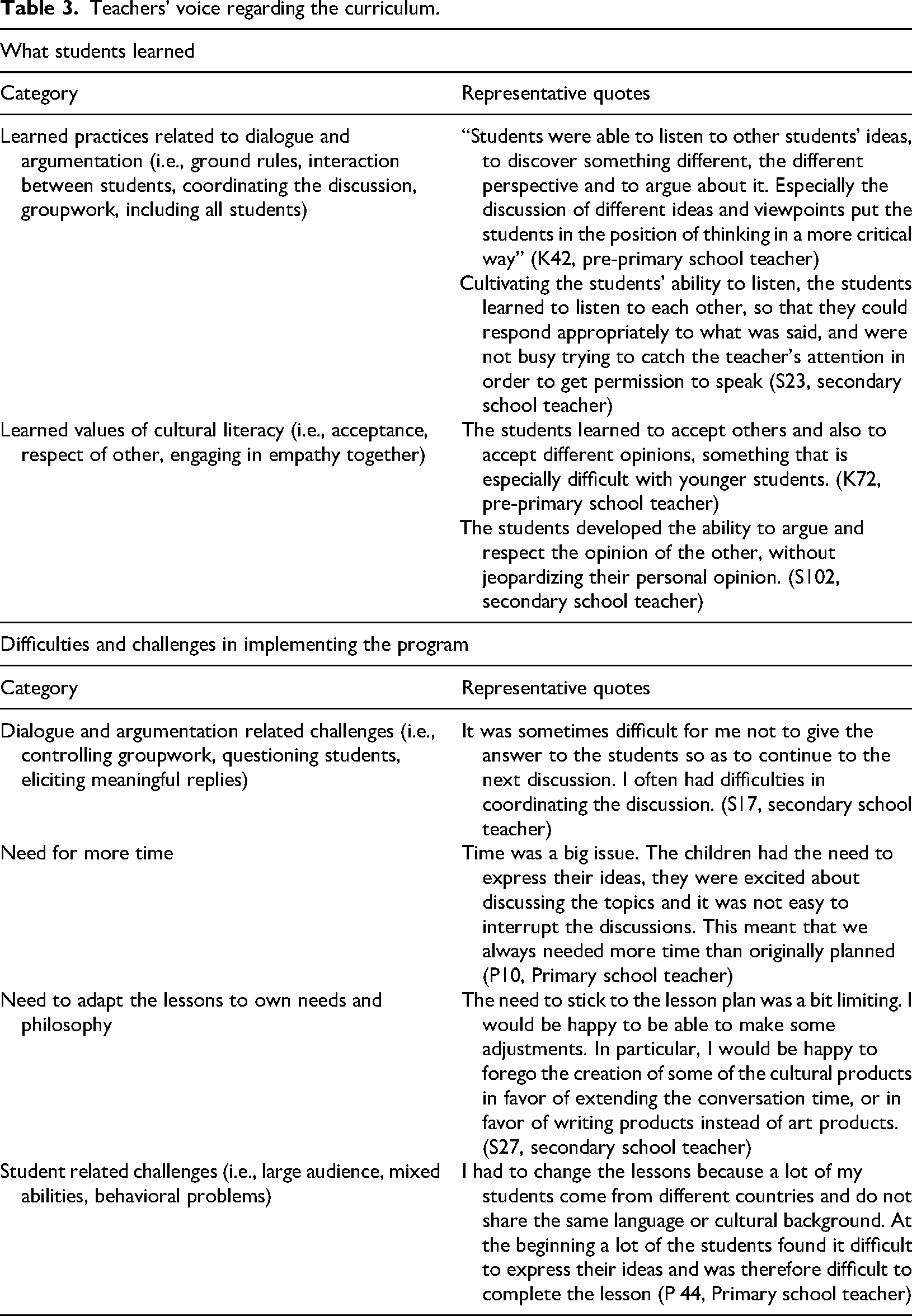
Based on teachers’ voices, during the implementation of the program the students had the opportunity to engage in dialogue and argumentation and learn specific practices related to working in groups and having ground rules for discussion. Additionally, students learned values related to cultural literacy, as for example accepting others and accepting different opinions. Furthermore, teachers reported challenges implementing the program that had to do with the need for more time for students to engage in discussions, and the necessity of supporting teachers to acquire practices related to dialogue and argumentation and adapting lessons to classroom characteristics and needs.
To explore students’ voice in detail, the open-ended questions from the questionnaire were analyzed. Two open questions were asked for the students to reflect on: what they liked and what they disliked about the program. Table 4 below presents students’ voice regarding what students liked as part of the program and what they would like to see being changed.
Students’ voice regarding the program.
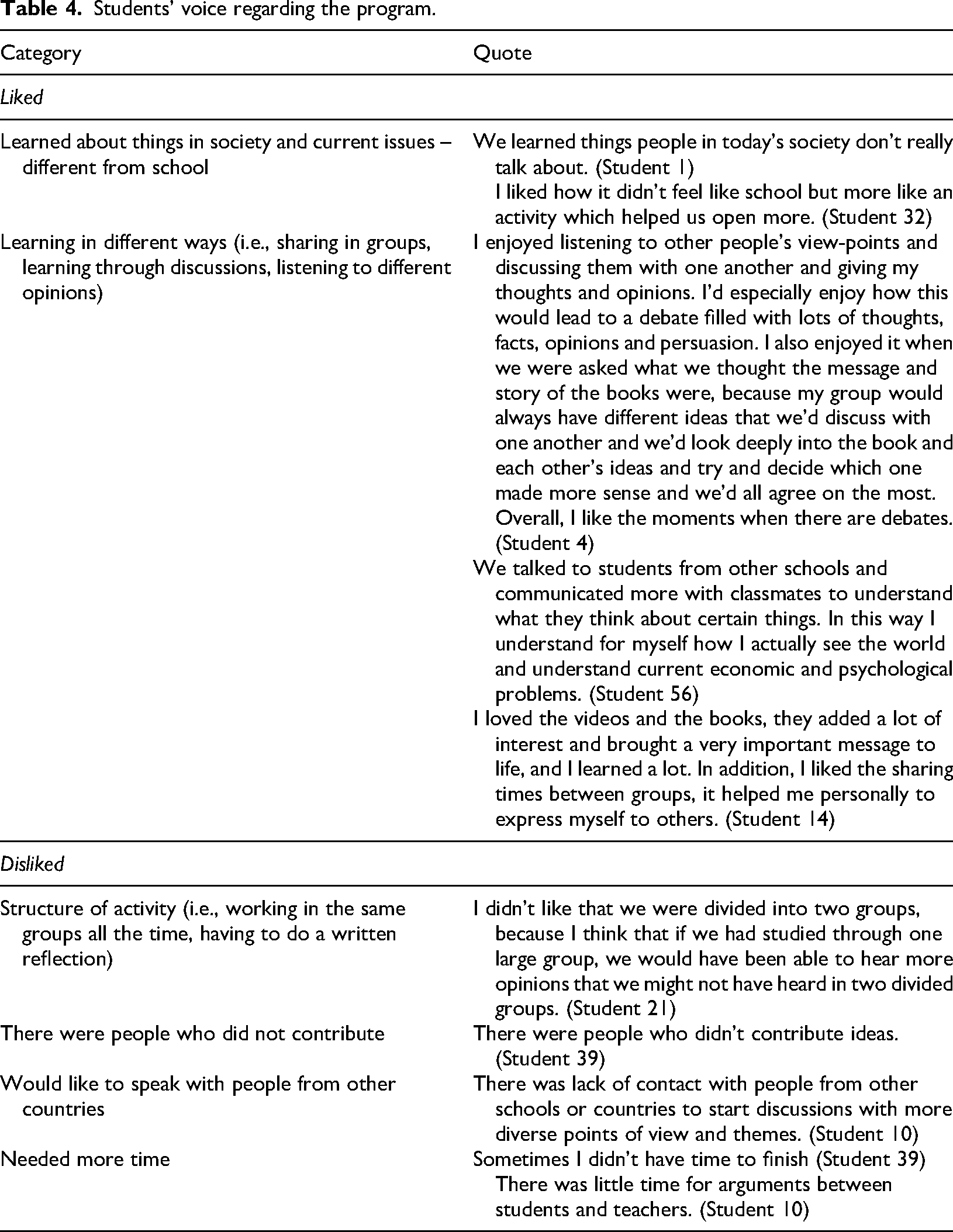
Students’ responses to the open-ended questions suggest that aspects of the program related to sharing your viewpoint and discussing different opinions were the highlight of the program, along with the fact that, as students’ put it, engaging in the program did not feel like school. Students’ criticism of the program focuses on the lack of time to listen to all opinions and discuss with teachers and other students, and organizing the activities (i.e., working with the same group each time). Furthermore, students comment that they would like to contact people from other schools and other countries, something that was planned to take place but was disrupted by the pandemic lockdown.
Findings and conclusion
The current study aimed to examine the outcomes of the implementation of the curriculum as relevant and appropriate to enhance students’ citizenship skills by engaging them in dialogic and argumentative practices. Specifically, the questions driving this study were concerned with teachers’ views (R.Q.1) and students’ views (R.Q.2) on the outcomes of a curriculum program focusing on citizenship education as cultural literacy. The first finding of this study, associated with the first research question, is that teachers consider the specific curriculum as successful on supporting students on dialogue, argumentation and cultural literacy and they have identified changes in their practices related to dialogue and argumentation during the enactment of the curriculum. This finding is important, especially when linked with findings from previous studies highlighting that implementing dialogic practices has many challenges for teachers (Lefstein and Snell, 2014). For example, previous studies have reported changes in teachers’ practices related with dialogue and argumentation over a longer period of time (Sedova et al., 2014). According to research, changes in teaching practices are associated with how teachers introduce the topic, the type of questions they ask (Vrikki and Evagorou, 2023), and how they engage students in discussions (Pehmer et al., 2015). We acknowledge the limitation of self-reported changes in practice, but findings from classroom observations from our study highlighting change in practice are reported elsewhere (Vrikki and Evagorou, 2023) and show that during the implementations of lessons and when comparing initial lessons to lessons at the end of the implementation, most the teachers improved specific dialogic and argumentative practices such as asking open ended questions and responding to students in ways that could support continuing the discussion in an open, inclusive and democratic way.
A second finding is teachers underlining the aspect of student enjoyment of the curriculum during the implementation. Specifically, most of the teachers highlighted that students enjoyed the lessons and were asking for more similar lessons. Studies exploring students’ emotions and enjoyment during the learning process support that such emotions can be motivating for students and can also help them in seeing the connection between school knowledge and real life (Evagorou et al., 2015). Finally, a third finding from the teacher perspective is that despite the teacher professional development and the ready to use materials that were available to teachers, they still report some challenges. These challenges have to do with time (i.e., they need more time for the implementation), teaching practices (i.e., more information on how to support groups), and adapting lessons to diverse population (i.e., how do you implement the lessons in a classroom with students from different linguistic backgrounds). These challenges can potentially be addressed through long-term teacher professional development and the use of communities of practice to support teachers with the implementation of innovative materials (Chalmers and Keown, 2006).
Regarding the second research question about students’ views on the implementation of the curriculum, the students also report similar challenges that are linked to limited time (i.e., need more time to discuss during the lesson), and also the need for better practices in managing group activities (i.e., use different groups each time). Despite the reported challenges, overall, the program was rated as successful by the students and ticks points reported in the literature highlighting links to students’ everyday lives. The curriculum focuses also on values, skills and knowledge, addressing the limitation of previous curricula as highlighted by Ahmed and Mohammed (2022) in their recent review. Given that contemporary citizenship education curriculums aim to talk to the issue of disengaged youth (Heggart et al., 2019), a curriculum that is enjoyed by students is highly relevant and important. Additionally, if we consider the participants of this study, secondary school students, we hypothesize that the issues that were included as part of the curriculum, and the pedagogical practices can afford engagement of students.
In conclusion, the findings of the current study are consistent with prior research on teacher and student views but offer a wholistic evaluation of the designed lesson plans as a citizenship education program that can be used to support both teachers and students in improving their dialogue and argumentation and cultural literacy as skills to promote citizenship education in schools. A first contribution of this study is that we have designed a citizenship education curriculum which focuses on the combination of dialogue, argumentation and cultural literacy which is considered by both teachers and students as successful. The success of the implementation of the curriculum on the aspect of improving teachers’ self-reported practices has been reported in previous studies (i.e., Sedova et al., 2014). Teachers’ comments on their further needs (i.e., more support on specific practices, more time for implementation, more information on specific techniques) align with the need to prepare teachers both through specially designed teacher professional development and specially designed materials, but to also support them during the process of implementation by creating a community of practice for them. Creating a community of practice as part of the teacher professional development for citizenship education can serve as a collaborative platform for educators to engage in shared learning experiences, exchange ideas, and collectively address challenges related to their practice or difficulties from the implementation. Moreover, the collaborative nature of the community can nurture a sense of agency and professional identity, encouraging teachers to stay motivated and committed. In conclusion, the integration of a community of practice as part of teacher professional development in citizenship education can empower teachers to become agents of change and support their students in the challenges they will face.
Finally, this curriculum was evaluated both by the students and teachers as successful on the aspect of engaging with dialogue, argumentation and cultural literacy, and on the aspect of enjoyment and motivation. Complementing this aspect is the fact that students in the study highlight that they enjoyed listening to the others’ views and would like to continue doing so. This highlights the democratic and participatory aspect of the curriculum and adds a successful example of citizenship curriculum to the literature. Students emphasize that lessons make the connection to everyday life, and that issues that were discussed during the implementation of the curriculum are different from usual classroom related issues. This finding addresses the issue of linking curriculum and teaching to issues of concern to the students (Tibbitts and Torney-Purta, 1999) to make it relevant to their own lives. The importance of enjoyment in the learning process cannot be overstated. When students enjoy the learning process the become more motivated and engaged and they see the connection between learning and real life. Given the aims of citizenship education to instill values of democracy, responsibility, action taking and active participation, the enjoyment factor is of great importance. By nurturing a sense of motivation in citizenship education teachers can inspire lifelong commitment to active citizenship amongst students.
Implications from the findings of this study include the development of communities of practice between teachers as part of the implementation of the curriculum as a way to further support teachers in their practices. The collaboration and knowledge sharing in the community can empower teachers and give them agency of the materials they are implementing. An additional implication includes exploring how the curriculum can affect students’ active citizenship participation in the long run.
Footnotes
Data availability
No publicly available data is associated with this research. However, data can become available upon request.
Declaration of conflicting interests
The author(s) declared no potential conflicts of interest with respect to the research, authorship, and/or publication of this article.
Funding
The author(s) disclosed receipt of the following financial support for the research, authorship, and/or publication of this article: This project has received funding from the European Union's Horizon 2020 research and innovation Programme under grant agreement No. 770045. The sole responsibility of this publications lies with the author. The European Union is not responsible for any use that may be made of the information contained therein.
