



Abstract
This article investigates the identities of two students of African descent whose skulls, having first been acquired by the Phrenological Society of Edinburgh sometime in the mid-nineteenth century, today reside in the University of Edinburgh’s Anatomical Museum. Examining archival records in Edinburgh and the Caribbean, it proposes a possible identification of the individuals as Robert Bruce Richards and George Richards, two brothers of mixed European and African descent from Barbados who appear to have studied at the University of Edinburgh in the early 1830s and died during their time there. The article explains the rationale for this possible identification, while also acknowledging and explaining evidential gaps and inconsistencies. It provides information on the Richards’ background in Barbados and their deaths in Edinburgh and speculates how and why the students’ skulls might have been acquired by Edinburgh’s Phrenological Society (whose collection of human remains later entered the University’s Anatomical Museum). Finally, the article reflects on the significance and methodological and ethical complexities of this case, situating the research in the context of calls for decolonisation, reparative justice and the repatriation of colonially derived ancestral remains in the Anatomical Museum’s contested ‘collection’.
Readers should be advised that this study discusses the theft of human remains belonging to racially minoritised people for the purposes of racial science. Some of the historical sources cited, as such, include racist language and ideas about people of African descent.
The catalogue entries for two human skulls in the ‘Skull Room’ of the University of Edinburgh’s Anatomical Museum – a part of the Museum which has no public access – indicate that they belonged to two students of mixed African and European heritage who died in Edinburgh in 1832 and 1833, respectively. The two crania are first recorded as part of the 1858 catalogue of the Museum of the Phrenological Society of Edinburgh (est. 1820), whose papers, skulls and casts passed into the hands of the University of Edinburgh in 1886. 1 The two students’ skulls must, therefore, have been added to the Phrenological Society’s Museum at some stage in or before 1858. Although receiving a mixed reception among the scientific profession, phrenology was a remarkably popular ‘science’ in nineteenth-century Britain based on the (false) idea that the shape of the human skull provided key insight into character and moral behaviour.2 –5 Examining archival records of the Anatomical Museum, the Phrenological Society of Edinburgh and the University of Edinburgh, as well as other collections in both Edinburgh and the Caribbean, this article proposes a possible identification of the individuals as Robert Bruce Richards and George Richards, two brothers of mixed European and African descent from Barbados who appear to have studied at the University of Edinburgh in the early 1830s and died during their time in Edinburgh. The article explains the rationale for this possible identification, while also acknowledging and explaining evidential gaps and inconsistencies. It provides information on the Richards’ background in Barbados and their deaths in Edinburgh and speculates how and why the students’ skulls might have been acquired by Edinburgh’s Phrenological Society (whose collection of human remains later became part of the University’s Anatomical Museum).
Over four decades of repatriation research and practice have shown that the task of restoring the identity and the fundamental humanity of deceased individuals whose bodies were so violently objectified in museums and in other collections is an important historical project. Such research is often tied up with efforts to address historic and continuing harms inflicted upon colonised, racialised and Indigenous peoples. This includes the repatriation of human or ancestral remains and wider programmes of reparative justice and decolonisation. 6 The presence of the crania of two students of African descent within Edinburgh’s so-called ‘Skull Room’, if deeply troubling and so worthy of further investigation, is nonetheless something of an anomaly. Edinburgh phrenologists collected many of their skulls via contacts in Britain’s colonies and abroad, who typically stole human remains through war and colonial structures of violence and domination. Although phrenologists also studied the skulls and casts of those implicitly or explicitly racialised as ‘white’, Edinburgh’s ‘Skull Room’ contains no other human remains of those identified as university students. This article thus concludes with some reflections on the significance and methodological and ethical difficulties of this relatively unique case, situating the research in the context of calls for decolonisation, reparative justice and the repatriation of colonially derived ancestral remains in the Anatomical Museum’s contested ‘collection’.
The Edinburgh Phrenological Society’s 1858 catalogue (Figure 1) describes one of the skulls (recorded as ‘No. 1’) as having belonged to a ‘Mulatto’ student of divinity who ‘died at Edinburgh 17 March 1833 aged 21’, and the second skull (recorded as ‘No. 2’) as being ‘said to’ have also belonged to ‘a Mulatto’, a ‘student of Medicine, who died in Edinburgh, Jan 1832 aged 18’. ‘Mulatto’ is a racial category which, in a British context, historically indicated that one of someone’s parents, almost always the biological mother, was of African descent (someone racialised as ‘negro’), while the other, the biological father, was of European descent (someone racialised as ‘white’). The 1858 catalogue says nothing of the students’ place of origin. 1 A later catalogue of the ‘Skull Room’ made by Professor William Turner, likely dating to the early 1910s, states that one cranium is ‘Said to be the skull of a Mulatto from Barbados’. 7 A 1922 catalogue, meanwhile, identifies both students as ‘From Barbados’. 8 All three catalogues identify the students as ‘Mulatto’ and, as such, have historically been categorised into particular racial groupings within the skull collection. In Turner’s catalogue, for example, these two skulls were placed in the ‘West India Crania’ group and ‘Mulatto & Creole’ subgroup. For reasons as-yet unknown, the transcriptions of the 1858 catalogues entries for both skulls in the Anatomical Museum’s current digital catalogue identify the students as ‘Negro Mulatto’, even though this term does not feature in any of the three historical catalogues.
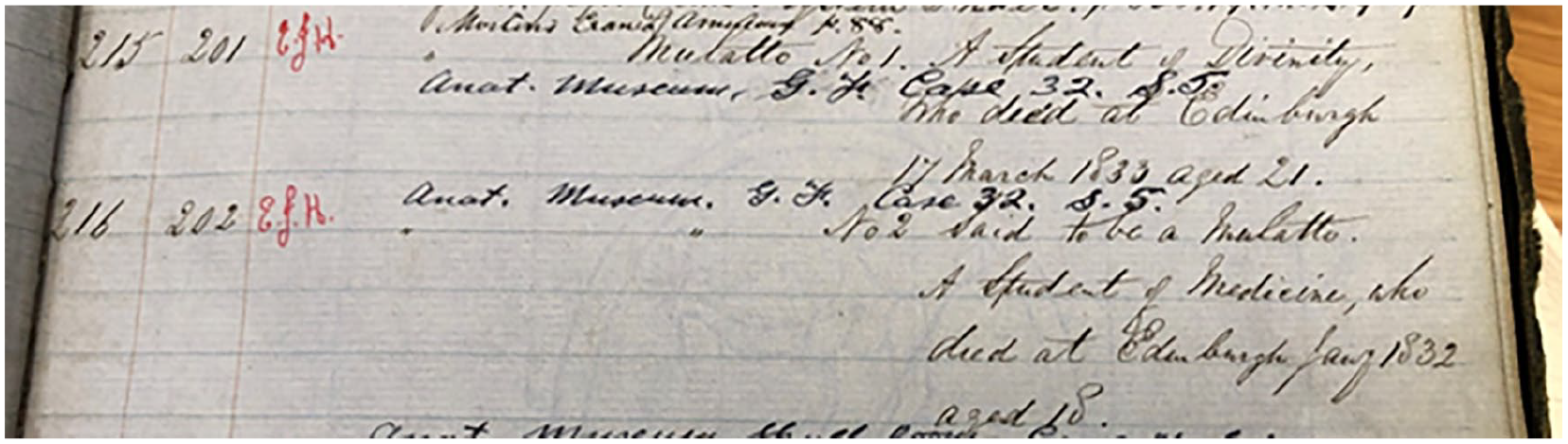
Entries for the skulls of two students of African descent in the Catalogue of the Phrenological Museum (1858).
None of the historic catalogues explicitly identify the individuals as students of the University of Edinburgh, though it would seem likely given their place of death. None of the divinity students listed in the University’s Divinity Rolls for the period 1825–1833 identified themselves as from Barbados. 9 Six students in medicine recorded their place of origin as either Barbados or an unspecified Caribbean location (‘West Indies’) in the matriculation album for the academic year 1832–1833. 10 It is possible that there were more Barbadian students. Those who came from the Caribbean to study at Edinburgh occasionally recorded their temporary residence in Britain, such as the home of a family member or friend, when they matriculated, and it was common for students to attend medical lectures without matriculating (a remarkably large student population known as ‘occasional auditors’). 11
Most of the six matriculating Barbados- or ‘West Indies’-originating medical students in 1832–1833 can be discounted as possible matches for the two individuals to whom these two skulls belonged, which for practical purposes I will refer in this section of the article as ‘No. 1’ and ‘No. 2’. This is not done, however, without acknowledging the deeply problematic nature of numerical and racial labels within anatomical ‘collections’. As Nicole Anderson writes in reference to the hundreds of ‘contested “objects”’ in Edinburgh’s Anatomical Museum, ‘[a]ssigned systems of value, meaning and taxonomy’ have ‘determined the collection’s worth’, and in this way the ‘subjectivities and individualities of each person represented in the collection have been erased’. 12 Most of these six self-identified Barbadian/‘West Indian’ students matriculated on dates after the given dates of death (i.e. 17 March 1833 and January 1832) in the Museum’s 1858 catalogue; others, meanwhile, left archival traces in later records, such as medical journals, meaning they can also be discounted as potential matches. The only matriculant for 1832–1833 from either Barbados or a non-specified Caribbean location whose record most closely matches the catalogue entries for either ‘No. 1’ or ‘No. 2’ is George Richards, a Barbadian medical student who matriculated in both the 1831–1832 and 1832–1833 sessions.
Burial records in the Old Parish Registers for South Leith (Figures 2 and 3), held by National Records of Scotland, document the cause of death and internment locations of George Richards, a 21-year-old ‘Student of Medicine of Barbados from 45 Frederick Street [Edinburgh]’ who died from smallpox on 20 March 1833. 13 Though we cannot be certain, it is very likely that George Richards was one of the two students whose skulls today reside in the Anatomical Museum’s ‘Skull Room’. He was buried in the ‘new ground’ of South Leith Parish Church cemetery, ‘above his brother’s remains, in his own purchase’. An earlier burial record identifies his brother: the 18-year-old Robert Bruce Richards, ‘of Barbadoes’, who lived with his brother George at 45 Frederick Street. Robert Bruce died of typhoid fever and was buried in South Leith Parish Church cemetery close to the ‘Macallum Browns Tomb’. Unlike his older brother, Robert Bruce’s burial record does not identify him as a student. Even with a clue as to the location of Robert Bruce’s grave within the cemetery, a search of the gravestones in South Leith Parish Church cemetery has uncovered neither the tomb of ‘Macallum Brown’ or the Richards brothers’ shared grave. Archaeological excavations were conducted on the site in 2008–2009 in advance of Edinburgh’s main tram track construction on Constitution Street. A subsequent report found approximately 260 graves and 302 inhumations, with some detail of the human remains uncovered; only one skeleton was found ‘head absent’, though the report’s author writes that it may be connected to another skull found close by. 14
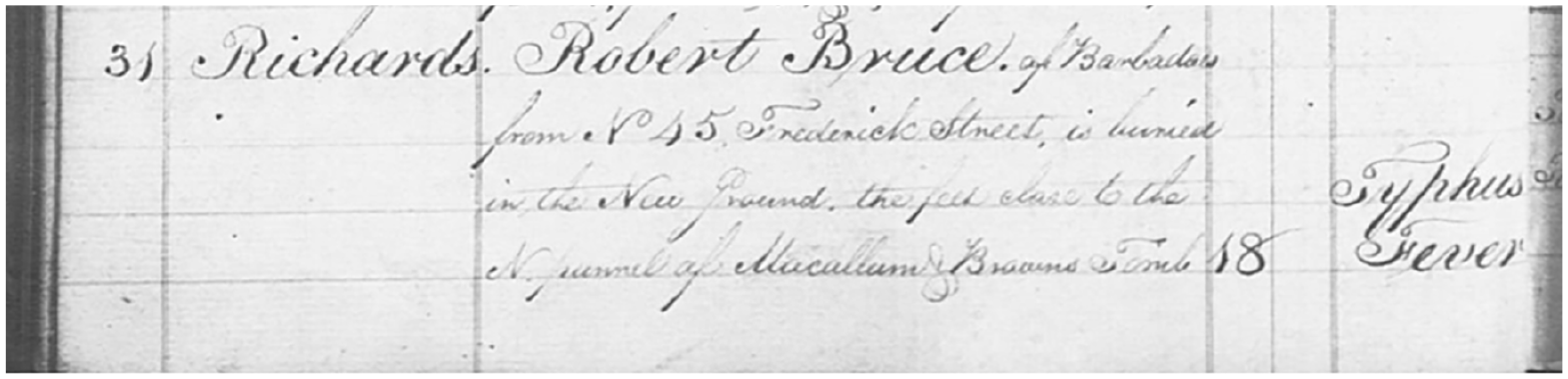
Record of the burial of Robert Bruce Richards in the Old Parish Registers for Leith South, National Records of Scotland.
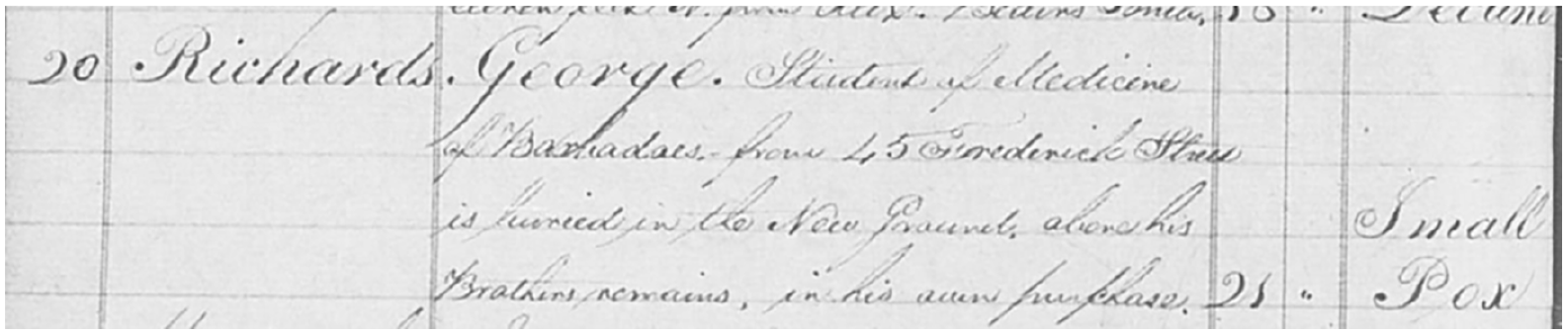
Record of the burial of George Richards in the Old Parish Registers for Leith South, National Records of Scotland.
The ages and places of origin in the Richards brothers’ burial records correspond with the catalogues for the skulls recorded as ‘No. 1’ and ‘No. 2’. The proximity in the date of death of ‘No. 1’ (17 March 1833) and the burial of George Richards (20 March 1833) strongly suggests they are the same person. Robert Bruce’s date of burial (31 December 1831) does not exactly match the month of death given for ‘No. 2’ (January 1832), though their proximity would suggest there was a misreporting or misremembering of dates. There are other slight inconsistencies between the records. The catalogue identification of ‘No. 1’ as a ‘student of divinity’ does not match with a record of George’s matriculation to study medicine; again, this may be attributed to a cataloguing or acquisition error (i.e. a mix-up of the two brothers’ areas of study). What has not been found yet is a record proving Robert Bruce Richards was a student: he is not described as a student in the Parish record, and nor is his name (or anyone from Barbados) listed in Edinburgh’s Divinity Rolls for the immediate years prior to his death in late 1831. These discrepancies aside, there is clearly a strong case to be made that it is George and Robert Bruce Richards’ skulls that today reside in the ‘Skull Room’ of the University of Edinburgh’s Anatomical Museum, separated from the rest of their bodies which, in theory, may still reside somewhere in South Leith Parish Church cemetery (Figure 4).
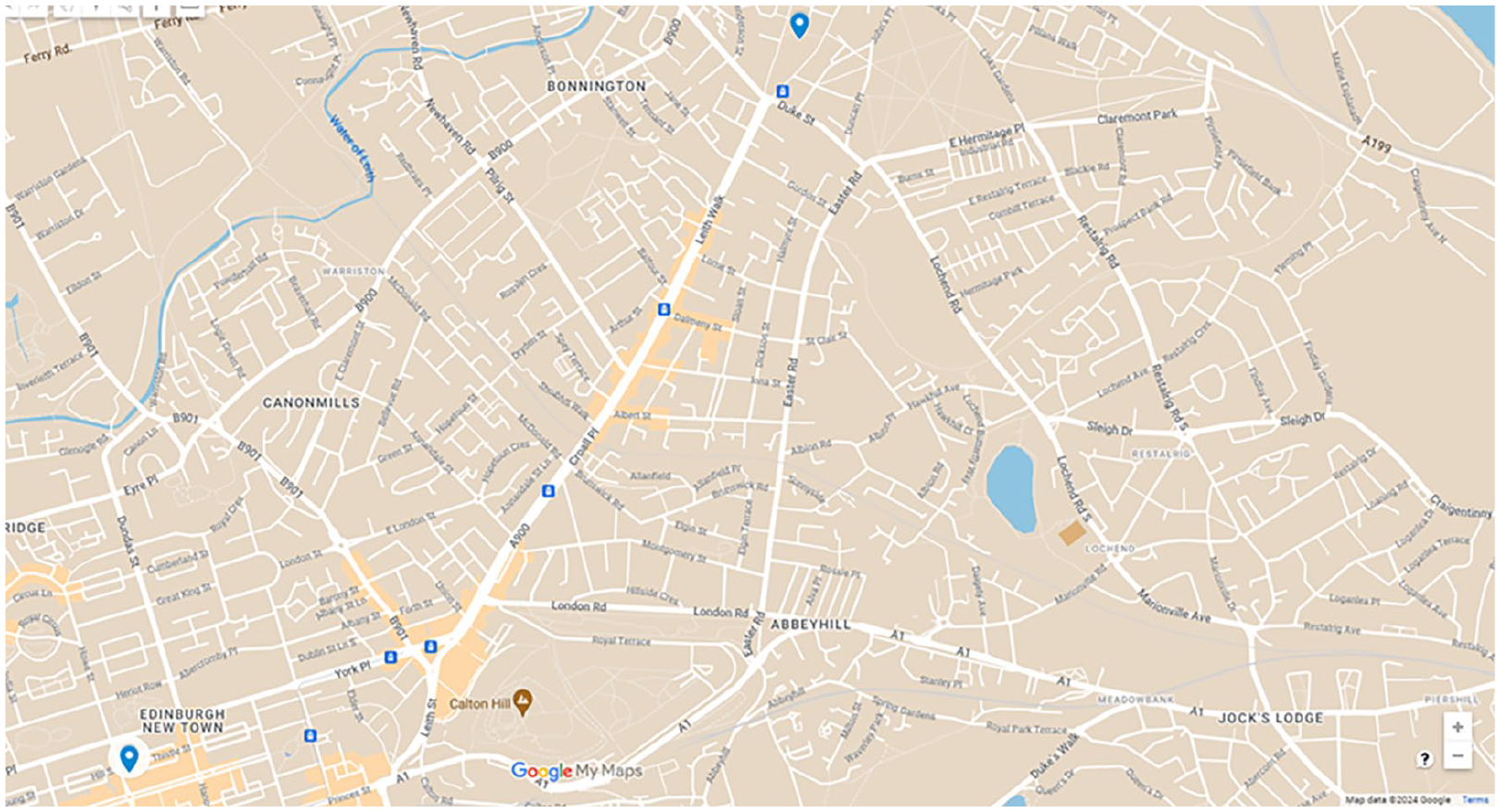
Present-day map showing the Richards’ home at 45 Frederick Street in Edinburgh’s New Town (bottom-left) and the site of their interment in South Leith Parish Church cemetery (top-centre). Image courtesy of Google Maps.
The Richards of Barbados
Who were George and Robert Bruce Richards? Reference to the brothers in The Barbadian newspaper sheds some light on their background. Someone by the name George Richards, possibly the same person, travelled to Britain in late 1828 (8 August, p. 2). More significantly, The Barbadian published notices of the deaths of each brother in 1832 (15 February, p. 3) and 1833 (11 May, p. 2). While the notice for George Richards’ death in 1833 provides minimal biographical detail, the obituary for Robert Bruce a year earlier is more substantial. The author expressed sorrow for the loss of such a promising young talent:
On the 29th December last, at Edinburgh, in the 19th year of his age, Robert Bruce, second son of our late valued countryman, George Richards, Esq., M.D. The early death of this young gentleman, whose amiable temper, brilliant talents, and exemplary piety, encouraged the hope that he would prove to his native country a splendid ornament, seems an event most deeply to be deplored. But he who has thought fit to arrest him in his promising career knows better than we feeble and ignorant mortals do what was best for the youth whose early death we lament, and will send his precious consolation to the hearts of the afflicted relatives and friends. (The Barbadian, 15 February 1832, p. 3).
Although a tenuous connection, the obituary writer’s religious tone and description of Robert Bruce’s ‘piety’ and ‘promising career’ certainly suit that of a memorial for a prematurely deceased divinity student. We can imagine from the text that if Robert Bruce had completed his studies, he would have likely joined the ministry, perhaps taking up a position back in Barbados.
The obituaries identify George Richards as the eldest son and Robert Bruce as the second son of ‘the late George Richards, MD’. The brothers’ father practised medicine on Barbadian sugar plantations, owned enslaved people, and appears to have been a member of the Barbados Society for Promoting Christian Knowledge (Barbados Mercury, and Bridge-town Gazette, 11 March 1820, p. 2). It is possible he studied medicine at Edinburgh: a George Richards matriculated in 1805, though he did not graduate. By at least 1812, he had become a member of London’s Royal College of Surgeons. 15 In 1823, Richards Sr testified before a committee of Barbados’s legislature on the conditions of the island’s enslaved people. This was one of several endeavours conducted in Britain’s Caribbean colonies during the so-called ‘amelioration’ period prior to the abolition of slavery in the British Empire (1833–1838). Owners of enslaved people and their allies – including medical professionals such as Richards – attempted to preserve the institution of slavery through measures supposedly intended to improve (‘ameliorate’) the conditions of the enslaved. In his brief testimony to the committee, Richards Sr explained that he daily visited at least eight larger estates and some other smaller properties, providing medical services to a total population of around 2,500 individuals, most of whom would have been enslaved people of African descent. The committee recorded that Richards Sr claimed ‘the slaves have the greatest attention paid them, and in case of illness they have every allowance that he [Richards] directs’. Asked whether he had seen enslaved patients who had suffered severe punishment, the doctor replied he had ‘never [witnessed] a single instance of that kind’. 16
Richards is listed as an owner of enslaved people, and executor for other people’s enslaved labourers, in the Slave Registers for Barbados for 1823 and 1826; in 1829 and 1834, someone else, John Henry Cutting, filed on behalf of the ‘deceased’ Richards Sr. 17 Richards Sr appears to have died at some stage before February 1829 (The Barbadian, 6 February, p. 1), at which point his furniture, china, glassware, horse and carriage, ‘an excellent medical library’ and set of surgical instruments were sold at auction from his residence, called Newburn, along with ‘several SLAVES, amongst whom are some Field People’. The 1829 Register recorded that three of Richards Sr’s twenty-two enslaved labourers were sold to other people, while fourteen ‘reverted’ to Ann Richards (relation unknown) and George Richards Sr’s children (whose names were not recorded). 17 Someone by the name Ann Richards (possibly the same person) and seemingly another relative, Sarah Richards, later claimed compensation for enslaved people in Barbados following emancipation. 18 Newspaper sources indicate that in September 1831 (The Barbadian, 14 and 24 September, p. 2), two freedom-seekers, Mary Ann and Sandy, who had escaped their bondage from the estate of ‘Dr Richards (dcd)’, were recaptured and imprisoned in jail. The 1829 Slave Register also noted the manumission of a 30-year-old ‘coloured’ woman called Eleanor. 17 Given it was not uncommon for enslavers in the British Caribbean to leave instructions on their death for the manumission of enslaved women who had birthed their mixed-heritage children, it is feasible that Eleanor was the mother of George and Robert Bruce. Further research using the manumission records in Barbados might provide more information about Eleanor and her emancipation. The Slave Registers also indicate the possibility that George and Richard Bruce Richards inherited their father’s human ‘property’, though we cannot be sure, as his children were not named in the Register. If this was the case, such an inheritance would have set up the two young men well to make the relatively privileged decision to travel from Barbados to Britain and to study in Edinburgh.
Race, the Richards brothers and Edinburgh’s Phrenological Society
The brothers died of typhus fever and smallpox, respectively. Both were common afflictions in Edinburgh in the 1830s; indeed, the Richards brothers’ deaths speak to a longer history of students who suffered and died from such diseases while undertaking their studies in Edinburgh. 19 There are no records of the brothers’ admissions in the Royal Infirmary of Edinburgh’s General Registers during this period; it is possible that they could have entered Queensberry House, which was used as a fever hospital, though no surviving patient records exist for that site. 20 The first record of the skulls we have is the 1858 catalogue, made over two decades after the individuals’ reported deaths, meaning we do not know exactly when their skulls entered the Phrenological Society’s collection. One would suspect that they were procured relatively soon (within a few days, months or perhaps years) after their deaths. It is worth noting that during this period, the procurement of human remains for research had become a deeply contested issue. Growing interest in human anatomy in the early nineteenth century, inspired by advances in surgical methods among other factors, created a demand for cadavers for medical research and education. As only executed murderers’ corpses were legally eligible for dissection, ‘resurrectionists’ or ‘body-snatchers’ stole human remains from morgues and graveyards and developed a thriving black market. The crania of these two students were procured in the wake of nationwide graverobbing scandals, including the notorious Burke and Hare murders in Edinburgh in 1828. The political response to such scandals was the Anatomy Act (1832), which regulated the trade in cadavers by allowing the bodies of those who died in workhouses to be taken for dissection, though an illegal trade nonetheless continued after the Act’s implementation.21 –24 It is possible, of course, that the ‘resurrection men’ or ‘body-snatchers’ who supplied anatomists in Edinburgh with cadavers were called upon to acquire these students’ crania.
What is known for sure, however, is that at some point after their deaths, the students’ skulls were separated from their bodies and added to the Phrenological Society’s Museum. No record of skulls of students of the University or individuals from Barbados is recorded in the first two volumes of the Society’s minute book or letter book for the period 1832–1858, though not all items that entered the Society’s collections are recorded in those records. 25 Given phrenologists’ preoccupations with identifying racial differences through cranial analysis, it can be assumed that the racialisation of these two individuals as ‘Mulatto’ – a racial category that both fascinated and bewildered phrenologists – is what sparked an interest in their skulls. The individual(s) who stole the students’ skulls and ‘gifted’ or sold them to the Phrenological Society were possibly driven by such motivations. In the 1858 catalogue, scribbled between the entries for the two students’ skulls and others on the same page, is a citation: ‘Mortons Crania America, p. 88’. Samuel George Morton was an influential craniologist in the USA who trained in Edinburgh. Morton was a polygenist. Monogenism, the dominant view of the eighteenth century, aligned with Judeo-Christian scripture in claiming that all humans derived from the same source. For monogenists, differences between populations are derived from external factors (climate, environment, diet, etc.). Morton and other polygenists, by contrast, subscribed to the idea that differences between populations were because they derived from separate origins, meaning those differences were (more-or-less) permanent. In this worldview, racial admixture was deemed unnatural and inadvisable, purportedly leading, for example, to the constitutional weakening of offspring emerging from ‘mixed’ unions.26–28 On page 88 of Morton’s Crania Americana, an influential text in phrenological circles, Morton discussed whether the first humans were African or Caucasian. He suspected that it would take many centuries for one ‘race’ to emerge from the other by physical causes (i.e. the influence of climate). In Morton’s estimation, this would be ‘nothing short of a miracle’. 29 Ultimately, those racialised as ‘Mulatto’ presented a problem for Morton and his followers, as if skulls did change shape over time then their ‘science’ would be proven as false. Although the annotation in the Anatomical Museum’s catalogue could have been made in relation to other skulls in the collection – including those listed on the same page of the catalogue – we can guess that these students’ skulls would have been examined with these wider discussions in mind.
The relationship between the Phrenological Society and the University of Edinburgh was a complicated one. Some Edinburgh professors were critical of the emerging ‘science’. 30 Others were more open to phrenological theories: William Gregory (1803–1858), Professor of Chemistry, served as the Society’s secretary from 1832 to 1836.31,32 We know some students were interested in phrenology as they wrote essays on and debated the discipline’s merits in student debating societies such as the Dialectic Society, though the outcomes of votes generally indicated that Edinburgh’s students were not, at least in the majority, enthusiastic phrenologists. 33 In 1839, George Combe, founder of Edinburgh’s Phrenological Society, sent the editor of the American Phrenological Journal an extract from an article in the Edinburgh Chronicle on a recent several-hour debate held by the Associated Societies of the University of Edinburgh on the question ‘Does phrenology afford or contain a sound system of mental philosophy?’ The students rejected the motion by a majority of forty to thirteen. The enraged Combe observed that Edinburgh’s professors were, in general, ‘hostile’ to phrenology and that the debate’s outcome indicated students’ ‘subservience’ to their teachers on the topic. Nonetheless, Combe was consoled with the knowledge that around one-quarter of the Edinburgh students had, through their vote, effectively condemned their professors’ ‘prejudices in opposition to truth’. 34
Some students, Combe would have been pleased to know, joined the Phrenological Society. A minute book notes the application of two students of medicine, James Cox and Richard Cowan, to the Society in February 1833. Given Cox and Cowan were likely classmates of George Richards, and joined the Society only a month before he died, it is tempting to consider whether either or both of these two ‘card-carrying’ student-phrenologists were responsible for the transfer of the Richards brothers’ skulls to the Phrenological Society. 35 This, however, is entirely circumstantial evidence. There were other phrenologists among Edinburgh’s student body. In 1840, Society members considered a proposal to move its collection to ‘an apartment’ in the ‘college’ (i.e. University of Edinburgh) on the ‘understanding the society should in return agree to admit students and the public to inspect it under such regulations as might be agreed upon’. 36 While nothing came of the proposal, Edinburgh’s student population evidently presented an important target audience for the Society during those years.
As yet absent from the historical record is an exact idea of how the students’ skulls were studied, and what ‘conclusions’ – racial or otherwise – phrenologists drew from them. No reference to the students’ skulls has yet been found in nineteenth-century phrenological, anatomical or anthropological literature, though further research may unearth such evidence. Identification of the students as of mixed African–European heritage is likely what piqued phrenologists’ initial interest in their skulls, though perhaps that information alone was not enough to leave a pronounced archival trace (e.g. an article in a phrenological journal). In other cases, the phrenological study of certain skulls had profound and determinable consequences. ‘Race’, writes Kim Wagner in relation to nineteenth-century India, was a ‘significant element of early phrenology, especially in the colonial context where skulls of “primitive” people were collected and the scientific examination often made to legitimize colonial policies’. 37 Other research has explored similar connections in other British colonial contexts.38,39 A lack of knowledge about the ‘analysis’ of these students’ skulls means we do not currently know what effect their presence in the Society’s collection may have had on phrenological, anatomical or anthropological debates over subsequent years. However, we know that the acquisition of these skulls was part of a wider, deeply harmful research culture in the nineteenth and early twentieth centuries in which the global circulation and examination of thousands of remains of racialised people collectively contributed to a racist discourse on human variation and the justification of racist policies and the ‘civilising’ mission of European empires. 40
Conclusion
In the absence of additional evidence, we can only speculate as to what actually happened in this case. All we know is that some person or persons – fellow students, medical professionals, members of the Phrenological Society or grave-robbers acting on their behalf – were aware of the deaths of these two so-called ‘Mulatto’ students and perceived their skulls to be a valuable phrenological resource. Curiously, neither the burial records nor the articles in The Barbadian identify George or Richard Bruce as ‘Mulatto’, ‘Creole’ or any other label that would indicate their ‘mixed’ racial identity. It is possible that this absence means that the brothers ‘passed’ for ‘white’ in Barbadian society. The racialisation of the students’ skulls as ‘Mulatto’ in the catalogue records, however, would indicate that some of their contemporaries in Edinburgh were aware of, or made assumptions about, their ‘mixed’ racial identities. It was this information, we can guess, that prompted the culprit(s) to commit the horrific act of separating the students’ skulls from their bodies and transferring them to the Society’s Museum. Given the lack of evidence suggesting otherwise, we can assume that neither brother gave their consent prior to their deaths.
The students’ skulls remained in the Phrenological Society’s Museum on Chambers Street until 1886, when they and the Society’s wider ‘collection’ were transferred to the University’s Department of Anatomy. There is a morbid irony in the acquisition of their skulls by the University where these students (likely) studied, but it is a trajectory that illustrates the fact that ‘many large collections (of human remains) today, particularly in Europe, contain a number of smaller collections’, often those of phrenological societies or individual ‘collectors’ and how this creates ‘challenges for those trying to trace their ancestors’. 41 Although we are still left with many unanswered questions, it is worth recognising that the limited information we know about who these two students (possibly) were and how their remains (possibly) entered the collection is in fact relatively detailed when compared with the vast majority of individuals whose human remains are held within Edinburgh’s Anatomical Museum for whom, tragically, we know vanishingly little. Indeed, the ‘majority of Indigenous human remains in museum stores are anonymous, which, as science rendered them as “data” and “research resource,” contributed to their objectification and commodification’. 41 The University of Edinburgh’s long history of the repatriation of colonially derived ancestral remains in its care dates back to 1947.42,43 While the moral argument for the repatriation of these students’ skulls may be similar to that for others within Edinburgh’s ‘collection’ of human remains, the practicalities and ethics in this case are quite different. The rest of these individuals’ skeletons may still reside nearby in Edinburgh (i.e. in South Leith Parish Church’s cemetery). Unlike the vast majority of the colonially derived crania within the Anatomical Museum, then, the re-unification of these students’ body parts is, at least theoretically, possible. Furthermore, given what information we know about the Richards brothers, it may also be possible to identify their descendants in Barbados or elsewhere, something difficult or, in many cases, impossible to achieve for most of the individuals whose body parts were stolen from British colonies and elsewhere abroad.
Provenance research on the collections of human remains established in the nineteenth and twentieth centuries is notoriously difficult. The issues in substantiating the identifications of these two individuals are a good example of why human remains have often proved elusive to return and rebury. Lingering ambiguities have historically complicated, delayed, impeded and even blocked claims for repatriation, but there is sense also in erring on the side of caution. Mistakes can be and have been made. The University of Edinburgh, for example, made a large number of ‘returns’ of the skulls of Indigenous peoples to Australia in the 1990s. A later discovery of new documentation revealed that additional post-cranial remains, stored separately to the skulls at the time of repatriation, had remained in Edinburgh. 44 In the case of the re-unification and/or repatriation of these students’ remains – if either or both are desirable outcomes – further archival and archaeological research would be required in Edinburgh, ideally alongside work with(in) Barbadian archives and communities. As community engagement work undertaken over 2022–2024 by the University of Edinburgh’s Decolonised Transformation Project (from which this research has emerged) showed, any next steps in this case should be guided by descendants and/or Barbadians, with thoughtful and careful consideration of the ethical and reparatory dimensions of the work at hand. 45
As Ann Fabian writes, while there is a ‘special grief’ in all ‘stories of the unburied dead’, it is the ‘tensions between skulls as measures of racial difference and as markers of common humanity’ that make histories of crania collections relatively unique in opening up a window onto to the disturbing world of nineteenth-century race-making. 46 The remains of these two students of African descent in Edinburgh, for example, speak to two important, if underappreciated, aspects of the history of race, science and university education in Britain. First, they represent examples of the theft within Britain of the body parts of people of African descent for the purposes of racial ‘science’. Such theft not only occurred in the colonial peripheries but also within metropolitan centres of the British Empire. It did not seem to matter to the morgue- or grave-robbers who stole these skulls, or the phrenologists who collected and studied them, that the two racialised individuals were, in fact, relatively privileged, wealthy enough (if we are to accept the hypothesis of this article) to study at one of Britain’s leading universities and to pay for their own graves, using money derived from the enslavement of other people of African descent.
Second, and finally, the presence of the students’ skulls in the collection provides a particularly shocking example of how students of colour experienced racism in nineteenth-century Britain. These two students were posthumous victims of the violent logics of a racial science practised by a significant minority of Edinburgh’s citizens, students and medical professionals. Many of those people whose skulls were collected during this period, as Ann Fabian writes, ‘died far from the communities they might have expected to protect their corpses, [and] to usher them out of one life and into a next’. 46 These students also died far from home, though they presumably would not have expected their skulls to receive such a fate following their deaths. They may, however, have been aware of how their peers and teachers thought about racial difference. Even if phrenology was seen by mainstream academia as a fringe ‘science’, these two students would nonetheless have studied alongside other students and under professors who, if not (for the most part) signed-up phrenologists, engaged in other ways in the study and teaching of racial theories. 47 These considerations are important in light of renewed attention on the lives of historic students of colour at British universities. Studies of these historically marginalised student groups – including the University of Edinburgh’s relatively substantial Black and Asian student population in the nineteenth century, a history recently explored by the student-led archival project UncoverEd – flesh out our understanding of the presence, contributions and vitality of Black and Asian people in British history. 48 Yet, it is important to also reflect on the worlds in which racially minoritised students in the past lived and studied, including the racially motivated harms and indignities many will have faced in life and, as the story of these students’ skulls would appear to indicate, in death.
Footnotes
Acknowledgements
The author would like to thank Ruth Pollitt and Malcolm MacCallum at the Anatomical Museum, and Louise Williams at Lothian Health Services Archive, for their support, as well as Nicola Frith, Diana Paton, Ian Stewart and the two anonymous reviewers who generously advised on earlier drafts.
Declaration of conflicting interests
The author declared no potential conflicts of interest with respect to the research, authorship, and/or publication of this article.
Funding
The author disclosed receipt of the following financial support for the research, authorship, and/or publication of this article: This research was conducted while a Research Fellow (2022–2024) at the Institute for Advanced Studies in the Humanities, University of Edinburgh, and as part of the Decolonised Transformations Project tasked with confronting the University of Edinburgh’s legacies of slavery and colonialism.
