




Abstract
Standing at an imposing 6”2, Dr Alfred Labinjoh was a man of considerable stature in Edinburgh – physically, socially and politically – between the 1920s and 1950s. Born in Lagos, Nigeria, he studied medicine in Edinburgh during the early 1920s and subsequently lived in the city until 1957, working as a popular family doctor. By the 1940s, he ran surgeries in Fountainbridge, Pilton and Newlandrig, as well as the Carnegie Nursing Home at 29 Morningside Road. A prominent freemason, philanthropist, and baritone singer, he was also politically active during the 1920s and 1930s, working with the local Edinburgh African Association to raise money for the Red Cross mission to Ethiopia after fascist Italy’s invasion. Although monetary donations and military volunteers from Scotland to Republican Spain are well known, there were also important earlier precedents set by West African students and graduates in Edinburgh in support of Ethiopian resistance fighters which helped galvanise a new form of popular politics in explicit opposition to colonialism and fascism, at home and abroad.
Standing at an imposing 6”2, Dr Alfred Labinjoh was a man of considerable stature in Edinburgh – physically, socially and politically – between the 1920s and 1950s. Born in colonial Lagos, he studied medicine in Edinburgh during the early 1920s and subsequently lived in the city for much of his life, working as a popular family doctor. By the 1940s, he ran surgeries in Fountainbridge, Pilton and Newlandrig, as well as the Carnegie Nursing Home at 29 Morningside Road, where he helped deliver over 1,000 babies. A prominent freemason, philanthropist and baritone singer, he was also politically active during the 1920s and 1930s, working with the local Edinburgh African Association (EAA) to raise money for the Red Cross mission to Ethiopia after fascist Italy’s invasion in October 1935. Numerous scholars have documented the long history of West African students coming to Edinburgh for a medical degree since the 1850s, but from the 1920s a tiny handful stayed in the city and had a disproportionate political influence. 1 Particularly in the 1930s, West African students and graduates helped galvanise a new form of popular politics in explicit opposition to colonialism and fascism, setting important precedents for better-known Scottish struggles against Spanish and German fascism later in the decade. 2
Alfred Adekunle Aina Labinjoh was born on 18 August 1891 into an influential and well-off Lagos family – his nephew, Adeyinka Oyekan, was the oba (king) of the city from 1965. 3 His father, Alfred Aina Labinjoh senior, was a ‘shippers’ commercial trader’ who together with his mother, Rachael Christiana Labinjoh, employed a number of servants. 4 Alfred Labinjoh junior later attributed ‘his ability to sing with perfect accuracy of pronunciation, traditional Scots songs written in broad Doric, to the fact that in his extreme youth, spent in Africa, he was taught by a Scotswoman, his nurse’. 5 During the First World War, Labinjoh served in the West African Frontier Force, before travelling to Scotland to study medicine. 6
Labinjoh initially registered as a medical student at the University of Edinburgh in January 1921, and over the next 2 years studied physics, elementary biology, chemistry and anatomy at Surgeon’s Hall and the New School on Bristo Place. Alongside further academic studies, he undertook placements at Ringo Street Dispensary, the Victoria Dispensary, the Royal Infirmary and the Simpson Memorial Hospital between 1922 and 1925. Like many international students, he re-enrolled at the Royal College of Surgeons in the middle of his studies. Rather than taking the university’s expensive examinations, he chose to take the cheaper ‘Scottish Triple’, a qualification issued jointly by the Royal Colleges of Surgeons and Physicians in Edinburgh and the Royal College of Physicians and Surgeons in Glasgow. In July 1924, he took his third exam for the ‘Scottish Triple’, scoring 65 and 50 in pathology exams. He passed the ‘Scottish Triple’ in October 1925, scoring between 55 and 61 for his final exams in midwifery and gynaecology. 7 Surviving results at the Royal College of Surgeons indicate that Labinjoh was a good rather than exceptional undergraduate, but Dr James Burnett who taught him the disease of children later recalled that he was ‘one of my most brilliant students’. 8
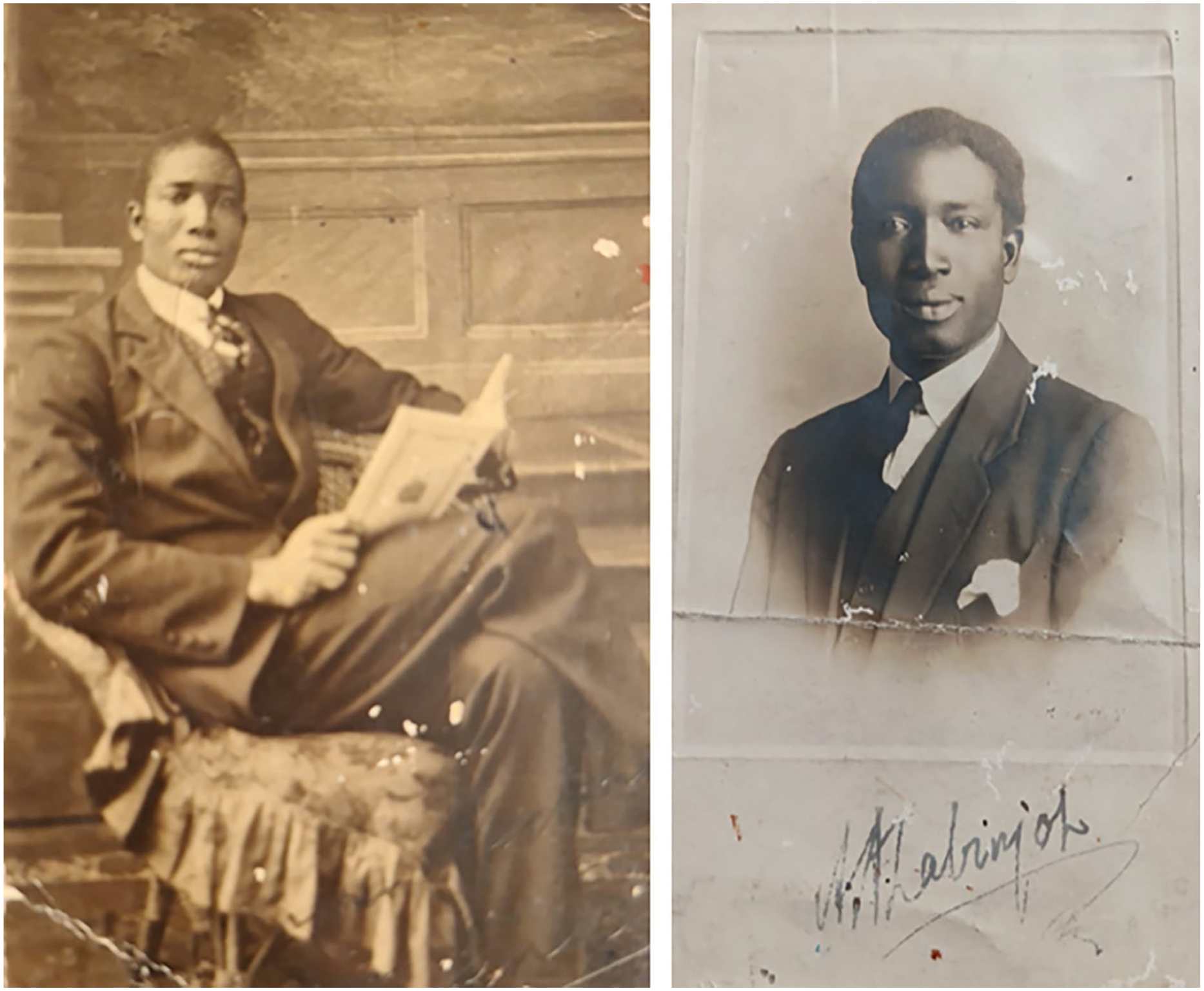
Photos of Dr Alfred Labinjoh (courtesy of Ina Cogger nee Labinjoh).
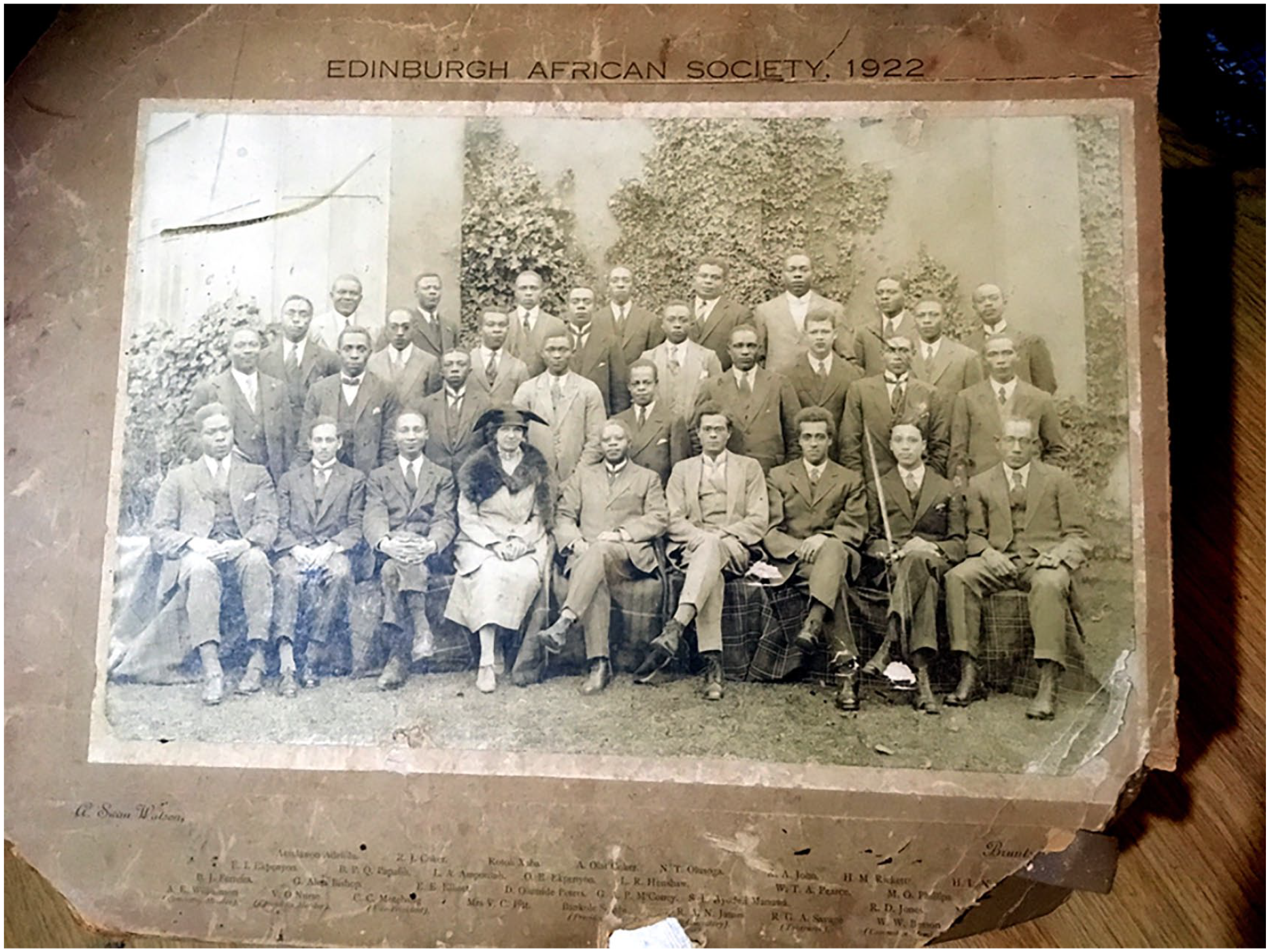
Alongside his studies, Labinjoh was active in African student politics. Based among students at the university and Royal Colleges, an Edinburgh African Society existed in 1922 (while Labinjoh was studying) with officers from Europe, West Africa, Southern Africa and the Caribbean: Richard Gabriel Akiwande Savage, a Scottish-Nigerian medical student was treasurer; Calvin Motebang, a Basotho medical student, served as vice-president; committee members William Besson and AE Williamson were from Trinidad. 9 In touch with global political developments, another member, Rotoli Xaba (a South African medical student), was in correspondence with WEB Du Bois’ Pan-African Congress and staunchly critical of colonial rule. 10 The organisation was almost entirely made of men, but a 1922 photo does include a ‘Mrs VC Pitt’, the sister of a West African student. 11 This early image does not appear to contain Labinjoh, but he may be one of the two individuals on the far right of the image whose names are missing.
The Edinburgh African Society in 1922 (courtesy of Margaret Busby).
Labinjoh was definitely involved with a later organisation, the Edinburgh African Association (EAA), which was established in 1927 for ‘all African students in Edinburgh who are of Negro blood’. 12 Labinjoh was president of the EAA between 1928 and 1929, and on the back of a studio portrait (above on the right) there is an unsigned, undated note: ‘Dr Labinjoh under whose conduction the African Association choir will render their little bits for the Shilling Fund’. 13 The British empire was praised at an EAA event in July 1928, when Ghanaian traditional ruler Nana Ofori Atta visited Edinburgh. 14 But in September 1930, the EAA helped organise a meeting of the League Against Imperialism at Oddfellows Hall alongside the Edinburgh Indian Association and Edinburgh Egyptian Society that staunchly criticised British colonialism. 15 Former EAA member Emmanuel Evens-Anfom later recalled that members were ‘mostly [from] West Africa, that is, Nigerians, Gold Coasters, Sierra Leonians and one or two from the Gambia, which met once a month to discuss issues concerning Africa in general and, as I recall, looking ahead to the time when our countries would become independent from colonial rule and the contributions we would make’. 16 Labinjoh was listed as one of the EAA’s eight honorary presidents in 1935. 17
Most international medical students left Edinburgh after graduating to take up posts throughout the empire. Nevertheless, there were a few important exceptions: An Indian doctor, Pulipaka Jagannadham, established a surgery at 13 Rillbank Terrace in the 1890s; South African Indian doctors, William and Ernest Godfrey, ran a surgery out of 21 Minto Street between the 1920s and 1930s; and another Indian medical graduate, Shaikh Ziaddin Ahmad, lived in Edinburgh between the 1930s and 1950s. 18 There were also discriminatory prejudices and licensing laws in West Africa which made it increasingly difficult for West African doctors to practice. 19 Fellow Edinburgh medical graduate Agnes Yewande Savage, in particular, faced persistent discrimination because of her race and sex, eventually becoming a teacher at Achimota School in Accra during 1931. 20 Rather than return to West Africa, Labinjoh had established a surgery at four Gardiner’s Crescent by 1930. 21 He soon had a very busy professional life. Edinburgh residents later remembered him as an outstanding family doctor, with a bustling waiting room and a large grey parrot who harassed patients. 22 It was not unusual for him to be out on call into the early hours and then back at the surgery the next morning. Labinjoh was also a good chemist, and often prescribed medicines that he had made himself. His son recalls that there was always a pharmapedia to hand in the family home. 23
Labinjoh soon becomes a prominent local personality in Edinburgh. Newspapers reported that he was ‘very well known in golfing circles’ in 1932.
24
By the mid-1930s, he was medical officer of the Scottish Amateur Wrestling Association;
25
president of Harburn Golf Club;
26
a freemason with the Journeyman Lodge at 73–77 Blackfriars Street;
27
and a renowned baritone singer, who was likened to Paul Robeson and often performed at charity events supporting the local Brotherhood movement and unemployed workers.
28
The Midlothian Advertiser reported that during one fund-raising event in November 1932
Dr Labinjoh’s mastery of the Scotch language was quite remarkable and he scored a notable success in ‘Duncan Gray’ and ‘Lass of Ballochmyle’ as his opening numbers. ‘Annie Laurie’ and ‘Mary Morrison’ were also received with hearty applause. In the second part of the programme he gave a stirring rendering of ‘A Man’s a Man.’ In response to hearty encores he have ‘Devonshire Cream and Cider,’ and ‘Think of Me’.
29
He married Annie Leonara Mackie, a typist from an East Lothian farming family, at Abbey Parish Church on 18 August 1934, in a service led by Reverend Archibald Morrison. 30 A son, Alfred Labinjoh junior, was born in 1935. 31
By the 1930s, the Labinjohs’ house at four Gardiners’ Crescent was a key hub for Africans in Edinburgh. When Hastings Banda, a Malawian medical student, arrived in September 1937, he was directed to Gardiners’ Crescent, where he was welcomed by Labinjoh, ‘a man in his forties, big and broad-shouldered’ who was ‘well known in Edinburgh and very much respected’. Banda distinctively remembered Labinjoh’s ‘kindness and his helpfulness’, and was immediately inducted on a whistle-stop tour of the city in search of lodgings, as Labinjoh quickly worked through an extensive network of trusted landladies. Labinjoh subsequently introduced Banda to administrators at the Royal College of Surgeons, where he enrolled. 32 Over the years, innumerable other students stayed at four Gardiners’ Crescent, many of them family relatives of the Labinjohs studying at the University of Edinburgh. These included Reginald Maxlino who studied agriculture at Edinburgh, Ninku Lapite who studied law, and Jimmy Beyoku who went on to become a prominent politician in Lagos. Adeyinke Oyekan, the future oba, also stayed with the Labinjoh family in the mid-1950s, married a local Scotswoman, and lived at Labinjoh’s cottage in Newlandrig. 33
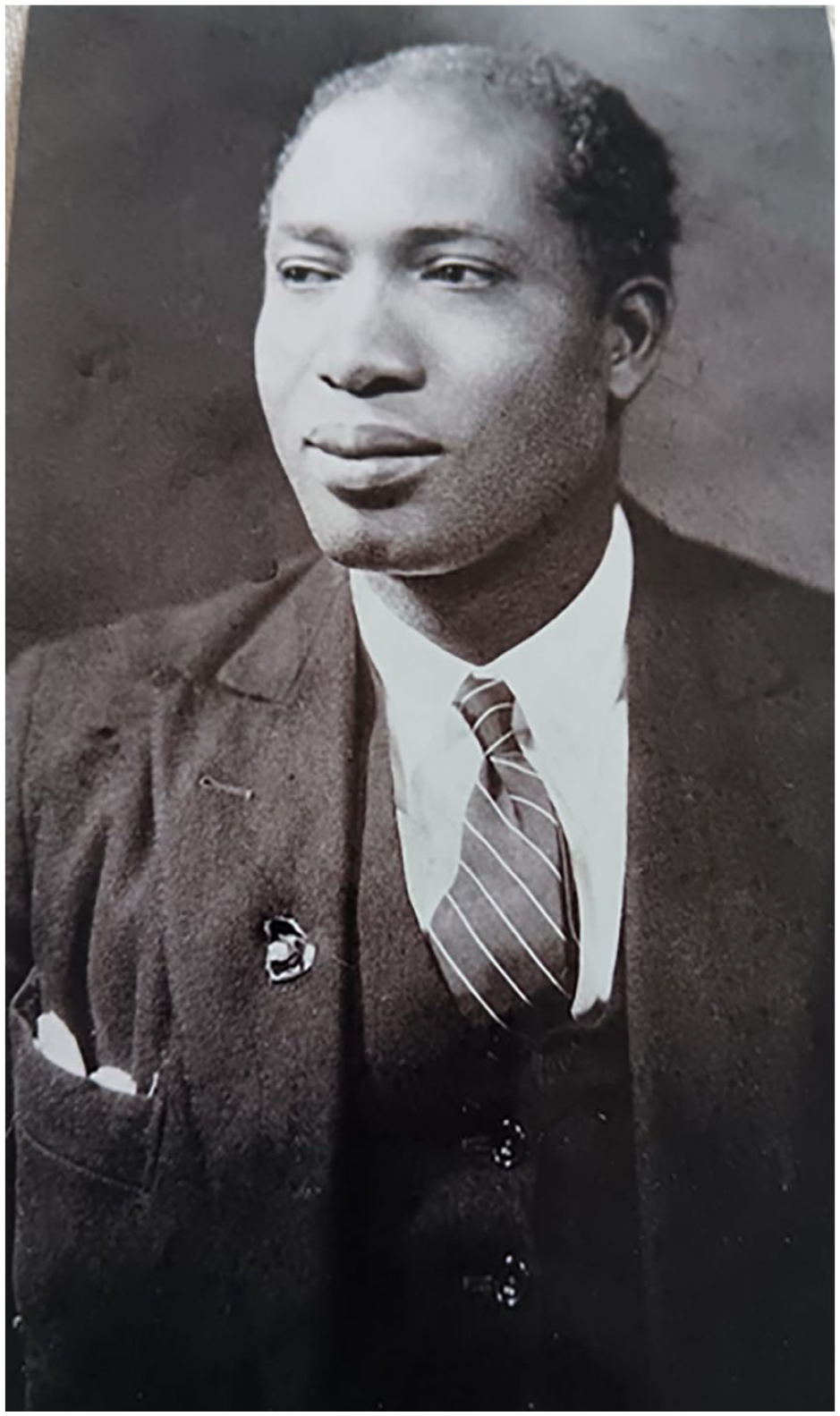
Dr Labinjoh later in life (courtesy of Ina Cogger nee Labinjoh).
Mirroring developments across the African diaspora, Labinjoh’s political activism was catalysed by Mussolini’s invasion of Ethiopia in October 1935. 34 The invasion caused considerable debate in Scotland. The West Lothian Courier reported that ‘in Edinburgh, as elsewhere, one topic overshadows all others. Italy-Abyssinia-War-Sanctions. Everywhere you go. In the trams, in the cafes, over office desks, during the luncheon hour, and at the club in the evening, you hear people discussing the latest turn of events in Africa’. 35 Open-air pro-Mussolini meetings at the Mound organised by the British Union of Fascists were ‘broken up by a large, hostile section of a crowd of several thousands’. 36 The vice-chair of the Edinburgh Peace Council warned that Italian fascism was ‘the most serious menace to economic, social, cultural and moral progress’. 37 Edinburgh Liberals denounced Mussolini’s ‘inhuman and barbarous policy’. 38 Ernest Ludlam, a leading member of the Edinburgh University Cosmopolitan Club, called for sanctions. 39 Some Edinburgh students nominated Emperor Haile Selassie as Rector. 40 Scots were also prominent among those who volunteered to fight on Ethiopia’s behalf. The Sunday Post reported: ‘Many are from Scotsmen, who want to fight Mussolini with a rifle in their hands, or, indirectly, with their medical aid, engineering capabilities, or some other form of service. The list includes lorry drivers, doctors, bank clerks, accountants, university students, out-of-works, men of standing and education’. 41
Through his well-established social networks, Labinjoh was soon at the forefront of local campaigns to raise money for the Red Cross mission to Ethiopia.
42
An Edinburgh Ethiopian Relief Committee had already been established by October 1935, with Labinjoh as chair, Evan Adeleye Shanu (a Nigerian medical student and executive member of the EAA) as secretary, and Reverend Archibald Morrison as treasurer. EE Elliot (who was pictured as a member of the Edinburgh African Society in 1922 and on the EAA executive throughout the early 1930s) wrote to the Edinburgh Evening News appealing for donations.
43
Shanu implored in a letter to the same newspaper:
Today Ethiopia is at war with a powerful nation. She does not require foreigners to pay the supreme sacrifice to help maintain her independence - her Emperor and sons shall pay the cost with their lives. We sons of Africa, wherever we may be in the world, jealously look upon Abyssinia as the last vestige of pride we possess. All we, the members of this committee, ask of you is a generous contribution for Red Cross work among the Ethiopians.
44
On 11 December, Labinjoh organised an ‘ambitious’ fund-raising concert ‘specially selected and arranged musical items by coloured artistes’ at the Music Hall on George Street, which included performances from the renowned Nigerian actor and singer, Orlando Martins, the comedian Jimmy Martins, and the singers, the Breakey Sisters, as well as Labinjoh himself.
45
Whilst drives and dances were organised at the Masonic Hall on Forth Street.
46
And on 26 January 1936, Labinjoh addressed a ‘big rally’ organised by the Edinburgh Peace Council at the Synod Hall on Castle Terrace, in ‘protest against the bombing of the Red Cross and in defence of Abyssinia’, alongside Alice Ross of the Women’s Freedom League and David Kirkwood, the renowned local firebrand Labour MP.
47
Kirkwood spoke
against the murder of tens of thousands of innocent people – not only Abyssinians but Italians. He held there was no country in the world, no Empire today, abler than ours to declare openly and above board for peace. The people of this country, irrespective of political opinions, ought to inform the government that it was bound hand and foot at all times against war with any one[.]
48
Labinjoh’s committee had raised £30 by November 1935; a further £25 had reached the Ethiopian Legation in London by March 1936. 49 His efforts must have also contributed to the greater success of the Scottish branch of the Red Cross, which reported raising a staggering £3,541 to fund ambulances in Ethiopia by early 1936. 50
Over subsequent decades, Labinjoh continued as a community doctor and remained active as a freemason, golfer, committee member and leader of the local Brotherhood movement. By 1939, he was the ‘physician’ for the Blackfriars Street Lodge. 51 After their relationship became strained, he divorced his first wife, Annie, in 1938. He married Margaret Wishart, a nurse from Shetland, in 1942. 52 They had a son, Edward Labinjoh, the same year. 53 He remained close to EE Elliot, who also stayed in Edinburgh and regularly visited the Labinjoh family home, but he otherwise appears to have concentrated on medical work. 54 His portfolio of practices expanded: He moved from 4 to 8 Gardiners’ Crescent around 1935; ran the Carnegie Nursing Home at 29 Morningside Road from 1945; started the Newlandrig surgery around 1948. Edinburgh councillors described Labinjoh as being ‘popular, highly-respected, and trustworthy, and one who had done magnificent work among the poorer people’. 55 He retired from medicine in June 1957 and relocated to Nigeria with his sons and adopted daughter, Ina, the same year. 56 Labinjoh’s family believes that he returned to Nigeria because he wanted to see his elderly mother, Rachel Christiana Labinjoh. 57
He may, nevertheless, have also left Edinburgh because of local events: Many well-established doctors with extensive private practices were opposed to the formation of the National Health Service in 1948 because it encroached on their business portfolios, and Labinjoh himself faced a personally difficult court case in 1953 when he was blamed for the death of a 7-year-old child. He was fully exonerated, but the only image of Labinjoh that I have been able to find in British newspapers comes from this episode, as he left court covering his face. 58 Returning to West Africa, he soon opened a clinic in central Lagos. The Labinjoh family lived upstairs, while he ran a busy surgery, a hospital with six beds and a dispensary on the ground floor. He passed away in Nigeria on 18 October 1965. 59
I first stumbled across Labinjoh when reading the unpublished autobiography of Hastings Banda. In the Banda manuscript, Labinjoh appears as a remarkable and prominent public individual, but he is someone who has almost completely dropped out of public memory in subsequent decades. I then trawled newspapers for references and contacted his granddaughter Catherine Labinjoh (herself a prominent heart doctor), and two children, Edward Labinjoh and Ina Cogger, who were all generous with their support. Labinjoh and Banda both returned to their countries of birth after decades abroad in 1957 and 1958, respectively. Labinjoh was distinctly more preeminent in 1930s Scotland, but he dedicated subsequent years to Edinburgh patients and does not appear to have undertaken any further political work, within or beyond the EAA. Banda, in comparison, spent considerable energy networking, corresponding and organising, alongside his medical work in Liverpool, North Shields and London, and would go on to lead Malawi to independence in 1964. Nevertheless, while numerous Edinburgh graduates (like Banda and Julius Nyerere) went out ‘into the world’, there were also a number like Labinjoh, Shaikh Ziaddin Ahmad, William Besson, EE Elliot, Ernest Godfrey and Richard Gabriel Akiwande Savage who made homes in Scotland and had an important, under-appreciated influence.
Monetary donations and military volunteers from Scotland to aid the Republican cause during the Spanish Civil War from July 1936 are well known and rightly celebrated. But there were also important examples of solidarity from Scotland in the face of an earlier fascist expansionism that set important precedents in both the short and the long term. In 1947, the EAA invited Nnamdi Azikiwe (the future president of Nigeria) to Scotland and organised meetings critical of British colonial rule; into the 1950s, the EAA remained prominent in campaigns against British colonialism and the Central African Federation. 60 By 1961, African students in Edinburgh, disillusioned at the failures of Pan-Africanism, had reduced their involvement in the EAA and splintered into nationality-based organisations. 61 But in the 1920s and 1930s, the kind of Pan-Africanism that Labinjoh and others espoused was full of possibilities, connecting West African students in Scotland to resistance fighters in north-east Africa and galvanising a new form of popular politics in explicit opposition to colonialism and fascism, at home and abroad.
Footnotes
Author Note
It would not have been possible to write this article without speaking to Labinjoh’s family: Edward Labinjoh, Dr Catherine Labinjoh and Ina Cogger (nee Labinjoh). I first came across Labinjoh in the unpublished autobiography of Hastings Banda, which was kindly shared with me by Emma Orchardson. Margaret Busby, Margaret White and two anonymous reviewers have generously advised on the early draft. I’m also indebted to archivists Jacqueline Cahif and Robin Fixter-Paterson at the Royal College of Surgeons, Edinburgh, Estela Dukan at the Royal College of Physicians, Edinburgh and Louise Williams at the Lothian Health Archives.
Declaration of conflicting interests
The author declared no potential conflicts of interest with respect to the research, authorship, and/or publication of this article.
Funding
The author received no financial support for the research, authorship, and/or publication of this article.
