



Abstract

Adding petrol to the fire
Earth’s mean surface temperature (MST) remains stable if energy gain from incoming solar radiation matches radiative loss into space. But so-called ‘greenhouse gases’ (GHGs) (e.g. carbon dioxide (CO2), methane (CH4), nitrous oxide and water vapour) allow shortwave radiation from the sun to pass but absorb and reemit longwave radiation (e.g. heat from a warmed Earth’s surface). Past abrupt changes in GHG emissions (e.g. from volcanic activity) have thus caused abrupt changes in temperature and weather and consequent mass extinction events. The physics and future responses remain unchanged.
Global anthropogenic CO2 emissions were only 196.75 million tonnes in 1850 but 40.9 billion tonnes (Gt – each 557 × 1012 litres) in 2023 – 20% remaining in our atmosphere for >33,000 years. Atmospheric CO2 concentrations have thus risen from 280 parts per million (ppm) to 424 ppm. Concentrations of other GHGs are also rising (e.g. CH4 up 170% in 200 years), trapping energy in our atmosphere. The oceans alone have absorbed the bulk – 345 × 1021 Joules since 1955 alone, the energy equivalent of 19 billion Hiroshima Bombs (each releasing 1.8 × 10¹³ Joules). In 2023, Earth’s annual MST rose to a record 14.98°C–1.5°C above the preindustrial average; average land temperatures were up 2°C; and ocean heat to a depth of 2 km was the highest recorded. We may breach a 2°C average 10-year MST rise (the maximum which the Paris 2010 agreement sought) by 2030. 1 As a consequence, Antarctica lost 7.5 trillion tonnes of ice from 1997 to 2021; the Greenland ice sheet >1 trillion tonnes (1985–2022) and now billion tonnes/year; Swiss glaciers 10% of their volume in 2022/2023 alone and the Arctic 1.73 million km2 of January ice since 1979. Together with thermal expansion, water from land ice melt has caused sea levels to rise 10 cm since 1993 alone.
Atmospheric energy gain is driving more frequent and severe extreme weather: climate-related events have risen 83% between 1980–1999 and 2000–2019. Between 2019 and 2023, annual or seasonal temperature records were broken in Antarctica, Andorra, the Arctic, Belgium, Brazil, Canada, China, Cyprus, Cuba, France, Germany, Holland, India, Iran, Japan, Korea, Laos, Mexico, Oman, Pakistan, Portugal, Singapore, Spain, Sri Lanka, Syria, Taiwan, Thailand, Turkey, the United Kingdom, Uruguay, Vietnam and more. Storms and strong winds, heatwaves and droughts, and floods and fires have all increased in frequency and severity. In Australian forests alone, the burned area is increasing linearly each year but exponentially during autumn and winter. Time intervals between fires are falling, and the frequency of fires burning >10,000 km2 is rising fast. In the 10 years to 2021, the area of tree cover lost to wildfires each year has increased by 93%.
Human survival
In only 45 years, ⩽3 billion people (if surviving intervening climate catastrophe) would be exposed to annual temperatures >29°C – now found in only 0.8% (mostly the Sahara) of land surface area, and likely incompatible with survival. 2 Accelerated heating (below) may make this an underestimate. Additionally, sudden heat waves kill. Since the 1990s, heat-related mortality has risen 85%. Since the early 2000s, the number of days each person globally was exposed to very high wildfire hazards has risen 57% – and smoke exposure far more. 3
Changes in temperature and rainfall will increase vector-borne diseases (e.g. malaria, dengue, Lyme Disease, West Nile Fever, Zika and chikungunya) through the expanded thermal range, water pools for mosquito vector breeding, and increased (temperature dependent) parasite replication and vector feeding. Weather (through changes in temperature, drought-forced use of stagnant or polluted water and flood-related contamination) increases diarrhoea risk.
Food scarcity – and thus the food process – will rise. The global land area affected by extreme drought annually rose from 18% to 47% between 1951–1960 and 2013–2022. 3 But global food supplies are threatened not just by drought but by rising sea levels (loss of coastal land, salt ingress); declining soil quality; desiccation and loss of soil volume; increased crop (temperature dependent) respiration/evapotranspiration reducing water availability; poorer animal productivity and herd survival; loss of crops/cattle to individual extreme-weather events; changes in weed flora; increases in animal and plant diseases, pests, parasites and vectors; and impaired ability to perform outdoor agricultural work (reviewed in Hendriks et al. 4 ).
But population health and human survival depend not just on disease exposure and access to affordable food but on strong global and regional economies, access to food and social cohesion in an increasingly globalised economy. Climate change threatens our economies and employment, social fabric and security. From 1980 to 2022, weather- and climate-related extremes caused EUR 650 billion in asset losses to European Union (EU) states (EUR 59.4 and 52.3 billion in 2021 and 2022, respectively). Heatwaves alone cut EU annual GDP growth by 1% in vulnerable regions. The 2022 heatwave cost Italian farming EUR 6.6 billion, and Pakistan floods US$ 40 billion. Overall, the 2023 heatwave across the United States, Southern Europe, and China may have cost 0.6% of GDP and as much as 1.3% for China. Globally, climate change has accounted for US$ 1.3 trillion in economic losses over the last decade. Losses of US$ 5 trillion are predicted over the next 5 years, with a 1:300 risk of an event costing over $17.5 trillion – about a sixth of world GDP. 5 Insurance actuaries are blunt in their assessment: ‘our economy may not exist at all if we do not mitigate climate change’. 6
With disease, starvation and economic collapse come migration and war, the UN Secretary-General warning (2023) that accelerating sea-level rise could displace 1 in 10 of the Earth’s population within 75 years, a ‘mass exodus of entire populations on a biblical scale’ causing massive global economic and social impacts. 7 With such migration, poverty and disease comes war. 8 Indeed, climate change is already a ‘national security threat to Europe’. 9
Finally, climate change threatens the very life on Earth on which we depend. Vertebrate species abundance is already 69% lower now than that was in 1970. Overall, 1 in 3 are threatened with extinction if emissions continue to rise. Indeed, the Earth’s past five major mass extinctions were associated with a global heating of circa 5.2°C. A similar rise over preindustrial temperatures today would cause mass extinction at a similar scale (i.e. circa three-quarters of all marine life destroyed). 10 ‘With accelerating GHG emissions, species losses from warming and oxygen depletion alone become comparable to current direct human impacts within a century and culminate in a mass extinction rivalling those in Earth’s past’. 11
Worse still
Our societal and individual survival is thus under immediate threat. However, that threat may have been underestimated.
Earth’s heat gain is accelerating due to the triggering of multiple (and cross-interacting) positive feedback loops. Snow and ice melted leaves less to reflect light into space (loss of ‘albedo effect’) – which adds an energy gain equivalent of an extra 100 ppm atmospheric CO2. 12
Methane is 83× as potent a GHG as CO2 over its first 20 years. Anthropogenic methane emissions were 11.3 billion tonnes CO2 equivalent in 2022 but 1.5× as much is released from ‘natural’ sources. This is accelerating due to global heating, 13 with rising temperatures causing release from frozen clathrates in permafrost and carbonate rocks, and from accelerated wetland fermentation.
Wildfires are increasing (above), and the release of carbon monoxide extends the atmospheric half-life of CH4. Wildfires also release (heating) CO2 – nearly ¾ billion tonnes in the 3 months to January 2020 in Australia alone, and 22 billion tonnes, in Canada in 2023. 14 Dark soot also causes accelerated heating in the short term, detectable up to 10 km in altitude, followed by significant disruptions to global energy transport and weather, and destruction of atmospheric ozone. Soot lands on glaciers many 1000s of km away, enhancing their heat absorption and melt rate and reducing their albedo effect (above) yet further.
Increasing ocean evaporation worsens summer storms and injects (GHG) water vapour <19 km up into the atmosphere. The ability of rainforests to draw down CO2 is in decline, with some areas becoming net CO2 emitters. 15
Finally, reduced burning of fossil fuels used in shipping (as must happen) has reduced (reflective) aerosol release and has dramatically accelerated heating as a consequence. 16
Abrupt dangerous changes in weather patterns
As energy is added to our atmosphere, weather systems may change abruptly and catastrophically.
Polar regions are warming 3–4× faster than the global average, meaning that the Northern Jet Stream (a fast-moving high-altitude ‘river’ or moist air at the junction of cooler Arctic/warmer southern air) will move progressively northwards causing worsening Spanish/Portuguese droughts and worsening Northern European winter flooding. Acceleration in jetstream windspeed will bring even more extreme weather events.
The influx of cold water from melting ice has rendered the Atlantic Meridional Overturning Circulation (which transports ocean heat) its weakest in >1000 years and close to a point of critical transition. 17 When this occurs, it will catastrophically disrupt global weather patterns. 18 Likewise, the slowing of the Antarctic Ocean circulation is happening and will have dramatic weather impacts over several thousand kilometres.
But we may have triggered severe and sudden Arctic heating, which will accelerate such impacts on the jet stream, ocean circulations, global weather systems and sea-level rise. 19 In 2022, Antarctic temperatures rose 45°C in just 3 days. Sudden massive Greenland ice melts have now occurred every Autumn since 2021. 20
Who will save us?
Whether through ignorance or short-term self-interest, politicians have failed to deliver. The much-trumpeted ‘Paris Deal’ targeted emissions reductions of 45% by 2030 from a 2010 baseline to keep emissions below 1.5°C. By 2022, they had risen by 12.7%, the 1.5°C is no longer attainable, and we are likely to breach a 2°C rise by 2030 (above). As the chair of the Intergovernmental Panel on Climate Change stated in 2022, ‘Any further delay in concerted global action will miss a brief and rapidly closing window to secure a liveable future’. 21
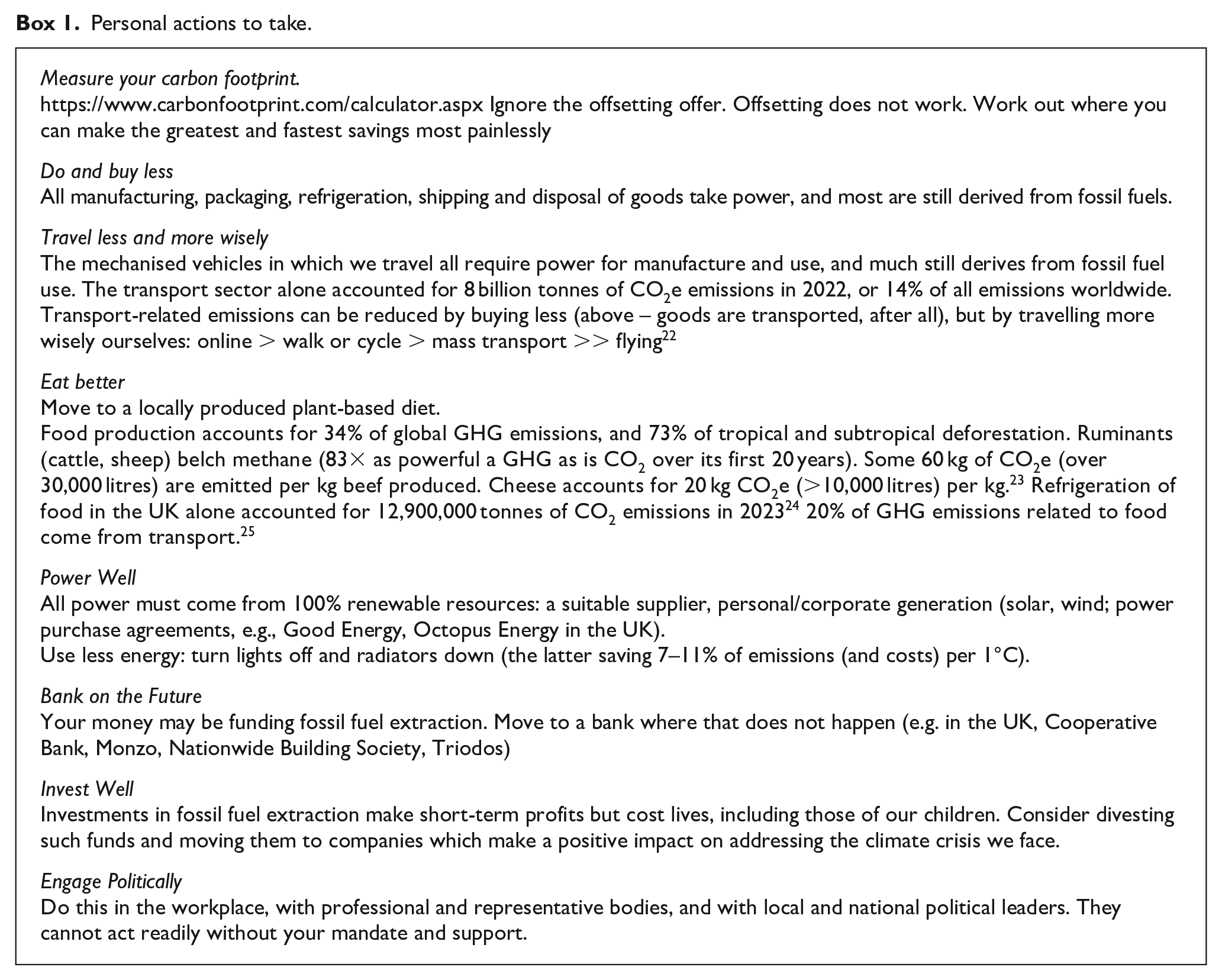
Whatever our motivation – altruistic (for our ecosystem or others) or selfish (for ourselves or our children alive today) – we must thus act now. Every individual and business must now take their action, immediately, and thence at pace and scale (Box 1). Such actions may seem ineffective – a mere ‘drop in the ocean’. But there is hope. Our behaviour influences others and also creates a permissive environment in which politicians can act. But, perhaps more importantly, changes in our spending deliver a disproportionate impact on financial flows – moving money from fossil fuel extraction and use to non-polluting energy and agricultural systems. Together, we can make the difference we need – but only if we all take responsibility as individuals.
Personal actions to take.
Summary
Climate change threatens our biosphere, economies, health and survival now. Impacts have been underestimated, are accelerating and are largely irreversible outside geological timescales. We all have to act. Right now.