



Abstract

Keywords
Recently, there has been a significant increase in medical research driven by a growing interest in addressing researchers’ hypotheses. However, this surge has also led to the emergence of metrics that compare the impact of articles against one another. As a result, the current discourse revolves not only around a competition to publish more and achieve greater impact, as mentioned in Thomaz and Mormul, 1 but also the creation of biases, studies of perceived ‘little value’, and an inefficient standard evaluation that fails to determine the quality of science, thereby compromising the overall quality of research. 2 The undervaluation of local studies occurs when they are published in low-impact journals, despite evidence suggesting that the impact factor of a journal does not guarantee the impact of a study.2,3 This correspondence aims to reassess the existing criteria for evaluating medical research and explores how researchers can generate high-value studies to avoid the excessive dissemination of information that makes a poor contribution to the scientific community.
One crucial approach in this regard is the Leiden Manifesto, which puts forth ten principles emphasising the importance of avoiding excessive reliance on quantitative metrics and instead focusing on qualitative metrics to assess the value of local research. Local research is particularly affected in the current system, and it is crucial to utilise both quantitative and qualitative parameters to foster high-quality science with robust data. 2 The manifesto plays a vital role in highlighting and safeguarding the excellence of local research, which directly influences public health concerns in each specific region. Ultimately, its aim is to enhance health indicators. In the realm of biomedical sciences, the ultimate goal is to achieve tangible and significant outcomes for the population.
A novel and essential tool for complementing the arguments and reflections of Leiden manifesto is evidence-based research, proposed by Robinson et al. 4 This approach advocates a systematic and comprehensive method for conducting research, relying on several pillars to prevent biomedical research from resulting in redundant and low-value studies. These pillars encompass: (1) The researcher and research context; (2) Synthesis of earlier similar studies; (3) Synthesis of end-user perspectives; and (4) Underpinning research. The ultimate objective of this approach is to determine the validity and value of the hypothesis under investigation.4,5 Consequently, it aims to furnish ethical, scientific and transparent justifications for funding or investing time in research. Moreover, it introduces a noteworthy and innovative aspect of evidence-based medicine, namely, the practical applicability and adherence of the acquired results while assessing the end-users’ perspectives (patients and healthcare providers).4,5
Until now, separate discussions have taken place regarding these two concepts. However, we believe that given the recent increase in scientific publications, global health priorities, challenges in funding accessibility and, most importantly, out of respect and honesty towards science and researchers, a fair and objective evaluation of scientific evidence must be sought. Additionally, it is crucial to safeguard genuinely valuable and valid research. Therefore, we propose the integration of the Leiden manifesto and evidence-based research as pillars in the appropriate evaluation of pluralism, gaps and relevance in medical research (Figure 1). This approach would enable special considerations when comparing different areas of biomedical research, research questions, study designs and the research’s scope and pertinence. Unquestionably, even in the meta-research proposed by Ioannidis et al., 6 when examining the quality, reporting, incentives, reproducibility and evaluation of research, this would be a crucial factor to consider. Ultimately, this would lead to the rigorous evaluation and enhancement of research methods and practices.
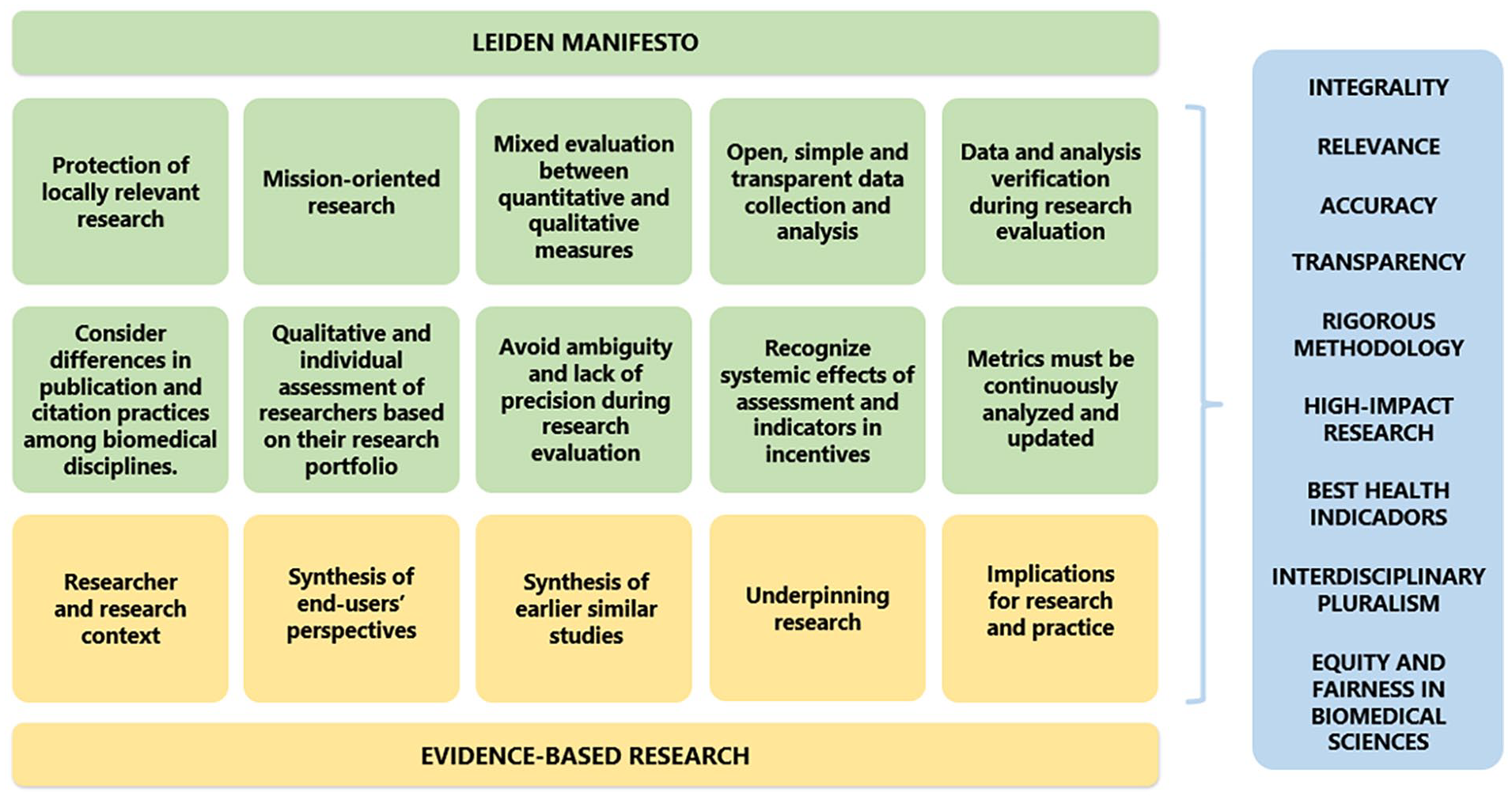
Network of principles for the comprehensive and equitable assessment of pluralism, gaps and relevance in medical research, which is founded on the definitions proposed by the Leiden Manifesto and Evidence-Based Research.2,4,5 The integration of these concepts proposes that during the design of a study, consideration should be given to the assessment of the Leiden manifesto (point by point), which recognises the pertinence, reproduction and relevance of the research, starting from the local, regional and global scope, in order to protect mission-oriented research. To achieve this, a methodology must be developed to understand and show the background, impact and effects on policies, health strategies and the end-users’ perspectives. Thus, the research is aligned with the needs of each community, and it does not produce weak and unhelpful evidence for healthcare stakeholders, including the government. Accompanied by evidence-based research, it provides methods to complement the synthesis and presentation of the rigour and relevance of medical research, using approaches such as data systematisation, bibliometrics, data collection on the end-users’ perspectives of the information (those who use the evidence being sought to produce), and the context of the research and researchers. This will provide sufficient data to determine how useful, relevant, rigorous and potentially impactful a research is. Thus, it will be possible to achieve comprehensiveness, relevance, precision, transparency, methodological rigour, high-impact research and improve health outcomes more easily.
Over time, with the incorporation of additional tools, the analysis, critical review and evaluation of evidence can be personalised through experimentation and future research. For instance, in translational research, where numerous confounding factors need to be taken into account during experimentation and the application of results in clinical practice, such as genetics, epigenetics, interaction with the environment, phenotype, culture and society, it becomes justifiable to differentiate significant gaps when comparing populations. Investigating a phenomenon in a vulnerable and hard-to-reach population differs from studying a commonly observed disease in clinical practice. Furthermore, the impact and relevance may vary based on health indicators in each region, irrespective of the complexity of the phenomenon under study. A clear illustration of this is the research on human immunodeficiency virus (HIV) and obesity, which has witnessed a significant increase in incidence and prevalence in Colombia in recent years, as indicated by data from the Pan American Health Organization. 7 However, searching PubMed for the years 2019 to 2023 using ‘Colombia’ as the affiliation yields no more than 160 HIV studies and 130 obesity studies (without distinguishing how many are original research). Conversely, during the same time frame, using ‘Colombia’ as the affiliation generates over 23,000 results. Therefore, research on these two prioritised conditions in the country represents less than approximately 1.5% of the total research conducted in the last 5 years. This observation aligns with the discussions by Robinson et al.4,5 and underscores the need for personalised approaches, based on the principles of the Leiden manifesto, in designing funding programmes and policies that support studies addressing the unique needs of each region and yield meaningful and tangible outcomes for population health (regardless of the prestige of the journal where the results are published, as long as it is a journal that meets the quality standards).
Lastly, the consideration of limitations when enhancing research quality is always relevant. Authors have highlighted the challenges in implementing the principles outlined in the Leiden Manifesto. 8 Nevertheless, this serves as a call to reevaluate current parameters and redirect all medical research towards the pursuit of the highest quality principles and methods. It is preferable to decelerate the pace of publications to ensure the evidence presented holds significant value and encompasses all relevant aspects.2,8 Medical science should constantly prioritise the well-being of society, addressing the issues experienced. By doing so, numerous aspects of individuals’ lives can be improved.
Footnotes
Declaration of conflicting interests
The author(s) declared no potential conflicts of interest with respect to the research, authorship, and/or publication of this article.
Funding
The author(s) received no financial support for the research, authorship, and/or publication of this article.