



Abstract

Confluent and reticulated papillomatosis (CRP) is a rare skin condition, primarily documented in individual case reports and limited case series. The disorder is associated with aberrant keratinization. We present a case of CRP in an 18-year-old, non-smoking, teetotaler female who exhibited positive responses to combined oral doxycycline treatment and topical tretinoin.
The patient complained of a brownish-pigmented patch over her neck, armpits and flexures since the age of 13, with an increase in pigmentation preceding the presentation. Notably, no associated pain, itchiness, erythema, pustules or scaly lesions were observed. The patient had no significant allergy or family history and had been using whitening cream over the affected areas.
Clinical examination revealed brownish papules and plaques on the neck, bilateral axillary regions, abdomen, back of the trunk, and posterior knee (Figure 1(a), (c), (e)). Blood tests were within normal limits, including full blood count, renal profile, liver function test, fasting blood sugar, cholesterol, thyroid function test and serum cortisol. Skin scraping for potassium hydroxide and fungal culture yielded negative results. A skin biopsy from the right abdomen showed hyperkeratosis, papillomatosis and mild acanthosis, without significant dermal inflammation or malignancy (Figure 2).
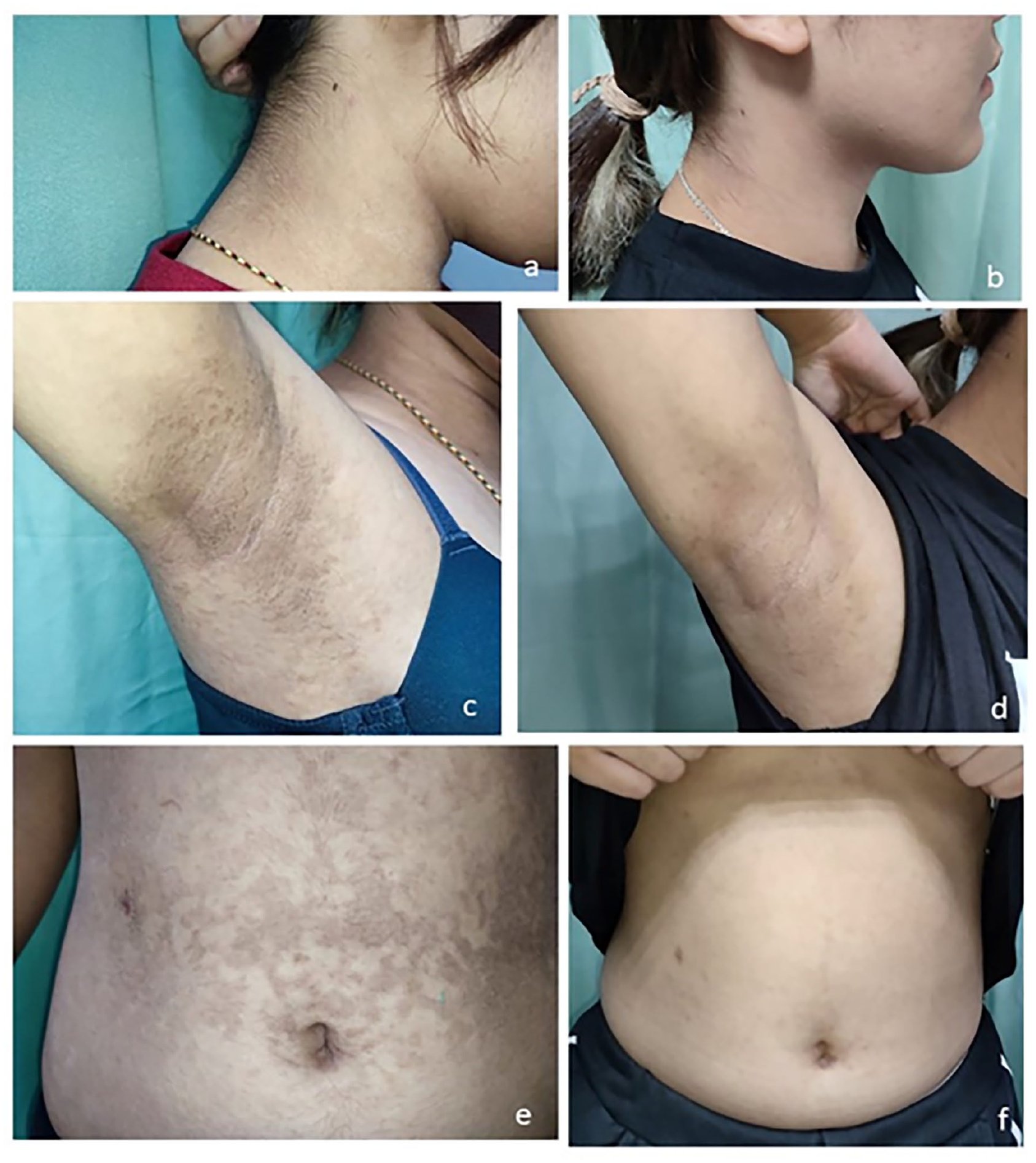
Typical brown macules/papules in a reticulate pattern on the (a) neck, (c) bilateral axillary, (e) abdomen region. Resolution seen after 6 months of treatment (b), (d), (f).
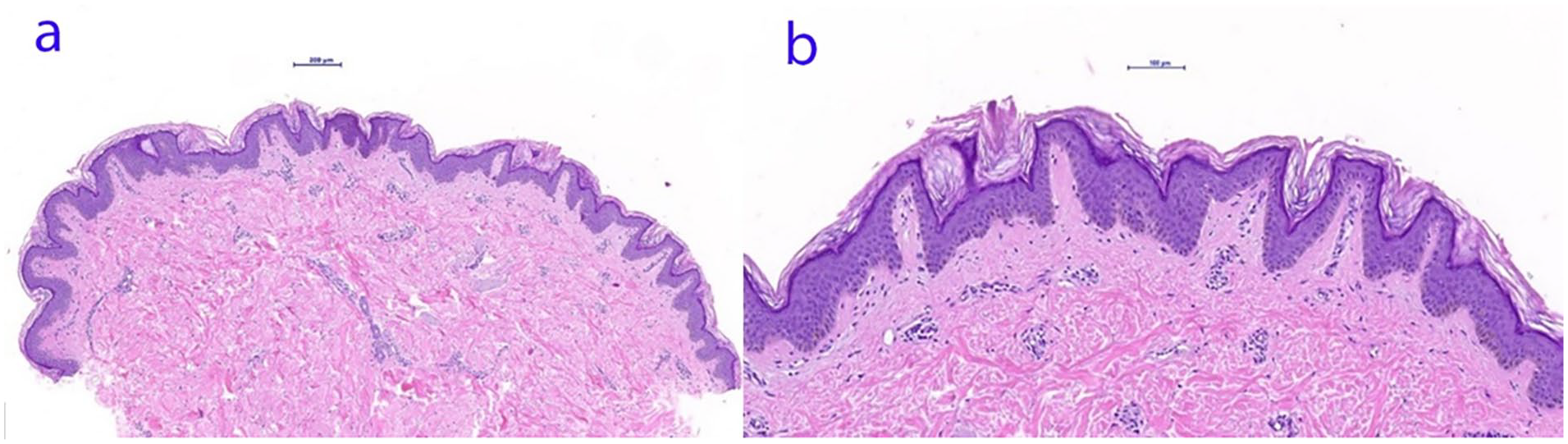
(a) 10× H&E and (b) 40× H&E showing hyperkeratosis, papillomatosis, acanthosis and mild focal lymphocytic infiltrate.
Treatment involved a 6-month course of oral doxycycline (100 mg twice daily) and topical 0.05% tretinoin cream nightly resulting in more than 90% reduction or resolution of CRP (Figure 1(d), (e), (f)), with no reported adverse events.
Differential diagnosis considerations included acanthosis nigricans, prurigo pigmentosa, Terra firma forme, and Dowling-Degos disease ruled out based on clinical and histopathological findings. Skin biopsy played a crucial role in confirming the diagnosis, revealing characteristic features of CRP, such as an undulating basket-weave pattern of hyperkeratosis, papillomatosis, focal acanthosis and increased melanin pigmentation in the basal layer. 1
Antibiotics, particularly minocycline, are commonly used for treatment. 2 Other choices of antibiotics that have been used recently with good response are doxycycline, erythromycin and azithromycin, but our patient responded well to doxycycline, chosen for its anti-inflammatory effect, 3 practitioner familiarity and concerns about potential minocycline side effects. The decision to prescribe a dosage of 100 mg twice a day was grounded in the literature, demonstrating successful treatment.4,5 The treatment was well tolerated by our patient without any reported adverse events and the duration was determined based on the patient’s response. The varying timing of responses reported in the literature underscores the need for individualized treatment approaches.4,5 The combination with topical tretinoin aimed to reduce keratinocyte proliferation and its treatment alone gave variable results. 6
Footnotes
Acknowledgements
The authors would like to thank the Director of Health Malaysia for the permission to publish this paper. We acknowledge Yong Pei Wen for contributing to the histopathological (HPE) picture.
Declaration of conflicting interests
The author(s) declared no potential conflicts of interest with respect to the research, authorship, and/or publication of this article.
Funding
The author(s) received no financial support for the research, authorship, and/or publication of this article.
Ethical committee approval
This study obtained approval from the Medical Research and Ethics Committee (MREC) Malaysia with NMRR approval NMRR ID-22-02054-XJN.
Patient consent
We have obtained written consent from patient for publication.
