



Abstract
Quinine has been used in Western medicine since the 16th century, and far longer in South America. It has gained an undeserved reputation as an effective treatment for leg cramps and continues to be widely used in the United Kingdom and elsewhere despite warnings from the Medicines and Healthcare products Regulatory Agency (MHRA) and the US Food and Drug Administration (FDA). The effects in overdose are outlined and a personal perspective of scientific investigation of treatments at one time advocated provided.
Keywords
Introduction
I still enjoy a gin and tonic at the end of a long day, despite my awareness of the potential effects of ethanol on my brain and adverse consequence or chronic alcohol misuse. Have you ever thought what gives the tonic its taste? The bitter flavour comes from the extract of the bark of the cinchona tree, well at least used to until modern chemists worked out how to isolate the active part of the bark extract, a complex chemical called an alkaloid. It was the Jesuit missionaries who noticed that the local South American Indians were using the bark as a medicinal product to help treat fevers and diarrhoea and, in the 1560s, brought it back to Europe (Figure 1). The exact story of why it became used for treating malaria is lost in history; malaria was not a South American illness. Cinchona extract was widely available in the Catholic community in southern Europe and malaria a common illness in southern Italy at that time. So, the recognition of an association between cinchona and benefit in malaria is not hard to imagine.
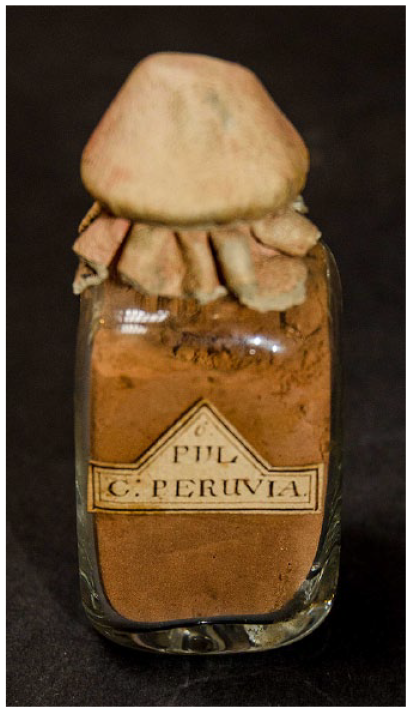
Peruvian Bark – mid-1700s – Medicine chest of Sir Stuart Threipland.
Use of quinine today
Malaria is not very common in the United Kingdom today. I treated only one patient in a 40-year career in general medicine and this in Newcastle upon Tyne. I remember the patient to this day, a Geordie holidaymaker who had ‘forgotten’ his malaria prophylaxis at home in the belief that Geordies were somehow immune to tropical diseases. The quinine, initially used intravenously, had a dramatic effect and rapidly cured him. It may therefore surprise you to know that there were over 2.3 million prescriptions for quinine in the United Kingdom in 2001. 1 These were not used for malaria but to treat muscle pains and cramps, particularly in patients with renal disease or in those getting on in years. How it came to be that quinine was thought beneficial in this indication is, like malaria, also uncertain, but recent clinical trials have failed to show dramatic benefit. The FDA banned use for this indication in 2007 and a Cochrane review found week evidence of benefit. 2 The MHRA issued a warning about quinine in 2010 but although there were some changes in areas where there was closer monitoring of prescribing across England and Wales the drug was still widely used. 3 Thus, as for many treatments, this ancient therapy continues to be used for leg cramps despite lack of good evidence of efficacy.
Toxicity of quinine
Quinine has some interesting biological properties and adverse effects. It is was recognised as a treatment for symptomatic atrial fibrillation in the 19th century, allegedly following its use by a sea captain. Its isomer, quinidine is used as an antiarrhythmic. It causes changes to the ECG due to blockade of sodium channels. It binds to the outer membrane of platelets and in susceptible patients can result in an immune-related sudden haemorrhagic purpura or even a more dramatic clotting disorder called thrombotic microangiopathy with its associated haemolytic uraemic syndrome due to the circulating small clots and lack of platelets caused by the adverse drug reaction. This is rare and only very occasionally causes dramatic effect, as in an airline passenger given a soft drink containing quinine that precipitated an acute haemorrhagic purpura, for which there is no specific therapy other than supportive.4,5
The more widely recognised clinical toxicity is due to excess drug and is known as cinchonism, after the tree. This syndrome starts with sweating and nausea, disturbance of vision, particularly initially colour vision, and cardiac arrhythmias, before blindness, coma and death.4,6 The mechanisms are complex, including an important sodium channel blocking effect on the myocardium in overdose responsible for the arrythmias it causes, and likely a different direct toxic effect on retinal cells. 7 Quinine also causes release of insulin and may cause low blood sugar. 4 These effects are all sometimes seen in high-dose quinine treatment for malaria.
Overdose
My first experience of serious cinchonism was dramatic. A toddler had been visiting his grandparents. One of them had left a bottle of pills on the mantelpiece. These were white and sugar coated similar in size to ‘Smarties®’ sugar coated chocolate drops. They got hold of the bottle and tasted one, it was sweet and so had a few more, but no more than a mouthful. Six tablets were thought to be missing from the bottle by the horrified grandparents. They immediately took the child to the nearest emergency department where in front of them the child became semiconscious after vomiting. The tablets were identified as quinine and after a short telephone consultation the child was transferred 20 miles to our centre immediately by ‘blue light’ ambulance so we could attempt the then advised treatment of choice, exchange blood transfusion. Throughout this period, cardiovascular status was unstable and with a consultant cardiologist colleague trying to manage the cardiac arrhythmias exchange transfusion proceeded.
We had recently developed an assay for quinine in our laboratory, and so were able to accurately measure the quantities of quinine removed as we conducted the procedure. Tragically despite all this the child died. We later carefully evaluated how much quinine our efforts had removed from the tiny body. The amount removed proved minuscule and we all felt devastated at the effort we had all put in for so little reward. At least the data we collected proved useful in asking a question on procedure benefit of exchange transfusion.
Study of treatments
This case sparked my interest in the techniques then being used in adults to manage quinine poisoning. Over the next few years, we had a steady stream of patients with this potentially tragic disorder. The next memorable patient was a teenager who had had a major argument with their parents on Christmas Eve. They had reached for their mother’s tablets and taken a handful of several bottles, them one of which contained quinine. The ingestion was rapidly recognised, and the teenager was brought to us for consideration of treatment for this poisoning. This young patient’s cardiogram was abnormal but improving and they seemed otherwise reasonably well. My plan was therefore to observe them overnight planning to discharge them on Christmas morning after counselling. As was my habit I did a ward round on Christmas morning and was horrified to realise the patient could not see me clearly. On examination, they had a very typical quinine induced amblyopia. They had realised sight problems before I arrived when they could not see to open their Christmas presents. Fortunately, their sight mostly recovered over the next few days, but they were left with permanent residual loss of peripheral vision. This was a devastating after-effect, for they had been planning a career in the Royal Air Force.
By then we had worked out that the previous established therapies of forced acid diuresis, haemodialysis and charcoal perfusion were as ineffective as exchange transfusion at removing clinically useful quantities of quinine from the body. The reputation of these treatments was based on the observation that in the recovery phase from the overdose some patients’ sight recovers quite suddenly, and this could be in association with the time of the intervention. In a collaboration between Edinburgh and Newcastle we were able to clearly show by studying a case series that this improvement was purely due to chance and not to the treatment, by calculating the amounts of quinine removed. 8 These findings have been subsequently endorsed by modern review. 9
The standard treatment for quinine-induced blindness in the 1980s had been introduced 30 years earlier following the observation that the retinal vessels appeared constricted on fundoscopy after quinine overdose as an attempted abortifacient, a reputed but untrue effect. The obvious solution then had seemed to be to reverse the vasospasm. The method chosen to do in the 1950s was by blockade of the stellate ganglion, achieved by injection of local anaesthetic into this small piece of nervous tissue in the neck, not without its own hazards as this sits close to the carotid artery. It was usually done unilaterally and that was when the great insight came to us. In those who recovered sight it would come back in both eyes, usually simultaneously but sometimes earlier in the non-injected side. It was clear that, like haemodialysis, this was a totally ineffective treatment, and we collected a case series of 31 patients to prove it. 10
Perhaps it also worth adding that we did find one therapy that seemed to effectively increase quinine clearance in volunteers, repeat dose activated charcoal. 11 Despite this it seems unlikely it would have a major impact on the early toxicity seen with quinine that is responsible for the early (within 10 h) cardiac and (within 10–20 h) ocular toxicity that are so problematic.
Conclusion
It is quite a career achievement to discover a new therapy, but to get rid of a bunch of useless ones does not carry the same caché. There are no College awards for that!
If any of you have any quinine tablets in the house, please, please get rid of them, or at minimum lock away from your grandchildren. Now where is that gin and tonic?
Footnotes
Declaration of conflicting interests
The author declared no potential conflicts of interest with respect to the research, authorship, and/or publication of this article.
Funding
The author received no financial support for the research, authorship, and/or publication of this article.