




Abstract
In this paper, the historical context of inequities in Aotearoa New Zealand’s education system are explored. We track the systematic bias of government policies enacted over the course of the past 200 years and show evidence of bias within the education system through to today. The authors also suggest that there are programmes already developed and shown to positively influence the achievement of all students, particularly Māori and disadvantaged students, which could support them and turn the tide on the inequity of achievement in Aotearoa New Zealand. The need for targeted strategic Government interventions that could significantly enhance the achievement of Māori and contribute to an equitable and just society, will also be discussed.
Introduction
Over almost 200 years, Aotearoa New Zealand has implemented a series of educational policies and practices that have seriously impeded the academic growth and educational achievement of Māori. From the time of Governor Grey’s Education Ordinance of 1847, which outlined the principles of education in Aotearoa New Zealand, the early policies and practices of the colonial regime intentionally sought to marginalize Māori language and culture and assimilate Māori children into European ways (Walker 2016). The Crown was also deliberate and calculated in their approach and intent to ensure that the position of Māori people in society would be confined to those of the lower working class. It was thought that the schools would enhance the moral influence of government. They were also expected to develop ideas of individual ownership of property and displace communal ownership, thereby making Māori land more accessible (Simon, 1998). The Government also wanted the mission schools to provide industrial training and laboring on the land and gardens. The underlying objective was to prepare Māori for a future as a laboring underclass (Walker, 2016:23).
For the best part of 120 years such low and discriminatory expectations of Māori within education would be echoed across Parliamentary chambers, legislation, official’s reports, and in the classrooms and educational institutions of the country. Many examples of these will be provided in this paper.
These beliefs of Māori abilities and the appropriate roles and position they should hold in society, emanated from notions of European superiority that saw Māori as an inferior race in intellect and ability to that of the European. The education policies born from that mindset, were directly aligned to the economic, political, and other social agendas of the colonial regime, that served to alienate Māori from their lands and resources and exclude them from equitably participating in the economy and society at large.
It is perhaps no surprise that over time, these policies and practices achieved their objectives and resulted in generations of low Māori educational achievement and inequitable access to educational opportunities at all levels of schooling when compared to their Pākehā (New Zealand European) peers (Mayeda et al., 2022). The impact of these experiences resulted in intergenerational patterns of low expectations and stigmatization that saw significant proportions of Māori exiting education early and being channeled into low-level occupations. For the majority of children, school became a site of resistance, an arena of cultural conflict exacerbated by teachers steering pupils towards manual labor and domestic service. Few went on to high school; most dropped out to join the workforce as manual workers (Walker, 2016:25).
Despite various government initiatives, over many decades, little has changed in terms of Māori achievement outside of Māori medium education settings primarily because many of the core systemic problems within the system have not been addressed, nor have the mindsets and beliefs that gave rise to them in the first place and allowed them to persist within education through to the present time.
Te Reo Māori in the curriculum
An example of this practice can be seen in the treatment and classification of te reo Māori (the language) in the education system. Te reo Māori was gazetted as a School Certificate subject (the national Year 11 qualification until 2002) within the secondary schooling curriculum in 1934 and first offered to students as a subject 11 years later in 1945. However, the language was not formally recognized in Aotearoa New Zealand’s national secondary qualification system until 2002, when NCEA (National Certificate of Educational Achievement) was introduced and it became a subject with Achievement Standards under the NCEA Framework. Although te reo Māori had been taught as a subject in a number of secondary schools prior to this time, it was the only language in the Aotearoa New Zealand curriculum considered to be non-academic, which meant there was not a standardized qualification pathway equivalent to all other languages in the curriculum, which were deemed to be academic in nature and positioned at the top of the subject hierarchy. The academic or subject hierarchy is related to a belief that some curriculum areas are more valuable than others; some are ranked more highly than others (Bleazby, 2015).
Other policies served to marginalize learners of te reo Māori and restrict their access to higher education. The rules governing School Certificate included a scaling system which allocated proportions of grades to different subjects. For students of te reo Māori, only 38% were permitted to pass in any given year, whereas 80% of those taking French, Latin, and German were allowed to pass. Over time other languages such as Japanese, Chinese, and Russian were introduced into the Aotearoa New Zealand curriculum as options for the formal qualifications and they were also at the top of the academic hierarchy (Treaty Resource Centre, 2024). Te reo Māori was the only language given a lower status. It was placed alongside vocational subjects such as home economics, woodwork, and typing, which succeeded in limiting the opportunities for Māori learners of te reo Māori to pursue a University qualification.
Besides the large number of government policies that have been to the detriment of Māori education, there are also societal-level problems that have implications for Māori. For example, various negative stereotypes influence attitudes in society and, in turn, the attitudes of some teachers of whom only 12% are Māori (71% Pākehā; Ministry of Education, 2025), whereas within the Aotearoa student population, 25% are Māori and 51% are Pākehā (Statistics NZ, 2024). These stereotypes have been shown to produce teacher expectations that are lower for Māori than for other ethnic groups (Rubie-Davies et al., 2006; Turner et al., 2015). In turn, rather than receiving challenging opportunities to learn, the activities that Māori receive can be mundane, boring, and low-level (Rubie-Davies, 2018). When one group of students is assigned higher-level tasks that are cognitively stimulating, whereas another group completes low-level skill-based activities, the two groups learn different things, and, not surprisingly, any existing achievement gaps become exacerbated (Rubie-Davies, 2015).
Post-Colonial theory
Post-colonial theory underlines this paper. It is a critical approach used to analyze how colonialism has impacted the cultural, social, and political structures within society. Post-colonial theory posits that the society in which we live cannot be understood without considering imperialism and colonial rule (Loomba, 2005). It therefore provides a basis for understanding and critiquing the impact of colonization on Māori. It helps to show how Māori culture, identity, and knowledge systems became marginalized through colonization. However, whereas colonization is generally regarded as being embedded in historical injustices, we argue that coloniality is a more appropriate term as it refers to the structures of power, culture, and knowledge that have endured despite colonialism being regarded as completed or achieved (Mignolo and Bussman, 2023).
This paper will detail many of the government policies that, over time, have detrimentally affected Māori education and achievement. It will then discuss two programs, one in primary school and one in secondary, that have shown large, positive benefits for Māori achievement. Policy implications of the findings outlined in this paper, will also be included.
Methodology
In order to understand how educational policy has impacted Māori education and achievement, a systematic overview was conducted. A comprehensive search strategy was employed using electronic databases such as PsycINFO, Google Scholar, EBSCO Host and ProQuest. In addition, relevant journals and books were included. The search terms included, for example, “Māori AND education”, Māori educational disadvantage,” and “Education policy AND New Zealand.” The inclusion criteria were that the publications needed to be peer reviewed and that they were published in English. Publications also needed to focus on historical and current government educational policy in Aotearoa New Zealand.
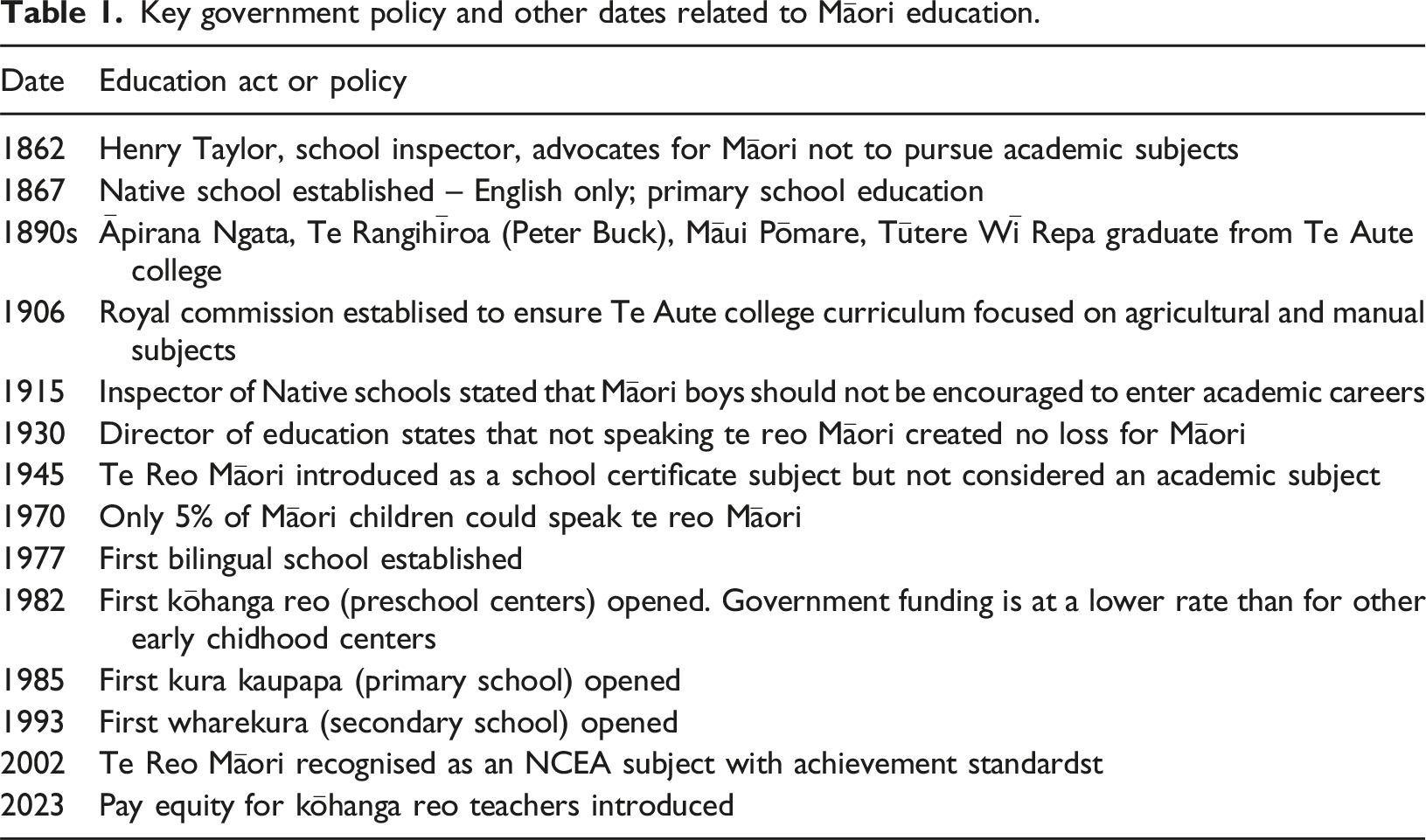
Key government policy and other dates related to Māori education.
Positionality statement
The first author who is Pākehā has always conducted research related to improving the achievement, self-belief, motivation, and engagement of disadvantaged students, particularly Māori. She became aware of the historical bias against Māori within the Aotearoa New Zealand education system upon beginning a Masters degree at university. This was a history that shocked her because, although educated, she was completely unaware of systematic policies that had disadvantaged Māori. That made her want to make a difference for Māori students. Hence, her own primary teaching (where she had observed teacher bias and stereotyping) coupled with these new learnings strongly influenced her academic career and shaped her research direction. She now often conducts professional development with teachers helping them to acknowledge the biases in the educational system but also offers practical strategies that can raise student achievement markedly while increasing students’ confidence and self-belief.
The second author is of Māori and Pākehā descent, with her tribal affiliation on her father’s side being to the Kāi Tahu people of the South Island. She was raised in a family deeply immersed in the fight for Māori Treaty rights and justice across all spheres and was aware from an early age of the significant challenges experienced by Māori in the education system. While attending Māori boarding school for her secondary schooling, the author experienced first-hand the systemic low expectations of Māori learners and inequities inherent in the curriculum concerning the treatment of Māori language and culture. These experiences influenced her greatly and ultimately compelled her into a career centered on the revitalization of the Māori language, educational equity, and Māaori community development. Her career has seen her take roles within academia and in leadership positions on national boards and advisories concerned with Māori language, culture, and education, including providing professional development across the education, health, and justice sectors, centered on raising awareness of inequities and the history of Aotearoa New Zealand.
Results and discussion
The whakapapa (story) of Māori disadvantage
Despite Māori showing that they were keen to become fully literate in English and te reo Māori, in 1862, Henry Taylor, who was a school inspector, at the time, wrote, “I do not advocate for the Natives under present circumstances a refined education or high mental culture: it would be inconsistent, if we take into account the position they are likely to hold for many years to come in the social scale, and inappropriate, if we remember that they are better calculated by nature to get their living by manual rather than by mental labor (New Zealand Government, 1862).” Unfortunately, this attitude that Māori are best suited for manual labor and unskilled occupations persisted thenceforth, and can still be found in some circles, even today.
The Native Schools Act (New Zealand Government, 1867) allowed for the establishment of a series of schools to be built for the education of Māori. These were initially embraced with enthusiasm by Māori who were keen to learn how to read and write and to learn more about the new European (Pākehā) society and culture with which they were becoming increasingly confronted (Simon, 1998). Indeed, by the middle of the 19th century, such was the Māori appetite for Pākehā knowledge, and the new skills associated with it, that Māori had become prolific writers and were more literate than Pākehā (Sligo, 2022).
Native schools were built on Māori land, Māori contributed to half the construction costs (including for a teacher residence) and ongoing maintenance, and even though Native Schools were classed as government schools, Māori had to raise half the salary of any teachers. In addition, all instruction was to be in English only and there was a deliberate policy that the focus for Māori was to be on manual and domestic, rather than academic subjects. Native schools enabled the students to gain a primary school level of education (Years 1–8; 5–12 years of age). They were found in rural areas where most Māori lived but this meant that there was no facility for Māori to receive an education beyond the primary level within rural areas (Simon, 1998). Clearly, these schools disadvantaged Māori compared to Pākehā both in terms of access to higher-level education as well as in the focus on learning manual and domestic skills rather than academics. Further, although initially te reo Māori could be used to facilitate teaching in the junior classes to “induct infants into school routines, thereafter, it was progressively displaced by English as the medium of instruction in reading, writing, and arithmetic” (Walker, 2016:24), and by 1903, students could be punished physically and in other ways for using te reo Māori at school – even in the playground (Bell, 1991).
Te Aute college
Despite the many obstacles imposed on Māori that limited their educational opportunities within the compulsory and post-compulsory sectors, there were a number of historical outliers who challenged the status quo and fought to actively provide pathways for Māori learners into higher education. One such education leader was John Thorton, who was appointed to the role of principal of Te Aute College in the Hawkes Bay in 1878. Thornton encouraged Māori to enroll in the school and offered them all the benefits of an academic education (Graham, 2009). Thornton provided his senior students with the opportunity to learn subjects required for the matriculation examination including English, arithmetic, algebra, Euclid, physiology, French and Latin, science, chemistry, and Classics which enabled them to go on to university (Walker, 2016:25).
As a result, a flow of Māori scholars emerged from Te Aute College and proceeded to attend and graduate from university. These included Āpirana Ngata (the first Māori to complete a degree [in law] at an Aotearoa New Zealand university and later a government minister), Te Rangihīroa (Peter Buck who became a doctor and prominent anthropologist), Māui Pōmare (who became a doctor and Māori health officer), and Tūtere Wī Repa (who became a doctor and community leader). As stated earlier, this result was not one that was aligned with the intention of the education system and expectation for Māori within it. The appearance of Māori graduates so early in the colonial encounter constituted a challenge to the nexus of power and knowledge monopolized by Pākehā… The powerbrokers in education moved to quench the flame lit by Thornton (Walker, 2016:26).
Despite these obvious indications that Māori could excel in academic studies, a Royal Commission on Te Aute and Whanganui School Trusts was established specifically to stop the teaching of academic subjects to Māori students. As a result, Thornton was directed to cease teaching the academic subjects and instead concentrate on agriculture and manual instruction. Thornton strongly defended his position and insisted on the right of Māori to be able to access these academic opportunities; however, ultimately, he was defeated because The Department of Education introduced policies that restricted the continued pursuit of academic work at the college (Graham, 2009).
The “place” of Māori in society
Among government officials, the attitude that Māori were best suited to manual labor and, therefore, should only learn manual skills persisted and became further entrenched in the education system. Māori wanted the academic learning open to Pākehā but were deliberately precluded from receiving it. The belief in the empowering nature of education and trust in equitable treatment and opportunity within the Aotearoa New Zealand education system was quick to wane within Māori society as successive generations continued to be deliberately channeled into predetermined pathways and limiting careers. Because Māori could see little point in sending their children to boarding colleges in larger towns and cities to learn agricultural skills, when they were working on their farms, interest in secondary education dissipated somewhat (Simon, 1998).
This attitude among education officials that Māori were more suited to manual labor rather than academic learning persisted well into the 20th century even though some officials began to express concern. However, even in 1915 the Inspector of Native Schools still stated, “So far as the Department is concerned, there is no encouragement given to [Māori] boys who wish to enter the learned professions. The aim is to turn their attention, if possible, to the branches of industry for which Māori seem best suited” (Education for Māori, n.d).
In 1930, the New Zealand Federation of Teachers attempted to introduce te reo Māori into schools because by this stage many Māori had lost their language. This was prevented, however, by the Director of Education who first expressed his belief that, “the natural abandonment of the native tongue involves no loss to the Māori,” and went on to reiterate the expectation of Māori receiving an education that “should lead the Māori lad to be a good farmer and the Māori girl to be a good farmer’s wife” (Jenkins and Morris Matthews, 2006).
Not surprisingly, over time the educational achievement divide between Māori and Pākehā students became wider and more evident. The race-based policies that had dominated the colonial era of education in Aotearoa New Zealand and that were developed to confine and limit Māori academic aspirations, along with the thinking and practices that enabled them, had achieved their goals of Māori being assigned to lower-level occupations, considered only fit for manual labor, and not being able to access higher-level learning. The normalization of the thinking and negative expectations of the Māori learner would continue to go unchecked and unquestioned over generations.
Revitalization of the Māori language
Māori protests against the educational policies and practices were however gaining momentum. By the 1970s, the state of te reo Māori within Māori communities had reached an all-time low, with less than 5% of Māori school children being able to speak the language. Māori society started to collectively mobilize again in protest and a reassertion for justice and Māori rights in land, education, and the economy. Throughout this decade of protest, te reo Māori featured prominently as a unifying beacon for redress and attention, and as a symbol for Māori resistance (O’Regan, 2012).
In 1972, the protest group Ngā Tama Toa (The Young Warriors) presented a landmark petition with 30,000 signatures to the steps of Parliament in Wellington, calling for te reo Māori and culture to be taught in all schools in Aotearoa New Zealand.
Subsequent petitions in 1978 and 1981 continued to lobby and advocate for the place and status of te reo Māori to be recognized and upheld. Although the Crown was largely apathetic and slow to respond, these waves of protest resulted in a number of community-based initiatives to stimulate the language revitalization effort and provide opportunities for education in te reo Māori, including the first bilingual school established in 1977 and the birth of kōhanga reo or language nests for preschoolers in 1982.
Although initially kōhanga were not funded by the Government, they conceded by the end of 1982 and agreed to fund kōhanga reo, albeit at a lower rate of funding than mainstream early childhood centers. Inequity of investment in Māori medium education in comparison to its English-medium counterparts, has remained a point of contention and protest since their inception. The disparity of funding for kōhanga reo for buildings, resources, and teachers, would continue through time, with pay equity for kōhanga reo teachers only being achieved in May 2023, 41 years after their establishment.
The kōhanga reo movement would lead to the development and rise of Māori immersion primary schools or kura kaupapa, with the first opened in Auckland in 1985, and the first wharekura or total immersion high school in 1993 (O’Regan, 2012). The success of Māori medium education was not just in their role at shifting the tide of language decline and energizing the language revitalization efforts across the country, it was also in the academic successes achieved by the students, who tended to outperform their Māori peers in English-medium education settings at every level. Despite these successes, lack of equitable funding, access issues, and inherent prejudice within the education system favoring English-medium settings, means the vast majority of Māori students, approximately 97%, are in English-medium education settings where they continue to experience inequitable outcomes in engagement and achievement (Education Review Office, 2021).
Apportioning blame
By the 1980s and 1990s, the language of Government policies and reports had shifted from explicitly speaking of low expectations and perceptions of Māori intellect and ability, to instead the attribution of educational failure of Māori being due to their own lack of effort and interest. The blame for the lack of Māori educational achievement was laid squarely at the feet of Māori themselves and reflected deficit theorizing: socioeconomic and parenting “problems” being seen as responsible for the under-achievement of Māori (Mahuika et al., 2011). This led educators to focus on social backgrounds, parenting, and other potential societal influences as being related to the achievement gap rather than examining how government policies over 100 years were responsible. It was as if the educated power-culture had suffered a collective, considered attack of selective historical amnesia that prevented them from seeing the relations between what had caused Māori educational failure and, in turn, the effect of the low levels of achievement on Māori engagement, participation, and achievement within the education system. The focus became on what Māori students were seen to lack. Deficit theorizing also enabled some teachers to abdicate responsibility for Māori student learning: the students did not do well academically because of their home background/poverty/parenting (Rubie-Davies, 2015).
More recent policies and their effects on Māori
In 2002, the National Certificate of Educational Achievement (NCEA) was introduced into secondary schools (New Zealand Qualifications Authority, 2023). This assessment was standards-based and replaced the former performance-based system whereby only 50% of students passed their examinations during each of the 3 years of senior high school. With NCEA, students needed to reach certain standards (clearly specified) and obtain credits to ultimately enter university. Alongside the NCEA achievement standards were unit standards. These were considered lower-level standards that students could achieve that might lead to a trade, for example, but would not be sufficient to enter university. Perhaps not surprisingly, Māori students were often channeled into and encouraged to take unit standards (Webber et al., 2016). A review in 2010 (Shulruf et al., 2010), noted many disparities in the NCEA system that were creating inequity for Māori and recommendations were made to address credit parity and fairness. For example, the researchers showed that Māori students often could not enter university not because of low grades but mostly because they had been directed to take subjects that did not lead to a university entrance qualification.
The examples presented above highlight the intentional nature of the inequities experienced by Māori in education over the last two centuries. Māori educational under-achievement did not happen “by chance” or because Māori learners were of lesser ability. They occurred because inequitable policies and systems were deliberately designed into the Aotearoa New Zealand system. Lack of access to the educational history of the country and any awareness of the policies and intentions outlined above, meant that most New Zealanders had little knowledge or understanding of what had led to the lower achievement of Māori students compared to their Pākehā peers. This enabled restrictive perceptions and stereotypes of the Māori learner to be nourished and allowed to grow, eventually becoming accepted as the norm.
In the face of the glaring intergenerational disparities, and in a modern era where calls for equity and justice became more vocalized and persistent within education and wider society, the emergence of more targeted interventions to address the educational inequities gradually came to fruition. Many such interventions have been introduced to try to overcome the disparities created by systematic policy decisions that have negatively impacted Māori. Two such programs will be presented below but it is worth noting that despite their success in improving Māori student academic and psychological outcomes, neither program has been fully funded by successive governments. Funding and implementation into government education policy could redress much of the disparity in educational outcomes between Māori and Pākehā. Of note, both programs have resulted in improved outcomes for both Māori and Pākehā. Similarly, both programs have their foundations in culturally responsive pedagogy and critical consciousness. Both feature the four necessary characteristics identified in a recent review (Caingcoy, 2023) which were recognizing and valuing students’ cultural backgrounds, building relationships and creating inclusive classrooms, adapting instructional strategies to meet diverse learning needs, and challenging stereotypes and promoting critical consciousness.
Te Kotahitanga
Arguably, one of the more successful programmes with Māori secondary school students (Years 9–10; ages 13–14) has been Te Kotahitanga. An evaluation of Te Kotahitanga commissioned by the Ministry of Education (2010) concluded that Te Kotahitanga, “is a sound and effective process for improving classroom teaching for Māori students” (Ministry of Education, 2010: p. 7). Te Kotahitanga began with the researchers interviewing Māori secondary school students and their whānau (family), teachers, and principals about why they thought Māori students were not succeeding in high school education at the same rate as Pākehā (Bishop and Berryman, 2006). Overwhelmingly, the students, whānau, and principals identified poor relationships with teachers and low expectations as being primary causes. Students did not believe that either they or their culture were respected by teachers. Te Kotahitanga was then developed as a professional development program to help teachers develop a culturally responsive learning environment. One of the lead researchers was Māori and several Māori teachers led the program. Te Kotahitanga resulted in much improved results for Māori students in both numeracy and literacy as well as improved relationships with teachers. In addition, although originally targeted at Māori students, students from all cultures made increased academic gains when involved in the Te Kotahitanga programme (Bishop et al., 2009). However, the evaluation (Ministry of Education, 2010) reported challenges for facilitators such as variability in curriculum expertise across schools, and limited change by teachers in some classrooms. Nevertheless, overall, the program was highly successful. Unfortunately, a change in government led to funding for this program ceasing in 2014 with little explanation. This was despite evidence for the success of the program in raising Māori student achievement and funding for Te Kotahitanga having cost US$35 million over 12 years.
High expectations remarkable outcomes
As outlined above, Te Kotahitanga was developed with the intent of raising Māori achievement but was then found to benefit all students. In contrast, a newer programme, HERO (High Expectations Remarkable Outcomes) was originally developed to benefit all primary-level students (Years 4–8; ages 8–12), but has also shown positive benefits particularly for Māori, Pasifika (those with origins in the Pacific Islands), and those from lower socioeconomic areas (Rubie-Davies and Rosenthal, 2016). The HERO program is grounded in high expectation teaching theory (Hornstra et al., 2023) and was developed in consultation with Māori researchers who ensured that its culturally responsive practices were appropriate. HERO is based on a successful experimental study in which teachers in the intervention group learned and then applied the practices of high expectation teachers in their classrooms. At the end of 1 year, students in the classes of teachers trained in high expectation teaching principles had made much larger gains in mathematics compared to their counterparts with control group teachers, the equivalent of 28% additional learning in 1 year (Rubie-Davies, 2015; Rubie-Davies et al., 2015). Further, analyses by school, school year level, ethnicity, gender, and socioeconomic status showed that regardless of which variables were analyzed, if students were with a teacher trained in the high expectation practices, they achieved at higher levels and made more progress than their peers with untrained teachers (Rubie-Davies and Rosenthal, 2016). The program had benefits for all students but those from low socioeconomic areas, Māori, and Pasifika gained most. Unlike Te Kotahitanga, HERO is aimed at primary school students although secondary schools have also successfully participated in the program.
High expectation theory is based on three key principles: Using mixed ability and flexible grouping coupled with high-level learning experiences; developing a warm class climate; and using goal setting and teacher feedback to motivate students while focusing on skill-based goals. These principles were developed following the finding that high expectation teachers had large effects on student learning (d = 0.97; Rubie-Davies, 2007) – the equivalent of more than 2 years of academic learning in 1 year – and subsequent classroom observations (Rubie-Davies, 2007) and interviews (Rubie-Davies, 2008) to determine the practices and beliefs of high expectation teachers that made such a large difference to student learning.
Similar to Te Kotahitanga, there is a strong emphasis in HERO on teachers creating a learning community whereby teachers form strong, positive relationships with all students and encourage students to work together and support each other. Teachers enjoy the diversity and divergence of students, respect the cultures of all students, aim to learn more about their students and their backgrounds, and expect all students to make large progress while in their classroom. They actively seek to involve whānau (family) in their child’s learning through regularly updating them about student progress, encouraging whānau to come into school, and often letting them know when their child has successfully mastered a new concept or made a positive contribution to the classroom. Seating groups are mixed achievement and change regularly. This means that all students work with everyone else in the classroom over time, which in turn, strengthens the relationships in the class. Although teachers may use workshops to focus on the development of skills, these are temporary and, therefore, those opting into the workshops change regularly as well. Students often complete cooperative and collaborative learning activities where they work together to solve problems. The learning opportunities for all students are rich and complex because the teaching is continually just beyond where students currently are. However, high expectation teachers also understand the curriculum and know how to break the learning into achievable chunks. Students are all given skill-based goals aligned with the learning intentions; teachers closely monitor the progress and provide feedback that tells students how they are going and what they need to do next in order to master the goal(s). These teachers understand the importance of creating a vibrant learning environment coupled with a positive and supportive class climate (Rubie-Davies, 2015; Rubie-Davies and Hattie, 2024).
The HERO program, which has been delivered in six countries, through over 150 workshops to teachers, school leaders, and education organizations, has built on the earlier experimental study (McDonald et al., 2014; Rubie-Davies, 2015; Rubie-Davies et al., 2015; Rubie-Davies and Rosenthal, 2016) and shown that teachers can be trained in high expectation practices and that when they do, all their students benefit.
Policy implications
This article has shown a history of bias within education and schooling in Aotearoa New Zealand that has detrimentally affected Māori over successive generations. Policy changes over the years such as the move from banning te reo Māori in schools to requiring its use in schools have made some difference but many of these changes have been hard-fought by Māori, not initiated by the government (O’Regan, 2011). The movement in the late 1970s by Māori to first establish full immersion kindergartens (kōhanga reo) and then later to add in primary, secondary (kura kaupapa Māori), and tertiary equivalents (whare wānanga) was a direct response to the government policies that saw te reo Māori become an endangered language (O’Regan, 2011). And although government policy followed, at first encouraging the use of te reo Māori in schools and then requiring its use, the degree to which this occurs in all schools differs. Further, given the serious disadvantages and bias that Māori have sustained over the past 200 years in education, it is time for government policy to lead rather than follow what is advocated for by Māori and many non-Māori. In a just society, all would be given equal opportunities to excel through targeted support for those traditionally disadvantaged.
It is important to note that the inequities discussed are not confined to the colonial era or from a bygone time. There are still considerable examples of inequities in treatment of the Māori language, Māori culture and knowledge, and Māori learners themselves that persist in the classrooms and educational institutions of today. As recently as within the last 5 years work has been done by our National Qualifications Authority (NZQA) to address the inequity of treatment of Māori subjects studied under the Te Marautanga o Aotearoa–Māori Medium curriculum, in comparison to subjects taught under the Aotearoa New Zealand Curriculum, that saw a number of key Māori medium subjects classified as unit standards (lower level), and their equivalent in mainstream education being classified as achievement standards (lead to university). The Māori medium subjects that have been reclassified as achievement standards include the following: Hauora (health), Ngā toi (Arts), Ngā mahi a te rēhia (Performing Arts), Ngā toi ataata (Visual Arts), Ngā toi puoro (Music), and Tikanga ā iwi (Social Science). Many Māori students still continue to battle with low expectations and negative stereotypes and are still often channeled and streamed into lower-level classes and vocational subject choices (Tokona te Raki 2019:5). For equity to be achieved in our schools, all pre-service teachers should learn about the history of bias within the Aotearoa New Zealand education system and have their own stereotypes and biases challenged. Learning about historical and current low expectations for Māori and the possibilities for change should be included in all teacher education programs.
This article has also shown that there are programs available that can go some significant way to addressing the current disparities and enable all Māori to succeed at the highest levels. However, government commitment to such programs remains questionable. Te Kotahitanga was hugely successful in raising Māori student achievement (Bishop et al., 2009) and yet government funding to the program was cut in 2014. Similarly, although medical schools in Aotearoa New Zealand have for some time been provided with funding and support to enable Māori students to pursue careers in medicine, acknowledging the historical and current barriers to access and engagement for Māori, this support is being questioned in the current political environment, where calls to end targeted Māori initiatives are finding traction in the new wave of political decision making. The current rhetoric that portrays Māori as “privileged” and “unfairly benefiting” from targeted interventions designed to address the historical and current inequities experienced, seems to ignore or deny the causes of those very inequities. The rallying calls to end “race-based policies” that are designed and developed to address the imbalance of power and historical educational opportunities for Māori learners, ignore the deliberate and intentional “race-based policies” that created the problems. It is important that through media and education, the general public comes to understand the historical bias against Māori in Aotearoa New Zealand and why targeted supports for Māori are needed. The voices that wish for Aotearoa New Zealand to be a just and equitable society need to become louder than those seeking to destroy what has been achieved over the past 150 years.
Nevertheless, although there have been waves of progressive policy shifts over the last four decades, in various attempts to address the inequities previously designed into the Aotearoa New Zealand education system, such as the taha Māori program of the late 1970s and 80s, the introduction of NCEA in 2002, the work done around assessment resources and guidelines for teaching and learning te reo Māori in the 2010s, and the curriculum refresh (Te Mātaiaho) initiated in 2023 which sought to have Māori language, knowledge, and perspectives more effectively taught across all curriculum areas, significant vulnerability still exists. This is evident in, for example, recent calls by the current government to only allow Māori seats on local councils if voted for by a majority of voters. This means that the hard-fought right for Māori to have representation on each council could disappear in some areas of Aotearoa New Zealand.
Other examples of this can be seen with the political shifts following the Aotearoa New Zealand elections at the end of 2023, that brought with them a sweeping tide of policy changes across education, where previous commitments to mātauranga Māori (Māori knowledge), te reo Māori, and the newly developed Aotearoa New Zealand Histories curriculum were altered, or in some cases completely abandoned.
Although there is still a Governmental commitment to Māori medium education settings, there has been an assault on the place of te reo Māori across the curriculum, with Māori terminology, commonplace in education settings for the last 30 years, now being expunged from key documents, resources, and communications, in line with the Government’s broader attack on bilingual signage and bilingualism in te reo. Perhaps even more concerning is the declaration of an end to any “race-based” policies, which highlight initiatives and programs aimed at addressing the systemic bias and inequities experienced by Māori and Pacific learners, no longer considered aligned to the Government’s agenda.
What is perhaps more alarming for current generations of educators and learners in Aotearoa New Zealand, is that the language that accompanies these shifts bares considerable similarities to those articulated by policy and political leaders in the mid-late 1800s, and through until the changing of the tides in the 1970s. However, it is of note that the recent government assault on Te Tiriti o Waitangi (The Treaty of Waitangi – Aotearoa New Zealand’s foundation document) resulted in backlash and protests to Parliament, and, importantly, that although thousands of Māori marched on Parliament so, too, did thousands of Pākehā. Whereas in the 1800s, government policies went unchallenged, today many Pākehā stand alongside Māori in the fight for equity. It will be important that Māori and Pākehā continue to loudly voice their opposition to proposed policies that serve to undermine the progress that has been made. The strength of such unity will ensure we do not regress as a country at this crucial time in our Nation’s journey, as stated in the whakataukī “ko te waka kōtuia e kore e wāwāhi”—a canoe bound together will not break apart.
The challenge for Aotearoa New Zealand as a country is two-fold. We must collectively commit to raising our awareness of the policies and historical contexts that gave rise to the educational inequities that many in our communities face today, so we may actively and intentionally support existing successful models and create new policies and interventions that are designed for equitable outcomes for Māori and all learners. But we must also work to raise our awareness of the mindsets and beliefs that allowed those policies to emerge in the first place and take hold of the minds and hearts of those charged with fashioning and overseeing our education system. If we remove the policies without addressing the underlying perceptions and bias, inequitable outcomes for marginalized learners will prevail and the low expectations for some learners will inevitably continue to limit their opportunities to achieve. The students and communities of Aotearoa New Zealand deserve a future where all are given every possible opportunity to succeed at the highest level. Nothing else is acceptable.
It is hoped that the equitable and just society that most New Zealanders crave and support will become a reality within a short time in our history. For that to happen, we first need to learn our history and then learn from it to help us craft new and positive realities into the future. We have come too far and shown what can be achieved when we are brave enough to acknowledge and address bias and prejudice, to allow ourselves to retreat. Our students and communities deserve better.
Footnotes

Funding
The authors received no financial support for the research, authorship, and/or publication of this article.
Declaration of conflicting interests
The authors declared no potential conflicts of interest with respect to the research, authorship, and/or publication of this article.