



Abstract
This article explores the role of teacher unions in shaping teacher professionalism discourses in New Zealand. Through an analysis of organisational documents and mainstream public media reports from recent decades, the article contends that tension and cooperation serve as defining characteristics in the relationship between teacher unions and governments, particularly concerning professional matters. While teacher unions generally strive to collaborate with governments on professional issues, an underlying sense of mistrust and tension remains deeply ingrained in their relationship. This article sheds light on this dynamic by examining the introduction and implementation of two significant education policies during the 2000s and 2010s: the National Certificate of Educational Achievement (NCEA) and the National Standards. While these two education policies are official achievement and assessment standards implemented in secondary and primary school education, respectively, the two main teacher unions responded differently. This divergence in stances on education standards policies presents an intriguing area for investigation. This article highlights the often-overlooked role of teacher unions in shaping professionalism discourses, particularly through their critical interactions with the government. It delves into the political dynamics and competing ideologies that influence the broader landscape of teacher professionalism.
Introduction
In recent decades, teacher unions have increasingly emphasised their role in shaping the teaching profession (Cowen and Strunk, 2014; Osmond-Johnson, 2018). Previous studies have predominantly focused on North American and European contexts (e.g. Bascia, 1992; Bascia and Osmond, 2013; Kerchner and Koppich, 2004; Lilja, 2014a; Mausethagen and Granlund, 2012; Osmond-Johnson, 2015). These existing studies show two apparent conflict phenomena. On the one hand, some studies show that there has been a pragmatic change in teacher unions’ stances from confronting education reforms to supporting them (Bascia and Osmond, 2013; Kerchner and Koppich, 2004; Lilja, 2014b). On the other hand, some other studies argue that teacher unions maintain a very different understanding of teacher professionalism from those of government, and that tension and confrontation characterise teacher unions’ relationship with government (Mausethagen and Granlund, 2012). However, little is known about how teacher unions manage to maintain a positive relationship with governments in relation to professional issues while holding a very different understanding of teacher professionalism. Moreover, teacher unions’ role in shaping teacher professionalism discourses remains relatively underexplored (Cowen and Strunk, 2014; Osmond-Johnson, 2018). As Bascia (2004) noted, the role of teacher unions in shaping the teaching profession has often been overlooked by researchers. Limited research has been conducted from the perspective of teacher unions themselves as collective actors shaping professionalism discourses (Johnson et al., 2009). This is also true in the New Zealand context. Therefore, this article aims to address this research gap by shedding light on how teacher unions in New Zealand have shaped teacher professionalism discourses in recent decades.
The New Zealand Educational Institute (NZEI) and the Post Primary Teachers’ Association (PPTA) are the two main teacher unions in compulsory education in New Zealand, and they have adopted different stances and strategies on teacher-related policies. This article illustrates these differences through an examination of two specific education policies introduced in the 2000s and 2010s: the NCEA (introduced in 2002) and the National Standards (introduced in 2010). Although both the NCEA and National Standards are official achievement and assessment standards implemented in secondary and primary school education, respectively, the PPTA and NZEI responded differently. While the PPTA welcomed the NCEA, the NZEI strongly opposed the National Standards policy. Investigating the divergent stances of these teacher unions on education standards, policies will further contribute to understanding the nuanced dynamics and power relations between teacher unions and governments regarding professional issues.
Literature review
Teacher unions play an important role in shaping the teaching profession and influencing education policy (Bascia and Osmond, 2013; Kerchner and Koppich, 2004; Stevenson et al., 2020). Recent research has shed light on the importance of teacher unions in shaping teacher professionalism discourses, particularly in relation to government policies. This literature review aims to explore teacher professionalism discourses within teacher unions and governments, as well as the dynamic relationship between them in shaping these discourses.
Teacher professionalism
Previous studies have shown that teachers (and their unions) and governments tend to maintain markedly different understandings of teacher professionalism (Alexander et al., 2019; Sachs, 2016; Whitty, 2000). According to Sachs (2016), while governments adopt discourses of managerial professionalism (or organisational professionalism), teachers subscribe to democratic professionalism (or occupational professionalism) discourses. It has been argued in the literature that managerial professionalism dominates teacher-related policies, emphasising teacher performativity, control, accountability, and competitiveness (Alexander et al., 2019; Whitty, 2000). As a response, it has been argued that teacher unions provide a platform for exploring alternative discourses to the dominant official discourse of teacher professionalism (Ball et al., 2011; Osmond-Johnson, 2018; Stevenson et al., 2020). It is also believed that teacher professionalism discourses are used both by governments to gain control over the teaching profession and by teachers and their unions to protect their occupation from government interventions (Ozga and Lawn, 2017). In other words, different teacher professionalism discourses are used to mobilise the special interests of different policy actors (Stevenson et al., 2007). Sachs (2003) noted that teacher professionalism had become a competitive arena of various ideologies. Notably, managerial professionalism and democratic professionalism are two ideal types of teacher professionalism; in practice, the meanings of teacher professionalism are complex and keep changing over time. The current study uses the terms managerial professionalism and democratic professionalism, focusing on mapping the competing and shifting meanings of teacher professionalism.
Managerial professionalism has been perceived as a threat to the teaching profession in many jurisdictions, such as the United States and England (Evetts, 2009, 2011; Milner, 2013; Stevenson and Gilliland, 2015). For example, Evetts (2009) identified some negative effects of managerial professionalism in practice, such as the limited time spent on real teaching activities, standardisation undermining teachers’ motivation to be innovative and creative, the neglect of immeasurable aspects of teachers’ work, and the commodification of teachers’ work resulting in a mistrust or audit culture in the education system. Moreover, Apple (2013) argued that the state tries to ‘deskill and reskill teachers’, a process that occurs through the intensification of teachers’ workloads (p. 46). It has been argued that the state redefines teacher professionalism by focusing on standards and external motivations, but that this focus fails to take into account the complexity of teaching (Apple, 2013; Ball, 2003; Milner, 2013). Ball (2003) described this focus as performativity, where government interventions create performative competition among teachers, and the ‘hyper-rational’ standardising regulation leads teachers to suffer from ‘inner conflicts, inauthenticity and resistance’ (p. 215). Consequently, the relational and moral aspects of teaching are undermined.
The state is perceived to adopt the notion of managerial professionalism to enhance their external control over teachers’ work rather than increasing teacher autonomy (Evetts, 2009; Hargreaves, 2001; Whitty, 2000). For instance, Whitty (2000) noted that, in an ‘evaluative state’, teachers’ professional autonomy at the local level is severely restricted by the specific standards and competencies formulated at the national level (p. 288). Similarly, Evetts (2009) noted that managerial professionalism functions as a managerial instrument that managers and employers use to exert control over the teaching profession. In this situation, she argued that professionalism discourses are often selective, imposed and false, and function ‘as a disciplinary mechanism of autonomous subjects exercising appropriate conduct’ (p. 22). This imposition of control and the emphasis on accountability and standardisation often lead to a lack of trust between teachers and those in managerial positions. Moreover, Evetts (2011) argued that in managerial professionalism, teachers’ power is severely limited when confronted with increasing demands for accountability, transparency, and bureaucracy, further exacerbating this erosion of trust within the profession.
Research also showed that teachers sometimes welcomed discourses of managerial professionalism as a means to improve the professional role of teachers; however, the change mainly functions to intensify teachers’ workloads and exploit rather than empower teachers (Evetts, 2009; Hargreaves and Goodson, 2003; Sachs, 2003). For instance, Hargreaves and Goodson (2003) argued that official political rhetoric of professionalisation actually functions as ‘a rhetorical ruse’, which makes teachers unaware of their own exploitation and gets them to voluntarily accept the increased intensity of their work in schools (p. 20). Similarly, Sachs (2003) noted that, in the name of promoting professionalisation in official education policies, the role of teachers is more associated with implementing education policy and increasing productivity through more effective and efficient practices. Overall, the research on managerial professionalism in other jurisdictions provides useful background information to examine how teacher unions perceived managerial professionalism discourses impact the teaching profession in New Zealand.
The relationships between teacher unions and government
There are multiple types of relationships between teacher unions and governments in shaping teacher professionalism discourses. For example, in one Canadian province, while the teacher union provides counter-balancing discourses to governments’, their professionalism discourses are also mutually reinforced (Osmond-Johnson, 2018). In Norway, the contradictory and contested professionalism discourses between teacher unions and the state are more visible (Mausethagen and Granlund, 2012). In Sweden, teacher unions tend to seek cooperation with governments, which weakens their role in critiquing education policy (Lilja, 2014b). Bascia and Osmond (2013) found that teacher unions internationally often maintain mixed types of relationships with governments, not simply negative or positive. Overall, the type of relationship between teacher unions and governments depends on the particular socio-political context and involves cooperation and/or tension. Teacher unions become more active in shaping teachers’ professional lives in either a strong way or a limited way, at least on a discursive level.
Teacher unions sometimes seek to cooperate with governments on professional issues in order to influence education policy (Bascia and Osmond, 2013; Kerchner and Koppich, 2004). For instance, Bascia and Osmond (2013) claimed that because of the threat of being removed from the education policy-making process, some teacher unions changed their strategies and adopted more supportive stances on education reforms. This was illustrated in the establishment of the Teacher Union Reform Network (TURN) in 1995 in the United States. TURN aimed to explore a new model for teacher unions as the agents of education reforms (Teacher Union Reform Network, n.d.). This represented a fundamental change in the model of teacher unions (Kerchner and Koppich, 2004). Bascia and Osmond (2013) emphasised the importance of building collaborative relationships between teacher unions and governments in education reforms and improving education quality.
However, some studies have expressed concern that teacher unions would lose their independence by cooperating with governments (Bascia, 2000; Lilja, 2014a, 2014b). Teacher unions were regarded as providing a counter-discourse to the dominant discourse of teacher professionalism (Ball et al., 2011; Osmond-Johnson, 2018; Riegel, 2003); however, Bascia (2000) noted that rather than challenging governments’ limitations of definitions and teaching and learning activities in the education system, teacher unions (in North America) often aligned with and reinforced them. This was also exemplified by the teacher unions in Sweden. According to Lilja (2014a, 2014b), the teacher unions positioned themselves more as professional associations and avoided industrial strategies; their cooperation with governments undermined their influence in education policy and their representation of teachers’ voices in education policy. With the above in mind, the current study aimed to explore the type of relationship between teacher unions and governments, and how this relationship affects the ability of teacher unions to articulate a strong professional voice for teachers in the New Zealand context.
Furthermore, previous studies in New Zealand and other jurisdictions have shown that a division or separation between teacher unions (within one jurisdiction) poses a significant challenge to maintaining a national teaching profession, especially by weakening teachers’ collective voice in education policy (Education Workforce Advisory Group, 2010; Freidson, 2001; Jesson and Simpkin, 2007). For example, the two main teacher unions in Sweden 1 had quite different historical beginnings and understandings of the meaning of teacher professionalism, or ‘unreconciled ideologies of professionalism’ (Milner, 2018: 196; Lilja, 2014a, 2014b). The tension and division between the two teacher unions posed a significant challenge to their influence on education policy: the two teacher unions competed for political support, which made them avoid adopting industrial activities to challenge official education policies (Lilja, 2014a, 2014b). Similarly, Jesson and Simpkin (2007) argued that, based on their different historical development experiences, the two main teacher unions in New Zealand (NZEI and PPTA) tend to adopt quite different strategies in response to initiatives from governments concerning professional issues. They state that the ‘separateness’ and ‘prejudices’ of these two unions constrain the unions’ capability to articulate a powerful national professional voice for teachers, and this division consequently undermines their ability to have an impact on education policies. Also, partly because of the disparity between primary and secondary sectors, it was harder to establish an independent and teacher-owned professional organisation (Education Workforce Advisory Group, 2010). With the above in mind, the current study investigated whether the differences between the two main teacher unions in New Zealand impact their capability in affect education policies and their effort to maintain a national teaching profession.
Theoretical framework: Critical discourse analysis and power relations
Critical discourse analysis (CDA) offers a robust methodological approach for examining the construction and contestation of teacher professionalism discourses within socio-political contexts. CDA focuses on how power relations are produced, negotiated, and resisted through discourse (Ball, 2013; Fairclough, 2012). Rooted in the works of Foucault, CDA underscores the dual nature of discourse as both a product and a mechanism of power. According to Foucault (1998), discourses are not merely reflections of reality but active constructs that shape and legitimise ‘truths’, often obscuring the dynamics of power they sustain. This study adopts this perspective to explore how teacher unions in New Zealand contest governmental standardisation policies, engaging in complex power negotiations to defend professional autonomy.
A key strength of CDA is its capacity to reveal the often invisible or marginalised voices within discursive fields (Phillips and Hardy, 2002). In the context of teacher professionalism, dominant neoliberal discourses tend to prioritise accountability and standardisation, aligning with managerial professionalism. By contrast, teacher unions often advocate for democratic professionalism, which foregrounds collaboration, autonomy, and relational practices. This binary, however, oversimplifies the interwoven nature of these discourses. Ball (2013) highlights that educational policies and practices rarely adhere strictly to one framework; rather, they represent strategic amalgamations of competing discourses. This study extends such insights by demonstrating how teacher unions both resist and adapt to dominant narratives, illustrating the fluidity of power relations. Moreover, the interplay of power relations becomes particularly visible in the contradictions embedded within discourses. As Foucault (1998) argues, power operates through ‘continual variations’, where resistance and domination are dynamically intertwined. For example, the New Zealand Educational Institute (NZEI) frames its opposition to National Standards as a defence of teacher autonomy, challenging the neoliberal emphasis on measurable outcomes. Similarly, the Post Primary Teachers’ Association (PPTA) negotiates the boundaries of professional agency within the standards-based framework of NCEA, revealing a nuanced engagement with both managerial and democratic discourses. These examples illustrate how unions strategically navigate discursive tensions to advocate for collective professional identities.
Intertextuality is central to this analysis, as texts operate within networks of meaning that transcend individual instances of communication. According to Luke (1995), discourses are constituted through ‘intertextual webs’ that connect recurrent ideas across diverse texts. This study examines how union publications, policy documents, and media reports collectively construct teacher professionalism by building on and referencing each other. For instance, union publications often echo and respond to policy documents by reframing government-driven managerial discourses to emphasise teacher autonomy. Media reports further mediate these exchanges, amplifying or contesting the narratives constructed by both unions and governments. For example, Gibbons et al. (2018) demonstrate how teacher narratives in policy contexts are influenced by broader discourses embedded in political and institutional texts, revealing the multi-layered nature of meaning-making. Similarly, Gould et al. (2023) highlight how recurring themes of equity and inclusion are intertextually woven across diverse educational debates, linking union discourses with broader societal calls for justice. These examples illustrate how intertextual networks function as sites where competing narratives of professionalism are constructed, contested, and negotiated.
Beyond identifying discourses, CDA actively challenges the power structures they sustain. Apple (1999) suggests that dominant discourses often naturalise inequalities, making them appear inevitable. This study examines how teacher unions articulate counter-discourses that disrupt neoliberal narratives. For example, the NZEI’s portrayal of teacher autonomy as essential to professionalism subverts the performative metrics prioritised by government policies. In doing so, unions not only defend their members’ professional rights but also contribute to broader critiques of educational reforms. The methodological rigour of CDA lies in its attention to the socio-historical contexts in which discourses emerge and operate. Drawing on Foucault (2002) concept of ‘archaeology of knowledge’, this study systematically analyses how professionalism discourses are shaped by intersecting power relations. Ball (2013) reinforces this approach by emphasising the inseparability of power and knowledge in educational contexts. Through such analyses, CDA provides a critical lens to explore how unions both contest and reproduce power structures, offering insights into the ongoing reconfiguration of teacher professionalism.
Method
Organisation of Databases for Archives and Documents.
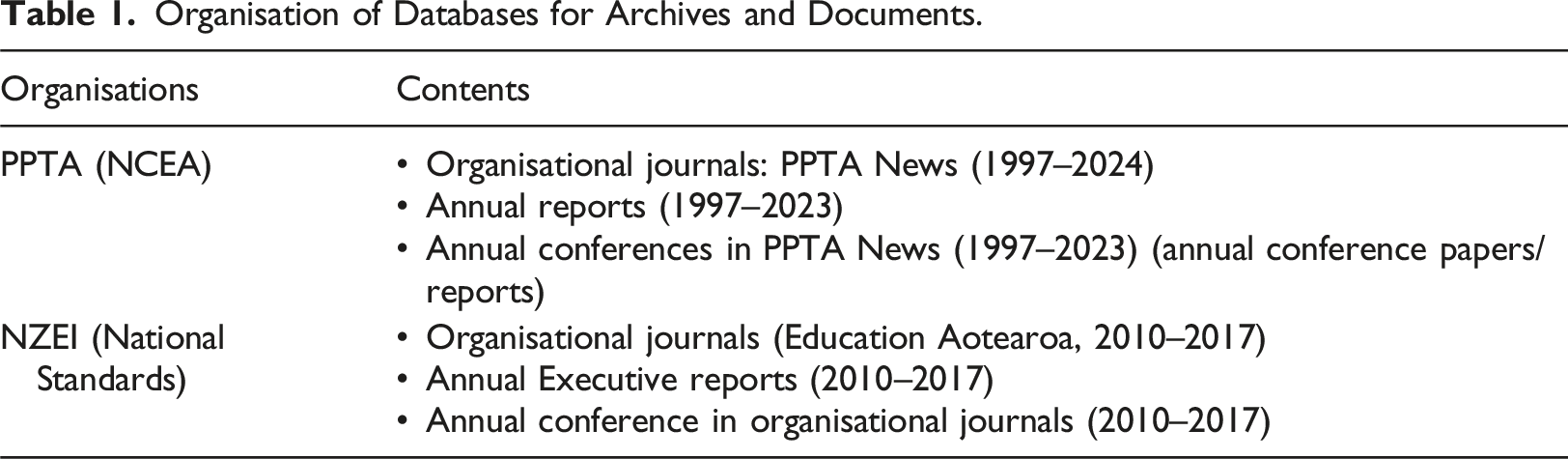
The analysis followed a rigorous and multi-step process to systematically examine and interpret the texts, ensuring that key themes and discourses were thoroughly explored. Initially, the documents – including union publications, government policy papers, and media reports – were read in full to establish a broad contextual understanding of their content and the socio-political environments in which they were produced. This initial reading also helped identify recurring language patterns, key terms, and rhetorical strategies relevant to the research questions. Detailed notes were taken during this phase to capture preliminary impressions and potential areas for deeper analysis. Following this, a coding framework was developed, combining inductive and deductive approaches to analyse the texts in detail. The inductive approach allowed for themes to emerge naturally from the data, ensuring that unexpected patterns or discourses were not overlooked. At the same time, deductive coding was guided by pre-defined categories informed by the theoretical framework of critical discourse analysis (CDA) and key literature on teacher professionalism. These categories included ‘managerial professionalism’, ‘democratic professionalism’, ‘resistance’, ‘collaboration’, ‘accountability’, and ‘autonomy’. For instance, phrases such as ‘teacher autonomy’ and ‘professional judgment’ in NZEI’s press releases were coded under ‘democratic professionalism’, highlighting their resistance to the standardisation agenda of the National Standards policy.
Once initial coding was complete, the data was revisited to refine the themes and categories, ensuring that the analysis was both comprehensive and consistent. During this phase, intertextual connections were examined, such as how union narratives responded to or reframed government policies and how these narratives were mediated through public discourse in media reports. For example, the PPTA’s critique of NCEA implementation, which focused on the intensification of teacher workloads, was juxtaposed with government narratives promoting NCEA as a fair and inclusive assessment framework. These intertextual analyses helped uncover the dynamic interplay between competing discourses, aligning with Foucault’s (1998) emphasis on power relations embedded in texts.
The analytical process also involved a critical examination of language and rhetorical devices used in the texts. Drawing on Fairclough’s (2012) principles of CDA, the analysis considered how specific word choices, metaphors, and syntactic structures reinforced or challenged dominant discourses. For instance, the NZEI’s description of National Standards as ‘divisive’ and ‘unfair’ not only contested the government’s framing of the policy but also positioned the union as a defender of equitable and inclusive education. Similarly, the PPTA’s evolving discourse around NCEA – from support to critique – was analysed to reveal shifts in the union’s strategic positioning in response to policy implementation challenges. Overall, the findings from the coding and textual analyses were synthesised to construct a coherent narrative of how teacher unions in New Zealand shape and contest discourses of professionalism. This synthesis involved triangulating the insights from union documents, policy texts, and media reports to provide a nuanced understanding of the discursive power dynamics at play. By systematically applying this multi-layered analytical process, the study ensures a robust and in-depth exploration of the role of teacher unions in shaping teacher professionalism discourses.
Teacher unions’ complex positions on education standards
Given that the introduction of education standards has become a crucial way that governments use to improve education quality, it is important to investigate their impacts on teacher professionalism. In the 2000s, education standards were introduced into public education sectors in New Zealand: in 2002, the Labour-led government introduced NCEA into secondary schools and in 2010, the National-led government introduced National Standards into primary and intermediate schools. An analysis of document data showed that while PPTA generally supports the principle of introducing standard-based assessment, its attitude towards standard-based assessment became increasingly sceptical. Conversely, NZEI adopted a firm resistance to the introduction and implementation of education standards.
PPTA and NCEA: Standards-based assessment and intensification
Previous research has shown that teacher unions in other Western countries sought to have an impact on education policy by cooperating with their governments on professional issues (Bascia and Osmond, 2013; Kerchner and Koppich, 2004). For instance, Bascia and Osmond (2013) found that when teacher unions were threatened with being excluded from the education policy-making process, they tended to adopt more supportive stances on education reforms. In the current study, this argument has been manifested to some degree by PPTA. The findings showed that the professional voice of PPTA was seriously undermined and even excluded from the development of education policy in the 1990s. PPTA then shifted its general strategy from confrontation with governments on professional issues to one of cooperation, which was particularly evident in the early 2000s. By doing this, PPTA aimed to have an increased, meaningful involvement in the education policy-making process. This was exemplified by PPTA’s position on NCEA.
PPTA published a review of the implementation of the Qualifications Framework (NZPPTA, 1997), which focused on ‘the educational validity and resourcing’ of the framework and aimed to ‘provide a constructive basis on which PPTA members can formulate a position on the future of secondary school qualifications in New Zealand’ (NZPPTA, 1997: 4). PPTA identified eight criteria for ‘an educationally valid qualifications system’: ‘fair, inclusive, cumulative, clear, motivating, coherent, constructive and manageable’ (NZPPTA, 1997: 95), which laid the foundation for PPTA to review NCEA further (NZPPTA, 2002; NZPPTA, 2005; NZPPTA, 2015). Between 2002 and 2022, there were 12 annual conference papers on NCEA. The evidence suggests that NCEA has been a key area of discussion within PPTA in the last two decades. These conference papers established ‘a considerable body of evolving policy about NCEA’ (NZPPTA, 2018: 15). PPTA played a pivotal role in the design, introduction, and implementation of the NCEA qualification (NZPPTA, 2015).
However, although PPTA welcomed the introduction of NCEA in 2002 as its standards-based assessment approach progressed in qualifications reform, it adopted a more suspicious, critical attitude towards the NCEA policy as it was being implemented. PPTA identified a number of issues from the implementation of NCEA: increased teachers’ workload and stress (NZPPTA, 2008a) – a sign that it was unmanageable (NZPPTA, 2015); a far greater focus on summative assessments rather than formative assessments of the ‘depth of learning, the richness of the learning environment, and students developing a sense of enjoyment of learning for its own sake’ (NZPPTA, 2008a: 3); it was not fair, clear, motivating, coherent, and manageable and increased teacher anxiety that their school-level assessments would not be nationally comparable (NZPPTA, 2008a). This finding partially aligns with the research of Evetts (2009) and Hargreaves and Goodson (2003), who argue that the discourse of managerial professionalism is sometimes welcomed by teachers as a means to improve the professional role of teachers but, in practice, it mainly functions to intensify teachers’ workloads and exploit them rather than empower them.
It is worth nothing that PPTA initially promoted internal assessments, which would allow teachers to exercise professional autonomy and judgement compared with external assessments which were considered unfair and would constrain teachers’ professional autonomy. In the early 1990s, PPTA was concerned that the education system was moving ‘towards an outmoded and unwieldy consolidation of the external examination system and an obsession with purely academic, economy-driven, assessment structures’ (NZPPTA, 1991: 16). In the early 2010s, PPTA continued to call for more support for internal assessment and argued that it should be given the same attention as external assessment (NZPPTA, 2010). However, in the late 2010s, PPTA called for more external assessment and less internal assessment to reduce teachers’ unmanageable workloads (Collins, 2018; Taskforce, 2016). External assessment was ‘a pragmatic solution’ (NZPPTA, 2018). PPTA’s shifting stance on external assessment - from strong opposition to conditional support - reflects how professionalism discourses in official government policy influence teacher unions' position over time. However, there is still a lack of evidence whether PPTA’s changing stance towards internal and external assessment is mainly out of professional or industrial concerns; and how this will impact their professional profile either in front of their members or in the public eyes.
PPTA argued that central agencies failed to provide adequate support for the implementation of NCEA; the ‘poor quality and quantity of sample assessment resources for achievement standards and the absence of ministry-produced material for curriculum-based unit standards’ further increased teacher workload and stress (NZPPTA, 2008b). The MoE and NZQA – the ‘two owners’ of NCEA – did not fulfil their responsibilities or carry out appropriate interventions (NZPPTA, 2015) and administrative processes became problematic (Grant, 2003). NZQA claimed that its responsibility was to inform schools of the direction and timeframes of the development of NCEA rather than resourcing schools (NZPPTA, 2015). Although NZQA was not the employer of teachers, it put considerable administrative demands on them (NZPPTA, 2010). As the qualification developer, the MoE failed to provide adequate resourcing to support the development of NCEA.
PPTA believed that NZQA Internal assessments were primarily responsible for the dramatic increase in teachers’ workload. NZQA devolved to teachers the responsibility of designing internal ‘assessments to a quality standard equal to external exams, marking them and then issuing final grades in unit and achievement standards’ (NZPPTA, 2010: 4) but without adequate support (NZPPTA, 2010). PPTA also argued that the quality of assessment NZQA provided ‘has often been dubious and the range available narrow’ and the ‘range of exemplars for sufficiency and to delineate grade boundaries has been largely non-existent’ (NZPPTA, 2010: 1). A 2005 PPTA survey of teachers identified that the main problem in the implementation of NCEA was a lack of systematic support (Alison, 2005: 29). PPTA blamed the government for failing to provide enough support for the implementation of NCEA and argued that the fragmentation of central agencies failed to provide systemic support to teachers. The evidence suggests that, although PPTA supported the education standards policy, it was also critical of its effects in practice.
PPTA also considered that the NCEA policy had a more political agenda; the government was using the policy to increase central control over the teaching profession. This finding aligns with the research of Evetts (2009), who argued that managerial professionalism adopted by governments aims to enhance the state’s external control over the teaching profession rather than the profession having self-control. PPTA argued that the government did not properly consult with teachers and their representatives during the formation and implementation of NCEA. It rarely consulted the Secondary Qualifications Advisory Group (SQAG) established to develop and implement the NCEA or the Workload Advisory Group established in 2014 (NZPPTA, 2015).
In summary, the findings show that PPTA’s position on NCEA was complex. PPTA initially supported the introduction of NCEA, but its implementation led to dramatically increased teacher workloads and stress. It was used as a political tool rather than an educationally valid qualifications system, and lacked adequate resourcing and support from central agencies. Therefore, PPTA challenged the implementation of NCEA. PPTA’s positions on NCEA reflected its complex relationship with governments on professional issues. In contrast, the findings showed that NZEI was strongly opposed to education standards policy (in the form of National Standards). The evidence suggests that NZEI experienced greater tension and confrontation with governments in relation to education standards. The following section outlines the relationships between NZEI and governments with respect to education standards in learning outcomes (National Standards).
NZEI opposition to National Standards: Politicisation
Although NCEA and National Standards were both instances of the official introduction of achievement and assessment standards into school education, the response of NZEI was quite different from PPTA’s. Compared with NCEA, the introduction of National Standards was more controversial, dramatically increasing tension between the government and the education sector. From the perspective of NZEI, teachers and principals strongly opposed the introduction of National Standards into primary and intermediate schools (NZEI, 2012b) and the education sector had no confidence in the National Standards policy (Lewis, 2009). NZEI was so opposed to National Standards that they threatened to take industrial action (Trevett, 2009). In response to the NZEI’s opposition, critics (e.g. the government and other political parties) criticised teacher unions for manufacturing a crisis in the policy implementation. NZEI’s opposition to the National Standards policy was also considered unprofessional by critics, such as John Langley, the CEO of Cognition Education (Langley, 2010). In this sense, the tension and confrontation between NZEI and government was apparent in the National Standards policy.
Previous research suggests that the teaching profession suffered from increasing government interventions that emphasise the role of standards in teaching and learning (Apple, 2013; Ball, 2003; Day, 2002a, 2002b). In the New Zealand context, National Standards were viewed as the introduction of a high-stakes assessment and audit culture that intensified teacher workloads and tension among teachers (Thrupp and White, 2013). The current study aligns with these previous studies; findings from this article show that NZEI saw the introduction of the National Standards policy as an attack on the professional role of teachers. More specifically, NZEI thought National Standards were not educationally or professionally sound. First, National Standards were ‘a relentless undermining of the national curriculum by an untrialled and untested lurch back to the 19th century’ (NZEI, 2011: 5) and eroded ‘the delivery of a vibrant and child-focused curriculum in favour of narrow targets to meet the National Standards requirements’ (NZEI, 2012a: 4). Second, they stressed standardisation and a view of ‘learning as linear and age-related, rather than recognising the variations in students’ learning’ (NZEI, 2010a: 2). This ‘one-size-fits-all’ approach had increased teachers’ workload, denied the complexity of teachers’ work, and led to chaos in practice (Goulter, 2010). Third, National Standards were viewed as data-driven assessments, requiring teachers to collect so much data for assessment that it dramatically reduced the time they could spend interacting with students (NZEI, 2017). Fourth, NZEI believed that National Standards were unreliable and unfair (NZEI, 2012a) and very ‘divisive’ (NZEI, 2010a). It was thus unreasonable to use these external standards to evaluate teachers and decide whether they should be promoted or fired (Goulter, 2011). Fifth, the National Standards policy was also seen as assisting the introduction of performance pay and a competitive model into the teaching profession. NZEI argued that the teaching profession should emphasise collaboration and trust rather than the competition encouraged by National Standards (NZEI, 2014a). Overall, NZEI argued that National Standards were an attack on the professional role of teachers (NZEI, 2012a); with respect to the National Standards policy, NZEI’s professionalism discourses were fundamentally different from the government’s. Additionally, it is worth noting that although National Standards were revoked by the Labour-led coalition government in 2017, the government’s standardisation agenda remained. For example, the review of the National Certificate of Educational Achievement (NCEA) was seen as a plan to introduce NCEA assessment to Year 7 students, which had the potential to bring back a form of National Standards (NZEI, 2020).
Evetts (2009) argued that ‘when the discourse is constructed “from above”, then often it is imposed, and a false or selective discourse is used to promote and facilitate occupational change (rationalization) and as a disciplinary mechanism of autonomous subjects exercising appropriate conduct’ (p. 22); this type of teacher professionalism functions as a managerial instrument to exert external control over the teaching profession. The findings of the current study align with this argument; given that there had been little or no professional voice in the introduction and implementation of National Standards, it significantly undermined teachers’ sense of ownership of their own profession. The National Standards policy was primarily dictated by a political agenda rather than engaging with teachers (Thrupp, 2017). Teachers were positioned as technicians who did not need to make professional judgements and therefore were subjected to increasing external controls. NZEI argued that the introduction and implementation of National Standards lacked engagement from teachers and their representatives, and the consultation with them was solely superficial (NZEI, 2010b, NZEI, 2014a). It also suggested that the government only focused on their ideological experiments in education rather than the genuine problems that led to students’ underachievement (NZEI, 2014b). Overall, from the perspective of NZEI leaders, the politicisation of education policy posed significant challenges to the teaching profession.
A possible explanation for PPTA and NZEI adopting quite different positions on the respective education standards policies lies in their different historical development experiences. PPTA had historically advocated strongly for achievement-based assessment to replace the existing examination-based system (Alison, 2007). Therefore, PPTA could at least see traces of how they envisioned a professional assessment model in the NCEA policy. In contrast, NZEI opposed national standards in primary schools as a matter of principle (NZEI, 2010a). NZEI’s opposition to the introduction of National Standards may also be related to PPTA’s experience of increased teacher workloads with the standards-based assessment of NCEA. That is, when National Standards were introduced in the late 2000s, NZEI may have strongly opposed them partly on the basis of the envisaged workload.
There was some evidence from the current study that NZEI and PPTA adopted quite different stances on the introduction of education standards into the primary and secondary education sectors. However, both unions were also strongly critical of the implementation of education standards, indicating that the political rhetoric of professionalisation led to an intensification of teachers’ workloads and the teaching profession consequently suffered from increasing politicisation. The evidence suggests that NZEI and PPTA shared similar teacher professionalism discourses even though they sometimes adopted quite different or contradictory strategies. In this regard, it is difficult to determine whether the differences between NZEI and PPTA have been barriers to teachers collectively shaping teacher professionalism discourses or made it difficult to maintain and enhance national teacher professionalism, which has been suggested in the research of Jesson and Simpkin (2007) and Lilja (2014a, 2014b).
Discussion and conclusion
The findings of this study underscore the significance of discursive power in shaping teacher professionalism, revealing the intricate dynamics of resistance and adaptation between teacher unions and government policies. Through the lens of critical discourse analysis (CDA), the responses of the NZEI and PPTA highlight how dominant managerial discourses in educational reforms are actively contested. For instance, NZEI’s rejection of National Standards illustrates the union’s effort to disrupt the performative framework imposed by the government, framing it as a threat to teacher autonomy and the relational aspects of teaching. Simultaneously, PPTA’s evolving stance on NCEA – from initial support to critique – demonstrates how unions negotiate dominant discourses to advocate for sustainable professional practices. These examples reflect Foucault’s (1998) assertion that power relations are dynamic and embedded in discourses, where acts of resistance expose and challenge hegemonic control. The study’s findings extend this theoretical insight by illustrating how teacher unions navigate these dynamics through public and professional platforms, asserting alternative discourses that foreground collaboration, equity, and professional judgment.
Intertextuality further enriches this analysis by revealing how teacher professionalism discourses are shaped through interconnected texts, including union publications, policy documents, and media reports. The NZEI and PPTA not only respond to governmental narratives but also engage with broader societal discourses to legitimise their counter-narratives. For example, NZEI’s framing of National Standards as ‘unfair’ and ‘divisive’ resonates with public concerns about equity and inclusivity in education, while PPTA’s critiques of NCEA align with broader professional discourses about the intensification of teachers’ workloads. These intertextual connections, as emphasised by Luke (1995), illustrate how competing discourses of professionalism are co-constructed within a network of meaning-making practices. By identifying these intertextual dynamics, this study demonstrates how teacher unions contribute to reconfiguring the dominant narratives of teacher professionalism, positioning themselves as pivotal agents in the broader discourse on educational reforms.
According to Stevenson (2008), teacher unions play a crucial role in challenging the official discourses surrounding teacher professionalism and education, raising fundamental questions about the nature of professional development and the education system itself. By challenging dominant discourses, particularly those aligned with neoliberal agendas, teacher unions provide critical and alternative perspectives. The findings of the current study align with Stevenson’s arguments, indicating that teacher unions in New Zealand hold distinct perspectives on professionalism discourses compared to the government. The study reveals that teacher unions maintain a deep sense of mistrust and pose significant challenges to the government in professional issues, reflecting the tensions and contradictions inherent in their relationship. Particularly, NZEI has exhibited a strong resistant stance, further highlighting the underlying tensions between teacher unions and the government. It is evident that these tensions shape the context within which teacher unions frame teacher professionalism discourses, at least at the discursive level. The evidence from this article also underscores the association between teacher unions’ role in shaping the teaching profession and their political influence in professional issues.
Previous research has shown that the political aspect of professional issues is more visible in teacher unions’ accounts than in those of individual teachers (Grace, 1995; O’Neill, 2001; Sachs, 2005). For example, Grace (1995) argued that the political aspect of professional issues was much less visible in individual teachers’ accounts than in those of teacher unions. The majority of individual teachers tended to be compliant or silently resistant (e.g. Gibbons et al., 2016), whereas teacher unions were explicitly resistant to education reforms. Similarly, in the New Zealand context, O’Neill (2001) found that although the discourses of the secondary school teacher union (PPTA) conflicted strongly with governments’ on certain professional issues, this confrontation was less visible in teachers’ accounts. Sachs (2005) explained that being an ‘active agent’ in education policy involves taking some risks and, therefore, is more suitable for a collective organisation than for individual teachers to take on this role. Therefore, it is not surprising that the findings from the current study showed that, as collective actors, the teacher unions in New Zealand were committed to explicitly articulating criticism of official professionalism discourses. In other words, one of the unique features of contemporary teacher unions as collective actors is the articulation of more visible, explicit critical and political professional discourses.
The findings of the current study also suggest that a new type of relationship is developing between the teacher unions and governments characterised as both cooperative and tense. Jesson and Simpkin (2000) argued that PPTA was more resistant to the government in the 1990s than NZEI and wondered whether PPTA’s relationship with the government in the 2000s would shift to the 1980s’ collaborative one. The current study provides some evidence that tensions continue to be deeply rooted between the teacher unions (PPTA and NZEI) and governments and that NZEI particularly has sometimes maintained a strong resistant stance over the past 20 years. It seems reasonable to conclude that it is necessary to continue exploring ways to build a collaborative or cooperative relationship between the teacher unions and governments. However, rather than establishing a purely collaborative relationship as in the past, the evidence from the current study suggests that in future, cooperation (or collaboration) and tension (or contradiction) will both characterise the teacher unions’ relationship with governments on professional issues. Overall, it appears that both tension and cooperation between the teacher unions and governments underpin the context within which the teacher unions frame teacher professionalism discourses; while tensions or contradictions tended to be more ideological, cooperation tended to be more apparent in practice.
This article contributes to the existing literature by exploring the often-overlooked role of teacher unions in shaping teacher professionalism discourses, particularly in the New Zealand context. By uncovering the strategies employed by teacher unions and their perspectives on professionalism, this article enhances our understanding of the influence of teacher unions within the teaching profession. By acknowledging the complexity of the teacher union relationship with the government, this article also contributes to a more comprehensive understanding of the dynamics at play. However, it is important to acknowledge the limitations of this research, as it focuses solely on one example – the education standards – as a demonstration of the relationship between teacher unions and the government in professional issues. Teacher unions also play a significant role in various other professional issues with the government, and their relationship often exhibits more positive than negative aspects. For instance, in 2019, the removal of compulsory teacher appraisal highlights a collaborative and constructive engagement between teacher unions and the government. Future studies should endeavour to explore the broader landscape of this relationship, taking into account a wider array of professional issues, the diverse contexts in which they arise, and the varying degrees of collaboration and negotiation between teacher unions and the government. Such research would provide a more nuanced and complete picture of the intricate nature of this significant relationship in the teaching profession.
Footnotes
Declaration of conflicting interests
The author(s) declared no potential conflicts of interest with respect to the research, authorship, and/or publication of this article.
Funding
The author(s) disclosed receipt of the following financial support for the research, authorship, and/or publication of this article: This work was supported by the Massey University Doctoral Scholarship (2020-2022).
Disclosure
This article is part of the author’s doctoral research. The author expresses sincere gratitude to supervisors, Professor John O’Neill and Dr. Genaro Oliveira, for their invaluable guidance throughout the doctoral journey. Any errors or oversights in this article remain solely the responsibility of the author.
