



Abstract
Portugal, a semi-peripheral player in international student mobility (ISM), has historically attracted few international students. Against a significant growth in international enrolments in recent years, this paper explores the institutional strategies underpinning this expansion in 13 Portuguese higher education institutions with the highest proportions of international students. Through semi-structured interviews with 24 top institutional leaders and middle managers, we analyse the recruitment strategies deployed to improve attractiveness and target publics through the lens of globalisation theories. Findings indicate that institutions are deliberately and proactively navigating the changing landscape of ISM through strategies that range from more traditional marketing actions to some very innovative and unique approaches to recruitment. They also reveal a deliberate diversification of target publics. The paper enhances knowledge about recruitment strategies in a less popular destination, highlighting that creativity and resourcefulness are necessary for semi-peripheral countries to gain terrain in international recruitment.
Keywords
Introduction
Over the past 50 years, the internationalisation of tertiary education has undergone significant transformations, transitioning from a peripheral element to becoming a cornerstone of higher education reform agendas. This evolution, as highlighted by de Wit and Altbach (2021), has been largely influenced by the forces of globalisation, regional integration efforts, the rise of the knowledge economy, and the post-Cold War era dynamics, triggering a more deliberate and strategic approach to internationalisation since the 1990s. Such a shift has also resulted in a realignment of the priorities associated with internationalisation, with economic considerations and student mobility emerging as dominant factors. The growth in international student mobility is a testament to this shift, with UNESCO (2022) reporting a significant increase from 2 million international students in 2000 to 5 million in 2019, a trend expected to continue.
The escalation of global mobility has subsequently led to increased competition among countries to attract international students. The traditional pattern of student mobility, characterised by flows from middle and low-income countries to predominantly more economically developed particularly English-speaking nations, has been undergoing transformation. New patterns have emerged, diversifying the landscape of international student mobility (ISM). This competitive milieu has seen countries like Portugal, which are considered semi-peripheral within the ISM context, emerge as attractive destinations. In Portugal, Decree-Law 36/2014 represented a legislative shift, facilitating the country’s efforts to increase and diversify its student base beyond the conventional Lusophone population (Sin et al., 2021).
This study explores the strategies employed by Portuguese higher education institutions (HEIs) to navigate this competitive landscape and implement effective international recruitment strategies. Specifically focussing on degree mobility, that is, students who come to Portugal to get a diploma, the research questions guiding this study are: What strategies contribute to the success of Portuguese HEIs in attracting international students? How do these institutions describe their approaches to international recruitment? Through examining these questions, the study aims to contribute to the understanding of the dynamic field of ISM, particularly within the context of semi-peripheral countries like Portugal, which are making significant strides in becoming attractive destinations for international students amidst a rapidly changing global higher education landscape.
Globalisation theories in international student recruitment
The landscape of international student mobility (ISM) is undergoing significant changes, reflecting shifting global dynamics. Historically, ISM primarily involved students moving from Asia to affluent, mainly English-speaking countries (Börjesson, 2017). However, recent studies show a decline in this pattern, with new flows emerging, especially within regions and between developing countries, known as South-to-South mobility (Hou and Du, 2022; Kondakci, 2011; Perkins and Neumayer, 2014). This diversification has led to new countries becoming key players in global higher education, increasing competition between traditional and emerging destinations (Choudaha, 2017; Glass and Cruz, 2023). Examples include Mexico, Russia, South Korea, South Africa and Turkey, which are becoming education hubs in their regions (Kondakci et al., 2018). Asian countries, traditionally student exporters, now also stand as significant importers (Wen and Hu, 2019), while Singapore, Malaysia and Qatar attract regional students due to demographic shifts (Ahmad and Buchanan, 2017; UNESCO, 2018). Western institutions establishing campuses in Asia, combined with Europe’s enhanced appeal following the establishment of the European Higher Education Area, further intensify the competitive environment for ISM (Caruso and De Wit, 2015; Cox, 2012; Vögtle and Windzio, 2016).
These evolving patterns of international student mobility can be interpreted through various theories of globalisation. The neoliberal perspective views globalisation as intensifying competition among universities, driving them to operate in a market-like environment and commodify education to attract international students (Naidoo, 2016; Shields, 2013). From this viewpoint, institutions focus on enhancing their global standing through strategies that attract students, for example, through the emphasis on career prospects and globally recognised qualifications (Lo, 2019). In contrast, critical theories such as world-systems analysis and neo-Marxism focus on how globalisation reinforces inequalities, benefiting wealthier nations and students while marginalising those from less advantaged regions (Shields, 2013). These theories argue that the global education market sustains a hierarchy favouring institutions with more resources, rather than promoting equitable access. A third theoretical underpinning, the New Institutionalism and World Culture theory, suggests that globalisation leads to the spread of similar cultural norms and practices across educational systems, prompting universities to adopt internationalisation strategies that align with global expectations, such as promoting a cosmopolitan identity and values like global citizenship (Shields, 2013).
Strategies of international student recruitment: an evolving landscape
The diversification of strategies to attract international students reflects these broader dynamics within the global higher education landscape, as well as technological advancements, showcasing a dynamic interplay between traditional approaches and innovative methods.
Institutions from major player countries, such as the United States, United Kingdom, Australia, and Canada, have traditionally capitalised on their strong global reputations, extensive alumni networks and the prevalence of English as a medium of instruction to attract international students (Onk and Joseph, 2017; Ozturgut, 2013; Wilkie, 2015). Their strategy relied heavily on substantial investments in branding and marketing to forge an internationally appealing image (Onk and Joseph, 2017; Ozturgut, 2013; Russell, 2005). At the beginning of the 21st century, Russell (2005) reported advertising strategies through various promotional materials, including prospectuses, dynamic websites, exhibition stands, stationery and business cards. About a decade later, Ozturgut (2013) mentioned similar practices among the top five international recruitment methods in leading HEIs in the United States, namely participation in international recruitment events, providing academic support, leveraging international alumni, employing passive marketing strategies and using staff recruiters. Attending international recruitment fairs has served as a foundational strategy, enabling direct interaction with prospective students (James-MacEachern, 2018; Onk and Joseph, 2017). In parallel, the agent model has established itself as a key aspect of the recruitment process, particularly in markets like India and China. Agents, acting as intermediaries, employ their local expertise and networks to guide students through their decision-making process (Falcone, 2017; Huang et al., 2022; James-MacEachern, 2018; Robinson-Pant and Magyar, 2018).
Acknowledging the evolution of the student market and the advent of the digital, Choudaha et al. (2013) argued for the integration of traditional methodologies with avant-garde approaches underpinned by rigorous market research, technological advancements and partnerships with education institutions abroad and other organisations. Harnessing the power of new technologies, international recruitment has witnessed a significant transformation with the adoption of online recruitment techniques, including virtual college fairs, webinars and social media platforms. This has allowed institutions to extend their reach and engage with a broader audience in a cost-effective manner and marking a key moment in the evolution of recruitment strategies (Arndt et al., 2021; Feng, 2019; Hsueh, 2018; Morrison, 2021; Zinn and Johansson, 2015). The COVID-19 pandemic acted as a further catalyst, accelerating the digital shift and reshaping traditional approaches (Hung and Yen, 2022; Sin et al., 2023).
Occupying a distinctive position in the international higher education ecosystem, semi-peripheral nations neither exert the dominance of core nations, nor recede into the periphery of global academic exchange. These countries both attract international students and send domestic students to foreign institutions (Fit, 2022; Sin et al., 2021). Confronted with unique challenges in international recruitment, these nations grapple with issues ranging from global recognition to surmounting financial limitations and bridging cultural and linguistic divides (Urbanovič et al., 2016). In response to these challenges, institutions within these semi-peripheral countries, while still making use of traditional marketing and advertising (Gao and Liu, 2020; Oladipo and Sugandi, 2022; Sin et al., 2019), are compelled to design strategies that are both innovative and adaptable. In an effort to dismantle linguistic barriers, they have begun to offer English-taught courses, allowing them to strengthen their position in the market despite the dominance of more resource-rich institutions in core countries (Fit, 2022; Gao and Liu, 2020; Kotake, 2017; Oladipo and Sugandi, 2022; Urbanovič et al., 2016). Additionally, the promotion of multicultural campuses and of cultural integration initiatives emerges as critical to render these institutions more appealing to a global student body (Gao and Liu, 2020; Onk and Joseph, 2017). So is preparing teaching staff for the challenges of multiculturalism and diverse student populations (Buchanan et al., 2022; Nada and Araújo, 2019). Adopting a research-driven approach to recruitment also enables these institutions to understand and address the educational aspirations, cultural expectations and specific needs of their target demographic (Falcone, 2017; Hung and Yen, 2022).
The literature also reports some less explored recruitment strategies. For example, scholarships (Gao and Liu, 2020; Kent, 2018; Oladipo and Sugandi, 2022; Onk and Joseph, 2017) or tuition fee reductions (Sin et al., 2019) can significantly improve institutions’ attractiveness. When offered to students from specific countries, scholarships can change the asymmetrical flows that have long dominated international student mobility and promote exchanges between developing countries (Oladipo and Sugandi, 2022). Another strategy is the collaboration with foreign education institutions (high-schools and tertiary institutions) and other organisations in target countries, promoting academic exchange and increasing enrolments (Oladipo and Sugandi, 2022; Onk and Joseph, 2017). Mechanisms which can help international students find employment upon graduation are also attractiveness boosters (Cox, 2012; Gao and Liu, 2020; Hung and Yen, 2022). Onk and Joseph (2017) suggest that highlighting speciality programmes and disciplinary strengths is another way for institutions in emerging destinations to attract students. Student advocacy, whereby current students and alumni are intentionally informed of admission and scholarship opportunities in order to promote the institution to their social circles, has also been found to increase attractiveness (Oladipo and Sugandi, 2022).
Nonetheless, in recent years, recruitment strategies involving digital media and online platforms appear to be the most frequently documented ones in emerging destinations, allowing engagement with prospective students in a manner that is both personal and cost-efficient (Bamberger et al., 2020; Cassar and Caruana, 2023; Hung and Yen, 2022; Kim Khanh and Ngoc, 2023; Oladipo and Sugandi, 2022; Sin et al., 2023; Vrontis et al., 2018; Zhu, 2019). Multilingual websites and admission requirements are effective to reach out to students from specific national target groups (Oladipo and Sugandi, 2022). A digital presence to communicate with prospective students (Hsueh, 2018; Oladipo and Sugandi, 2022), on mainstream social media platforms (Instagram, Facebook and Twitter) but also on local platforms such as Wechat, Weibo (Oladipo and Sugandi, 2022) is also an essential recruitment strategy nowadays. Studies also elaborate on how social media can be optimally harnessed, beyond simply advertising the institution. For example, story-based content which describes alumni and student experiences, that is, human or personal stories, appear to be more effective in catching prospective students’ attention than argument-based content which narrates institutional achievements (Bamberger et al., 2020; Cassar and Caruana, 2023). Thus, Cassar and Caruana (2023) advise recruiters to find ways to motivate alumni and students to share their experiences, for example, through incentives such as university merchandise as awards for the best-narrated experience, recognition certificates or mentions in university newsletters. Drawing on personal stories could also help identifying the most attractive selling points about the university and its offer (Cassar and Caruana, 2023). Social media also represents a mine of data whose analysis can help institutions infer student behaviour and preferences and ensure responsiveness to their needs and interests (Hung and Yen, 2022; Morrison, 2021). Additionally, web analytics (website traffic, engagement rates, etc.) and social listening of online discussions are a window into students’ perceptions, providing information on what needs improving (Tripathi, 2021). Morrison (2021) also argues for the use of AI to personalise the experience of individual prospective candidates, allowing institutions to have a broader and more diversified engagement, reaching out to underrepresented groups beyond traditional markets.
Portugal in the context of semi-peripheral countries
Portugal has been successful in attracting European students, primarily for credit mobility through Erasmus exchanges (Breznik and Skrbinjek, 2020). However, in terms of degree mobility, it has been an exporter of students and researchers, with national and European science policies actively promoting studying abroad for capacity building (Delicado, 2019). However, this picture is changing, with recent data from the General Directorate of Education and Science Statistics (DGEEC) indicating an 85% increase in international enrolments in Portuguese HEIs over the last decade (DGEEC, 2023).
In the 2022/23 academic year, Portugal reached a historic peak in total enrolments, with 446,028 students, marking a 3% increase compared to the previous year (see Figure 1). The number of international students (on degree and credit mobility) also hit an all-time high, with 74,597 students, representing 17% of the total enrolments. Total and international students enrolled in Portuguese higher education.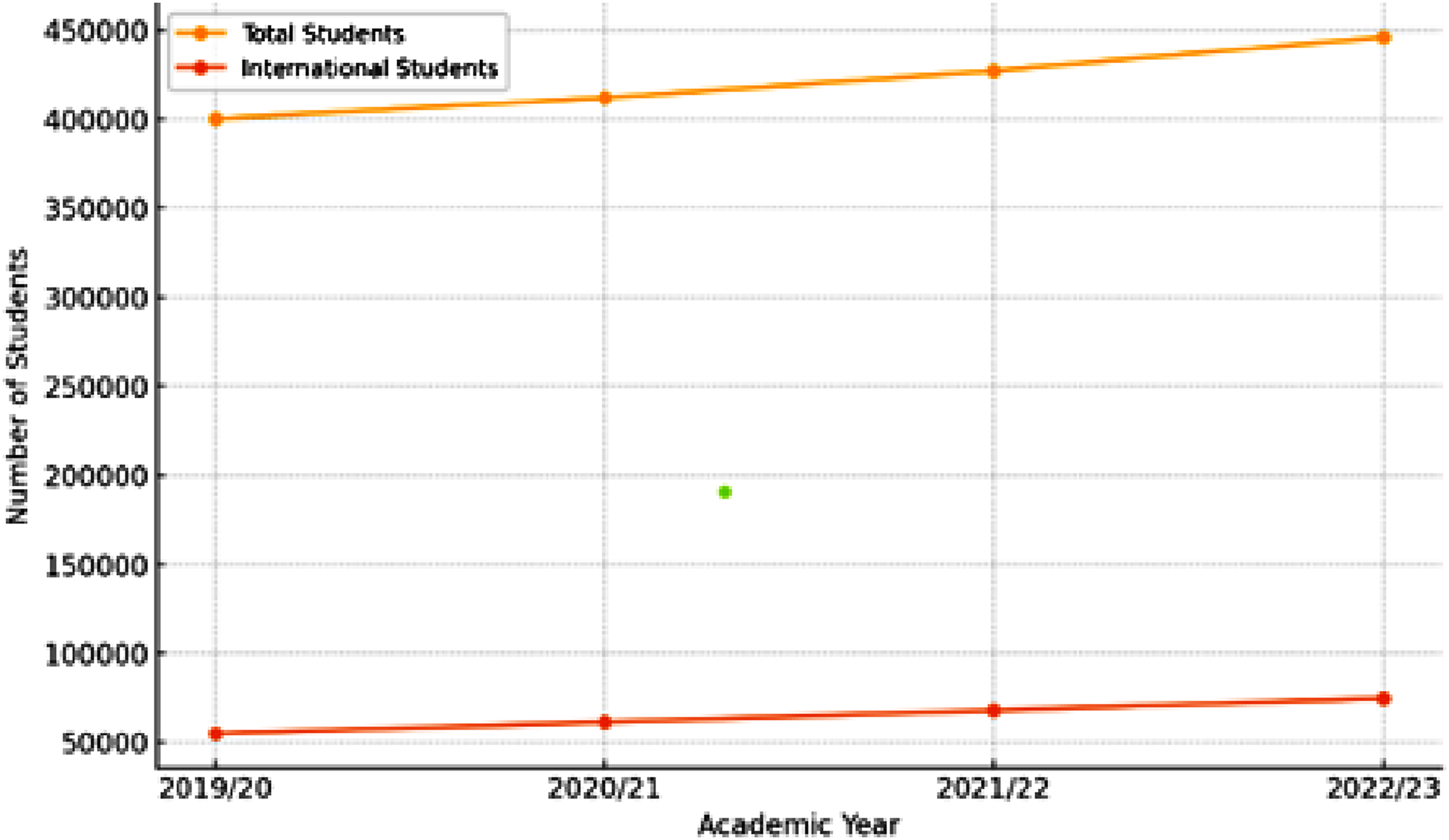
When analysing the total number of international students by type of mobility (Figure 2), one notices an increase in degree mobile students, even during the pandemic, while credit mobility saw a slight decline due to the pandemic. In the most recent academic year, of the total international students, 56,775 were degree mobile. The most common countries of origin were Brazil (30.0%), Guinea-Bissau (12.2%), Cape Verde (11.4%), Angola (9.3%) and France (6.0%). International students enrolled in Portugal by type of mobility.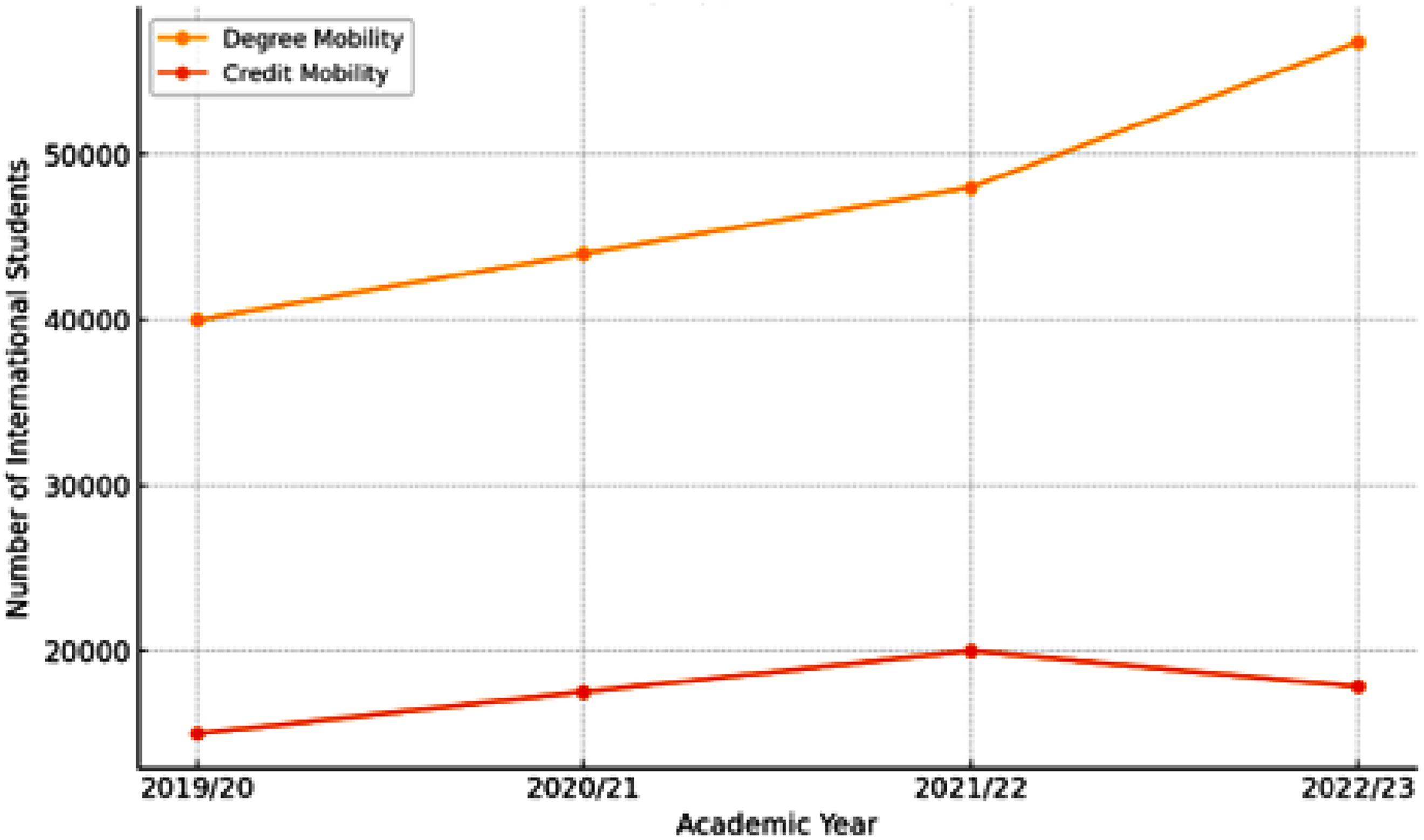
Like Portugal, other European countries that can be considered peripheral or semi-peripheral in ISM have been increasing their number of international students. Poland, for instance, has seen a steady growth in international student numbers over the years, despite challenges such as visa restrictions and demographic changes (Shenderova et al., 2023). In the 2021/2022 academic year, Poland hosted approximately 89,500 international students, making up 7.3% of the total student population. The leading countries of origin for these students include Ukraine, Belarus and India (Shenderova et al., 2023). Estonia has also experienced a rise in international student numbers, albeit on a smaller scale compared to Poland. By 2022, Estonia had around 5000 international students, which represented 10.6% of its overall student body. The country is increasingly recognised for its high-quality education, attracting students from Finland, Russia and Ukraine (Jarvis, 2020). While these countries are not among the largest destinations for international students in Europe, they have shown consistent growth in attracting students from abroad, driven by factors such as active recruitment, strategic location and affordability.
In the Portuguese context, the increase in international enrolments is reinforced by national policy changes and various recruitment strategies, such as institutional branding, revising admission procedures and curricular adjustments (Sin et al., 2019). International students seeking a degree in Portugal have traditionally come from Portuguese-speaking countries. A decade ago, these students were almost the only international students, but in 2023 their share went down to around 70% (DGEEC, 2023). Recent trends indicate a diversification in the international student body, including students from other parts of Europe like France, Spain, Italy and Germany, as well as from Asian countries such as China and Iran (Sin et al., 2022). Such diversification adds complexity to recruitment strategies and necessitates a more global outreach approach. The representation of international students within universities is now intertwined with complex socio-political influences. The neoliberal agenda, for instance, complicates this representation by creating a tension between revenue-centric objectives and the more holistic goals of internationalisation (Ford and Cate, 2020).
This paper sets out to investigate what strategies the Portuguese institutions with the highest proportions of international students are employing to enhance their competitive stance, given their position in the semi-peripheral context of global higher education. Against Portugal’s relative recent success in attracting an increasingly diverse international student body, the purpose of this study is to elucidate the type and nature of recruitment strategies, thereby contributing to a deeper understanding of approaches to international recruitment in Portugal and, by extension, in semi-peripheral countries.
Methodology
Characterisation of the interviewees according to the type of institution and the role they perform.

In each institution, we aimed to interview both top leaders (from the Rector’s or President’s Office) and middle managers (individuals from the International Relations Office or Marketing Office). All interviews were conducted by the same researcher to maintain consistency. Lasting around 40 min and conducted online, most interviews were individual, but in some cases they included both senior leaders and middle managers, resulting in 24 participants across 19 interviews. The fieldwork was carried out in 2021 as part of a broader project on international students in Portugal (Sá et al., 2021). Ethical standards were upheld, including ensuring anonymity, data confidentiality and informed consent for recording and data processing.
These interviews were subsequently transcribed and systematically analysed using MaxQDA software. A grounded theory approach adapted from Strauss and Corbin (1990) guided the analysis. This paper reports the findings related to the institutional strategies employed to enhance attractiveness and to recruit prospective international students, as well as the target publics. Emerging themes from the interviews comprised two broad categories under recruitment – marketing and partnerships – and a category for the key target publics.
Recruitment strategies and target publics in Portugal
The institutions in our sample employed a broad range of strategies to enhance the recruitment of international students, from traditional market-driven actions to innovative and unique approaches. They also identified their specific target groups. The strategies and target groups will be presented in order of importance based on the number of identified occurrences.
Marketing
A first set of recruitment strategies observed in the data reflects a market-driven approach, consistent with the neoliberal perspective, which views globalisation as a key factor pushing universities to function within a competitive, market-like environment. Marketing efforts were diverse, covering various activities such as advertising and promoting the institution through both digital and traditional channels, participating in fairs, offering tailored information and conducting market research.
The most frequently mentioned marketing initiatives involved digital advertising, including the use of social media, search platforms with search engine optimisation, chatbots and institutional websites in multiple languages. This shift from traditional to virtual marketing methods reflects broader trends (Hung and Yen, 2022; Kim Khanh and Ngoc, 2023; Oladipo and Sugandi, 2022) and suggests the growing pressure on institutions to adopt digital strategies to stay competitive. This emphasis on visibility and reach, however, may come at the expense of deeper engagement and meaningful connections with prospective students.
For example, one university collaborated with a former student’s company to engage Chinese students through Chinese social networks, a move that demonstrates creativity in entering new international markets but also carries the risk of over-reliance on personal networks and digital strategies. The growing interest in Chinese students, who have only recently become a target group, also reflects a market-driven recruitment strategy aimed at high-potential markets. This interest, now recognised by multiple institutions, reveals the high expectations that Portuguese universities have from this demographic group, which they have until recently overlooked. To effectively reach international students, institutions are also employing a variety of languages in their advertising efforts, a strategy that reflects the need for smaller nations like Portugal to overcome linguistic barriers and diversify their international student base beyond Lusophone countries (Fit, 2022; Urbanovič et al., 2016): We harness all the social networks we have, in various languages. We even have three for Chinese communities. Vlogs, virtual open days, improve our website by adding chatbots and use new social networks that students are used to because… many times we are focused on Facebook and sometimes we know that these new students don’t use it, they use WhatsApp. So we take advantage of everything that the virtual world allows us to do (Public University 4). We try to make the website information available in various languages, for example for master degrees there is information in six languages (Private University 3).
Another institutional representative described how they used an ‘influencer’ to advertise the university. This approach, reminiscent of student advocacy (Oladipo and Sugandi, 2022), can be viewed as a creative method to attract prospective students by leveraging habits popular among young people, but it may also suggest an emphasis on visibility in a competitive market, which may not fully address the broader educational needs of a diverse international student body: I remember one of our students… Once, occasionally, I saw a video and discovered that she was making videos about what it was like to live in Europe, (…), publishing them, and already had 40 to 50 thousand followers. So I thought ‘well, we must take advantage of this’. So I talked to her and then she started to make videos in specific places on the university campus (Public University 2).
Despite the rise of digital channels in global communication, institutions still commonly maintain a physical presence at international fairs, believing personal interaction to be irreplaceable. Some representatives noted that these fairs are often organised jointly with other Portuguese institutions or organisations to enhance institutional credibility. It’s very interesting, in fairs, to see that some talk to us on the first day and then come back the next day because some things were not clear (…) This proximity relationship and personalised assistance is very, very important (Public polytechnic 2). We go to many student fairs (I can say that, in Brazil only, we do two every year). Some we organise with other Portuguese institutions, in some other countries we go to fairs promoted by the European Commission, so they give us some certainly about the credibility of the event and we end up having support from the Portuguese local consular authorities too, or we do together with multinationals in the market which organise big recruitment fairs (Private Polytechnic 1).
Another marketing subcategory comprised measures to facilitate recruitment of students of specific nationalities. Examples include dedicated webpages outlining admission conditions for target countries like Brazil and application support in the form of degree recognition, document translations and visa applications. While these initiatives primarily help students navigate admission requirements, they also serve as a marketing tool by simplifying the process. We have a specific website for Brazilian students, with information targeted specifically at them. When we wrote up the plan and started going to fairs there, we created the site with an application module embedded. This was a huge step to enable applications and admission of Brazilian students (Public University 1). After the application, for which students normally have support, many find it difficult to enter the platform or to register, so we contact them by email or even directly. This is where our relationship with them starts, already remotely (Public Polytechnic 3).
Another common strategy for many of the selected institutions was automatic recognition of high-school diplomas from some countries (e.g. Brazil and China), which smoothened international recruitment from key target countries: We have the same measure in place with Macau. Therefore, they can enrol based on the exams taken in Macau. We have the same for Brazil. We are working, specifically with countries like Ecuador, to try to also recognize their bachelor's degrees and the exams they take to facilitate the process. With Africa, we have not yet succeeded, mainly because their exams are not like ours (Public Polytechnic 2).
Finally, interviewees from eight institutions also stated that market research assisted them to understand how they could ease admission for target international publics. For example, these institutions studied the education systems of target countries to find ways to simplify access to Portuguese higher education for their students, while adhering to the legal provisions of the International Student Statute that specifies admission requirements. What we did was, based on the defined priority markets, an analysis of the education systems. That is, before going to a country we analyse to understand, in the context of the International Student Statute, the admission routes, how we can speed up the process without crossing the red lines, for example by accepting their national [school-leaving] examinations, like the ENEM in Brazil (Private University 1).
Partnerships
Partnerships emerged as the second most frequently mentioned strategy, which signals their perceived importance for institutions that might otherwise face challenges in reaching their target audiences (Oladipo and Sugandi, 2022). While institutions demonstrated creativity by engaging with various actors, the reliance on agreements with high schools abroad as a direct source of prospective students reveals a tendency to favour easier, more established recruitment channels. This strategy is particularly prevalent in Portuguese-speaking countries, where shared language and historical links simplify communication, potentially reinforcing existing dependencies. One public university even noted that it formed networks with reputable private high schools in countries like Brazil, Angola and Mozambique, which suggests a selective approach aimed at securing high-quality students from familiar territories, rather than expanding outreach to a broader range of international students: We made agreements with high-schools, these high-schools work in Brazil like our own embassy. We went to these high-schools, we created a network in Brazil, Angola, Mozambique which is made up private high-schools… in each town we only chose one high-school, which has to be a reference one in town (Public University 2).
Then, bilateral partnerships with foreign higher education institutions were also mentioned, especially in the delivery of joint programmes, but not only. While in the case of high-schools, partnerships were exclusively in Portuguese-speaking countries, partnerships with HEIs were more diverse, including in European countries through the European Universities Initiative or worldwide via Erasmus Mundus programmes. Institutions are therefore not only seeking economic benefits, but also aligning themselves with global cultural expectations of being ‘international’, as explained by the New Institutionalism and World Culture theory. A desire to attract a more diverse student body is evident in the following quotes: It’s fundamental to recruit students both from Europe and outside Europe, from regions that are not speaking Portuguese. And to this end we have a strategy which is clearly defined, with concrete objectives (…) to invest heavily in Erasmus Mundus programmes (Private University 2).
Especially in Cape Verde and São Tomé, both small Portuguese-speaking islands, several interviewees referred to a different type of partnerships, namely with local councils. This suggests that local authorities in these countries are directly involved in shaping student outflows to Portugal, probably because of insufficient domestic capacity to satisfy demand and because Portugal is a historical reference for higher education in the former Portuguese colonies. Local NGOs were mentioned in two instances, for example, supporting students in the application process by administering the admission exams: To recruit students, we work directly with secondary schools with which we have partnerships and with local councils. The local councils are mainly in São Tomé and Cape Verde (Private Polytechnic 2). Besides local councils and embassies, there are private, not-for-profit associations that help students in their countries to apply to [institution name]. For example, this association from Guinea… Guinean students do not have in their high-school curriculum the disciplines necessary to apply, so we set up this relationship and send over the tests. They sit the tests in this association which guarantees efficiency and trust. They send back the tests and we correct them (Public Polytechnic 3).
Agents
Representatives of four institutions also mentioned the use of agents to enter less familiar markets. It seems to be favoured to break into countries with which Portugal does not share a common history and language, but which represent potential new sources of international students, especially in Asia and the Middle East. In such unchartered territory, where creating direct relationships with education establishments is more difficult and where competition for students is also more intense, agents appear as the strategy of choice: When the markets are very large, we opt for these routes (…) for example partnership agreements with various agents in the world, normally in more exotic countries like in Asia, the Middle East, not so much Brazil (Private Polytechnic 1).
From a Critical Theory perspective, although agents can help institutions penetrate new markets, this strategy risks perpetuating inequalities by prioritising recruitment from regions that are seen as economically advantageous, rather than fostering genuinely inclusive educational opportunities. Some interviewees, indeed, expressed reservations about agents for reasons such as miscommunication, indiscriminate recruitment, comparing them to ‘fishing trawlers’, and the risks associated with recruiting ‘false students’, that is people who intend to migrate by using the student visa, but without a real intention to study. Ethical concerns (Denisova-Schmidt et al., 2020) therefore appear to be shared by Portuguese institutions, leading to a reluctance to use this channel. These ethical implications reflect broader issues of academic integrity and fairness within global higher education. Partnerships with diplomatic bodies to prevent this type of recruitment or to speed up visa processing have also been mentioned. That’s why we made a change here which we hope will be a stepping stone in our strategy, where we work more with Portuguese diplomatic representations in these countries and less with agents (Private Polytechnic 1).
Other recruitment strategies emerged with less weight or incipient: alumni networks, financial incentives (discounted tuition or scholarships) or cross-border initiatives. Some other creative approaches were mentioned as ways of boosting recruitment, for example, financial rewards to students who bring in new students; a start-up company incubated in the institution to do market research and conduct recruitment abroad; or mobility agreements with Brazilian institutions which give Brazilian students the possibility of studying a semester back in Brazil, if they feel homesick, thus making them feel more comfortable with studying abroad and increasing the institution’s attractiveness.
Target publics
Most institutions in the sample target primarily students from Portuguese-speaking countries, including Brazil, Cape Verde, Angola, Mozambique and São Tomé. This appears to be a strategic decision based on historical and linguistic ties, which are seen as convenient for recruitment purposes. However, it may also suggest an ongoing influence of Portugal over these former colonies, potentially reflecting the persistence of a neo-colonial relationship. By using a shared language as a recruitment tool, institutions seem to be drawing on historical connections to maintain a consistent flow of students, which could be perceived as reinforcing existing dynamics. Institutions often frame this emphasis on Portuguese-speaking countries as an effort to honour cultural connections, rather than as an expression of postcolonialism: Brazil and Africa, or the Portuguese-speaking countries, are always a strategic priority of [institution name], because of the historical connections and the importance we give them. Not the colonial past, this needs to be made clear, it’s not the historical past, it is a connection of great respect for these countries which speak our language (Public University 3).
However, critical theories (Shields, 2013) suggest that such strategies may inadvertently reinforce unequal power dynamics.
Two private institutions which offer degrees in Health-related areas represent an exception to the overreliance on Portuguese-speaking students. These institutions have capitalised on the growing demand for health-related degrees among European students over the past decade. By focussing on high-demand programmes and leveraging their established reputations, particularly in France, Spain and Italy, they are able to attract students who face limited availability of similar opportunities in their home countries (Sin et al., 2022). This approach mirrors the broader trend in which universities strategically position themselves to offer programmes that promise enhanced career prospects and globally recognised qualifications, thereby framing their recruitment efforts as a competitive pursuit within the global education market (Shields, 2013): We have no target public in terms of nationality. But inverting the issue, we seem to be the preferred target of some nationalities (…) The question with French, Italian and Spanish students is very specific to Health and is rooted in the access routes in these countries, particularly in France and Italy. In Spain, I believe it has something to do with the growing acceptance of private education (Private University 3).
Adding further nuances to recruitment, another private institution referred to the Luso-descendent communities in other European countries as a target public, while one of the institutions offering Health programmes mentioned North Africa as a target market. Like these institutions, several others suggested an ambition to diversify their international student body in non-traditional markets for Portugal. Countries such as China, India, Iran or Vietnam were mentioned. However, a difference is emerging regarding nationalities and qualification levels: while students from Portuguese-speaking countries are generally concentrated in undergraduate courses, these other students from new countries of origin seem more appealing for doctoral degrees. The case of India is different because we went there with a strategy defined for postgraduate degrees, because it is a very interesting market for engineering areas. But of course, ideally, we could also accept students in first degrees (Public University 1).
In sum, Portuguese institutions continue to invest in recruiting from Portuguese-speaking countries, using cultural and linguistic proximity as a key asset. At the same time, there is an effort to diversify the international student population by exploring new markets. While these efforts reflect a blend of strategic pragmatism and ambition, they can also reflect the complexities and challenges faced by semi-peripheral countries like Portugal in balancing historical ties with the pursuit of more comprehensive global engagement.
Conclusion
This paper analysed the strategies that Portuguese HEIs use to recruit international students and found that they employ a varied range, including traditional and digital marketing, diverse partnerships and niche specialisation. In response to the rise of virtual communication, Portuguese institutions have expanded their digital presence through content marketing, social media and targeted platforms. They are also forming varied partnerships with educational institutions, local authorities, NGOs and embassies, tailored to specific countries to enhance recruitment efforts. These strategies reflect both adaptation to global trends and a proactive approach to attracting international students. While Portuguese-speaking countries remain key targets, there is a deliberate effort to diversify into new markets, including Asia and other European nations, underpinned by market research and driven by geopolitical considerations.
When comparing these strategies to those of other semi-peripheral European countries, a broader trend of strategic growth in ISM becomes apparent. Countries like Poland and Estonia have also seen significant increases in their international student populations by implementing targeted recruitment strategies to leverage their unique advantages, such as geographic location, affordability and educational quality. Within this European context, Portuguese HEIs are not just following global trends, but intend to present themselves as competitive players in the international education market. Their ability to attract and retain international students is driven by strategic decisions that align with their strengths and adapt to the evolving global education landscape.
For these reasons, we can argue that Portuguese institutions are positioning themselves with relative success as a destination ‘off the beaten track’ for international degree-mobile students. What appears to be making the difference is a capacity of adaptation to a fast-changing environment, as well as resourcefulness and creativity in designing innovative strategies for recruitment, in partnering with the most adequate organisations in target countries or in finding niche disciplinary areas which attract international students. However, although these strategies demonstrate adaptability and an innovative spirit, they might limit Portuguese institutions’ broader attractiveness, potentially concentrating their international student body to specific segments, despite attempts at diversification. Also, the emphasis on adapting to market trends could lead to prioritising short-term gains over long-term sustainability and inclusivity in international recruitment. This approach carries the risk of sidelining efforts to build more diverse, globally representative student communities.
This study has some limitations. Firstly, the small sample size, while including HEIs with the highest proportions of international students, may not represent the full range of recruitment strategies used across all Portuguese HEIs, limiting the generalisability of the findings. Secondly, the reliance on self-reported data from semi-structured interviews could introduce bias, as respondents might present their strategies in a favourable light.
Despite these limitations, the paper adds to the current knowledge of ISM by shedding light on international recruitment strategies in a semi-peripheral country. The findings offer practical information for policymakers and institutional leaders in similar contexts by illustrating how Portuguese institutions adapt to the global education landscape through market-driven strategies, such as niche marketing, tailored information, strategic partnerships and innovative approaches like using influencers. It also emphasises the importance of cultural and contextual sensitivity in recruitment efforts. Future research could focus on the experiences and satisfaction of international students in Portugal to better understand how recruitment strategies align with their expectations and needs, as well as to identify areas for improvement in student services and support.
Footnotes
Declaration of conflicting interests
The author(s) declared no potential conflicts of interest with respect to the research, authorship, and/or publication of this article.
Funding
The author(s) disclosed receipt of the following financial support for the research, authorship, and/or publication of this article: This work was supported by FCT—Portuguese Foundation for Science and Technology within the project UIDB-4114-2020, and by EDULOG - Fundação Belmiro de Azevedo (EDULOG/ENI/2020).
