



Abstract
In recent years, there has been a change in the objectives of Higher Education (HE): the inclusion of employability. The successful inclusion of employability as a goal of HE requires a change to the sector’s teaching, learning and assessment (TLA) methods, which ought to be part of an HEI’s strategy. In particular, there needs to be an emphasis on adjustments to both curriculum design and modes of assessment, both for the inclusion of employability and also in preparation for digital transformation (Education 4.0) as well as internationalisation. Any HEI development plan should acknowledge the importance of employability. To meet national standards and keep up with evolving trends in the job market, every programme needs to equip students with the necessary skills, knowledge, and experience to succeed in their future careers. Every institution is obligated to provide opportunities for students from all backgrounds and capabilities to learn about work.
Introduction
In recent years, there has been a change in the objectives of Higher Education (HE): the inclusion of employability. More rigorously, this has been something of an evolution since the polytechnics of the pre-1992 era became post-92 universities. Before 1992 universities had been concerned primarily with education for its own sake, while the polytechnics tended to offer a variety of qualifications which were more vocationally oriented. In fact, this shift has been something of a return to the original (mediaeval) aims of universities, which were designed to provide an educational foundation for the social, political and religious leaders of that time.
The successful inclusion of employability as a goal of HE requires a change to its teaching, learning and assessment (TLA) methods, which ought to be part of an HEI’s strategy. In particular, there needs to be an emphasis on adjustments to both curriculum design and modes of assessment, both for the inclusion of employability and also in preparation for digital transformation (Education 4.0) and internationalisation (Buckley, 2020; Oliveira and de Souza, 2021). These latter two will have their strongest impact on how teaching is delivered. Associated with these developments should see HEIs redefining their impact on the lives of individuals, social justice, and on the wider community. All of these will need to be outlined within any HEI’s strategy (Chaka, 2022).
There are two primary approaches to embedding employability: I. via new individual models which focus on employability skills (in addition to the existing curriculum) or II. embedding aspects of employability into existing modules.
Of course it may be possible to combine both. The first method may require some displacement of existing material as it requires some existing modules to be eliminated. It also has the disadvantage of not clearly aligning the degree subject with employability aspects. The second method overcomes both of these disadvantages, and is the method we shall be primarily discussing here.
An analysis of current trends at HEIs necessitates reviewing academic quality, as well as ensuring resources are more effectively used for more diversified approaches conducive for learning. TLA strategies must adapt and respond according to defined graduate attributes, as well as the role of faculty, staff, and other key stakeholders. With an ever-widening student demographic, both geographically (more international) as well as by age, gender and due to widening participation, the growing importance of the Bologna process’s influence on overall employability and key competencies cannot be overestimated (Biggs and Tang, 2011; Buckley, 2020).
Going further, with HEIs endeavouring to meet economic indicators set through the sustainable development goals, SGD (4); SDG (10), which are required to build the global education architecture and hold institutions accountable for achieving these objectives, there is added value placed on employability (Chaka, 2022). The Further Education Act (1992), suggested developing employability should be an aim for every undergraduate university degree, although the literature recommends effectiveness of execution to be within a threshold of well-managed or optional routes when tailoring learning according to student generational attitudes, primarily pre-to-post 2000s. Emerging opportunities demonstrate how the multifaceted nature of the learning infrastructure validates development and exponential digital uptake of technologies, driving the new educational paradigm (Oliviera and de Souza, 2021).
Any TLA plan must endeavour to meet the needs of a diverse student demographic in 21st century learning and work. Ideally, proposed methods should be applied through small-scale adjustments to pre-existing programmes, specifically embedding employability into overall curriculum design and assessment criteria (see I. and II. above).
Before the pandemic, Education 4.0 (defined in WEF, 2023) was forecasted to influence change within the HE sectors, particularly via the use of digital technology, including remote access, diverse open online courses, voice calling, and interactive video conversations via such media as MS Teams, Zoom, etc. (Chaka, 2022). The impact of the pandemic was to speed up the use of digital technologies as a matter of necessity, particularly due to lockdowns and social distancing. This post-pandemic acceleration of the use digital technology presents HEIs with the need to restructure aspects of their programmes as well as face up to the growing demand for the refinement of soft skills, often referred to as ‘digital literacy’ in employment settings (Bowen, 2020; Chaka, 2022). HEIs are re-positioned to reflect on the learning experience of students’ skills, and what role can, or should an individual HEI play in making a graduate more employable. Reflecting on the many meanings of delivering employability demands insight into how employability is taught, learnt, and ultimately assessed in many phases of digital transformative pathways (Brookfield, 1995).
Methodology
The methodology applied within this article was built on a critical review of secondary literature. This systematic review provided an exhaustive summary of literature relevant to embedding employability, curriculum design and impact.
The first step of the review was a thorough search of the literature for relevant publications. Next, the titles and the abstracts of the identified articles were checked against pre-determined criteria for eligibility and relevance. To ensure that the searches undertaken were consistent and comparable, the method applied involved keywords and phrases derived from the research topic. These were then placed into categories and assigned keyword numbers to allow their strategic combination according to researcher impressions from a preliminary literature trawl: keyword 1 words were to be paired with every keyword 2 word once. These were ‘Embedding Employability’ and ‘Curriculum Design’ respectively. The initial search returned a high number of references (i.e. 100 or more), the second search was further refined by adding further keywords (‘impact’) to the search string (Chambers and McIntosh, 2008).
Publications were assigned an objective assessment of methodological quality using a rating system. The researchers kept a log of the search strings used and the results. Search logs were compared between researchers to ensure that the terms had been applied consistently (Saunders et al., 2019). This research was refined to 50 articles which directly addressed the topic under consideration.
Organising for digital innovation and employability
In the 21st century it has become crucial that the workforce is ‘tech savvy’. Thus, adding to the complexity of employability is the need to be able to deal with a constantly evolving technological environment, which can lead to misaligned stratagems. Education 4.0 might be perceived to be seriously disruptive, capable of unbundling the HE system in favour of a re-packaged, personalised and peer-to-peer learning experience (Chaka, 2022). The disruptive nature of Education 4.0 and its game-changing capability serves as one of its main differentiators (to be either effectively leveraged or inaccurately implemented structurally) (Chaka, 2022). This primarily requires a reconfiguration of the HE system, disaggregating its course pallet, and integrating the various technologies through which students have access and interact with (Chaka, 2022). Similarly to Education 4.0, the now ubiquitous use of information technology (IT) was once regarded as an educational and innovative disruptor too. Multiple roles are increasingly expected from a graduate, meaning that the transition between education and work is more fractured today than ever before.
Embedding employability into curriculum design
There are nine key elements which are considered crucial for employability to be embedded successfully into a modern HEI curriculum:
The pathway and accessibility of services
Education provides the opportunity for students to learn new skills, cultivate character and develop as a person. A university degree should also make graduates employable, increasing the probability of lifting individuals, families and communities out of poverty and into the world of work and opportunity. Employability is defined as ‘A set of achievements—skills, understandings and personal attributes—that make individuals more likely to gain employment and be successful in their chosen occupations, which benefits themselves, the workforce, the community and the economy’ (Knight and Yorke 2004: 5). It is concerned with ensuring graduates have the chance to participate in the workforce, earn a good income, live with dignity and comfort, and contribute to their communities having developed ‘the ability to find, create and sustain meaningful work and learning across the career lifespan’ (Bennett 2018: iv). An articulated employability framework can aid an HEI in consciously navigating the tensions between the cultivation of technical skills and attributes of character and maturity. It can also guide an HEI in developing its employability strategy and educational pedagogy, curriculum and programme development in a coherent and strategic manner.
A successful approach will typically be ‘end-to-end’. Thus, messages on employability should echo through students’ university journey. Regular alumni events allowing successful alumni to share their career journey with current students. Job and career fairs allow alumni who recruit staff to consider their alma mater as the first port of call when they are hiring staff.
The role of technology and building awareness in course groups
Technology has continued to play a vital role in increasing employability in recent years. As the job market becomes more competitive it is important for individuals to acquire the necessary skills and knowledge to succeed, both technical skills and basic workplace skills. Technology makes this possible by providing individuals with access to resources and tools that can help them enhance their employability.
For example, technology can improve employability by providing individuals with online platforms that offer training and certification programs. Such platforms allow individuals to learn new skills and obtain certifications that can help them stand out in the job market. Platforms such as Udemy and Coursera provide online courses in a variety of fields, from coding to digital marketing, which can help individuals build their resumes and increase their employability.
In addition to online training platforms, technology offers individuals networking opportunities through social media platforms, such as LinkedIn. LinkedIn allows individuals to connect with professionals in their field, search for job opportunities, and showcase their skills and experiences. By using LinkedIn, individuals can build their professional network and increase their visibility in the job market.
Building awareness is also essential in increasing employability. Educators and course groups can play a significant role in this process by providing individuals with information about the job market and the skills required for various positions. By building awareness about the skills and knowledge required for different professions, individuals can better prepare themselves for the job market and increase their employability.
The relationship between the respective programme and employability services
At Higher Education Institutions (HEIs) this relationship is critical in preparing students for the job market. Different programmes provide students with the knowledge, skills, and competencies needed for their chosen profession, while employability services support students in developing career management skills and helping them to connect with potential employers.
Research suggests that there is a positive relationship between the respective programme and employability services at HEIs. This relationship is critical in ensuring that students have access to relevant career development support, which is embedded within the curriculum, and that it aligns with industry needs (Dacre Pool and Sewell, 2007).
The integration of employability skills into HEI programmes can lead to improved employability outcomes for students. HEIs which have successfully embedded employability report higher rates of graduate employment and increased student satisfaction (Hinchcliffe and Jolly, 2011). Moreover, the integration of employability skills into a programme can help students to develop a range of transferable skills, such as communication, problem-solving, and teamwork, which are highly valued by employers (CBI, 2019).
Despite the potential benefits the integration of employability skills into a programme is not always straightforward. It requires a collaborative approach between academic staff and employability services to ensure that employability is embedded within the curriculum and that it aligns with the relevant industry needs (Harvey et al., 2019).
Diversification of resources
It is crucial that HEIs undertake widespread consultation with industry partners, both those who provide placements as well as potential employers of graduates, to understand fully the employability skills most in demand from industry. Such consultations often produce a list of skills required, including report writing, minute taking, digital literacy (in using specific software programs and more generally), punctuality and meeting deadlines, presentation skills, leadership and initiative taking and teamwork. However, there may be difficulty in translating these findings into the curriculum design of academics, who are often reluctant to make changes to the status quo.
Embedding employability into the course curriculum
A complication with developing graduate employability skills is agreement on what knowledge, skills and values are relevant. Another involves concerns about ‘replacing academic rigour and standards’ of a university education concerned with developing a person of culture, character and practical wisdom (phronesis), with the commoditisation of education aimed at merely ‘preparing students for employment’ (Cole and Tibby 2013: 6) through training in technical skills (techne) (Antonacopoulou, 2010). While there is no universal prescription for which employability skills are important, a traditional educational ethos and pedagogy is not incompatible with employability awareness. Further, employability development need not require adding additional modules to the curriculum.
The current student population is composed of several generations, including Baby Boomers, Generation X, Millennials, and Generation Z, each with unique characteristics and expectations. For instance, Millennials and Generation Z are known for prioritising work-life balance, social responsibility, and career development opportunities (Deloitte, 2020). In contrast, Baby Boomers tend to prioritise job stability and financial security (Kang and Shankar, 2018). Thus, when embedding employability into HEI course curricula it is essential to adapt for these generational differences. For instance, the approach to career development support may need to vary to cater to different generational preferences. Baby Boomers may prefer traditional job fairs and recruitment agencies, while Millennials and Generation Z may prefer online career portals and networking opportunities (Deloitte, 2020). However, it may require making explicit the existing components of employability within the curriculum that support students lifelong learning of the knowledge, skills and behaviour that will facilitate their success in life as much as in employment. It is also noteworthy that discipline specific skills are often not enough to gaining and maintaining employment, practical wisdom is also vitally important.
It is important to note that as the job market evolves with technology advancements and changes in work arrangements, the skills and competencies required for employability may also change. Thus, HEIs must ensure that the respective programme and employability services remain relevant and up-to-date to prepare students to meet the evolving needs of the ever-changing job market.
Diversity and social inclusion
Nowadays these are essential factors in employability, especially HEIs. HEIs are responsible for providing a learning environment that values diversity and fosters social inclusion to prepare students for the diverse and inclusive workforce. UK HEIs have recognised the importance of diversity and inclusion in employability and have made efforts to promote them.
Diversity refers to the recognition and acceptance of differences among individuals based on their race, ethnicity, gender, sexual orientation, socioeconomic status, religion, and cultural background. Social inclusion refers to the process of ensuring that everyone has access to opportunities and resources to participate in social, economic, and political life.
HEIs can promote diversity and social inclusion in employability by creating an inclusive environment that respects and values differences. This can be achieved through policies and practices that promote diversity, such as diversity training, diversity committees, and hiring practices that prioritise diversity. Additionally, HEIs can provide students with opportunities to engage in diversity and inclusion activities, such as cultural events, community service, and internships in diverse settings and enhance students’ employability prospects.
Studies have shown that diversity and social inclusion in the workplace can lead to increased productivity, creativity, and innovation (Nembhard and Edmondson, 2006). Moreover, employers increasingly value diversity and inclusion in their hiring practices, as it has been found to be positively correlated with organisational performance (Cox, 1994).
Placement programmes
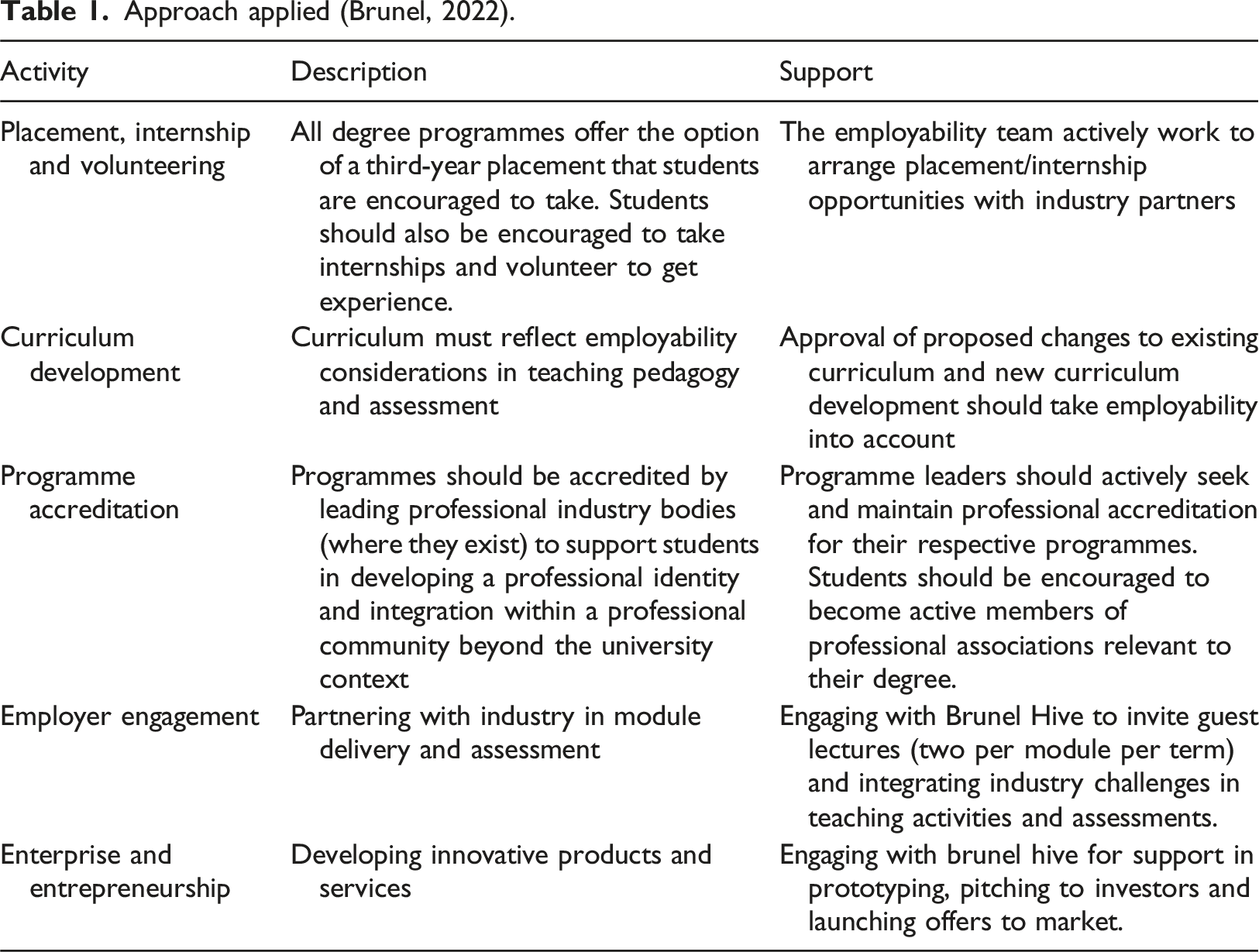
Approach applied (Brunel, 2022).
Student services
Student services also play a critical role in enhancing employability in HE. These services are responsible for providing students with the necessary support, guidance, and resources to help them develop the skills and knowledge required for successful employment. In recent years, student services have expanded their focus from traditional academic support to include employability services. This includes career counselling, résumé (CV) and cover letter writing assistance, job search strategies, and networking opportunities. These services help students understand their strengths and interests and identify career opportunities that align with their goals. Additionally, student services may partner with employers to provide students with internships, job shadowing, and career fairs, which can help students gain real-world experience and make connections in their field of interest.
Studies have shown that employability services provided by student services can have a positive impact on graduates employability (Gale and Parker, 2014). Moreover, employers have reported that they value graduates’ employability skills, such as communication, teamwork, problem-solving, and adaptability, which are developed through the support of student services (Harvey et al., 2013).
Education 4.0
This refers to the integration of emerging technologies into teaching and learning practices, has significant implications for employability in HE. The use of technology in education can enhance students’ skills, knowledge, and experiences, leading to improved employability outcomes.
One key aspect of Education 4.0 is the use of ‘big data’ and analytics. Institutions can gather and analyse data on student performance, engagement, and preferences, providing insights into areas that require improvement. This data can be used to tailor respective programmes and employability services to better meet the needs of students and the job market (Diamantopoulos and Zeriti, 2019).
Another aspect of Education 4.0 is the use of immersive technologies such as virtual and augmented reality. These technologies can provide students with simulated real-world experiences, allowing them to develop practical skills and knowledge in a safe and controlled environment. This can increase students’ confidence and enhance their employability prospects (Kipper and Rampasso, 2020).
The integration of Education 4.0 can lead to the development of new and emerging disciplines that are highly relevant to the job market, such as data science, artificial intelligence, and cybersecurity. These disciplines can provide students with highly sought-after skills and knowledge that are in high demand by employers (Capuano and Ferrari, 2018). However, the successful integration of Education 4.0 into programmes and employability services requires a significant shift in mindset and approach. Institutions must be willing to invest in new technologies, training and development for faculty, and support for students to ensure that they are equipped with the necessary skills to succeed in an Education 4.0 environment (Bilbao-Osorio et al., 2019).
Identifying employability gaps
While many HEIs offer modernised programmes with a strong focus on employability it is important that HEIs continue to audit their offerings and adapt to changes in job market requirements. Many competing HEIs seem to effectively embed practical forms of learning (internships, and other work placement opportunities) as well as opportunities for career development (HEA, 2006; QAA, 2017). Nevertheless, it is important to review all course material, especially learning objectives, for both degree programmes and individual modules to identify any gaps between what is being taught and the knowledge employers are looking for in prospective graduates (Biggs and Tang, 2011; Jisc, 2016). A ‘second opinion’ may also be helpful, via consultation with both faculty and academics associated with the programme as well as industry experts (Kotter, 1996). The system of External Examining in the UK (and elsewhere) can also provide a fresh pair of eyes in this area. Such monitoring and control tasks are undertaken to gain further insight and an overall perspective on the skills that are most important for graduates to possess by the time they graduate. Additionally, student evaluations offer are a third aspect to identify whether or not and where more practical-based work might aid with relevant job postings across the industry (Biggs and Tang, 2011; Vögtle, 2019).
Faculty conservatism (the ‘inertia of the status quo’) can limit the possibility of producing well-prepared students with robust employability skills (Biggs and Tang, 2011; Kaliraj and Thirupathi, 2022; Oliveira and de Souza, 2021). Critically, students may lack the technical skills required to secure employment after graduation (Ghani and Muhammad, 2019; Kerin and Pham, 2019; Li, 2022; Nathan, 2015).
As well as a collective recognition that graduates needed to be prepared for a rapidly changing job market, HEIs need to become (or remain) focused on improving the student experience which could be used as a driver for future implementation. This includes elements of both internationalisation and Industry 4.0, where the evolution of Education 4.0 plays a fundamental role in how programmes are developed, including the design of learning objectives, outcomes, and content across modules (Biggs and Tang, 2011; Buckley, 2020; Ghani and Muhammad, 2019; Jisc, 2016; Kaliraj and Thirupathi, 2022; Kerin and Pham, 2019; Li, 2022). There are a variety of catalysts for embedding employability in modules, but a strongly targeted strategy can pave the way for increasing the probabilities of change (Jisc, 2016; Kotter, 1996). This should also involve new ways of thinking about the hierarchical process at HEIs, including relevant policies, protocols, and agency under particular constraints (Kotter, 1996).
Internationalisation and employability
Employability for international students and preparation for transitional processes outlined by Industry 4.0 initiatives depends mostly on their skills, acquired knowledge, and current adaptability to new technologies in accordance with new trends in the job market (Vögtle, 2019). Skillsets are characterised by the integration of advanced technologies such as robotics, IoT technologies, artificial intelligence, and big pharma in the healthcare sector. Familiarity with digital technologies, programming languages, and data analysis tools are an integral part of working within many industries. While international students already have some degree of employability premium due to their native and other language skills and the experience of living overseas, practical experience in their chosen field increases the value of international students even further (Biggs and Tang, 2011; Vögtle, 2019).
A crucial element to embedding employability is for faculty to encourage critical thinking and build confidence related to communication skills, and not compromise on the aspect of collaboration between cross functional teams (Tannahill and Douglas, 2014). If all attributes are met, students who can work effectively in multicultural environment will have an edge in the job market (Biggs and Tang, 2011; Kaliraj and Thirupathi, 2022). This fits perfectly well with global-oriented programmes for widening participation leading to promising careers in the 4.0 era (Biggs and Tang, 2011; Vögtle, 2019).
Embedding employability at curricular level
Embedding employability provides students with the opportunity to develop their skills, experience, and knowledge to help them make a successful transition from (higher) education to employment (Biggs and Tang, 2011). However, consideration must be made as to employability can be taught effectively (if at all!), as well as the pedagogical constructs for employability to enhance learning (Biggs and Tang, 2011; Yorke, 2004). It is worth reiterating that the job market is increasingly competitive, as well as being necessary to identify the demands of a diverse range of stakeholders (Kotter, 1996). To this end it is necessary to ensure that a supportive institutional culture is carefully cultivated (Biggs and Tang, 2011; Blackmore et al., 2016; Yorke, 2004).
As noted above, it is vital that students experience some element of employability activity as part of their programmes, narrowing down the plan to re-create employability outcomes and strategically embed such pathways through explicit course validation processes, including playing a key role in enhanced execution of delivery and assessment processes. Examples include the importance of embedding enterprise into the curriculum and institutional ecosystem (Blackmore et al., 2016). Further, the potential to implement change should also explore how intercultural practice could be embedded to support international recruitment and retention, which further enhances employability (primarily relevant due to the global nature of the most HEI programmes).
Measures for success, key indicators and time scale
Measuring success in academic settings can be a challenging task, and academics are faced with the problem of defining measures accurately. Principally, there are a variety of ways to conduct measurements depending on the context of the programme objectives. Measuring success in assessment at postgraduate level scrutinises achievement of the learning outcomes, which is one of the most common methods of examining whether students have achieved the intended learning outcomes of the programme (Biggs and Tang, 2011; Gunn et al., 2010). Secondly, through rigorous research and feedback analyses with reflective practice being a core proponent for self-assessments, or simply encouraging ongoing learning echoes potential change. Isolating employability outcomes can be an effective way of demonstrating value of a programme by tracking career progress and figures illustrating success rates. The point for initiating change is to ensure students demonstrate their ability to apply their learning in a professional context. In essence, a pragmatic approach, using a combination of qualitative and quantitative methods strategically aligned with the programme objectives and intended outcomes of the assessment support with contextualising metrics.
It is also important to consider the specific goals of an individual HEI. The Quality Assurance Agency for Higher Education (QAA) identified widening participation and access as an important factor (Biggs and Tang, 2011; QAA, 2017). Many students face challenges with securing employment; therefore, changes to embed employability should be at the forefront of any strategy to complement initiatives already in place with an inclusive curriculum that reflects diversity (QAA, 2017). Additional measures for employability include KPIs attached to the proportion of graduates who are employed in relevant professional positions and supporting alumni success statements through employer feedback portals. In terms of time-frames, approximately 6 months for a shorter time frame as opposed to many HEIs typically reporting measurements at later stages to depict employability outcomes (Biggs and Tang, 2011; Gunn et al., 2010; Jisc, 2016; QAA, 2017; Cox et al., 1991).
Conclusion
Any HEI development plan should acknowledge the importance of employability. To meet national standards and keep up with evolving trends in the job market, every programme needs to equip students with the necessary skills, knowledge, and experience to succeed in their future careers. Every institution is obligated to provide opportunities for students from all backgrounds and capabilities to learn about and become comfortable with the real world of work (see standards outlined in QAA, AdvanceHE, Ofsted, SDGs and OFS). Therefore, enhancing employability will create a more diverse pool of candidates with connections to a highly skilled workforce that can contribute to economic growth and social development. Changes enforce re-assessment of key drivers to prioritise employability for meeting national standards, thus discussion around the plan for embedding employability has been received well as evidenced by the trial in place. Amendments to the module deliverables and wider construction positions plans for enhancements to be applied incrementally over the course of a year.
Footnotes
Declaration of conflicting interests
The author(s) declared no potential conflicts of interest with respect to the research, authorship, and/or publication of this article.
Funding
The author(s) received no financial support for the research, authorship, and/or publication of this article.
