




Abstract
This paper focuses on contemporary tensions and contradictions in current Norwegian educational policy discourse. Based on critical discourse analysis (CDA) of Norwegian governmental white papers our analysis reveals that contemporary Norwegian policy formulation is torn between an egalitarian and a selection discourse about how to tackle educational inequality in the Norwegian comprehensive school system. The egalitarian discourse is characterised by principles like inclusion, equity and recognising diversity in the education system with a stated aim to balance educational outcomes. The selection discourse advertises greater selection, competition, and outcome control in the light of international competition and calls for better correspondence between schooling, higher education, and labour market needs. Paradoxically, both discourses are advertising themselves as proper solutions for tackling and reducing educational inequality in Norway. Taking indications of growing social inequality in Norway into consideration we conclude that growing importance of selection and competition arguments in contemporary Norwegian educational policy have increased dissonance and inconsistency in discourse and have started to overpower egalitarian values. We conclude that this will, against egalitarian creed and rhetorical claim in Norwegian educational policy, rather foster than reduce educational inequality.
Introduction
The Norwegian education system is founded upon a comprehensive school system with egalitarian values, which reflects the socio-democratic Scandinavian welfare model (Bambra, 2007; Esping-Andersen, 1990). Comprehensivness has been a political objective ever since the Norwegian Parliament was established in the late 1800s and has been fundamental to Norwegian social democracy throughout the 20th century (Volckmar, 2016). Accordingly, the principles of inclusion, diversity, and equity have long been at the forefront of educational policy (Bjørnsrud and Nilsen, 2021). For many decades, it seemed that the Norwegian comprehensive school system had found a way to equalise educational opportunities in the younger generation, that is, to increase the opportunities for less privileged children and young adults to a certain extent without significantly reducing the educational opportunities of more privileged children and young (Van de Werfhorst, 2019; Van de Werfhorst and Mijs, 2010).
However, recent research indicates a countertrend, namely that the gap in educational participation based on socio-economic and cultural factors is on the rise in Norway (Bjordal and Haugen, 2021; Hansen, 2017; Volckmar, 2016). Furthermore, research shows that while rhetorically there is persistent focus on collective equality and compensation for inequal chances in Norwegian educational policy, there is a growing focus on and emphasis of individual skills, abilities and an individualisation of responsibility for learning outcomes (Aasebø, 2021; Skarpenes, 2021). In the context of such dynamic, conflictual, and contradictory developments in Norwegian education, the following article aims to shed light on Norwegian educational policy discourse in recent years using critical discourse analysis (CDA). Following CDAs four-step approach (Fairclough, 2012, 2013) the article analyses of how educational inequality in contemporary policy discourse is semiotically described as ‘a social wrong’ (Fairclough, 2013: 226) and what solutions are proposed to tackle and overcome this ‘social wrong’. In doing so, we uncover how issues of educational inequality become discursively problematised in contemporary Norwegian educational policy and which solutions – based on this definition of situation – are proposed to address them. We empirically base the analysis on a range of significant white papers (Stortingsmeldinger) posted by the Ministry of Education and Research (Kunnskapsdepartementet) over the last 10 years (2013–2023).
We begin our analysis by briefly reviewing key aspects of education reforms implemented in Norway and discuss persisting educational inequality considering these reforms and evaluations of them. Thereafter we demonstrate – based on critical discourse analysis – how contemporary Norwegian educational policy discourse constructs educational inequality as a ‘social wrong’ and how dissonant, two-way challenging and (to a certain extent) contradictory the proposed policy solutions discursively emerge in data for tackling educational inequality. The paper finishes with a contextualised critical reflection of the findings. By doing this we try to fill an existing research gap in contemporary Norwegian educational policy analysis, namely the widely missing research on the construction of educational inequality as ‘a social wrong’, the discursive construction of strategies for mitigating or tackling it and related challenges regarding these discursive construction processes.
Permanency of reforms and persistent educational inequality in Norway
Educational equality, early efforts as well as adapted learning have been at the core of Norwegian educational policy for decades (Bjørnsrud and Nilsen, 2021). Already the reform Mønsterplan for grunnskolen of 1974 (M74) took a clear stand stating that all pupils although different are of equal worth. For guaranteeing both the recognition of differences and equality, adapted learning – under the framework ‘adapted education’ – became seen as key and was further developed in the M74 successor, the 1987 Mønsterplan for grunnskolen (M87). In its core adapted learning recognises that pupils, apprentices, or students have different abilities and skills as well as individual, socio-cultural and economic prerequisites which must be compensated for if an education for all will succeed. The reforms of the 1990s and 2000s provided a continuation of this concept. For example, in Reform 97 it was argued that individual adjustments were necessary to offer equal education for all. Furthermore, the goal was to promote equal and adapted learning for everyone in a coordinated school system built on the same curriculum.
Early efforts to support those who are likely to struggle throughout their educational trajectories has also been an important element of the comprehensive school (Bjørnsrud and Nilsen, 2021). While the education policies of the 1970s focussed on early efforts regarding pupils with special educational needs, since 2000, a re-articulation of the concept with a broader focus on basic education for all came into focus. Simultaneously, the Education Act was expanded, where the importance of helping pupils who ‘lag behind’ was emphasised. The notion of early efforts was specifically introduced in the 2008 Education Act enforced in 2009 Ot.prp. nr.55 (2008-2009), with a focus on the first 4 years of school and on children at risk (§§ 1-4).
In the wake of the PISA studies (Programme for International Students Assessment), another national reform was initiated – namely LK06 (Kunnskapsløftet, 2006). This reform sought to advance adapted education by strengthening expected learning outcomes while decentralising content and teaching methods (Volckmar, 2016: 113). The purpose was to ensure that all pupils develop competence to be active participants in society and increase the level of knowledge amongst all pupils, independent of factors like family background and gender (Bakken and Elstad, 2012: 9). In this regard, assessments of pupils, teachers and schools were vastly expanded (Bachmann and Haug, 2007: 272). According to the LK06 problem framing, education must be varied and differentiated to account for the diversity of pupils.
However, based on critics of LK06 that it did not reduce educational inequality (Bakken and Elstad, 2012: 11–13; Bjordal and Haugen, 2021; Volckmar, 2016) a renewal of LK06 – namely LK20 – was implemented in both primary, lower secondary and upper secondary schools in 2020. LK20(Kunnskapsløftet, 2020) was aimed at reforming the content or curriculum of primary, lower secondary and upper secondary educational institutions, both private and public. At its core the reform introduced a new ideal for learning called ‘in-depth learning’ (dybdelæring) which builds upon the idea that the labour market is changing ever faster with high demands for knowledge and skills to adapt (NOU, 2014: no. 7: 6).
Despite the ambitiously introduced reforms the proposed changes and adjustments have not resulted in all pupils gaining sufficient learning outcomes. As existing research indicates, grades across different socioeconomical groups have stayed largely unchanged despite reform implementation, with a slight increase in differences (Bakken and Elstad, 2012; Bjørnsrud and Nilsen, 2021). One of the most consistent findings is that pupils from lower socio-economic backgrounds have significant higher risks for leaving school without a requisite diploma and have lower take up rates and higher drop out risk regarding higher education (Abamosa et al., 2020). It seems that the impact of social background has become even more influential over the last decade, and thus is shaping even stronger the educational field, which indicates growing and not declining educational inequality (Bakken and Elstad, 2012; Borgna et al., 2019; Drange and Telle, 2021; Hansen, 2017; Hansen and Mastekaasa, 2010; Skarpenes, 2021). Furthermore, there has been an increase in terms of the number of boys (Hansen and Mastekaasa, 2010) 1 , pupils with migrant background (Instebø et al., 2021) or refugees (Abamosa et al., 2020), indigenous groups (e.g. Sami people) (Aamotsbakken, 2015) and LGBTQ + youth (Svendsen et al., 2018) who struggle with regard to both access, treatment and outcome in the education system 2 . As research also indicates, there are persistent variations amongst schools caused by limited finances (Rød and Karlsen Bæck, 2020). Thus, schools find themselves in unequal preconditions to implement the reforms and thus to adapt to the needs of a diversity of pupils continuing or even fostering educational inequalities (Luimes, 2023: 85).
Hence, although ambitious educational reforms in Norway over decades the implemented measures only had small effects regarding the reduction of educational inequality. It even seems – when taking latest research results into consideration – that educational inequality is on the rise. Against this background the question arises as to how contemporary Norwegian policy discourse addresses this tension between an education for all, implemented reforms for tackling educational inequality and persistent (over the last years even rising) educational inequality in Norway.
Critical discourse analysis of white papers
Discourse characterising Norwegian contemporary educational policy formulation was examined first by conducting a qualitative content analysis of key policy documents – so-called ‘white papers’ (Stortingsmeldigner) on education posted by the Ministry of Education and Research (Kunnskapsdepartementet) – which were released from 2012 to 2022 and second by applying critical discourse analysis (CDA) (Abamosa et al., 2020; Fairclough, 2012, 2013; Fairclough and Halskov Jensen, 2008). This timeframe was strategically selected to represent what can be regarded as contemporary policy formulation and also to provide sensible limitation on the amount of data to be reviewed for thorough analysis. White papers are documents provided by Government and presented to Parliament to enable discussions that form basis for resolutions, bills, or reforms to be implemented at a later stage (Hilt, 2015). Therefore, they are ideal for mapping discourse used by Government since they provide insight into the discourse behind the rational of the implementation of them.
Data material.
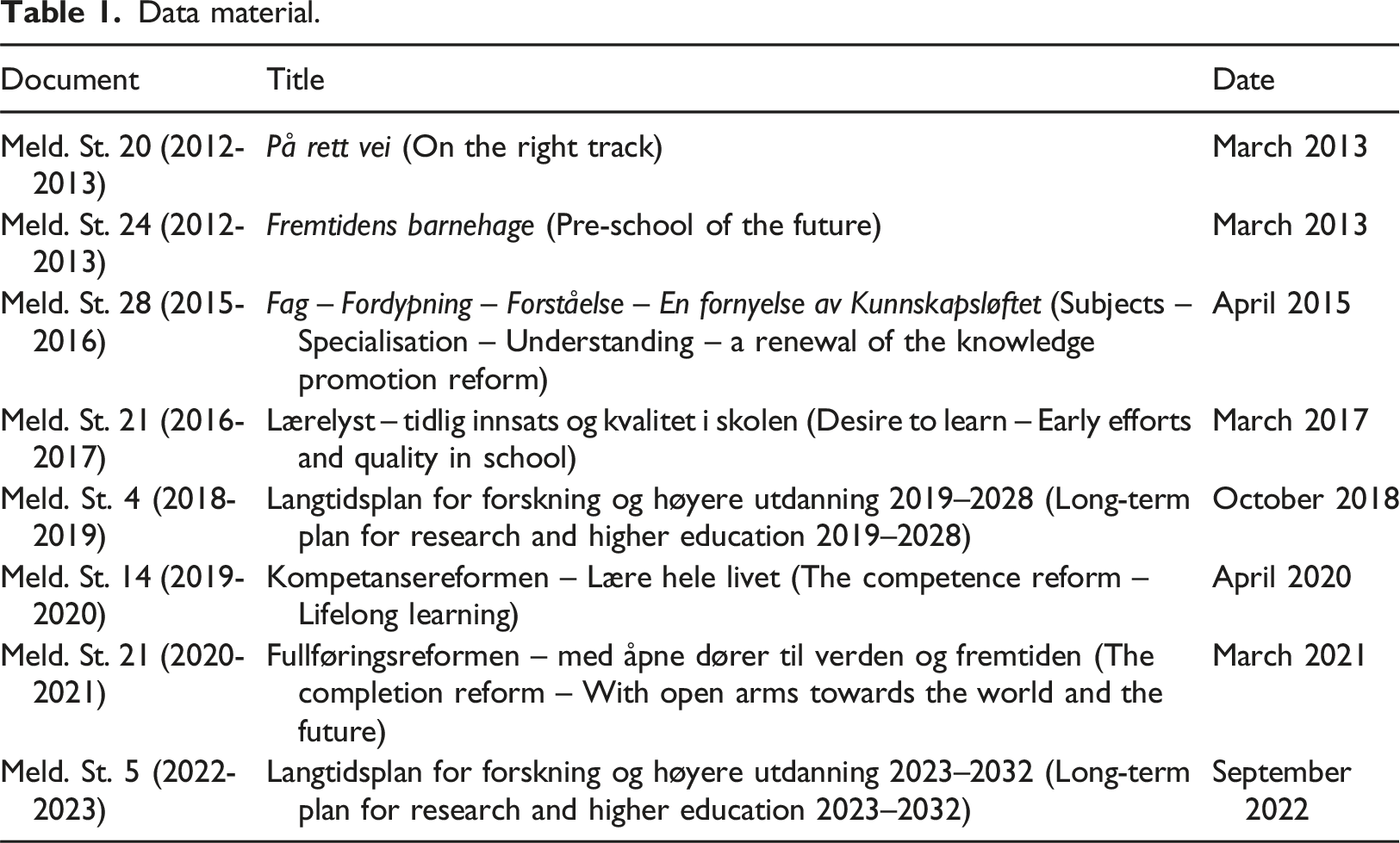
When key documents had been selected, a first step was to read through them and look for relevant codes. Here the qualitative open coding framework developed by Miles and Huberman (1994) had a central function for mapping in a first analytical step important dimensions and codes. According to (Miles and Huberman, 1994: 61) there is always more going on in the field than the social scientists’ initial analytical frames suggest. Therefore, the documents were first and foremost examined in an open and inductive manner to identify main codes. In this process, key paragraphs, sentences, and words were highlighted (Abamosa et al., 2020; Sundberg et al., 2023). The next step was to further examine the documents and develop the main codes by identifying several sub-codes that expanded upon aspects described by the main codes. For example, the main code ‘socio-democratic values’ consists of sub-codes like ‘inclusion of all’, ‘redistribution of resources’ and ‘recognition of diversity’ while the main code ‘competition’ consists of sub-codes like ‘outcome’, ‘labour market needs’, and ‘globalisation’. Selected quotes from the white papers to support our analysis have been translated to English as the white papers are published in Norwegian only.
In the following step, the identified codes were interpreted and reconstructed to generate different orders of discourse – that is different forms of ‘particular social ordering of relationships between different ways of meaning-making’ (Fairclough, 2013: 232-233). Critical discourse analysis (CDA) has increasingly been used in conjunction with other methodological frameworks in educational policy research (Lester et al., 2016). However, it should be noted that the focus of this article has been on discourse (and not ‘genres’ or ‘styles’) as would be included in a pure CDA framework. As stated by (Fairclough, 2013: 11), research does not ‘exclude the possibility of making use of certain CDA categories and relations … in work which does not itself count as CDA’. Against this background, CDA was also of inspiration due to its normative function addressing social wrongs and ways to mitigate them (Fairclough and Halskov Jensen, 2008: 99-100).
By using CDA the following analysis of discourse in white papers sheds light on how policy formulation relates to broader social structures and processes in a dialectical manner (Abamosa et al., 2020). In this regard, we applied – as Fairclough (2012, 2013) recommends – a four-step approach which fits our analysis, as educational inequality can be regarded as a ‘social wrong, in its semiotic aspect’ (Fairclough, 2013: 226) with obstacles that can be identified – while possible ways to overcome the obstacles also can be addressed. Utilising the open coding results, we first reconstructed the ‘social wrong’ (persistent educational inequality), semiotic aspects and related issues. In a second step, we casted light on obstacles, issues, or challenges in addressing the ‘social wrong’. The third analysis step examined the extent to which the ‘social wrong’ is framed as a social fact and in a fourth step, we looked at the strategies that were proposed to find solutions, to ‘heal the social wrong’. Finally, we synthesised and interrelated the results of the respective four analysis steps and identified two distinctive types of discourse which propose a certain framing of the social wrong and solutions to it: in the following called the egalitarian and the selective discourse.
Contesting discourse in contemporary Norwegian educational policy
The egalitarian type of discourse
Norwegian educational policy accentuates egalitarianism and highlights terms like ‘diversity’, ‘inclusion’, and ‘equity’. These terms are highly prevalent in contemporary policy formulation. Inclusion is regarded as a ‘founding principle in Norwegian educational policy’ (Meld. St. 21 (2016-2017): 57) while in Meld. St. 28 (2015-2016) – which lays the foundation for curriculum reform LK20 – it is stated that the Norwegian school system should have an ‘open and inclusive attitude towards pupils with backgrounds from different life-stances, cultures, and traditions’ (19). In other words, contemporary Norwegian policy provides a continuation of egalitarian principles that have been at the foreground of policy formation the last five decades (Bjørnsrud and Nilsen, 2021).
By focussing on including all pupils through adapted learning and spending more resources on those who are struggling in school, policy emphasises ‘recognition’ (Fraser and Honneth, 2003) of disadvantaged groups. As stated in Meld. St. 20 (2012-2013), the diversity of pupils with their ‘different prerequisites’ should be met ‘in an inclusive manner, so that pupils experience recognition and safety’ (11). Meld. St. 21 (2020-2021), which is a precursor to the Completion Reform, states that boys, migrant students, and students with disabilities are overrepresented among ‘drop-outs’. Sámi students, students with learning disabilities, as well as linguistic minority students are also mentioned as particularly disadvantaged in this white paper. Students with mental health challenges are described as an important target group in Meld. St. 21 (2016-2017). Regarding adult education and re-training, migrants and refugees are specified as important target groups for equalisation measures in Meld. St. 14 (2019-2020). Moreover, in Meld. St. 28 (2015-2016), which lays the foundation for LK20, the discourse focuses on the increasing diversity in Norwegian society over the last 20 years. Generally, and as stated in Meld. St. 4 (2018-2019), attempts should be made to ‘develop equal educational- and welfare opportunities for a diverse population’ (60).
LK20 awards responsibility to the professional community and the individual teacher for developing framework conditions, taking account of the diversity in the classroom, and ensuring adapted learning (Bjørnsrud and Nilsen, 2021). For example, it is stated that there is ‘no contrast between belonging to a unity and to be seen as an individual pupil and receive an education that takes into account different prerequisites such as interests, gender, ethnicity, and cultural and religious affiliation’ in Meld. St. 28 (2015-2016) (23). Thus, the egalitarian argument for inclusion is closely related to the focus on disadvantaged groups in the sense that children and young people from all of Norway’s diverse groups should participate in education. As stated in Meld. St. 28 (2015-2016), schools should ‘provide adapted education so that every single pupil’ regardless of social background ‘is stimulated to highest possible level of goal achievement’ (10).
In relation to the social context, one can say that the egalitarian type of discourse, reflects Norwegian society at large. Together with the other Nordic countries, Norwegian society is characterised by egalitarian values (Gullestad, 1992; Skarpenes, 2007), which is reflected in school policy by the fact that the ‘social wrong’ (educational equality) is to be addressed by differentiating pupils within a uniform classroom and school. More specifically, the differentiation of children can be viewed as pedagogical rather than structural in the sense that in the first 7 years of compulsory school children are not assessed based on formal grades, but on verbal feedback and developmental discussions with parents, teachers and children (e.g. Hestholm and Jobst, 2020) 3 .
The selective type of discourse
Although our analysis reveals that egalitarian values of inclusion, diversity, and aiming to balance educational outcomes are important in contemporary policy thinking it can be observed that a competitive selection argument is also prevalent in Norwegian educational policy discourse. At the core it focuses on preparing young people to be competitive in the national – and in a wider sense in the global – labour market. Thus, the ‘brightest’ should get the ‘best’ positions in society. In this discourse school is seen as a prerequisite for national competitiveness in the international global economic market and schooling should meet ‘the demands for competence in the labour market’ (Meld. St. 21 (2016-2017): 11). For example, according to Meld. St. 14 (2019-2020) – an early formulation of the proposed Competence Reform 4 – the global labour market is evolving quickly. Here, it is highlighted that development of competence is central to ‘encourage competitiveness’ (90). Furthermore, this white paper explicitly problematises aspects of globalisation. It is argued that Norway has benefitted from participating in the global economy but also that globalisation ‘has led to some negative consequences for people with low and medium’ levels of education because they are competing with ‘cheaper labour on the global labour market’ and thus face penalties of educational underinvestment (19).
In this sense, education is understood as adaptation – or in some nuances even assimilation – to (economic) change, and the meanings and needs formulated with it – as a kind of counter-concept to education as emancipation/self-determination of the person. In this regard, it is argued that the demands for educational self-investment, easy access to adult education and re-training are increasingly relevant, which is highlighted as essential to have a competent workforce needed so that Norway can participate in global society. Additionally, in Meld. St. 5 (2022-2023) it is argued that universities and colleges have a responsibility to design their courses in line with the competence demands of the labour market, as development of new knowledge is regarded as one of the ‘most important competitive factors for Norwegian business life’ (17). Even discourse on pre-schooling includes the selection narrative. Investments in pre-school is described as having ‘positive effect … on labour market participation’ later in life and can thus also contribute to ‘reducing public expenses’ on welfare costs (Meld. St. 24 (2012-2013): 10).
L97 proposed, based on OECD’s critical assessment of the Norwegian education system, the need for stronger control, evaluation and increased competitiveness for Norwegian schooling. This provided throughout the 1990s and onwards the foundation for a national strategy which increasingly focused on control via evaluation of results while at the same time strengthening inter-school outcome comparison. In other words, there was a transition from input (curriculum) to output (test results) control. With a view to LK20, more decentralised and more competitive arrangements are emphasised as essential. For example, it is argued in Meld. St. 28 (2015-2016) that ‘the national curriculum should provide autonomy to adapt education in local contexts’ (43) while it is recommended that ‘school owners and school leaders pay particular attention to the quality of implementation’ of measures and ‘that they tailor the implementation of measures to local conditions’ in Meld. St. 21 (2016-2017) (85). In this regard, school owners should be able to plan and execute local initiatives to adapt better to local ecologies and opportunity structures, as earlier national initiatives have not enabled the adaptations necessary to account for varying local differences throughout Norway. As such, the decentralisation argument goes hand in hand with standardisation (output governance, testing), external evaluation and therewith with a stronger focus on comparison and competitiveness of schools (as well as universities) in the educational market. Furthermore, it can be seen as a shift of responsibility from the national level to the local level – more so than actually realising local wiggle room for adapting the curriculum, however, accompanied with an increasing top-down control of the content, implementation, and outcome of curriculum development.
Problems, tension and dilemmas in Norwegian policy discourse – extending CDA
Based on the CDA, three sources of confusion and tensions emerge in Norwegian policy discourse: a) a friction between ‘descriptive’ and ‘normative’ aspects of inequality – thus how the ‘social wrong, in its semiotic aspect’ namely ‘educational inequality’ is presented, b) a meritocratic illusion regarding selection based on ‘skills’ and ‘abilities’ against the background of growing educational and social inequalities and c) a blindness regarding the function of schools and the schooling system as means of reproduction of inequality based on the relative autonomy of school (Bourdieu and Passeron, 1990: 11–12) while proposing selection as medicine to the problem of educational inequality.
As the CDA of the selected white papers reveals, the term ‘inequality’ has a shaky discursive image. One of the main challenges with the term is its different usage regarding descriptive and normative qualities. In a descriptive perspective ‘inequality’ is used as synonymous with ‘difference’. Therewith inequality becomes somehow constructed as a ‘natural’ quality, as something what is empirically given and interdependent of the social (Therborn, 2013: 38). Consequently, educational inequalities emerge from ‘natural’ differences or uneven ‘natural’ and ‘inevitable’ variances of skills, abilities, and varying contexts (Yanagisako and Delaney, 1995). With this the selection discourse attributes educational differences in access, treatment, and outcome to different ‘natural’ abilities to compete within the educational system for credits (Bowles and Gintis, 1976: 24).
However, proposing such kind of ‘naturalising’ discursive perspective on educational inequality masks its social-cultural and economic conditions (Bernard, 2007: 98). The applied CDA shows that the egalitarian discourse clearly problematises – contrary to the selective one – that educational inequality and its sources are socio-economically or culturally induced, that educational inequality has its origin in socio-culturally produced unequal distributions of resources and not in ‘natural’ differences. Consequently, educational inequality appears in the egalitarian discourse as something ‘unjust’, ‘wrong’ and according to welfare state values ‘not legitimate’. By this educational inequality becomes ‘de-naturalised’. Therefore, the egalitarian discourse reminds us that means and ends of education point to issues of hegemonic misrecognition of symbolic capital and the arbitrariness of its social construction – materialised in the means and ends as well as their relation in education (Bourdieu et al., 1995: 255). In this discourse, the education system and it pedagogic practices are seen as rooted in the culture of the privileged, as a product of unequal processes of recognition and misrecognition of symbolic capital as well as unequal distribution of capital (Bourdieu and Passeron, 1990: 7). They are the driving forces for unequal educational outcomes.
Hence, the applied CDA clearly underlines that the Norwegian policy discourse materialised in the data obviously confounds two perspectives which are mutually exclusive. Selection focused meritocratic perspectives by which educational inequalities are to be attributed ‘to inevitable human differences in intellectual capacities or patterns of free choice’ (Bowles and Gintis, 1976: 24) coexist – in a kind of doublethink and thus without any recognised fractions, contradictions or perceptions of being dissonant – with egalitarian perspectives which assume that selection in the educational system arguably works only ‘for those children whose parents have been able to provide a reasonably secure place on a generally uneven playing field’ (Bills, 2019: 97). All this – as Bourdieu and Passeron (1990: 12) would name it – is a ‘logical contradiction and a sociological impossibility’.
Additionally, the CDA reveals that both discourses show blindness regarding the function of schools and the schooling system as means of reproduction of inequality based on the ‘relative autonomy of school’ (Bourdieu and Passeron, 1990: 11-12). Pedagogic actions ‘tend to reproduce the structure of the distribution of cultural capital among these groups or classes, thereby contributing to the reproduction of the social structure the school system can’t resist the forces to correspond with external expectations from other parts of society’ (Bourdieu and Passeron, 1990: 11), hence powerful imperatives of the contemporary labour market, broader educational market, segmentation, and structuration processes: “The laws of the market which fixes the economic or symbolic value, i.e. the value qua cultural capital, of the cultural arbitraries produced by different PAs
5
(educated individuals), are one of the mechanisms – more or less determinant according to the type of social formation – through which social reproduction, defined as the reproduction of the structure of the relation of force between the classes, is accomplished.” (Bourdieu and Passeron, 1990: 11).
However, both discourses do not recognise or problematise the society-imposed imperative of selecting, grouping, and ranking of pupils or students – and by this the reproduction of the order of recognition and distribution – due to schooling. This common sense becomes not touched at all. And this basic function of schooling, namely the reproduction of symbolic power due to its selection function, becomes as our CDA clearly shows tabooed, ignored, or covered in both discourses (Bourdieu and Passeron, 1990; Littlewood, 1999: 167). Exactly here we connect with our argument: need differentiation and unequal treatment within the educational system – although demanding redistribution of resources and aiming to changing the game – are not powerful enough for bursting the superiority or rightness of the dominant culture and for evaluating hierarchies of symbolic capital in education (Fraser and Honneth, 2003: 233) since they do not touch the unequal distribution of economic capital in society. Quite the contrary, although pupils should be treated differently according to their individual needs for compensating educational penalties regarding inequal outcome – the egalitarian discourse – the parallel enforcement of selection and meritocratic ideology due to naturalisation of differences – the selection discourse – combined with an increasing importance of measuring outcome according to a common standard does not dissolve symbolic violence, the cultural arbitrariness and arbitrariness of power, does not penetrate the selection imperative or function of schooling and thus does not substantially change the game to the better regarding capital distribution within the existing social structure (Bowles and Gintis, 1976). It does as we conclude here in line with Bourdieu and Passeron (1990), Bowles and Gintis (1976), and Fraser and Honneth (2003) rather revitalise and strengthen symbolic order, fosters a better correspondence between education and its surroundings, and here especially with the labour market and does not emasculate but rather strengthen the reproduction of cultural and capital power hierarchy.
Further reflections
As identified in the CDA, there is a wider tension between the egalitarian ideals of inclusion on the one and the ideas of selection on the other hand. The idea of selection (interlaced with meritocratic beliefs and ideology) goes in the analysed data material hand in hand with ideas to strengthen (neo)liberal policies and New Public Management in Norwegian educational policy over the last decades (Bjordal and Haugen, 2021; Hansen, 2017). This has – as research underpins – led to increased competition between pupils, teachers and schools and against policy programmatic to a continuation or even amplification of educational inequality in Norway. Furthermore, as the discourse indicates, decentralisation and output control are seen as useful central governmental means for comparison, evaluation power execution techniques along with standardisation, hence techniques that, despite proclamation, do not foster equal participation, recognition, and compensatory resource distribution within and between schools in education but rather decrease chances for an education for all and therewith for an egalitarian educational system (Jobst, 2013: 17).
Thus, and although educational policy discourse in Norway focuses on recognition and unequal treatment through redistribution of resources in schooling, it forfeits power – due to the contemporary importance of the selection discourse – to mitigate educational inequality. Egalitarian principles like inclusion of all or equality of outcome are – as our CDA clearly reveals – semantically as well as logically simply not compatible with selection discourse and the selection function of school. Both perspectives are rather ‘antithetical’ forcing into doublethink and dissonance. ‘Equality’ as it has been at the centre of Norwegian educational policy throughout decades seems to have become increasingly watered down to mean that the school should still account for a diversity of pupils but without any longer imperative for significantly redistributing resources to the weak, for changing recognition and thus for substantially changing outcomes for the disadvantaged. By this, there is a risk that educational policy in Norway deteriorates from a policy which has changed the game to the better over decades into a rather symbolic wish policy which talks about educational equality frontstage but increasingly poses risks for educational inequality backstage. This – which comes of no surprise – goes along with the fast-growing grasp of New Public Management and standardisation of education.
The frameworks of neoliberalism and New Public Management have been employed to justify the restructuring of governmental bureaucracies as well as processes related to public policy, which have also significantly influenced the education sector (Peters and Tesar, 2018: 7). While the term ‘neoliberalism’ remains subject to debate and lacks a straightforward definition, there is growing consensus that it has contributed to a rise in global inequalities (15) and has led to a ‘restructuring of state education systems … in many Western countries in recent decades’ (2). Consequently, neoliberalism has eroded the notion of education as a shared public good and an equaliser (Biesta et al., 2022). Instead, education is ‘increasingly becoming a commodity, a private good in a competitive market place’ (1221). In this regard, it is argued that the ideology shaping Western education systems is one of individualisation of responsibility, of globalisation and the contemporary global neoliberal hegemony (Adick, 2003; Birchfield, 1999; Evans, 2009; Muench et al., 2022; Peters and Tesar, 2018; Santos, 2009). Thus, perspectives that pupils, students and teachers, schools as well as countries must be highly competitive to survive in a global economy may be overpowering egalitarian values even within Scandinavian contexts, which have historically operated under a socio-democratic welfare regime (Bjordal and Haugen, 2021; Blossing et al., 2013; Imsen et al., 2017; Imsen and Volckmar, 2013; Muench et al., 2022; Skarpenes, 2021; Solhaug, 2011; Wiborg, 2013).
Hence one can hypothesise on persisting challenges with the actual implementation of equalising measures according to its initial egalitarian aims as being caused by the contesting selection discourse. In this regard, efforts aimed at mitigating systematic disparities in educational outcomes, despite being explicitly articulated in policy discourse, may fall short in implementing the necessary tools and measures required to achieve substantial reductions in educational inequality (Bakken and Elstad, 2012: 251). Current practices of equalisation education seem to first and foremost place more personal responsibility on the individual pupil to reach educational goals (Skarpenes, 2021) and thus might align more closely with individualisation of responsibilities, (neo)liberalism and selection rather than its intended egalitarian aims. However, we do not agree with those who argue that the problem may not be the implementation of these measures, but actually the comprehensive school system itself (Luimes, 2023). It is rather that the Norwegian education system cannot both reduce its selectivity by recognising and redistributing for the sake of equality (in performance, access, treatment, and outcome) and at the same time strengthen selection, individual responsibility, competition, and testing. And here Norway follows – although lagging temporarily and in extent behind – other Scandinavian countries like Sweden or Denmark. In these countries, market-based and accountability-driven discourses and reforms have led to ‘intensified competition between schools’ which ‘increases educational inequality instead of reducing it as it is claimed’ and by this countering egalitarian principles and socio-democratic values (Muench et al., 2022: 14). Thus, the odds ascend (and not drop!) that egalitarian values and resulting game changing practices for tackling educational inequality become further overpowered in Norwegian schooling against the manifold and colourful symbolic creeds in Norwegian policy and public discourse (Aasebø, 2021).
Footnotes
Declaration of conflicting interests
The author(s) declared no potential conflicts of interest with respect to the research, authorship, and/or publication of this article.
Funding
The author(s) disclosed receipt of the following financial support for the research, authorship, and/or publication of this article: This work was supported by PIONEERED [grant number 101004392] which has received funding from the European Union’s Horizon 2020 research and innovation program. The content provided in this paper reflects the authors’ views only. Neither the Research Executive Agency (REA) nor the European Commission are responsible for any use that may be made of the information it contains.
