



Abstract
This paper offers analysis of the policy drivers and legal frameworks associated with school exclusion in Northern Ireland. This activity is timely given limited analysis in this area in recent decades. The research is an element of an UK-wide, multi-strand, ESRC Large Grant project, examining the Political Economies of School Exclusion and their Consequences across the UK, informally referred the Excluded Lives Project. The paper examines representation and discourse surrounding school exclusion from the perspective of three domains: government, media and civil society. Bacchi’s, ‘What’s the problem?’ (2009; 2012) approach was used to critically interrogate a range of documentation produced by the aforementioned domains and a range of key questions relating to the representation, discourse, gaps and solutions in the policies associated with school exclusion are addressed. Key findings reveal how school exclusion represented over time has changed. In the 1990s and early 2000s, exclusion was represented as an extreme measure in response to serious behavioural problems; as a school improvement measure which ensured positive learning experience of other pupils and as a measure that maintained school safety and order. Towards the present day an inclusive, rights and needs based discourse has emerged influenced by community organisations. The findings also point to an overly legalistic and procedural tone coming from government when communicating with schools. The authors argue that the current policies are dated and new and explicit policies on school exclusion should be developed. There is also an opportunity for the development of a single common scheme for all grant-aided schools which was legislated for but not commenced. Lastly, schools need more support and the development of new, evidenced based guidance and training is required to assist schools in managing exclusions and in the development of inclusive environments that reduce the likelihood of exclusions.
Introduction
The act of excluding a pupil from a classroom or from the school, usually as a consequence of behaviour deemed as inappropriate, is in itself a complex intervention (Daniels et al., 2022). There may be official or formal conceptions of school exclusion often carefully laid out in national legislation and policy documentation which extend to the school level but to understand school exclusion more comprehensively, we also need to consider hidden, (Power and Taylor, 2018) informal and unofficial exclusions that are also practiced in schools systems – the types of actions that are not officially recorded by schools. The official data across the UK and internationally reveal persistent exclusion patterns, in particular, the over-representation of those from low-income families (Gazeley, 2012); care experienced (Macleod et al., 2021); from certain racial and ethnic backgrounds (Okonofua et al., 2022; Shaw et al., 2016) and those with health, social, emotional, behavioural and well-being (SEBW) difficulties (Daniels et al., 2019; Obsuth et al., 2022). The literature also points to associations between school exclusion and increased chances of anti-social behaviour, criminality (Arnez and Condrey, 2021; Daniels et al., 2003) and substance misuse (Higgins et al., 2018) and negatively impacting on job prospects. (Madia et al., 2022)
This paper aims to provide an analysis of the policy drivers and legal frameworks associated with school exclusion in Northern Ireland but the paper should be considered as part of a larger project to provide a UK-wide cross-disciplinary analysis of school exclusion. The context and analysis presented here is part of a collaborative research project from the ‘Excluded Lives’ group, (Cole, 2018; Cole et al., 2019; Daniels et al., 2019; Duffy et al., 2021; McCluskey et al., 2019; Power and Taylor, 2018) made up of academics from Oxford University, Cardiff University, Edinburgh University, London School of Economics and Queen’s University Belfast which seeks to understand more about the formal and informal practices associated with school exclusion and the reasons why there are significant disparities in rates of temporary and permanent exclusions across the UK. This is part of an ongoing (2019–2024) ESRC funded project examining the political economies of school exclusion and their consequences across the UK (POLESE), initial contributions from each of the UK jurisdictions work can viewed in a special edition edited by Thompson et al. (2021).
The education system in Northern Ireland
For brevity and for reasons of history, (See Gallagher (2016) for the history of education in Northern Ireland), the education system in Northern Ireland is characterised by a number of different sectors there are Controlled schools which are owned and managed by the Education Authority (EA), these schools also have representation from the Protestant Churches on their Boards of Governors. Maintained schools are owned and managed by the Catholic Church through Trustees appointed by the Bishops and the Council for Catholic Maintained School’s (CCMS). There are also Voluntary Grammar schools, which are academically selective and Grant Maintained Integrated schools which are owned by Trusts and managed by their Boards of Governors. There is also a small number of Irish medium schools. Compulsory school age is from ages 5 to 16 but many students continue education post 16, undertaking a further 2 years and leaving at 18. At the time of writing there are 171,213 pupils in primary schools (years 1–7) and 154,313 pupils are enrolled in post-primary schools (DE, 2023a). There are also 85,000 pupils in all schools who are entitled to free school meals. In terms of school exclusions in the academic year 2021/22, the Department of Education recorded 4714 suspensions (temporary exclusions) and 20 expulsions (permanent exclusions) from schools. (DE, 2023b)
Literature review on school exclusion pertaining to Northern Ireland
One of the key findings based on a critical review of literature on school exclusion in Northern Ireland is that there is a paucity of research on the theme spanning almost three decades dating back to the mid-1990s. There was, albeit limited, academic attention given to the topic between the late 1990s and mid-2000s (Abbott, 2006; Barr et al., 2000; Barr and Kilpatrick, 1998; Horgan, 2011; Kilpatrick et al., 2007; Knipe et al., 2007; McGuckin and Lewis, 2008). Related to this, a series of studies examining alternative educational provision and the educational context surrounding young people after permanent expulsion from school (Bryson, 2010; Gallagher, 2011; Kilpatrick et al., 2007; Perry, 2015). There was also a series of studies examining links between school exclusion and adolescent substance misuse. These studies were based on a subset of young people within the Belfast Youth Development Study (BYDS) – a longitudinal study and one of the largest cohort studies of its kind in the UK. (Duncan and McCrystal, 2002; Higgins et al., 2018; McCrystal et al., 2005; McCrystal et al., 2007). More contemporary perspectives are offered by O’Lynn (2022) who considers school exclusion within the context of a divided society. Duffy et al. (2021) examine the UK-wide disparities in official school exclusion figures, as well as offer an overview of the legislation and procedures and again O’Lynn’s doctoral thesis (2022) provides a comprehensive and much needed examination of young people’s experiences of school exclusion.
A brief overview of the legal framework and procedures
An overview of the Northern Ireland legal framework and the procedures related to school exclusion was provided by Duffy et al. (2021), who also argued that examination of school exclusion in Northern Ireland was timely, given a lack of explicit investigation particularly in the last decade (2010–2020). In Northern Ireland, the terms suspension and expulsion are used to describe official school exclusion. The legislative framework stems from Article 49 of the Education and Libraries (Northern Ireland) Order (1986), then amendments in the Education and Libraries (Northern Ireland) Order (1993) which in short describes how the then Education and Library Boards, (preceding the Education Authority established in 2015) and the other governing sectoral bodies should have schemes which specify exclusion procedures; that individuals can only be expelled by the expelling authority within the sectors, such as the Boards which manage controlled schools or the Boards of Governors in grant-maintained schools and a series of regulations associated with appeals. There have been amendments to the legislation in 1995 and 1998 which provide more specificity regarding the length of suspensions, the maximum number of days a student can be suspended in a term and over a school year and the role of the principal in informing parents/pupil of the right appeal. A significant review of the legislation and procedures was undertaken in 2004 and a range of new articles were included in The Education and Libraries (Northern Ireland) Order, 2006 relating to the use of a common scheme in all grant-aided schools (Article 31); appealing an exclusion (Articles 32 & 33) and the provision of continued education for pupils who have been suspended (Article 34) were introduced. However, aside from Article 34, the rest have yet to be commenced (DE, 2022).
Policy and official guidance related to exclusion and managing behaviour in schools
The Department of Education (DE) has released a variety of guidance documents which address school exclusion and strategies for dealing with behaviour including the following: The promotion of Good Behaviour and Discipline in schools (DE, 1998); Pastoral Care in Schools (DE, 2001); Guidance for Education Otherwise than at School (2014); The Role of the Principal and Governors in Relation to Good Behaviour and Discipline (DE, 2018) and The Use of Restraint and Seclusion (DE, 2022). The Department of Education is currently reviewing pupil suspension & expulsion procedures and a report is expected shortly. The Council for the Curriculum, Examinations and Assessment (CCEA) have also produced documents that offer more explicit guidance for schools on identifying and supporting students with social, emotional and behavioural difficulties (CCEA, 2014); Young Learners and Social Emotional and Behavioural Difficulties (CCEA, 2016); Guidance on Supporting Learners with Severe Learning Difficulties at Risk of Social, Emotional and Behavioural Difficulties (CCEA, 2018).
Civil society and community sector documents that address exclusion
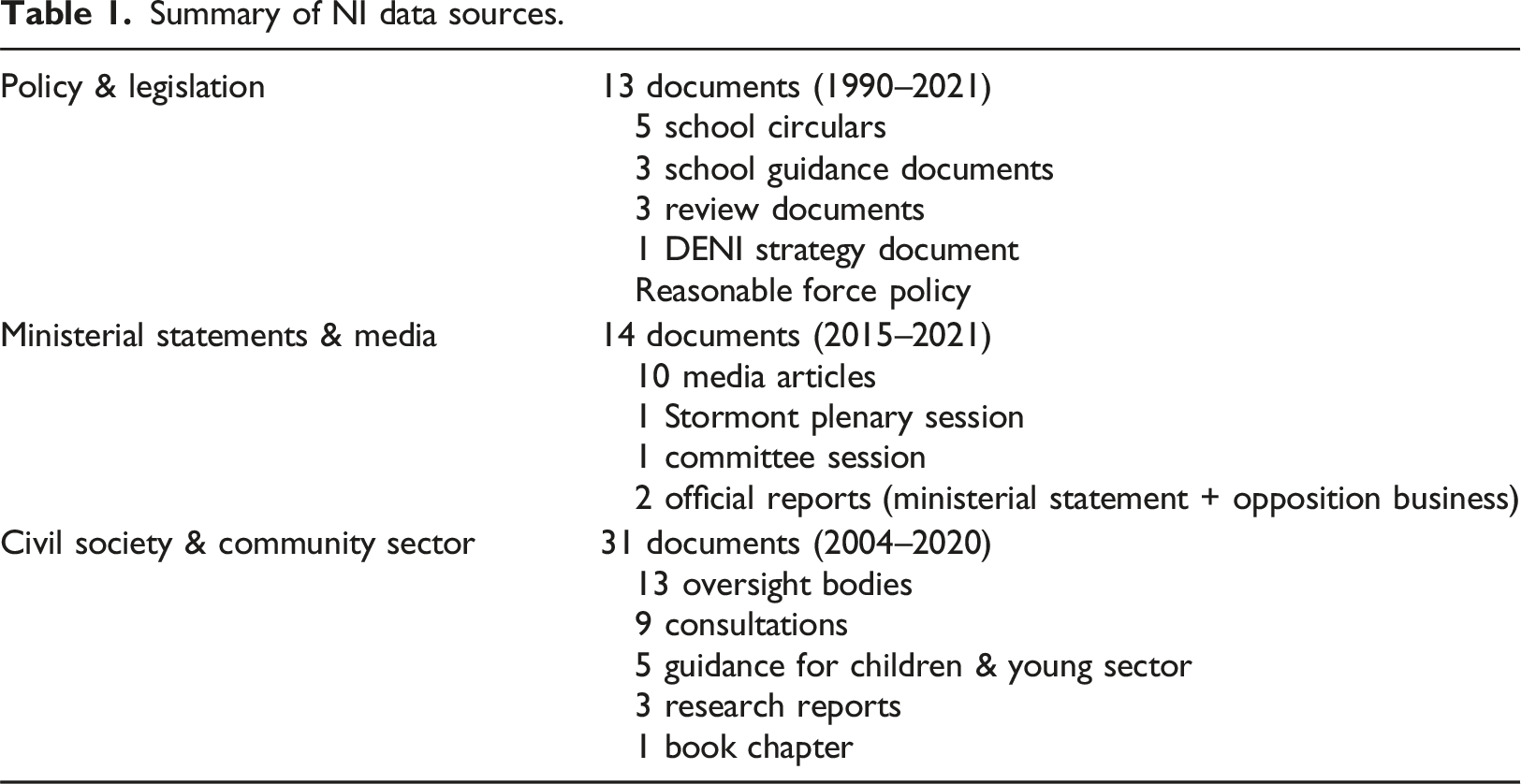
Summary of NI data sources.
Outline of the paper
The methods section below will elaborate on our approach. We examined a range of documentation relating school exclusion in Northern Ireland but grouped these broadly into three categories (i) policy, legislation, procedures and school guidance – the majority of which were sourced from the Department of Education (DE) in Northern Ireland, (ii) ministerial statements and media and (iii) policy documentation from civil society and the community sector.
In order to analyse the dataset, we used and adapted the approach developed by Bacchi (2009) and in particular adapted the ‘What’s the Problem?’ (WPR) approach (Bacchi, 2012) as a means critically interrogating school exclusion policy and procedure. Tawell and McCluskey (2022), have previously used this approach to examine and compare school exclusion in England and Scotland. We have constructed the findings and discussion sections around addressing six key questions: (1) How is the problem represented? (2) What are the dominant discourses around school exclusion? (3) What are the (a) policy levers, (b) drivers and (c) warrants underpinning school exclusion? (4) What are the solutions to school exclusion? (5) Who are the key influencers in the policy field? (6) Where are there silences/absences?
In relation to these key questions, our analysis identifies the Department of Education as the main driver of formal policy but civil society and the community sector do exert influence. It is likely that this influence has impacted on, over time, how the problem of exclusion has been represented, has changed and the way that the dominant discourses have been framed. In our analysis, points to note are that in the recent past, exclusion has been framed in different ways: as extreme behaviour; it has been couched in terms of school improvement and a means of ensuring a safe and orderly learning and working environment. In observing the shift in discourse, exclusion has also been represented as an issue of children’s rights and more recently policy has shifted language towards strategies of inclusion alongside exclusion. Furthermore our analysis of the documentation described in the methods section argues that the tone and general discourse stemming from the Department has tended to be legalistic, procedural and instructional, whereas the discourse and tone stemming from civil society and community sector tends to be right’s based and framed around support and advocacy of children and families going through the exclusion process by drawing attention to children’s personal and family circumstances and how these impact their educational attainment and engagement. Central policy on exclusion appears to stem from two main documents: The Promotion of Good Behaviour and Discipline in Schools (DE, 1998) and Pastoral Care in Schools (DE, 2001), both of which are now quite dated. Our analysis also points a type of decentralisation in which the responsibilities associated with exclusion reside mostly with schools. Furthermore, given the structure of the school system in Northern Ireland the main school sectors operate, in essence, different systems and schemes of exclusion mostly in terms of permanent exclusion but there is no one singular or consolidated system-wide framework which had been advocated for in the 2004 review of legislation (Article 31) but as yet has not been commenced.
Methodology
The study began early 2021 when the four jurisdictional research teams met online to agree a protocol for a review that could assess the landscape of school exclusion policy and legislation in each jurisdiction. To broaden our understanding of the implementation and impact of school exclusion policy and legislation, civil society and other third sector advocacy documents were also included. Whilst we tried to standardise the review methods as much as possible, it was clear that some jurisdictional flexibility was required to uncover and interpret documents relevant to each context. Therefore, the definition of school exclusion and search terms were adapted by each jurisdiction to include the technical terms, concepts and jargon used that best described formal and informal forms of school exclusion in their own contexts.
Each jurisdiction team conducted their own national level internet trawl for relevant sources and analysed their own jurisdiction specific documents. An analytical framework was developed based on previous work carried out by team members Tawell and McCluskey (2022), using Bacchi’s (2009) 6-step process to policy analysis and Hyatt’s (2013) work on critical discourse analysis (CDA). Integrating both approaches provided a mechanism for critically investigating the policy discourse, substance and ideology around school exclusion, within the wider political and social context. Key aspects of both approaches were discussed and refined to address the following research questions, which were contextualised for each jurisdiction. 1. What are the dominant political discourses and legal frameworks underpinning school exclusion policy in the four UK jurisdictions? How has each jurisdiction’s approach been shaped since devolution in the UK? 2. What are the key school exclusion levers and drivers in the four UK jurisdictions?
Search strategy
• Search: internet trawl of websites of known (and unknown) sources such as Department of Education; Hansard official reports of NI Parliamentary debates; NI Assembly Education Committee; Education Authority NI; Council for the Curriculum, Examinations (CCEA); General Teaching Council; The NI Children and Young People’s Commissioner (NICCY); Equality Commission; Children’s Law Centre; Association of School and College Leaders; Children’s community groups. • Search terms (adapted for the NI strategy): School exclusion; Alternative Education Provision; School part-time timetable; Pupil Referral Unit; Alternative Provision; Fixed-term exclusion; Temporary exclusion; Pupil suspension; Pupil expel, expulsion; Suspend*; Expelled; Exclusion from school; Off-rolling; Community-based education; Education Other Than At School (EOTAS); Single registration; Dual registration; Not in Education, Employment or Training (NEET).
Inclusion criteria
• Scope: Jurisdiction level. • Focus: All jurisdictions considered legal and illegal forms of exclusion including ‘managed moves’, ‘off-rolling’ and ‘internal/informal forms of exclusions’. (i) Documents with a specific focus on school exclusion (formal and informal, legal and unlawful), (ii) more broadly on schools, behaviour management, alternative provision and additional support needs, and SEN where this relates to exclusion. • Sources: Government policy documents, consultations and ministerial speeches; legislation and statutory guidance; ministerial statements; guidance for parents and children young people; press releases and website statements; relevant media coverage; reports; etc. published by relevant, influential non-governmental organisations. • Time limiter: Each jurisdiction identified a critical juncture relevant to their context that reflected a point of change in school exclusion policy. For NI this was 1990 to coincide with The Education and Libraries (Northern Ireland) Order (1993) • Setting: secondary school only.
Data sources
The search identified 58 documents relevant to school exclusion in NI. Sources were screened and categorised as originating from, (i) Policy and Legislation, (ii) Ministerial statements and media or (iii) Civil society and community sector. Table 1 provides a summary of the NI Data sources. For policy & legislation, we retrieved only 13 documents spanning across a 31-year period: not a lot. The output from this domain is relatively low compared to the others. The primary format of publication is school circulars of which there were five. For activity at Stormont and the media, there were few instances in which school exclusion was the primary focus on deliberation. We also searched for school exclusion activity, business or briefings associated with NI Education Committee, as far back as 2011 and found only one related reference to the use of Seclusion and restraint. We retrieved 14 articles and the majority of these (10) were media articles, and these are mostly concerning the same incident around school restraint and seclusion (so not a direct school exclusion focus). It is important to note that the official archive at Stormont is limited and only hosts records from approximately 2010 onwards. The community sector in Northern Ireland has been much more active over the years with 31 documents in total across a 16-year period.
Data analysis
The analysis process took place over spring and early summer 2021. Analysis included critically examining the documents to identify how school exclusion is understood in each jurisdiction over time, and how this underpins the representation of young people in the educational context.
Coding process
A coding framework was created by the wider team and organised around five overarching themes. The coding process was developed to identify (i) key ideological/political discourses and discursive representations of young people; (ii) relevant policy/guidance and responses, for example, school approaches and interventions such as, alternative provision, restorative practice and relationship-based practice; (iii) national and local structures of governance; (iv) role and influence of key institutions; and (v) external drivers (media, public, wider socio-political, research). The coding framework was entered into NIVIVO (20) and each document was read through and coded accordingly.
Before proceeding with the coding frame, two documents, one from NI and one from Wales, were selected for each team to code independently using NVIVO. The trial coding process was useful to highlight issues relating to inter-coder reliability and accuracy. Challenges with the coding frame were discussed during regular team meetings where we agreed to have a core set of codes for all jurisdictions but that each jurisdictional team could identify additional codes particular to their context. While this approach ensured a standardised set of coding across jurisdictions, it also allowed contextual differences to emerge when each jurisdiction was interpreting their data.
Reporting framework
Bacchi’s (2009) ‘problematising’ approach and Hyatt’s (2013) conceptualisation of drivers (expressions of the intended aims or goals of a policy); policy levers (instruments that the state has at its disposal to direct, manage and shape change in public services); and warrants (justifications for a particular policy response: evidentiary, accountability and political), were considered when developing a set of a-priory questions. 1. How is the problem represented? 2. What are the dominant discourses around school exclusion? 3. What are the (a) policy levers, (b) drivers and (c) warrants underpinning school exclusion? 4. What are the solutions to school exclusion? 5. Who are the key influencers in the policy field? 6. Where are the silences/absences?
These key questions guided each jurisdictional team’s interrogation of the data to understand the dominant discourses around how school exclusion is understood and helped us identify the assumptions, contradictions, silences, consequences and effects of school exclusion on young people’s lives. The six questions not only provided a framework for analysis but also a structure for discussion of the key findings that follows in relation to the NI context.
Analysis
As identified previously, we explored three spaces within the education policy environment in Northern Ireland: policy & legislation, Ministerial Statements & Media and Civil Society & Community Sector. We present the data in narrative form to describe how each of the domains responds to a question from our analysis framework.
Q1. How is the problem of school exclusion represented?
It was important for us to look at how the problem of exclusion has been represented in policy over time and thus consider if there has been variance or even contestation of representation? Is there coherence across the field and determine where concepts may be underdeveloped?
Using the approaches developed by Bacchi (2009) and Hyatt (2013), a key finding from our policy analysis is that the narrative of school exclusion has changed over time, particularly within the policy and legislative domain. However, we would argue that older representations of exclusion have not given way to more contemporary representations, rather the representation takes on many forms and is more accurately viewed as an amalgam of issues related school safety, school improvement, framing and managing extreme behaviour, and issues related to inclusion and children’s rights.
In the 1990s and early 2000s, the issue of school exclusion was couched in three different ways: as an extreme measure in response to serious behavioural problems in schools (DE, 2001); as a school improvement measure (1998), exclusions were couched as a measure designed around ensuring a positive learning experience for other pupils and as a measure concerned with maintaining school safety and order (DE, 1998): The creation and maintenance of an orderly working environment is a pre-requisite to effective learning and teaching. Pupil behaviour is therefore, in a very real sense, a school improvement matter, as important as development planning or target-setting; and in those classrooms where, for whatever reason, discipline cannot be effectively managed (DE, 1998: P2)
As we move towards the more contemporary end of the timeline, 2010 onwards, the focus appears to shift to incorporate the concept of inclusion into the representation of exclusion. Particularly with reference to special educational needs. For example, in the Promoting and Sustaining Good Behaviour document (DE, 1998) those pupils exhibiting challenging behaviours outside what would be considered mainstream are regarded as ‘pupils with problems’, this then shifts towards describing pupils in need of SEN supports in more recent policy documents. Within the policy domain exclusion is also represented as a rights-based issue: Since 1993 there have been a number of significant changes in the legislative context in which schools operate and these should be reflected in the arrangements for suspension and expulsion. The Human Rights Act 1998 has now been incorporated into domestic law and in the context of this review the right to education and the right to a fair hearing are of particular significance. The Northern Ireland Act 1998, in particular Section 75, places a duty on all public authorities to promote social inclusion and to ensure that policies do not have a differential impact on any of the groups identified in the legislation as at risk. (DE, 2014: p3)
Our analysis also identified an interesting perspective within one of the key official policy documents. In attempting to develop a rights-based climate in schools some teachers felt that this limited their capacities to discipline pupils: [O]n the basis that the school would address their child’s disciplinary needs. Some staff felt that the new climate of ‘parents’ rights’ had put them, as teachers, on the defensive and reduced their capacity to enforce disciplinary measures. (DE, 1998)
When we examined how school exclusion was represented in the media, there was little or infrequent attention given to this theme but unsurprisingly the media representation of exclusion tended to be critical in nature although we would suggest did not reflect the broader issues associated with school exclusion. Although the exception to this is the investigations undertaken by Torney (2018), who reported on the education of the most vulnerable in Northern Ireland and school days lost due to suspension (2018). In our retrieved results, the media tended to draw attention towards more extreme incidents related to school exclusion and because these are relatively infrequent, their representation of the issues lacked nuance and sophistication. Similarly, MLAs and Stormont have been largely reactionary in their agenda around school exclusion and appear to only focus on related issues once they generate public interest. For example, this political engagement with issues tends to reflect what had been drawn out by the media and that has primarily been around school practices of restraint and seclusion, (NI Assembly, 2021).
The civil society and community sector represent the problem in a much more nuanced way, by deliberating factors internal and external to schools, and highlighting those that are disproportionately affected by school exclusion. This includes contextual influences such as the social background and circumstances causing disruption in children’s lives. They also focus on whether the learning environment, as outlined in official policy, is fit for the needs of these pupils, and explore ways that would make the model of education in NI a better fit and less likely to cause disaffection.
Q2. What are the dominant discourses around school exclusion?
It was important for us to look at the dominant discourses because we can better understand which perspectives have traction, in what ways the narrative reflects existing power structures; which perspectives/discourses are being either disregarded or overshadowed?
The space in which official school policy and regulation is formulated, the focus is on setting expectations for schools. The Department use discourse that is legalistic, procedural and instructional, the majority of which has been conveyed through circulars and guidance documents focusing on issues like summarising the legislation, updating changes to the legislation, how schools should formally record suspensions and reminding schools to do this. This tone or discourse is obvious in the extracts below. Of note, the second extract hails from the key pastoral care guidance document from 1998 which is still live and reflective of existing policy: This Circular advises schools of the commencement of Article 34 of the Education (Northern Ireland) Order 2006 in relation to the education of suspended pupils. The Article will commence on 16 December and places a statutory requirement on Boards of Governors to arrange for the provision of suitable education for registered pupils of the school when they are suspended. (DE, 2014: Circular 2011/25) The right to education is now enshrined in domestic law since October 2000 with the introduction of the Human Rights Act. Suspensions or expulsions from school may be interpreted as an infringement of that right if the reasons for the action taken are not well founded. (DE, 1998)
Our interpretation of this that perhaps there are tacit suggestions that schools may not [always] be following procedures; or there may have been a need for legal backstopping to prevent litigation and that the aforementioned documents help frame the role of DE as legislative custodians rather the body responsible for offering support, counsel and capacity building for schools.
In regards to exclusion in general, the domain of politics and media, the prevailing discourse around school exclusion is that the education system has in one form or another failed certain types of pupils, which are predominantly those with special educational needs, (Torney, 2019)
The civil society and community sector have a very strong association with discourses on children’s rights. They strongly advocate child centred approaches to education and there is an expectation that schools should provide a quality education to meet individual needs, balanced with the rights of staff and the larger class group to a disruption-free learning experience. With regard to suspension and expulsion the UN Committee on the Rights of the Child in its 2002 Concluding Observations noted its concern “at the still high rate of temporary and permanent exclusion from school affecting disabled children amongst other groups of children.” The Committee recommended that Government “undertake all necessary measures to remove the inequalities in exclusion rates between children from different groups” (CDSA, 2012: 57)
The retrieved documents for this domain also demonstrate an appreciation that sometimes this might be challenging for schools. A lack of resources and problematic assessment procedures for statementing can preclude a child from accessing education, which has a significant impact on their educational experience and schools’ ability to provide adequately for a child’s needs.
Q3. What are the (a) policy levers, (b) drivers and (c) warrants underpinning school exclusion?
It was important for us to look at (a) policy levers, (b) drivers and (c) warrants underpinning school exclusion because this allows us to determine how accessible the policies are for schools, pupils, parents, wider bodies with the civic and community sectors with an educational focus. The analysis also allows us to consider the adaptability of policy mechanisms for addressing school exclusion matters and ascertain if there are there policy gaps or imbalances?
The statutory education bodies, namely, DE, have sought to manage and shape school exclusion practices at school-level in two ways. In the first instance, they administer centrally formulated policy, with two documents in particular: ‘Promoting Good Behaviour’ (1998) and ‘Pastoral Care in Schools’ (2001). The second lever used is an attempt to shape school ethos through policy. We have already discussed themes related to ethos above, in terms of safe and orderly environments but other themes in these core documents point to the importance of developing an ‘atmosphere of care’, feeling secure, being made to feel ‘welcome and valued’ and in particular the emphasis placed in relationship building: Evidence from many studies over the last decade suggests that schools can and do make a difference to young people’s lives, and that principals and their staff have the power, through their own efforts, to improve standards of work and behaviour and the life chances of their pupils regardless of their background […] A climate which fosters effective learning, both within class and about the school, is at the heart of the education process. Such a climate, or ethos, is best promoted through focusing on the creation and maintenance of good relationships (DE, 2001: 5–6)
It is worth noting that in both policy documents there are frequent claims made about the strength of evidence from research on effective pastoral care and maintaining good behaviour, as can be seen in the extract above, but the documents offer little in the way of evidentiary support.
Within the domain of ministerial statements and media, there are tools and levers at the disposal of elected officials that are underused – there has been a notable lack of plenary sessions and committee pressure associated with school exclusion evident within our analysis, only three instances across a 10-year period that in fact focused on a related theme of restraint and seclusion practices – the catalyst for these came from a parental campaign and wider international campaign for tougher laws around restraint and seclusion in schools, arguably heightened in the public domain by the support of Paris Hilton (Meredith, 2021). The expressed aim of this parliamentary scrutiny was to address a lack of guidance around these aspects of school exclusion. Little to no policy action at Stormont suggests that there was no political warrant for looking at the issue during the period we examined, which likely reflected the level of national interest in the issues.
The civil society and community sector take a slightly alternative approach for operating within the policy space by querying the purpose, processes, and impact of policy and practices around school exclusion. Part of this method is to examine the practice of sanctions and informal exclusions that highlight potential contradictions, vulnerabilities within the system and concerns regarding children’s rights and inclusion. The then Children’s Commissioner called for a more inclusive system: In his response to the proposed changes on suspension and expulsion procedures the Commissioner calls for the Department of Education in Northern Ireland to “develop totally inclusive schools/education so that no child, irrespective of his/her behaviour looses out of his/her education because of being excluded/expelled from school, when his/her behaviour is part of a medical condition.” (NICCY, 2004)
Additionally, there are those within the sector that critique the adequacy and appropriateness of alternative or community-based provision (EOTAS). Some of this tension and dispute relates to the EOTAS engagement model and how long pupils stay in this provision. Some argue that EOTAS is driven by therapeutic priorities rather than educational ones. Others question the viability of the educational provision. Some argue EOTAS performs a type of dumping ground for problem children and others point to the fact that most young people who go to EOTAS tend not to return to mainstream provision despite the formal designation of being dual registered between school and EOTAS centre. The Committee has also expressed concern that several groups of children have problems being enrolled in school or in continuing or re-entering education, either in regular schools or alternative educational facilities, and as such cannot fully enjoy their right to education. (Human Rights Commission, 2016)
Q4. What are the solutions to school exclusion?
It was important for us to examine policy so that solutions, absences and contestation can be addressed in relation to school exclusion. Our aim in this regard is to understand what solutions are proposed, by whom and do they adequately connect to the problem as we have analysed it? Have the solutions been attempted and are they theoretically effective, what alternatives have been proposed and not attempted, who decides which solution is best?
The perceived solution to school exclusion within the policy space, or at least an approach to deal with issues, has been to increase the bureaucracy for schools, which may be seen as a legitimisation of exclusion practice through the formal recording of incidents. There is a tacit belief that schools should be clear about what is expected of them in terms of procedures and reporting exclusions and this is reflected in the multiple documents that we reviewed from the Department of Education in the form of circulars to schools and contained within policy documents previously cited, that inform of schools specifically school leadership about their legal responsibilities and amendments to legislation associated with school exclusion.
As our search timeline progressed, there has been a decentralisation of responsibility, which is likely linked to the establishment of a central Education Authority (EA) in NI that replaced five obsolete education library boards (ELBs). At the early stages of our timeline, as the ELBs began to cease operation, they defer responsibility for exclusion practices to schools and this continues as the EA begins its mandate. The rationale for this, as described by the earlier policy documents that we retrieved, is that schools are best placed to meet the needs of pupils and that they know their context much better than a statutory body. Other solutions that are described throughout the documents in this domain include introduction of alternatives and supports for SEN pupils, flexible curricula, early identification and whole-school approaches: There is a firm belief on the part of schools, which the Government shares, that the best place to manage pupils who are presenting behavioural problems is within the school, and a strong preference that any external support be directed to assist in this objective (DE, 2001: 6)
But what is important to note is that this domain offers a patchwork of solutions rather than one coherent and consolidated framework or a national policy for school exclusion.
The media search results appear to problematise school exclusions and only in very rare instances offer any workable solutions. This is by nature of their role as a check and balance upon governance structures and politics – their solution is to draw light upon the challenges experienced by others within the system. Similarly, solutions have been rarely offered by Stormont in relation to school exclusion. On the few occasions that we found school exclusion being referenced during plenary sessions, MLAs cited examples from Scotland as potentially offering policy direction, referring to a national policy and how education was linked to youth justice services: [R]easonable force restraint should be used only as a measure of last resort and never as a form of punishment, what can be learned from other jurisdictions? Are there lessons to be learned from England, Scotland or Wales? Training and guidance are important, and staff need to have access to regular and up-to-date guidance and training on restraint and seclusion so that they are well informed about how to deal with a wide range of scenarios. (NI Assembly, 2021)
Based on our analysis, there is evidence of contestation. The civil society and community sector have tended to focus on solutions that relate to equality, diversity and inclusion, whereas official bodies focus on legal requirements and procedures. Oversight bodies such as the Human Rights Commission, Equality Commission, NICCY and the CLC, actively advocate for and promote greater awareness of the need to develop reasonable adjustments across all sectors in NI to facilitate the inclusion of all children (particularly those with disabilities and their families (CDSA, 2016). This involves ensuring that learning environments are fit for purpose, the system has capacity for early intervention with vulnerable pupils, and that the complex needs of marginalised groups of children and NI, such as those experiencing trans-generational trauma from ‘the troubles’, newcomers and the traveller community, are being met.
The conviction of the domain is clear that much work is needed to address the many complex societal issues, linked to the legacy of conflict, and help individuals and communities deal with their personal circumstances (e.g. deprivation and trauma) and the effects of the past, that may impact their ability to engage with their education.
Q5. Who are the key influencers in the policy field?
It was important for us to look at who the key influencers are because this allows us to better understand the distribution of authority and power on relevant matters (structural power), determine the spectrum of influence, and level of public engagement/participation
The search results give us a good sense of who the key influencers are in each of the respective domains. The influencer(s) within each domain is as we expected, but how they exert influence was more compelling.
The Department of Education NI are the main drivers of formal policy and they tended to publish school circulars on an ad hoc basis to course correct or update the policy environment in which the school estate operates.
And in the civil society and community sector we could not identify a sole organisation as being central or acting as the key influence, but rather, influence within this domain was distributed across several children’s rights advocacy groups and oversight bodies (Children’s Commissioner, Human Rights and Equality Commissions, Children’s Law Centre, a variety of youth and community groups, and other professional and charitable bodies). This group attempted to exert influence by publishing research and consultations informed by practitioners, young people and their families.
Q6. Where are there silences/absences?
It was important for us to look at the silences/absences in the policy because this allows us to identify vulnerabilities/weaknesses within policy formulation, draw attention to potential issues forthcoming, provide substantiated recommendations, and identify areas for future research and policy development.
There are a range of silences and/or absences within the school exclusion policy environment that could potentially undermine the efficacy of official policy, but also offers potential opportunity for policy development. Firstly, because of way in which the education system in Northern Ireland developed, and other compounding factors such as conflict, the education system is broadly divided into separate school sectors representing the interests of different communities within society, each with its own unique structure of governance and authority, (Duffy et al., 2021). Consequently, most of these sectors have different processes and schemes for how they exclude pupils and while the schemes are similar, the processes related to expulsion (permanent exclusion) are different, as each sector has its own expelling authority. While this is provided for in the legislation and acknowledged within the official policy documents that we analysed, the impact of it is not examined in any way. The discrete approaches to exclusion within the system also reflect that there is no single overarching national policy or framework that offers guidance to all grant-maintained schools on school exclusion. This was proposed in the 2004 review of legislation and procedures and an article included in The Education and Libraries (Northern Ireland) Order, 2006 but Article 31 was never commenced and the rationale for this is not clear but our read of this is that there may have been sectoral and political resistance to a single policy or framework.
Where there has been updated guidance, for example, concerning the disaggregation of suspension data to account for SEN pupils, political instability and lack of response has stalled implementation. Across the majority of the official policy documents there is a notable absence of children’s rights considerations and where this has been included it is often piecemeal and lacking rigour.
If official policy is to be updated to include more nuanced and sophisticated conceptualisations of school exclusion, then there must be political impetus and pressure from the domain of ministerial statements & media. However, during the period that we analysed there has been a lack of focus on the issue of school exclusion and much of the scrutiny that has occurred has largely been reactionary. There is also an absence of the experiences of the broader school population from scrutiny, in that the media tend to focus on extremes or atypical incidents. In summary, there is a lack of representativeness around the experiences of young people vulnerable or at risk of school exclusion within policy formulation.
The civil society and community sector attempt to offer these young people vulnerable or at risk of school exclusion an advocate and draw attention to certain absences that hinder reliable representation of their issues. Our analysis revealed concerns around data capture (i.e. recording, accuracy, big data, linkage, etc.), issues arising from a lack of guidance for and engagement with parents and pupils (child-friendly) around the processes of school exclusion, making education relevant to those excluded from mainstream education (e.g. practice-based, vocational, subjects and appropriate provision), and they advocate for an integrated multi-sector model in which different organisations external to the school work alongside families and staff to offer a holistic model of education and intervention.
Conclusion
The final section will draw out and develop keys point from the Bacchi (2009) and Hyatt (2013) framework used in the previous section.
In Northern Ireland the framing of school exclusion has changed over time but rather than shed older representations, contemporary representation is not unitary and continues to incorporate these older representations. Arguably, the narrative or representation of exclusion is muddled. It is welcome though, that latest additions to this representation are discourses around rights, official responsibilities, inclusion and behaviour that results in exclusion as an outworking of need. It is likely that these more recent additions have come about from pressures and influence from the civil and community sector and possibly the school system too.
Arguably, the Department’s discourse or tone around exclusion has and remains legalistic, procedural and instructional. Historically, much of the communication with schools has been in the form of instructive circulars that focus on the legislation and procedures. And, where the Department have produced more substantive documentation, namely, The Promotion of Good Behaviour and Discipline in Schools (DE, 1998); Pastoral Care in Schools (DE, 2001) these offer limited support and capacity building for schools and teachers and the documents are now dated.
There is opportunity to produce new guidance and policy documents for schools where the discourse is reframed – where there is a change of tone, elevating and prioritising themes of inclusion, need, children’s rights and much more support for teachers and schools in the forms of professional development training and on site supports around managing behaviour and supporting those most at risk. We also think future policy documents should be more evidenced based in terms of best practice from other jurisdictions and stemming from academic research. A point of reference for comparison is the guidance document produced by the Scottish Government (2017). This also ties into the one of the solutions posed in addressing Question 4. There is an absence of a single cohesive procedural framework that applies to all grant-maintained schools. This has previously been recommended, legislated for (but not commenced) and it is possible that this might be included as a recommendation in the forthcoming review of exclusion procedures recently undertaken by the Department.
When we looked at Ministerial statements and the focus of NI Education Committee over time, the analysis points to school exclusion as not being a political priority, this may be because the issue is not perceived as requiring attention given the relatively low levels of official suspension and expulsions in Northern Ireland (Duffy et al., 2021), compared to other jurisdictions of the UK. However, early indications from the Excluded Lives research group (forthcoming) point to exclusion practices across the UK as being problematic in terms of the extent of informal or unregulated practice, lack of official support for schools, a need for teacher capacity building, onerous and bureaucratic procedures, limits in the supports that are offered to young people who have been or are at risk of exclusion and the need for more support for families in the community.
Footnotes
Declaration of conflicting interests
The author(s) declared no potential conflicts of interest with respect to the research, authorship, and/or publication of this article.
Funding
The author(s) disclosed receipt of the following financial support for the research, authorship, and/or publication of this article: Economic and Social Research Council; ESRC Large Grant Award.
