



Abstract
Academic freedom constitutes an integral part of traditional university values that ensure the proper functioning of universities in pursuing truth and inculcating civic values. In a globalized world where Higher Education (HE) policy is the result of the interaction of local, national, and international levels, the positions of international organizations on questions of academic freedoms deem significant. Within global discourses on HE, literature contrasts the World Bank’s human capitalist to UNESCO’s humanistic approach. Through Foucauldian Discourse Analysis of both organizations’ documents, the paper presented a genealogical analysis of academic freedom that challenged the existence of static, opposite, and binary positions. Transformations, ruptures, juxtapositions as well as gaps, limits, and exclusions were detected within and across International Organizations’ discourses. Juxtaposition of economic and humanistic rationales as well as academic freedom protection and neoliberal policy interventions have muted discursive conflicts and inherent contradictions. The failure of UNESCO to address contemporary threats to academic freedom emerged from the appearance of neoliberal transnational governmentality as an inevitable social regularity that delimits what can be said and cannot be said about academic freedom. Through coercive funding schemes and technologies of differentiation, surveillance, and monitoring, the WB created the space for such transnational governmentality, and placed faculty members under its gaze resulting in undermining academic freedoms and de-professionalization of academics.
Introduction
Academic freedoms have been central to the well-functioning of universities. Freedom of academic community members to produce, disseminate, express, and discuss knowledge allows for the evolution of new ideas, promotion of critical thinking, and subjecting theories and laws to continuous testing. However, the hegemonic neo-liberal transformations introduced to universities have altered roles, functions, and values of Higher Education (HE) with specific implications for academic freedoms (Brown, 2016; Gburi, 2016; Giroux et al., 2016).
In a globalized world where HE policy is the result of the interaction of local, national, and international levels, the positions of international organizations on questions of academic freedoms deem significant. The (1) What are the values, priorities, and purposes of HE promoted by HE policy documents released by WB and UNESCO? And what are their implications for academic freedoms? (2) What are subject positions and identities developed by HE discourses for faculty members and how they affect their constructed right to academic freedom?
Literature review
Role of UNESCO in HE
UNESCO is the only UN agency with a clear and comprehensive mandate in HE as stated in its organizational charter (Bassett, 2018; Sadlak and Hufner, 2002). What is distinctive about UNESCO’s role in HE, is its humanistic vision and rights-based approach to HE (Beech, 2009; Mundy and Madden, 2009). UNESCO opposes the instrumental and human capital approach to HE where humans are regarded as mere tools for economic development. From a humanist approach, individuals are placed at the heart of development process and their happiness, self-fulfillment, and human rights and freedoms are the main goals for education (Beech, 2009). Grounded in the right to inclusive HE, UNESCO views HE as a public good for which government funding should be viewed as an entitlement and investment rather than a burden on public budget (Kent, 1996). While taking into account the role of private sector and cost-sharing strategies, UNESCO stipulates that they should not be an alternative for government funding which should not be based solely on rates of return and economic calculations (Kent, 1996). UNESCO’s vision of HE advocates cultural pluralism and linguistic diversity while rejecting the idea of a single one-size-fits all model that is based on economic and technological determinism and fails to take into account local specificities (Lebeau and Sall, 2011).
UNESCO’s activities in HE included sharing information, setting standards, organizing world conferences, building partnerships and networks, providing technical assistance, and collecting data and statistics (Shahjahan, 2012). Despite UNESCO’s distinct vision and potential competencies, the influence of UNESCO in HE is diminished by its limited role as a coordinator between different stakeholders rather than a leader and initiator of well-defined vison and agenda for HE (Madden and Mundy, 2018). Since the 1990s, the division of HE in UNESCO worked on responding to emerging issues, giving piecemeal and disparate advice, and building networks (Madden and Mundy, 2018). Budgetary limits, political crises, and bureaucratic rigidities restricted potential leadership roles for UNESCO’s HE division. Yet, the most visible impact for UNESCO in the past years has been in recognition of qualifications in cross-border education, advancing quality assurance mechanisms, and initiating centers and regional offices for development of HE research (Madden and Mundy, 2018).
Role of World Bank in HE
The WB is considered the largest single source of external funding for education in developing countries with HE constituting about 25% of its total funding in education (Sadlak and Hufner, 2002). Between the years 2003 and 2012, the Bank funded 110 HE projects with US$3.34 billion in 58 countries worldwide (Bassett, 2018)
The WB’s vision for HE is embedded in “human capital theory” which stresses the role of education in producing skillful labor for the economy (Beech, 2009; Moutsios, 2009). HE has an instrumental mission in increasing human productivity and thus enhancing economic development and national competitiveness in the global knowledge economy. Accordingly, policy decisions in HE are based on cost-effectiveness analyses of interventions and educational expenditures (Beech, 2009).
Neoliberal HE reforms and academic freedom
Neoliberalism is a theory of “political economic practices” where the role of the market is maximized and extends to all realms of social life. The role of state by turn is re-defined as facilitating and providing institutional support for the well-functioning of markets (Harvey, 2005) In a Foucauldian sense, neoliberalism is not confined to a set of particular economic policies but rather constitutes a moral system, an art and rationality of government, and a mode of governance that “produces subjects, forms of citizenship and behavior, and a new organization of the social” (Brown, 2003).
The role of neoliberal managerial reforms and corporatization of universities in curtailing academic freedoms has been widely investigated in the developed countries (Brown, 2016; Gburi, 2016; Gerber, 2010; Giroux et al., 2016; Harris, 2014). Although threats to academic freedom in the developing countries have always been associated with political authoritarian forces, threats emanating from the neoliberal structuring of HE have also been explored in some developing African contexts (Khelfaoui and Ogachi, 2011; Mama, 2006; Sifuna, 2014; Zeleza, 2003). Market-driven reforms have been adopted in African countries in light of structural adjustment programs imposed by global financial institutions, especially the WB. In this context, it is argued that market forces have replaced the state as the major threat to academic freedom in African countries (Khelfaoui and Ogachi, 2011; Mama, 2006).
The diminishing of state funding to HE, corporatization of university management, dependence on donor funding, and commodification of knowledge have created new pressures on academic freedoms and university autonomy (Zeleza, 2003). Corporatization of university management and the focus on income-generating activities have deprived academics from the adequate employment conditions necessary for the exercise of their academic freedom. The increase of contingent and part-time employment made academics susceptible to more censorship from managers and to self-censorship in order to secure future contracts (Mama, 2006). Urged by their poor financial conditions, academics supported admission of higher numbers of fee-paying students, and thus become loaded with increasing teaching functions to the detriment of time devoted to high quality research (Khelfaoui and Ogachi, 2011). As a result of withdrawal of state funds, research activities have become dependent on donor resources and thus risked sacrificing national research interests in support of donor agendas (Mama, 2006). In addition, the research demanded by donor agencies is in the form of “simple investigation reports’ which can be contrasted with real scientific research that is based on innovation and discovery (Khelfaoui and Ogachi, 2011). As such, the submission of academics to business research interests does not only constrain academic freedom but also affects the quality of African knowledge production.
Conceptual and methodological framework
The paper employs Foucauldian Discourse Analysis (Foucault, 1972, 1984) which is guided by his notions of discourse, subjectivity, governmentality, power, and knowledge in identifying objects of knowledge and subject-positions advanced by WB’s and UNESCO’s HE policy discourses. Discourses, according to Foucault, are practices that don’t represent but rather construct objects of knowledge and shape subjectivities. Discourses cannot be reduced to linguistic apparatuses that signify things: A task that consists of not - of no longer - treating discourses as groups of signs (signifying elements referring to contents or representations) but as practices that systematically form the objects of which they speak. Of course, discourses are composed of signs; but what they do is more than use these signs to designate things. It is this more that renders them irreducible to the language (langue) and to speech. It is this 'more' that we must reveal and describe. (Foucault, 1972: 49)
By understanding discourse as “a space of positions and of differentiated functioning for the subjects” (Foucault, 1972: 232), FDA can be employed to analyze the processes of subjectification and construction of identities. Discourses do not signify existing subject positions but “constitute both subjectivity and power relations” (Ball, 1990: 17). They include “social practices” that seek to govern and subjectify individuals and implicate “power” through their truth effects and production of knowledge. Thus a FDA elaborates technologies and techniques of power, processes of subjectification, and apparatuses of governmentality (Tikly, 2004).
While interlinked with power, knowledge, and governmentality, IOs’ discourses on academic freedom are conceptualized as practices of transnational/global governmentality in the HE realm. While being a contested concept, the construction of a contemporary global governmentality has been studied in literature through extending Foucault’s analysis of governmentality from the national to the transnational level (Elshihry, 2016; Jaeger, 2010; Larner and Walters, 2004; Merlingen, 2003). Within education policy studies, the evolution of transnational Foucauldian governmentality (Deuel, 2022; Tikly 2004) and emergence of global education policies (Moutsios, 2009; Robertson, 2008; Shahjahan, 2012) were investigated. Building on such literature, the study utilizes Foucault’s governmentality in analyzing discursive and governing practices implicated in WB’s and UNESCO’s discourses on HE and academic freedom.
Methods and data sources
Methods of analysis were guided by Foucault’s four rules of archaeological and genealogical discourse analysis: reversal, discontinuity, specificity, and exteriority (Foucault, 1984: 126, 127). According to the principle of reversal, discourse analysis does not lie in the positive search for origins and sources of discourse but instead investigates the processes of exclusion and rarefaction of discourses. The search for what is ruled out does not imply, however, that beneath such “systems of rarefaction” there is “silent, continuous and repressed” discourse that we seek to uncover which is emphasized by the “principle of discontinuity.” As a consequence of such discontinuity, the principle of specificity entails that we should not imagine discourses as emanating from some “pre-existing significations” that we seek to discover but rather deal with discourses as “practices that we impose on things.” Finally, the principle of exteriority holds that instead of looking internally into hidden meanings inside discourses, we have to start from the formations and regularities towards the external conditions of existence of discourses, that is, what external conditions and circumstances make certain discourses possible and others impossible.
Corpus of texts analyzed.
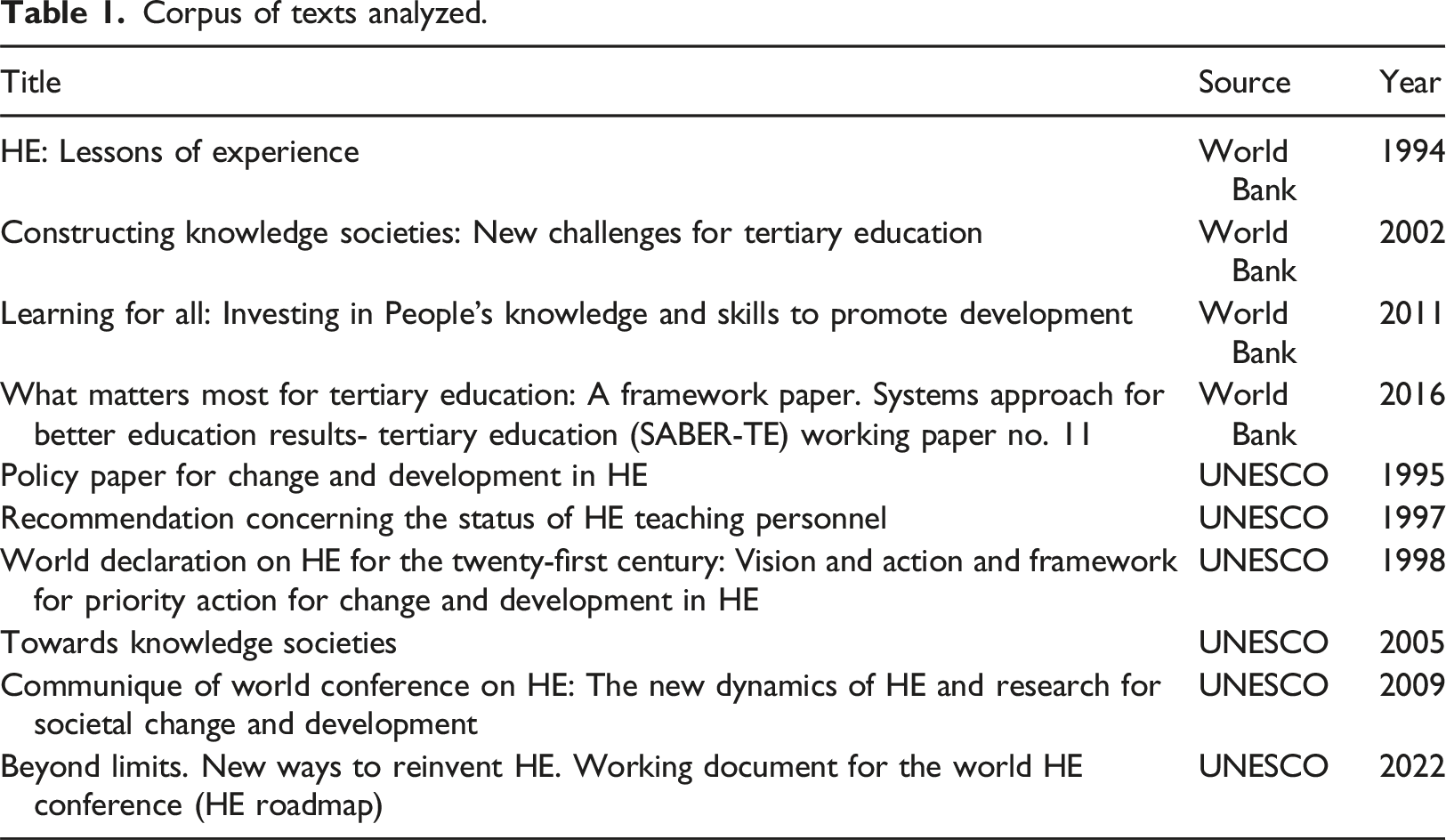
My data analysis was guided by Foucault’s notions of discourse, subjectivities, governmentality, and power as well as his four rules of archaeological and genealogical discourse analysis. I began my analysis with speed reading and skimming of documents in order to understand the main themes and arguments. I then focused my reading on three aspects: definitions and conceptualizations of “academic freedom” and ‘autonomy,” purposes and functions of HE, and academic subjectivities of faculty members. Following the rules of reversal, discontinuity, specificity, and exteriority, I was not looking for origins or grand narratives in HE discourses but rather ruptures, discontinuities, thresholds, and transformations. I looked for whether and how notions of academic freedoms and values of HE have shifted over time and how different discourses are juxtaposing and/or excluding each other.
Findings and data analysis
Purposes of higher education and conceptualization of knowledge
The discursive construction of HE’s role in society, function of universities, and nature of knowledge have implications for positioning of academic freedoms within HE policy discourse. A human capitalist approach to HE prioritizes applied knowledge that have the highest monetary value and hence restricts freedom of academics to conduct research wherever the search for truth may lead. Instead of having the more comprehensive goal of advancing human knowledge, academics are urged to focus on knowledge that can yield short term gains and returns. Academics have to respond in their teaching and research functions to research needs of industries, to demands of labor market and to evaluation and audit standards put by government to ensure HE’s role in economic development. On the other hand, a humanistic and holistic approach to HE purposes makes values of academic freedom central to fulfillment of university functions. The ultimate pursuit of truth and development of knowledge in its all its pluralist forms cannot be achieved without free, reflective and critical inquiry. Moreover, universities’ role in building democratic values and defending human rights and freedoms is best attained where members of academic community exercise such values inside universities. Accordingly, investigating the position of IOs’ on HE purposes in the coming section has implications for academic freedom.
WB position on HE purposes
In the 1994 report which is considered the first major document issued by the WB on HE, the WB stresses HE’s contribution to human resource development and relates investment in HE to economic growth (WB, 1994: 1). Other purposes were marginalized with the existence of one sentence on HE role in building national identity and fostering pluralistic debate. However, this changed in later reports representing a discontinuity in the exclusive dependence on “human capital” discourse. In the 2002 report, the WB recognizes “humanistic” dimensions of HE and asserts its status as a “public good” which were completely absent from the previous report: The need for a balanced and comprehensive view of education as a holistic and global system that includes not only the human capital contribution of tertiary education but also its critical humanistic and social capital building dimensions and its role as an important international public good (WB, 2002: 4)
Starting from this report and later reports political, social, and cultural roles were juxtaposed with the main economic discourse. This gives the impression that both “economic” and “humanistic” conceptualizations of HE can work together. Such muting of discursive conflicts implies that stressing the economic role of HE is not at the expense of other functions and thus responds to criticisms directed to WB policies. It is worth mentioning, however, that policy measures and recommendations mentioned throughout the reports are designed to fulfill the economic roles while political, social, and cultural roles are stated on the rhetorical level only. So institutional differentiation, quality assurance, and governance reforms are intended to better align educational output with the labor market and improve learning skills (WB, 2002; WB, 2011). On the other hand, the WB documents failed to specify the necessary institutional instruments and tools to ensure that education plays its role in inculcation of “democratic values, attitudes and norms” (WB, 2002).
With regard to conceptualization of knowledge, WB documents stresses the importance of knowledge that can be used in problem solving and translated into new applications (WB, 2002). This is the kind of knowledge that industry needs, described by Gibbons et al. (1994) as MODE 2 knowledge; a transdisciplinary research produced in context of application and subject to heterogeneous systems of accountability. This is contrasted to MODE 1 traditional knowledge produced by autonomous disciplines subject to academic standards of academics.
UNESCO position on HE purposes
The analyzed UNESCO documents view HE as a public good that is concerned with the pursuit of truth, development, and dissemination of knowledge, promotion of human rights and freedoms, inculcation of citizenship and democratic values and defense of social justice (UNESCO, 1995). Universities are constructed as communities of scholars who are engaged in unrestricted and disinterested pursuit of truth which results in development and dissemination of human knowledge. In addition, the role of HE in fostering sustainability and addressing issues of climate change, loss of biodiversity, and environmental degradation represents a main theme in the latest 2022 roadmap.
However, the existence of internal contradictions, ruptures, and incorporation of other discourses was noticed while analyzing UNESCO’s discursive construction of notions of knowledge economy, knowledge societies, and lifelong learning. The 2002 report was presented as a distinctive humanistic approach to knowledge by arguing that “Useful knowledge is not simply knowledge that can be immediately turned into profit in a knowledge economy” (UNESCO, 2005: 19). However, some literature argued that these claims remain on the rhetorical level while a careful analysis of the arguments made by the report reflects its internalization of the knowledge based-economy discourse and neoliberal logics (Adhikary, 2014; Leye, 2007). Adhikary (2014) argues that the report gives supremacy to knowledge that has a monetary value over other forms of knowledge: ‘What distinguishes innovation from simple invention ... is the attachment of value to knowledge generated, .. . by the production of a demand for new goods or products. The entrepreneur is the mediator who transforms inventions into economic innovations’ (UNESCO, 2005: 58)
Likewise, lifelong learning which appeared as a discursive construct in all of the analyzed documents can be conceptualized as a technology of control that subjugates individuals to changing labor needs with the aim of producing global neoliberal subjects (Adhikary, 2014; Leye, 2007; Olssen, 2006). Looking through the documents, UNESCO’s definition of lifelong learning witnessed discursive shifts that are not unidirectional as suggested by the literature. While the 1995 report defines lifelong learning in purely economic terms as a way to enable graduates to be “job creators in continuously shifting labour markets” (p. 8), the 2002 report juxtapose both humanistic and economic rationales (pp. 76–80), and the 2022 roadmap presented lifelong learning as a “richer framework to address the learning needs of human beings” (p. 11)
Subject positions
Faculty members in WB documents
The eligibility of faculty members to academic freedoms and rights emanates from the discursive construction of academic subjectivities and identities. In this context, the WB 1994 report refers to faculty as “the major cost factor” for universities: Institutions should also have the power to recruit and retrench personnel which represents the major cost factor for most HE institutions. This flexibility is essential if universities are to be able to build up new programs in response to new labor market demands and to control costs by eliminating faculty when student-teacher ratios in other departments decline below efficient levels. (WB, 1994: 64)
The WB positioning of faculty members as service providers/submissive employees/input factors/accountable workers as opposed to autonomous professionals/members of academic community/partners in university governance affects the construction of faculty rights and freedoms. Universities that produce utilitarian salable knowledge, satisfy needs of student-consumers, and respond to labor market demands should deal with faculty members as one of its factors of production who need to be controlled and monitored so as to produce the best output. Faculty members are constructed as service providers who need to respond to student-consumer demands.
The WB’s positioning of faculty members is elaborated in the following quote: The ownership of tertiary institutions has often shifted away from those who should be the main clients (students, employers, and society at large) to control by the teaching staff. The raison d’être for some institutions has become to provide staff employment and benefits rather than to serve as educational establishments focused primarily on the needs of the students and the labor market. Such systems are rigorously guarded by cadres of academic leaders represented in academic councils that operate within a framework of institutional autonomy and are accountable almost exclusively to administrative staff and academics. This deviation of purpose could almost be described as a form of privatization of public institutions to the benefit of specific internal stakeholder groups. (WB, 2002: 62)
In the previous quote, the positioning of faculty members as autonomous professionals is devalued and discredited. The WB constructs faculty members as self-interested and rent seeking professionals who tend to misuse their academic freedom and professional autonomy to pursue their private goals. Instead, universities should be managed and aligned to respond to public interests. In neoliberal governance of HE, professional power should be controlled, managed and audited which has resulted, as argued by Olssen and Peters (2005) in “de-professionalization” of academics.
Faculty members in UNESCO documents
UNESCO documents emphasize the professional identity of faculty members, which is viewed as the basis for academic rights and freedoms. The 1997 recommendation stipulates that teaching personnel at HE institutions should possess the necessary professional qualifications, competence skills, and ethical and intellectual potentials. By the virtue of such professional preparation, faculty members enjoy freedom of teaching and discussion, freedom of research and dissemination of results, right to participate in institutional governance and to express opinions about their institutions, freedom from institutional censorship, and freedom of association. Adherence to professional standards is seen as the legitimate limitation to exercise of academic freedoms and rights. (UNESCO, 1997, Articles 28, 29).
The right of teaching personnel to participate in university governance is ensured in the 1997 recommendation through emphasizing collegiality and self-governance (Articles 31, 32). Collegial governance implies involvement of all faculty members in decision-making process and determination of education policy including teaching curricula, research priorities, and recourse allocation. Collegial governance is also a kind of democratic governance where faculty members have the right to elect a majority of representatives inside HE institutions. Faculty members should also enjoy the right to form their own representative associations and unions. (Articles 52, 53).
Respect for values of academic freedom in accordance with the 1997 recommendation is reaffirmed in all of the analyzed UNESCO documents. However, how academic freedom is defined, however, indicates transformations, limits and gaps in the discursive construction of the concept. In the UNESCO’s 2022 roadmap, academic freedom is defined in terms of absence of political interference: One of the key missions of HED is to uphold the academic tradition of free and fair inquiry and debate. This has been undermined by authoritarianism and populist attacks on ‘political correctness.’ HEIs are well-placed to offer a safe space to present and assess a diversity of views and engage with society in public debates on complex issues. It is essential to protect the academic freedom of staff and students from political interference.
By this academic freedom is conceptualized as a “negative” right defined in the absence of political intrusion. A full protection of academic freedom, amid spread of neoliberal managerial techniques of quality assurance, accreditation, performance-based management, and commercialization requires a positive conceptualization for academic freedom that creates the necessary conditions for fulfillment of academic freedom. Defining academic freedom as a positive “right to act” entails “security of employment, the time and stable funding for research, and the ability to participate in governance” (Prelec et al., 2022: 4).
The shaping of academic freedom as a negative right represents a discontinuity and shift from the academic freedom discourse adopted by the 1997 recommendation which was a comprehensive document that put forth necessary structural conditions that should be put in place to protect academic freedom such as tenure, academic representative bodies, and institutional autonomy. In addition, while tackling accountability and quality assurance systems, the 1997 recommendation asserts that such systems should be designed by institutions themselves while ensuring no harm to academic freedoms (UNESCO, 1997, Article 24, p.9). One of the mechanisms suggested was the participation of academic representative organizations in the planning of such systems. Such a positive and proactive approach was absent in the 2022 roadmap where the threats imposed by current systems of quality assurance on individual academic freedoms and relevant measures were never discussed.
Institutional autonomy and academic freedoms
University autonomy
University autonomy is the institutional form of academic and includes freedom of universities to determine their education policies, research priorities, human and financial resource management, and governance rules without interference of external forces.
WB position on university autonomy
Throughout the analyzed WB documents, institutional autonomy of HE institutions is emphasized. However, how such university autonomy is defined has implications for functioning of universities and prospects of academic freedom. The 1994 report refers to autonomy as a kind of fiscal decentralization that ensures efficiency: Decentralization of all key management functions (including the power to set fees, recruit and retrench personnel, and use budgetary allocations flexibly across expenditure categories) to HE institutions themselves is a sine qua non for successful reform, especially with respect to funding diversification and more efficient use of resources. Institutions cannot respond to incentives to improve quality and efficiency without control over their resources and processes. (WB, 1994: 10)
According to the WB, institutional autonomy is primarily defined in financial terms which include decisions over financial and human recourse mobilization, allocation, and distribution. (WB, 1994, 2002). The 2002 report states that “Throughout the developing world, many governments have tried to encourage greater autonomy at the institutional level, allowing universities and other tertiary education institutions more freedom to manage their resources and develop proactive income-generation policies” (WB, 2002: 72). Financial autonomy allows institutions to mobilize and retain more resources through income-generating activities and student fees. It is needed in order for governments to hold HE institutions accountable for achieving education outputs and hence increases resource efficiency and education quality. Governments ensure accountability through evaluation mechanisms such as performance based budgeting and quality assurance and accreditation bodies (WB, 1994, 2002; Marmolejo, 2016).
The focus on financial autonomy was, however, juxtaposed with other forms of autonomy (academic, staffing, and governance autonomy) in the more recent document of Systems Approach for Better Education Results- Tertiary Education (SABER-TE working paper 2016). It is the first time where institutional autonomy is related to academic freedom where the paper argues that “old models of total control by a central ministry of education or similar entity may prove unworkable with respect to academic freedom” and hence HE institutions shall enjoy autonomy in managing their internal affairs (Marmolejo, 2016, SABER-TE working paper, pp. 31–32). Despite such introductory phrase, the discussion under the institutional autonomy section was restricted to financial autonomy in terms of the ability of HE institutions to diversify their financial resources and to autonomously allocate their funds (p.32).
University autonomy denotes independence from both state and business interests. One of the recommended strategies by WB documents is the participation of representatives from the private sector in the governing bodies of HE institutions (WB, 1994: 71). Participation of private sector representatives shall constrain practice of institutional autonomy and academic freedoms. Scholars who are critical of neoliberal restructuring of universities tackled the increasing influence of industrial forces on research priorities through pressures on academics to have funds for their research. Researches, disciplines, and courses that can produce monetary value in market are prioritized while those that cannot be translated into short-term profits are marginalized. As such, applied rather than basic research and short-term as opposed to long-term projects are encouraged. This produces a ranking for the different disciplines where engineering, business administration and information technology occupy the upper ranks while humanities as history, philosophy, and art are marginalized (Connell, 2013; Marginson and Considine, 2000; Slaughter and Rhoades 2004)
UNESCO position on university autonomy
UNESCO shapes a comprehensive view for university autonomy where it is linked to individual academic freedoms and together seen as vital components for the proper functioning of universities. Institutional autonomy and academic freedom are prerequisites for the pursuit of truth, critical deliberation, and open debate which lie at the heart of HE. Autonomy isn’t confined to financial matters but encompass universities’ self-governance and power to determine academic standards and managerial activities. In article 18 of the 1997 recommendation, Autonomy is “the institutional form of academic freedom and a necessary precondition to guarantee the proper fulfilment of the functions entrusted to higher-education teaching personnel and institutions.” (UNESCO, 1997) The recommendation stipulates that self-governance and collegiality are necessary for fulfillment of university autonomy. It also denotes that institutional autonomy has to be combined with social accountability.
Discursive spaces, transnational governmentality, and academic freedoms
The paper aimed to analyze governing practices implicated in WB’s and UNESCO’s discourses on HE and academic freedom. By understanding governmentality as the way of governing the conduct of human subjects, that is, the “conduct of conduct,” data analysis sought to identify technologies, techniques, and practices of governing employed by IOs in controlling and governing a global HE policy space. However, governing practices and technologies of power were mainly detected in the WB’s documents. UNESCO documents came in the form of guiding principles, visions, and positions regarding the future of HE with few discussion of governing tools to ensure compliance of states with such principles. The latest 2022 roadmap, however, represents a discontinuous discursive practice in this regard where UNESCO incorporate some governing techniques. It proposes turning dialogue into actions through setting “ambitious targets and carefully monitoring progress towards them” and initiating a timeline (2022–2025) for designing an initiative led by UNESCO to “monitor progress towards the SDG 4 targets and the contribution of HEI to all SDGs” (p. 38). It also calls for strengthening collecting and disseminating global data on HE through developing a global platform for knowledge production and sharing of good practices (p.38). The mentioned governing practices are still goals and plans and the ability of UNESCO to implement them will tell about its visibility and influence in controlling the transnational HE global space.
For the WB conditional funding schemes in addition to technologies of differentiation, surveillance, hierarchisation, normalization, and homogenization were employed to control and govern the conduct of national states, HE institutions, and academic subjects towards the adoption of neoliberal ideals.
The Bank asserts that countries that are ready to adopt a “differentiated institutional structure” and “diversified resource base” will be prioritized for receiving WB loans (WB, 1994). WB lending schemes create benchmark and evaluation tools to ensure states’ policy compliance. In addition, technologies of differentiation are employed to distinguish between HE systems of economically developed countries (built on neoliberal systems of quality assurance, accreditation, and performance based management and budgeting) and those of developing countries who are lagging behind and whose HE systems need to be developed to the more efficient and effective neoliberal model.
Through production, dissemination, and disclosure of data about the performance of different HE systems and institutions in the WB designed indicators and benchmarks, the WB places states under its control and constant gaze. The learning for all strategy (WB, 2011) sought to build a “powerful global knowledge base” to guide reforms of education systems where the Bank will “invest in the development of indicators that measure education system functions, collect data that correspond to those indicators, and produce analytical work” (WB, 2011: 39). In this context, the SABER-TE is constructed as “an evidence-based diagnostic tool” to evaluate HE systems where “Government education policy makers can use SABER-TE to assess policy areas of relevance to a country’s tertiary education system and then benchmark them against international best practices” (Marmolejo, 2016, SABER-TE working paper, p.5).
While controlling and monitoring the performance of national systems, the WB is governing HE institutions and academicians “at-a-distance.” The WB urges national states to put in place efficient quality assurance, accreditation, reporting mechanisms, and performance based management and budgeting systems in order to effectively control and monitor the performance of individual HE institutions towards achievement of national economic development. In the public sector, one of the most effective policy instruments to steer institutions and improve their performance is the linking of funding formulas to performance measures. Incentive-based funding involves the provision of funds to institutions based on their success in meeting certain performance targets or their contribution to certain systemwide goals. (Marmolejo, 2016, SABER-TE working paper, p. 33)
HE institutions in turn design and implement performance indicators as “surveillance” tools for measuring, assessing, and monitoring the performance of individual academics in order to enhance institutional performance. This has devastating impact on academic freedoms where traditional academic controls of peer review are replaced with hierarchical managerial controls and key performance indicators. Research generation in terms of both intensity and quality (measured by the ability to get published in high ranked journals), teaching quality, grant revenues produced, and consultancies awarded are among the most used tools to evaluate faculty members and affect their promotion and tenure paths, and hence producing a system of “political surveillance” that invokes compliance (Jarvis, 2014).
Conclusion and discussion
The above genealogical analysis of the construction and positioning of academic freedom in UNESCO’s and WB’s HE policy discourses challenged the existence of two opposite, binary, and static approaches to HE (human capitalist vs humanistic). The findings demonstrated irregularities, ruptures, transformations as well as convergences, juxtapositions, and continuities within and across IOs’ policy discourses on HE and academic freedom. As such discourses are seen as “discontinuous practices, which cross each other, are sometimes juxtaposed with one another, but can just as well exclude or be unaware of each other” (Foucault, 1984). The WB discourse on HE purposes shifted from the exclusive focus on economic benefits of HE towards the juxtaposition of both economic and humanistic concerns. Previous literature refers to the WB’s reductionist approach to education (Beech, 2009; Moutsios, 2009; Tikly, 2004) where “human capital theory” represented a “resilient discursive resource” (Tikly, 2004). While current genealogical analysis of documents identifies the WB construction of HE purposes in primarily economic terms, it also indicates discontinuities, transformations, and juxtapositions. Such transformations were not, however, reflected in a shift in policy interventions which implies that humanistic functions of HE can be fulfilled while adopting the same neoliberal tools.
And through the lens of transnational governmentality, the inevitability and taken-for-granted status of global discursive constructions and governing practices were problematized. The WB’s discourses on HE constitute a transnational governing space that seeks to govern the conduct of states on the national level, universities on the institutional level, and academic subjectivities on the individual level. Through conditional funding schemes as well as technologies of differentiation, surveillance, and homogenization the WB placed academic subjects under its control and gaze resulting in degradation of academic freedoms and de-professionalization of faculty members.
Transformations, juxtapositions, and shifts were also identified in the evolution of the concept of academic freedom in UNESCO’s documents. The 1997 recommendation (which constitutes the main international reference in protecting and maintaining academic freedoms of faculty members) adopted a comprehensive definition for academic freedom as both negative right (freedom from interference) and positive right (freedom to act) through proposing the necessary structural conditions for maintaining academic freedom including institutional autonomy, security of employment, collegial governance, and academic representative bodies. More recent documents, however, defined academic freedom as a negative right that can be fulfilled by absence from political interference while conditions to protect and maintain academic freedom amid neoliberal practice of auditing, monitoring, and accreditation were never discussed.
Instead of understanding each organization discourse as a static apparatus that reflects prior ideological positions, my analysis investigated processes of rarefaction and conditions of existence that make certain discursive practices possible while omitting another ones (Foucault, 1972, 1984). And while I refrained from searching for some hidden or unspoken statements, the regularities and conditions that create gaps and exclusions through controlling and limiting what can and cannot be said were detected. Neoliberal governmentality in this sense is the major external regularity that hinders the discussion of effects of quality assurance, performance monitoring systems, and commercialization on constraining academic freedoms in UNESCO’s documents.
So while UNESCO claims a different rationale and approach to HE, it adopts the same neoliberal policy interventions embraced by the WB such as privatization, internationalization, flexible systems of lifelong learning and quality assurance without questioning their impacts on academic freedoms. Emphasizing academic freedom as a central value is juxtaposed with the adoption of neoliberal policy tools which thus excludes and negates the existence of a potential problematic relationship. Robertson (2008) pointed to policy alignment of all international organizations in education around “market multilateralism” and “neoliberal tenets.” In a similar way, Beech (2009) argued that international organizations promoted a single universal model of education. Other scholars referred to failure of UNESCO to lead, consolidate and organize stakeholders around a humanist policy agenda to HE. Mundy and Madden (2009: 58) argue, “UNESCO rarely raises specific concerns about the negative effects of quality assurance practices, or of cross-border provision, such as the marginalization of disciplines that do not fit the method of quality measurement, the limitations to academic freedom.” It became evident from above discussion that protection of academic freedoms and their positioning at the center of global HE policy agenda remains a challenging mission in light of a hegemonic policy discourse of neoliberal governmentality.
Footnotes
Declaration of conflicting interests
The author(s) declared no potential conflicts of interest with respect to the research, authorship, and/or publication of this article.
Funding
The author(s) received no financial support for the research, authorship, and/or publication of this article.
