



Abstract
In this essay, we argue that pupils in compulsory school education seem to be exposed to conflicting pressures from an (internal) tendency towards individualisation and an (external) tendency towards standardisation. Drawing on Luc Bolanski and Laurent Thévenot’s pragmatic sociology of orders of worth, we develop a theoretical framework to discuss the two conflicting cultures. In the first part of the analysis, we present the broad and enhanced tendency towards individualisation in terms of methods and content in Norwegian compulsory education – the construction of an inspirational pupil – and in the second part of the analysis, we present the development of standards for assessment – the construction of an industrial pupil. In the final section we discuss two forms of processes – individualisation and standardisation – rooted in two incompatible orders of worth, the inspirational and industrial order, respectively, and argue that these processes represent a major challenge in schools, a conflicting pressure to which pupils are being subjected.
Introduction
In this essay, 1 we argue that compulsory education seems to be undergoing a trend whereby two conflicting processes are creating paradoxes and challenges for pupils. First, we have seen a growing trend towards individualisation in Western society in recent decades. In the 1990s, several sociologists argued that individuals in late modern society are required to be reflexive and are exposed to continuous demands related to self-determination and self-realisation (Bauman, 2001; Beck, 1992; Beck and Beck-Gernsheim, 2002; Giddens, 1991). The condensed version was that individuals must seek biographical solutions to systemic challenges (Beck, 1992). Sennett (1998), Bourdieu (1999) and Harvey (2005) argued that social problems are individualised in a neoliberal society. Challenges that were previously solved collectively at an institutional level are more often seen as individual problems. Individuals are responsible for their own self-realisation in work, education and health and must bear the cost of failure. In Norwegian schools, this process manifests pedagogically by emphasising pupil’s self-regulated learning, metacognitive skills, goal achievement and performance focus, and in school subjects it manifests in the way in which knowledge is rooted in the pupil’s own experiences (Skarpenes, 2007, 2021).
Second, we have seen a rapid trend in society towards what we could call a culture of standardisation. A simultaneous construction of statistics and society is occurring (Sætnan et al., 2011), and it has an impact on individual self-understanding. The relation between statistics and society has been central in the sociology of science studies (Desrosières, 1998; Hacking, 2010; MacKenzie, 1981). However, we argue that the tendency to standardise and assess is particularly strong in the field of education, fuelled by the global ‘education as social investment’ paradigm (e.g. Esping-Andersen, 2002; Heckman, 2006), as epitomised in The Organisation for Economic Co-operation and Development’s (OECD) annual Education at a Glance reports (Nilsen and Skarpenes, 2022). Moreover, a culture of quantification and standardisation, in which statistical classifications become standardised categories that teachers use and with which pupils identify, can have unintended consequences (Timmermans and Epstein, 2010). Pupils seem to be exposed to conflicting pressures from individualisation and standardisation. While the processes of individualisation and standardisation in schools have been identified and analysed in international sociological and pedagogical research, they are often discussed separately.
This essay consists of four sections. First, based on the French pragmatic sociology of justifications (Boltanski and Thévenot, 2006), we offer an approach for simultaneously discussing the two processes described above. Second, in the first part of the analysis, we discuss the broad and enhanced tendency towards individualisation in terms of methods and content in Norwegian compulsory education – the construction of an ‘inspirational pupil’. Third, in the second part of the analysis, we present the development of standards for assessment – the construction of an ‘industrial pupil’.
In the fourth and final section, we discuss two processes – individualisation and standardisation – rooted in two incompatible orders of worth, the inspirational and industrial order, respectively, and argue that these processes represent a major challenge in schools, a conflicting pressure to which pupils are being subjected.
Comparison is not the aim of this article. Rather, the goal is simply to reveal some tendencies and paradoxes in educational policy by using Norway as the empirical case, revisiting previous research on curricular reforms in Norway and using extracts from the latest official Norwegian reports on education and curricula in the most recent school reforms as examples in the analysis.
Theoretical approach
In 1991, Luc Boltanski and Laurent Thévenot published De la justification: Les économies de la grandeur. The English translation, On Justification: Economies of Worth, was published in 2006. Based on previous empirical studies, Boltanski and Thévenot revealed regularities between classification processes and evaluation, critique and justification processes. Actors engaged in both types of processes must make unsimilar entities similar, using the concept of equivalence. Boltanski and Thévenot explain: Let us focus on the moment when persons enter into dispute. An important feature of this moment deals with the establishment of equivalence. In order to criticize and to explain to somebody else what is going wrong, one has to bring together different sets of people and objects and to make connections between them. One has, for instance, to connect stories and details sampled from the past in order to display the pertinent characteristics they share. The operation of bringing together different items and different facts must be justified with reference to a principle of equivalence which clarifies what they have in common. (Boltanski and Thévenot, 1999: 361)
Schematic summary of orders of worth. Source: Boltanski and Thévenot (1999).
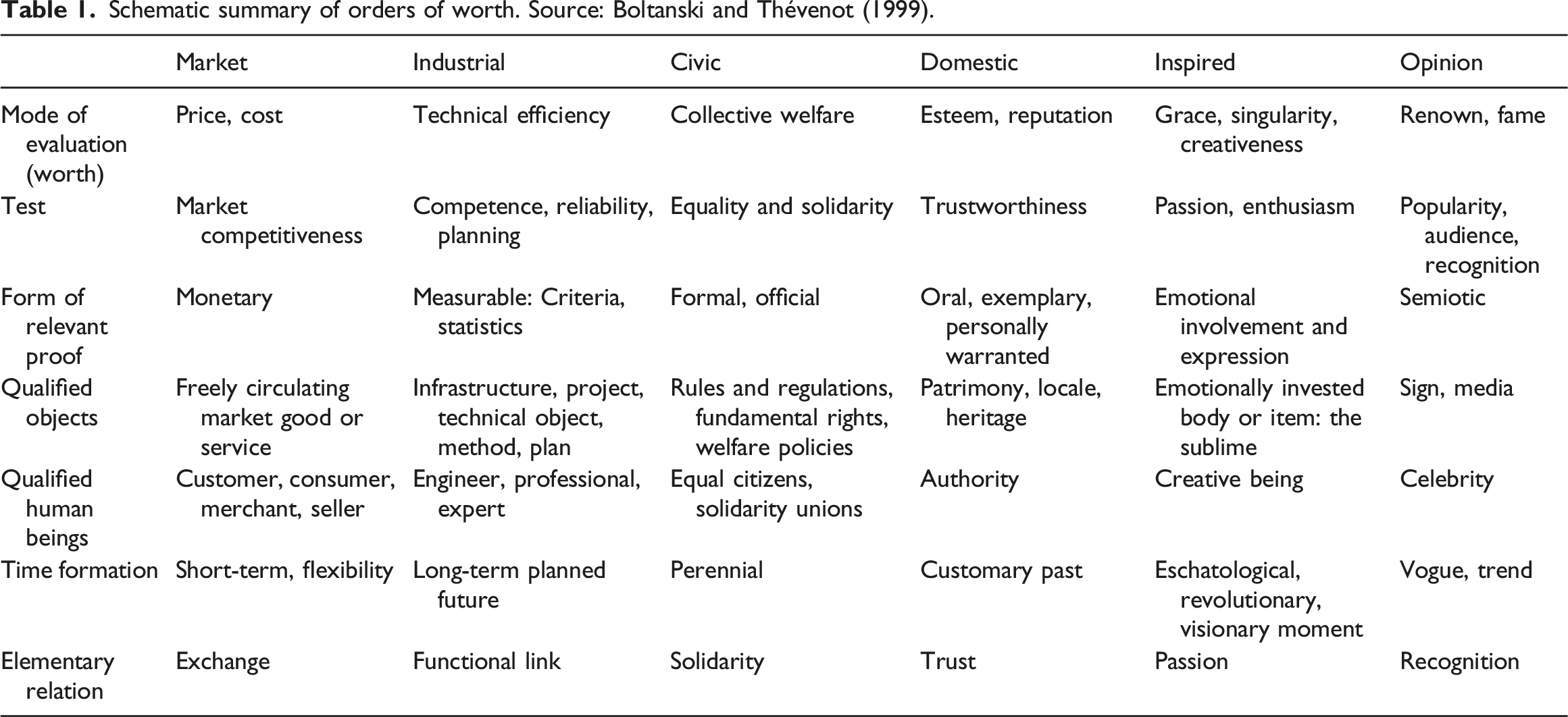
Boltanski and Thévenot (2000: 208-209) explained that the development of the model/typology was intended to provide an instrument ‘with which to analyse the operations persons perform when they resort to criticism, when they have to justify the criticisms they produce, when they justify themselves in the face of criticism or collaborate in the pursuit of a justified agreement’. Thévenot (2015: 87) argued that the genealogy of orders of worth can be regarded as the result of an early modern effort to go beyond cultural particularities and look for universalising constructions of commonality. The typology shows six ways to justify one’s opinions, each one citing its collective order of worth. They subsequently expanded it with two additional orders of worth: the green order of worth (Thévenot et al., 2000) and the project order of worth (Boltanski and Chiapello, 2005). In public situations, when actors critique others or justify their own opinions, they must activate one or more of these orders of worth. In recent decades, the typology of justifications has been used in numerous analyses of public disputes and political debates (see Ylä-Anttila and Luhtakallio, 2016).
After On Justification, two important follow-up works expanded the framework. In The New Spirit of Capitalism, Boltanski (along with his colleague, Eve Chiapello) used the framework in a study on the transformation of capitalism (Boltanski and Chiapello, 2005). What becomes evident from this analysis is that the dispute over forms of justifications and their consequences can become sedimented in institutions, which then shape an entire social configuration (Wagner, 2014: 241). Boltanski and Chiapello pushed the perspective in the direction of historical sociology, while in Rethinking Comparative Cultural Sociology, Thévenot (together with Lamont) expanded the pragmatic perspective of justification in a comparative direction in analysing parallel situations of disputes in two societies (Lamont and Thévenot, 2000: see Wagner, 2014: 240-242). Thus, the orders of worth are embedded in national cultures and mobilised by actors in disputes. We use the typology of orders of worth to show how school content, pedagogy and assessment are justified, and consequently, how they might be engaged in the construction of different types of pupils.
The culture of individualisation in schools – Construction of the inspirational pupil
Skarpenes’ (2007) historical-sociological study on the justifications for changes in pedagogy and content in the school subjects of mathematics, Norwegian language and social studies in upper secondary education from the early 1960s to the mid 1990s focused on changes in value configurations in the transition from the industrial society to the knowledge society. In this transition, knowledge was primarily rooted in values associated with efficiency and utility combined with collective values of equality (a compromise between the industrial and civic orders of worth), but a compromise between more romantic and market-based valuations (the inspirational and the market’s orders of worth) came to the fore during that period. This compromise had strong legitimacy. One reason for this was the fusion of radical left progressive ideas on education and a neoliberal market logic, both of which gave weight to self-realisation, individual authenticity and pupil-centred learning. The pedagogical consequence was that teaching methods and learning methods had to be tailored to the individual pupil, and relevance to the pupil’s life experiences became a key criterion for the selection of subject content. This tendency to let the pupil’s lifeworld colonise the academic content was not an example of Norwegian exceptionalism (Skarpenes, 2007, 2014). Along similar lines, Gert Biesta argued ‘against learning’ and expressed concerns about the ‘learnification of education’ (Biesta, 2005:58, 2020: 91; Biesta et al., 2022), and the convergence of neoliberalism and left-wing romanticism was also identified in the Anglo-American context (Brukhard, 2007; Furedi, 2009; Hargreaves and Goodson, 2006; Ravitch, 2000; Whitty and Wisby, 2007).
Since then, compulsory education in Norway has been reformed three times: in 1997 (L97), 2006 (LK06) and 2020a (LK20), 2020c. Our analysis of the latter reform is based on the adopted curricula as well as the preparatory works (NOU 2015:8; NOU 2014:7). A core purpose described in the main documents underpinning the Knowledge Promotion reform of 2006 (LK06) as well as in the curricula itself was the organising of learning outcomes as competencies and skills (Mølstad and Karseth, 2016). In addition, pupils’ responsibility for their own learning was emphasised in terms of metacognition and self-regulation (Hovdenak and Heldal, 2022).
The current curricula, LK20, extends pupils’ individualised accountability. Differentiated instruction was a key concept in LK06 (Bachmann and Haug, 2006), facilitated by the customisation of methods and learning materials to meet individual needs, in line with the pupil-centred pedagogy. On the contrary, the subject curricula include standardised learning outcomes that apply to all pupils, irrespective of their learning abilities and situations. All pupils are provided with the same amount of teaching, and within this framework they should achieve the same learning outcomes (Læreplanverket, 2020b: 15). Individualisation, however, is limited to tailoring the size of pupil groups and allocating teaching to benefit the individual pupil. This combination of individualisation and standardisation is hardly tenable, as it implies that time and thus practice are replaceable in learning. The preparatory work to LK20 included an implicit solution by enhancing the focus on individual reflection and the monitoring of one’s own development as keys to pupils’ motivation, methodology and perseverance. The expert group argued that qualifying pupils in this way would lead to more productive learning and intensified individual effort on their own time. Therefore, differentiation was supported by the reinforcement of pupils’ accountability in terms of metacognition and self-regulation in the reform (NOU 2014:7: 33; NOU 2015:8; Riese et al., 2020). Eventually, metacognition and self-regulated learning were no longer employed as explicit terms in the actual curriculum. Instead, the current approach was branded as learning to learn and reframed as an ‘ambition of developing the lifelong learning ability in all pupils’ (Læreplanverket, 2020b: 13). This accountability structure is one of five principles ‘for education and all-round development’, including competence in the subjects and basic skills, all of which are described as central to every aspect of school (Læreplanverket, 2020b: 10-14). Thereby, the individualisation of the pedagogy is reinforced by focussing not only on the life worlds and learning activities of individual pupils but also on their self-regulation in terms of motivation, grit, self-perception, etc.
The combination of differentiated instruction and self-regulated learning is an individualised pedagogical design that prepares children to compensate for disadvantages related to their backgrounds, situations and abilities throughout their lives. It stands in contrast to Basil Bernstein’s (1972 [1971]) warning that individualised (invisible) pedagogies could increase the differences between children with educated parents and those without. The pedagogical construction of the self-regulated learner is based on the inspirational order of worth.
Moving from pedagogical methods to school subject content, curriculum research in Norway has identified the emergence of a pupil-centred approach to knowledge. Social studies research, published in Norwegian, found that content was adapted to pupils’ realities as much as possible, with a corresponding decrease in the focus on disciplinary knowledge and societal concerns (Foros, 2006; Foros and Vetlesen, 2012; Krüger and Trippestad, 2003; Skarpenes, 2007, 2014). Whereas previous generations of school critics cautioned against the tendency to not take pupils’ subjectivity seriously, the time had come to worry about taking it too seriously. Researchers pointed to the risk of a ‘disintegration’ of knowledge. Others raised concerns that the tendency might have unintended consequences in schools – what Thomas Ziehe (2001) called an aversion to strangeness. Ziehe (2001) argued that pupils would become so used to education being adapted to their horizon and to their expectations and interests that they would respond to the unknown with reluctance and resistance. A similar line of reasoning was presented in numerous international publications (Ball, 2008; Bentley, 1998; Biesta, 2004, 2005, 2020; Furedi, 2004; McEneaney and Meyer, 2000; Ravitch, 2003).
There appears to be a research consensus in Norway that the core curriculum in 2006, the one now being renewed, implied an even more significant shift away from the subject content dimension (Mausethagen, 2013: 171; Sivesind, 2013: 375; Sundby and Karseth, 2022). The Knowledge Promotion reform (LK06) includes aims related to skills, content and competences for each subject. In the latest reform (LK20), the number of competence aims was drastically reduced in order to reduce the congestion of subject content. Consequently, the content descriptions are increasingly vague, abstract and open to differentiation (Karseth et al., 2020). Thus, the Knowledge Promotion reform (LK20) may be viewed as individualising both subject content and pedagogy at the school, teacher and pupil levels.
All the same, the quality of education is monitored, and individual performance is among the indicators of quality. In the curriculum structure, the competence aims are designed as assessment tools, indicating expected learning results. There seems to be some kind of double communication occurring. The competence aims are both individualised (content and pedagogy, justified inspirationally) and standardised (performance, justified industrially). It appears that pupils are confronted with two incompatible worth orders. The inspirational order communicates that they are the centre of education. Content and methods should be customised to their wants, needs and interests and related to their personal experiences and reflections to facilitate their learning and personal development in terms of competence and skills. Meanwhile, the industrial order of worth conveys the message that these personalised processes are subject to assessment based on formal criteria. Hence, it may be unclear whether it is the pupil’s performance or personality that is measured.
We will give an example from the latest school reform (see Hidle and Skarpenes, 2021). In LK20, the subject social studies contains 19 competence aims for lower secondary school, representing an average of six competence aims per year (SAF01-04E). The reform also introduces five core elements to the subject: (1) a sense of wonder and exploration, (2) deliberating on society and interconnections, (3) understanding and participating in democracy, (4) sustainable societies and (5) the development of identity and belonging. In addition to these elements, three interdisciplinary topics permeate the curriculum: health and life skills, democracy and citizenship, and sustainability. Altogether, there are eight control elements intended to provide direction for the work on the 19 competence aims for the subject. This raises some important questions: Which aims belong to which element? What is the relationship between the five core elements, and between the three interdisciplinary topics? How do these categories relate to each other? The national curriculum does not provide answers. Instead, the Directorate for Education and Training developed a digital support tool that connects the elements in a way that gives associations to commercial platforms (LK20s). Specifically, the Directorate for Education and Training recommends that the 19 competence aims be given priority a total of 81 times in the eight control elements, the five core elements and the three interdisciplinary topics in social studies. In other words, the digital support tool does not provide the teacher with an overview of the curriculum. In fact, it is extremely difficult to obtain an overview of all the cross-connections between the specified aims, elements and topics. The complexity of the system is so overwhelming that it takes time, energy and perseverance to obtain an overall picture of it. A key problem is that the criteria for the proposed connections do not make intuitive sense and are not explicitly explained. Consequently, teachers do not have access to examples or other resources in this digital support tool that they can use to make their own professional judgements. This means that, for teachers, the curriculum has serious limitations as a curriculum management tool. Our hypothesis is that this will lead to even more individualisation in schools.
The Knowledge Promotion reform (LK06) introduced a shift from content- to competence-oriented curriculum in Norway. Evaluations have concluded that there were too many aims and a lack of specific content in each subject curriculum (Karseth et al., 2020). The latest reform responded to these issues by reducing the number of aims and introducing core elements (Sundby and Karseth, 2022). Consequently, the social studies curriculum is characterised by fewer but broader and vague competence aims, and the core elements have similar characteristics. The actual content of the subject is therefore very open, and the autonomy in selecting teaching and learning methods is expanded to include content and direction within the curricular framework of steering elements. These changes have resulted in comprehensive changes in the selective traditions of the topics, which require extensive local planning as well as high levels of subject-specific knowledge within the profession. The reform also accommodates further individualisation of the subject content. Textbooks are increasingly being replaced by digital learning platforms in Norwegian schools, and publishing houses are now advertising vacancies for school subject content designers. Content in this context gives associations to commercial platforms, for example, streaming services (Netflix, HBO, etc) must be attractive enough to hold the customer’s attention. When the term is used in the context of developing compulsory education, it is linked to pedagogical terms like ‘motivation’, ‘engagement’ and ‘mastering’ and ascribes these terms a new – commercial – meaning and may be aimed at teachers or directly at individual pupils. Good ‘content’ holds the customer’s – or the learner’s – attention, and they can allow their personal motivation and engagement to guide their choice of school subject content. Relevant knowledge is not as strongly tied to the university disciplines, textbooks and professional teachers. Instead, an individual pupil is supposed to create and construct a personal curriculum based on their own interests and experiences and use digital (often commercial) platforms. The individual construction of a curriculum is justified by the inspirational order of worth.
The culture of standardisation in schools – Construction of the industrial pupil
Education comprises methods, content and assessment. Above, we described a broad and enhanced tendency towards individualisation in terms of the methods and content of the curricula in Norwegian compulsory school. Below, we will describe the scope and form of the corresponding development of standards for assessment. In a review of the relevance of standards and standardisation in theoretical traditions, Timmermans and Epstein (2010: 71) cited the work of Boltanski and Thévenot as an example of theorising about informal standards. Standards and standardisation, they argued, ‘aim to render the world equivalent across cultures, time and geography’ (Timmermans and Epstein, 2010: 69). Drawing on Bowker and Star (1999), they defined standardisation as ‘a process of constructing uniformities across time and space, through the generation of agreed-upon rules’ (Timmermans and Epstein, 2010: 70), not unlike the pragmatic approach suggested by Boltanski and Thévenot. Furthermore, Timmermans and Epstein (2010: 72) classified standards into four subtypes: design standards, such as tools and products with properties in need of detailed specifications; terminological standards, such as the International Classification of Diseases; performance standards, which typically set outcome specifications; and finally, procedural standards, which specify how processes should be performed.
In the following, we discuss educational standardisation but limit the discussion to the assessment of pupil performance. Mountains of research have explored educational standardisation (Ozga, 2009; Timmermans and Epstein, 2010), and many scholars have taken a special interest in performativity, assessment and accountability within the neoliberal regime. In one research review, more than 11,000 publications were included (Lindblad et al., 2015). There are multiple ways to define and discuss educational standardisation (Landri, 2022; Riese et al., 2022). Our ambition is modest. We want to show how assessment performance standards construct pupils within the industrial order of worth.
The use, proliferation and quantification of performance standards in assessment have followed globalisation, digitalisation, neoliberalism and scientific developments within psychometry and statistics (Baird et al., 2017). In fact, performance standards are now a main driver of education (Tolo, 2022: 165). A series of new tests has emerged from the standardisation resulting from the OECD’s educational policy. International large-scale assessments (ILSAs) and national tests are also used to assess pupils’ performance and skills as well as educational, teacher and school quality (Tolo, 2022). PISA, TIMMS, national tests, screening tests and standard skills mapping tests are commonly implemented. In addition to locally developed assessments based on the Education Act and related regulations, pupils are subject to national and international testing.
The first Knowledge Promotion reform (LK06) was based on an official Norwegian report on quality in compulsory education (NOU 2003:16). The commission proposed basic skills and competence aims as performance standards and organising principles in compulsory school. Consequently, competence aims were introduced as a basic structure for performance standards throughout the curricula, and adaptations of basic skills were included in each subject’s curriculum. Competence aims became standards for pupils’ educational rights, and in 2018, the Education Act was expanded with a paragraph prioritising performance in basic skills over competence aims in initial education (Hidle and Krogstad, 2019: 126ff). Schools are obliged to intensify basic skills training for individual pupils who need it to reach the performance standards in years 1–4 (Education Act, 1998: § 1-4). Sivesind (2013) summarised the findings from the research-based evaluation of the development and use of the curricula in LK06. She argued that the new and comprehensive assessment regulation that was introduced in concurrence with LK06 is imperative to the changes following the reform (Sivesind, 2013: 378). The regulation implemented ‘assessment for learning’ (AfL) as the standard for assessment. According to Tolo, AfL was developed to ‘counteract the democratic deficit caused by the increasing focus on metrics and large-scale assessments’ in England (Tolo, 2022: 163). The choice of this approach in Norway suggests that reservations about metric assessment were considered in the design of the Knowledge Promotion reform. An eight year extensive national effort, involving the participation of 310 of 428 municipalities from all Norwegian counties in the project period from 2010 to 2018, supported the implementation (Directorate for Education and Training, 2019). However, knowledge about the ways in which assessment traditions are developed in the different subjects remains limited.
The regulation has developed in response to teachers’ call for more guidance on assessment in the curriculum, and the latest curriculum, LK20, elaborates on assessment in the ‘principles for the school’s practice’ and provides specific guidelines for assessment within each subject. According to the regulation, the purpose of assessment is threefold: to promote learning, sustain motivation and provide route and final information about obtained competencies (Regulations for Education, 2006). Standardised performance indicators in the form of numeric marks are prohibited in Norwegian primary school but are introduced in year eight and included in all half-year assessments. In the core curriculum, teachers are warned about the unfortunate and excessive use of assessments, such as idle mapping and observation, which do not include constructive measures. The relationship between assessment and differentiated (individualised) instruction, which requires close personal monitoring of each pupil, is underscored. The emphasis is on the promotion of learning and development and formative assessment. Nevertheless, the curriculum must also ‘give an idea of what they [pupils] know and can do’ related to subject competence (Læreplanverket, 2020b: 19). In addition, as mentioned above, these performance indicators also have juridical implications.
Considering the inspirational curriculum tendency, the call for guidance on assessment in a curriculum is well founded. The inspirational order of worth does not imply assessment, nor does it legitimise common material norms, such as shared (objective) cultural standards for good lives and societies, measurable criteria, disciplinary canons etc. The lack of emphasis on mastering subject content is legitimised by this value order. But, what about the competence aims in the subjects? Can formative assessment be conducted in line with the inspirational order? Below, we discuss these questions by employing social studies as an example.
Existing research on formative assessment in social studies in Norway is strikingly scarce (Koritzinsky, 2020; Kosberg and Erdal, 2021; Langø, 2015; Langø and Børhaug, 2022) compared to other countries, for example, Sweden (Berg and Persson, 2020). The literature suggests that current understandings of AfL are informal and that practices are relatively arbitrary. In a small-scale study, Langø and Børhaug (2022) interviewed teachers to learn more about their practices in upper secondary school. Their findings were in line with the call for guidelines prior to LK20, suggesting that the profession has questions about how to design continuous assessment and often focuses on the frequency rather than the formative quality of assessments. Analysing the social studies curriculum, we find that the standards for formative and summative assessments are intertwined.
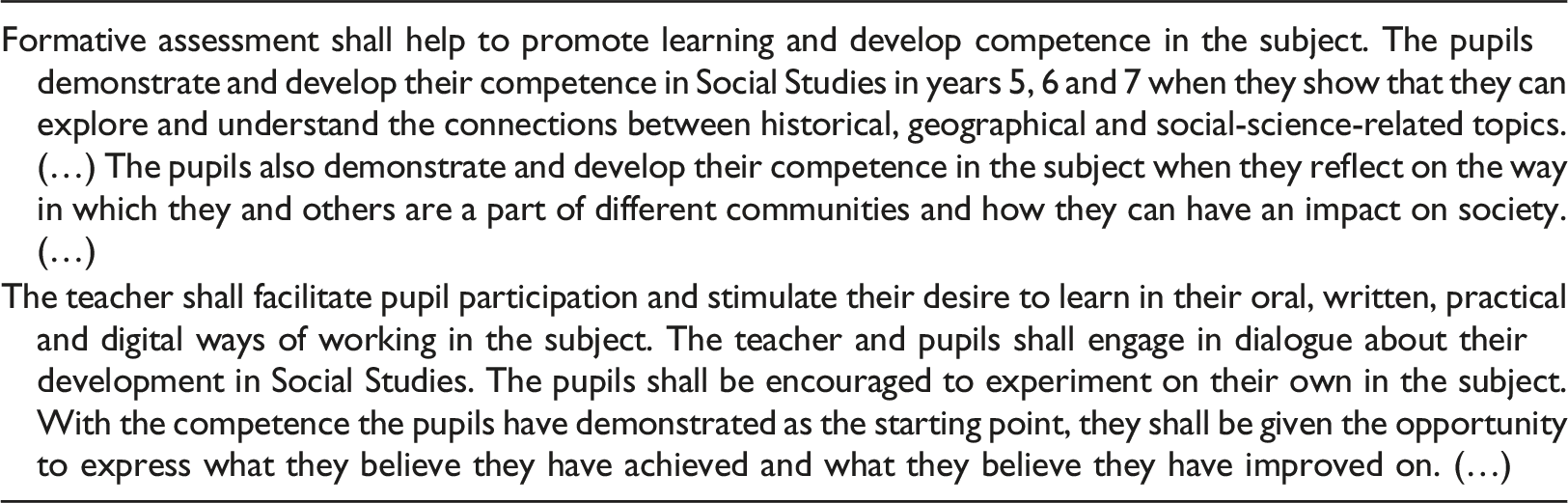
The guidelines underscore the purpose of assessment for learning, which is to facilitate motivation, methodology and perseverance through self-regulation. Further, it clarifies the teachers’ obligations related to these results and emphasises pupil participation. The first paragraph describes relevant ways in which pupils display and develop their competencies in the subject, and thus it suggests relevant situations for assessment connected to general topics in the subject. Clearly, and in line with the emphasis on self-regulated learning, the pupil’s activity and reflection are key. Beyond this, the eventual development of standards in terms of terminological, procedural or other considerations is left to the teacher’s discretion, which, as we have seen, is also the case with the selection and differentiation of content and methods.
The second paragraph is a generic reiteration of the three purposes of assessment, focussing on the teacher’s obligations. It emphasises pupils’ participation and motivation for learning as well as learning principles from the core curriculum and basic skills. Variation in this second paragraph across intervals and subjects is limited. A comparison between the subjects reveals a core of standardised wording supplemented by the name of the subject and references to subject-specific activities, themes or arenas. Within each subject’s curriculum, identical phrases are repeated at every interval. On the different levels, they are combined with different basic skills and verbs, but specific learning content is not mentioned beyond general topics. The guidelines for assessment for learning are pupil centred, individualised and in line with the inspirational order of worth, which emphasises the concrete and unique pupil, that is, a pupil who is different from everyone else. However, it is unclear if they can be implemented for the assessment of goal attainment without the development of subject-specific terminology and local praxis as well as local development of professional discretion in each subject and on every level. As mentioned above, doing this would require some sort of standardised assessment based on industrial justifications, which must treat the pupil as an abstract and standard entity, that is, a pupil equal to everyone else. The unique and concrete (inspirational) pupil is incompatible with the abstract and standardised (industrial) pupil. In sum, beyond self-regulation, it is unclear what is assessed and what the standards for assessment are.
The implementation of LK06 as a reorganised curriculum structure in Norwegian compulsory education was fuelled by concerns about the quality of compulsory education, based on international evaluation legitimised by the industrial value order. Following the reform, national tests were introduced and revised in Norway. Currently, three national tests (reading, arithmetic and English) are administered to all pupils in years 5, 8 and 9, once a year. The national tests are designed to serve multiple purposes, including AfL, adapted education and quality development on aggregated levels. Years 5 and 9 are also the focus of international tests. Norwegian schools participate in five international programs: PISA, TIMMS, PIRLS, ICCS and ICILS. These tests are designed to serve analytic purposes on an aggregated and comparative level. In other words, participation does not include AfL. This means that pupils are both exposed to standardised testing and AfL throughout compulsory education, and AfL can be considered a soft form of assessment. It may or may not be standardised, depending on the discretion of the teacher. While daily life in school features an inspirational and pupil-centred culture, the pupils know that performance standards exist. But, who knows what those standards are and how they are applied? Considering the focus on self-regulated learning throughout the educational pathway, it seems fair to expect that many pupils will approach standardised tests self-reflectively. Moreover, it is unlikely that the overview and information necessary to reasonably appraise their individual efforts and success are available to the average pupil. We found no studies that include pupils’ experiences from their participation in such tests. Only a small percentage of pupils are tested in reading, arithmetic, natural sciences, digital competence and citizenship education at regular intervals. Although four of these tests are administered to pupils in year 9 and three in year 5, the intervals (from three to 6 years) and the small percentage of participants (approximately 10% of age groups) mean that it is unlikely pupils will be recruited into these samples, especially more than once.
In summary, we find that while the educational system is highly exposed to globalisation and standardisation trends, pupils in Norwegian compulsory school may not encounter extensive standardisation in terms of multiple national and international tests. Nonetheless, their basic skills development, especially initial education (years 1–4) is closely monitored. AfL has been adopted as the approach to assessment, and the guidelines for implementation are vague rather than standardised. It is unclear if continuous assessment can be achieved without the development of some sort of standards by the teachers. While it is too early to evaluate the implementation of this approach, some studies point to a tendency towards a higher frequency of testing in subjects as well as uncertainty regarding the characteristics of AfL and how to employ it in subjects. A central question therefore is whether frequent testing and assessment for learning promote different (and incompatible) orders of worth in the curriculum pupils experience in school.
Discussion
An oxymoronic construction: The inspirational pupil and the industrial pupil
Pedagogy and subject curricula are individualised in schools, and commercialisation is accommodated. The presentation of overviews and in-depth knowledge can be moved from teachers’ discretion in the planning and teaching of school subjects and pupil’s learning onto the selected digital platforms. A specific type of equivalence is being created. It is now the pupils’ uniqueness, their personal experiences and their individual thoughts and feelings that are supposed to inform pedagogical practice and content in schools. New concepts, categories, knowledge and digital objects have evolved from this construction process in the educational sector. The tendency corresponds to what Boltanski and Thévenot (2006) called an inspirational order of worth. Pupils are supposed to look inside themselves to find their creativity and uniqueness. We have described aspects of the latest curricular reform that enhance this tendency by accommodating individualised subject content that mirrors pupils’ selves. There is an ongoing process through which the inspirational pupil is constructed. AfL may indeed be regarded as an attempt to establish a new form of pupil-centred and individualised assessment that is not standardised. Ideally, individual pupils engaged in AfL should have opportunities to utilise their distinctive cognitive skills and personal emotions in learning processes. Thus, AfL can also be legitimised by an inspirational order of worth. However, some important questions about AfL remain unanswered: What is it that is assessed, and what are pupils learning? Is it so individualised and differentiated in terms of content and procedure that it cannot be standardised? If not, is it education? While the question of how AfL will be implemented in different school subjects and classrooms remains open, a completely individualised system of assessment is nonsensical, as it would entail the transformation of education to care and the total dissolvement of any hierarchy of knowledge, competence and quality as we know it. 2
Throughout compulsory school, AfL, which may be interpreted as inspirational, is accompanied by summative and standardised forms of assessment. International tests (PISA, TIMMS, PIRLS, ICCS and ICILS), national screening and standard skills (reading, arithmetic and English) mapping tests, and a variety of commercial tests (Carlsen and Moe, 2019) are all summative forms of assessment intended to evaluate learning outcomes by comparing the results with a performance standard or benchmark (Timmermans and Epstein, 2010: 72). The tendency towards individualisation in terms of curricular methods and content, where pupils are supposed to look inside themselves to find their inspirational creativity and uniqueness, is challenged when it comes to the assessment of performance and evaluation of the quality of education. All sorts of evaluations, tests and assessments are legitimised by what Boltanski and Thévenot (2006) call the industrial order of worth. In this order, objects like statistics, methods, quantifiable goals and definitions are considered important because the relevant arguments are those that can be measured and/or monitored. In other words, standardisation is a key feature of the industrial order of worth. It objectifies the singular as equivalence in relation to culture, time and geography and facilitates comparison. It shifts the focus from looking inside to looking outside; from inspirational creativity and uniqueness to industrial productivity and similarity. Standardised tests and assessments run contrary to the tendency towards individualisation in terms of curricular methods and content, and as outlined above; the inspirational pupil and the industrial pupil are not compatible.
Conclusion
We have discussed how the reforms oscillate between two processes – individualisation and standardisation – rooted in two incompatible orders of worth, the inspirational and industrial orders, respectively. The simultaneous attempt to construct an inspirational and industrial pupil – both unique and standardised – is oxymoronic. Thus, a major challenge in schools is the conflicting pressures to which pupils are being subjected. This generates a series of institutional paradoxes and, possibly, frustrated pupils. In the section on the core curriculum in the Knowledge Promotion reform, it is stated that pupils shall develop the skills needed to reflect on their own learning and understand their own learning processes (Læreplanverket, 2020b). It appears as if the ambiguity, individualisation and fragmentation of subject content may have unintended consequences for these processes, as they undermine the signposts pupils need to guide them in their tasks. The merging of pupil centrism, competencies and subject knowledge renders the knowledge culture unclear. Correspondingly, teachers’ assessment tasks become untenable if they are unsure about the object of and criteria for assessment. Ironically, this may result in a call for more standardisation of assessment in subjects.
Historically, pupils in Norway have reported that school is tolerable (Bakken, 2022). But, are the pupils genuinely thriving? Concurrently, the public sphere and social media have reported the emergence of new groups labelled as ‘pupils of concern’, ‘school refusers’, ‘pupils with psychological problems’, ‘ADHD pupils’, ‘loser boys’, ‘dropouts’ and ‘insanely good girls’. The conflicting pressures of individualisation and standardisation may be impossible for pupils to understand, complicated to circumvent, and difficult to avoid. What are the consequences of daily exposure to such conflicting pressures from an early age? How do pupils respond as they seek solutions that may not lie within themselves, despite being thoroughly trained in introspection and reflection? Our concern is that this may result in refusal, disengagement, exhaustion and anger rather than fostering citizenship and agency. The mounting tide of pupils who are resisting school in different ways raises unsettling questions.
Footnotes
Declaration of conflicting interests
The author(s) declared no potential conflicts of interest with respect to the research, authorship, and/or publication of this article.
Funding
The author(s) received no financial support for the research, authorship, and/or publication of this article.
