



Abstract
Early childhood education (ECE) teachers have expressed being silenced, indicating their responses to everyday issues of political concern may be hidden. This voicelessness underscores the importance of examining strategies and spaces that incite ECE teachers to vocalise their political dialogues. The pandemic, as a crisis event, within Victoria, Australia, during 2020 offers an unrivalled viewing of such entreaties. Posing unique and unusual dangers and opportunities, the early days of the pandemic serve as an entry point to viewing the strategies and spaces utilised by teachers during marked political crisis. Considering these pandemic dangers, this study undertakes a uniquely complex and opportunistic investigation into the political thoughts, ideas, and voices of ECE teachers within these coordinates, which may be of use for other community members beyond these dimensions. Comprising a larger doctoral study, teachers’ posts within a closed ECE Facebook group were analysed against Bakhtinian crisis chronotopes and carnivalesque responses. Insights infer the pandemic crisis incited teachers’ political dialogues to problematise their historical and ongoing issues. Doing so fostered a supportive peer network, opening up and renewing narratives from within the sector. Provocations to arise include the potential of crisis, the ability of laughter to empower teachers to speak up and have voice, as well as creating spaces for political dialogue and activism within the sector.
Introduction
Early childhood education (ECE) teachers have expressed being silenced (McDonald et al., 2018; Molla and Nolan, 2019, 2020), indicating their responses to everyday political issues may be hidden. This voicelessness underscores the importance of examining strategies and spaces that incite ECE teachers to vocalise their political dialogues. The pandemic, as a crisis event, within Victoria, Australia, during 2020 offers an unrivalled viewing of such entreaties. Posing considerable risks, the early days of the pandemic serve as an entry point to viewing the strategies and spaces utilised by teachers during political crisis. Mikhail Bakhtin, who methodologically orients this study, was also described as ‘living in an unusual period, a time when virtually everything taken for granted in less troubled ages lost its certainty, was plunged into contest and flux…. Generations were presented with unusual dangers and unique opportunities’ (Holquist, 1984, p. xv, emphasis added). Although not seeking to compare the atrocities of Stalinism to the pandemic, I investigate how the early Covid days and policies fostered ‘unusual dangers and unique opportunities’, that may prove of use for other teachers’ political dialogues beyond these coordinates.
Pandemic dangers for ECE teachers included considerable job insecurity, reduced pay, and hours (Westbrook et al., 2022). At the end of March 2020 in Victoria, ECE centres were kept open, whilst others were encouraged to isolate at home. ECE teachers were positioned as caring for children so that parents could continue to work, thus keeping the economy afloat (Parliament of Australia, 2020). Additionally, in April 2020, children’s attendance in ECE centres was encouraged through a politically uncharacteristic Free Child Care Relief Package that spanned numerous lockdown alerts and levels (Lucas, 2020). By June 2020, lockdown regulations began to ease after a lowering of transmissions. With this easing, the government began reducing financial aid. Undertaken during pandemic uncertainty, this shift earned the title of the ‘Snapback approach’ (Carey, 2020). Federally, ECE teachers were the first ‘industry’ removed from JobKeeper, a supplementary payment to support workers with reduced pay and hours. However, when announced, women, who predominantly compose the sector’s workforce, were experiencing the brunt of pay cuts, reduced hours, and job insecurity (Batchelor, 2020). Considering these pandemic dangers, this study undertakes a uniquely complex and opportunistic investigation into the political thoughts, ideas, and voices of ECE teachers within these coordinates.
To frame this investigation, my research questioned: what were the strategies of teachers’ political dialogues within the time and space of a closed Facebook group during the Covid pandemic? This question’s aim is to generate insights of how teachers are strategically responding with their political dialogues. White (2009) explains how dialogism’s purpose is not to reach an end point, or necessarily to reach a point of agreement, but ultimately (to embrace Bakhtin’s interpretation of communion where the receiver has the ability to disagree) negotiate or even reject what is being offered. (p. 54)
In accordance with this framing, my research delved into teachers’ political dialogues not as definitive conclusions or endpoints, but rather as a means to gain insights into how teachers strategically expressed their political voice. My investigation did so by seeking teachers’ everyday experiences, analysing their dialogues within such encounters as their worldviews. Therefore, understanding teachers’ political dialogues requires setting aside thematic conclusions or fixed beliefs, and instead engaging in complex examinations of language forms as responses shaped by the speaker’s intentions. Embracing this approach proves beneficial for the sector, as it avoids assuming complete knowledge of teachers, instead seeking contextualised perspectives that could be valuable in future scenarios. Hence, such insights may offer potential strategies, and spaces for contemplation, in ongoing circumstances.
Acknowledging the dialogic importance of time and space, or chronotope, this research question emphasises the essential role of these dimensions in interpretations. Yet, the acquired insights do not terminate when these coordinates change, as the past continues to exert influence on the present and future (Bakhtin, 1981; 1984a). As Wegerif (2022) explains, the dialogue is never closed because when you think it is over and reflect back on it, your understanding of the dialogue inevitably takes the form of ‘answering words’ even if these are not spoken or written down or even explicitly recognized as such. (p. 11)
Thus, while specific to a particular time and space, the questions and responses generated by this study among teacher participants (and readers), have the potential to sustain an ongoing (political) dialogue. This dialogue could encourage contemplation of the nuanced language strategies employed in teachers’ political discussions. Consequently, the perspectives gained from this study may offer insights into aspects that could hold significance for future teachers’ political dialogues, including ways to ensure their voices are heard.
Reviewing the literature: Political dialogues
Although this study utilises the term political dialogue, this terminology is infrequently cited in educational literature, yet, it has been employed in sociology and political science. Esquith (1996) identifies political dialogue as ‘objects (political things) to be discussed and the distinctive way (politically) the dialogue is conducted’ (p. 9). Esquith explains that political ‘objects’ or ‘things’ can be difficult to define. He conceptualises them as involving both the political nature of the discussions and the topics that dialoguers want to discuss. Serrano-Contreras et al. (2020) define political dialogue as a fundamental element of democratic societies that helps citizens formulate their opinions and develop an understanding of what they perceive as problems. Additionally, political dialogue enables citizens to interact with those who hold opposing views (Serrano-Contreras et al., 2020). James and Cotnam-Kappel (2020) recently expanded the meaning of political dialogue by describing it as a broad examination of ‘issues of public concern’ (p. 145). As such, when utilising this concept within this study, it encompasses an extension beyond policies, elections, and institutional politics to address what citizens, namely, teachers, consider political issues that need further dialogue.
ECE teachers’ political dialogues
Whilst studies have shown how accounts of advocacy for families and children orientated many ECE teachers’ political dialogues, their self-advocacy, or advocating on behalf of themselves, was often muted (Macdonald et al., 2015; Gibbons et al., 2018). Teachers’ political dialogues in Macdonald et al. (2015) research in Canada were often orientated by advocacy for children and families within their everyday centre practices. As a result, there was little time and space to challenge the ‘sociopolitical order’ (p. 105) framing and constraining teachers’ everyday lives, ‘even though their personal and professional well-being was at stake’ (p. 109). Similarly, Ewens’ (2019) Aotearoa New Zealand research demonstrated teachers’ political dialogues prioritising children and families, attempting to be ‘everything to everybody’ (p. 325), consequently silencing their issues of stress and overwork. Covid may have worsened such encounters, with ECE teachers’ mentioning increased pressure upon their professional responsibilities to children and families, whilst experiencing considerable challenges for their wellbeing (Pramling Samuelsson et al., 2020, p. 141). Pre-pandemic, Fenech and Lotz’ (2018) Australian-based findings led to the conclusion that teachers’ political dialogues were integrally orientated by advocacy within centres, to support children and families. The authors also highlighted how the teachers’ political dialogues were orientated by perceptions of ECE as a saviour, which according to Bown and Sumsion (2016), is a common perception among Australian state and federal governments.
It may be that ECE teachers who are informed by such narratives do not engage in self-advocacy, because their interests, wellbeing, and needs are not included in these received political dialogues. Furthermore, the prospects of ECE advocacy for children may also instigate the hidden voices of teachers. This is because when compared to the possible outcomes for other community members, teachers may be prompted to downplay their voices due to perceptions of their political dialogues, and therefore needs, are less significant.
Although teachers’ political dialogues may at times be silent in self-advocating, this workforce has remarked on the poor conditions they face, especially in regard to the devaluing of their professionalism. In two separate Australian studies by Molla and Nolan (2019, 2020), the authors shared ECE teacher narratives of being undervalued by parents and the wider community, such as policy makers. Within Ewens’ (2019) research, the ECE teachers articulated how poor understanding of quality ECE resulted in family and wider community members’ lack of bestowed legitimacy upon them. In McDonald, Thorpe and Irvine’s (2018) Australian research, a teacher expressed a disheartened response to the political, everyday issue of being unrecognised, with this prompting her dialogue. Replying to how this affected her wellbeing, the teacher stated: ‘Some days I want to crawl into a ball.… You just feel like you really should be celebrated by other people around you for all the great things that you’ve done and it’s really hard when you don’t get that recognition’ (pp. 660–661). These everyday issues of political concern caused anger for teachers in Fenech and Lotz’s (2018), and Armstrong’s (2019) Australian research, prompting dialogues that responded to topics of professional recognition and remuneration. However, within these responses were also disheartened feelings their voices may not have impact, given the lack of government valuing of ECE.
Narratives of ECE teachers’ political dialogues being silenced were also prevalent in the literature (Gibbons et al., 2018; Molla and Nolan, 2020). In Molla and Nolan’s (2020) research, teachers discussed being silenced and thus unrecognised and de-professionalised by colleagues. One encountered being ‘shot down’ by her peer teachers via the delimiting reply ‘it’s policy’ (p. 74) when attempting to challenge centre politics. Another teacher expressed being silenced by her centre manager, as she was not granted ‘the privilege to speak to the parent or speak to another teacher or speak to a manager or something like that’ (p. 75, emphasis added). According to Molla and Nolan (2020), when teachers are silenced in ways such as this, their sense of voice and agency is negatively affected, and thus perhaps encourages hidden voices and feelings of being undervalued and unrecognised. Within Aotearoa New Zealand, Gibbons and colleagues (2018) low survey response from ECE teachers prompted their analysis that neoliberal performativity has strategically undermined teachers’ voices, prompting ‘silence as the best or only option’ (p. 50). Potentially, amplifying this issue, Phillips and colleagues (2021) raised concern about the pandemic’s impact on the overlooked needs and rights of ECE teachers, stating that Covid exacerbated the silencing of this workforce. As such, it appears the silencing of teachers’ political dialogues may be linked to feeling undervalued and unrecognised with a futility and inability, perhaps heightened due to the pandemic, of speaking up.
Connected to the undervaluing and silencing of ECE teachers’ political dialogues, are connotations to selfless civil servants engaging in ‘woman’s work’ (Ewens, 2019; Leach-McGill, 2018; Molla and Nolan, 2019, 2020). Such narratives are fostered against historical and ongoing perceptions of ECE teachers being ‘good mothers’ and thus ‘selfless civil servants’ in their childminding (Ewens, 2019; Leach-McGill, 2018: p. 325). For example, being labelled ‘babysitters’ was a recurring political dialogue for ECE teachers in several studies (Leach-McGill, 2018; Molla and Nolan 2019, 2020). In fact, all three researchers (Leach-McGill and Molla and Nolan) commented on the ‘striking’ fact that all participants thought that others viewed their profession in this way. Covid has been connotated as further impacting gendered expectations and strain, with female ECE teachers ‘disproportionally impacted by the pandemic’ due to stresses and imbalances in work-life roles and responsibilities (Leo et al., 2022: p. 696). Such occurrences implicate the importance of investigating how teachers’ political dialogues responded to such issues within this time. Furthermore, the idealisation of ECE teachers as selfless fostered the perceptions of having to be ‘superhuman … you kind of have to be a saint to really do a good job’ (Ewens, 2019: p. 171). Ewens linked comments such as these to maternal dispositions of altruism. Therefore, the teacher’s political dialogues responded to unobtainable perfection all whilst putting their wellbeing last (Ewens, 2019). Seeking strategies and spaces that might open up such teachers’ political dialogues, I utilised a dialogic methodology to enable a nuanced investigation of such language endeavours.
A dialogic methodology
Drawing on Mikhail Bakhtin’s dialogism (1984a, 1984b; Gratchev, 2019), I present an exploration of teachers’ political dialogues as co-subjective, relational exchanges. For Bakhtin (1984a), ‘to be means to communicate’ (p. 287). Hence, teachers are always in communion with others’ opinions, which in turn forms their responding political dialogues. As indicated in the literature review, these others can include children, families, peers, and managers. Pertinent to these discussions, dialogic analysis facilitates insights into political issues impacting teachers’ lives through their discussions between the self and other. Bakhtin (1986) posits that people encounter one another ‘on the boundary between two consciousnesses’ (p. 106, emphasis in original). In other words, the self, such as a teacher steps out from their consciousness to engage with the values and opinions of others. Then, they return to their own values and beliefs to form their interpretations and responses. This fundamental process lies at the core of Bakhtinian dialogism’s ontology and epistemology (Sullivan, 2012). Consequently, this methodology diverges from concerns about overarching structures and discursive institutions that dictate what can be said. Rather, it facilitates a viewing of everyday exchanges as rich with potential responses, that shape our understanding of existence and knowledge acquisition. This entreaty enables my conceptualisation of political dialogues as teachers’ encounters with everyday issues alongside others, providing a framework to investigate their responses.
Conducting a dialogic analysis of political dialogues involves methodologically contemplating the political issues the speaker encounters and responds to. As Bakhtin (1986) commented, ‘I hear voices in everything and dialogic relations among them’ (p. 169). Hence, I regard teachers’ political dialogues as encompassing face-to-face interactions, silences, gestures, news outlets, and social networks. Neilson (2000) outlined the features of a Bakhtinian political dialogue as being relational and ethically imperative, emphasising the question of how one should respond to an ‘imaginary but not fictional subjectivity of another who can answer me back…how should I act toward this other’ (p. 145). Teachers’ political dialogues are, therefore, conceived as inherently responsive, whether to a real or imagined other with whom they are in dialogue. Within Facebook, where this study is situated, I appreciate posts as never in isolation but always a response to a previous other, including encounters of everyday political issues in a given situation. Consequently, all teachers’ political dialogues become a relational, ideological struggle and a means of expression, fostering continual becomings through encounters with the self and other.
Dialogism’s focus on authentic experiences goes beyond themes by problematising generalisable findings in favour of authentic voice, that is not so easily summarised (Sullivan, 2012). Resisting the confinement of themes, dialogic methodology enables an analysis of teachers’ political dialogues as intricate language forms, reflective of their responses to political issues impacting their lives. In the ensuing analysis, I present my researcher insights, and from these develop provocations that may benefit other teachers. I build on Wegerif’s (2022) assertion that ‘learning is not a piling up of facts but an expansion of dialogic space, each new voice adding a new perspective from which to experience and understand the world’ (p. 9). I apply this approach to teachers’ political dialogues, aiming not to accumulate discursive themes, but to gain insights and deeper perspectives into the unique dialogues, or posts. From these, I aim to better understand these political dialogues as strategies of response that may serve as provocations for fellow teachers in other times and spaces. Hence, the provocations arrived at in this paper are not definitives, but intent on arousing and provoking strategies that teachers who feel silenced and voiceless may find of use.
A chronotopic framing
Dialogism interrogates time, space, and axiological coordinates, or chronotopes, that shape responses, rendering what is said, or unsaid, distinctive to these specific dimensions. This methodological framing contextualises the dimensions influencing teachers’ political response. A specific chronotope investigated in this paper, as a methodological framing, is crisis thresholds. A crisis threshold chronotope is a precipice encounter that can alter typical forms of response. Bakhtin (1984a) explains crisis chronotopes via a novel’s lead character. For protagonists, a crisis event prompts them to stand ‘on the threshold of great internal decisions’ (p. 62). This precipice moment offers a ‘whole of life itself, life poised on the threshold’ (p. 63, emphasis in original). Or in other words, the climax of the plot reaches a crisis that incites the lead character to a response that is poised to change the story, depending on the form chosen. As such, this chronotope affirms (political) responses of action and inaction as equally consequential. My investigation of teachers’ political dialogues in Victoria, Australia, during 2020 is of particular interest when conceptualised within this chronotope, considering the challenges the ECE sector encountered within this time and space (Westbrook et al., 2022). Such thresholds may offer insights into the strategies and capabilities of teachers’ political dialogues under these circumstances, which may serve as provocations beyond these coordinates.
Carnivalesque unit of analysis
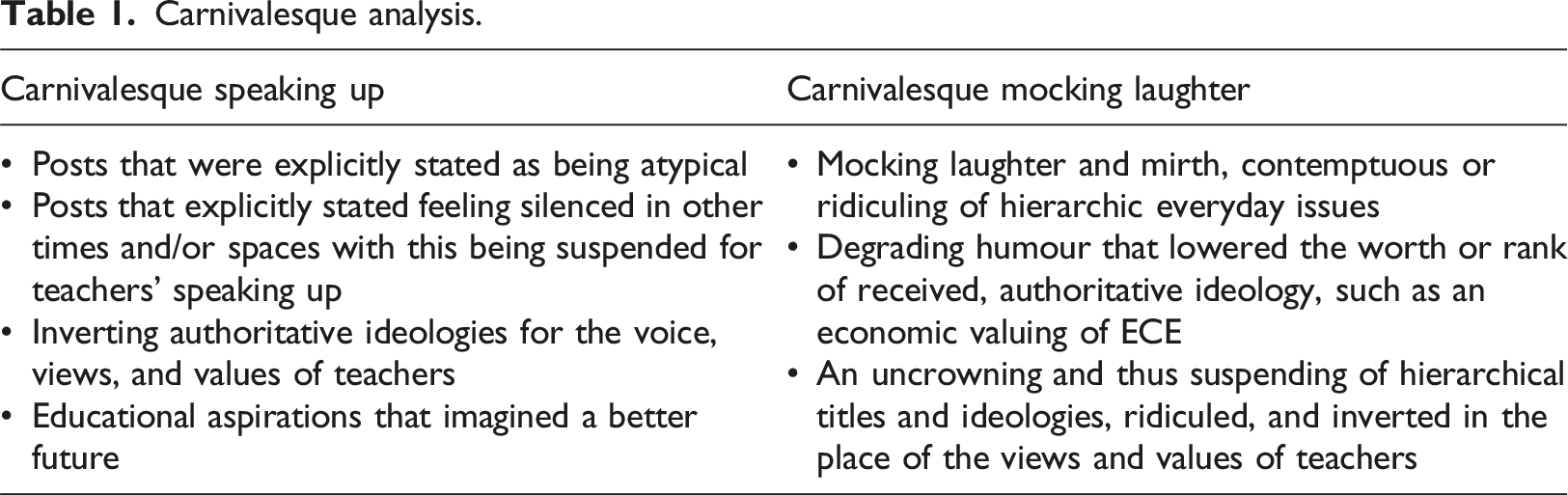
Within the crisis chronotope, I employ the Bakhtinian concept of carnivalesque as my unit of analysis. In his youth, Bakhtin intended to write a treatise on the ethics of politics, but his carnivalesque ideas were the closest he ever came (Emerson, 1997), leading to my claim this concept is seminal to Bakhtinian investigations of political encounters. Bakhtin (1984b) describes carnivalesque as a fleeting, festive moment where terror is vanquished, making way for ‘complete liberty’, empowering those usually silenced to raise their voices (p. 47). Consequently, this concept highlights the significance of those typically muted, such as ECE teachers, as indicated in the literature review, breaking down barriers that may suppress them. When speaking up one can embody the ‘origins of carnival, because he [or she] is only interested in life once it parts ways with the ordinary’ (Gratchev, 2019: p. 105). Therefore, a carnivalesque speaking up entails the ways teachers’ political dialogues deviate from the norm, enabling an investigation of their nuanced responses that may challenge problematic stereotypes and conceptions. In addition to doing so ‘for a time entering the utopian realm of community, freedom, equality, and abundance’ (Bakhtin, 1984b: p. 9, emphasis added). As such, this aspect of carnivalesque is analysable in the aforementioned emphasised values. This concept is also analysable when teachers share how such responses, although enabled during carnivalesque, are silenced in other times and spaces. In this way, carnivalesque speaking up sparks the second life of the people beyond official culture. Thus, I analysed the explicitly stated atypical ways teachers’ political dialogues suspended authoritative positions and ideologies in favour of their assertive views and values.
Another facet of carnivalesque is mocking, tongue-in-cheek, parodying laughter. Bakhtin (1984b) described how such mirth, fosters a free and frank dialogue. Through this process, hierarchical positions and ideologies are uncrowned through satire and ridicule, enabling everything to be seen anew (Bakhtin, 1984b). In turn, such festivities crown those lacking voice. Therefore, I investigated teachers’ political dialogues that poked fun at authority, ‘legitimised’ and hierarchical worldviews, or ranks. I analysed crownings and uncrownings that enabled those from the underground to strategically renew everyday issues through jesting laughter. Such a conceptualisation facilitates investigations of the strategies and spaces teachers’ political dialogues utilised to speak up. In addition to how the new world order may have been of benefit to the carnivalesque participants, even if only temporarily.
Analysing Facebook dialogues
Carnivalesque analysis.
Chronotopic crisis prompting teachers’ carnivalesque political dialogues
Prompted by the pandemic as a crisis chronotope, teachers’ political dialogues were analysed as entering a carnivalesque contestation, speaking up in atypical ways within the Facebook group. Such responses occurred with posts about, and thus opening up, letters sent to politicians addressing pandemic policy concerns and demands. One such concern was the health and safety of ECE teachers in the early pandemic days, with the demand for closing ECE centres in line with primary schools. Another concern was the inequity of the Snapback approach. Two of these open letter posts began with a pre-blurb, explaining the responses as atypical, indicating a carnivalesque speaking up: Teacher 1: I’ve never written to a minister before or stood up for myself or the profession in such a public way, but today’s event have me fired up to a level beyond a vent with colleagues (March 23rd, 2020). Teacher 2: I’ve never written something like this. I was surprised at how it poured out of me! Its not perfect but I can’t stand by (June 9th, 2020).
These posts indicate how these open letters written to politicians are novel in comparison to a commonplace ‘vent with colleagues’ (Teacher 1). The threshold crisis seemingly altered such responses through a ‘firing up’, inferring that crisis in ECE, if elevated, may foster a means to establish a carnivalesque counterculture that might enable ECE ideologies to be seen anew. Here ‘life outside the norm… disruptions to the regular course of life’ (Gratchev, 2019: p. 105) was arguably enabled in ways that incited the teachers’ political dialogues to speak up to those in authoritative positions, demanding better futures. Although this speaking up may not have led to an altering of policies or politicians’ ideologies, it could have enabled and emboldened the teachers to share their responding political dialogues. Such responses may be significant for a workforce that has repeatedly described itself as having hidden voices (Molla and Nolan 2019, 2020).
Furthermore, the aforementioned posts indicated the significance of morals for the teachers’ chronotopic speaking up, implying ethical crisis may be a means for prompting voice. Teacher 1’s post sought to ‘register extreme concern’, inferring an ethical imperative that incited their atypical response. Meanwhile, Teacher 2’s post was apparently prompted to respond due to the crisis threshold, whereby they could not ‘stand by’ in silence. Another teacher who shared an open letter to a politician, seeking for centres to be closed early on in the pandemic, wrote, Teacher 3: Some people (even teachers) get so complacent that we are still the bottom of the ‘food chain’, but enough is enough! (March 24th, 2020).
Bakhtin (1981) described the crisis chronotope as ‘connected with the breaking point of a life, the moment of crisis, the decision that changes a life (or the indecisiveness that fails to change a life, the fear to step over the threshold)’ (p. 248). Morals appear to have been interwoven in the above posts as breaking points. Their ‘stepping over’ into verbalised thresholds of response was expressed as shifted from silenced complacency, due to the heightened expendability these teachers experienced during the pandemic. Their carnivalesque responses appeared incited out of a sense of moral and ethical urgency to (re)address that which placed them at risk, and that which stood to devalue their workforce. Literature has also demonstrated how ethical imperatives and teachers’ morals, when impeded, prompted a speaking up to political issues (Ewens, 2019). As such, crisis in ECE, especially those that challenge a teacher’s morals, may offer provocations to open up political dialogues via threshold moments, which could break silenced complacency. Perhaps, if teachers are encouraged to consider their morals in light of current ECE challenges, such provocations may potentially incite breaking points for silencing barriers, prompting the workforce to verbalise their aspirations for the future of ECE. As a consequence, this may provoke renewing discussions about authoritative narratives for those engaged in these encounters.
Inverting the selfless ECE teacher and gendered care notions
During the crisis chronotope, teachers’ political dialogues appeared to suspend idealised notions of the selfless teacher, demanding their needs and rights. These instances can arguably be seen below, whereby posts inverted authoritative ideologies. Teacher 4: Today marks the day that [I] as a new overseas graduate teacher feel the educators and teachers are undervalued in this community… Every new and new policies are about children and families, didn't see anything about looking after educators and teachers (April 3rd, 2020). Teacher 1: You [politicians] are not providing the early childhood teachers and co-teachers with a safe and healthy workplace given the risk of coronavirus transmission (March 23rd, 2020).
In these posts, the teachers’ political dialogues appear to prioritise and appeal for their wellbeing, demanding recognition for their rights as professionals. I analyse such responses as uncrowning the pervasive ideology of the selfless ECE teacher who strives for unobtainable perfection (Corr et al., 2017; Ewens, 2019), often at the sake of their wellbeing, limiting their self-advocacy (Macdonald et al., 2015) for idealised ‘Mary Poppins’ aspirations, with ageist, gendered notions of an innate carer, who is energised by a love of children, and is therefore consistently merry (Ewens, 2019: p. 141). If flipping these worldviews, these teacher peers may support one another to enter a renewing world order. For instance, a teacher within the Facebook group who has never problematised silent self-advocacy, might be prompted to reconsider this narrative. Such is the possibility of carnivalesque, where the official world order is temporarily inverted, opening up discussions in ways that can enable re-conceptualisations for those involved in these dialogic encounters.
In situ with these carnivalesque responses, perceptions of ECE teachers as innate carers were arguably uncrowned, crowning their expertise as professionals. Posts that appeared to do so included comments such as, Teacher 2: Just like [primary] teachers we study for years to be able to educate young children, but we are still seen as glorified babysitters. I have a Diploma in early childhood Teacher 4: We are teachers and educators, we are not born to only look after children (April 3rd, 2020).
Through these responses, the teachers’ political dialogues are analysed as contesting outdated and potentially harmful ‘classic image [s]’ (Bakhtin, 1984b: p. 25) that connotated ECE as childminding. This babysitting narrative was exacerbated by the pandemic (Westbrook et al., 2022). Emphasising their degrees and expertise, these aforementioned teachers’ political dialogues seemingly sought a better imagined future, where the ‘prevailing worldview’ (Bakhtin, 1984b) of babysitting appeared overturned for their professionalism. Furthermore, the term ‘glorified babysitters’ utilised by Teacher 2, was also included in other ECE studies of teachers’ responses to everyday political issues, implying the extent to which this narrative might form a crisis chronotope in the sector (Leach-McGill, 2018; Molla and Nolan 2019, 2020).
With the aforementioned teachers’ political dialogues vocalised in an ECE Facebook group, such sites may enable fertile spaces for speaking up, in atypical ways to the seemingly ongoing crisis of being labelled childminders. Similar spaces may support a reinvigoration of teachers’ political dialogues by offering a site where peers could validate their responses and enabled them to feel heard within their community. As Bakhtin (1984a) comments, ‘death (nonbeing) is the state of being unheard, unrecognized, unremembered’ (p. 287). Therefore, any space and strategy, such as carnivalesque speaking up in an ECE Facebook group, that enables teachers to feel their political dialogues are heard is of importance.
Debasing, carnivalesque laughter
Carnivalesque laughter was also analysed as being prompted by the crisis chronotope, enabling the ECE teachers to crown themselves as experts and ridicule those who devalued them. Initiating this jesting, was a post stating Teacher 5: I’m not surprised that Scott Morrison [the Australian Prime Minister at the time] has forgotten about the Early Childhood sector [during the pandemic given his 2015 comment] …referring to early childhood[:] “We’re not trying to run an education system here were trying to provide a payment to help people stay in work which is good for the economy” (March 25th, 2020).
This hierarchical figure and narrative appear to enter the second life of the teachers’ political dialogues, prompting ‘parodies and travesties, humiliations, profanations, comic crownings and uncrownings’ (Bakhtin, 1984a: p. 11). Whilst the above post seemingly did not include carnivalesque jesting, it incited such responses from fellow teachers, showcased in the reply posts below.
Teacher 6’s responding political dialogue brings the leaders Scott Morrison and Donald Trump into conversation in ways that seemingly inverts politicians’ hierarchies. The post arguably does so through the trope of an Oompa Loompa, which Trump, the American President of the time, was parodied as on numerous occasions to infer his foolishness (see Mazza, 2019). Teacher 6: Don’t think his opinion has changed. [E]veryone is an essential worker? Is he taking his lead from the [O]ompa [L]oompa (March 25th, 2020).
Such framing is analysed as denoting Trump as a childish fool (see, for instance, White in Tesar et al., 2021), facilitating the comical ‘degrading level, with the images of a clownish carnivalesque uncrowning’ (Bakhtin, 1984b: p. 74). Bringing Morrison into this conversation appears to equally uncrown his dictate that ECE’s value is merely economic. By drawing on these past devaluing encounters, the post seems to further entrench a political uncrowning of those in such authority positions as foolish. Additionally, referring to Covid’s ‘essential worker[s]’, in which the crisis chronotope erupted, also infers subjecting this categorisation to carnivalesque mirth. In this instance, the potential of this satirical mocking is the voice it incites for teachers’ political dialogues, inverting hierarchies, and edicts from those who might be typically esteemed, such as politicians.
In situ with politicians’ uncrowning was the analysed crowning of teachers as experts of their sector, granting them voice to preside over claims lodged against their workforce. Such responses did not seek permission or recognition to be seen as professionals. Instead, they laughed derisively at those who did not value them, as indicated in the above and below replies, Teacher 7: Lord help me with this one! (March 25th, 2020).
This response indicates exacerbation by the foolery of politicians’ economically limited views of ECE. These edicts are inverted for the expertise of the teacher who appears to preside over their foolishness. Bakhtin (1984b) explained how ‘the negative derisive element was deeply immersed in the triumphant theme of bodily regeneration and renewal’ (p. 74). Hence, instead of attempting to gain recognition or demand better conditions (as arguably occurred in the speaking up posts), which may not always be successful, 1 carnivalesque laughter seemingly enabled the teachers to assert and highlight their professional expertise. Mocking laughter may, therefore, enable teachers to enshrine their views as experts. Such responses appear important for ECE teachers, who have described feeling dejected at being undervalued (McDonald et al., 2018). By not waiting to be granted legitimacy, these teachers’ political dialogues could arguably facilitate reinvigorating discussions that may challenge problematic views of the sector from within.
Possible provocations
Although the traversed insights are tied to the coordinates of the pandemic in Victoria, these acute conditions offer several provocations for others who may feel voiceless, and are seeking strategies and spaces to politically respond. One such provocation is the potential of crisis in ECE, that if highlighted and affirmed, as opposed to mitigated, might prompt teachers to speak up. Encouraging these community members to consider hierarchical and official narratives that are not in their best interest, or impede upon their moral values, might enable an opening up of received, problematic narratives. Such endeavours may empower teachers, given the links between the affirmation of their voices and empowerment (Zhang et al., 2021). Another provocation is the space of the aforementioned carnivalesque responses. Occurring in an ECE Facebook group, it may be that similar sites could enable teachers to share their political dialogues, especially during crisis chronotopes. Within such times and spaces, teachers may be granted a place for activism. Notably, their political voices, especially in regard to policies, have been indicated as silenced and limited in spaces (Gibbons et al., 2018), prompting further consideration of how ECE Facebook groups are organised and promoted within the sector, if offering this ability.
Laughing derisively at received narratives, teachers’ political dialogues were inferred as seeking no consent from authoritative others to be recognised, as the letters did. Rather, their posts were implicated as strategically establishing a heady carnivalesque atmosphere that was temporarily liberated from received official truths, and upheld ECE teachers as the experts. As such, the potential of carnivalesque laughter is the opening up of discussions in ways that seeks to challenge, affirm, or reimagine ECE narratives, granting teachers voice over such matters. Although there could potentially be perceptions that legitimacy is garnered through authoritative responses, such as professionalism’s austerity (see, for instance, teachers’ responses to memes as unprofessional resources in Westbrook et al., 2021), carnivalesque mirth and laughter defies such notions. Instead, it offers the possibility to imagine better educational futures in keeping with the sector, rather than attempting to centralise with politicians’ narratives, which may further dilute the values of those within ECE.
Carnivalesque responses may not necessarily change the opinion of another, an aim which is dialectic rather than dialogic (see Combs, 2020; Wegerif, 2022), but could enable as of yet unknown becomings. For example, Klumbytė (2014) articulated how carnivalesque becomings within Lithuanian politics, enabled open-ended and fluid participation, engaging ‘communities of despair’ to be political, reframing debates, narratives, and practices (p. 473). Therefore, this provocation, to poke fun and laugh, is not to say that the struggles of ECE teachers are overlooked, but that the rights and abilities of laughter prevail even, and perhaps in spite of ‘the most serious historic struggle’ (Bakhtin, 1984b: p. 179), such as the sectors current stated crisis (see Bates, 2021; Curtis, 2022). In turn, carnivalesque laughter might be a rejuvenating force for teachers’ political dialogues, abolishing hopelessness at having no voice or ability to advocate for change. Consequently, the feeling of having voice may inspire fellow teachers to initiate and support one another’s’ transformative actions within the sector.
Concluding thoughts
Although an event few would likely wish upon themselves, the acute conditions experienced during the pandemic in Victoria, offered a unique glimpse into what incited teachers’ carnivalesque political dialogues. The analysed responses flipped silenced complacency, about being the ‘bottom of the ‘food chain’” (Teacher 3), for an assertive speaking up, such as open letter writing, that appeared to reinvigorate and renew narratives that undervalued ECE teachers. Demanding recognition, the aforementioned political dialogues were analysed as flipping notions of silent self-advocacy, and placing one’s wellbeing after other community members, to stipulate their rights and wellbeing. Carnivalesque laughter seemingly shifted from this demanding recognition, to mocking hierarchical positions and narratives that did not acknowledge teachers’ professionalism. Although these insights are tied to the specific posts analysed, uniquely situated within the teachers’ time and space, they offer provocations which may be of use to fellow teachers and researchers beyond these dimensions.
Provocations based on the insights suggest that if crisis in ECE is highlighted and embraced, this might prompt teachers to speak up with their political dialogues. Furthermore, by encouraging teachers to question hierarchical and official narratives that may not serve their best interests, there is an opportunity to challenge problematic narratives within the sector, and potentially empower teachers. Within these responses, spaces that enable carnivalesque, such as Facebook groups are emphasised in significance. Similar social media sites might grant teachers a platform for activism and enable the affirmation of teachers’ voices.
Another provocation is the seemingly trivialised act of laughter, offering a potential strategy for teachers’ political dialogues. Such jesting may be a potential means to reimagine and reject received dictates in ways that upholds the legitimacy of those within the sector. While carnivalesque responses may not necessarily change others’ opinions, they can enable unknown possibilities and becomings. This jesting challenges notions that political activism is solely or wholly achieved through legitimised, authoritative austerity. Instead, as Bakhtin affirms, carnivalesque laughter offers the possibility to imagine better futures, ones that may be aligned with the aspirations of ECE teachers, resisting the dilution of these values by political narratives. Hence, carnivalesque laughter may empower teachers, granting them voice, and creating spaces for political dialogues that renew and reinvigorate from within the sector.
Footnotes
Acknowledgements
I am deeply grateful to my doctoral supervisors, Jayne White, Linda Knight, and Elise Hunkin for their consistent and ongoing support, as well as the teachers who gave their time and consent to be a part of my doctoral study. Without their ongoing contributions, this research would not have been possible.
Declaration of conflicting interests
The author(s) declared no potential conflicts of interest with respect to the research, authorship, and/or publication of this article.
Funding
The author(s) received no financial support for the research, authorship, and/or publication of this article.
